Introduction
Driving is one of the main forms of transport for older people in Western countries and it is an important aspect of contemporary life (Liddle and McKenna, Reference Liddle and McKenna2003; Gardezi et al., Reference Gardezi2006). Driving has been described as a symbol of independence and freedom (Ralston et al., Reference Ralston, Bell, Mote, Rainey, Brayman and Shotwell2001) and a convenient means to access the community (Coughlin, Reference Coughlin2001), providing a sense of social connectedness (Eisenhandler, Reference Eisenhandler1990), feelings of enjoyment, and a sense of control (Eisenhandler, Reference Eisenhandler1990; Coughlin, Reference Coughlin2001). In later life, older people may need to or choose to stop driving which can negatively impact on their quality of life and health (Ralston et al., Reference Ralston, Bell, Mote, Rainey, Brayman and Shotwell2001). Intervention programs are being developed to reduce the negative outcomes associated with driving cessation (Molnar et al., Reference Molnar, Eby, St Louis and Neumeyer2008), which are recognized to be individual and may range from transport and other practical concerns to difficulties with mood and adjustment. The purpose of this study was to explore the nature of the concerns and needs associated with driving cessation by identifying the transport and lifestyle issues of older people who attended an intervention program aimed at improving outcomes related to driving cessation for older people.
Driving cessation
Driving cessation is defined as the process of reducing and stopping driving (Ragland et al., Reference Ragland, Satariano and MacLeod2005). Driving cessation can be brought about by events such as failing a driving test, sudden onset of illness, or involvement in an accident (Dellinger et al., Reference Dellinger, Sehgal, Sleet and Barrett-Connor2001). It may also be the result of anxiety surrounding driving, increasing impact of medical illnesses, and/ or advice to stop driving from doctors or family and friends (Lyman et al., Reference Lyman, McGwin and Sims2001). Sudden driving cessation, whereby the person ceases driving almost immediately, is less common than a gradual and voluntary process whereby the person will gradually increase self-imposed restrictions until eventual cessation (Dellinger et al., Reference Dellinger, Sehgal, Sleet and Barrett-Connor2001).
The practical losses associated with driving cessation are characterized by a decrease in participation in activities such as essential medical appointments, leisure interests, and social engagements (Harrison and Ragland, Reference Harrison and Ragland2003). Marottoli et al. (Reference Marottoli, Mendes de Leon, Glass, Williams, Cooney and Berkman2000) reported that retired drivers experienced a reduction in their out of home activities that was three times greater than people who were still driving (β = –1.29, p < 0.001). Maintaining access to social activities and health services is important to promote a sense of social connectedness and enhance a person's health, well-being, and quality of life (Coughlin, Reference Coughlin2001; Molnar et al., Reference Molnar, Eby, St Louis and Neumeyer2008).
The psychological consequences of driving cessation include changes to self-identity, mood, and perceived control over life (Marottoli et al., Reference Marottoli1997; Harrison and Ragland, Reference Harrison and Ragland2003; Rudman et al., Reference Rudman, Friedland, Chipman and Sciortino2006; Windsor et al., Reference Windsor, Anstey, Butterworth, Luszcz and Andrews2007). Several large-scale studies have noted that driving cessation results in an increased number of depressive symptoms after accounting for confounding factors such as socio-demographic and health factors (Marottoli et al., Reference Marottoli1997; Fonda et al., Reference Fonda, Wallace and Herzog2001; Ragland et al., Reference Ragland, Satariano and MacLeod2005). Eisenhandler (Reference Eisenhandler1990) used thematic analysis to explore the symbolic loss of driving and found that holding a valid driving license symbolized that a person was part of an active and valued society and had managed to overcome the negative impact of aging (Eisenhandler, Reference Eisenhandler1990). For these participants, holding a valid license was perhaps more important than driving itself. However, it must be recognized that individuals attribute a unique importance, experience, and meaning to driving (Shope, Reference Shope2003), and driving cessation is uniquely experienced by each individual (Hakamies-Blomqvist and Siren, Reference Hakamies-Blomqvist and Siren2003).
Interventions to assist with driving cessation
Interventions to assist with driving cessation should address the concerns highlighted by the research evidence while acknowledging the need for an individualized approach. The University of Queensland Driver Retirement Initiative (UQDRIVE) program was developed in 2001 to meet the needs of older people experiencing driving cessation (Liddle et al., Reference Liddle, McKenna and Bartlett2007). UQDRIVE is an education and group support program that caters for groups of eight to 15 older people who have stopped driving or plan to stop driving. It was developed following research involving older people, their family members, and health professionals, which identified the process of driving cessation, the lifestyle changes, and perspectives and preferences of the key stakeholders for provision of support (Liddle and McKenna, Reference Liddle and McKenna2003; Liddle et al., Reference Liddle, McKenna and Bartlett2007). Development of the program applied three program principles– empowerment of older people, phases of driving cessation, and the individuality of the experience– and drew on occupational therapy theory, adult learning principles, and client-centered practice approaches (Liddle et al., Reference Liddle, McKenna and Bartlett2007). The intervention aimed to ameliorate the range of negative outcomes often associated with driving cessation by promoting planning, adjustment, and active participation in valued roles, while enhancing safety, well-being, and personal control.
Older people attend the program one morning a week for a total of six weeks (Liddle et al., Reference Liddle, McKenna and Bartlett2007). Each group session is attended by health professionals, peer leaders, and retired and retiring drivers. UQDRIVE focuses on the individual's experience of driving cessation and includes seven topic areas, which are prioritized by the group members. They include modules involving talks, discussions, and group and individual activities related to growing older, driving in later life, adjusting to losses and changes, experiences of retiring from driving, alternative transport, lifestyle planning, and advocacy and support. Practical exercises including outings into the community are planned by group members and allow experience to be gained with using alternative transport such as trains or buses. Within the group setting, individuals and their expectations and issues may be the focus of group discussion and activities, or may be met through individual group and home tasks contained within the UQDRIVE workbook, and individual time with group leaders.
The measurement strategies used to determine the effectiveness of an intervention program like UQDRIVE must capture both the practical and psychological consequences of driving cessation. In addition, measures must allow for the expression and measurement of individual experiences of driving cessation. It was anticipated from the literature that the older people attending UQDRIVE would have a range of transport and lifestyle issues or concerns related to driving cessation. Allowing people to identify their own issues, concerns, and expectations from attending a group like UQDRIVE provides an individualized quantitative and qualitative measurement that is meaningful to the individual (Park, Reference Park and Duncan2009). This process allows the older person to identify clearly what they hoped to achieve, or expect to change, for their identified issues and concerns. This paper reports the results of the data collected around transport and lifestyle issues or concerns from the participants of UQDRIVE. The specific research questions were:
• Does UQDRIVE improve individual participant perceived performance and satisfaction with transport and lifestyle issues?
• What are the main categories of transport and lifestyle issues of older retired and retiring drivers in the Australian context?
Methods
This study has been cleared in accordance with the ethical review guidelines and processes of the University of Queensland. This paper reports one outcome measure from a larger randomized controlled trial (RCT) investigating the effectiveness of the UQDRIVE program.
Participants
Inclusion criteria stated that participants should be 60 years of age and above and living independently in the community. They must have either voluntarily or involuntarily stopped driving, or hold a definite plan to stop driving within the next six months. Participants were required to be available to participate in the research for six weeks and to be able to communicate sufficiently in English. Participants were excluded if they scored below 7 on the Mini-Mental State Examination (Folstein et al., Reference Folstein, Folstein and McHugh1975).
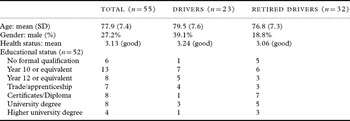
There were a total of 55 participants, of whom 32 were retired drivers and 23 retiring drivers. There were more female (n = 40) than male (n = 15) participants and participants had a mean age of 77.9 years (SD = 7.4 years). Their self-reported health status prior to the start of the study was reported on a scale of 1 (poor) to 5 (excellent), with a mean health status of good (3.1). Participants had a range of educational attainments from no formal qualification through to higher university degree. Table 1 reports the demographics for retired and retiring drivers.
Demographic characteristics of UQDRIVE program participants

Data collection tools
Demographic information was collected from all participants with respect to their driving status, age, gender, self-reported health status, and educational level.
Outcome measures
The Canadian Occupational Performance Measure (COPM) is an individualized outcome measurement that focuses on the person's self-identified problems with regards to daily functioning using goal setting (Law et al., Reference Law, Baptiste, McColl, Opzoomer, Polatajko and Pollock1990). The COPM was designed for use across all disability and age groups (Law et al., Reference Law, Baptiste, McColl, Opzoomer, Polatajko and Pollock1990). Clients are encouraged to identify their issues and then to rate their perceived quality of performance of each issue and their level of satisfaction with this performance level on a ten-point scale (Baptiste and Rochon, Reference Baptiste, Rochon and Hemphill-Pearson2008). That is, each identified issue is rated on a performance (1 = lowest performance to 10 = highest performance) and then a satisfaction (1 = least satisfied to 10 = most satisfied) scale by the client. Studies have demonstrated that the COPM has strong test-retest reliability in the performance scores ranging from 0.63 to 0.89 and satisfaction scores ranging from 0.75 to 0.88 (Sanford et al., Reference Sanford, Law, Swanson and Guyatt1994; Law and Stewart, Reference Law and Stewart1996; Cup et al., Reference Cup, Scholte op Reimer, Thijssen and van Kuyk-Minis2003). Several studies also support the validity of COPM as a measure of performance and satisfaction (McColl et al., Reference McColl, Paterson, Davies, Doubt and Law2000; Lewis and Jones, Reference Lewis and Jones2001). The COPM was used to allow participants in UQDRIVE to articulate clearly their transport and lifestyle issues, including a self-reported measure of their current performance of each issue and satisfaction with this performance. The individual issues presented a qualitative component for analysis while the rating of performance and satisfaction allowed quantitative analysis and identification of change scores. A two-point difference between the final and initial scores is considered indicative of a clinically significant change in perception of performance and/or satisfaction of issues (Law et al., Reference Law, Baptiste, McColl, Opzoomer, Polatajko and Pollock1990).
Procedure
Participants were recruited using convenience and snowball sampling. Information about the UQDRIVE program was distributed to health professionals and potential participants using local media, postal mailouts, and awareness-raising talks. Potential participants would phone to register an interest in the program and were screened for eligibility. Eligible participants were provided with a written and verbal description of the study and invited to provide written consent for the research study. Initial data collection was undertaken after consent was obtained and participants were then randomly allocated to a treatment or waitlist control group. The larger study design meant that all participants would have an opportunity to participate in UQDRIVE; however, this was delayed for the control group to allow for comparison of outcomes.
All participants identified transport and lifestyle issues using the COPM in the first week of attending the UQDRIVE program. After a general group discussion about the range of experiences and needs that may relate to driving cessation, group members were encouraged to identify issues and subsequent expectations from attending the group. This was broadened to identifying their own needs, hopes, or problem areas that they wished to work on within the program if the term issue posed a difficulty. Participants discussed their identified issues individually with the group leaders in a semi-structured interview format, as specified by the COPM instructions, and then rated each issue on the ten-point performance and satisfaction scales. The performance scale asked the participant to rate how well they were able to perform the identified issue, while the satisfaction scale asked them to rate how satisfied they were with this level of performance. In the final week of UQDRIVE (sixth session), all participants were required to re-rate their performance and satisfaction with their original issues.
Analysis
The COPM yielded data that could be analyzed from a qualitative and quantitative perspective. The first aim of this study was to evaluate the effectiveness of UQDRIVE in improving the performance and satisfaction scores of transport and lifestyle issues of older retired and retiring drivers. The pre- and post-group scores on the performance and satisfaction scales for each issue were entered into STATA. These data met the assumptions of normality, and paired sample t-tests were conducted for performance scores (pre- and post-group scores) and satisfaction scores (pre- and post-group scores).
The second aim was to explore and understand the range and types of issues of older retired and retiring drivers in the Australian context. The issues were read several times to gain a thorough understanding of the participants’ perspectives and were analyzed using content analysis (Miles and Huberman, Reference Miles and Huberman1994). Two researchers independently reviewed the comments to identify common content areas. These were discussed and coding categories were determined inductively by consensus (Elo and Kyngas, Reference Elo and Kyngas2008). Definitions of content areas were developed to increase understanding and to ensure consensus for future coding. The two researchers re-coded the responses based on the content categories formed and any differences were discussed until consensus was achieved (Elo and Kyngas, Reference Elo and Kyngas2008). The responses for the retiring and retired driver groups were explored within each content category. Once content areas had been determined, the number of comments that fit within each was counted, as were the number of participants making comments. When comments are used in the results, the participant number and driving status are used to identify them.
Results
Quantitative analysis
Paired t-tests explored the change in performance and satisfaction scores at pre-group and post-group. According to standard COPM scoring procedures, a mean score for performance and satisfaction was calculated from the participants’ ratings at the pre- and post-group time point. Table 2 outlines the results of paired t-test analysis. There was a significant change (p < 0.001) for performance and satisfaction scores, indicative of a positive effect of the group program on individual transport and lifestyle issues. The changes in performance and satisfaction scores were not significantly different between male and female participants (t = 0.67, p = 0.50), or between retired and retiring drivers (t = 1.23, p = 0.22).
Analysis of change in COPM scores pre- and post-group

Qualitative analysis
Content analysis of the issues of the participants identified three categories: protecting my lifestyle, a better understanding of transport options, and being prepared and feeling okay. There were a total of 160 issues of which 89 issues were from retired drivers and 71 issues from the drivers who planned to stop driving. Each participant identified up to five issues, which may have belonged to any of the coded categories. Thirteen participants identified five issues, five participants identified four issues, ten participants identified three issues, 20 participants identified two issues, five participants identified one issue, and two participants did not identify any issues. The categories are presented in order of apparent importance to participants, with codes most commonly and strongly reported stated first.
Protecting my lifestyle
Participants identified transport and lifestyle issues which were clearly linked to the need or desire to continue with activities that were important aspects of their life. A total of 82 issues were listed by 37 participants and the issues fell clearly into two subcategories. The first was related to “meeting responsibilities” and included activities that the participants needed to complete either for themselves or others, such as attending medical appointments, shopping for necessity, and volunteer activities. The second subcategory was related to “staying involved, active, and connected” and included activities that had links to personal interests such as leisure, hobbies, spirituality, holidays, and remaining connected with family and friends.
Meeting responsibilities: In this subcategory, participants identified transport issues related to activities such as medical appointments, shopping for necessity, and volunteer work. There was a trend for participants in the retired driver group (n = 16) to be more concerned about the impact of driving cessation on these activities, identifying 26 issues in comparison to the 13 issues identified by the 11 retiring drivers. Participant issues reflected a need to access transport in order to meet basic healthcare needs for themselves and their significant others. This was exemplified by Participant 16 (driver) who asked, how will I get to the doctor and chemist without driving? In addition, many spoke of the need to attend to tasks such as shopping, banking, and going to the post office. Participant 3 (retired driver) wondered about getting to the shopping center. I can walk, I thought I was fit but I find I get [tired]. As I get older, I may have to look for a better solution to my hike there and would be interested in alternatives. A final level of responsibility related to people who were in a volunteer role. A retired driver, who obviously valued the volunteer role, wondered how to continue working for meals on wheels (Participant 6) – a meal delivery service which is intricately linked to the volunteer's access to a car.
Staying involved, active, and connected: In this second subcategory, participants identified issues around activities that were driven by interests, preferences, and choices rather than responsibility or need. Twenty-nine participants (15 retired drivers and 14 retiring drivers) came up with 43 issues (22 retired drivers, 21 retiring drivers) within this category. Participants identified that they wanted to learn about ways to stay involved in their community and engaged with old and new leisure activities, community groups, social groups, and friends. Participants also spoke of their desire to continue to attend exercise groups and the need for transport to continue with this activity. Participant 18 (driver) asked: how to stay healthy when you cannot drive to areas you go for walks or exercise (beach, garden, swimming pool). Many identified a desire to be able to travel either for holidays or for day trips. Participants either wanted to specifically go on a train holiday (Participant 13, retired driver) or more generally to be able to travel further afield for day trips (Participant 12, driver).
The links between transport and social connectedness were evident in the issues of participants who wanted to maintain or increase their contact with friends and family. The need for social enjoyment was clear from Participant 3 (retired driver) who stated: Socializing. I have found a lovely tea house, which I want to share, and now have difficulties getting my friends there to treat them. That is one big disappointment to me! On the other hand, the importance of basic social contact and an uncertainty of how to maintain this without driving was evident from Participant 16 (driver) who said, I feel my life will really end – I love people, life, and laughter. I could not possibly stay in my house every day. How will I have a life I value without driving?
A better understanding of transport options
In this second category, participants identified issues related specifically to gaining general knowledge about other transport options, problem solving trip planning issues, and feeling more independent, confident, and secure with new transport options. A total of 50 issues (31 retired drivers, 19 retiring drivers) were identified in this area from 39 participants (23 retired drivers, 16 retiring drivers). Participants indicated a desire to have broader transport options, expanding where and when they would be able to travel without a car. They wanted to know how to go from A to B (Participant 48, retired driver) or those planning to stop driving wanted to learn what resources are available to assist with alternative transportation when I stop driving (Participant 18, retiring driver).
Participants identified issues related to using public transport with impairments, such as using a mobility device or with a visual impairment. Participants also wanted to learn about using public transport under specific circumstances such as how to handle bulky items on public transport (Participant 22, retired driver) or were interested in finding out more information about being able to travel with [my] pet dog (Participant 17, retiring driver). Finally, participants were hoping to expand where and when they would be able to travel on their own. For one it was the desire to be able to go out without relying on my friends (Participant 1, retired driver) or another was concerned that they were unable to go out at night without driving (Participant 9, retiring driver). Other participants related this more specifically to the need to increase their confidence with the use of public transport including the ticketing systems. As Participant 47 (retired driver) stated, I am afraid of buses and taxis are so expensive or Participant 18 (retiring driver) wanted to be . . . safe on bus and at bus stops and waiting for transport/[learn] safety precautions to reduce [my] anxiety.
Being prepared and feeling okay
This category contained issues related to psychological adjustment to driving cessation, both in preparation and after the transition. There was a cognitive reframing that occurred before (e.g. making informed decisions), and after driving cessation (e.g. feeling okay and accepting driving cessation). This was the final category and the only category in which there was a trend for the retiring drivers to provide more issues than retired drivers. There were a total of 24 issues (8 retired drivers, 16 retiring drivers) from 20 participants (8 retired drivers, 12 retiring drivers). Issues for these participants surrounded their hope that the UQDRIVE group would help them to make informed decisions about when to stop driving (retiring drivers), learn from the experiences of others, and to feel okay about being a retired driver. Retiring drivers wanted to feel in control of the decision to stop driving, looking to make the right decision about when to stop driving (Participant 11, retiring driver). The emotional aspect of driving cessation was evident from both groups and was related to how they perceived themselves as well as how they felt perceived by others. Examples of this are from Participant 14 (retiring driver) who wanted to feel ok about stopping driving while Participant 26 (retired driver) hoped to feel like others see you as contributing without driving.
Discussion
Participation in the UQDRIVE program resulted in a statistically and clinically significant improvement in self-rating of the performance and satisfaction scores of the participants’ transport and lifestyle issues. These issues could be coded into three categories, which demonstrated a greater concern for practical rather than psychological issues. The retiring and retired drivers were representative of two phases in the transitional process of driving cessation described by Liddle et al. (Reference Liddle, Carlson and McKenna2004). The retiring drivers were in the decision phase, a period when there was an anticipation of, and planning for, the associated changes to lifestyle and transport. This phase features challenges involved with making the decision and owning (feeling control over) the decision. The retired drivers were in the post-cessation phase, a period when people who have stopped driving experience ongoing adjustment to life without driving in both practical (finding other ways) and emotional (coming to terms) ways. This has been shown to include finding alternative ways to access the community, learning to accept help from others, and adjusting to the decision made to stop driving (Liddle et al., Reference Liddle, Carlson and McKenna2004; Reference Liddle, Turpin, Carlson and McKenna2008).
Congruent with previous research by Harrison and Ragland (Reference Harrison and Ragland2003), this study found that the maintenance of life roles and activities (51% of issues) was the most common issue raised. The participants who were retired drivers were more likely to express concern over the ability to continue with activities that were considered important for meeting responsibilities such as medical appointments, shopping for necessity, and volunteering. This relates to the ongoing practical adjustments that have been described in the post-cessation phase of driving cessation in terms of finding other ways to access the community (Liddle et al., Reference Liddle, Turpin, Carlson and McKenna2008). On the other hand, the participants who were driving were less aware of the limitations. Perhaps they had assumed that there were options available to them or they had not tried to use the alternatives (Sterns et al., Reference Sterns, Sterns, Aizenberg and Anapolle2001). It is likely that once people no longer have the option to drive, they become fully aware of the complexities that can exist in finding and using other options.
In contrast, both retired and retiring drivers expressed equal concern over loss of leisure and social activities. Leisure activities are an important influence on a person's well-being and quality of life (Everard, Reference Everard1999; Unruh, Reference Unruh2004). Staying engaged in leisure activities within the community is likely to enhance social networks and connectedness and prevent isolation that can become problematic after driving cessation (Gardezi et al., Reference Gardezi2006). However, the spontaneous nature and varied locations of leisure activities can limit the suitability of alternative transport (Burkhardt et al., Reference Burkhardt, McGavock and Nelson2002) and it can be perceived as an inconvenience to ask others for help (Burkhardt, Reference Burkhardt1999). The findings of this study reinforce that improving transport or planning for leisure activities must be prioritized (Burkhardt, Reference Burkhardt2003). Programs such as UQDRIVE can play an important role in providing the information and resources needed to facilitate access to valued leisure activities and community resources.
While gaining practical experience and knowledge of alternative transport was a commonly identified issue for participants, the focus was on improving mobility options or, for a few participants, to improve confidence. Safety issues surrounding alternatives to driving, such as being a pedestrian and using public transportation, are continuing concerns for older people (Shope, Reference Shope2003; Molnar et al., Reference Molnar, Eby, St Louis and Neumeyer2008). The use of public transportation can involve difficult aspects such as maintaining personal safety and security amidst crowds, and difficulties getting on and off buses and trains. Older people often do not recognize that these difficulties will lead to a safety issue (Holland, Reference Holland2002) or may perceive this as an issue for other older people and not themselves (Oxley et al., Reference Oxley, Fildes and Dewar2004). These findings suggest that there is a need to include modules in an intervention program for driving cessation that increases awareness of the safety risks faced by older retired drivers in a sensitive and shared manner, including strategies to improve their level of safety. The need to promote mobility as well as enhance safety is beginning to be recognized within driving and transportation research (Eberhard et al., Reference Eberhard2006).
The final, and smallest, category was related to psychological adjustment to driving cessation. Psychological issues related to making the decision and feeling okay about driving cessation were raised as an area of concern in only 15% of the issues. This finding is not aligned with earlier research documenting the negative psychological consequences of driving cessation, such as increased depressive symptoms and changes in self-identity (Marottoli et al., Reference Marottoli1997). A number of factors may have impacted these findings. Previous research has indicated that it is difficult to engage older people in discussions about stopping driving, their emotional adjustments, and psychological concerns (Murray et al., Reference Murray, Banerjee, Byng, Tylee, Bhugra and Macdonald2006). The issues for this study were collected at the end of the first session of a group program. This may not have allowed adequate time for the participants to feel comfortable with revealing how they were really feeling about driving cessation. Equally, participants may have been unaware of the psychological help available and were reluctant to identify issues that they do not believe could be sorted out. Issues related to practical adjustments may be more easily understood and communicated, particularly when rapport has not been fully established.
Encouragingly, this study has shown that drivers who attended the UQDRIVE groups were looking to plan and make the right decision about when to stop driving. Their concerns were not just related to the adjustment issues after driving cessation but also to the need to control the decision for driving cessation. Earlier research has suggested that it is hard to engage older people in discussion and planning about driving cessation prior to their actual cessation (Sterns et al., Reference Sterns, Sterns, Aizenberg and Anapolle2001). It is therefore a positive finding that some participants in the UQDRIVE program were attending with the goal of planning and maintaining control over the decision to cease driving. This dovetails with the finding that “owning the decision” is a challenge of the decision phase of driving cessation (Liddle et al., Reference Liddle, Turpin, Carlson and McKenna2008). Finally, a few retired drivers identified that they were hoping to feel okay about their decision and status as a retired driver. “Coming to terms” is a significant challenge for the post-cessation phase which is related to psychological adjustment and acceptance (Liddle et al., Reference Liddle, Turpin, Carlson and McKenna2008).
Limitations and future research
Before considering the implications of this study, it is important to note that this study had several limitations. This study was restricted to one geographical area and the sample size of 55 participants may not be a representative sample of all older retired and retiring drivers. Despite the small sample size, the demographics of the group is similar to that of other older driver studies with more female than male older retired and retiring drivers (with an approximate ratio of 2:1 for female to male; Dellinger et al., Reference Dellinger, Sehgal, Sleet and Barrett-Connor2001). The participants were recruited using convenience sampling. This approach is subject to bias as participants voluntarily participated in these groups and may have been more motivated to improve their experience of driving cessation. The data collected and analyzed were a brief statement of issues and not an in-depth exploration of the participants’ needs. There was only one opportunity for identifying issues in the first week, and these issues were reviewed in the last week of the UQDRIVE program. Hence, there was no opportunity for participants to add a new issue or modify an existing issue during the period of the intervention program.
Future research is needed to gain a further in-depth understanding of the transport and lifestyle issues of older retired and retiring drivers. Replication of this intervention group with opportunities to add or modify identified issues is warranted. Furthermore, examining the participants’ performance and satisfaction of their identified issues over a longer period of time would identify whether the UQDRIVE was able to create a sustained improvement.
Conclusion
The UQDRIVE program is an intervention group that focuses on the experiences of driving cessation for older retired and retiring drivers with an individual focus. This study has shown that the intervention had a positive impact on the participants’ rating of their current level of performance and satisfaction with individual transport and lifestyle issues. The issues identified by the participants were grouped into three categories and demonstrated that there was a greater concern surrounding practical rather than psychological issues. There were trends evident in the issues of retired and retiring drivers that are related to their stage of the driving cessation process. Further studies should involve an in-depth and longitudinal analysis of the transport and lifestyle issues for older people during driving cessation.
Conflict of interest
None.
Description of authors' roles
LG and JL were involved in the RCT, analysis of data, and development of the paper. NP and GM were involved in the RCT and provided comments on the paper. PL and MH were involved in data analysis and development of the paper. KM was CI on the project grant and involved in initial stages of RCT.
Acknowledgments
This work was supported by a National Health and Medical Research Council of Australia project grant (455876). We acknowledge and thank the UQDRIVE team for their tireless work and support of this project. We also acknowledge the important contribution of Associate Professor Kryss McKenna who has sadly passed away but who led the application for funding and was involved in the early stages of this study.