The monotypic genus Culbersonia Essl. was established by Esslinger (Reference Esslinger‘2000’/2001) based on the newly described taxon C. americana Essl. One year later, Esslinger (Reference Esslinger, Nash, Ryan, Gries and Bungartz2002) uncovered the synonymy with Pyxine nubila Moberg, described by Moberg (Reference Moberg1980), and transferred it to the new genus. Up to now Culbersonia nubila (Moberg) Essl. was known from a few localities in Peru, Kenya, Ethiopia, Tasmania, Saudi Arabia and the USA (Arizona).
During studies by the first and second authors on the lichen genus Pyxine Fr. from the Tibetan region, three specimens ofCulbersonia nubila from different localities (several hundred kilometres apart) were found. A search for further unpublished material, using the Global Biodiversity Information Facility website (http://www.gbif.org/), yielded additional specimens from South Africa and South America.
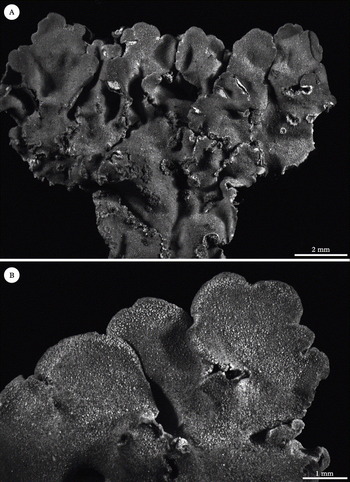
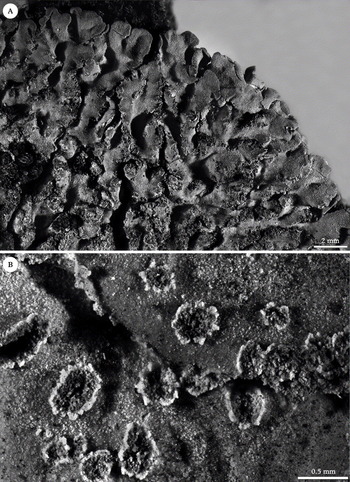
Culbersonia nubila is a foliose, sorediate lichen (Figs 1A, 2A, 2B) with a greyish colour (often with a bluish tint), pruinose (Fig. 1B), commonly radially spreading lobes (Figs 1A, 2A), two-celled brown spores (16–20 × 5–9 μm; only two fertile specimens with one apothecium each are hitherto known), and cylindrical to weakly fusiform pycnoconidia (5–6·5 × 1 μm). It was originally placed in the genus Pyxine mainly because of the K+ purple reaction of the epithecium, which is supposed to be rather uncommon within the Physciaceae. In contrast to all other species of the genus Pyxine, Culbersonia nubila lacks any acetone-soluble lichen substances, a fact which we have confirmed by our own TLC investigations. The acetone insoluble bluish-grey cortical pigment with a K+ purple-violet reaction, the mostly pale lower cortex, and the different size and shape of the pycnospores were regarded by Esslinger (Reference Esslinger, Nash, Ryan, Gries and Bungartz2002) to be of sufficient diagnostic value to separate it from the genus Pyxine. Rogers (Reference Rogers1986) had previously predicted either its segregation into a new genus, or its relocation either into the genus Physcia (Schreb.) Michaux or Physconia Poelt. Indeed, the superficial appearance of this lichen (Figs 1 and 2) is closer to that of members of Physconia or Phaeophyscia Moberg (or to a minor degree of Physcia) than of Pyxine, as had been observed by Moberg (Reference Moberg1980) in the original description. Molecular studies may eventually help to establish the true affinities of the taxon.
Culbersonia nubila (Tibet, Obermayer 04516). A, habit of a sorediate thallus with laminal and marginal soralia; B, pruinose upper surface of lobe tips.

Culbersonia nubila. A, habit of a sorediate thallus with mostly marginal soralia (Argentina, Nash 23900); B, crater-like, laminal soralia (Argentina, Nash 27635).

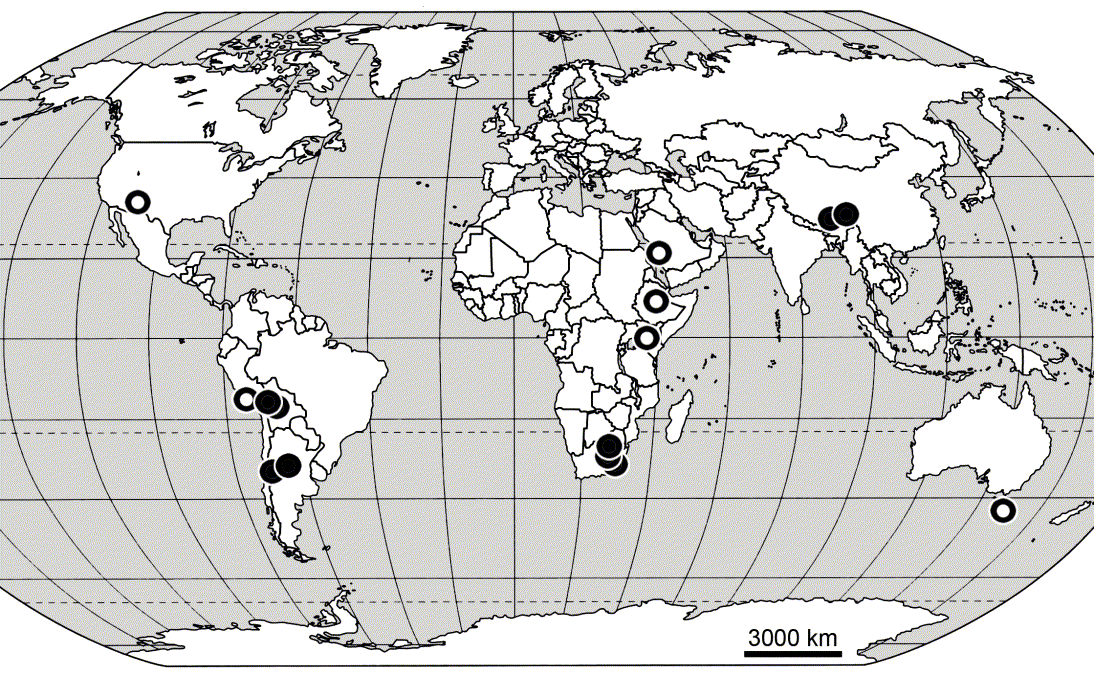
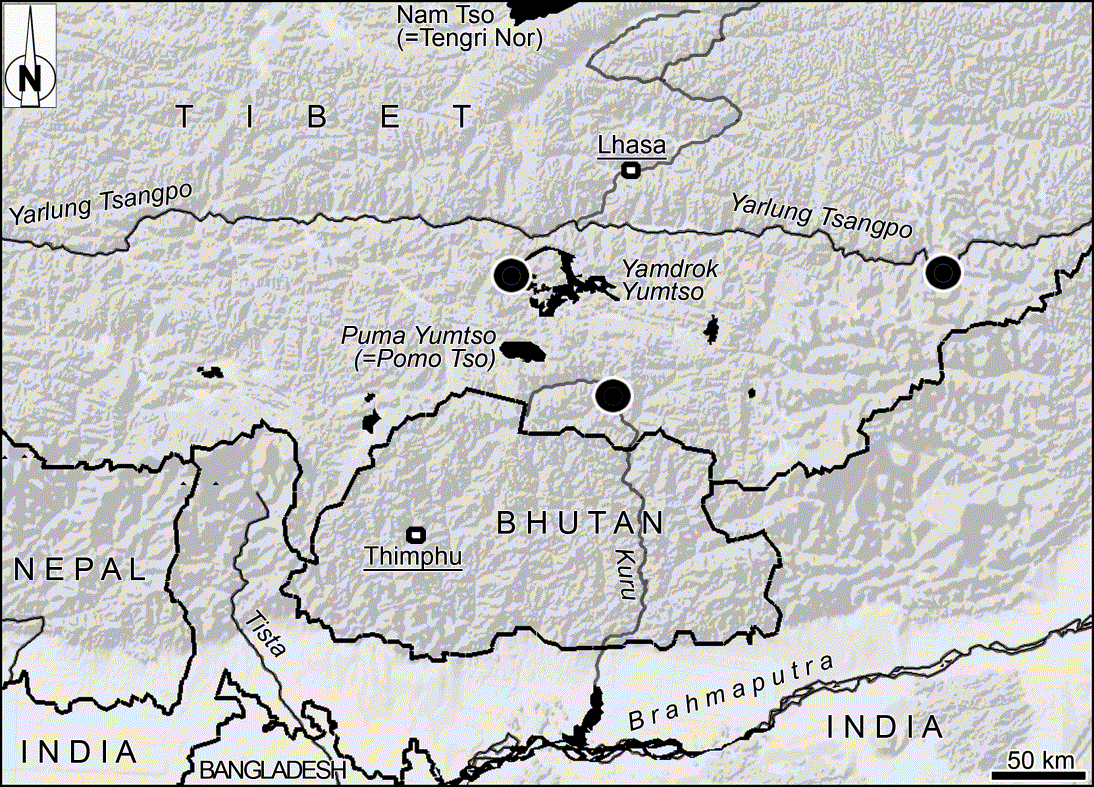
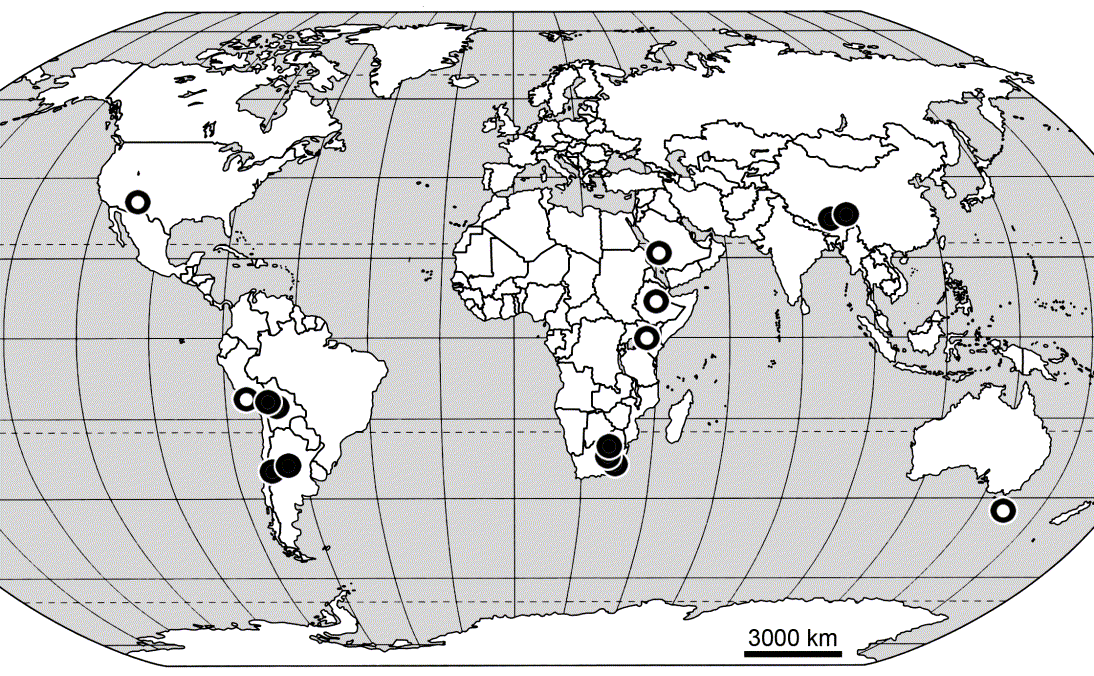
The collections from Tibet, housed in GZU, represent new reports for the Central Asian region (fide Wei Reference Wei1991; Hu & Chen Reference Hu and Chen2003), whereas the cited collections from Argentina, Bolivia, Lesotho and South Africa are new reports for each of these countries. These records show that Culbersonia nubila has a world-wide but very scattered distribution (Fig. 3) and is now known from a few localities on all continents except Antarctica; i.e. North America (Arizona), South America (Peru, Bolivia and Argentina), Africa (Kenya, Ethiopia, Lesotho and South Africa), Australia (Tasmania) and Eurasia (Saudi Arabia and Tibet [Fig. 4]). For previous reports see Moberg (Reference Moberg1980), Abu-Zinada et al. (Reference Abu-Zinada, Hawksworth and Bokhary1986), Swinscow & Krog (Reference Swinscow and Krog1988), Kantvilas (Reference Kantvilas1991), and Esslinger (Reference Esslinger2001, Reference Esslinger, Nash, Ryan, Gries and Bungartz2002). The report in the internet-checklist of the lichens of Thailand (Anonymous Reference Anonymous2008) is based on an incorrect determination (K. Boonpragob, curator of RAMK, in litt.).
World distribution of Culbersonia nubila. Records from literature (○), new records (•).
Localities (•) of Culbersonia nubila in Tibet.

The species has been collected from altitudes ranging from 200 m (Tasmania) to 4450 m (Tibet). The following list is sorted according to increasing altitudes: Tasmania (c. 200–400 m), Argentina (c. 1100–1300 m), South Africa (c. 1500–1700 m), Lesotho (c. 1500–1800 m), Ethiopia (c. 1800–2000 m), Saudia Arabia (1950 m), Kenya (c. 2000 m), Peru (c. 2000–2250 m), Arizona (c. 3000 m), Bolivia (c. 2500–3750 m), Tibet (c. 3300–4450 m).
The climatic features of these locations are consistent with the interpretation that the species requires cool to cold conditions with somewhat low to moderate precipitation. Under such conditions humidities will be higher than under hot conditions and evaporation less.
The specimens of Culbersonia nubila cited below were collected from trees (e.g. Jacaranda mimosifolia D. Don., Populus balsamifera L., and Cupressus gigantea W. C. Cheng & L. K. Fu), from acidic rocks and even from rather compact soil (Nash 23900), which often acts as a substratum for ‘usually epilithic’ taxa. The occurrence of epilithic and epiphytic specimens was previously reported in the original descriptions of the species and its synonym (Moberg Reference Moberg1980; Esslinger Reference Esslinger2001).
Specimens examined. Argentina: Prov. San Luis: 17 km SW of El Toma along route 20, 1100 m alt., 33°15′S, 65°55′W, on tree, 1989, Nash 27635 (ASU), conf. Moberg 1996; La Aguadita, 1 km E of Papagayos, thorn forest area, 32°42′S, 64°58′W, on tree, 1989, Nash 27657 (ASU) , conf. Moberg 1996. Prov. Mendoza: Partido de Lujan, 1 km W of Cacheuta along route 7, 33°02′S, 69°07′W, on soil, 1985, Nash 23900 (ASU), conf. Moberg 1996. —Bolivia: Cochabamba: Prov. Cercado: Cochabamba City, 2500 m alt., 17°28.2′S, 66°08.6′W, on Jacaranda mimosifolia, 2006, Canazas MC-75 (B); ibid., Canazas MC-86 (B). La Paz: Prov. Murillo: Laguna de Cota-Cota (calle 31), sector frente a la puerta principal, 3750 m alt., 16°32.4′S, 68°04.0′W, on Populus balsamifera, 2002, Canseco 121 (B). — China: [Tibet]: Prov. Xizang: Himalaya Range, 175–180 km S of Lhasa, between Lhohzag and Lhakhang Dzong, Kuru River Valley, 28°15′N, 91°00′E, 3380 m alt., boulders next to a sloping river bank of Kuru River, on rocks, 1994, Obermayer 04516 (GZU); Himalaya Range, 100 km SSW of Lhasa, 10 km E of Nargazê, shore of Yamzho Yumco (=Yamdrok Tso), 29°02′N, 090°26′E, 4450 m alt., SSE-exposed arid slope with Juniperus trees, on rocks, 1994, Obermayer 04907 (GZU); Himalaya Range, 230 km ESE of Lhasa, Tsangpo Valley, 15 km ESE of the village Xang Xian (=Namshan), 29°00′N, 93°13′E, 3300–3400 m alt., canyon of a tributary to the Tsangpo with Cupressus gigantea, on dead Cupressus gigantea, 1994, Obermayer 05415 (GZU).—Lesotho: [‘Basutoland’]: Distr. Maseru: Roma, [c. 1700 m alt., 29°27′S, 27°42′E, on tree], 1962, Kofler 210143 (LD); ibid., Caledon River, [c. 1500–1700 m alt., 29°26′S, 27°25′E, on tree], 9 viii 1962, Kofler s.n. (LD); ibid., Morija, [ca 1700–1800 m alt., 29°38′S, 027°31′E, on tree], 22 ix 1962, Kofler s.n. (LD). Distr. Quthing: Masitise near Quthing, trunk of Azedarac, in front of Reverend Ellenberger's cave, [c. 1500 m alt., 30°24′S, 27°39′E, on tree], 1963, Kofler 3118 (LD; specimen with one apothecium !).—South Africa: Prov. Cape: Distr. Matatiele, Porter's Hook, on trees at the waterfall in narrow small valley, [c. 1500 m alt., 30°21′S, 28°49′E, on tree], 14 x 1929, Höeg s.n. (TRH). Prov. Gauteng [‘Transvaal’]: in savannah on hill side sloping forwards the Klipriviersberg, S of Johannesburg, [c. 1700 m alt., 26°17′S, 27°59′E, on tree], 31 vii 1929, Höeg s.n. (LD, TRH).
The material from Tibet was collected during an expedition by the first author in 1990, which was supported by the Austrian Science Fund (project number P09663-BIO). Photographs were taken with a LEICA Wild M3Z stereo-microscope assembled with a ZEISS Axiocam MRc5 camera (additionally using ‘CombineZM’ as an open source image processing software package for creating extended depth of field images). We thank Kansri Boonpragob, Curator of the herbarium RAMK (Ramkhamhaeng University, Bangkok, Thailand), for her cooperation in the search for herbarium material.