




No CrossRef data available.
Article contents
Six years' experience with interdisciplinary review teams in health technology assessment in Norway
Published online by Cambridge University Press: 25 October 2005
Abstract
Objectives: The aim of this study was to evaluate the use of interdisciplinary review teams that have been the main and central work form in making health technology assessments at the Norwegian Centre for Health Technology Assessment.
Methods: Evaluation questionnaires were sent to all 112 participants in the 17 review teams for the period of January 1998 to June 2003 after completion of the literature assessment. Questions were on the theme/mandate of the assessments, composition of the review team, organization of the work, the working method, and update of the report.
Results: The teams ranged from 4 to 14 persons regarded as opinion leaders in their field. The project periods lasted from 4 to 33 months. In all, fifty-five participants gave fifty-eight responses (51.8 percent) to the questionnaires. A total of 83 percent thought the theme was well argued, and 62 percent thought the mandate for the assessments was sufficiently clear. Approximately 80 percent were positive to the composition of the review team. In all, 22 percent expressed that the work method was too extensive and 43 percent wanted more tuition. General comments were that the working method gave competence in assessing medical literature, relevant professional training, and tuition in a working method that ensured the legitimacy of their work.
Conclusions: The review team participants were satisfied with most aspects of the work. The Norwegian Centre for Health Technology Assessment will continue using interdisciplinary review teams in making health technology assessments.
Information
- Type
- RESEARCH REPORTS
- Information
- International Journal of Technology Assessment in Health Care , Volume 21 , Issue 4 , October 2005 , pp. 526 - 531
- Copyright
- © 2005 Cambridge University Press
When the Norwegian Centre for Health Technology Assessment (SMM) was established Autumn of 1997, the Department of Health and Social Welfare commissioned SMM to assess the efficiency of both new and established medical methods in the Norwegian health service. The overall aim of the Norwegian health authorities in assessing health technologies is to improve the quality of the health services offered to the society. SMM's mandate was to work in close cooperation with the clinical services, research centers, and health authorities. The work should be performed in a systematic and transparent manner characterized by an interdisciplinary approach including medicine, economy, ethics, law, and health service organization. The SMM Board of Directors prioritizes and decides which health technology assessments (HTAs) should be undertaken and formulates the mandate for the review. The SMM secretariat identifies, with the assistance of the Board, the relevant experts and establishes the review teams with a dual leadership consisting of an SMM project leader that administers and guides the process and one of the experts as a scientific leader. The review team's work consists of literature assessment, analysis, and the report. The SMM librarian performs the literature search in coordination with the SMM project leader. The SMM project leader leads the review work to the completion of the report by giving advice for the systematic literature review, analysis, and reporting of the results. As guidance for the review teams, SMM wrote an introduction to health technology assessments (3). This system of HTA is the basis for the establishment and development of HTA as a scientific field and work form in Norway (11;13–15). SMM's work is in accordance with internationally agreed principles of International Network of Agencies for Health Technology Assessment (INAHTA) (2) and the European Union project ECHTA (7).
To further improve the quality of SMM's reports and work form, SMM decided to evaluate the use of interdisciplinary review teams by surveying the review team participants. This evaluation concerned their experience in developing an HTA report. The goal was to find out whether this work form functions and to what extent experts should be involved in the HTA process.
METHODS
SMM sent questionnaires to all 112 participants of 17 review teams after the completion of their HTA report in the time period from January 1998 to June 2003. No reminders were sent. The questionnaire was unaltered throughout the period. The questionnaire comprised a mix of mostly closed-ended questions and some open-ended ones. The answer alternatives of the closed-ended questions were yes, no, and do not know. There were five domains: theme/mandate of the assessment; composition of the review team; work organization; the work method, and the professional review. Participants could also write in comments.
The analysis is based on questionnaire rather than individual participant. Results are presented as frequency and percent of replies. Analysis of variance (ANOVA) for differences between review teams were used when applicable (nine questions). Time-trend analyses were done for three questions. Logistic regression was used to study the associations between the total time spent and the time spent at meetings versus the participant response. Significance level was p<.05. The statistical analyses were done using SPSS 12.0.1 (22).
RESULTS
Fifty-eight questionnaires were received from 55 of the 112 persons who participated in the review teams, giving a response rate of 51.8 percent. Three of the responders had taken part in two assessments. The individual group response rates varied from 20 to 86 percent. In all, seventeen review teams participated in making an HTA review (8). The assessments covered many different issues in clinical medicine (Table 1) (1;4–6;9;10;12;16–21;23–26). The number of participants ranged from 4 to 14 per team, and they spent from 4 to 33 months doing the assessments. The number of meetings ranged from 1 to 21. The presentation of the results follows by domain.

Theme/Mandate of the Assessment
The participants believed the choice of subject was justified (82.8 percent), and it was clear to them who the commissioner was (89.7 percent) (Table 2). However, twenty (34.5 percent) believed that the mandate was not clearly stated and had to be discussed. Of these twenty responses, nine indicated that this lack of clarity slowed down the process, whereas six responses did not. Thirty-six believed the mandate was clearly expressed, and twenty-five believed that it nevertheless was useful for the members of the team to discuss the issue under study and assist in formulating the mandate.

Composition of the Review Team
Forty-nine responses were to questions on the importance of the composition of the review team. The factors that increased credibility and legitimacy of the report were the interdisciplinary structure and large group size, which gave improved competence and added to good scientific discussions that promoted high quality. Another comment was that it was important that the participants had enough time. It was also noted that Norway has few experts, and it may be that the use of experts creates barriers. In some instances, it was considered of importance that the different regions of the country were represented.
Organization of the Review Team Work
Forty-four responses (75.9 percent) showed satisfaction with the scientific review team leader and forty-six responses (79.3 percent) with the SMM's project leader (Table 2). There were nineteen responses for how to improve the leadership of the group. The replies centered on reducing the time spent, keeping steady progress, achieving goals, setting tighter time limits, and improving guidance in the writing process. In all, forty-nine responses (84.5 percent) indicated satisfaction with the service provided by SMM. Ten persons had suggestions for improvements. These centered on delays due to members of the group not doing their assignment in time due to a heavy workload and lack of flexibility in the writing stage of the report. There were forty-nine responses (84.5 percent) that showed satisfaction with the balance between expected workload and the SMM assistance. There were four missing responses to this question. Fifteen responses indicated the wish for more contact with the SMM Board during the work.
The Working Method
The working method, based on the principle of systematic review, was commented upon in fifty-one responses (Table 2). Many expressed that they had achieved good knowledge of the method. They had learned a valuable method, the work gave scientific credit, and the experience was useful for later work. Skepticism to single studies as the basis for review conclusions was reinforced. It was expressed by some that it had been a lot of work “for little use” and that systematic reviews easily can be seen as negative if they do not give evidence for a change of current practice for the technology in question. One person expressed that the work had been a waste of time.
Update of Report
The great majority of participants, forty-eight in all (82.8 percent), were positive to taking part in updating their HTA review assessment after some time using the same working method (Table 2). Only one expert answered “no” to this question.
Other Comments
Additional comments were given by forty-two responses. In short, the responses were as follows: important with a concise mandate; too much time spent on discussing concepts; the time spent on the report was too long; the time intervals between meetings were too long; important to have enough time for the job; meetings over several days would possibly have saved us time; a problem that not all the participants met deadlines; important to have the assistance by SMM's staff. The participants found the HTA work informative, interesting, of professional value, and it increased their qualifications. It was commented that SMM had developed into an important institution in Norway. In general, it was important that HTA studies also include low-status medicine short of resources.
Differences Between Review Teams
With regard to differences between review teams, nine questions had responses with the necessary variation required for ANOVA analyses. Five questions showed significant differences (p<.05). These findings showed disagreement about the importance of the composition of the review teams regarding interdisciplinarity, clear formulation of the mandate, a too high a workload considering the results, and a wish for more formal training. There were no significant differences regarding the importance of all Norwegian regions having representatives in the groups, any lack of clinical or scientific competence in the groups, additional review team contact with the SMM Board or publication of the work.
Time-trend analyses were only applicable on three questions—about clinical or scientific competence missing, about the need for further training, and publication strategy—and none of these showed any change with time.
Six significant associations were found concerning the associations between the total time spent and the time spent at meetings versus the participant response. The importance of interdisciplinary teams was found to be directly associated with increasing number of meetings. This finding is possibly because many of the reports covered larger medical issues (1;20;25). These review teams have most likely had more meetings and a higher requirement for being interdisciplinary, causing the establishment of large review teams to achieve a satisfactory assessment. Increasing time spent on the work was associated with the desire for more communication with the Board. The satisfaction with the project management was inversely related to the time spent. A satisfactory balance between the group members and SMM service was positively related to increasing time spent. Even in long-term projects, there was an understanding for factors influencing the time spent. However, the discontent with the workload in relation to the result was significantly associated with increasing time spent.
DISCUSSION
Advantages with the Use of Interdisciplinary Review Teams
SMM decided from the start to include clinical/scientific experts on each topic in the process of making the HTA reports. The purpose was to ensure a sound medical foundation and relevance and to achieve legitimacy among health personnel. In this manner, probability increases for health workers to adapt to the new documentation and to implement the conclusions of the assessments. The use of expert groups have the added advantage of giving a great number of Norwegian health workers tuition in the practical experience of performing critical literature review and health technology assessment. Their experience can be summed up as to have been useful, of professional interest, gave professional development, and the systematic process gave it scientific legitimacy.
Disadvantages with the Use of Interdisciplinary Review Teams
The use of interdisciplinary review teams, however, has some disadvantages in being work-, cost-, and time-consuming. It is debatable whether the “result” is defendable in terms of cost and use of other resources. Strict adherence to a fixed time schedule was a challenge, as busy clinicians were involved in the groups. In certain cases, this meant a substantial delay in the completion of the assessments. A prolonged production time is in itself a disadvantage, as report may have lost some of its relevance by the time it is completed.
Although the assessments by the teams was organized after common principles, there were differences between the teams with regard to composition and size, time of publication and total time spent, all of which could influence the response to certain questions.
The experts are paid by SMM for taking part. Payment is given for time spent reading the literature, writing the report, preparation for meetings, and time spent in meetings (Table 1). In addition, travel and hotel cost, which represent the major parts of the cost, are refunded.
The negative comments from the groups concerned mainly the time spent and the wish for more tuition in the working method. These comments give SMM valuable feedback as to where improvement in the work process could be made.
CONCLUSION
From its start, SMM has based its activities on its own technology assessments in cooperation with interdisciplinary review teams composed of highly qualified experts and opinion leaders in the medical fields relevant for the assessments. The responses from the review team members pointed to relevant aspects of the review process. They showed satisfaction with the interdisciplinarity of the group. The SMM's secretariat was positively evaluated and the dual leadership of the SMM project leader and the scientific leader functioned well. More tuition in the working method was desired in over 40 percent of the responses. Although learning the work method was valuable for improving participants' qualification and would be useful for future work, it was a time-consuming process. However, an understanding for the factors influencing the time spent was expressed. There was no time-trend in the three questions analyzed on need for further training, publication strategy, and lack of clinical or scientific competence in the review team. None suggested discontinuing the use of interdisciplinary review teams.
Policy Implications
The use of review teams has been especially important in building competence within HTA in Norway and ensuring professional legitimacy and implementation of the acquired knowledge.
Reducing the production time of HTA-reports is now one of the most important challenges for SMM. SMM's commissioners increasingly ask for a quick response to their request for an HTA-review and in certain circumstances, SMM has been given quite a short time limit for completion. Production of assessments at a higher rate will demand that SMM modify its methodology, which might imply that it will not be possible to use experts throughout the whole work process. Instead, the reports would go through an external peer review process. SMM hopes to meet the challenge in ensuring the clinical foundation and professional legitimacy of the HTA reports.
CONTACT INFORMATION
Lise Lund Håheim, PhD (lise.lund.haheim@nokc.no), Senior Research, Berit Mørland, PhD (berit.morland@nokc.no), Assistant Director, Torbjørn Fosen Wisløff, MSc (torbjorn.wisloff@nokc.no), Statistician, Anita Lyngstadaas, PhD (anita.lyngstadaas@nokc.no), Senior Advisor, Norwegian Knowledge Centre for Health Services, Olavs Plass, P.O. Box 7004, 0130 Oslo, Norway
We thank Cheryl Carling who has checked the English grammar of the article.
References
2000
Gene therapy—current status and possibilities in clinical medicine.
SMM report no. 1/2000.
Oslo:
The Norwegian Centre for Health Technology Assessment;
Hailey D,
Menon D.
1999
A short history of INAHTA.
Int J Technol Assess Health Care.
15:
236–
242.Google Scholar
Health Technology Assessment. An introduction.
In Norwegian. Available at: www.kunnskapssenteret.no/smm.
2000
Heart laser treatment.
SMM report no. 6/2000.
Oslo:
The Norwegian Centre for Health Technology Assessment;
2002
Hip replacement therapy.
SMM report no. 6/2002.
Oslo:
The Norwegian Centre for Health Technology Assessment;
2003
Hormone replacement therapy after breast cancer.
SMM report no. 2/2003.
Oslo:
The Norwegian Centre for Health Technology Assessment;
2002
Implantable defibrillator.
SMM report no. 1/2002.
Oslo:
The Norwegian Centre for Health Technology Assessment;
2002
Intracytoplasmic sperm injection (ICSI).
SMM report no. 3/2002.
Oslo:
The Norwegian Centre for Health Technology Assessment;
Jonsson E.
2002
Development of health technology assessment in Europa.
Int J Technol Assess Health Care.
18:
171–
183.Google Scholar
2001
Lumbar disc herniation with root affection.
SMM report no. 1/2001.
Oslo:
The Norwegian Centre for Health Technology Assessment;
Lund Håheim L,
Mørland B.
2003
Health technology assessment–a systematic approach for evaluation of the scientific documentation of medical technologies. In Norwegian.
Norsk Epidemiologi.
13:
309–
314.Google Scholar
Mørland B.
2003
Experiences form 5 years of health technology assessment in Norway. In Norwegian.
Tidsskr Nor Lægeforen.
123:
1213–
1215.Google Scholar
NHS Centre for Reviews and Dissemination.
Undertaking systematic reviews of research on effectiveness. CRDs Guidance for those carrying out or commissioning reviews.
CRD report number 4.
2nd ed.
UK:
University of York;
March 2001.
2002
PCI for acute myocardial infarction.
SMM report no. 5/2002.
Oslo:
The Norwegian Centre for Health Technology Assessment;
2000
Photodynamic therapy for age related macule degeneration.
SMM report no. 3/2000.
Oslo:
The Norwegian Centre for Health Technology Assessment;
2003
Planned caesarean section of breech birth at term.
SMM report no. 3/2003.
Oslo:
The Norwegian Centre for Health Technology Assessment;
2000
Positron emission tomography (PET)—diagnostikk og klinisk nytteverdi.
SMM report no. 8/2000.
Oslo:
The Norwegian Centre for Health Technology Assessment;
2003
Primary treatment of ovarian cancer.
SMM report no. 5/2003.
Oslo:
The Norwegian Centre for Health Technology Assessment;
1999
Screening for prostate cancer.
SMM report no. 3/1999.
Oslo:
The Norwegian Centre for Health Technology Assessment;
1999
SPSS version 12.0.1.
Chicago:
SPSS Inc.;
2001
Transcranial magnetic stimulation in the treatment of depression.
SMM report no. 6/2001.
Oslo:
The Norwegian Centre for Health Technology Assessment;
2002
Treating prostate cancer with brachytherapy.
SMM report no. 2/2002.
Oslo:
The Norwegian Centre for Health Technology Assessment;
2000
Use of ultrasonography in the primary health care setting.
SMM report no. 4/2001.
Oslo:
The Norwegian Centre for Health Technology Assessment;
2000
Whiplash injuries.
SMM report no. 5/2000.
Oslo:
The Norwegian Centre for Health Technology Assessment;
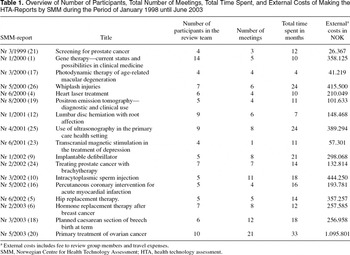
Overview of Number of Participants, Total Number of Meetings, Total Time Spent, and External Costs of Making the HTA-Reports by SMM during the Period of January 1998 until June 2003
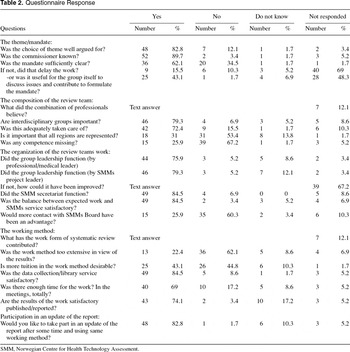
Questionnaire Response
 You have
Access
- 1
- Cited by