Introduction
Rice (Oryza sativa L.) is one of the most important sources of food in China, as it feeds more than half of the Chinese population (Peng et al., Reference Peng, Tang and Zou2009; Deng et al., Reference Deng, Grassini, Yang, Huang, Cassman and Peng2019). However, it is predicted that rice grain yields need to be increased by more than 70% by the year 2050 relative to the current level, with an annual growth rate of almost 2.5%, to meet the continually growing demand for food (Normile, Reference Normile2008; Fan et al., Reference Fan, Shen, Yuan, Jiang, Chen, Davies and Zhang2012; Song et al., Reference Song, Zhang, Ma, Peng SB and Xu2022). Therefore, there is an urgent need to breed new rice cultivars with stronger yield production potential and to improve crop management and enhance average farm yield (Mueller et al., Reference Mueller, Gerber, Johnston, Ray, Ramankutty and Foley2012; Yu et al., Reference Yu, Huang and Zhang2012; Ray and Foley, Reference Ray and Foley2013; Yuan, Reference Yuan2017).
Japonica and indica are the predominant subspecies of cultivated rice in Asia; however, these two varieties differ in their biological and ecological characteristics. It is generally accepted that cross-breeding between japonica and indica is an important approach for breeding new rice cultivars with stronger yield production potential (Zhang, Reference Zhang2020). Over the past 10 years, several high-yielding japonica-indica hybrid rice (JIHR) cultivars have been successfully bred in China, and these cultivars can produce a higher grain yield and have higher nitrogen use efficiency (NUE) than japonica or indica hybrid rice cultivars, these cultivars have now become more prevalent in the lower Yangtze River plain (Wei et al., Reference Wei, Zhang, Blumwald, Li, Cheng, Dai, Huo, Xu and Guo2016, Reference Wei, Hu, Zhu, Xu, Zheng, Chen, Hu, Cui, Guo, Dai and Zhang2018; Chu et al., Reference Chu, Chen, Xu, Wang and Zhang2019, Reference Chu, Xu, Chen, Xu, Liu, Abliz, Zhang and Wang2022; Zhu et al., Reference Zhu, Zhou, Shen, Yan, Xu, Wang and Yang2020).
The application of nitrogen (N) fertilizer is the most important practice in crop management, and it has contributed greatly to increases in rice grain yield (Ju et al., Reference Ju, Xing, Chen, Zhang, Zhang, Liu, Cui, Yin, Christie, Zhu and Zhang2009; Vitousek et al., Reference Vitousek, Naylor, Crews, David, Drinkwater, Holland, Johnes, Katzenberger, Martinelli, Matson, Nziguheba, Ojima, Palm, Robertson, Sanchez, Townsend and Zhang2009). However, given that N fertilizer application methods lack a scientific basis in China, more than 50% of the N fertilizer is wasted, and this has caused several environmental problems. Controlled-release urea (CRU) has been developed to reduce these losses by delaying the release of urea from the fertilizer granule. Applying CRU instead of conventional urea (CU) is considered as a more effective measure for reducing N loss and increasing NUE (Geng et al., Reference Geng, Sun, Zhang, Li, Yang, Liu and Li2015; Chu et al., Reference Chu, Chen, Chen, Xu, Zhang and Wang2018; Ke et al., Reference Ke, He, Hou, Ding, Ding, Wang, Liu, Tang, Ding, Chen and Li2018; Li et al., Reference Li, Lu, Wang, Wang, Hussain, Ren, Cong and Li2018; Zhang et al., Reference Zhang, Yu, Xu, Wang, Liu, Zhang, Gu, Zhang and Yang2021). Polymer-coated urea (PCU) is a currently used CRU (Golden et al., Reference Golden, Slaton, Norman, Wilson and DeLong2009; Lyu et al., Reference Lyu, Yang, Li, Fan, Wan, Geng and Zhang2015; Bhatt and Singh, Reference Bhatt and Singh2021). The release of N by PCU is controlled compared with that of CU, and this allows crop N requirements to be met for longer periods (Lyu et al., Reference Lyu, Yang, Li, Fan, Wan, Geng and Zhang2015; Chu et al., Reference Chu, Chen, Chen, Xu, Zhang and Wang2018; Bhatt and Singh, Reference Bhatt and Singh2021). Previous studies have indicated that PCU can significantly enhance grain yield and NUE and reduce greenhouse gas emissions compared with either CU or other modified N fertilizers when applied at the same N rate (Lyu et al., Reference Lyu, Yang, Li, Fan, Wan, Geng and Zhang2015; Chu et al., Reference Chu, Chen, Chen, Xu, Zhang and Wang2018; Bhatt and Singh, Reference Bhatt and Singh2021; Zhang et al., Reference Zhang, Yu, Xu, Wang, Liu, Zhang, Gu, Zhang and Yang2021). A recent meta-analysis has shown that the application of PCU at an equal N rate can increase crop yield by 9.2% compared with the application of CU (Zou et al., Reference Zou, Ba, Hou, Guo, Yang and Sun2022). These observations suggest that the application of PCU is a more effective approach for providing the N needed for rice growth and reducing N loss. No information is currently available regarding whether the one-time application of PCU before transplanting can increase both grain yield and NUE in newly bred JIHR cultivars.
The main objective of this study was to compare the effects of applying CU and PCU on grain yield and NUE in JIHR cultivars. Some agronomic and physiological traits that are closely associated with rice growth were investigated to understand the biological mechanisms underlying the effects of PCU application on rice yield and NUE.
Materials and methods
Plant materials and growth conditions
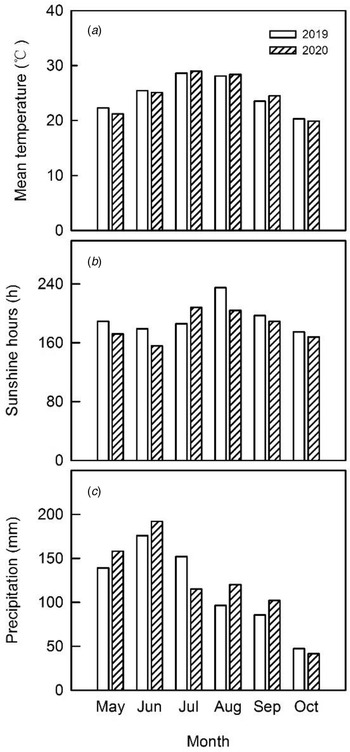
The experimental site was located in Buqiao Village of Fuyang City, Zhejiang Province, China (30̊5′ N, 119̊4′ E). The experiment was conducted during the rice-growing season in 2019 and 2020. Figure 1 shows the weather conditions during the two rice growing seasons, and weather data were recorded from a weather station located near the experimental field. The soil of the plough layer (0–20 cm) was classified as clay loam, and the main soil physical and chemical properties are listed in Table 1.
Monthly average temperature (a), and total sunshine hours (b) and precipitation (c) for the 2019 and 2020 growing seasons for the experimental site in Fuyang, southeast China..

Soil physical and chemical properties in the experiment field in 2019 and 2020

A local high yielding JIHR cultivar Chunyou-927 was grown during both study years. In 2019 and 2020, the pre-germinated seeds were manually sown in a seedbed on May 20. Twenty-five days later, the seedlings were manually transplanted into the experimental field at a hill spacing of 25 cm × 16 cm with two seedlings /hill. The heading dates of these cultivars ranged from 2 to 3 September, and rice was harvested on 31 October. Diseases, insect pests and weeds were strictly controlled to avoid yield losses.
Treatments
The experiment was conducted in a randomized complete block design with three replicates. Each plot (6.0 m × 8.0 m) was separated from the others by 1 m. There were three N application treatments: (1) 0N, no N fertilizer was applied during the entire growth period; (2) CU, application of conventional urea (N 46%, Zhejiang Julong Fertilizer Co. Ltd.; Huzhou, China) at a rate of 180 kg N/ha. Urea was applied in two doses following the practices of local farmers: 70% as a basal dressing one day before transplanting, and the other 30% as a topdressing 10 days after transplanting (DAT). In the (3) PCU treatment, polymer-coated urea (N 44%, longevity was 3 months, Shanghai Jinshengmei Fertilizer Co. Ltd.; Shanghai, China) was applied at a rate of 180 kg N/ha at 1 day before transplanting. Potassium was applied at a uniform rate of 180 kg K2O/ha, and potassium was applied in two doses: 60% as a basal dressing one day before transplanting, and the remaining 40% was applied as a topdressing at the panicle initiation stage. Phosphorous was applied as superphosphate (12% P2O5) at a uniform rate of 90 kg P2O5/ha in each experimental plot as a basal dressing one day before transplanting. After the seedlings were manually transplanted, flooded conditions were maintained in the field until 10 days before the final harvest.
Sampling and measurements
To characterize variation in the number of tillers, 20 plants were manually tagged at 10 DAT, and then the number of tillers was determined at the jointing (44–45 DAT), heading (83–84 DAT), and physiological maturity (138–139 DAT) periods.
Using the method described by Chu et al. (Reference Chu, Chen, Xu, Wang and Zhang2019), five representative hills from each plot were sampled to measure the green leaf area and shoot biomass at the jointing, heading, and physiological maturity periods with an LAI metre (Li-3100, Li-Cor, Lincoln, USA), and the leaf area index (LAI) was calculated. The leaf area duration (LAD) and crop growth rate (CGR) were calculated as follows:


where LAI 1 and LAI 2 are the first and second LAI measurements (m2/m2), respectively; DW1 and DW2 are the first and second shoot biomass measurements (g/m2), respectively; and t 1 and t 2 are the first and second (d) measurements, respectively.
Root biomass was measured at the heading stage. Using a core sampler, three soil cubes (25 cm × 16 cm × 20 cm) around each hill from each plot were carefully extracted. The three soil cubes were then divided into two parts, a 0–10 cm part and a 10–20 cm part. The roots were rinsed thoroughly using a hydropneumatic elutriation device and then dried in a forced-air oven at 80°C for 72 h to determine the root biomass. The root sampling method was used to sample three hills of roots, which were used to measure root oxidation activity (ROA) at three periods after heading: early grain filling (95–96 DAT), mid-grain filling (107–108 DAT), and late grain filling (119–120 DAT). ROA was determined according to the method of Chu et al. (Reference Chu, Chen, Xu, Wang and Zhang2019). The flag leaf net photosynthetic rate was also measured at the early, mid- and late grain filling periods with a portable photosynthesis system (Li-6400XT, Li-Cor, Lincoln, USA).
Following the method described by Chu et al. (Reference Chu, Xu, Chen, Xu, Liu, Abliz, Zhang and Wang2022), the activity of sucrose synthase (SuSase, EC 2.4.1.13) and adenosine diphosphoglucose pyrophosphorylase (AGPase, EC 2.7.7.27) in grains was determined at the three periods after heading: early, mid-, and late grain filling.
The grain yield of each plot was determined from 100 plants and adjusted to a moisture content of 14%. The N content in the plants was determined using the Kjeldahl method, and the methods for calculating NUE were based on those of Xue et al. (Reference Xue, Duan, Liu, Wang, Yang and Zhang2013).
Statistical analysis
The results of this study were evaluated using analysis of variance (ANOVA) with SPSS 25.0 software (SPSS Inc., Chicago, USA). Data from each sampling date were analysed separately. The significance of differences between means was determined using the least significant difference test at the 5% probability level.
Results
Root biomass
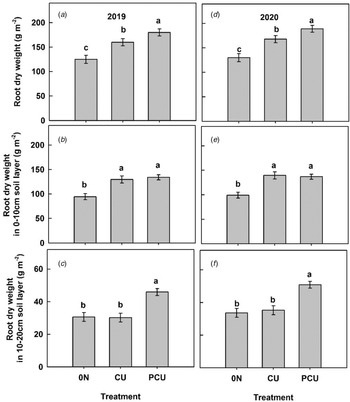
The root dry weight at heading was significantly higher in both N fertilizer application treatments than in the 0N treatment (Fig. 2). The root dry weight at heading was significantly higher in the PCU treatment than in the CU treatment (Fig. 2A, B). The study divided the roots into two parts, and there was no significant difference in root dry weight in the 0–10 cm soil layer between the CU and PCU treatment (Fig. 2C, D). However, the root dry weight in the deep soil layer (10–20 cm soil layer) was significantly higher in the PCU treatment than in the CU treatment (Fig. 2E, F).
Root dry weight (A and B), root dry weight in the 0–10 cm soil layer (C and D), and root dry weight in the 10–20 cm soil layer (E and F) of rice grown under different treatments at heading in 2019 and 2020. 0N, CU and PCU represent no N application, conventional urea application (CU) and polymer-coated urea application (PCU), respectively. Vertical bars represent ± standard error of the mean (n = 3) (which in some cases does not exceed the size of the symbol). Different letters above the column indicate statistical significance at the P = 0.05 level within the same stage.

Number of tillers and percentage of productive tillers
The number of tillers was significantly lower in the 0N treatment than in the CU and PCU treatment during the three periods in which measurements were taken (Table 2). At the jointing period, the number of tillers was significantly higher in the CU treatment than in the PCU treatment (Table 2). However, the difference in the number of tillers was not significant between the CU and PCU treatment at the heading and maturity periods (Table 2). The percentage of productive tillers was significantly higher in the 0N treatment than in the CU treatment, and the difference in the percentage of productive tillers was not significant between the 0N and PCU treatment (Table 2). The percentage of productive tillers was significantly higher in the PCU treatment than in the CU treatment (Table 2).
The number of tillers and percentage of productive tillers of rice grown under different treatments in 2019 and 2020

a0N, CU and PCU represent no N application, conventional urea application (CU), and polymer-coated urea application (PCU), respectively.
bThe number of panicles developed from tillers (tillers at maturity)/the number of tillers at the jointing stage.
cDifferent letters indicate statistical significance at the P = 0.05 level within the same column and the same year.
dNS, not significant at the P = 0.05 level.
*Significant at the P = 0.05 level.
**Significant at the P = 0.01 level.
Shoot dry weight and CGR
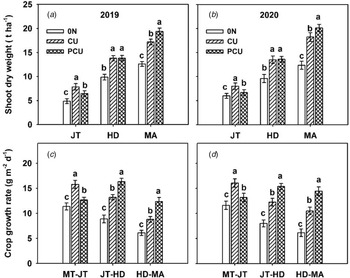
The shoot dry weight was significantly lower in the 0N treatment than in the CU and PCU treatment at the jointing, heading and maturity periods (Fig. 3A, B). The shoot dry weight was significantly lower in the PCU treatment than in the CU treatment at the jointing period, and the difference in the shoot dry weight between the PCU and CU treatment at the heading stage was not significant (Fig. 3A, B). However, the shoot dry weight was significantly higher in the PCU treatment than in the CU treatment at the maturity stage (Fig. 3A, B). CGR from transplanting to jointing was significantly higher in the CU treatment than in the PCU treatment, and the CGR was significantly increased from jointing to heading and from heading to maturity in the PCU treatment compared with the CU treatment (Fig. 3C, D).
Shoot dry weight (A and B) and crop growth rate (C and D) of rice grown under different treatments in 2019 and 2020. 0N, CU and PCU represent no N application, conventional urea application (CU) and polymer-coated urea application (PCU), respectively. JT, HD and MA represent jointing (44–45 DAT), heading (83–84 DAT) and physiological maturity (138–139 DAT), respectively. Vertical bars represent ± standard error of the mean (n = 3) (which in some cases does not exceed the size of the symbol). Different letters above columns indicate statistical significance at the P = 0.05 level within the same stage.

LAI and LAD
The LAI and LAD were significantly lower in the 0N treatment than in the CU and PCU treatment throughout the growth period (Table 3). The LAI was significantly lower in the PCU treatment than in the CU treatment at the jointing period, and the difference in the LAI between the PCU and CU treatment was not significant at the heading stage (Table 3). However, the LAI was significantly higher in the PCU treatment than in the CU treatment at maturity (Table 3). LAD from transplanting to jointing was significantly higher in the CU treatment than in the PCU treatment (Table 3). The difference in LAD from jointing to heading between the CU and PCU treatment was not significant (Table 3). During the grain-filling period, LAD was significantly higher in the PCU treatment than in the CU treatment (Table 3).
Leaf area index (LAI) and leaf area duration (LAD) of rice grown under different treatments in 2019 and 2020

a0N, CU and PCU represent no N application, conventional urea application (CU) and polymer-coated urea application (PCU), respectively.
bDifferent letters indicate statistical significance at the P = 0.05 level within the same column and the same year.
cNS, not significant at the P = 0.05 level.
*Significant at the P = 0.05 level.
**Significant at the P = 0.01 level.
Plant activity during the grain-filling period
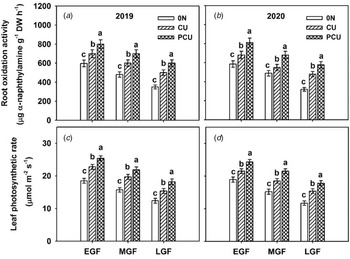
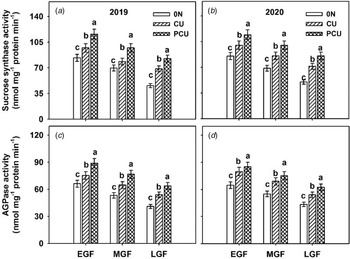
ROA was significantly lower in the 0N treatment than in the two N fertilizer application treatments. ROA was higher throughout the grain filling period in the PCU treatment than in the CU treatment, indicating that the application of PCU could increase the physiological activity of the root system (Fig. 4A, B). Similar patterns were observed in the flag leaf photosynthetic rate and the activity of SuSase and AGPase in grains during the grain-filling period (Figs 4C, D and 5). A correlation analysis revealed that ROA was significantly positively correlated with the flag leaf net photosynthetic rate and the activity of SuSase and AGPase in grains (r = 0.79** ~ 0.90**). These findings indicated the existence of a root–shoot interaction (Table 4).
Root oxidation activity (A and B) and leaf photosynthetic rate (C and D) of rice grown under different treatments during the grain filling period in 2019 and 2020. 0N, CU and PCU represent no N application, conventional urea application (CU) and polymer-coated urea application (PCU), respectively. EGF, MGF and LGF denote the stages of early grain filling (95–96 DAT), mid-grain filling (107–108 DAT) and late grain filling (119–120 DAT). Vertical bars represent ± standard error of the mean (n = 3) (which in some cases does not exceed the size of the symbol). Different letters above the column indicate statistical significance at the P = 0.05 level within the same stage.

The activity of SuSase (A and B) and AGPase (C and D) in rice grains under different treatments during the grain filling period in 2019 and 2020. 0N, CU and PCU represent no N application, conventional urea application (CU) and polymer-coated urea application (PCU), respectively. EGF, MGF and LGF denote the stages of early grain filling (95–96 DAT), mid-grain filling (107–108 DAT) and late grain filling (119–120 DAT). Vertical bars represent ± standard error of the mean (n = 3) (which in some cases does not exceed the size of the symbol). Different letters above the column indicate statistical significance at the P = 0.05 level within the same stage.

Correlation coefficients of root oxidation activity (ROA) with leaf photosynthetic rate (Pr) and activity of sucrose synthase (SuSase) and adenosine diphosphate glucose pyrophosphorylase (AGPase) in rice grains

**Correlation significant at the P = 0.01 level.
Grain yield and NUE
The grain yield was significantly increased in the CU and PCU treatments compared with the 0N treatment (Table 5). The grain yield was 1.0–1.3 t/ha higher under the PCU treatment compared with the CU treatment across both study years (Table 5). The difference in productive tillers between the PCU and CU treatment was not significant (Table 5). The total spikelet number per m2 under the PCU treatment was 5.74 × 10⁴–5.85 × 10⁴, which was significantly higher than that in the CU treatment (Table 5). The increase in the total spikelet number per m2 under the PCU treatment was mainly attributed to the increase in the number of spikelets per panicle (Table 5). Furthermore, the number of filled grains and grain weight were significantly higher in the PCU treatment than in the CU treatment, suggesting that the higher yield performance in the PCU treatment was not attributed exclusively to the larger sink capacity but also to the greater sink strength (Table 5).
Grain yield and yield components of rice under different treatments in 2019 and 2020

a0N, CU and PCU represent no N application, conventional urea application (CU) and polymer-coated urea application (PCU), respectively.
bDifferent letters indicate statistical significance at the P = 0.05 level within the same column and the same year.
cNS, not significant at the P = 0.05 level.
*Significant at the P = 0.05 level.
**Significant at the P = 0.01 level.
The total N uptake by plants at maturity was significantly higher in the PCU treatment than in the CU treatment (Table 6). Furthermore, NUE, including IEN, PFPN and AEN, was significantly higher in the PCU treatment than in the CU treatment (Table 6).
Nitrogen uptake at maturity and N use efficiency of rice under different treatments in 2019 and 2020

a0N, CU and PCU represent no N application, conventional urea application (CU) and polymer-coated urea application (PCU), respectively.
bPFPN = Grain yield in N application plots (kg) / N rate (kg).
cIEN = grain yield (kg) / N uptake of plants (kg).
dAEN = (grain yield in N application plots – grain yield in N omission plots (kg)) / N rate (kg).
eDifferent letters indicate statistical significance at the P = 0.05 level within the same column and the same year.
fNS, not significant at the P = 0.05 level.
*Significant at the P = 0.05 level.
**Significant at the P = 0.01 level.
Discussion
Simultaneously increasing grain yield, NUE, and utilizing minimal labour input in China may be challenging when there is an urgent need to increase total crop production due to a rapidly growing human population and scarce human resources. The findings of this study suggest that the one-time application of PCU before transplanting in JIHR cultivars could achieve the dual goal of increasing both grain yield and NUE. However, the mechanism underlying these effects is not fully understood. Our observations in the present study suggest several possible explanations.
Improved root morphological trait
The roots are a critical organ in rice plants that anchor the aboveground part of plants, absorb resources from the soil, and synthesize plant growth regulators (Yang et al., Reference Yang, Zhang and Zhang2012). Root biomass is considered the most important root morphological trait because this trait is closely associated with the nutrient- and water-absorbing ability of roots and aboveground biomass (Chu et al., Reference Chu, Chen, Wang, Yang and Zhang2014; Meng et al., Reference Meng, Wei, Li, Dai and Huo2018). The current study results showed that root dry weight at the heading period was significantly higher in the PCU treatment than in the CU treatment Fig. 2A, B). Furthermore, it was found that deep root (roots in the 10–20 cm soil layer) biomass was significantly higher in the PCU treatment than in the CU treatment (Fig. 2E, F), suggesting that PCU could promote the entry of the roots into deeper soil layers. The absorption of water and nutrients is thought to be enhanced when the roots penetrate more deeply into the soil (Ju et al., Reference Ju, Buresh, Wang, Zhang, Liu, Yang and Zhang2015; Meng et al., Reference Meng, Wei, Li, Dai and Huo2018; Chu et al., Reference Chu, Xu, Chen, Xu, Liu, Abliz, Zhang and Wang2022). Thus, greater root biomass and a deeper root distribution might have contributed to increased yield performance and NUE in the PCU treatment.
Less redundant vegetative growth during the early growth period
Previous studies have indicated that less redundant growth during the vegetative growth phase can reduce the consumption of resources (including N and water) and improve canopy structure (Wang et al., Reference Wang, Zhang, Beebout, Zhang, Liu, Yang and Zhang2016; Zhou et al., Reference Zhou, Ju, Wang, Zhang, Liu, Yang and Zhang2017; Chu et al., Reference Chu, Chen, Xu, Wang and Zhang2019). It was found that the number of tillers at the jointing period was significantly higher in the CU treatment compared with the PCU treatment (Table 2), which was mainly attributed to the large amount of N fertilizer applied during the early vegetative stage. However, there was no significant difference in the number of tillers at the heading and maturity periods between the CU and PCU treatment, and the percentage of productive tillers was significantly lower in the CU treatment than in the PCU treatment (Table 2), which indicates that the application of PCU can reduce redundant growth. Therefore, we suspected that less redundant vegetative during the early growth period of JIHR cultivars under PCU treatment might have contributed to the lower resource use for nonessential tissues and improved the quality of the canopy, thereby leading to higher grain yield and NUE.
Greater higher matter production during the mid and late growth period
Increasing the sink capacity of rice is important for enhancing rice grain yield (Cheng et al., Reference Cheng, Cao, Zhuang, Chen, Zhan, Fan, Zhu and Min2007; Yuan, Reference Yuan2017). It was found that the total spikelet number per m2 was higher in the PCU treatment than in the CU treatment (Table 5). Furthermore, the greater number of spikelets per unit area in the PCU treatment was mainly attributed to an increase in the spikelet number per panicle (Table 5). It was found that the CGR was significantly higher in the PCU treatment than in the CU treatment from jointing to heading (Fig. 3C, D), suggesting that the one-time PCU application before transplanting can enhance shoot biomass accumulation during the reproductive period compared with traditional urea application. Previous studies have indicated that the stronger shoot biomass accumulation ability from jointing to heading not only promotes spikelet differentiation but also reduces spikelet degeneration, thereby increasing the spikelet number per panicle (Ju et al., Reference Ju, Buresh, Wang, Zhang, Liu, Yang and Zhang2015; Chu et al., Reference Chu, Chen, Xu, Wang and Zhang2019). Thus, we suspected that the greater aboveground biomass production during the reproductive period in the PCU treatment might contribute to the strengthened sink capacity, which resulted in a higher grain yield and NUE.
Higher plant activity during the grain-filling period
Grain-filling efficiency has been reported to be negatively related to the sink capacity (Fageria, Reference Fageria2007). In our study, the yield sink capacity and grain filling were enhanced in the PCU treatment compared with the CU treatment (Table 5). Greater activity of the key enzymes involved in the conversion of sucrose to starch in grains can increase sink activity and enhance grain filling (Yang et al., Reference Yang, Zhang, Wang, Zhu and Liu2003; Zhang et al., Reference Zhang, Li, Yuan, Wang, Yang and Zhang2012). It was found that the activity of SuSase and AGPase was significantly higher in grains in the PCU treatment than in the CU treatment (Fig. 5). Therefore, the PCU treatment could significantly enhance the sink strength by increasing the activity of key enzymes involved in the conversion of sucrose to starch in grains, which can increase grain filling efficiency and thus grain yield and NUE.
ROA is an important root physiological trait, and the greater ROA observed during the grain-filling period might keep the physiological activity of plants high and enhance grain-filling (Osaki et al., Reference Osaki, Shinano, Matsumoto, Zheng and Tadano1997; Yang et al., Reference Yang, Zhang and Zhang2012). It was found that ROA was significantly higher in the PCU treatment than in the CU treatment during the grain filling period (Fig. 4A, B). Furthermore, correlation analysis revealed that ROA was significantly positively correlated with the flag leaf net photosynthetic rate and the activity of SuSase and AGPase in grains during the grain-filling period (Table 4). The root and shoot have an interdependent relationship wherein active shoots ensure an abundance of carbohydrates, and this facilitates the development and maintenance of root functions. This activation of root functions can enhance shoot characteristics by providing sufficient nutrients, water and plant hormones to increase crop productivity (Osaki et al., Reference Osaki, Shinano, Matsumoto, Zheng and Tadano1997; Yang et al., Reference Yang, Zhang and Zhang2012). Therefore, the application of PCU significantly increased root physiological activity, which contributes to increases in aboveground physiological activity, grain filling, and both the grain yield and NUE.
Conclusion
PCU application could increase grain yield by 1.0–1.3 t/ha, and agronomic NUE by 5.2–5.9 kg/kg compared with CU treatment in JIHR cultivar. The better yield performance and higher NUE were mainly attributed to the higher percentage of productive tillers, greater CGR from jointing to maturity, greater LAD from heading to maturity, larger root biomass and deeper root distribution at heading, higher activity of the key enzymes involved in the conversion of sucrose to starch in grains, higher ROA, and higher net photosynthetic rate of the flag leaves during the grain filling period. PCU application holds great promise for increasing the yield and NUE of JIHR cultivars, as well as reducing labour inputs.
Author contributions
G. Chu and D.Y. Wang conceived and designed the study. R. Xu and S. Chen conducted data gathering. C.M. Xu and Y.H. Liu performed statistical analyses. R. Xu, X.F. Zhang and G. Chu wrote the article.
Financial support
This study was supported by the Key Research and Development Program of Zhejiang Province (2022C02034), the National Natural Science Foundation of China (32101825), and the National Rice Industry Technology System (CARS-01).
Conflict of interest
The authors declare there are no conflicts of interest.
Ethical standard
Not applicable.