Accessory pathways with antegrade-only conduction represent an uncommon form of ventricular pre-excitation. While long recognised as a subtype of ventricular pre-excitation, there have been few publications regarding antegrade-only accessory pathways, most notably absent in children. Reference Tai, Chen and Chiang1–Reference Milstein, Sharma and Klein4 As diagnostic methods and criteria, catheter interventions, and consensus statements have evolved since the initial reports of these accessory pathways, a contemporary analysis of these unusual variants of pre-excitation was performed. 5,Reference Etheridge, Escudero and Blaufox6
Methods
This study was a single-centre, retrospective study of young patients with antegrade-only accessory pathways. Institutional review board approval was obtained prior to initiation of this review. Subjects were included if they were <21 years of age and the electrophysiology study was performed between January 2000 and November 2018. Antegrade-only accessory pathways were defined by the following criteria: manifest ventricular pre-excitation on the surface of electrocardiogram (ECG), local ventricular activation at the atrioventricular annulus preceding His bundle activation during the electrophysiology study, and no evidence of retrograde conduction at or near the site of antegrade ventricular pre-excitation. Patients with subtle pre-excitation during sinus rhythm which became manifest with programmed atrial stimulation were included; however, using this criteria, patients with bystander His-Ventricular fibres were excluded from further analysis. Mahaim fibres were defined as atrio-fascicular connections with antegrade-only conduction and decremental properties. Reference Gallagher, Smith, Kasell, Benson, Sterba and Grant7
Data collection
Data collection included basic demographics, clinical history, baseline ECG, and cardiac anatomy and ventricular function as determined by echocardiography. Details of the electrophysiology procedure included location and electrophysiology properties of the accessory pathway, induction and type of any arrhythmia, and the presence of multiple arrhythmia substrates. If catheter ablation was performed, acute success, any complications, and follow-up data were included.
Electrophysiology study and risk assessment
All electrophysiology procedures were performed with standard reference catheter positions (e.g., His bundle, right ventricle, and coronary sinus catheters). Localisation of the site of the antegrade-only accessory pathway was defined as the site of earliest ventricular activation as defined by electro-anatomic mapping. Location of the accessory pathway was further defined as the site of elimination of pre-excitation by catheter ablation, when performed and acutely successful. Evaluation of accessory pathway antegrade effective refractory period with timed atrial extra-stimuli was performed in all studies, while the shortest pre-excited R-R intervals during rapid atrial pacing was determined in 31 of 33 patients. The lowest value for either the accessory pathway effective refractory period or the shortest pre-excited R-R intervals of patients with antegrade-only conduction were then compared to three age-matched controls for each study patient. In addition, the study patients were subdivided into three categories to further analyse if there were differences in risk stratification between the groups: an isolated antegrade-only accessory pathway group, a Mahaim fibre group, and an antegrade-only pathway with second arrhythmia substrate group.
Statistical analysis
Descriptive statistics were analysed in R version 4.0.0 (R Core team, Vienna, Austria). Categorical variables were reported as frequencies and compared with the Chi-square test. Continuous variables were first tested for normality using the Shapiro–Wilk test and due to the non-Gaussian distribution presented as median ± interquartile range and compared with the Wilcoxon rank-sum test. Accessory pathway location and electrophysiologic properties, secondary arrhythmia substrates/locations, acute ablation success rates, and any procedural complications were analysed.
Results
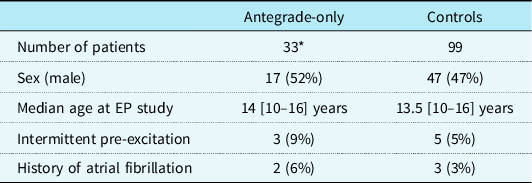
Of a total of 522 patients with ventricular pre-excitation who underwent electrophysiology evaluation during the study interval, 33 (6.3%) had an antegrade-only accessory pathway. The 33 patients who met inclusion criteria for an antegrade-only accessory pathway are the subjects of this analysis. The median patient age at time of the electrophysiology study was 14 [10–16] years and 16 (48%) were male (Table 1). The most common presenting symptoms were palpitations (47%), chest pain (25%), and syncope (22%). One patient had Ebstein’s anomaly and another hypertrophic cardiomyopathy. Otherwise, all other patients had structurally normal hearts and normal ventricular function.
Demographics of study and control populations

AP = accessory pathway; EP = electrophysiology.
* One patient with two right-sided antegrade-only APs
Accessory pathway location and additional substrate-type characteristics
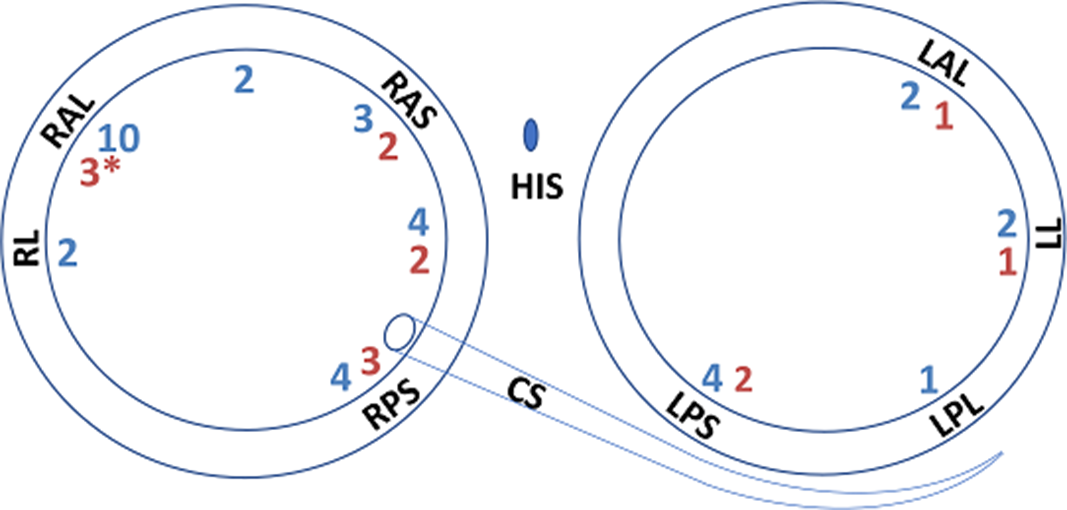
The majority of the antegrade-only accessory pathways were right-sided (25/34, 74%) (Fig 1). There were 15 patients with a single-antegrade accessory pathway and no inducible arrhythmias, and 1 patient with 2 distinct antegrade-only accessory pathways (right mid-septal and right postero-lateral) and no inducible arrhythmia. The antegrade-only accessory pathways in patients with no inducible arrhythmia were right-sided (i.e., related to the tricuspid annulus) in 12 of the 16 patients (75%). Of note, atrial fibrillation was the presenting clinical finding in two of these patients, including the one patient with two distinct antegrade-only accessory pathways.
Number and location of antegrade-only accessory pathways. Numbers in blue denote the number and location of all antegrade-only accessory pathways. Numbers in red indicate the number and location of antegrade-only accessory pathways with a second substrate. The 3* indicates the patients with Mahaim fibres and a second substrate for supraventricular tachycardia. RA, right anterior; RAL, right anterolateral; RAS, right anteroseptal; RL, right lateral; RMS, right mid-septal; RPS, right posteroseptal; LAL, left anterolateral; LL, left lateral; LPL, left posterolateral; LPS, left posteroseptal.

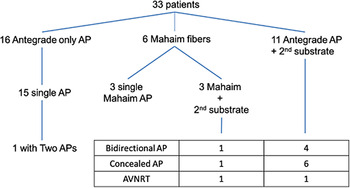
Mahaim fibres were present in six patients, all located in the right anterolateral aspect of the tricuspid annulus. Antidromic reciprocating tachycardia was inducible in all six patients. One patient with Ebstein’s anomaly and a Mahaim fibre also had a bidirectional postero-septal accessory pathway. Two additional patients with Mahaim fibres had a second substrate for supraventricular tachycardia, one with atrioventricular node re-entrant tachycardia and one with a right posterior concealed accessory pathway (Fig 2).
Summary diagram of all patients with antegrade-only accessory pathways, electrophysiologic subtypes and the presence and types of secondary substrates for supraventricular tachycardia. AVNRT, atrioventricular nodal reentrant tachycardia.

The final group consisted of 11 patients with a single-antegrade-only accessory pathway, but with inducible supraventricular tachycardia due to a second electrophysiologic substrate. These additional arrhythmic substrates were concealed accessory pathways in six patients, bidirectional accessory pathways in four patients and the common form of atrioventricular nodal reentrant tachycardia in one patient. Sustained supraventricular tachycardia was inducible during electrophysiology study in all 11 patients. In patients with a second substrate for supraventricular tachycardia and inducible tachycardia, the antegrade-only pathways were right-sided in seven patients and left-sided in four patients. Conversely, the majority (8/11) of the second arrhythmic substrates were left-sided.
Risk stratification
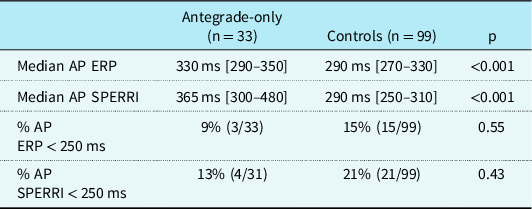
For the entire group of study patients, the median accessory pathway effective refractory period with timed atrial extra-stimuli was 330 [290–350] ms. In comparison, for age-matched control patients with bidirectional accessory pathway conduction, the median accessory pathway effective refractory period was 290 [270–330] ms (p = 0.0068). The median shortest pre-excited R-R interval of the antegrade-only group with rapid atrial pacing was 365 [300–418] ms, whereas the median for the bidirectional group was 290 [250–310] ms (p < 0.001). The lowest value between the accessory pathway effective refractory period and shortest pre-excited R-R interval was taken for each patient, and the aggregate median of the antegrade-only group was significantly higher than the bidirectional group (310 [280–360] ms versus 270 [240–302] ms, p < 0.001).
However, the prevalence of individuals with an accessory pathway effective refractory period <250 ms was not significantly different between the two groups of patients: 3/33 (9%) antegrade-only accessory pathways compared to 15/99 (15%) bidirectional accessory pathways (p = 0.55). In addition, the shortest pre-excited R-R interval was <250 ms in 4/31 (13%) antegrade-only accessory pathway patients compared to 21/99 (21%) bidirectional accessory pathway patients (p = 0.43) (Table 2).
Electrophysiologic properties of antegrade-only and control patients

Values reported as median and interquartile range
AP = accessory pathway; ERP = effective refractory period; SPERRI = shortest pre-excited R-R interval
Sub group analysis
There were 16 patients with isolated antegrade-only accessory pathways that had no inducible arrhythmia. The median accessory pathway effective refractory period was 330 [320–360] ms. With rapid atrial pacing, the median shortest pre-excited R-R interval was 345 [300–423] ms. None of these isolated antegrade-only accessory pathways had an accessory pathway effective refractory period less than 250 ms. Sustained atrial fibrillation was induced in the two patients with clinical atrial fibrillation (shortest pre-excited R-R intervals of 280 and 450 ms).
There were six patients with Mahaim (atrio-fascicular) fibres. The median antegrade accessory pathway effective refractory period was 280 [230–310] ms. With rapid atrial pacing, the median shortest pre-excited R-R interval was 330 [280–400] ms. Two patients with Mahaim fibres had an accessory pathway effective refractory period <230 ms. Sustained atrial fibrillation was induced in two patients with shortest pre-excited R-R interval intervals of 250 and 350 ms.
There were 11 patients with an antegrade-only accessory pathway and a second mechanism for supraventricular tachycardia. The median antegrade accessory pathway effective refractory period was 350 [280–360] ms. With rapid atrial pacing, the median shortest pre-excited R-R interval was 370 [300–435] ms. Two patients had an antegrade-only accessory pathway effective refractory period <250 ms. Sustained atrial fibrillation was induced in one patient with a shortest pre-excited R-R interval interval of 280 ms.
Catheter mapping and ablation
Catheter mapping of the location of the antegrade-only accessory pathway and, if present, second substrate for tachycardia was performed in a systematic, consistent method in all patients. However, the decision to proceed with catheter ablation was based on individual patient and accessory pathway characteristics, the presence of any inducible arrhythmia, the location of the antegrade-only accessory pathway in relation to the normal conduction system, as well as individual judgement. Overall, ablation of the antegrade-only accessory pathway was initially successful in 30 of the 31 patients where it was attempted, with a second procedure required in 4 patients due to initial ablation procedure failure in 1 patient with a Mahaim fibre and late recurrence of accessory pathway conduction in 3 patients: 2 patients with Mahaim fibres and 1 with high-risk antegrade conduction properties. Catheter ablation was performed in 13 of the 15 patients with an isolated antegrade accessory pathway and no inducible supraventricular tachycardia. A decision not to perform accessory pathway ablation in two patients was based on low-risk conduction properties and proximity to the normal conduction system. The one patient with two antegrade-only accessory pathways also had successful radiofrequency ablation of both accessory pathways.
Catheter mapping and ablation was performed in all six patients with Mahaim fibres, although a second procedure was required in three patients due to initial failure (n = 1) or recurrence of antidromic reentrant tachycardia (n = 2). The secondary substrate for supraventricular tachycardia in the Mahaim patients included one each with a bidirectional accessory pathway, retrograde-only accessory pathway, and atrioventricular nodal reentrant tachycardia.
Among the 11 patients with an antegrade-only accessory pathway and second substrate for supraventricular tachycardia, mapping and successful catheter ablation was performed for the antegrade-only accessory pathways and the additional arrhythmic substrates. Conversely, in both patients with inducible sustained atrioventricular nodal reentrant tachycardia, antegrade-only accessory pathway ablation was performed first (based on mapping of ventricular pre-excitation) followed by recognition of dual atrioventricular node physiology during post-accessory pathway ablation evaluation. No significant complications were associated with the electrophysiology/ablation procedures.
Discussion
In this study of young patients with ventricular pre-excitation, antegrade-only accessory pathways were identified in 33 of 522 consecutive cases. While the majority of these accessory pathways had long antegrade effective refractory periods, potential “high-risk” conduction properties were identified in a small, but not insignificant number of patients. Furthermore, the presence of a second substrate which provided the basis for re-entrant supraventricular tachycardia in 14 of the 33 patients was an unanticipated finding and emphasises the need for complete evaluation in patients who are found to have an antegrade-only accessory pathway during electrophysiology study.
Currently, there remains debate regarding the need for risk stratification and treatment for patients with “asymptomatic” Wolff Parkinson White, that is, patients with ventricular pre-excitation but without recognised symptoms. 5 The absence of sustained supraventricular tachycardia in these patients may reflect either an antegrade-only accessory pathway or possibly a bidirectional accessory pathway with a short antegrade effective refractory period, with differentiation far from accurate using non-invasive means. Reference Di Mambro, Russo and Righi8,Reference Kubuš, Vít, Gebauer, Materna and Janoušek9 Regardless, the clinician providing care for patients with the incidental finding of ventricular pre-excitation on the ECG should be aware that this finding may or may not be associated with a risk of future arrhythmias, and furthermore, that supraventricular tachycardia may occur in these patients based on a different or second mechanism of tachycardia.
While the characteristics of bidirectional and retrograde-only accessory pathways are well described, few reports have focused on accessory atrioventricular pathways with antegrade-only conduction. Tai et al compared 33 adults with antegrade-only accessory pathways to 377 adults with bidirectional accessory pathways (controls) and found that patients with antegrade-only accessory pathways were older and had a higher incidence of atrial fibrillation and syncope than controls. In addition, most antegrade-only accessory pathways were located in the posterior septal region and were associated with retrograde atrioventricular nodal conduction. Reference Tai, Chen and Chiang1 Hammill et al studied a group of 111 adult patients and found 7 patients with antegrade-only pathways who had similar antegrade refractoriness and conduction characteristics compared to a control group of bidirectional accessory pathways. Reference Hammill, Pritchett, Klein, Smith and Gallagher2 Klein et al compared patients with intermittent pre-excitation versus those with consistent pre-excitation and reported 5 patients with antegrade-only pathways in a group of 52 patents without a significant difference in the electrophysiology properties between the 2 groups. Reference Klein and Gulamhusein3 Milstein et al evaluated a group of patients with asymptomatic Wolff-Parkinson-White (WPW) and found that 18/42 (42%) patients had antegrade-only accessory pathway conduction. Reference Milstein, Sharma and Klein4
In the current study, antegrade-only accessory pathways were also uncommon in young patients, with a 6.3% prevalence rate, similar to the aforementioned adult studies. The majority of antegrade-only accessory pathways were right-sided (25/34, 74%) and most (29/33, 87%) had risk stratification testing consistent with low-risk conduction properties.
Another important finding in this study is that 14 of 33 (42%) of patients with an antegrade-only accessory pathway had a second arrhythmia substrate with inducible supraventricular tachycardia. This is a somewhat unexpected finding, given a prior report in a large study by Zachariah et al that multiple accessory pathways were present in only 10% of young patients in the absence of structural heart disease. Reference Zachariah, Walsh and Triedman10 However, similar to this report, multiple accessory pathways were noted to occur with increased frequency in patients with Ebstein’s anomaly and hypertrophic cardiomyopathy. Also, McCanta et al have reported that sustained atrioventricular nodal reentrant tachycardia was inducible in 15 of 350 patients (4.2%) following successful accessory pathway ablation, similar to the 2 of 33 patients (6%) observed in this study. Reference McCanta, Collins and Schaffer11 Comparable to the patients with only the single-antegrade-only accessory pathway, the majority of patients with a second arrhythmia substrate (10/14) had right-sided antegrade-only accessory pathways – whereas the second arrhythmia substrate was more commonly left-sided (concealed or manifest accessory pathway) in eight patients.
The decision to perform catheter ablation of the antegrade-only accessory pathway was based on several considerations, including prior symptoms, risk stratification, the presence of a second substrate, and location of the antegrade-only accessory pathway relative to the normal conduction system. This remains a debated issue, despite several guidelines and surveys regarding catheter ablation in the asymptomatic patient with ventricular pre-excitation. 5,Reference Chubb, Campbell, Motonaga, Ceresnak and Dubin12,Reference Raposo, António, Andrade, Sousa, Pires and Gonçalves13 Furthermore, determination of the antegrade effective refractory period of an antegrade-only accessory pathway in the setting of a second antegrade accessory pathway may be imprecise. The findings of a differential effective refractory period with programmed stimulation with a change in the pattern of pre-excitation was observed in three of the four cases with multiple antegrade accessory pathways and has been reported to be a useful finding to suggest the presence of multiple accessory pathways. Reference Helm, Varkey and Karnik14
Limitations
This was a retrospective, descriptive study which sought to characterise antegrade-only accessory pathways in children. As this is an uncommon diagnosis, data were limited to 33 patients studied over an 18-year interval. With regard to risk stratification, we did not uniformly attempt to induce atrial fibrillation as an aspect of risk stratification consistently during electrophysiology study. It is possible that antegrade-only pathways may have a shorter pre-excited R-R interval during atrial fibrillation than determined by accessory pathway effective refractory period or rapid atrial pacing. Additionally, isoproterenol testing was not routinely performed on all patients, which may have underestimated the conduction properties of the antegrade-only accessory pathways. Reference Moore, Kannankeril and Fish15 Finally, the long-term success following initially successful catheter ablation cannot be verified in all patients due to the lack of consistent long-term follow-up on several patients and transition to adult care providers.
Conclusions
Antegrade-only accessory pathways are an uncommon cause of ventricular pre-excitation in children. In this study, antegrade-only accessory pathways, other than Mahaim fibres, did not provide a substrate for antidromic reentrant tachycardia. However, a second arrhythmia substrate was present in 42% of these patients and provided a basis for clinical and/or inducible sustained supraventricular tachycardia. Furthermore, 13% of these accessory pathways demonstrated high-risk conduction properties, similar to bidirectional accessory pathways. We conclude that the initial finding of a single, antegrade-only accessory pathway should not be the end point of electrophysiology evaluation, as our data suggest that these accessory pathways potentially may have high-risk conduction properties and that a second mechanism of supraventricular tachycardia frequently may be present in these patients.
Acknowledgements
None.
Financial support
This research received no specific grant from any funding agency, commercial or not-for-profit sectors.
Conflicts of interest
None.
Ethical standards
Not applicable.