Introduction
There are more than 900,000 sworn law enforcement officers in the United States, serving a population of approximately 325,056,400 persons. 1 Traditionally, law enforcement operated primarily to support Emergency Medical Services (EMS) on medical calls, ensuring scene safety and situational stability rather than providing direct medical care. However, law enforcement personnel are increasingly viewed as a key component in the out-of-hospital chain of survival.
Fundamental to successful out-of-hospital care is the rapid arrival of trained providers. By the nature of their responsibilities, law enforcement personnel respond to motor vehicle accidents and violent crimes. As a consequence, law enforcement personnel frequently arrive on scene prior to EMS arrival. One study indicated that 59.0% of law enforcement agencies reported response times less than four minutes.Reference Hawkins, Shapiro, Sever, Delbridge and Mosesso 2 Law enforcement personnel reported being on scene prior to EMS 70.0% of the time.Reference Hawkins, Shapiro, Sever, Delbridge and Mosesso 2 , Reference Sztajnkrycer, Callaway and Baez 3 Even when on scene, EMS may encounter delays in patient contact due to scene safety concerns, accounting for an additional 4.5 minute in scene time.Reference Gratton, Garza, Salomone, McElroy and Shearer 4 The ability of trained providers to rapidly arrive on scene may save lives.Reference Myerburg, Fenster and Velez 5 - Reference Meizoso, Ray and Karcutskie 7
More than 80.0% of law enforcement agencies respond to medical emergencies, and approximately one-half of agencies provide some form of on-scene patient care.Reference Alonso-Serra, Delbridge, Auble, Mosesso and Davis 8 The use of automated external defibrillators (AEDs) by law enforcement during the response to out-of-hospital cardiac arrest is now part of law enforcement culture, and associated with improved survival when performed appropriately.Reference White, Hankins and Bugliosi 9 - Reference Sumner, Mercado-Crespo and Spelke 12 In order to stem deaths from the national opioid epidemic, law enforcement personnel have begun administering naloxone with life-saving efficacy.Reference Sumner, Mercado-Crespo and Spelke 12 - Reference Fisher, O’Donnell, Ray and Rusyniak 14
Despite the potential survival advantages offered by a rapid response by trained law enforcement personnel, little is known about the nature of care provided by law enforcement prior to the arrival of EMS. Such information is important for both training and planning purposes. The purpose of the current study was to perform a descriptive analysis of pre-arrival care provided by law enforcement and reported to a national EMS database.
Methods
Study Design
A descriptive analysis of the 2014 National EMS Information System (NEMSIS) Public Release Research Data Set v2.2.1, the most recent complete dataset, as provided by the NEMSIS Project (NEMSIS Technical Assistance Center, University of Utah School of Medicine; Salt Lake City, Utah USA), and containing EMS emergency response data submitted by 41 states, was performed. The study was reviewed by the Mayo Clinic Institutional Review Board (Rochester, Minnesota USA) and deemed exempt.
Study Setting
As part of the NEMSIS Project, individual EMS agencies collect patient care specific data using standardized data element definitions with computer software programs conforming to NEMSIS data element standards. These data are aggregated at the state level by the respective lead EMS regulatory body; statewide aggregate data are subsequently exported to the NEMSIS national data repository. Each state varies in regards to its inclusion criteria, data collection systems, and reporting requirements. Although states may collect additional data, only 83 unique data elements are exported into the NEMSIS database, with some being mandatory and others optional. These NEMSIS data definitions can be accessed from the National EMS Database, NEMSIS Research Data Set v. 2.2.1 User Manual. 15 These data are subsequently de-identified to remove patient and agency-specific information prior to release as a public research database.
Selection of Study Participants
Mandatory data element E09_02 (Prior Aid Performed By) contained a specific code for law enforcement (1200) and was used to identify specific records for subsequent analysis.
Invalid Data Codes
Observations with invalid codes were set to missing to more easily report frequency counts and percentages.
Primary Data Analysis
Descriptive analyses were generated from the NEMSIS Research Data Set using SAS version 9.3 (SAS Institute; Cary, North Carolina USA).
Results
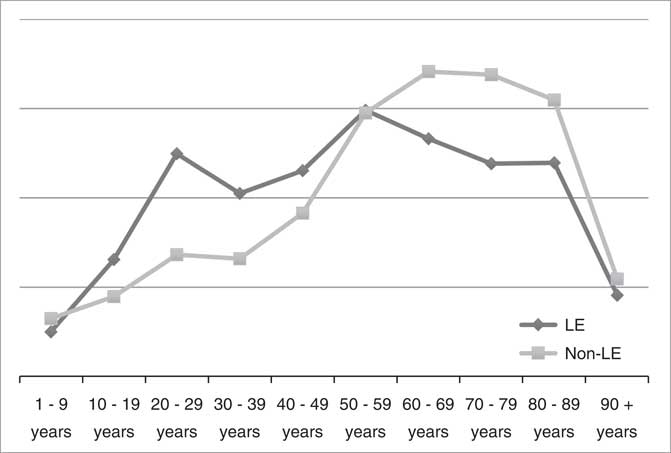
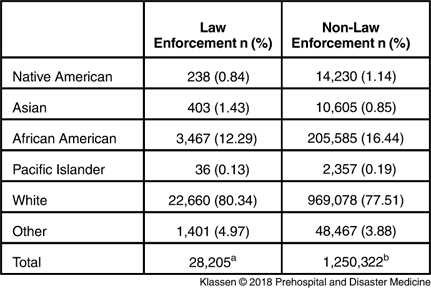
A total of 25,835,729 EMS activations were reported during the study period. There were 1,720,923 records with documented pre-arrival care, of which 34,699 reported prior aid by law enforcement (2.0%). Patients receiving law enforcement pre-arrival care were more likely to be younger (52.8 [SD=23.8] years versus 58.7 [SD=23.3] years), with a shift towards patient ages 10-49 years as compared with patients receiving non-law enforcement prior aid (Figure 1); male (54.8% versus 46.7%); and white (80.3% versus 77.5%; Table 1).
Age Distribution in Years of Patients Receiving Aid by Law Enforcement Prior to EMS Arrival. Abbreviation: EMS, Emergency Medical Services; LE, law enforcement.

Racial Distribution of Patients Receiving Aid Prior to EMS Arrival

Abbreviation: EMS, Emergency Medical Services.
a 6,494 records contained missing values.
b 435,902 records contained missing values.
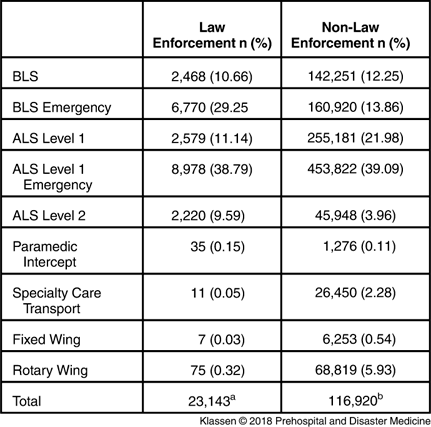
The level of EMS response is provided in Table 2. Basic Life Support (BLS) response was more common in patients receiving prior aid by law enforcement, compared with other prior aid, while Advanced Life Support (ALS) response was more common amongst non-law enforcement prior aid. Single-patient encounters occurred in 95.1% of law enforcement responses, while multiple-patient encounters occurred in 4.9%. In contrast, multiple-patient encounters occurred in 0.9% of responses receiving other forms of prior aid, representing a nearly 5-fold increase in multiple-patient encounters in the law enforcement prior aid group. The most common response locations for law enforcement aid were home/residence (58.1%), street or highway (18.3%), and trade or service (defined as a business, bar, restaurant, etc; 6.8%).
Center for Medicare and Medicaid Services (CMS) Service Levels for Patients Receiving Aid Prior to EMS Arrival

Abbreviations: ALS, Advanced Life Support; BLS, Basic Life Support; EMS, Emergency Medical Services.
a 11,556 records contained missing values.
b 1,569,304 records contained missing values.
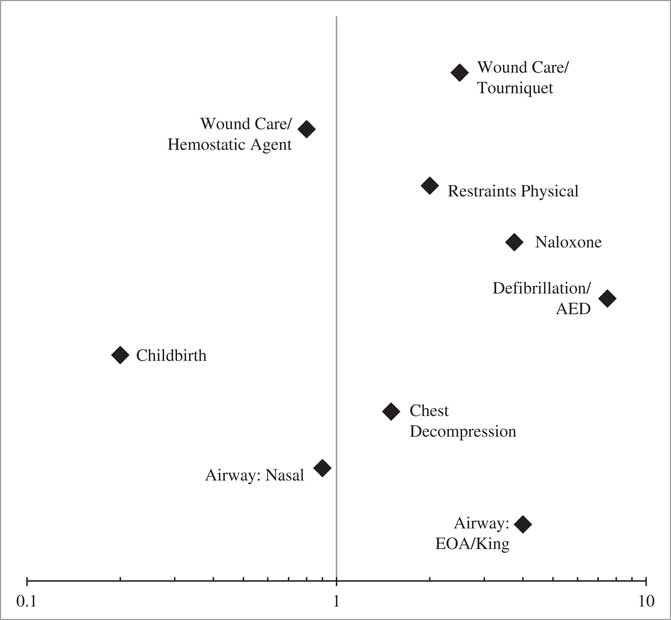
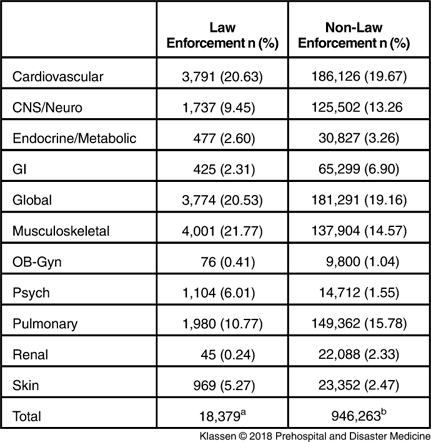
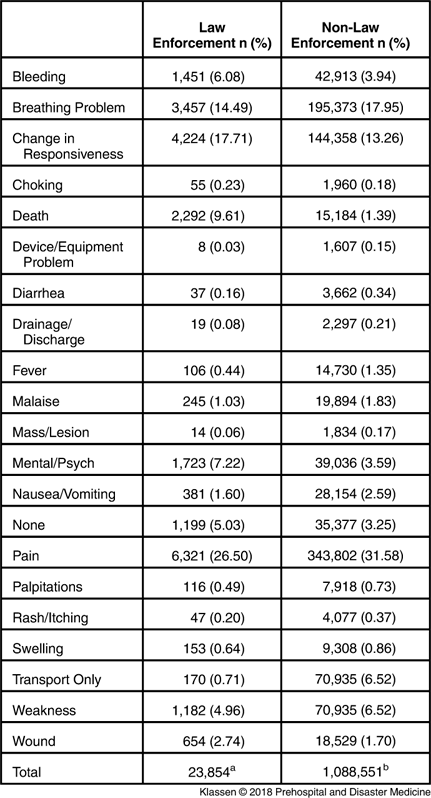
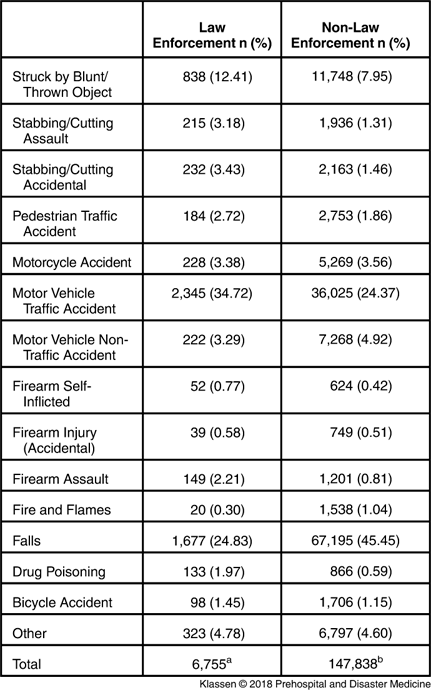
Injury was more common amongst patients receiving prior aid by law enforcement (26.2%) compared with those receiving other forms of prior aid (16.8%). Chief complaint by primary organ system affected is provided in Table 3. Amongst reported primary symptoms, bleeding, change in responsiveness, psychiatric/mental health, wound, and death were more common in patients receiving prior aid by law enforcement (Table 4). Selected causes of injury are noted in Table 5. Law enforcement personnel were more likely to respond to motor vehicle traffic accidents, firearm and stabbing assaults, and drug poisoning. They were less likely to respond to falls and fires. The proportion of selected procedures performed on patients receiving law enforcement versus other prior aid is shown in Figure 2.
Relative Proportion of Selected Procedures Performed in Patients Receiving Prior Aid by Law Enforcement versus Non-Law Enforcement Responders. Abbreviations: AED, automated external defibrillator; EOA, esophageal obturator airway.

Chief Complaint by Primary Organ System in Patients Receiving Aid Prior to EMS Arrival

Abbreviations: CNS, central nervous system; EMS, Emergency Medical Services; GI, gastrointestinal.
a 16,320 records contained missing values.
b 739,961 records contained missing values.
Primary Sign or Symptom in Patients Receiving Aid Prior to EMS Arrival

Abbreviation: EMS, Emergency Medical Services.
a 10,845 records contained missing values.
b 597,673 records contained missing values.
Mechanism of Injury in Patients Receiving Aid Prior to EMS Arrival

Abbreviation: EMS, Emergency Medical Services.
a 27,944 records contained missing values.
b 1,538,386 records contained missing values.
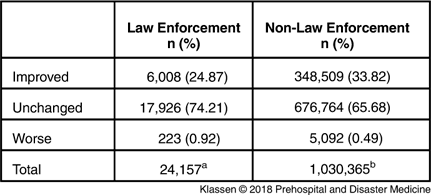
Cardiac arrest was more common in patients receiving prior aid by law enforcement (16.5% versus 2.6%). Compared with patients receiving non-law-enforcement prior aid, patients receiving law enforcement pre-arrival care were more likely to be declared dead on scene (4.6% versus 0.7%), refuse EMS care (6.9% versus 2.1%), and less likely to be transported by EMS (78.7% versus 92.1%). After emergency department arrival, patients receiving law enforcement care were more likely to be admitted to the hospital (41.1% versus 24.7%), admitted to the intensive care unit (ICU; 8.7% versus 6.8%), or die (14.5% versus 2.3%), yet they were also more likely to be discharged (19.7% versus 6.7%). In contrast, they were less likely to be transferred to another facility for evaluation (10.3% versus 34.1%). The effect of the prior aid, as perceived by EMS, is shown in Table 6. Although numbers were small, 0.9% of prior aid provided by law enforcement was associated with a perceived negative outcome, compared with 0.5% of prior aid by non-law-enforcement personnel.
Perceived Impact of Prior Aid on Patient Outcome, As Reported by Responding Paramedics

a 10,542 records contained missing values.
b 655,859 records contained missing values.
Discussion
Law enforcement is increasingly viewed as an integral component of prehospital patient care and the chain of survival. Prior studies indicated that approximately 80.0% of law enforcement agencies responded to medical emergencies, and that 50.3% provided some form of on-scene care.Reference Hawkins, Shapiro, Sever, Delbridge and Mosesso 2 , Reference Alonso-Serra, Delbridge, Auble, Mosesso and Davis 8 In the current study, 34,699 patient encounters reported to NEMSIS in 2014 involved prior aid by law enforcement, representing 2.0% of all patients with documented pre-arrival care. Patients receiving prior aid by law enforcement were more likely to receive definitive EMS care at the BLS level. This may reflect diminished EMS capacity in these systems, requiring a more integrated law enforcement role in patient care. In prior studies, smaller communities were more likely to have BLS-only EMS response capacity.Reference Alonso-Serra, Delbridge, Auble, Mosesso and Davis 8
Traumatic injury was more commonly noted as a dispatch complaint in patients receiving law enforcement pre-arrival care as compared with other pre-arrival care. Amongst mechanism of injury, motor vehicle accidents and penetrating trauma secondary to firearms and stabbings were more common in patients managed by law enforcement, while falls were less likely (Table 5). Given law enforcement responsibilities, it is not surprising that they would be more likely to encounter acute traumatic events, and especially those that involve potential criminal activity.Reference Callaway, Robertson and Sztajnkrycer 16 , Reference Stiles, Cook and Sztajnkrycer 17 Tourniquets were 2.5-fold more likely to be used in law enforcement responses, while hemostatic agents were less likely to be used. Military and civilian guidelines currently emphasize the use of tourniquets for exsanguinating compressible extremity hemorrhage.Reference Butler 18 - Reference Scerbp, Mumm and Gates 20 Prior studies have suggested a life-saving role for law enforcement tourniquet application.Reference Callaway, Robertson and Sztajnkrycer 16 , Reference Stiles, Cook and Sztajnkrycer 17 , Reference Aberle, Dennis, Landry and Sztajnkrycer 21
The use of AEDs by law enforcement is increasingly common, and is now considered part of the law enforcement scope of practice.Reference Papson and Mosesso 11 The number of agencies deploying AEDS increased from 2.6% to 39.0% over an approximately 20-year period.Reference Hawkins, Shapiro, Sever, Delbridge and Mosesso 2 , Reference Alonso-Serra, Delbridge, Auble, Mosesso and Davis 8 This expectation of law enforcement defibrillation may account for the increased frequency of cardiac arrest in patients receiving law enforcement care prior to EMS arrival (16.5%) versus those receiving other forms of pre-arrival care (2.6%). In the current study, AED use was 750% more likely in patients receiving prior aid by law enforcement (Figure 2).
Drug poisonings were disproportionately represented in patients initially cared for by law enforcement personnel (Table 5). Naloxone administration was nearly four-fold more common in patients receiving initial care by law enforcement (Figure 2). Previous studies have indicated the efficacy and life-saving potential of law-enforcement-administered naloxone.Reference Sumner, Mercado-Crespo and Spelke 12 - Reference Fisher, O’Donnell, Ray and Rusyniak 14 In contrast, childbirth was far less common in patients receiving law enforcement response, occurring with only 20.0% the frequency of non-law-enforcement response.
The minimum training requirement for the majority of US law enforcement agencies is American Heart Association (Dallas, Texas USA) cardiopulmonary resuscitation (80.2%), while emergency medical responder is required by 14.5%.Reference Landry, Aberle, Dennis and Sztajnkrycer 22 As such, current medical training for law enforcement is limited. Prior studies have indicated a desire by law enforcement for additional medical training.Reference Sztajnkrycer, Callaway and Baez 3 , Reference Alonso-Serra, Delbridge, Auble, Mosesso and Davis 8 Tactical Emergency Casualty Care guidelines have been developed to provide guidance for law enforcement medical response in high-threat events.Reference Callaway 23 Little guidance exists for law enforcement medical training under more routine circumstances. Results of the current study may suggest opportunities for development of such training, providing information on both the nature of call requests and procedures performed and medications administered on scene. In addition to specific procedures, multiple-casualty triage would appear warranted.
The study also appears to demonstrate that, especially in the case of AED use and naloxone administration, law enforcement has widely adopted effective prehospital care treatments previously deemed to be beyond their scope of operations.
One concerning finding of the current study was the outcome of prior aid as perceived by responding paramedics (Table 6). Patient outcome after prior aid by law enforcement was less likely to be perceived by the paramedics completing the patient care reports as improved, and nearly twice as likely to be perceived as worsened. Law enforcement personnel were more likely to be summoned for fatalities, and more likely to be involved in cardiac arrest care, which may account for the increased perception of negative outcomes. Additionally, this may reflect recall bias on the part of EMS providers, who might be more likely to document law enforcement involvement if they believe prior aid to have adversely impacted patient care.
Limitations
This study has limitations and biases inherent in any retrospective study, including the potential for miscoding or reporting biases. The NEMSIS Project identifies several specific limitations in its own documentation, including convenience sampling, use of event-based rather than patient-based coding, selection and information bias, and missing data. 15 Although the NEMSIS Project is a large, multi-state dataset, it is not comprehensive within any individual state, nor does it capture all 50 US states. The Public Release Dataset used in this study is further constrained by access limited to selected data elements collected by the NEMSIS Project.
Of particular note, the NEMSIS data set is resource-based rather than patient-based. A single patient may be represented in more than one record for a variety of reasons. Several agencies may respond to the same event (ie, one patient) and each submit a record to the National EMS Database. In the current study, it is unlikely that law enforcement first responders would generate a patient care report for the patient encounter.
Several other limitations have been identified in regards to this study. Although prior aid (E09_02) is a mandatory field, law enforcement aid may be under-reported, especially if more than one agency provided care prior to EMS arrival.
The NEMSIS care documentation is based upon EMS agencies completing patient care reports rather than based upon law enforcement records. As such, the actual nature of law enforcement care rendered and procedures performed cannot be determined. For example, it remains unclear who placed the tourniquet, simply that one was required during that patient care encounter. That said, the fact that law enforcement responded to specific calls, during which specific interventions were performed, provides important insight into potential practice gaps required for future law enforcement medical training.
Although uncommon, patient condition was perceived to be twice as likely to worsen after law enforcement care (0.9% versus 0.5%). Further clarification of events leading to this determination is required in order to better understand this finding. The limited nature of the NEMSIS data does not permit a determination of causality for the perceived negative outcomes. Specifically, it does not allow distinction between negative patient care performance versus simply reflecting the severity of injury or illness encountered by law enforcement personnel. Further study is critical to determine whether a true quality of care issue leading to adverse patient outcomes exists.
Conclusions
According to the NEMSIS dataset, where noted, law enforcement pre-arrival care occurs in 2.0% of EMS patient encounters. The majority of cases involve cardiac arrest, motor vehicle accidents, and assaults. Specific interventions, including tourniquet application and naloxone administration, were more common in this patient group compared with patients receiving prior care by non-law-enforcement personnel.
Patients receiving prior aid by law enforcement were more likely to be admitted to hospital, admitted to the ICU, or die. Better understanding of the nature of law enforcement care is required in order to identify potential barriers to care and to develop appropriate training and policy recommendations.