The ongoing coronavirus disease 2019 (COVID-19) pandemic caused by the novel severe acute respiratory coronavirus virus 2 (SARS-CoV-2) reveals the significant detrimental impact that a widespread novel respiratory viral infection can have on public health, the economy, and many other aspects of modern society. The SARS-COV-2 virus spreads from person to person primarily through the droplet route, with the possibility to spread through the direct or indirect contact of contaminated surfaces and inhaling virus-containing aerosols. The clinical manifestations of COVID-19 range from asymptomatic, mild infections, to severe forms, including pneumonia and death. These features of the SARS-COV-2 virus are shared with a group of common seasonal respiratory viruses that include not only seasonal influenza (flu) but also respiratory syncytial virus (RSV), human parainfluenza (hPIV), human metapneumovirus (hMPV), respiratory adenovirus, human coronavirus (hCoV), human rhinovirus (hHRV), and respiratory enterovirus (rENT). These viruses circulate in communities every year, especially during the fall and winter seasons, and they disproportionally affect immunocompromised individuals and children. Each year, the Centers for Disease Control and Prevention (CDC) documents >100 flu-related deaths in children. RSV was discovered >50 years ago. Since then, it has been identified as the most common cause of acute respiratory tract infections in infants and one of the leading causes of death of infants aged <1 year worldwide, second only to malaria. Reference Hall, Weinberg and Iwane1 Population-based studies have reported that rhinovirus associated hospitalization rates per 1,000 children ranged from 5 in those aged <5 years to 47 in those aged <2 years. Reference Toivonen, Schuez-Havupalo and Karppinen2,Reference Miller, Lu and Erdman3 Despite the global impact of these seasonal respiratory viral infections in children, relatively few vaccines and therapeutic options are available to prevent or treat them.
Amid the COVID-19 pandemic response, including widespread adoption of preventive measures such as masking, social distancing, and school and daycare closures, a substantial decline of seasonal influenza infections has been reported worldwide and in the United States. Reference Song, Delaney, Shah, Campos, Wessel and DeBiasi4 In contrast, little is known about the incidence of other common seasonal respiratory viruses including RSV, hPIV, hMPV, respiratory adenovirus, hCoV, and hHRV/rENT infections during this period of the COVID-19 pandemic. Furthermore, no study has compared the outcomes in patients with COVID-19 versus those with common seasonal respiratory viruses. Hence, we conducted this retrospective cross-sectional cohort study to describe incidences of 8 common seasonal respiratory viral infections before and during the COVID-19 pandemic and to compare patient outcomes associated with COVID-19, influenza, RSV, hPIV, hMPV, respiratory adenovirus, hCoV, and hHRV/rENT infections among pediatric patients at the Children’s National Hospital (CNH) in the District of Columbia.
Methods
Study setting
Children’s National Hospital is a free-standing children’s hospital serving patients from communities in the District of Columbia, State of Maryland, and Commonwealth of Virginia, as well as other outlying areas. It has 2 emergency departments (EDs), 12 community-based ambulatory clinics, and a hospital with 323 inpatient beds to provide general acute and critical care as well as subspecialty care to pediatric patients.
Since the first detected COVID-19 case presented for care to the CNH ED on March 15, 2020, we have continuously diagnosed and treated patients with COVID-19 in both inpatient and outpatient settings, as described in our recent studies. Reference Song, Delaney, Shah, Campos, Wessel and DeBiasi4,Reference DeBiasi, Song and Delaney5 To further prevent nosocomial transmission of COVID-19 from patients to staff and other patients, we instituted active screening for COVID-19 in early April 2020 by testing patients for SARS-COV-2 on the day of admission or within 48 hours before a patient undergoes an elective procedure under anesthesia.
Before the COVID-19 pandemic and since 2009, the Office of Infection Control/Epidemiology at CNH conducted routine surveillance for common seasonal respiratory viruses during respiratory viral infection seasons to monitor virus transmission patterns and to identify patients with infections that meet the reportable condition criteria, as defined by the local department of health. Patients who presented with acute onset of signs and symptoms suggestive of respiratory viral infection were considered for testing after accounting for the patient’s underlying health conditions, needs for hospitalization, benefits of receiving antiviral treatment, and other factors as outlined in the professional guidelines. Reference Uyeki, Bernstein and Bradley6
Patient population
The study included patients aged <18 years who were admitted to CNH between October 1, 2015, and December 31, 2020. The study population was divided into 3 cohorts. Patients in cohort 1 were tested for COVID-19 at least once between March 15 and December 31, 2020, by the CNH laboratory. Patients in cohort 2 were tested for common seasonal respiratory viruses between April 1 and December 31, 2020, after the 3 jurisdictions (District of Columbia, the State of Maryland, and Commonwealth of Virginia) surrounding CNH issued executive orders to enforce masking, social distancing, and other measures to prevent COVID-19 transmission in the community. By institutional protocol, patients who presented signs and symptoms suggestive of respiratory viral infection were tested for SARS-COV-2 and common seasonal respiratory viruses. Patients in cohort 3 were tested for the common seasonal respiratory viruses during the regular respiratory viral seasons between October 1, 2015, and March 31, 2020. For the simplicity of analysis, the respiratory viral season in this study is standardized as the months between October 1 through March 31 of the following year. The study included patients with >1 hospital encounter and/or with >1 test performed during the study period.
The study was approved by the institutional research board, and due to the retrospective nature of this study, a waiver of informed consent was granted.
Data sources
Patients who were tested for SARS-COV-2 and common seasonal respiratory viruses were obtained from surveillance databases maintained by the Office of Infection Control/Epidemiology at CNH. After the study patients were identified, we then matched them with the hospital’s electronic medical records to obtain additional information, including patient demographic data, admissions to the hospital and an intensive care unit, and discharge disposition.
Laboratory testing
Testing for the SARS-CoV-2 virus was conducted using 1 of 4 molecular diagnostic assays that were approved under the emergency use authorization by the US Food and Drug Administration (FDA). The 4 tests were used interchangeably as supplies were available: ePlex SARS-CoV-2 test (GenMark Diagnostics, Carlsbad, CA); Simplexa COVID-19 assay (DiaSorin Molecular, Cypress, CA); Xpert Xpress SARS-CoV-2 (Cepheid, Sunnyvale, CA) and Allplex SARS CoV-2 Assay (Seegene, Seoul, South Korea). Testing for RSV was performed using Xpert Xpress Flu/RSV (Cepheid). Testing for other seasonal respiratory viruses was performed using ePlex Respiratory Pathogen Panel (GenMark Diagnostics).
Statistical analysis
We performed descriptive analyses and calculated percentages for categorical variables and means or medians for continuous variables. We employed the χ2 method for categorical variables to assess statistical significance. The data were managed using Microsoft Access (Microsoft, Redmond, WA). The statistical analysis was conducted using the Stata software (Stata Corp, College Station, TX).
Results
Description of patients
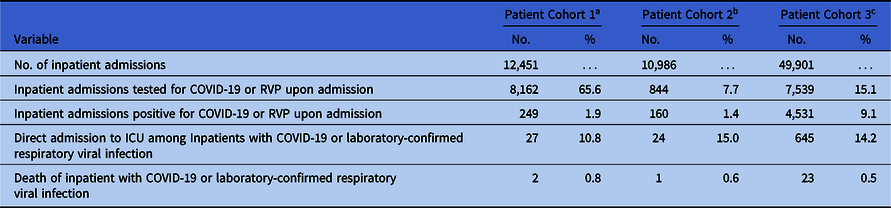
In total, 37,054 SARS-COV-2 PCR tests were performed on 26,922 patients between March 15 and December 31, 2020. Of 12,451 patients who were admitted, 8,162 (66%) were tested for SARS-COV-2 and 249 (2.0%) were positive. These patients who tested positive for SARS-COV-2 were 50.4% male and their average age was 6.2 years (range, 0.0–17.9).
Between April 1 and December 31, 2020, 1,822 respiratory viral tests were performed on 1,288 patients who presented at CNH with respiratory viral infection symptoms that warranted testing. The cohort included 720 males (56.0%), and the average age was 4.8 years (range, 0.0–17.9). Among 10,986 admissions during this study period, 844 patients (8%) had a respiratory viral test within 48 hours of admission, and 160 were positive for 1 or more common seasonal respiratory viruses. In this cohort, 1.5% of patient admissions were associated with a laboratory-confirmed respiratory viral infection.
During the respiratory viral seasons between October 1, 2015, and March 31, 2020, 11,205 patients had a total of 16,239 respiratory viral tests performed at CNH. The cohort included 6,152 (54.9%) males and the average age was 4.2 years (range, 0–18.0 years). Of the 49,901 patient admissions during this study period, 7,539 (15%) were tested for seasonal respiratory viruses within 48 hours of admission, and 4,531 tested positive for at least 1 seasonal respiratory virus. In this cohort, 9.0% of patient admissions were associated with a laboratory-confirmed respiratory viral infection.
Description of viruses detected among admitted patients
Of patients who were admitted with a laboratory-confirmed respiratory viral infection, hHRV/rENT was the most detected virus with an overall positive rate of 29.4%, followed by RSV with a positive rate of 19.4% and influenza with a positive rate of 7.8% (Table 1).
Common Seasonal Respiratory Viruses Detected in Patients at the Time of Admission

a April 1–December 31, 2020.
b Respiratory viral seasons between October 2015 and March 2020.
Compared with patients in cohort 3, patients in cohort 2 had a substantially lower viral detection rate of hHRV/rENT and adenovirus. When the study ended on December 31, 2020, no RSV, influenza, hMPV, hPIV, and common hCoV had been detected at the time of patient admission after March 27, March 21, April 29, and April 21, 2020, respectively.
Comparison of patient outcomes by patient cohort
Of the 249 patients with a laboratory-confirmed COVID-19 infection, 27 (10.8%) were admitted directly to the ICU (Table 2). In contrast, 15.0% and 14.2% of patients with a laboratory-confirmed respiratory viral infection caused by 1 or more common seasonal respiratory viruses were admitted directly to an ICU in cohort 2 and cohort 3, respectively. There was no statistically significant difference in the percentage of patients requiring ICU care at the time of admission among the 3 cohorts. Upon discharge, 2 patients (0.8%) with COVID-19 died, in contrast to 1 patient (0.6%) among patients in cohort 2 and 23 patients (0.5%) in cohort 3, respectively. The death rates in these 3 patient cohorts were comparable.
Patients Admitted with a Laboratory-confirmed Respiratory Viral Infection or COVID-19

Note. RVP, respiratory viral panel.
a Patients with COVID-19.
b Patients with seasonal respiratory viral infection, April–December 2020.
c Patients with seasonal respiratory viral infection, October 2015–March 2020.
Furthermore, we compared virus-specific percentages of direct admission to ICU and found that hHRV/rENT had the highest percentage (19%), followed by RSV (17%) and common hCoV (17%). Coinfection of 2 or more viruses was not associated with a higher percentage of ICU admissions (Table 3). In these hospitalized patients, adenovirus was associated with the highest death rate (2.1%), followed by hHRV/rENT (1.1%), common hCoV (0.8%), and influenza (0.6%) (Table 3).
Virus-specific Direct Admission to ICU and Mortality upon Discharge

Discussion
This retrospective, observational study included >55,000 pediatric patients aged <18 years who were admitted to the Children’s National Hospital during the 5 respiratory viral seasons preceding and during the COVID-19 pandemic in 2020. Moreover, 15% of patients presented with clinical signs and symptoms that warranted testing for the 8 common seasonal respiratory viruses at the time of admission, and up to 9% of hospital admissions were associated with a laboratory-confirmed respiratory viral infection. The vast majority of the testing (90%) occurred among patients who were admitted during a regular respiratory viral season before March 31, 2020. After the governments of the 3 jurisdictions surrounding CNH issued executive orders to enforce public health measures to control the COVID-19 pandemic, we observed an abrupt decline in patients with clinical symptoms that warranted laboratory testing for common seasonal respiratory viruses at the time of admission. Furthermore, <2% of admissions were associated with a laboratory-confirmed respiratory viral infection, in contrast to 9% during a regular respiratory viral season. Admissions for an infection caused by the RSV, influenza, hPIV, hMPV, and common hCoV were largely absent in children and young adults, with none detected at our institution for months.
Despite the mounting challenges during this COVID-19 pandemic, we are encouraged by the substantial decrease in seasonal respiratory viral infections observed in children, especially the severe forms that require hospitalization. Given that the decline of these infections in our patient population coincided with the adoption of COVID-19 public health measures that were enforced by mandatory administrative orders, it is reasonable to hypothesize that universal masking in shared spaces and social distancing in the form of school and daycare closures played major roles in the marked reduction of these viruses. Schools and daycare centers that remained open instituted additional measures such as proactive symptom screening at the point of entry and prompt isolation of children and staff with signs and symptoms suggestive of respiratory viral infections. Moreover, good hygiene practices such as frequent hand washing and surface disinfecting have been widely adopted by the general public. Before the COVID-19 pandemic, studies had demonstrated these physical interventions, when utilized alone or in combination, were highly effective to interrupt or reduce the spread of respiratory viruses in public settings and within households. Reference Jefferson, Del Mar and Dooley7 However, the adoption of these interventions for routine public health is hindered by perceived barriers such as disbelief about infection, rejection of personal risk of infection, concern about the potential costs, and importantly stigma associated with the intervention. Reference Teasdale, Santer, Geraghty, Little and Yardley8 During the COVID-19 pandemic and when these interventions were implemented by administrative mandate, our observational data support that they are highly effective in preventing these respiratory viral infections in children and young adults. Considering that children aged <10 years have been identified as the principal source of respiratory viral infections and asymptomatic children can spread the viruses to adults around them, Reference Galanti, Birger and Ud-Dean9–Reference Iwane, Edwards and Szilagyi11 sustaining low or zero incidences of seasonal respiratory virus in children benefits the general public at large. In light of these extraordinary benefits, which were incidentally achieved during the COVID-19 response, we urge the public and stakeholders to consider integrating some, if not all, of these physical interventions into routine operation. At the minimum, schools and daycare facilities should remain vigilant to proactive identify and exclude individuals with respiratory viral infection symptoms, masking in shared indoor spaces, accommodating social distancing during break or mealtime when mask must be removed, and providing sufficient products to promote frequent hand hygiene and surface disinfection practices.
Although a substantial decrease of patients with hHRV/rENT and adenovirus was observed after public health measures were broadly instituted, these 2 viruses have remained detectable among patients who require hospital admission, suggesting that additional preventive measures such as an effective vaccine may be needed to further prevent their spread and reduce disease severity.
Overall, the proportions of patients requiring ICU care at the time of admission and death at the time of discharge were similar among patients who were admitted with a laboratory-confirmed respiratory viral infection or COVID-19. The proportion of patients requiring ICU admission was highest in those with hHRV/rENT, whereas patients with adenovirus were associated with the highest proportion of death.
At the beginning of this unprecedented COVID-19 pandemic, children and young adults were less likely to be infected by the SARS-COV-2 virus and to suffer less severe infections if infected, compared to the adult population. As the COVID-19 pandemic progressed, children and young adults were recognized as the primary group that can develop a rare but serious COVID-19–related medical condition called multisystem inflammatory syndrome in children (MIS-C). As this pandemic continues to unfold, COVID-19 in children can continue evolving; thus, frequent assessments are required to fully understand its impact on this vulnerable patient population.
As a single-center study with information collected retrospectively from databases that are created for surveillance or administrative purposes, this study bears limitations inherent to the use of an administrative database. However, an administrative database is the most efficient approach for conducting cohort studies with an adequate sample size. Also, findings from this study may have been influenced by institutional protocols and may not represent general practice. Thirdly, we analyzed respiratory enterovirus and human rhinovirus as 1 group because the testing kits were unable to distinguish the 2 viruses accurately. Additional limitations may also include healthcare avoidance. The use of telehealth due to COVID-19 concerns may have led to a decrease in viral testing. Finally, bias may have been introduced by the selection of patients who received respiratory virus testing during a pandemic.
In summary, we have demonstrated that seasonal respiratory viral infections were associated with a higher proportion of inpatient admissions in pediatric patients compared to COVID-19. The public health measures implemented during the COVID-19 pandemic were highly effective in ceasing the transmission of RSV, influenza, hPIV, and hMPV. We detected no statistically significant difference among patients with seasonal respiratory viral infection or COVID-19 with regard to ICU admission and mortality at the time of discharge. Effective and feasible public health measures must remain in place in the postpandemic era to improve the health of children and the general public, to diminish the threat of a potential pandemic from other emerging or re-emerging respiratory viruses, and to maintain the orderly operation of society.
Acknowledgments
Financial support
No financial support was provided relevant to this article.
Conflicts of interest
All authors report no conflicts of interest relevant to this article.