BACKGROUND
Self harm is one of the complex issues faced by health care professionals in low secure unit settings. Previous studies have identified various clinical characteristics as possible factors associated with self harming behaviour in different psychiatric patient populations. However, there are relatively few studies which identify the clinical characteristics of self harming patients in inpatient psychiatric populations and there are no studies to date that specifically identify the clinical characteristics of patients who self harm while admitted to inpatient low secure settings.
In their study of self harm predictors of patients in a maximum security psychiatric unit in United States, Hillbrand et al. (1994) identified the following factors to be associated with self harming inpatients: younger age, a diagnosis of personality disorder or mental retardation, outwardly directed aggression (as measured by Overt Aggression Scale), treatment with higher doses of neuroleptics and having a civil or correctional status. A study of suicide and significant self harm incidents in psychiatric inpatients at 31 different mental health trusts across England found that the factors associated with 12 suicides and 19 cases of serious self harm were ‘being male, having a dual diagnosis of mental illness and drug and alcohol abuse, and age between 21 and 30 years’ (Gournay & Bowers, Reference Gournay and Bowers2000). Few case control studies (Hunt et al., Reference Hunt, Kapur, Webb, Robinson, Burns, Turnbull, Shaw and Appleby2007; King et al., Reference King, Baldwin and Sinclair2001; Powell et al., Reference Powell, Geddes, Hawton, Deeks and Goldacre2000) have identified indicators of inpatient suicide in psychiatric patients. These have included: male gender, family history of suicide, admission under the Mental Health Act, involvement of the police during the admission, patients being absent from the ward without leave, a significant care professional being on leave, recent adverse life events, bereavement, previous deliberate self harm, previous planned suicide attempt, actual suicide attempt, violence towards property, symptoms of mental illness at last contact with staff, depressive symptoms, presence of delusions, chronic mental illness, affective disorder and co-morbid psychiatric disorder. In a prospective study, Myers (1982) suggested clinical characteristics such as female gender, patients aged below 35 and suicidal ideations at the time of or before the initial referral as factors associated with deliberate self harm. In a survey of incidents of suicide attempts specifically by incineration in psychiatric inpatients in an inner London hospital over a 9 year period, Jacobson et al. (1986) found that younger age, greater psychiatric morbidity, absence of alcoholism, history of childhood arson and past and current self-burning were features specific to self-incineration.
There are studies with different methodologies looking at factors associated with self harm in different patient populations other than psychiatric inpatients. Some of the identified factors in patients presenting to accident and emergency departments include previous self-harm, previous psychiatric treatment, employment status, marital status and white ethnic group (Johnston et al., Reference Johnston, Cooper, Webb and Kapur2006). Risk factors for self harm identified in the prison psychiatric populations include young age, drug abuse, significant background of maltreatment and presence of borderline, passive aggressive and antisocial personality disorder (Young et al., Reference Young, Justice and Erdberg2006; Mohino et al., Reference Mohino, Ortega-Monasterio, Planchat, Cuquerella, Talón and Macho2004). With regard to specific diagnostic groups, risk factors for self harm in patients suffering from schizophrenia include past or recent suicidal ideation, previous deliberate self harm, past depressive episode, drug abuse or dependence and higher mean number of psychiatric admissions (Haw et al., Reference Haw, Hawton, Sutton, Sinclair and Deeks2005) and for those suffering from bipolar disorder include family history of suicide, early onset of the disorder, extent of depressive symptoms, increasing severity of affective episodes, the presence of mixed affective states, rapid cycling, comorbid axis I disorders and abuse of alcohol or drugs (Hawton et al., Reference Hawton, Sutton, Haw, Sinclair and Harriss2005). Morgan et al. (1976) highlighted clinical factors such as previous psychiatric treatment, previous act of deliberate self harm and having a criminal record as factors associated with repetition of self harm.
AIMS
The aims of this study were:
(1) To describe the methods of self harm incidents in a low secure unit population
(2) To identify and compare the clinical characteristics of patients displaying inpatient self harming behaviours with those who do not display such behaviours in this population.
METHOD
Study setting
The study data was collected from a low secure unit inpatient population derived from a multiethnic London catchment area. The unit where the study was carried out admits patients between the ages of 16 and 65 presenting with mental illnesses and severe challenging behaviours which have been of longer than six months duration and not manageable in an open setting. Most admissions are from the general adult psychiatric services. Patients are primarily referred from the general adult inpatient unit when aggression is causing difficulties in management, or from intensive care psychiatric settings when a longer period of treatment in a secure setting is needed. However, due to the complex nature of this patient group, a notable proportion of patients also tend to present with self harming behaviours.
Study design and data collection
A retrospective case control study was designed. All patients admitted to the unit during a 6½ year period between January 1997 and June 2003 were included in the study. Demographic and clinical variables identified as relevant to the study aims were extracted from an electronic patient record database maintained by one of the authors as a part of the unit’s service evaluation. The demographic and clinical characteristics collected included: age (≤ or > 35 years), gender, ethnic group (white versus others), employment status (employed versus unemployed), marital status (single versus non single), referral source (forensic versus non forensic), mental health act detention status (civil versus criminal sections), admission from locked or unlocked unit, history of aggression, history of non compliance, history of sexually inappropriate behaviour, history of fire-setting, history of self harm, history of absconding, history of abuse (physical or sexual), history of childhood conduct problems, history of receiving educational qualifications, history of previous psychiatric admissions, forensic history, whether the patient was a smoker or not, clinical diagnosis, substance misuse history (alcohol or drugs), psychotic symptoms, delusions of control and persecution, auditory hallucinations and insight to illness. The ethnic data were grouped into white versus others due to the small sample size when the ethnic minority groups were categorised. With regards to the marital status, those single, separated or divorced were grouped as single and those married or with a partner were grouped as non single.
Incident reports made by the unit in the study period and an additional six months until January 2004, pertaining to the patients in the study period, were extracted from an incident database maintained as a part of the hospital trust policy. For the critical incidents, an additional six months was included to assess for any critical incidents resulting from patients admitted towards the end of the study period. All incidents classed as self harm incidents in the incident reports from the database were scrutinised for details of the method of self harm. Those patients from the study period who had contributed to the self harm incidents were considered as cases (self harming inpatients) and those who did not were considered as controls (non self harming inpatients). The demographic and clinical characteristics of these two groups were compared.
Statistical analysis
Percentage frequencies of different methods of self harm were calculated. Demographic and clinical characteristics of the self harming and non self harming inpatients were compared in numbers and percentages. Two tailed Fisher’s exact tests were conducted to test for statistical significance of the differences observed between the two groups. Odds ratios (OR) and 95% confidence intervals (CI) for the observed differences were calculated.
Ethical approval
The proposal of this study was submitted to the Bexley Local Research Ethics Committee. As the data collection was anonymous and collected as a part of service evaluation, the ethics committee did not deem it necessary to give permission.
RESULTS
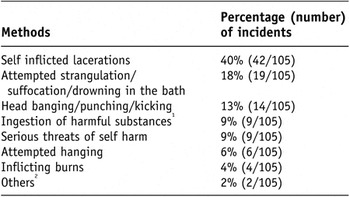
The total sample size for the 6½ year study period was 78 patients. 21% (16/78) of patients self harmed as an inpatient and 79% (62/78) did not self harm. A total of 105 self harm incidents were reported from the 16 patients (8 males and 8 females). Of the 105 incidents, 48 involved female patients and 57 involved male patients. Of note, 57% (60/105) of the incidents were caused by 13% (2/16; one male and one female) of patients. The different methods of self harm and their frequencies are presented in Table 1.
Methods of self harm

1 E.g. overdose on tablets, washing liquid
2 Incidents mentioned as self harm but not descriptive
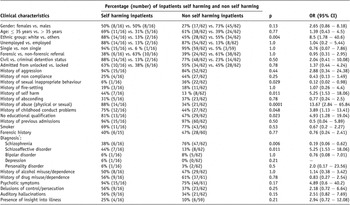
Comparison of the clinical characteristics of the self harming and non self harming inpatients resulted in a number of observations which were statistically significant. The self harming inpatients were more likely to be of white ethnic origin (p = 0.004, OR = 8.5, 95% CI 1.78–40.6). They were also more likely to have histories of self harm (p = 0.011, OR = 5.25, 95% CI 1.53–18.06), physical or sexual abuse (p = 0.0001, OR = 13.67, 95% CI 2.84–65.84), childhood conduct problems (p = 0.048, OR = 3.89, 95% CI 1.13–13.41), no educational qualifications (p = 0.023, OR = 4.93, 95% CI 1.28–19.04) and a diagnosis of schizoaffective disorder (p = 0.011, OR = 5.25, 95% CI 1.53–18.06). On the other hand they were less likely to have a history of sexually inappropriate behaviour (p = 0.029, OR = 0.12, 95% CI 0.02–0.98) or a diagnosis of schizophrenia (p = 0.006, OR = 0.19, 95% CI 0.06–0.62). While some differences were observed in other clinical characteristics these observations were not statistically significant. The full results are presented in Table 2.
Clinical characteristics of self harming (cases) and non self harming inpatients (controls)

1 Each diagnosis compared against others grouped together
DISCUSSION
It is worth noting that it is difficult to compare the results of this study with other studies as, to our knowledge, there are no studies exclusive to a low secure unit inpatient population with regard to self harming behaviour. In this study, it was observed that in a low secure setting the majority of self harm incidents were caused by a minority of patients. 2 out of the 16 patients (13%) who self harmed were responsible for a little over half of all the self harm incidents. This is a common clinical observation in such settings and has been reported in a previous study (Beer et al., Reference Beer, Khan and Ratnajothy2006). There was no specific gender preponderance and an equal number of males and females were responsible for the incidents. The most frequent method of self harm was self inflicted lacerations to body parts, mostly of a non serious nature, which amounted to 40% of all incidents. Other incidents of a lesser frequency included attempted strangulation, suffocation or drowning (18%), reckless behaviours such as head banging, punching and kicking objects to self harm (13%), taking overdoses (9%) and attempted hanging (6%). There were no incidents of suicide. All the attempted hanging incidents were caused by one female patient which ceased following the removal of ligature points.
Self harming inpatients were more likely to be of white ethnic origin (88%), an observation made by Johnston et al. (2006) in deliberate self harming patients presenting to accident and emergency departments. Previous history of self harm is a well known risk factor for future self harm in other psychiatric populations. The same finding was observed in this population with 44% of the self harming inpatients group having a previous history of self harm, compared with 13% of the non self harming group. Other factors more prevalent (and statistically significant) in the self harming group compared with the non self harming group included a history of physical or sexual abuse (88% versus 34%), childhood conduct problems (75% versus 43%) and lack of educational qualifications (81% versus 47%). Of these, women experiencing sexual abuse has been cited as a risk factor for deliberate self harm though a direct causal relationship has not yet been clearly established (Klonsky et al., Reference Klonsky and Moyer2008). The inpatient self harming group was less likely to have a diagnosis of schizophrenia and more likely to have a diagnosis of schizoaffective disorder. It is conceivable that those with schizophrenia had more negative symptoms which could account for the lower levels of self harm compared with those suffering from schizoaffective disorder.
Risk factors such as gender, unemployment, single status, substance misuse (alcohol and drugs), depression and personality disorder are known to be associated with deliberate self harm (Wessely et al., Reference Wessely, Akhurst, Brown and Moss1996) but the differences observed in this study were not statistically significant. Patients with personality disorder who display self harming behaviours may present with fewer of these behaviours in contained environments such as secure units. The lack of statistically significant results may also be a reflection of the limited sample size with inadequate power to detect differences. Further, this is a highly selective population unlike other psychiatric population groups studied where the aforementioned risk factors have been established. Nevertheless, it is reasonable to expect a number of these risk factors to overlap between the different psychiatric patient groups.
Limitations
Elaborate descriptions of the methods of self harm were not available from the database due to the retrospective nature of this study. During the study period the trust incident database did not include the level of seriousness of the incidents. Each reported incident was therefore considered as one incident without taking the severity into consideration. A larger sample size would have been preferable yet significant results were noted with this sample. Most of the clinical characteristics considered were historical factors. It would be useful to consider dynamic clinical factors during the incident of self harm (e.g. presence or absence of depressive symptoms, substance misuse and similar factors).
CONCLUSION
In a low secure inpatient setting self inflicted lacerations are the most frequent method of self harm. The majority of self harm incidents are caused by a minority of patients. Clinical characteristics such as white ethnic background, history of self harm, history of physical or sexual abuse, history of childhood conduct problems, lack of educational qualifications and having a diagnosis of schizoaffective disorder are more likely to be present and associated with those patients who display self harming behaviour in low secure inpatient settings. On the other hand sexually inappropriate behaviour and a diagnosis of schizophrenia are less likely to be present in this group. A prospective study with a larger sample size addressing the methodological limitations mentioned is likely to provide a better understanding of the risk factors of inpatient self harm in this population.
Declaration of interests: None.