As organizations are under increased pressure to focus on their customers, effective customer-relationship management has become a subject of keen interest to practitioners and scholars (Gulati & Oldroyd, Reference Gulati and Oldroyd2005). Researchers have suggested that one key factor to success in customer-relationship management is the quality of service provided by frontline workers (Miciak & Desmarais, Reference Miciak and Desmarais2001). Frontline workers are employees who interact directly with the customer in a variety of organizational functions. Customers often build a sense of satisfaction and loyalty on the basis of the quality of their interactions with frontline workers. The literature has emphasized the role of frontline workers’ attitudes and behaviors on customer satisfaction and service quality (e.g., Podsakoff & Mackenzie, Reference Podsakoff and Mackenzie1994; Dean, Reference Dean2004; Slåtten & Mehmetoglu, Reference Slåtten and Mehmetoglu2011).
An important trend regarding frontline workers is that many organizations increasingly outsource frontline workers’ responsibilities to various types of partner organizations, even those located in foreign countries (e.g., India and China). Naturally, a growing portion of frontline workers representing telecommunications companies are likely to be the employees of partner organizations, as many telecommunications companies may not consider some frontline functions as their core business functions. This is also true in Korea. For example, a previously government-owned telecommunications company outsourced a number of non-core business functions, including call center operations and telephone installations. Through outsourcing, it reduced its payroll by 15,000 from 1998 to 2001 (Jung, Reference Jung2001).
While outsourcing is commonly associated with cost-related benefits, it can also pose substantial risk. The foremost potential problem with outsourcing is related to the fact that frontline workers are those who project a company's attitude toward customers via their work behavior. Accordingly, if an organization wants to build positive customer relationships, it needs to evaluate carefully whether the values of the customer are being recognized and reinforced, not only within their own organizations but also within their partner organizations (Prahalad & Ramaswamy, Reference Prahalad and Ramaswamy2000). The organizations’ outsourcing frontline functions must make sure that the outsourced functions show an equivalent or higher level of customer satisfaction unless the money saved through outsourcing more than offsets the lower customer satisfaction. With a trend toward outsourcing and its implications, the present study aims to examine the implications of outsourcing frontline functions in terms of customer orientation using data from a Korean telecommunications company and its partners. More specifically, we attempt to determine whether outsourced frontline functions show the same or higher levels of customer-oriented behaviors. Then, we investigated a couple of potential antecedents of customer-oriented behaviors. Finally, we examined whether the antecedents can explain the differences, if any, in customer-oriented behaviors. This paper first reviews the relevant literature in related disciplines and subsequently develops a number of hypotheses. This is followed by a discussion of the methodology, data analyses, and conclusion.
LITERATURE REVIEW AND HYPOTHESES
Customer-oriented behavior
Saxe and Weitz (Reference Saxe and Weitz1982) defined customer-oriented selling behavior as the selling behavior in which salespeople try to help their customers to make purchase decisions to satisfy the customers’ long-term needs. According to Saxe and Weitz, customer-oriented selling behavior may be characterized as helping customers to assess their needs, offering products that will satisfy customers’ needs, describing the products accurately, and avoiding the deceptive influence tactics or use of high pressureFootnote 1. The working behaviors of frontline workers can also be categorized into long-term relationship-building customer-oriented behaviors versus short-term cost-saving or revenue-generating behaviors with less regard for relationship building. In the current study, as we are interested in expanding the concept of customer-oriented selling behaviors to various types of frontline functions, we will use the term ‘customer-oriented behavior’ rather than customer-oriented selling behavior.
Studies on customer-oriented behavior have received a significant amount of attention from researchers owing to the expected long-term positive organizational outcomes. A number of studies have indicated that customer-oriented behavior is related to higher performance (e.g., Keillor, Parker, & Pettijohn, Reference Keillor, Parker and Pettijohn2000; Román, Ruiz, & Munuera, Reference Román, Ruiz and Munuera2002; Liaw, Chi, & Chuang, Reference Liaw, Chi and Chuang2010), buyer–seller relationships (Williams & Attaway, Reference Williams and Attaway1996), customer satisfaction (Goff, Boles, Bellenger, & Stojack, Reference Goff, Boles, Bellenger and Stojack1997), and customer's trust in the salesperson (Wray, Palmer, & Bejou, Reference Wray, Palmer and Bejou1994). A study on 1,305 salespeople from a commercial firm distinguished customer-oriented behavior from customer-oriented attitudes, and showed that customer satisfaction is related to both a customer-oriented attitude and customer-oriented behavior (Stock & Hoyer, Reference Stock and Hoyer2005). A recent firm-level study by Kilic and Dursun (Reference Kilic and Dursun2007) examined the antecedents and consequences of customer orientation with 189 marketers from a broad range of businesses, and showed that the level of customer orientation is positively related to two outcomes including buyer–seller relationships and performance. A business unit-level study also showed a positive relationship between customer orientation and financial performance indirectly through market performance (Zhu & Nakata, Reference Zhu and Nakata2007). Meanwhile, Karatepe, Yavas, and Babakus (Reference Karatepe, Yavas and Babakus2007) also examined frontline hotel employees in Turkey and identified that customer orientation and job resources (supervisory support, training, empowerment, and rewards) enhance job satisfaction and effective organizational commitment, although diminishing their turnover intention. They also showed the importance of customer orientation.
Outsourcing and customer-oriented behavior
Le Bon and Hughes (Reference Le Bon and Hughes2009) provided three categories as a rationale for outsourcing decisions including ‘anticipated cost savings, attempt to improve quality or expand services through contracted expertize, and a desire to focus internal resources on core competencies’ (p. 404). Of them, cost saving appears to be the dominant rationale considering that a consulting company's survey results indicated that 70% of the companies cited cost saving as a key cause for outsourcing (Deloitte Consulting, 2005). However, outsourcing frontline functions may cause unexpected or unanticipated costs because of the poor service by outsourced customer service representatives.
The agency theory may explain the lower level of customer service by partner organizations. According to the agency theory, there is a principal–agent relationship whenever one party (the principal) compensates another party (the agent) for performing some action(s) on the principal's behalf (Jensen & Meckling, Reference Jensen and Meckling1976). As the two parties often do not share the same goals and both parties are assumed to be motivated by self-interest, principal–agent problems can arise. That is, the agent may act opportunistically in the absence of appropriate controls and behave in a manner inconsistent with the principal's best interests.
On the basis of the agency theory, we posit that a principal company that relies on its partner companies to provide part of its customer-interacting functions (e.g., customer service, maintenance, sales, or others) is likely to experience agency problems. The agency problem may lead to a lower level of customer-oriented behavior among the frontline workers of partner organizations compared with their principal organizations. We can imagine that there exists a fictional principal organization that believes in the importance of long-term customer relationship building. This organization may want to adopt the management practices that promote customer-oriented behavior in its frontline employees. For example, a call center of a principal telecommunications company may want to use customer-oriented performance criteria such as ease of contact and customer satisfaction ratings to evaluate the performance of its call center employees. Meanwhile, customer-oriented management practices may be more costly or difficult to implement. Thus, the subcontractors and partner organizations of the principal company may have different priorities such as efficiency of the operation or more profits for themselves, instead of long-term customer relationship building; as such, they use different types of performance criteria such as talk time and calls per hour. For example, a study on Indian call centers, a fast growing group of subcontractors, indicated that the call centers tend not to measure customer-oriented behavior when assessing service performance. Instead, they depend too much on the operational measures such as queue time, average talk time, agent turnover, and adherence (Jaiswal, Reference Jaiswal2008). It is also acknowledged that the operational measures of customer service assessment do not actually represent customers’ perceptions of service quality (Jaiswal, Reference Jaiswal2008). The use of performance variables with no or little relationship with the customer's perception of service quality is not likely to improve the frontline workers’ customer-oriented behavior. Although many principal organizations may also disregard customer orientation in the assessment of service performance, there may be some differences in performance measures between the principal and partner organizations. Different organizational goals and management practices of a principal organization and a partner organization are likely to result in different levels of customer orientation between the two groups of frontline workers.
Antecedents of customer-orientation gap
If there is a significant difference between the employees of principal organizations and partner organizations on the level of frontline workers’ customer-oriented behavior, it is important to identify the antecedents of the difference to remedy the situation. Numerous variables have been examined as antecedents of customer-oriented behavior, such as job satisfaction, work involvement, organizational commitment (e.g., Hoffman & Ingram, Reference Hoffman and Ingram1992; MacKenzie, Podsakoff, & Ahearne, Reference MacKenzie, Podsakoff and Ahearne1998; Pettijohn, Pettijohn, & Taylor, Reference Pettijohn, Pettijohn and Taylor2002), and organizational climate and culture (Williams & Attaway, Reference Williams and Attaway1996; Boles, Babin, Brashear, & Brooks, Reference Boles, Babin, Brashear and Brooks2001).
In the present study, we chose to investigate two potential antecedents that are more specifically targeted toward customer-oriented behavior than other general antecedents of customer orientation: training in customer orientation and the immediate supervisor's level of customer orientation. The two variables were chosen because, owing to their specificity, it would be easier to design and implement organizational interventions that can affect them. Training programs that focus on customer orientation provide not only relevant skills but also a signal to its employees that the organization values customer orientation (Pettijohn, Pettijohn, & Parker, Reference Pettijohn, Pettijohn and Parker1997; Pettijohn, Pettijohn, & Taylor, Reference Pettijohn, Pettijohn and Taylor2002). Thus, frontline workers who are provided with a number of customer-orientation training are likely to show more customer-oriented behaviors, as they are aware of the organization's expectations.
Meanwhile, an immediate supervisor generally has considerable power to shape his/her subordinates' attitudes and behaviors, and research evidence has supported the role of immediate supervisors on subordinates' customer orientation (e.g., Hartline, Maxham, & McKee, Reference Hartline, Maxham and McKee2000; Peccei & Rosenthal, Reference Peccei and Rosenthal2000; Jones, Busch, & Dacin, Reference Jones, Busch and Dacin2003). For example, Peccei and Rosenthal (Reference Peccei and Rosenthal2000) emphasized the role of managers in instilling and strengthening frontline workers' service attitudes and values to promote employees' customer orientation. In a similar vein, leadership studies also showed the influence of leaders on subordinates' customer orientation. For example, González and Garazo (Reference González and Garazo2006) examined the influence of organizational service orientation on frontline workers' job satisfaction and citizenship behavior, and incorporated servant leadership, human resources management practices, and service encounter practices as aspects of the organizational service orientation. They found a direct relationship between service communicative leadership and employee organizational citizenship behavior among frontline workers in the hospitality industry. Another study examined the role of transformational leadership on customer orientation and found perceived supervisor's support to be a mediator between transformational leadership and customer orientation (Liaw, Chi, & Chuang, Reference Liaw, Chi and Chuang2010). In sum, the immediate supervisor could influence on subordinates' customer orientation by providing direct and indirect feedback or being a role model to his/her subordinates.
Both customer-orientation training and immediate supervisor's customer orientation may foster customer-oriented organizational climate for frontline workers. For example, a study on the telecommunications sector examined the influence of organizational climate perceptions on frontline workers’ customer orientation and found an indirect relationship through perceived role conflict (Coelho, Augusto, Coelho, & Sá, Reference Coelho, Augusto, Coelho and Sá2010). Coelho and his colleagues conceptualized ‘customer climate’ as ‘the employee perceptions of the extent to which the firm is oriented towards customer’ (p. 1346) and assumed positive relationships between customer climate and employee's customer-oriented behaviors, including being honest, trust-building behavior, and being responsive to customer desires (Coelho et al., Reference Coelho, Augusto, Coelho and Sá2010). Various research studies have supported the roles of training in customer orientation and immediate supervisor's customer orientation on frontline workers’ customer orientation, although explanations for the relationships did not always coincide.
On the basis of this conceptual and empirical evidence, we hypothesize customer-orientation training and the immediate supervisor's customer orientation as possible antecedents of frontline workers’ customer-oriented behaviors. Moreover, we expect that training in customer orientation and the customer orientation of employees’ immediate supervisor not only predict the customer-oriented behavior level of frontline worker, but also account for the gap between the principal organization and the partner organization regarding the level of customer-orientated behaviors among frontline workers. That is, we hypothesize that once we control for these two variables, the difference between the levels of customer orientation of the frontline workers of the principal organization and its partner organizations will disappear. The hypothesized model is presented in Figure 1.
Hypothesized model

Specifically, we test the following hypotheses:
Hypothesis 1 : Frontline workers who are employees of a partner company show a lower level of customer-oriented behavior than those who are employees of a principal organization.
Hypothesis 2 : The more an immediate supervisor shows customer orientation, the more likely the frontline workers are to show customer-oriented behaviors.
Hypothesis 3 : The more an organization provides customer-orientation training, the more likely the frontline workers are to show customer-oriented behaviors.
Hypothesis 4 : The group difference in the level of customer-oriented behaviors between a principal organization's frontline workers and partner organization's frontline workers becomes non-significant if employees’ immediate supervisors’ levels of customer orientation and customer-orientation training are controlled for.
METHODS
Participants and procedures
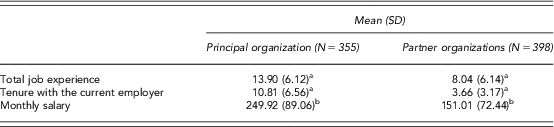
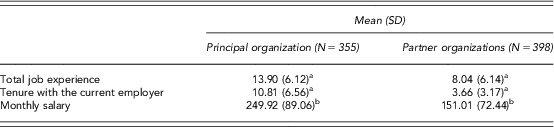
The principal telecommunications company has four categories of collaborative partners: infrastructure construction, suppliers, external distribution network, and network installation/repair. The partner organizations in the external distribution network and network installation/repair categories perform frontline functions on behalf of the principal organization. The participants in this study were 753 frontline workers employed by a leading South Korean telecommunications company and its partner organizationsFootnote 2. A group of trained survey administrators from a marketing survey company visited the respondents’ organizations and asked the participants to fill out a questionnaire. The major functions performed by the participants from the principal organization (n = 355) included customer service, sales, and/or repairs, whereas the major functions of those from the partner organizations (n = 398) were customer service, telephone and internet installation, and/or retail sales. Of the respondents, 32.1% in the principal telecommunications company and 54.3% in the partner organizations were female. On average, the respondents of the principal telecommunications company had more overall job experience and more tenure with the current employer and received higher salaries compared with those of the partner organizations (Table 1).
Characteristics of the respondents of the principal and partner organizations
Note. aYears.
bIn tens of thousands of Korean Won.
Measures
Customer-oriented behavior
Saxe and Weitz's (Reference Saxe and Weitz1982) Selling Orientation–Customer Orientation scale was translated into Korean and used to measure frontline workers’ levels of customer orientation. The Selling Orientation–Customer Orientation scale has 12 selling orientation items and 12 customer orientation items. The current study incorporated only the 12 items that measure customer orientation. The Cronbach's α of the 12-item scale was 0.95.
Immediate supervisor's customer orientation
Five questionnaire items were developed to measure how respondents perceived their immediate supervisors’ level of customer orientation. An example of these items required participants to respond on a 7-point Likert scale to the statement, ‘My supervisor often personally mentions the importance of customers.’ The Cronbach's α of this 5-item scale was 0.94.
Training on customer orientation
Two questionnaire items were developed to measure an organization's efforts to provide training in customer orientation. One item was ‘the company often provides training on the importance of customer orientation’, and the other item was ‘the company often provides training on how to serve customers.’ Participants responded to a 7-point Likert scale. The Cronbach's α of this 2-item scale was 0.94.
Control variable
Participants’ job experience levels were incorporated as a control variable. The participants who worked at the principal and partner organizations showed different levels of job experience.
Data analysis
The present analyses are based on the structural equation modeling using LISREL 8.50 (Jöreskog & Sörbom, Reference Jöreskog and Sörbom2001). To test our hypotheses, a series of alternative models were fitted to the covariance matrices and means. We describe each model in the results section in detail. To assess the adequacy of the overall fit of each model, we examined multiple overall fit indices, including the χ2-test statistic, comparative fit index (CFI; Bentler, Reference Bentler1990), root mean squared error of approximation (RMSEA; Steiger & Lind, Reference Steiger and Lind1980), and standardized root mean square residual (SRMR). The χ2 difference tests were used to compare the fit of the nested models.
For the customer-orientation construct, we used parcel scores rather than individual item scores as indicators of the customer-orientation factor. Although there is some disagreement in the literature concerning the appropriateness of using parcels, the use of parcels of items is often preferred to the use of individual items, especially when the number of items is fairly large (e.g., Gribbons & Hocevar, Reference Gribbons and Hocevar1998; Bandalos, Reference Bandalos2002; Coffman & MacCallum, Reference Coffman and MacCallum2005; Sass & Smith, Reference Sass and Smith2006). To construct the parcels, the 12 customer-orientation scale items were randomly assigned to one of four parcels, and each parcel score was set as the average of three items in each parcel.
Before the hypothesis test, we checked the normality of each of the measured variables in the models using a skewness and kurtosis index using SAS 9.2. Most of the skewness and Kurtosis indexes were close to zero, with a mean of −0.66 (SD = 0.45, maximum absolute value = 1.17) for skewness and a mean of 0.38 (SD = 0.67, maximum absolute value = 1.81) for kurtosis. The statistics suggest that the distribution of each variable is close to normal distribution.
RESULTS
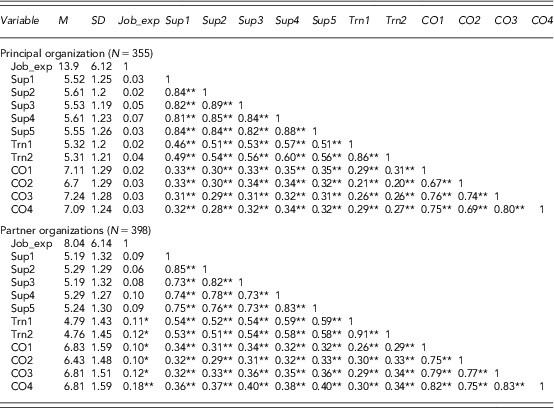
Table 2 shows the means, standard deviationsand zero-order correlations between the indicators used for structural equation modeling for the respondents from the principal organization and those from the partner organizations, respectively. Although job experience was not a variable of interest in the current study, it was included in the models as a control variable because there was a significant difference in the job experience levels between the principal and the partner organizationsFootnote 3.
Means, standard deviation and intercorrelations of the observed variables
Note. *p < .05; **p < .01.
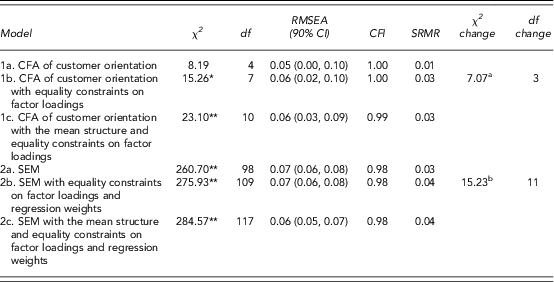
Hypothesis 1 addresses whether the frontline workers of the principal company show a higher level of customer-oriented behaviors compared with those of the partner organizations. For such a comparison between different groups, it is critical to establish measurement equivalence of the constructs across the groups under comparison (Reise, Widaman, & Pugh, Reference Reise, Widaman and Pugh1993; Vandenberg & Lance, Reference Vandenberg and Lance2000). To evaluate the measurement invariance, we first fitted two confirmatory factor models of one-factor customer-oriented behaviors, one with no equality constraint between the two groups (Model 1a) and the other with equality constraints on the factor loadings (Model 1b). The overall fit indices in Table 3 suggest that both Model 1a χ2 (4) = 8.19 (CFI = 1.00, SRMR = 0.01, RMSEA = 0.05) and Model 1b, χ2 (7) = 15.26 (CFI = 1.00, SRMR = 0.03, RMSEA = 0.06) fit the data well. The χ2-difference test between Models 1a 1b was only marginally significant, Δχ2 (3) = 7.07 (p < .10). The results indicated that, although the overall fit of the model with the equality constraints (Model 1b) decreased relative to the model without the constraint (Model 1a), this decrement was only marginally significant, and Model 1b still fits the data quite well. Thus, it was deemed acceptable to consider that the construct of customer-oriented behaviors is comparable between the two groups.
Fit statistics and model comparisons
Note. aChange from Model 1a.
bChange from Model 2a.
*p < .05; **p < .01.
Once we established the measurement invariance of the customer-orientation scale between the two groups, the next step was to compare the levels of customer-oriented behaviors between the employees of the principal organization and those of the partner organizations. For this purpose, we constructed Model 1c by introducing the mean structure to Model 1b. In Model 1c, the mean of the customer-oriented behaviors of the partner organizations was fixed to zero and the mean of the principal organization was freely estimated. The estimate of the mean of the principal organization's customer-oriented behaviors was 0.33 and was significantly different from zero (SE = 0.09, p < .01). This result suggests that the mean of the customer-oriented behaviors of the principal organization is significantly higher compared with that of the partner organizations. Accordingly, Hypothesis 1 was supported.
Hypotheses 2–4 address whether the antecedents of interest explain the differences in the levels of customer-oriented behaviors across the groups. To test the hypotheses, we first fitted Models 2a and 2b. Both the models have three antecedents of customer-oriented behaviors: the supervisor's customer orientation, customer-orientation training, and total job experience. The difference between the models is that Model 2b has equality constraints on all of the factor loadings of the antecedents and customer-oriented behaviors and on the paths from all three of the antecedents to customer-oriented behaviors, whereas Model 2a does not have any equality constraints. If the fit of Model 2b is not significantly worse than that of Model 2a, it means that all of the constructs in the model have measurement invariance across the two groups and the relationship between each of the antecedents and customer-oriented behaviors is identical across the two groups. The equality of the regression weights of the three predictors of customer-oriented behaviors is important because when the regression weights are considered to be identical between the two groups, the intercept of the customer-oriented behaviors factor can be interpreted as the group difference concerning customer-oriented behaviors when supervisor's level of customer orientation, customer-orientation training, and total job experience are controlled for.
Both Model 2a, χ2 (98) = 260.70 (CFI = 0.98, SRMR = 0.03, RMSEA = 0.07) and Model 2b, χ2 (109) = 275.93 (CFI = 0.98, SRMR = 0.04, RMSEA = 0.07) fit the data reasonably well. The χ2-difference test between Models 2a and 2b was not significant, Δχ2 (11) = 15.23 (p > .10), which indicates that the equality constraints on all of the factor loadings and path coefficients from the three antecedents to customer-oriented behaviors are acceptable for the data.
The unstandardized path coefficient estimates for Model 2b are presented in Figure 2. The factor loadings for all three factors were invariably high. Unstandardized path coefficient estimates from the immediate supervisor's level of customer orientation to frontline workers’ customer-oriented behaviors were 0.35 (SE = 0.05, p < .01). Thus, as expected from the Hypothesis 2, the results showed that the immediate supervisor's level of customer orientation had a significant positive effect on frontline workers’ customer-oriented behaviors in both groups. The training effect on customer-oriented behaviors was also significant in both groups, which supports the Hypothesis 3. In both groups, the unstandardized path coefficient estimates from training to customer-oriented behaviors was 0.14 (SE = 0.05, p < .01). Finally, total job experience, a control variable, was not significantly related to customer-oriented behaviors in both the organizations (unstandardized path coefficient of 0.01 with SE = 0.01, p > .10). Hypothesis 4 posited that the supervisor's levels of customer orientation and customer-orientation training can explain the difference between the principal organization's and the partner organizations’ levels of frontline workers’ customer-oriented behaviors. To test whether the intercept of customer-oriented behaviors is the same once the antecedents are included in the model, we fitted Model 2c, which includes the mean structures. If the intercept of customer-oriented behaviors is identical between the two groups in Model 2c, this means that the difference between the two groups’ levels of customer-oriented behaviors disappears once the antecedents are included in the model. In Model 2c, the intercept of customer-oriented behaviors and the means of all of the antecedents of the partner organizations were fixed to zero and those of the principal organization were estimated freely.
Unstandardized parameter estimates for Model 2b
Model 2c also fits the data reasonably well, χ2 (117) = 284.57 (CFI = 0.98, SRMR = 0.04, RMSEA = 0.06). The estimate of the intercept of the principal organization's customer-oriented behaviors was 0.07 and was not significantly different from zero (SE = 0.10, p > .10). This result suggests that the mean customer-oriented behaviors of the principal organization was not significantly higher compared with that of the partner organizations after controlling the supervisor's level of customer orientation, customer-orientation training, and total job experience. However, the means of the supervisor's levels of customer orientation (0.32, p < .01), training in customer orientation (0.54, p < .01), and job experience (5.85, p < .01) in the principal organization were significantly higher than the partner organizations. Accordingly, Hypothesis 4 was supported.
The hypotheses were also supported when we fit the same series of the models with only the supervisor's level of customer orientation and customer-orientation training, without total job experience. That is, the principal organizations’ customer-oriented behaviors were significantly higher than that of the partner organizations when there was no predictor, but the difference became non-significant when the two antecedents were included in the model.
DISCUSSION
The present data showed that the frontline workers of partner organizations have a significantly lower level of customer-oriented behaviors compared with that of the principal organization. A lower level of customer-oriented behaviors by the partner organizations is likely to be associated with a lower level of customer satisfaction with the principal organization, as the customers are likely to assume that the service was provided by the principal organization. A study conducted by Tompkins (Reference Tompkins2005) showed that 95% of those who reported a company's customer call center experience as negative perceived the company negatively as a result. The difference suggests that the principal organizations need to pay close attention to the customer-oriented behaviors of the frontline workers of partner organizations and to that of their own employees. To ensure an appropriate level of customer orientation among the outsourced frontline functions, principal organizations may need to make outsourcing decisions pertaining to the selecting and/or overseeing of partner organizations with extra caution.
In fact, a lower level of customer-oriented behaviors among partner organizations is not surprising, as many authors have warned that lack of customer-oriented behaviors is a possible hidden cost of outsourcing (e.g., Ross, Dalsace, & Anderson, Reference Ross, Dalsace and Anderson2005; Jennings, Reference Jennings2006; Le Bon & Hughes, Reference Le Bon and Hughes2009). However, some organizations make outsourcing decisions only on the basis of standard cost analysis ignoring other important factors such as differences in selling effectiveness between an in-house sales force and an outsourced sales force (Ross, Dalsace, & Anderson, Reference Ross, Dalsace and Anderson2005).
Thus, it has been suggested that organizations should be more cautious when they consider outsourcing frontline business functions. For example, a study conducted by Deloitte Consulting reported that 70% of principals had significantly negative experiences with outsourcing projects and tried to be more cautious in outsourcing some of their functions (Deloitte Consulting, 2005). The current finding confirms this concern and suggests that organizations should take ‘human issues’ into account when they make decisions about using outside partners to perform frontline workers’ functions.
Once an organization decides to outsource its frontline functions, it is critical to implement a system to ensure a high level of customer-oriented behaviors in the partner organizations’ employees. This study has identified two promising factors that enable us to explain and to close the gap between principal and partner organizations regarding the level of customer-oriented behaviors of frontline workers. One factor is the immediate supervisor's level of customer orientation and the other is customer-orientation training. Both of the variables are significantly related to frontline workers’ customer-oriented behaviors in both the principal organization and the partner organizations. Furthermore, the difference between frontline workers’ customer-oriented behaviors in the two groups, the principal organization outsourcing its frontline functions, and the partner organizations performing the frontline functions was significantly diminished once the variables were statistically controlled for.
The findings suggest that when organizations want to promote the level of customer-oriented behaviors of its frontline workers, placing customer-oriented immediate supervisors and providing customer-orientation training may be effective tools to use. In other words, outsourcing frontline functions to partner organizations with customer-oriented immediate supervisors and sufficient customer-orientation training could lead to higher level of customer-oriented behaviors. As González and Garazo (Reference González and Garazo2006) showed a direct relationship between service communicative leadership and frontline workers’ organizational citizenship behavior, immediate supervisors’ customer orientation appears to be related to frontline workers’ customer-oriented behaviors. A highly customer-oriented immediate supervisor may instill customer-oriented behaviors into frontline workers, and/or such a supervisor may serve as a role model for the frontline workers to emulate.
Meanwhile, organizations with customer-orientation training could promote the frontline workers’ learning of appropriate customer-oriented behaviors (Pettijohn, Pettijohn, & Parker, Reference Pettijohn, Pettijohn and Parker1997; Pettijohn, Pettijohn, & Taylor, Reference Pettijohn, Pettijohn and Taylor2002). Training in customer orientation also implies that the organization values long-term customer relationships over short-term gains from selling behaviors. In fact, immediate supervisor's customer orientation and customer-orientation training both demonstrate the partner organization's value system that emphasizes the importance of customer orientation on behalf of the principal organization. In contrast, Dean and Rainnie's (Reference Dean and Rainnie2009) study with a focus group showed that management's emphasis on sales is negatively associated with the service quality. It indicates that managements’ attitudes toward customers determine actual service behaviors of frontline workers.
LIMITATIONS AND FUTURE RESEARCH
When considering the findings of this study, several limitations should be considered. First, the sample of the study was limited to the frontline workers of a South Korean telecommunications company and its partner organizations. Thus, caution is warranted against generalizing the findings to other industries and/or cultures. In addition, readers should not conclude that all partner organizations necessarily have lower levels of customer-oriented behaviors compared with their principal organizations. Moderator variables, such as the principal organization–partner organization relationship and reward systems, should be further investigated. Nevertheless, the present findings do provide valuable evidence of and insight into the implications of outsourcing frontline functions. Further studies could seek additional empirical evidence from different cultures and industries with more comprehensive models.
Second, this study did not differentiate among frontline workers working in different business functions. Although various frontline worker functions share common characteristics, workers in different business functions may encounter different types of customers in different contexts. Future studies need to extend the current findings by examining a possible interaction effect between business functions and the types of organizations (i.e., principal vs. partner) on the level of customer-oriented behaviors. This line of research has the potential to provide valuable information regarding which frontline functions should be performed in-house and which are acceptable to outsource.
A third limitation is the possibility of common method bias, given that all variables were measured using self-report. As each variable had a differential pattern of correlation, this is an unlikely explanation for the observed results. Nonetheless, future studies could incorporate multiple raters such as supervisors, peers, customers, and/or self to measure customer-oriented behaviors and the antecedents of customer-oriented behaviors.
A fourth limitation is related to practitioners’ perspectives. Although the customer-oriented behavior level of a partner organization may be lower than that of a principal organization, the benefits of cost savings by outsourcing some of the frontline functions may exceed the cost of lower customer-oriented behaviors. Especially, when most companies in an industry outsource a similar level of frontline functions and considering that they all show lower levels of customer orientation when outsourcing frontline functions, competitive advantages or disadvantages are not likely to be found among the companies. Customers may have no choice but to endure a lower level of customer service. Future studies can incorporate utility analyses of outsourcing frontline functions.
In discussing the findings from this study and its limitations, a number of areas for future research were identified. Although the present study focused on the variables that are specifically related to customer-oriented behaviors, to improve the customer-oriented behaviors of frontline workers, more comprehensive measures may be needed. Future research should also investigate the roles of other types of antecedents of customer-oriented behaviors, such as other organizational practices, personality traits, job satisfaction, and/or levels of organizational commitment.
In conclusion, we believe that this study contributes to the understanding of the human side of the cost for outsourcing customer-related functions. Although the importance of frontline workers and their relationships with customers via customer-oriented behaviors have been emphasized in the fields of marketing and management, relatively few studies have provided an empirical evidence of the difference between a principal and its partner organizations. Our study showed the differences and potential antecedents for the differences between principal and partner organizations.
The present study also warrants a number of future studies on the issue of customer orientation between principal and partner organizations. Academic researchers need to develop and test more comprehensive models by identifying other antecedents and testing models in different industries and cultures. Potential antecedents may include quality of inter-organizational relationship between principal and partner organizations, reward structures, technology types, and/or industry differences.
Meanwhile, practitioners could analyze the utility of outsourcing frontline functions more thoroughly, thus helping to make the benefits greater than the costs of outsourcing frontline functions. Practitioners also need to ensure that the level of customer-oriented behaviors is not compromised by the frontline workers of the partner companies after outsourcing. Close monitoring of the partner companies’ level of customer orientation and cooperation in training programs for immediate supervisors and frontline workers could minimize the potential cost of outsourcing frontline functions.