


1. Introduction
Governments in large countries (which can influence world prices) may distort domestic environmental policy in the presence of transboundary pollution to reduce carbon leakage, which occurs when strict domestic pollution policy increases foreign emissions. Gürtzgen and Rauscher (Reference Gürtzgen and Rauscher2000) discuss different mechanisms through which carbon leakage can occur. We present another mechanism of leakage, even in closed or small open economies, due to the sequential order of setting environmental policies.
Most papers in the literature on trade and environmental policy focus on the policy choice of large countries in simultaneous-move games.Footnote 1, Footnote 2 However, it is well known that additional strategic considerations come into effect when policy is set sequentially. We consider environmental policy in neighboring countries that suffer from bilateral transboundary pollution. To focus on the effect of sequential policy setting on pollution policy in the presence of local and bilateral transboundary externality, we assume that neither country can influence world prices, i.e., they are closed or small open economies. The importance of the sequential nature of setting policy is clear from the ongoing debate on differences in environmental regulations between developed and developing countries. Within the context of our model, one can think of developed countries setting environmental policies, and only subsequently do the developing countries set their own policies. Our results, thus, provide some insights about possible outcomes when such countries set policies sequentially.
Bárcena-Ruiz (Reference Bárcena-Ruiz2006) analyzes first-mover advantages in setting environmental policy in the presence of imperfect competition when there is transboundary pollution between two large policy-active countries.Footnote 3 The ‘rent capture effect’ lowers pollution taxes in both countries; lowering pollution taxes provides an implicit subsidy to producers which is optimal under his imperfectly competitive framework. The ‘pollution shifting effect’, which works by increasing the price of the polluting good when either country increases its pollution tax, increases the tax rate; countries increase their domestic emission taxes to shift pollution to the other country.Footnote 4 Further, the ‘sequential setting effect’ increases taxes in both countries; in contrast, in our model, this effect lowers the tax in the leader and increases it in the follower. He finds that, when transboundary spillovers are low (high), the ‘pollution shifting effect’ (‘rent capture effect’) dominates and the leader sets a higher (lower) tax than the follower. Our analysis departs from the large country assumption of Bárcena-Ruiz; since the price of the pollution-intensive good is either given (for small open economies) or determined by conditions within the country (for closed economies), there is no ‘pollution shifting’ motive and countries cannot shift pollution overseas by strategically increasing their pollution taxes. Countries also have no incentives to distort environmental policy for terms of trade objectives. Furthermore, in our model, all sectors in both countries are perfectly competitive and there is no ‘rent capture’ motive. Hence, our results are driven purely by the transboundary pollution interaction and the sequential nature of the game.
MacKenzie (Reference MacKenzie2011) analyzes sequential announcement of internationally tradable pollution permit allocations when pollution is a pure global public bad. Aggregate permits, and hence pollution, are higher (lower) in the sequential game than in the simultaneous announcement game if announcements are strategic substitutes (complements). This paper complements MacKenzie as we analyze the effect of sequential setting of pollution taxes rather than internationally tradable emission quotas. Furthermore, we also consider situations in which pollution is not a pure global public bad and conditions under which the sequential nature of the game does not give rise to additional strategic effects.
In our setup, emissions in any country reduce welfare in both countries, i.e., there are both domestic and transboundary effects of pollution. One can think of this sort of local and bilateral transboundary pollution in terms of water bodies shared between countries.Footnote 5 Release of effluents in such waters by neighboring countries affects only these countries, resulting in bilateral transboundary pollution; such problems have been observed worldwide.Footnote 6
We find that when the only strategic interaction between countries is via transboundary pollutionFootnote 7 and policies are set simultaneously, there is no carbon leakage. But, in a sequential-move game, carbon leakage occurs even if neither country can influence world goods prices: if the leader sets a high pollution tax, it leads to higher emissions in the follower, which, in turn, reduces the leader's welfare via increased incidence of transboundary pollution; this lowers the leader's marginal benefit from regulating pollution. The leader's pollution tax is lower than that in the simultaneous-move equilibrium and lower than the marginal damage from own pollution. The only motive behind the leader's underregulation of pollution is to reduce the incidence of transboundary pollution from the follower, i.e., to reduce carbon leakage. Both the non-cooperative simultaneous and sequential taxes are lower than the Pareto efficient taxes.
If pollution is a pure global public bad, aggregate pollution is higher in the sequential-move game as compared to the simultaneous-move game. The leader's welfare is higher, while the follower's welfare is lower, than that under simultaneous moves. The leader, by strategically setting lower taxes, is able to lower emissions by the follower and attain higher welfare. Hence, in our setup, governments always prefer to be leaders in setting environmental policies.
We find that, if there is an increase in the ratio of marginal damage from transboundary pollution to that from domestic pollution, say, due to an increase in the degree of transboundary pollution spillover from the follower to the leader, the leader's ratio of emission tax to marginal damage from own emissions declines. The increased incidence of transboundary pollution from the follower increases the leader's incentive to underregulate own emissions to reduce the follower's emissions. Since our results are purely driven by the presence of bilateral transboundary pollution, if there is no transboundary pollution or if it is unidirectional, setting policies sequentially does not introduce any additional strategic effects, and the sequential- and simultaneous-move equilibria lead to the same outcome.
In the next section, we present the model, and derive efficient pollution taxes and non-cooperative taxes under simultaneous moves. Section 3 analyzes the sequential-move game and compares the outcomes to those in the simultaneous-move game; we also analyze the welfare implications of sequential moves and the choice between becoming a leader or a follower in setting environmental taxes. Section 4 concludes.
2. The model
We consider two neighboring countries, home and foreign countries (foreign variables are denoted using an *), affected by local and bilateral transboundary pollution. The rest of the world (assumed not to behave strategically) does not generate pollution that affects these countries, nor is it affected by pollution from the latter; pollution in water bodies shared between countries would be such a case. There are two goods (X, Y) that are produced under perfectly competitive conditions and consumed in these two countries.
Home and foreign feasible production sets are, respectively,

where z (z*) is home (foreign) emission and  is the home (foreign) country's factor endowment vector. This specification nests the case in which pollution is generated as a by-product of production of either or both goods.Footnote 8 It also allows for the possibility of abatement, substitutability between inputs and having polluting as well as non-polluting inputs.
Preferences of the representative agent in the home and foreign countries are, respectively,

where c x (c x*) and c y (c y*) denote consumption of X and Y in the home (foreign) country; ψ (.) and ψ* (.) are twice differentiable and concave. Pollution damage functions in both countries, ϕ (.) and ϕ* (.), are strictly convex in emissions, and the marginal damage in each country is increasing in emissions of either country. Hence, ϕz, ϕz*, ϕzz, ϕzz*, ϕz*z* > 0 and ϕz**, ϕz*, ϕz* z**, ϕzz**, ϕzz* > 0; α and β are shift parameters to be used later.Footnote 9 We use these shift parameters to analyze the effect of changes in pollution damage functions, say, due to changes in the degree of transboundary spillovers; hence,  may denote, for instance, the degree of spillover of foreign emissions into the home country. Furthermore, we assume that the marginal damage from own pollution is at least as high as that from transboundary pollution in both countries, i.e., ϕz ≥ ϕz* and ϕz** ≥ ϕz*. A pollution damage function, commonly used in the literature, that satisfies the above properties is ϕ (z, z*) = η (z + α z*)2, η > 0, α ≤ 1; α is the degree of transboundary pollution spillover.
Suppose that both countries use taxes on own emissions,  and
 , which are the only policy instruments available, to regulate pollution. Let Y be the numeraire good, i.e., set the price of Y, p y ≡ 1, and denote the price of X as p. The GNP functions for the home and foreign countries are,Footnote 10 respectively,

Home and foreign expenditure functions are,Footnote 11 respectively,

For more details on the dual general equilibrium approach,Footnote 12 see Dixit and Norman (Reference Dixit and Norman1980).
The budget constraints for the home and foreign countries are, respectively,

and

where we have assumed that all tax revenues are rebated back lump-sum to the consumers. Differentiating equation (1) with respect to  , we get the best response function of the home country as a function of the foreign country's taxFootnote 13:

The first term reflects the terms of trade effect; it depends on the relative pollution intensity of X and the trade pattern. The second term is the welfare effect of a change in  via a change in domestic emissions. The last term, the transboundary pollution effect, reflects the role of carbon leakage, which can occur through a change in the world price of the pollution-intensive good due to a change in the home country's pollution tax; this occurs if countries are economically interdependent and the world prices of goods are endogenous.Footnote 14 This can also occur if foreign pollution changes due to a change in marginal damage from own pollution in the foreign country as the home country's pollution tax changes. This latter channel is the only driving force in our model, as will be clear later. The foreign country's best response function as a function of the home country's tax is:

Assumption
Both home and foreign countries are small open economies and hence, 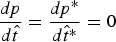 . Alternatively, both are closed economies and hence, R p = e p and R p** = e p**.
This implies that there is no terms of trade effect; thus, the only strategic interaction between countries is through transboundary pollution.Footnote 15 Equations (3) and (4) imply that, when pollution is purely local, i.e., there is no transboundary pollution, the optimal home and foreign taxes are, respectively,

i.e., each country sets its emission tax equal to its own marginal damage and this is Pareto efficient since there is no transboundary externality. Hereafter, we explicitly assume both local and transboundary pollution occur.
2.1. Pareto efficient taxes
The Pareto efficient pollution taxesFootnote 16 in the home and foreign countries are, respectively,

i.e., the efficient pollution tax equals the sum of marginal damages in the two countries. Hence, efficiency requires that countries internalize both the domestic and transboundary effects of their emissions. The cooperative solution with joint utility maximization (assuming transferable utility) is just one of the possible Pareto efficientFootnote 17 allocations.
2.2. Simultaneous-move pollution taxes
When countries set taxes simultaneously and non-cooperatively, since 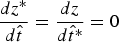 , equations (3) and (4) imply that the optimal pollution taxes are

i.e., each country sets its pollution tax equal to the marginal damage from its own pollution. In our setup, there is no strategic interaction in the simultaneous-move game since policies of neither country affect the price of the pollution-intensive good in the other country. Comparing equations (5) and (6), it is clear that, in the simultaneous-move game, the pollution taxes, although optimal from each country's perspective, are inefficient from the global perspective as countries do not internalize the transboundary effects of their emissions.
3. Sequential-move pollution taxes
We now consider the case where the home country moves first; denote the home and foreign taxes in the sequential-move game by t and t*, respectively. The foreign country (follower) still sets its tax equal to the marginal damage from its own emissions (using equation (4), since  ):

Since z = −R t and z* =− R t**, we have

We make the simplifying assumption that e u* u** = 0, i.e., the marginal utility of income is constant. Differentiating equation (7) with respect to t, we have, using equation (8),

i.e., the foreign country's pollution tax is decreasing in the home country's pollution tax; this is carbon leakage at work. Further, this implies that the reaction functions are negatively sloped. Using equations (8) and (9), we have
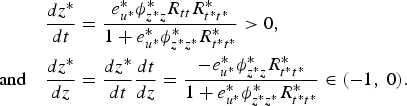
Hence, foreign pollution increases as the home pollution tax increases. This increased inflow of transboundary pollution, due to carbon leakage, reduces the home country's marginal benefit from regulating its own pollution. Equation (10) implies that home and foreign pollution are strategic substitutes.Footnote 18 This is in contrast to Bárcena-Ruiz (Reference Bárcena-Ruiz2006), where the ‘pollution shifting effect’ dominates the ‘rent capture effect’ if the level of transboundary spillovers is sufficiently low so that taxes are strategic complements. In our setup, without these two effects, the only interaction is through bilateral transboundary pollution and pollution in the two countries are always strategic substitutesFootnote 19 even for low (but positive) levels of transboundary pollution spillovers. The home country's best response function, equation (3), implies:
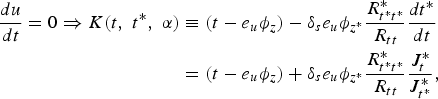
where δs = 0 in the simultaneous-move game and δs = 1 in the sequential-move game (when the home country moves first). Solving equations (7) and (11), assuming δs = 0, gives us the solution for the simultaneous-move game,  and
 . On the other hand, in the sequential-move game, the solution, t and t*, comes from solving equations (7) and (11), assuming δs = 1. The optimal pollution tax for the home country (leader) is:
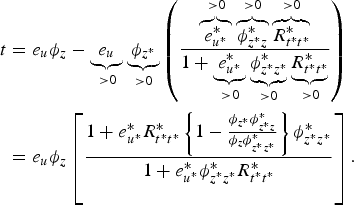
Hence, pollution taxes under simultaneous and sequential moves can be compared as follows:
Proposition 1
Suppose there is local and bilateral transboundary pollution in countries that cannot influence world prices, i.e., closed or small open economies. If pollution taxes are set sequentially, the leader underregulates pollution as compared to the simultaneous-move game, i.e.,  , and sets its pollution tax lower than the marginal damage from own pollution, i.e., t < e u ϕz. The follower sets its pollution tax higher than that in the simultaneous-move game, i.e.,
 .
Proof. Using equation (7), define the foreign country's reaction function as t* = B(t, β); equation (9) implies 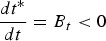 . Substituting the reaction function in equation (11), define (since δs = 1):

The second order conditions imply  . Furthermore, evaluating the above equation at
 we have
 ; hence,
 . Given L t (.) > 0, this implies that the optimal solution
 . Finally, the negative slope of the foreign country's reaction function implies that
 .
As the leader's emissions increase (z ↑), the follower's marginal damage from own pollution also increases (ϕz** (z, z*) ↑ since ϕz*z*(.) > 0). This prompts lower emissions (and higher pollution tax) in the follower country, which reduces the incidence of transboundary pollution in the leader country. This is the only motive behind the leader's underregulation of pollution. Hence, in contrast to Bárcena-Ruiz (Reference Bárcena-Ruiz2006), our assumption of closed or small open economies, i.e., no country can influence the price of the pollution-intensive good in the other country, allows us to focus on the transboundary pollution interaction. Furthermore, straightforward application of proposition 1 implies:
Corollary 1
If countries are symmetric,Footnote 20 the leader sets a lower pollution tax than the follower.
We get this unambiguous ranking of tax levels because, in our model, the only driving force is the interaction through bilateral transboundary pollution and, hence, taxes in the two countries are strategic substitutes.
If pollution is a pure global public bad, i.e., in both countries, the marginal damage from own pollution is positive and the same as that from the incidence of transboundary pollution, then ϕz = ϕz* and ϕz = ϕz**, which implies ϕzz** = ϕz* z**. Hence, from equation (12) we have

Corollary 2
If pollution is a pure global public bad, then the leader's pollution tax is always positive.
We can also compare total pollution under sequential and simultaneous moves as follows:
Proposition 2
If pollution is a pure global public bad, then aggregate pollution is higher in the sequential-move game than that in the simultaneous-move game.
Proof. From proposition 1, we have  , i.e.,
 . Hence, strict convexity of the pollution damage function implies
 .
Thus, when the externality is of a pure public bad nature, setting policies sequentially leads to higher aggregate pollution than setting policies simultaneously. This prompts us to compare welfare levels in the sequential- and simultaneous-move games.
Denote, as before, variable values under simultaneous moves using ^. Let  and
 be home and foreign emissions when countries set taxes simultaneously; let the corresponding welfare levels be Ŵ and Ŵ*, respectively. When the home country moves first, it has the option of setting emissions taxes, t, higher than, at the same level as, or less than that in the simultaneous-move game,
 . If the leader chooses
 , the follower's best response is to choose
 , and the leader obtains the same welfare as that under simultaneous moves, i.e., W = Ŵ. Hence, in the sequential-move game, the leader always obtains welfare at least as high as that in the simultaneous-move game, i.e., W ≥ Ŵ. However, as shown in proposition 1, the leader sets
 . Hence, the leader's emissions (z) are higher than that in the simultaneous-move game, i.e.,
 . Polluting more (or abating less) as compared to that under simultaneous moves implies that the leader's GNP is higher, which tends to increase its welfare. On the other hand, higher emissions under sequential moves tends to lower the leader's welfare. In our perfect information setup, the leader's choice of setting
 implies that the leader must be better off by choosing a lower tax rate under sequential moves, i.e., the welfare gain from higher GNP dominates the welfare loss due to higher pollution. Hence, the leader's welfare is higher than that under simultaneous moves, i.e., W > Ŵ; otherwise, it would have chosen
 .
The follower sets  (proposition 1) implying
 . Hence, the follower's GNP is lower as compared to the simultaneous-move game, which tends to lower welfare. If pollution is a pure global public bad, as shown in proposition 2, aggregate pollution is higher under sequential moves, i.e.,
 ; this tends to lower the follower's welfare relative to the simultaneous-move game. Thus, the combined effect of lower GNP and higher pollution lowers the follower's welfare as compared to the situation in which countries set taxes simultaneously, i.e., W* < Ŵ*.
If, in addition, the countries are symmetric, in the simultaneous-move game, both set the same taxes, i.e.,  , and obtain the same welfare, Ŵ = Ŵ*. Hence, it follows from the above discussion that the leader is better off compared to the follower, i.e., W > Ŵ = Ŵ* > W*. We summarize the above findings in the following proposition:
Proposition 3
The leader in setting environmental taxes is always better off as compared to the simultaneous-move game. If pollution is a pure global public bad, the follower is worse off relative to the simultaneous-move game. Furthermore, if countries are symmetric, the leader's welfare is higher than the follower's welfare.
The driving force behind the welfare rankings is the strategic substitutability between the taxes in the two countries. Setting environmental taxes first allows the leader to strategically lower its tax and increase its welfare at the expense of the follower.
Now suppose countries can choose whether to be a leader or a follower in setting environmental policies, i.e., the timing of setting taxes is endogenous. Thus, in the first stage of the game, countries can commit to their policy or choose to wait until the next period. In the second stage, if a country had chosen to wait in the first stage, the country chooses its policy and implements the policy; if a country had committed to its policy in the first stage, it implements this policy in the second stage. In our model, as shown in proposition 3, the leader (follower) attains higher (lower) welfare relative to the situation when countries set taxes simultaneously. Hence, committing to environmental policy in the first stage is a dominant strategy for both players, and we have:
Proposition 4
If countries can choose to commit to their environmental policies in the first stage of the game or wait till the second stage, it is a dominant strategy for both countries to choose their policies in the first stage. That is, if the timing of setting environmental policies is endogenous, both countries prefer to be leaders.
Thus, given the first-mover advantage, both countries prefer to be leaders regardless of what the other country does, since waiting to set environmental taxes lowers the country's welfare. Not only would countries choose to be leaders rather than followers, but given that one country commits to its policy in the first stage, the other would also choose to commit to its policy in the first stage (i.e., each country prefers the simultaneous-move solution to being a follower). Hence, under endogenous timing, both countries set their taxes simultaneously in the first stage of the game.
Now, we considerFootnote 21 how a change in the pollution damage function, say, due to a change in the degree of transboundary pollution spillover, affects policies. The home country's optimal pollution tax, t(α, β), is determined from equation (13), which can also be written as:
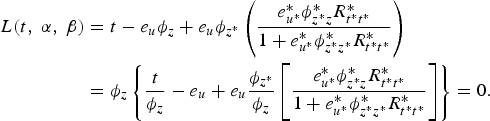
The last term […] in the above equation is independent of α. Hence,
Proposition 5
When countries set pollution taxes sequentially,
(1) a shift in the leader's pollution damage function, i.e., a change in α, such that
 will reduce the maximizing ratio of the leader's tax rate to marginal damage from own emissions, i.e., ;
(2) a shift in the leader's pollution damage function, such that
will reduce the leader's optimal tax rate.
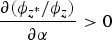 will reduce the maximizing ratio of the leader's tax rate to marginal damage from own emissions, i.e.,
 ;
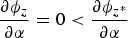 will reduce the leader's optimal tax rate.
Proof. Both results follow directly from the home country's second order condition.
Pollution damage functions of the form: ϕ(.) = η (z + αz*)2 and ϕ (.) = μ(z + αz*) + η (z + z*)2, with η, μ, α > 0, would be examples for propositions 5.1 and 5.2, respectively. Here, α is the degree of transboundary spillover from the foreign country (follower) into the home country (leader). Intuitively, an increase in the ratio of marginal damage from transboundary pollution to that from own pollution reduces the leader's ratio of tax rate to own marginal damage because it increases the leader's incentive to underregulate own pollution to reduce the incidence of transboundary pollution from the follower.
We now turn to situations in which the sequential nature of setting pollution policy does not have any differential impact on outcomes as compared to the simultaneous setting of policies. Equation (12) implies that, if ϕz* = 0 or ϕz*z* = 0, then t = e uϕz, i.e., the simultaneous-move and sequential-move equilibria are the same and the leader also sets its tax equal to the marginal damage from own pollution. If transboundary pollution is unidirectional,Footnote 22 i.e., if ϕz* = 0 or ϕz* = 0, the above condition is satisfied. ϕz* = 0 implies that the leader is not affected by the follower's pollution. Since the only incentive behind the underregulation of pollution is to reduce the inflow of transboundary pollution, in the absence of transboundary pollution, the leader does not have any incentive to distort domestic environmental policy. If ϕz* = 0, the follower is not affected by the leader's pollution; hence, the leader cannot influence the follower's pollution by strategically underregulating its own pollution. In our model, since the only strategic interaction between countries is through transboundary pollution, in the absence of bilateral transboundary pollution, both countries set pollution taxes equal to the marginal damage from own pollution. Even in the presence of bilateral transboundary pollution, if the follower's marginal damage from own pollution does not change with the leader's pollution level, i.e., if ϕz *z* = 0, then the leader is unable to influence the follower's pollution by strategically polluting more (by choosing a lower pollution tax). Thus, the leader sets its pollution tax equal to the marginal damage from own pollution. An example of a pollution damage function that satisfies the above property is ϕ* (z, z*) = η (z* + λ z), η, λ > 0. We summarize these results in the following proposition:
Proposition 6
When countries set domestic environmental policies sequentially, the equilibrium coincides with the simultaneous-move equilibrium, and both the leader and follower set their pollution taxes equal to the respective marginal damages from own pollution if either of the following holds:
• at least one of the countries does not suffer from transboundary pollution, i.e., transboundary pollution is either unidirectional or does not occur;
• the follower's marginal damage from own pollution is not affected by the leader's pollution level.
Hence, under the above conditions, sequentially setting policies does not introduce any additional strategic effects and leads to the same outcome as the situation in which countries simultaneously set pollution policies.
4. Concluding remarks
Pollution in water bodies shared between countries is a common type of transboundary externality problem. We analyzed non-cooperative environmental policy between such closed or small open countries; hence, the only strategic interaction is through transboundary pollution. We find that when pollution taxes are set sequentially, the leader (follower) sets a lower (higher) tax as compared to the simultaneous-move game. The only motive behind the leader's underregulation of pollution is to reduce the incidence of transboundary pollution from the follower, i.e, to reduce carbon leakage. Our analysis points out the possibility of carbon leakage even when countries are not large, i.e., they cannot influence world goods prices; this mode of carbon leakage (due to the sequential setting of policies) is new in the literature.
When pollution is a pure global public bad, aggregate pollution is higher in the sequential-move game than that in the simultaneous-move game. An important policy implication of our analysis is the importance of involving all countries, developed or developing, in environmental agreements since sequential policy setting may lead to higher aggregate pollution. We find that the leader's welfare is higher than that in the simultaneous-move game, while the follower's welfare is lower than that under simultaneous moves. The leader, by strategically polluting more, is able to lower emissions by the follower, and achieve higher welfare relative to the simultaneous-move game at the expense of the follower. Hence, due to this first-mover advantage, if countries could choose whether to be a leader or a follower, they would prefer to be leaders in setting environmental taxes irrespective of the other country's choice.
 such that
 . Standard envelope properties of this function imply
 and
 . If all firms face the same prices
 for goods and for the factors, v, then individual profit maximization, together with factor market equilibrium, will lead to GNP maximization, or the revenue function as defined above.


