Political efficacy, or the feeling that we have some degree of influence over our political surroundings (Almond and Verba Reference Almond and Verba1963; Campbell et al. Reference Campbell, Converse, Miller and Stokes1960; Campbell, Gurin, and Miller Reference Campbell, Gurin and Miller1953), is essential for the functioning of a representative democracy such as the United States. For government to be ruled by the people, the people must participate through voting and other avenues. If they do not, the people lose their power to influence government, and an unaccountable few rule for themselves and not the people (Madison Reference Madison, Carey and McClellan2005/1788; Tocqueville Reference Tocqueville, Mansfield and Winthrop2000/1835). Political efficacy is a known predictor of voting and other forms of political participation (Almond and Verba Reference Almond and Verba1963; Pollock Reference Pollock1983). With rates of political participation in the United States in significant decline in recent decades (Montanario, Wellford, and Pathe Reference Montanario, Wellford and Pathe2014; Putnam Reference Putnam1995; Sander and Putnam Reference Sander and Putnam2010), cultivating political efficacy is essential for the health of American democracy.
Political scientists have long recognized that political efficacy and participation are not distributed equally across the American population. Eisenhower was still president when Schattschneider (Reference Schattschneider1960, 35) published his famous statement: “The flaw in the pluralist heaven is that the heavenly chorus sings with an upper-class accent.” Despite significant federal action to secure voting rights for Black, Indigenous, and People of Color (BIPOC) citizens in the decades since, the choir’s accent remains pronounced (Schlozman, Verba, and Brady Reference Schlozman, Verba and Brady2012). Crucially, class and race are correlated highly in the United States (Bailey, Saperstein, and Penner Reference Bailey, Saperstein and Penner2014), which means that resource bias results in higher levels of political participation among white compared to BIPOC Americans. These stark differences continue into the twenty-first century: research has shown lower levels of political efficacy (Fridkin, Kenney, and Crittenden Reference Fridkin, Kenney and Crittenden2006) and political participation (Logan, Darrah, and Oh Reference Logan, Darrah and Oh2012) among Latinas/os and Asian Americans compared to white Americans.
Higher education is a known driver of increased political efficacy (Persson Reference Persson2015; Schlozman, Verba, and Brady Reference Schlozman, Verba and Brady2012; Verba, Schlozman, and Brady Reference Verba, Schlozman and Brady1995; Wolfinger and Rosenstone Reference Wolfinger and Rosenstone1980). This finding is not uniform, however, according to Dominguez, Smith, and Williams (Reference Dominguez, Smith and Williams2017, 64):
While a few studies have found that the university experience does not increase political participation or the development of civic values for students (Niemi and Klingler Reference Niemi and Klingler2012), in general, the literature suggests that there is a positive relationship between higher education and increased levels of political participation and political efficacy (Beaumont Reference Beaumont2011; Caprara et al. Reference Caprara, Vecchione, Capanna and Mebane2009; Lopez and Kiesa Reference Lopez, Kiesa and Jacoby2009).
Research shows that successfully completing a course in American politics can increase feelings of efficacy in students (Colby et al. Reference Colby, Beaumont, Ehrlich and Corngold2007; Dominguez, Smith, and Williams Reference Dominguez, Smith and Williams2017), but it has not isolated a specific mechanism that is causing this increase. It therefore is not clear to what extent high-impact pedagogical practices can bolster an increased feeling of efficacy (Galston Reference Galston2001). Separately, research suggests that resource-intensive, high-impact practices do increase students’ civic engagement (Chittum, Enke, and Finley Reference Chittum, Kathryn and Finley2022). Attempts to develop political efficacy have focused on resource-intensive projects (DeLaet Reference DeLaet2016; Elder, Seligsohn, and Hofrenning Reference Elder, Seligsohn and Hofrenning2007) and out-of-the-classroom cocurricular activities (Kumler and Whittaker Reference Kumler and Whittaker2019; Schmitt and Bryant Reference Schmitt and Bryant2019).
We examined the ways in which small classroom assignments that require students to directly practice the skills of citizenship can result in their gaining confidence that they can effectively participate in politics. By comparing sections of POL 101, our introductory US government course, with interactive assignments (e.g., contacting one’s US Representative and signing a petition) to sections without these elements, we explored what educators can do to foster political efficacy in their introductory US government courses. The civic engagement assignments that we use directly replicate the skills of active citizenship; moreover, they are not time intensive for either students or educators to implement, which makes them an ideal tool for cultivating political efficacy. Our research, therefore, has the potential to identify specific, easily adoptable teaching techniques that can increase students’ political efficacy without burdening them or their educators.
Conducting this research at California State University, Dominguez Hills (CSUDH), where both authors teach, allowed us to examine a second set of important questions—namely, those concerning race and political efficacy. It has long been known that political efficacy varies systematically by race and that white Americans have higher levels than their BIPOC counterparts (Abramson Reference Abramson1983; Beck and Jennings Reference Beck and Jennings1982; Cohen Reference Cohen2010; Niemi and Junn Reference Niemi and Junn1998; Tate Reference Tate1991). Recent studies that examine how individuals view their racial group’s political effectiveness reveal that Asian American, Black, and Latina/o respondents demonstrate a similar racial-efficacy gap: “All groups of color report similarly low racial efficacy relative to whites” (Phoenix and Chan Reference Phoenix and Chan2022). Even more alarming is the recent research that found introductory US government courses can increase this gap by decreasing the political efficacy of Black students (Centellas and Rosenblatt Reference Centellas and Rosenblatt2018). Similar findings occur in research that expands the analysis to Latinas/os and Asian Americans. A study conducted at the University of California, Irvine (UCI)—which is a Minority Serving Institution (MSI), a Hispanic Serving Institution (HSI), and an Asian American and Native American Pacific Islander Serving Institution—found that internal political efficacy decreases for Latina/o and Asian American students during introductory US government courses (Chan and Hoyt Reference Chan and Hoyt2021). Unlike their white classmates, “These students are left less certain of their personal ability to understand politics and no more certain that government is responsive to people like them (Chan and Hoyt Reference Chan and Hoyt2021, 984). CSUDH is both an MSI and an HSI. In fact, the university goes well beyond the federal definitions of these designations: fully 90% of its students are BIPOC and 66% are Latina/o (CSU, Dominguez Hills, Fact Sheet 2022). Additionally, 47% of CSUDH students are first-generation college students and 58% are Pell Grant–eligible. Because income and parents’ education also are known predictors of political efficacy (Beck and Jennings Reference Beck and Jennings1982), conducting this study at CSUDH presented a unique opportunity to examine ways of increasing political efficacy among those Americans who are least likely to feel politically empowered.
We must be cautious, however, in the conclusions drawn regarding the effects of institution type. All CSUDH students are required to take POL 101 to graduate; therefore, the demographics of those taking the course are the same as the overall student population. However, because we did not ask participants for demographic information as part of the study, we cannot condition across demographics to provide conclusive claims. We will address this in future studies at CSUDH—and it is hoped in conjunction with other similar universities and/or Primarily White Institutions (PWIs)—to test the demographic-based hypothesis generated by our study.
THEORY AND MOTIVATION
We wanted to test whether the direct replication of the skills of citizenship increase self-reported political efficacy. Civic engagement assignments provide students with the opportunity to engage in the political process. This experience and the memory of being able to participate may create confidence in their ability to participate (i.e., increase their political efficacy), making them more likely to participate in politics (Campbell et al. Reference Campbell, Converse, Miller and Stokes1960; Converse Reference Converse and Apter1962).
This theory aligns with decades of political science research on civic engagement, political efficacy, and political participation. As noted previously, higher education has been shown to increase political efficacy (Levine 2009), and higher levels of political efficacy have long been understood to correlate with higher levels of political participation (Almond and Verba Reference Almond and Verba1963; Pollock Reference Pollock1983). Therefore, if civic engagement assignments increase students’ political efficacy, then they also increase the probability that students will participate in politics in the future.
At its core, political efficacy is self-confidence. People generally are less confident of their ability to do something that they have not done before. Therefore, civic engagement assignments introduce students to some of the ways that they can participate in politics and also require them to gain participation experience. Confidence comes with experience, which presents a mechanism by which these assignments can increase political efficacy.
Research at the K–12 level has found significant gaps in political efficacy across wealthy and impoverished school districts (Fridkin, Kenney, and Crittenden Reference Fridkin, Kenney and Crittenden2006). This occurs in part because “resource-rich schools may provide ‘apprenticeships’ to help students develop the skills necessary for political activism. In addition, well-off school districts provide numerous opportunities for students to practice how to interface with government” (Fridkin, Kenney, and Crittenden Reference Fridkin, Kenney and Crittenden2006, 608). The civic engagement assignments that we used in this study were intended to play the same role in developing political efficacy through skill building.
RESEARCH DESIGN
To test our theory, we created a set of four civic engagement assignments (see online appendix A): (1) attend a public meeting (in person or virtually); (2) write to your member of Congress; (3) sign a petition (on paper or online); and (4) engage with an interest group (e.g., sign up for a newsletter, sign a petition on the group’s site, send an email, or make a donation). For the public meeting, students wrote one or two paragraphs describing the event and their impressions of it. For the other three assignments, uploading a confirmation email, screenshot, or photograph to the course Blackboard or Canvas site was sufficient to receive full credit.Footnote 1 Doing so assured students that they did not have to reveal their political views. In addition to the civic engagement assignments, students in both the control group and the treatment group had an opportunity to complete a survey asking about their political efficacy, early in the semester and then after course completion. The statements on this survey were drawn from the American National Election Survey (ANES), participation in both the pre- and post-class political efficacy surveys was voluntary, and results were confidential. This method—using a pretest to gauge students’ preexisting levels of knowledge, interest, and attitudes, paired with a posttest to allow for the measurement of growth during a fixed period—is one of the most used designs in pedagogical research (Angelo and Cross Reference Angelo and Cross1993; Black and William Reference Black and William1998; Campbell and Stanley Reference Campbell and Stanley1963; Mills, Martinez, and Forrester Reference Mills, Martinez and Forrester2018). We know which students participated because we have their signed informed-consent form. We do not have the ability to match datapoints to specific participants because of the confidentiality on the pre- and post-class political-efficacy surveys. However, there were separate survey links for students in the treatment and control groups. The surveys were conducted via Alchemer online survey software, with links to the surveys posted in the Blackboard and Canvas course sites. We received Institutional Review Board (IRB) approval in December 2021 (Hallenbrook and Russo Reference Hallenbrook and Russo2025).
…we created a set of four civic engagement assignments (see online appendix A): (1) attend a public meeting (in person or virtually); (2) write to your member of Congress; (3) sign a petition (on paper or online); and (4) engage with an interest group (e.g., sign up for a newsletter, sign a petition on the group’s site, send an email, or make a donation).
All of Dr. Russo’s POL 101 courses were assigned to the control group. He taught his standard syllabus, which did not include the civic engagement assignments. All intersession classes (i.e., summer and winter), taught by both Dr. Russo and Dr. Hallenbrook, were assigned to the control group and therefore did not receive the civic engagement assignments. These students took only the standard five-statement political-efficacy survey (see online appendix B) at the beginning and the end of the course to gauge the baseline effect of taking the course. In total, there were 49 respondents in the control group who took the survey before completion of the course and 33 in the control group who completed the survey after the course ended. In the treatment group, 114 students took the survey at the beginning and 69 completed it after the course ended.
The treatment group consisted of Dr. Hallenbrook’s POL 101 courses during the 2022 Spring and Fall semesters and the 2023 Spring semester. Students in these courses were required to complete the four civic engagement assignments regardless of whether they participated in the survey. The four assignments were worth a total of 10% of their course grade, and each assignment counted equally. Students who completed the assignment received 100% credit for their work; those who did not received 0% credit.
Due to low participation rates in the 2022 Spring semester, we sought and received IRB approval to modify our research design to offer extra credit to students who participated. Those who participated in the study received three points of extra credit on their final exam regardless of whether they were in the treatment or the control group. These students took the standard five-statement survey at the beginning and the end of the course so we could ascertain whether they had a greater increase in political efficacy than those in the control group.
Our dependent variable in each of the surveys was students’ responses to the ANES battery of five statements that gauged their feelings about political efficacy. Students were asked to respond to each statement whether they strongly agreed, agreed, somewhat agreed, neither agreed nor disagreed, somewhat disagreed, disagreed, or strongly disagreed. Their answers were recoded on a seven-point scale so that stronger agreement with the statement was reflected in lower scores and stronger disagreement was reflected in higher scores. Because some of the statements expressed a lack of political efficacy and others were positive statements, the data were recoded such that answers that reflected higher degrees of political efficacy would always result in a higher number. The control variable in each survey was whether the student had completed a treatment course or a control course. This was measured using a binomial variable for which having completed a treatment course was coded as 1 (N=69) and a control course as 0 (N=33).
RESULTS
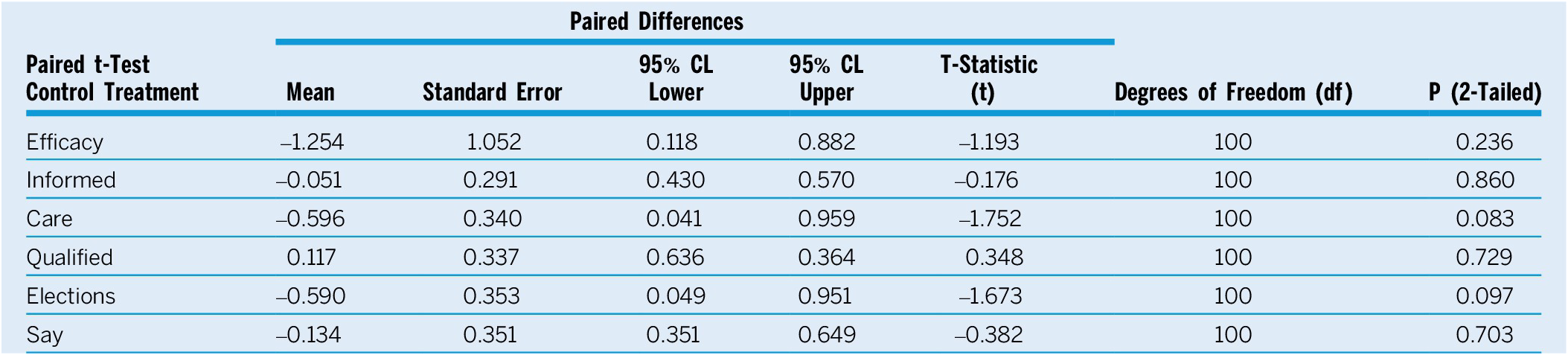
Initial results were mixed but they strongly indicated statistical significance. For both the control and treatment groups, participants showed increases in self-reported political efficacy on four of the five statements after completing the course. We also created an index combining each statement into a single variable. This new variable also was significant in the expected direction when a t-test was run comparing students who did and did not finish the course (table 1). Each increase in political efficacy was statistically significant at the 95% confidence level for five of six of the variables, including the indexFootnote 2 (see online appendix C). This was verified using a t-test in which the dependent variable was one of the index variables (i.e., the responses to each of the five statements), and the control variable was whether or not the student had finished the course. This was measured using a binomial variable in which responses from the post- and pre-class surveys were coded as 1 (N=102) and 0 (N=163), respectively. These results confirm existing scholarship that taking an introductory US government course increases political efficacy (Colby et al. Reference Colby, Beaumont, Ehrlich and Corngold2007; Dominguez, Smith, and Williams Reference Dominguez, Smith and Williams2017).
Treatment Effects: T-Test Results for Students Who Did/Did Not Receive the Treatment

Note: CL=confidence level.
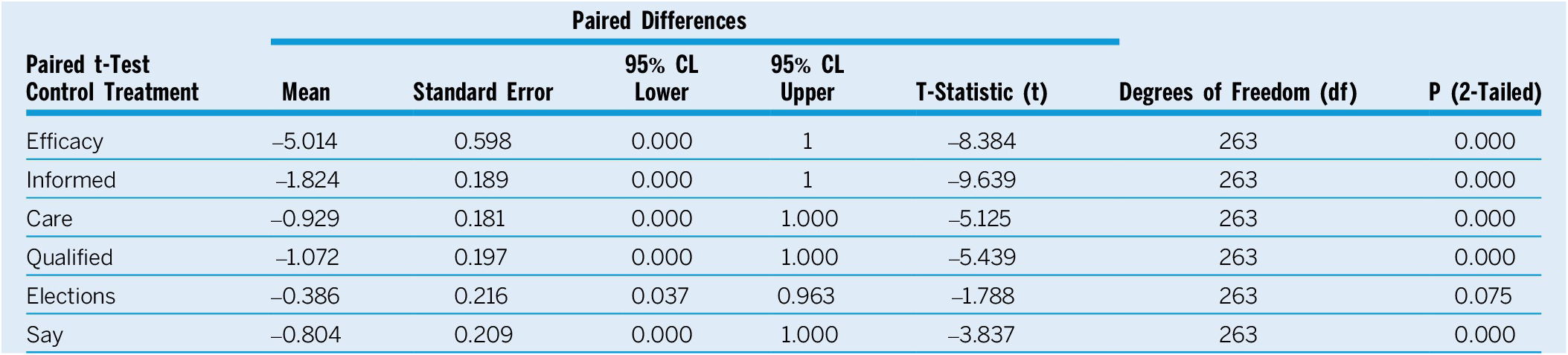
Review of the data before beginning the statistical analysis indicated that there were greater increases in political efficacy in the treatment group than in the control group (table 2). Due to the smaller sample size of this population, we switched from using a t-test to nonparametric statistics. Nonparametric tests are those in which the researcher is not assuming that parameters apply to the data. They are considered the most appropriate tests to use when—as in this study—sample sizes are smaller and we cannot assume normal distribution (Nahm Reference Nahm2016). It also is important that the data used were ordinal, based on a seven-point Likert scale. Traditionally, this form of data has been analyzed using nonparametric methods (Doering and Hubbard Reference Doering and Hubbard1979). When effect sizes are being examined, nonparametric measures such as Cohen’s d are commonly used (LeCroy and Krysik Reference LeCroy and Krysik2007; Lobo Reference Lobo2023). Note also that studies using smaller sample sizes have been published that explore issues similar to this study (Ginn and Hammond Reference Ginn and Hammond2012). When we analyzed using the Cohen’s d, Hedges’ g, Glass’s Delta 1, Glass’s Delta 2, and point-biserial correlation scores produced under a difference of means test, we observed statistical significance at the 90% confidence level. The exceptions were the statements: “I think I am better informed about politics and government than most people”; “I consider myself well qualified to participate in politics”; and “People like me don’t have any say about what the government does.” This simply may be the effect of the introductory US government course—for all of these statements, we observed statistically significant differences between those who did and did not complete the course—which overshadowed the effect of the treatment that students received. Admittedly, however, this is conjecture on our part.
Posttest Completion Effects: T-Test Result for Students Who Did/Did Not Complete the Posttest

Note: CL=confidence level.
There may be a mismatch between the assignments and the survey statements. That is, it is possible that the specific civic engagement assignments assigned to the students did not generate feelings of political efficacy that would be captured by the statements to which they were asked to respond. Other scholars also have questioned whether the currently accepted ANES battery of statements used to measure political efficacy should be revised—for example, if there should be open-ended follow-up questions asking why the respondents answered the way they did (Chamberlain Reference Chamberlain2012). Barring such modifications being made to the commonly accepted and used ANES survey, future studies may want to specifically tailor their statements to the treatments being offered rather than asking the standard ANES battery of statements used in the literature.
DISCUSSION
We are encouraged that the effect of taking the course was highly significant for the treatment and control groups. Regardless of whether students received the treatment, taking the course with either instructor increased self-reported student political efficacy on four of five survey statements. For all five statements, this increase was statistically significant at the 95% confidence level using a t-test. This reaffirms existing findings that an introductory US government course increases political efficacy (Colby et al. Reference Colby, Beaumont, Ehrlich and Corngold2007; Dominguez, Smith, and Williams Reference Dominguez, Smith and Williams2017). This is true despite our respondents being drawn from students who—due to race, income, and familial educational background—are among the Americans least likely to have a strong sense of political empowerment and efficacy (Fridkin, Kenney, and Crittenden Reference Fridkin, Kenney and Crittenden2006). Our research reaffirms the power of an introductory US government course to develop the next generation of citizens.
Our findings also provide an important, if tentative, counterexample to research by suggesting that this effect occurs only with white students (Centellas and Rosenblatt Reference Centellas and Rosenblatt2018; Chan and Hoyt Reference Chan and Hoyt2021). The finding of Centellas and Rosenblatt (Reference Centellas and Rosenblatt2018) was specific to Black students, and our respondents are primarily Latina/o; therefore, we cannot directly refute the findings. Our research does suggest that there are highly nuanced dynamics between race and political efficacy playing out in classrooms across the United States. Whether it is due to differences in institution type (e.g., PWIs versus HSI or R1 versus Directional State University), student body, or the instructors is a worthwhile avenue for future research.
We hypothesize that institutional demographics and the resulting classroom composition is a causal variable for these differences. The student body at the University of Mississippi, where Centellas and Rosenblatt (Reference Centellas and Rosenblatt2018) conducted their research, is 12.4% Black and 75.4% white (College Factual Reference Factual2025). Similarly, at UCI, where Chan and Hoyt (Reference Chan and Hoyt2021) conducted their experiment, the student body is 23.3% Latina/o (College Factual Reference Factual2025). These percentages could make it easier for Black students at the University of Mississippi and Latina/o students at UCI to perceive themselves as outsiders in classrooms where their classmates mostly do not look like them, compared to CSUDH. Because CSUDH is 66% Latina/o (California State University, Dominguez Hills, Fact Sheet 2022)Footnote 3, there may be a different mindset for Latina/o students in majority Latina/o classrooms. Research shows that Latinas/os with higher self-reported levels of belief in “Latino linked fate” participate in politics at higher rates, as do those who have more conversations with their neighbors (Shaw, Foster, and Combs Reference Shaw, Foster and Combs2019). Therefore, it is reasonable to hypothesize that there may be a similar community dynamic at play with developing political efficacy in the political science classroom. However, because of our sample size and we did not ask participants for demographic data, we only can hypothesize about effects of institutional type and classroom composition. Examination and testing of these hypotheses requires a follow-up investigation designed to gather this information—ideally in comparative analysis with scholars using the same design at other institution types (e.g., PWIs), especially in whiter classrooms.
One statement that was not statistically significant at the 95% confidence interval between respondents on the pretest and posttests was: “So many people vote in elections that it doesn’t matter much to me whether I vote or not.” We did not find this overly surprising. CSUDH is in the most populous metropolitan area (i.e., Los Angeles) in the most populous state (i.e., California) in the United States. As a result, so many votes are cast even in local elections that it is almost impossible that students will ever encounter an electoral tie or even an election decided by a few hundred votes. We believe that in our area of the country, increasing student political efficacy requires emphasizing participation beyond voting, which both authors do when we teach POL 101.
Regarding the treatment’s effect, for two of the five statements, the increase in the treatment group was both higher than the increase in the control group and statistically significant at the 90% confidence level using difference of means tests. The two statements were: “Public officials don’t care much what people like me think” and “So many other people vote in elections that it doesn’t matter much whether I vote or not.” (The statistically significant results are presented in online appendices D.1 and D.2.) There is an interesting gap between the statistically significant effect of the treatment on “Public officials don’t care much what people like me think” and the lack of effect for “People like me don’t have any say about what the government does.” Having students contact elected officials to express their views appears to increase their belief that the recipients care about their views to a greater degree than simply learning about how they can participate. However, this experience does not increase their sense that they can affect outcomes any more than the course does. It is unclear if this is because the gains from the course are sufficiently large relative to the treatment making its effectiveness minimal. That there is a statistically significant effect for this statement by simply taking the course is promising for the potential of introductory US government courses to increase an individual’s political engagement.
It is logical that the treatment did not have a significantly statistical increase on the statement, “I think I am better informed about politics and government than most people,” compared to the control. The treatments all required action. Some knowledge was gained through the public-meeting and contacting-an-interest-group assignments. However, this was not the main focus of these assignments. Students in the treatment group gained additional knowledge from the course itself, so it is likely that the specific treatments did not provide enough knowledge beyond the course to show up in the test of effect size.
In total, the treatments demonstrated the greatest increase in political efficacy on those statements for which there was the greatest alignment between the assignments that constituted the treatment and the statements in the survey instrument—namely, increasing students’ confidence in their ability to engage in politics. Although the treatment effect usually is not statistically significant beyond the course effect, a more refined set of assignments that better aligns with survey statements (i.e., the standard ANES statements in the study of political efficacy) may be. Online appendix A presents our assignments for those educators who may want to use or modify them for their own courses.
LIMITATIONS
Not all students participated in the survey; of those who did, not all completed the posttest.Footnote 4 This created two ways in which we may have overstated our results. Those students who opted in may have been more engaged in the course and therefore were more likely to have their political efficacy increase than those who did not. Those who finished both the pretest and the posttest may be an even more attentive and responsive group—especially because students who were motivated solely by extra credit could receive it without completing the posttest. In this case, our data would capture the highest effect and not be a representative sample of the effects of the courses and treatments.
Another limitation was a potential instructor effect. Because Dr. Russo taught only control-group classes, the difference in effect sizes in part could have been a result of students responding differently to different instructors. Mitigating factors include that we approached the course similarly, using comparable course structure, assignments (other than the civic engagement assignments), and the same student-learning outcomes. Both instructors have taught for a similar number of years; both teach POL 101 multiple times every year; and both have received teaching evaluations sufficiently favorable to earn tenure at a teaching-oriented university. However, we recognize that these mitigations do not eliminate the possibility of instructor effect.
We are able to show that both course completion and civic engagement assignments increased political efficacy of BIPOC students, contrary to Centellas and Rosenblatt (Reference Centellas and Rosenblatt2018), because more than 90% of CSUDH students identify as people of color. However, our survey was confidential (i.e., respondents did not include their name on the survey) and we did not collect demographic data from respondents; therefore, we could not compare results across racial and ethnic groups. Even if we had, only 5% of CSUDH students identify as white, and we would not have had a sufficient sample size of white respondents to draw statistically significant conclusions about treatment effects on white-versus-BIPOC students. Additionally, because our dataset consisted solely of CSUDH students, we can demonstrate only how the political efficacy of BIPOC students is increased at MSIs and HSIs, where students are surrounded by fellow BIPOC students. We could not control for the effects of institution type, which would have required our research design be replicated at PWIs and/or Historically Black Colleges and Universities (HBCUs).
We are able to show that both course completion and civic engagement assignments increased political efficacy of BIPOC students, contrary to Centellas and Rosenblatt (Reference Centellas and Rosenblatt2018), because more than 90% of CSUDH students identify as people of color.
CONCLUSION
Our study confirms the strength of introductory US government courses for increasing students self-reported political efficacy, even among those students who are least likely to have a sense of political empowerment. It is important to note that we moved beyond testing the effect of taking the course to explore how course design can provide additional increases in efficacy beyond simply taking the course. We demonstrate that educators do not have to use time- and labor-intensive projects but instead can have a significant impact by using civic engagement assignments that require minimal increase to their own and their students’ workload. Because educators with the greatest workloads teach the greatest number of students, our treatment holds great potential for increasing political efficacy in the next generation of voters.
Our study confirms the strength of introductory US government courses for increasing students self-reported political efficacy, even among those students who are least likely to have a sense of political empowerment.
There is still much for researchers to explore on the issue of using these or similar civic engagement assignments in their introductory US government courses. It could be argued that the apparent increase in cynicism among students may be from learning about the Electoral College system or from a lack of responsiveness on the part of elected officials in the large state where CSUDH is located. Thus, observing these or similar treatments used in different environments could produce novel results. We welcome interested instructors to use the four assignments included in online appendix A. To compensate for the lack of a treatment effect for the statement, “I think I am better informed about politics and government than most people,” instructors may want to develop an assignment in which students research an issue, candidate, or part of the political system.
Our findings raise interesting questions regarding the relationship among political efficacy, race, and institutional setting. Differences in institution type, the student body, and various other factors may drive the difference between our findings and the decrease in the efficacy of Black students at the University of Mississippi (Centellas and Rosenblatt Reference Centellas and Rosenblatt2018) and Latina/o and Asian American students at UCI (Chan and Hoyt Reference Chan and Hoyt2021). Can our results be replicable with BIPOC students at PWIs and HBCUs? Regardless of institution type, are our civic engagement assignments more effective with some demographics than others? The limitations of our current data leave these important questions unanswered and should drive future research—perhaps with a cross-institutional study that compares the effect size at universities with differing racial and ethnic compositions of their student bodies. Civic engagement assignments hold great promise, but the full scope and limitations of that promise is yet to be determined.
SUPPLEMENTARY MATERIAL
To view supplementary material for this article, please visit http://doi.org/10.1017/S1049096525101339.
ACKNOWLEDGMENTS
The authors thank our students for participating in this study; the IRB of CSUDH for supervising the research; and Jacob W. Dryden and Tolulope Babalola for their assistance.
DATA AVAILABILITY STATEMENT
Research documentation and data that support the findings of this study are openly available at the PS: Political Science & Politics Harvard Dataverse at https://doi.org/10.7910/DVN/JQGLXV.
CONFLICTS OF INTEREST
The authors declare that there are no ethical issues or conflicts of interest in this research.