The problem of work safety in conjunction with the country's economic boom has gained increasing attention in China in the past two decades. From 2000 to 2003, when China's GDP grew at an average annual rate of 8.1 per cent, industrial accidents were associated with over 100,000 deaths per year.Footnote 1 By 2004, the fatality rate in coal-mining production accidents, measured by the number of deaths per million tons of coal produced, was 30 times higher in China (4.17) than in the countries in Southern Africa (0.13) and 100 times higher than the United States (0.039).Footnote 2 More recently, despite a very strong push by the Chinese leadership to improve coal-mine safety, fatalities have remained woefully high. In 2007, there were 2,421 coal-mine accidents resulting in 3,786 deaths – a staggering average of seven accidents and ten deaths per day.Footnote 3 These figures suggest that the Chinese government has promoted amazing economic development at a huge cost of human lives.
To CCP leaders, the serious work safety situation has important political implications. It tarnishes the image of the party-state in the international community, jeopardizes social stability and impedes economic development. These are legitimate concerns. After three decades of market reform, China faces intensified social tensions brought about by rapid economic liberalization and an underdeveloped legal system coupled with broken social norms and values. An increasing number of collective petitions and fierce resistance by laid-off workers, peasants, city migrants, religious dissidents, ethnic minorities and online communities threaten social stability in post-Deng China.Footnote 4 The communist regime's robustness is further undermined by failures in safety regulations for food and drugs. Will the bitterness caused by fatal work-related accidents eventually reach a level that becomes the straw that breaks the camel's back? For the Party leaders, that risk is simply unaffordable.
To control rising death tolls in the early 2000s, the Hu–Wen administration established a set of “fatality indicators” (siwang zhibiao 死亡指标) in 2004, and since then these indicators have been prioritized in the measurement of local governments' performance. Fatality indicators are not unique to China. Some OECD and East Asian countries also use precise, quantified targets to measure government performance on occupational health and safety so as to obtain crucial information for safety improvement.Footnote 5 However, compared to the indicators used by these countries, China's are unusually rigid in two respects. First, the targets are expressed in extremely precise numbers. They are established by the central government each year through mathematical calculation and then allocated down the administrative hierarchy level by level, also based on a unified mathematical formula. Hence local officials have limited discretion to tailor the assigned indicators to local situations. Second, success in not exceeding the fatality indicator levels is closely related to Chinese local officials' career prospects. If local officials fail to keep the number of deaths within the required levels or a serious work-related accident occurs in the area as a result of supervisory negligence, their careers can be jeopardized and in some cases they may even be removed or dismissed from leadership positions.
Why did the Chinese leaders initially adopt such a method of safety measurement? How did they design the fatality indicators to achieve their goals? Has this strategy been effective in improving the country's socially devastating safety record? The key purpose of this article is to examine how the fatality indicators are used in dealing with the intensifying imbalance between growth and work-related deaths and injuries in China's rapid socio-economic development. We argue that, weirdly rigid as the fatality indicators are, their introduction is a rational and prudent strategy that enables the central government to strengthen supervision on local work safety management by stipulating well-defined goals and responsibilities for local governments. Their primary purpose is to overcome the problems inherent in China's work safety regulatory system and shift local officials' focus from a GDP-centred growth mode to a new mindset of reaching a balance between economic development and social stability in local governance. However, the implementation of fatality indicators raises new challenges in work safety regulation such as dishonest reporting of real death figures by local officials. The fluctuating number of very serious and catastrophic accidents implies that work safety is a problem which the system of fatality indicators alone cannot effectively handle.
There are few comprehensive studies on work safety management in China. Previous work mostly focuses on safety in coal-mines, with limited attention to the broader picture of work safety regulation. Several studies use coal-mine safety regulation as a case to explore the major characteristics of the Chinese regulatory state,Footnote 6 the difficulties of regulating mining safety,Footnote 7 the shortfalls of the state capacity in implementing crucial policies in local areasFootnote 8 and the causes of safety gaps between China and other countries.Footnote 9 Others examine the characteristics of work-related fatalities from the perspective of occupational health but do not analyse work safety as a public administration issue in the context of China's rapid socio-economic transformation. For example, Jin and Courtney's study aims to describe the major features of work-related fatalities in China such as their types, causes and regional distribution.Footnote 10 The study by Zhang et al. identifies countermeasures that have promised to address specific aspects of road safety problems in China.Footnote 11 These studies are very important for laying down the groundwork, but far from adequate for illuminating how Chinese reformers have dealt with challenges in work safety regulation in the reform era. To date, our study is the most comprehensive analysis on problems faced by the Chinese reformers and the solutions developed in the historical course of China's work safety regulatory system.
Our data are derived from a large number of central and local documents on work safety management as well as statistics from several years of official publications such as The China Work Safety Yearbook. It is notable that The China Work Safety Yearbook is the only source of detailed statistics of government policies on work safety and actual fatalities in work-related accidents in China available to the public. Given the limited extent of governmental transparency, the yearbooks are indispensable to enable evaluation of work safety management issues. In addition, in order to assess the reliability of official data and obtain important information such as the dynamics and effects of implementing the fatality indicators, we conducted in-depth interviews with leadership officials of different ranks who have been in charge of work safety affairs in local governments in Guangdong and Shaanxi since 2009. The interview findings provide insiders' interpretations that are crucial for understanding the purposes, functions and effectiveness of the implementation of the fatality indicators in local governments.
Work Safety Regulation in Post-Mao China: Thorny Issues
China's work safety regulation underwent an important transformation after 1993 from state supervision to “enterprise responsible, professional department managing, state monitoring and mass checking” (qiye fuze, hangye guanli, guojia jiancha, qunzhong jiandu 企业负责、行业管理、国家监察、群众监督).Footnote 12 Under this system, enterprises had the major responsibility of enforcing work safety policies and ensuring the occupational health and safety of the workforce. The state supervisory organizations were in charge of comprehensive management of work safety affairs, developing work safety policies and regulations, and directing local organizations to check and alleviate potential problems. Relevant professional departments were responsible for the management and supervision of work safety in enterprises in each specific industry. Trade unions in all work units and the mass media supervised government performance on work safety.
However, such a regulatory system created three major issues for the Chinese reformers. First, the multi-headed management (duotou guanli 多头管理) of work safety, an organizational formula inherent in China's tiaotiao/kuaikuai 条条/块块administrative structure,Footnote 13 obscured the boundaries of each organization's responsibility. At the national level, the general management of work safety was under the supervision of three organizations: the State Commission of Economy and Trade took care of the comprehensive management of work safety issues, supervision on occupational safety and mine safety; the Ministry of Health was responsible for occupational health (including mine health); and the State Bureau of Quality and Technology Supervision was in charge of work safety supervision of boiler and pressure vessels. In addition, other organizations were involved in the safety supervision of specific industries. Transport safety, for example, was supervised by the Ministry of Public Security (road transport), the Ministry of Railway (railways), the Maritime Safety Administration (fisheries and ships) and the Civil Aviation Administration (aviation).
In actual implementation, this segmented regulatory system severely limited the state capacity to monitor safety performance and enforce policies. Take supervision of township and village enterprise (TVE) coal-mine safety as an example. Wang's study shows that safety arrangements in TVE coal-mines were overseen by a wide range of regulatory bodies that did not always work in a coordinated fashion.Footnote 14 The responsibilities of the (previous) Ministry of Coal Industry, as the professional management organization of TVE coal-mines, were defined vaguely as “overall planning, organizational coordination, service provision and supervision.” The Ministry of Agriculture was entrusted to oversee reform and development of all kinds of TVEs, including coal-mines. The Ministry of Public Health had a portfolio for promoting occupational health in all enterprises including the mining industry. Many other organizations including the (previous) Ministry of Geology, the Ministry of Public Security and local township-enterprise management bureaus were all involved to different degrees in the administration of safety in TVE mines. Therefore, Wang points out that:
Having different agencies responsible for safety did not help enhance safety. On the contrary, a segmented framework was an impediment to the development of a coherent and consistent approach to work safety. Since the division of duties and responsibilities between different government agencies was not clearly defined, it was difficult for them to coordinate their actions. While their actions might be consistent with their own duties, responsibilities and interests, the potential for contradiction among them was actual and high. Compartmentalization not only led to conflict and shirking, but also undermined the importance of safety by diminishing incentives to treat safety related problems seriously, weakening enforcement efforts and leaving gaps in regulation and coverage.Footnote 15
The second problem was the complication created by implementing the principle of managing work safety on a locality basis (shudi guanli 属地管理). Article 9 of the Work Safety Law promulgated in 2002 stipulated that local work safety regulatory agencies in governments at and above the county level were responsible for the comprehensive supervision and management of work safety in the locality under their respective jurisdictions. It was local regulatory agencies' responsibility to improve and upgrade safety facilities and equipment, coordinate rescue resources in handling accidents, manage safety environments and so on. Local officials in charge of work safety regulation were held responsible for any work-related accidents that occurred in the locality as a result of supervisory negligence.Footnote 16 For example, if a Guangdong transport corporation bus had an accident in Fujian because of an unfinished road, Fujian local work safety officials should take responsibility. If a state-owned chemical plant located in a Henan county blew up because of a delayed safety inspection, the county officials were blamed and took the major responsibility.Footnote 17
The principle of localized management of work safety appeared to strengthen the responsibility of local governments at each level. However, it is a double-edged sword. In reality, this measure often becomes an excuse for scapegoating, shirking or evading responsibility. For example, the higher-level authorities or relevant professional departments may attribute fault to governments of the locality where an accident occurs. Yet local officials can make an argument that they should not be held responsible for accidents that are beyond their control and that at the very least they should not take major responsibility. Li Qinliang, the deputy head of the work safety bureau of Ningbo city, vividly described the implementation gap:
At present, work safety in provincial or ministerial enterprises, large-scale construction projects, pipeline wharfs and so on are managed on a locality basis. However, some provincial or ministerial enterprises set up their head offices in Beijing, create subsidiary companies in Guangdong, working offices in Shanghai, and place several hundred thousand cubic metres of dangerous chemical storage tanks in the responsible locality. Sometime, it is the higher-level authorities or the professional departments that decide safety equipment updates and choose construction contract partners. Under the circumstances, local work safety bureaus are even not allowed to participate. In some other cases, the [problematic] equipment of some pipeline wharfs is produced by an enterprise in Shanghai and managed by an office in Nanjing. What the responsible locality has is only a rented unit and several staff. In all these cases, how is it possible for local governments to supervise and exercise localized management on work safety?Footnote 18
The third thorny issue was the unwillingness of local work safety agencies to enforce an order to stop unsafe production when local leadership officials decide to “shelter” the enterprise. Since existing studies explain this problem well, we only briefly review it here using the management of TVE mines as an example. According to Wright, small TVE mines are the deadliest mines in China, with registered fatality rates around seven to eight times higher than that of the large state-owned mines during the past three decades.Footnote 19 Since 1997, the central government has launched several major campaigns to improve safety in these mines by closing dangerous small pits. However, it is extremely difficult for the central government to ensure comprehensive and effective implementation because of strong local resistance. Fiscal decentralization reforms during the 1980s made many local governments heavily dependent on revenues from TVE mines to balance their budgets. The growing market demand for coal also drives local officials to maximize mine output. As a result, county or township level officials are left with no choice but to tolerate the illegal operation of TVE mines. It is common for local offices to issue licences and permits to mines that do not meet the safety criteria.Footnote 20 Under such circumstances, local work safety agencies are not keen to strictly enforce safety policies and measures, but mainly supervise through token formalities. Fines in most cases are low, and as a result do not constitute a real threat or deterrent to mine owners. Prosecutions occur only after serious injuries or fatalities and the penalties imposed on those responsible are typically far from severe.Footnote 21 If local leadership officials are reluctant to take strong action against mines with bad safety records, mine owners' attitudes towards safety remain unchanged (that is, apathetic) and work safety in TVE mines is merely given lip service.
The Fatality Indicators
The steady rise of total fatalities in work-related accidents in the early 2000s impelled the Chinese leadership to take firmer action. In 2003, soon after Hu Jintao, the General Secretary of the CCP, stressed the importance of promoting an outlook of “scientific development,” work safety was made a priority political task for officials at all levels. Chinese leaders attempted to improve work safety based on existing regulatory systems, including the conventional way of mobilizing local leadership officials to take it seriously. They began by strengthening the authority and power of the state regulatory agencies. In March 2003, the Work Safety Commission of the State Council (Guowuyuan anquan shengchan weiyuanhui 国务院安全生产委员会, WSC) was established, with Huang Ju, then the first vice-premier and a member of the CCP Politburo Standing Committee, as its head. Appointing a senior CCP leader to chair the commission sent a clear signal that work safety was on the top leaders' agenda. Accordingly, a similar arrangement of assigning a senior leadership cadre to chair local work safety commissions was initiated, and work safety bureaus were established nationwide after 2003 in order to enforce the WSC policies and regulations. The WSC was housed in the State Bureau of Work Safety, which was separated from the State Commission of Economy and Trade and upgraded to an organization directly under the State Council. In 2005 the State Bureau of Work Safety (vice-ministerial level) was further upgraded to ministerial level and its name was changed to the State Administration of Work Safety (Guojia anquan shengchan jiandu guanli zongju 国家安全生产监督管理总局, SAWS). The Head of SAWS holds the concurrent position of director of the WSC Working Office. This change explicitly demonstrated the top leaders' determination to enforce work safety under a unified leadership.
The WSC, in its first plenary session in November 2003, proposed the establishment of a set of “fatality indicators” (in official terminology, work safety control evaluation indicators, anquan shengchan kongzhi kaohe zhibiao 安全生产控制考核指标) and since then has inserted these into the annual performance evaluations of local leadership officials.Footnote 22 This measure is designed to institute a system that clearly defines the performance level and accompanying responsibility structure. The indicators elucidate official responsibility in relation to the kind, nature and degree of severity of fatal accidents. In brief, the implementation of such a target-based performance measurement system is intended to bring down the total number of deaths in work-related accidents (especially those involving multiple fatalities) by holding local officials responsible for predetermined, clear, quantifiable results which are set for a specified period of time.Footnote 23
Beginning in 2004, the WSC has established a set of national annual fatality indicators, which are distributed down the administrative hierarchy level by level.Footnote 24 In general, there are two types of fatality indicators: absolute indicators (juedui zhibiao 绝对指标) and relative or ratio indicators (xiangdui zhibiao 相对指标). The absolute indicators are quantity-based standards that measure the absolute reduction of fatalities caused by work accidents, such as to control the total fatalities in fire accidents within a certain number of people in a specific year. Relative indicators are intensity-based standards such as the declining fatality rate per 100 million GDP or per million tons of coal produced.
The two types of indicators serve different evaluation purposes. Relative indicators are used to show the fatality to production ratio. Higher absolute numbers as a result of increased production levels may offset a reduction in this ratio. Hence, the use of relative indicators for safety improvement must be adjusted to include the absolute measurement indicators. For example, with a rising demand for coal, China could experience the paradoxical situation of lowering its intensity-based fatality rates while increasing actual deaths. By using the absolute indicators on coal-mine safety, the industry is forced to reduce absolute numbers of injuries and deaths in coal-mining.Footnote 25
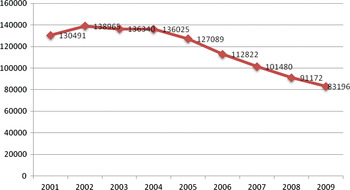
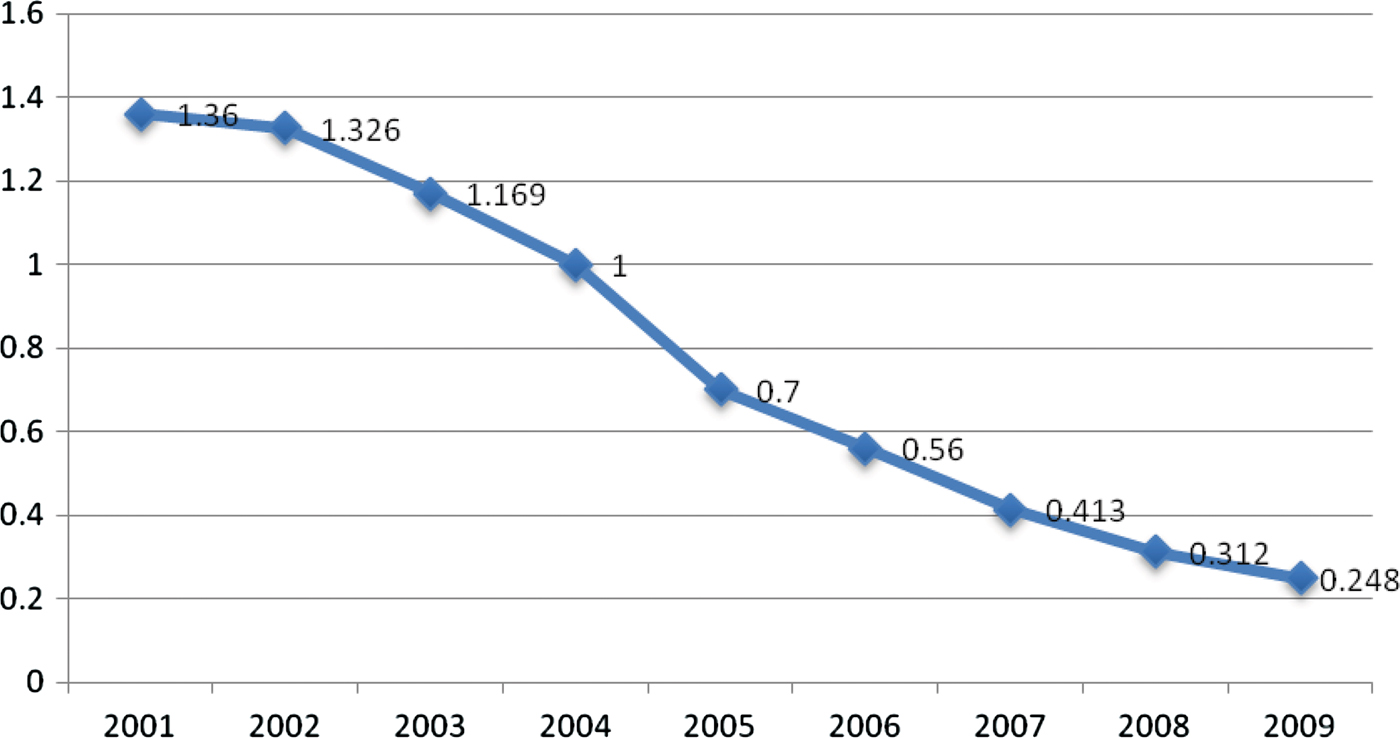
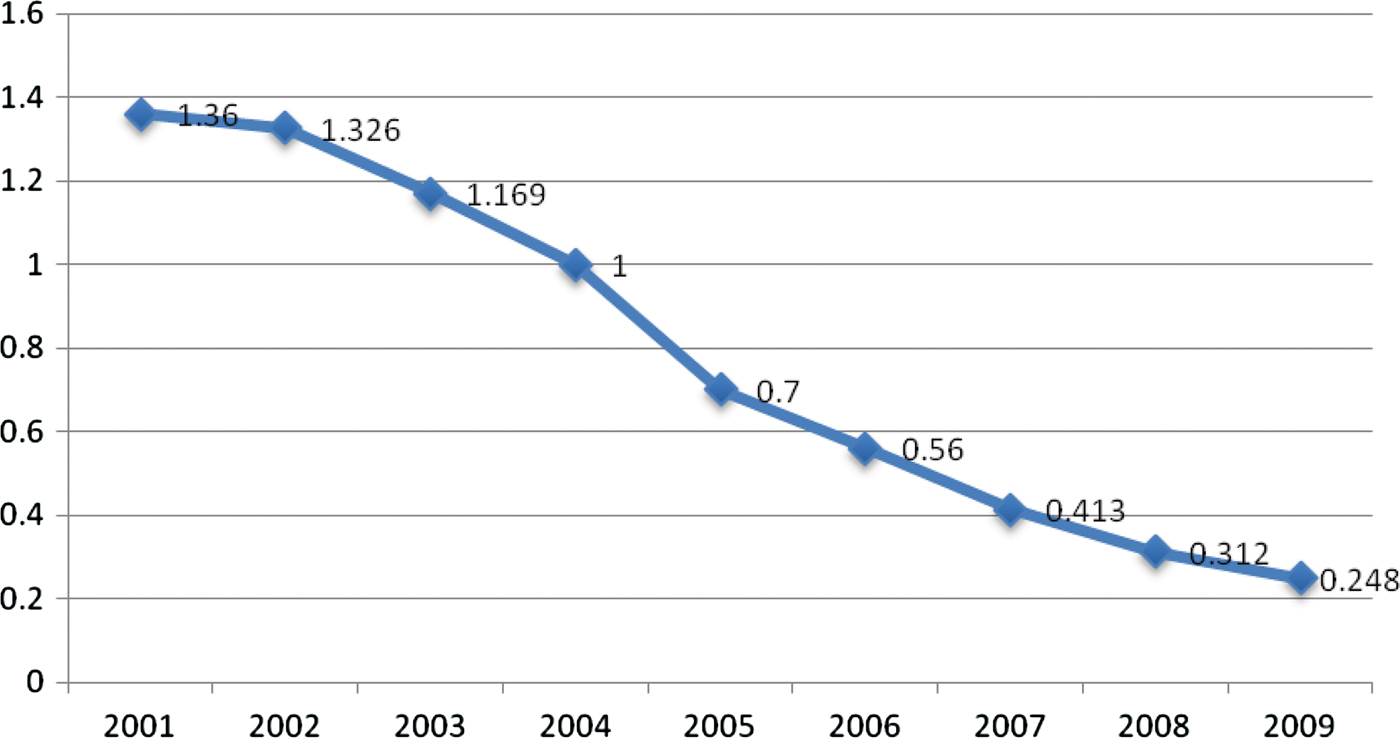
We use the statistics of national fatality indicators to illustrate this point further. The year 2003 was a significant watershed in terms of the growth in absolute number of deaths in work-related incidents in the early 2000s (see Figure 1), but an insignificant one in terms of fatality to production ratio (national fatality rate per 100 million GDP) (see Figure 2). From 2001 to 2003, the absolute number of deaths in work-related incidents increased year by year in China. But this was offset by a rapid growth of national GDP levels (an average annual rate of 8.38 per cent) during the same period. As a result, the fatality rate per 100 million GDP declined consistently from 2001 to 2008. One interpretation is that the fatality rate in some circumstances is a weak indicator of reliable information about the deteriorating work safety situation in China in the early 2000s. Also, it does not consistently explain government achievements in regulating deaths after 2003.
Total Fatalities Caused by Work-Related Accidents in China (2001–2009)
Sources: Data from 2001–08 are drawn from the State Administration of Work Safety (ed.), China's Work Safety Yearbook, 2000–08 (Beijing: Meitan gongye chubanshe, 2002–09). Data in 2009 are drawn from the website of the State Administration of Work Safety, http://www.chinasafety.gov.cn/newpage/aqfx/aqfx_ndtjfx.htm, accessed 22 July 2010. As an accurate number of fatalities in 2000 is not available in the China's Work Safety Yearbook 2000–01 our statistics start from 2001. (colour online)

National Fatality Rate per 100 million GDP in China (2001–2009)
Sources: Data from 2005–09 are drawn from the Statistic Bulletin on National Economic and Social Development in the People's Republic of China, 2005–09 as since 2004 work safety statistics are officially collected and reported in this bulletin, available at http://www.stats.gov.cn/tjgb, accessed 20 July 2010. Figures from 2001 to 2004 are calculated by the authors. The number for each year is derived by dividing total fatalities in work-related accidents in that year by the national GDP in the same year. Official data are not available because the central government did not require local governments to report the fatality per 100 million GDP until 2004 when the fatality indicators were established. In our database, statistics on China's national GDP from 2001 to 2004 are compiled from the Statistic Bulletin on National Economic and Social Development in the People's Republic of China, 2000–04. Statistics on China's total fatalities from 2001 to 2004 are drawn from the China's Work Safety Yearbook, 2002–05. (colour online)
Then why is there a need to develop a set of relative indicators if they can be misleading in reflecting work safety improvement as output increases? It should be noted that soaring work-related fatalities are viewed as the result of an imbalance in socio-economic development in China. Relative indicators show the cost, in terms of human deaths, that various governments have incurred relative to GDP growth. These indicators explain the extent to which China's GDP growth is “bathed in blood” (dai xue de 带血的) as well as showing how this changes over time. Such information is crucial to enable Chinese leaders to steer the arduous socio-economic transition. In addition, relative indicators are a control variable enabling comparisons on the work safety performance among localities (or by extension between China and other countries) that have huge differences in population density, economic strengths, implementation capacity, healthcare inputs and so forth. For example, it is illogical to conclude that Guangdong is doing a worse job on work safety than Xinjiang simply because 7,264 deaths were caused in the former locality in 2009 and 2,510 deaths in the latter. If measured by fatality to production ratio, the picture would be entirely different. Guangdong's work-related fatality rate per 100 million GDP in 2009 was 0.19 whereas the figure in Xinjiang in the same year reached 0.6.Footnote 26 This implies that Xinjiang had a higher fatality cost than Guangdong in promoting economic growth. Put in this light, relative indicators can provide useful information for making cross-regional comparisons on work safety performance.
The Whip of the Heaven: A Unified but Not Uniform Way of Fatality Control
Control by precise numbers
The establishment of fatality indicators enabled the WSC to strengthen its control over work safety management by imposing rigid requirements for fatality reduction each year in each locality. As mentioned above, a striking feature of the fatality indicators is that all targets are expressed in extremely precise numbers. In 2006, Wang Xianzheng explained in detail how the fatality indicators were calculated and distributed. According to the Eleventh Five-Year Plan on Work Safety of the PRC, China set an overall objective of keeping the national fatality rate per 100 million GDP controlled at 0.45 by 2010. The total national fatality number was set at around 112,890 people, which represents China's projected 2010 GDP multiplied by 0.45. This is 14,199 fewer than the number of fatalities in 2005 (127,089 people). Based on the 2010 objective, therefore, on average there should be a reduction of 2,838 fatalities per year over the Five-Year Plan period, with an annual average decline rate of 2.2 per cent. In 2006, in order to strengthen control over work-related accidents, the annual decline rate was set at 3 per cent, slightly higher than the average rate required for meeting the target. Accordingly, the total number of work-related fatalities in 2006 should not exceed 123,276 people. The national fatality rate per 100 million GDP in 2006 (0.66) was arrived at by dividing the absolute fatality number (123,276 people) by China's projected 2006 GDP (187,853 million yuan).Footnote 27 Fatality indicators of other type of accidents were produced by the same method.
The WSC distributes the national fatality indicators to each provincial-level government. Its sole authority to allocate and distribute the indicators is crucial because the central government's objective of reducing total fatalities may be hard to accomplish if local officials can tailor their performance levels. To ensure consistency, the WSC has developed a mathematic formula that unifies the way to distribute fatality indicators to governments at local levels. Simply put, the fatality indicators of a specific category of accidents (coal-mine accidents, fire accidents, road traffic accidents) in one locality are determined by both the locality's average performance of controlling the fatalities of that category of accidents in the previous three years and the cardinal number of the declining fatality rate of that category of accidents established by the WSC. All local governments must use this formula to find out the fatalities of each category of accident to be controlled each year. If the calculation result is higher than the actual fatalities in the last year, local governments are instructed to make proper adjustments to ensure that the number of fatalities keeps declining each year.Footnote 28 The adoption of a mathematical method to distribute the fatality indicators guarantees that central government's objectives will not be undercut by local officials. Lower-level officials might bargain with responsible officials at the next higher level to allow a few more deaths when distributing the fatality numbers among localities. But the higher-level officials must guarantee the sum total reduction in their area.
The following example illustrates the distribution of the absolute indicators. In 2008, the WSC set the national target of total fatalities to be controlled at 100,059 people. The total fatality number that the WSC allocated to Shaanxi province was 2,714 people, with concrete indicators set for different categories of accidents. The provincial government then disaggregated and further distributed this number downwards to its 11 subordinate cities. Hanzhong city, for example, was assigned a number of 217, again with precise indicators of each specific category of accidents. The city government further allocated downward the fatality number among its 12 subordinate counties and districts. At the end of the year, all the counties and districts accomplished their targets. This design ensured that Hanzhong city would meet its annual target set by Shaanxi province. The other ten cities in Shaanxi province also successfully controlled their total fatalities within the required numbers. Hence in 2008, Shaanxi province recorded 2,553 actual deaths associated with work-related accidents. Compared to the allocated indicator of 2,714, the province had successfully accomplished the task in that year. However, the fatality indicators became more difficult to achieve year after year. In 2009, Shaanxi province was assigned a number of 2,530 people. In adhering to the WSC's instruction, Hanzhong city, for example, was required to reduce its fatality number to 203. In order to meet this target, the city government had to assign stricter targets to eight of its subordinate governments. The trend continues to the present. In 2010, the provincial target was to control work-related deaths within 2,317 people.Footnote 29
Control by zones
The use of the two types of fatality indicators – absolute and relative – is a flexible way to deal with regional disparities in terms of their performance on fatality control. Work safety situations vary significantly across Chinese localities. According to WSC leaders, the broad picture is that localities in eastern China face high pressure to accomplish the absolute indicators, whereas localities in the middle and western part of China focus on accomplishment of the relative indicators.Footnote 30
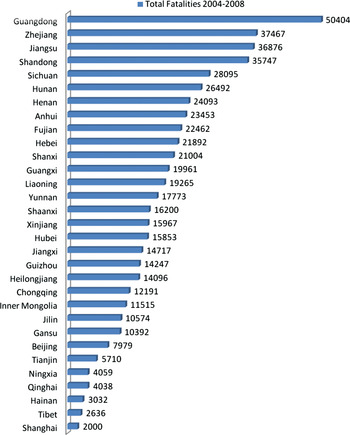
Figure 3 summarizes the numbers of fatalities in each province in Mainland China from 2004 to 2008. The top five on the list are Guangdong, Zhejiang, Jiangsu, Shandong and Sichuan. At the bottom is Shanghai, followed by Tibet, Hainan, Qinghai and Ningxia. To risk oversimplification, our interpretation is that the number of fatalities in each locality is positively related to its economic strengths. Four of the provinces at the top (the exception being Sichuan) are located in eastern China with relatively well-developed economies. During the same period (2004–08), Guangdong, Shandong, Jiangsu and Zhejiang were ranked the top four provinces in China in terms of GDP produced (13,007,946, 1,127,655, 11,089,298 and 8,038,192 million yuan respectively). The total GDP produced by these four provinces constituted more than one-third (36.5 per cent) of China's national GDP in the same period (119,010,536 million yuan). By contrast, Tibet, Qinghai and Ningxia are relatively poverty-stricken provinces in China's hinterland and Hainan is a travel site without substantial industrial production. The GDP produced by these four provinces (1,399,790 million yuan) was only around 1.2 per cent of the national GDP in the five years from 2004 to 2008.
Fatality Distribution among Provincial-Level Governments in Mainland China (2004–2008)
Note: The provincial data on work-related fatalities are available from 2004 because the release of the fatality indicators required all provincial-level governments to report total fatalities on a yearly basis.
Source: The State Administration of Work Safety (ed.), China's Work Safety Yearbook, 2004–08 (Beijing: Meitan gongye chubanshe, 2005–09). (colour online)

Of course, the level of a locality's economic development is not the sole factor explaining fatality variations. There are a number of additional factors that might explain the ranking result. We use the cases of Sichuan and Shanghai to illustrate this point. Sichuan is a locality with both a high level of coal-mining output and intensive employment in the coal-mining industry. In the measurement of fatality indicators, these two factors are highly related to the number of fatalities. In China, 20 out of 31 provinces are main providers of coal.Footnote 31 Measured by million tons of coal produced from 2004 to 2008, Sichuan was ranked eighth of the 20 provinces. In addition, Sichuan province was also ranked fourth of the 31 provinces in terms of both total population (82.17 million) and the number of employed population (47.8 million).Footnote 32 In contrast to the case of wealthy eastern localities, Shanghai, the economic centre of China, is an exception for having achieved a high value of GDP with the lowest fatalities. But this is reasonable given the nature of Shanghai's employed population. It has a much smaller workforce than the wealthier localities in eastern China. By 2008, Shanghai's employed population was about 8.66 million and was ranked seventh from bottom of the 31 provinces (Guangdong's number was 53 million, Shandong 53 million, Jiangsu 42 million and Zhejiang 36 million).Footnote 33 Furthermore, Shanghai does not produce coal. All these factors help to explain why it had a lower fatality figure than the wealthy eastern localities.
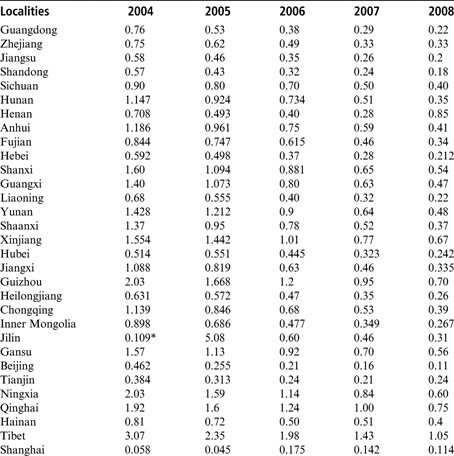
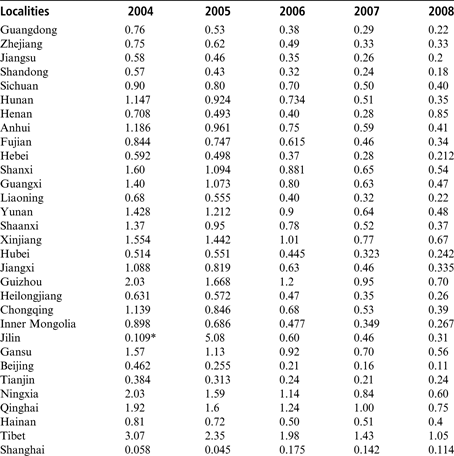
Tables 1 and 2 explain how the relative indicators can be used to pressure localities in middle and western China to improve work safety performance. Based on the ranking of Figure 3, Table 1 summarizes the fatality rate per 100 million GDP of the 31 provinces in Mainland China. It shows that the fatality to production rate in localities that have lower absolute fatalities in middle and western China are higher than those of eastern localities that have higher absolute fatalities. Guangdong, for example, although it records the highest fatalities among the 31 provinces (on average 10,080 per year from 2004 to 2008), has a fatality rate per 100 million GDP that declined from 0.76 in 2004 to 0.22 in five years because of its strong economy. By contrast, Tibet's fatality rate per 100 million GDP ranged from 3.07 in 2004 to 1.05 in 2008. However, it had a prominently low number of fatalities during the same period (on average 527 deaths per year). The hidden message is that although the absolute numbers of fatalities in localities in middle and western China may not be alarming, there is room for improving work safety performance and a need for reaching a better balance between economic growth and social development.
Fatality Rate per 100 Million GDP of Provincial-Level Governments in Mainland China (2004–2008)
Notes:
*The fatality of Jilin province in 2004 is markedly lower. According to the China's Work Safety Yearbook 2004, the total number of work-related fatalities in that year was 322. This may not be reliable because the total in Jilin province was 3,197 in 2005, 2,723 in 2006, 2,318 in 2007 and 2,014 in 2008. The number of 322 might be a typo in the report.
Sources:
Statistic bulletins on economic and social development in each locality, 2004–06, available online; The State Administration of Work Safety (ed.), China's Work Safety Yearbook, 2004–2008 (Beijing: Meitan gongye chubanshe, 2005–09).
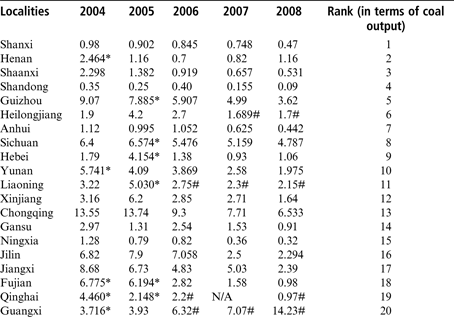
Fatality Rate per Million Tons of Coal Produced of Provincial-Level Governments in Mainland China (2004–2008)
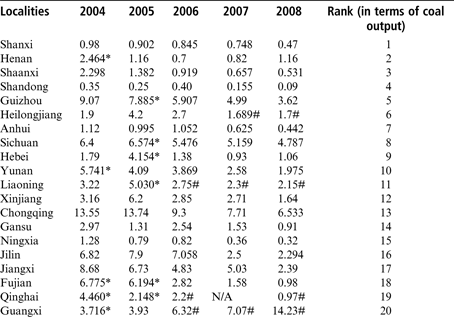
Sources:
Data are compiled from three sources since no one source has provided a consistent statistic on the fatality rate per million tons of coal produced in each locality in China. Most data are drawn from the State Administration of Work Safety (ed.), China's Work Safety Yearbook, 2004–08 (Beijing: Meitan gongye chubanshe, 2005–09); numbers marked * are compiled from the State Administration of Work Safety (ed.), China Coal Industry Yearbook 2004–08 (Beijing: Meitan gongye chubanshe, 2005–09); numbers marked # are drawn from the statistic bulletins of economic and social development in the specific locality in the specific year, available online. Inner Mongolia, measured by coal output from 2004 to 2008, ranks second in this table, after Shanxi. However it is not included because data from 2007 and 2008 are not available (0.48 in 2004, 0.54 in 2005, 0.18 in 2006).
Table 2 summarizes the fatality rate per million tons of coal produced in the 20 provinces. It shows that the relative indicators can be good reference points for making cross-locality comparisons regarding work safety performance. For example, Guangxi province recorded in total 184 deaths in coal-mine accidents from 2004 to 2008. However, the fatality rate per million tons of coal produced in the province ranged from 3.72 in 2004 to 14.23 in 2008, averaging 7.34 per year. Chongqing had a worse record in terms of absolute numbers when compared with that of Guangxi. It had 1,834 fatalities during 2004–08, an average of 366 per year. The fatality rate per million tons of coal produced in Chongqing dropped from 13.79 in 2004 to 6.53 in 2008, and averaged 10.14 per year. By comparison, Shanxi province, which is well known for rich coal resources and frequent coal-mine accidents, recorded a total of 2,229 deaths in coal-mine accidents during 2004–08, an average of 445 deaths per year. However, if measured by the fatality rate per million tons of coal produced, Shanxi's record was not that bad. The fatality rate declined from 0.984 in 2004 to 0.47 in 2008. This rate is much lower than that of Guangxi or Chongqing, which suggests that the latter two provinces paid a more expensive life price for producing coal than Shanxi.
Control by hierarchical accountability
Building bureaucratic accountability has been the central focus of China's target-based performance measurement system. Performance targets are allocated from the top down to the bottom of the administrative hierarchy. Lower-level officials are held responsible for the accomplishment of these targets to the next direct higher-level government. Performance targets have different priorities. The most important are “compulsory targets with veto power.” These are usually for crucial national policy goals such as work safety, family planning, environmental protection, corruption control, handling of mass petitions, energy saving and the like. Local leadership officials are held strictly responsible for the fulfilment of these priority targets. In general, “veto power” means that a failure to achieve any one of the priority targets would negate all other successful accomplishments for the year. Once vetoed, the organization would be banned from the annual evaluation and could consequently lose the opportunity to receive any rewards. In the meantime, the leadership officials who are in charge of the specific task vetoed may receive severe penalties such as bonus reduction, demotion, transfer or even removal from their positions.
Essential to this accountability mechanism is the measurement of compulsory targets with veto power. Nevertheless, in actual implementation, veto power is applied loosely because it is impossible for the central government to unify the measurement of the priority targets in localities. More often than not, it is local officials rather than central leaders who determine how the veto power of one specific target can be applied.
By comparison, the implementation of the fatality indicators enables the central government to unify when the veto power is triggered in assessing local officials' performance on work safety. First, the absolute indicators, which evaluate local officials on a pass-fail basis, provide a nationwide, standardized way to establish the circumstances where a local official's performance would be vetoed for failing the work safety task. The measure is undisputedly clear at all local levels: the veto power applies for one extra death exceeding the required number. Second, the fatality indicators support the establishment of a hierarchical accountability system, which has begun to take shape in some localities in recent years. Under this system, government officials and enterprise managers at different ranks and levels are held responsible for work-related accidents with different degree of severity.
The central government classifies work-related accidents into four types by the number of fatalities in one accident: normal accident (yiban shigu 一般事故, one or two deaths), major accident (jiaoda shigu, 较大事故, from three to nine deaths), serious accident (zhongda shigu 重大事故, 10–29 deaths) and so-called “special serious” accident (tebie zhongda shigu 特别重大事故, more than 30 deaths).Footnote 34 Generally speaking, managers of the production units have major responsibility for work-related accidents. Local leadership officials, particularly the government heads and officials who are in charge of work safety, have comprehensive leadership responsibilities. If an accident occurs, the unit of production must pay fines, the amount of which will depend on the cause and severity of the accident. The responsible persons of either the production unit or local government may be jailed if their actions violate criminal laws and other relevant legal rules and regulations.Footnote 35
Some localities have a more detailed division of responsibilities and penalties. For example, a document promulgated by Henan provincial government in 2008 stipulates that responsibility for coal-mine safety in the locality is based on the “personal rank” of an enterprise owner/manager or local official in line with the principle of management authorities. If there is one major coal-mine accident in the year, the head of the coal-mine, the deputy township head(s) and relevant county (city, district) officials responsible for coal-mine safety will be removed. If there are two major accidents in the year, the vice-manager of the coal-mine enterprise, township head(s) and heads of the relevant county (county-level city, district) agencies responsible for coal-mine safety will be removed. In the same manner, if there is one accident of more than 50 deaths or two accidents of 30–49 deaths in the year, the chairman of the coal-mine enterprise and the mayor will be dismissed or removed.Footnote 36
A caveat must be made here. Removal of leadership officials for their failure to accomplish priority targets in some cases does not put an end to their political career. Some of them are temporarily removed from their current position and assigned to another leadership position later on. What the Party leaders are eager to avoid is “appointment (and by extension promotion as well) with flaws” (daibing tiba 带病提拔), that is, appointing or promoting officials who tarnish the party-state's image and reputation for failing to accomplish the priority targets.Footnote 37 Nevertheless, ignominious removal and uncertainty about obtaining reappointment are effective enough to compel local officials to step up measures to improve work safety. In recent years, more and more officials have been penalized for serious work-related accidents. Official statistics show that in 2009 a total of 29,880 responsible individuals were investigated and received penalties for work-related accidents in China. Among the 549 people penalized for “special serious” accidents, 129 were local officials at or above the county level. They all received Party disciplinary or criminal penalties.Footnote 38 The fatality indicators certainly impose a huge pressure on local leadership officials, especially those who are in charge of work safety matters.
Discussion and Conclusion
Seven years have elapsed since the establishment of the fatality indicators in 2004. How effective have they been in changing China's work safety profile? The declining death tolls since 2004 provided by official statistics show notable improvement in reported work safety performance in local governments after the implementation of the fatality indicators. In 2009, China recorded a total of 83,196 deaths in work-related accidents, a 38.9 per cent drop from the 136,025 deaths in 2004. Hainan was the only provincial-level government out of 31 not to succeed in controlling total fatalities within the required numbers. In 2009 coal-mine accidents led to 2,631 deaths, a 60 per cent reduction from 6,027 in 2004.Footnote 39 The national fatality rate per 100 million GDP in 2009 was 0.248, an impressive achievement compared to 1.00 in 2004. The national fatality rate per million tons of coal produced reached 0.892, while in 2004 the number was 3.081.Footnote 40 Putting aside factors such as better law enforcement, the use of new safety technologies in workplaces and closure of numerous unsafe coal-mines, it appears that the implementation of fatality indicators has produced rather impressive results in curbing high fatalities.
As we have shown, the implementation of the fatality indicators is used to achieve three important policy goals. First, it ensures that local officials comply with the central work safety targets. The fatality indicators are a set of extremely precise targets allocated by the higher-level authorities downward level by level according to a unified method. This design prevents local officials from tailoring their performance levels for work safety management. Also, these precise targets clearly define when and how to apply the veto power and penalize local leadership officials who fail to curb fatalities as required. Second, the implementation of the fatality indicators to some extent tackles the responsibility traps of the previous work safety regulatory system. Giving local leadership officials the ultimate responsibility for work-related accidents is a strategy to dispel the responsibility confusion fostered by the multi-headed supervision system in work safety. In addition, the fatality indicators establish a clear link between the responsibility of leadership officials at a specific rank and the severity of work-related accidents. If a serious accident occurs, leadership officials at different levels in one locality are held jointly responsible. The implementation of the hierarchical accountability system prevents the higher-level authorities from simply dumping responsibility on the subordinate agencies because the system mandates that serious work-related accidents are to be managed on a locality basis. Third, the implementation of the fatality indicators provides crucial information for evaluating local government performance in maintaining a proper balance between social and economic development. Local officials are required to reduce both the absolute number of deaths and the fatality to production rate, but with a varying emphasis in different localities. Such an evaluation system compels local officials to give due attention to both economic growth and work safety.
Despite its many achievements, the implementation of fatality indicators brings challenges to work safety management as well. The most noticeable problem is local officials' dishonest reporting of their real performance of fatality control. In recent years, the media frequently report shocking news about local officials' behaviour of underreporting or covering up the real numbers of deaths in order to achieve the fatality indicator targets. For example, during the first four months of 2007, the WSC recorded nine cases of underreporting or covering up deaths in serious coal-mine accidents from several provinces.Footnote 41 On 2 February, a serious fire in Henan province led to 24 deaths due to illegal production. The mine owner, other stakeholders and several township officials colluded to cover up the real death toll. On 18 March, a gas explosion in Liaoning province caused six deaths. The mine owner covered up the information, faked working records and even secretly removed the corpses. On the same day, another serious explosion hit an illegal coal-mine in the Shaanxi province and killed 21 miners. The mine owner and other responsible people destroyed the evidence and absconded. Although the responsible parties in these accidents received severe penalties later after the cases were discovered, similar incidents keep occurring from time to time.Footnote 42
Output distortion, a typical gaming strategy in regimes emphasizing management by precise targets, has apparently become frequent, if not prevalent, in fatality control in Chinese local governments.Footnote 43 Further, the hierarchical accountability system may ironically stimulate higher-level officials to tolerate their subordinates' dishonest reporting for their own sake. As a result, local leadership officials at different levels may collude and form an alliance to cover up or underreport the real death tolls that exceed the fatality indicators. This phenomenon is well captured by a popular Chinese proverb: cheating originates from villages, levels up to townships, then counties and all the way to the State Council (cun pian xiang, xiang pian xian, yizhi pian dao guowuyuan 村骗乡,乡骗县,一直骗到国务院).
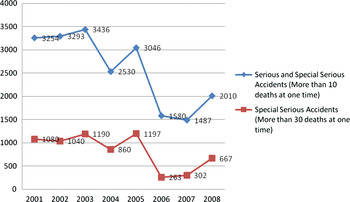
Another prominent challenge is that the implementation of fatality indicators has not so far successfully curbed serious and “special serious” accidents, which has been the central goal of work safety management since 1978. Figure 4 shows the fluctuation of fatalities instigated by serious and “special serious” accidents from 2001 to 2008. The two major fatality drops in 2004 and 2006 were followed by a rise of fatalities in the following years. The central leaders obviously felt the pressure of soaring serious accidents in 2007. As mentioned above, the first few months of 2007 recorded several cover-ups in reporting serious coal-mine accidents. Within the next five months, the State Council promulgated two documents to pressure localities to contain the occurrence of serious and “special serious” accidents.Footnote 44 However, such accidents still killed a total of 2,010 in 2008, a 35.2 per cent rise from 2007. Most sadly, the “special serious” accidents triggered 667 deaths, a 121 per cent rise over the previous year. The fluctuating number of very serious accidents is an odd phenomenon because theoretically local leadership officials should place a high emphasis on curbing these accidents for their own career concerns. Why did the fatality indicators fail to control such accidents? Was it because the serious or “special serious” accidents were more difficult to cover up or underreport? To what extent did the reporting politics – that is, how local officials manipulated the complicated evaluation system to report satisfactory performance – affect the effectiveness of the fatality indicators? Further studies are needed to answer these questions.
Fatalities Caused by “Special Serious” Accidents and Serious and “Special Serious” Accidents in China (2001–2008)
Note: Data in 2000 are not available.
Sources: The State Administration of Work Safety (ed.), China's Work Safety Yearbooks, 2001–08 (Beijing: Meitan gongye chubanshe, 2002–09); the Commission of Work Safety of the State Council, “2001 nian quanguo shangwang shigu qingkuang fenxi” (“The analysis on causalities around the country in 2001”), http://www.chinasafety.gov.cn/newpage/aqfx/aqfx_ndtjfx.htm, accessed 20 August 2010. (colour online)

It is beyond the scope of this article to discuss fully the consequences of implementing fatality indicators at the local levels in China. But several observations stand out. The fatality indicators are clearly not a panacea to resolve the crux of work safety problems in China as they deal with symptoms rather than causes. By nature their implementation strengthens only “inverse accountability” (nixiang wenze 逆向问责) of the vast Chinese bureaucracy, under which lower-level officials tend to be highly responsible for the policy directives of their next immediately higher-level supervisors and eventually up to those of the central leaders.Footnote 45 Such a system is inevitably limited in its effectiveness in holding leadership officials accountable to public interests.
In addition, whether the declining death tolls truly reflect improvement in work safety needs to be empirically examined. The system of fatality indicators puts band-aids on work practices (such as long hours with dangerous equipment) and poor human resources management that contribute to accidents. Keeping the death tolls down may be good public relations, but it does not do much for the conditions under which most coal-miners work. Some accidents are triggered by individual workers who are over-tired, bored, malnourished, socially isolated, or hate their jobs, coworkers and companies. In addition, the implementation of fatality indicators ignores the existence and knowledge of “normal accidents.”Footnote 46 Serious or “special serious” accidents resulting in multiple fatalities involve interactions that are not only unexpected but incomprehensible. People, particularly those in charge of work safety – the operators – have no clue about what is really going wrong. Indeed, people sometimes err to make serious mistakes. However, when blame for most of the accidents in a system is assigned to the operators who are responsible for work safety, it may indicate that they face an impossible task and that the true problems are systemic. For example, death indicators are affected by emergency responses and improved emergency/intensive care at the scene and in hospitals. As emergency care improves, deaths presumably decline, but safety may not improve.
Finally, in implementing the fatality indicators, zero tolerance may be unachievable. Yet the tolerance for a specific number of deaths per year can be dysfunctional. Suppose that a work safety official in a county in China has to have fewer than 100 deaths in a year. On 15 December there have been only 50 deaths but coal production has slipped. Should the official ratchet up production even though it may kill another ten miners? It is well known that American agencies rush to spend their full annual appropriations towards the end of the fiscal year. Has the implementation of fatality indicators provided an incentive for officials to ratchet up end-of-year production with the full knowledge that ten additional miners could be killed? Does it give a licence to tolerate (and in the most extreme case, virtually mandate) fatalities because the death number does not exceed the required level? Further studies are needed to address these issues and ascertain the effectiveness of the fatality indicators over a more extended number of years.