


Introduction
Lifetime prevalence of obsessive-compulsive disorder (OCD) is thought to be between 1 and 3% of the population, with peak age of onset during childhood (Kessler et al., Reference Kessler, Amminger, Aguilar-Gaxiola, Alonso, Lee and Ustün2007). OCD has a significant and negative effect on a child's psycho-social development (Valderhaug and Ivarsson, Reference Valderhaug and Ivarsson2005) and if untreated frequently continues into adulthood with increasingly detrimental effects (Stewart et al., Reference Stewart, Geller, Jenike, Pauls, Shaw, Mullin and Faraone2004). Cognitive behavioural treatment (CBT) of OCD has demonstrated greatest efficacy (Öst et al., Reference Öst, Riise, Wergeland, Hansen and Kvale2016) and is favoured in many health settings (see NICE guidelines; NICE, 2017). Nonetheless, a significant number of young people receiving CBT for OCD do not achieve full remission and many more delay or completely avoid accessing treatment (Eddy et al., Reference Eddy, Dutra, Bradley and Westen2004) suggesting significant room for improvement.
CBT for childhood OCD typically involves assessment, psychoeducation, formulation, cognitive restructuring and behavioural experiments involving exposure and response prevention. With recognition of the need for improvement, there is increasing call to examine different elements of treatment separately in order to identify the most active ingredients in achieving clinical change (Freeman et al., Reference Freeman, Choate-Summers, Moore, Garcia, Sapyta, Leonard and Franklin2007). Psychoeducation is a common component of treatments for mental health conditions both within and beyond CBT that aims to enhance clients’ insight, align them with available treatments, and in turn improve adherence. Whilst psychoeducation more broadly has been found to reduce the occurrence of mental health issues and help with their amelioration when they do occur (Donker et al., Reference Donker, Griffiths, Cuijpers and Christensen2009), its impact is yet to be explored specifically with childhood OCD.
Psychoeducation offered to children with OCD tends towards either a biomedical perspective (associated with organic factors/disease or a neurological disorder) or a cognitive behavioural perspective (associated with stable patterns of thinking or erroneous thoughts). This is exemplified by the two leading treatment manuals (March and Mulle, Reference March and Mulle1998; and Waite and Williams, Reference Waite and Williams2009) which sit in contrast with each other; the former advocates a ‘neuro-behavioural’ explanatory model, and the latter advocates a purely cognitive behavioural explanation.
In contrast to cognitive behavioural models that have highlighted family functioning (Derisley et al., Reference Derisley, Libby, Clark and Reynolds2005), behavioural conditioning (Meyer, Reference Meyer1966) and cognitive errors (Salkovskis, Reference Salkovskis1999), research advocating biomedical explanations of OCD has focused on genetics (Taylor, Reference Taylor2011), auto-immune disorder (Gause et al., Reference Gause, Morris, Vernekar, Pardo-Villamizar, Grados and Singer2009), neurological deficits (Ahmari et al., Reference Ahmari, Spellman, Douglass, Kheirbek, Simpson, Deisseroth and Hen2013) and serotonin abnormalities (Denys, Reference Denys2006). There is reported to be increasing evidence of biological factors in the aetiology of the disorder (e.g. Taylor, Reference Taylor2011), and it is viewed as de-stigmatizing and non-blaming in comparison with cognitive behavioural models and thus of benefit to the family (March and Mulle, Reference March and Mulle1998). However, critics of the biomedical model argue that a comprehensive biological model of OCD remains elusive, that it places an unsupported emphasis on pharmacological interventions (Deacon, Reference Deacon2013) and that, in adults at least, it promotes prognostic pessimism in the client (Rimes and Salkovskis, Reference Rimes and Salkovskis1998).
In addition to the absence of consensus as to the cause of childhood OCD, less still is known about the clinical utility of these explanatory models when offered to children as part of their psychoeducation. This poses a clear dilemma for clinicians; do explanatory models help children with OCD and which explanatory model should they offer? In the only related experimental test of this question to date, Lam and Salkovskis (Reference Lam and Salkovskis2007) found that depressed/anxious adult clients held a significantly more pessimistic prognosis when exposed to a biomedical causal explanation for panic disorder compared with those who were provided with a psychological explanation.
This clinical dilemma may be particularly pertinent when working with children. Child models of CBT have been criticized for failing to be sufficiently adapted from their genesis with adult populations (Field et al., Reference Field, Cartwright-Hatton, Reynolds and Creswell2008). Critics have pointed to the distinct variation in how and what information children are able to process. Dynamic periods in a child's cognitive development mark a challenge for clinicians in how to explain OCD in a way that it can be understood. Explanations that are inconsistent with prior knowledge are especially powerful triggers for children to engage in learning (Legare et al., Reference Legare, Gelman and Wellman2010) and they are more susceptible to the new explanation if it is assumed that their source is well informed (Robinson and Whitcombe, Reference Robinson and Whitcombe2003). Furthermore, where younger children tend to assume there must be one correct explanation, older children (>10 years) become aware of the epistemology of explanations (Kuhn and Franklin, Reference Kuhn and Franklin2006) and it is not until adolescence that the capacity for truly pluralist, relativistic explanations incorporating multiple dimensions are developed (Diamond and Savin-Williams, Reference Diamond and Savin-Williams2009).
This study used an experimental design allowing the examination of children's naive concepts of OCD and the relative impact of the explanatory models that participants were exposed to. Under controlled conditions the impact of two alternative explanations (biomedical and cognitive behavioural) for childhood OCD were compared.
Participants’ beliefs in terms of the consequences, timeline, curability, emotional impact, perceived level of understanding, and level of control of OCD were explored in three ways. We first examined children's ‘naïve’ pre-treatment beliefs about OCD. We then examined how they change under the influence of contrasting models of psychoeducation. Finally we tested for broader explanatory variables that may be impacting on the participants’ conceptualizations such as their age, gender, literacy and prior exposure to OCD.
We hypothesized that: (1) participants will become more aligned with the causal explanation provided in the psychoeducation they receive; (2) manipulating children's concepts of the cause of OCD using psychoeducation will have an impact on the prognosis they offer; and (3) biomedical psychoeducation will result in significantly worse prognosis.
Method
Participants
A non-clinical sample was selected in order to examine the naive concepts young people typically have of OCD. Two hundred and four participants were recruited from state-funded junior schools in a large city in Ireland, in areas deemed ‘marginally above average affluence’ (Central Statistics Office, 2011). Three responses were incomplete, resulting in a sample of 201: 79 boys and 122 girls. Their mean age was 11.54 years (SD = 31.23) ranging from 10 to 13 years incorporating the average age of onset of childhood OCD. All participants were required to speak English and have a proficient level of literacy. Twenty-nine participants (14.4%) indicated that they, or someone they knew, may have had OCD.
Procedure
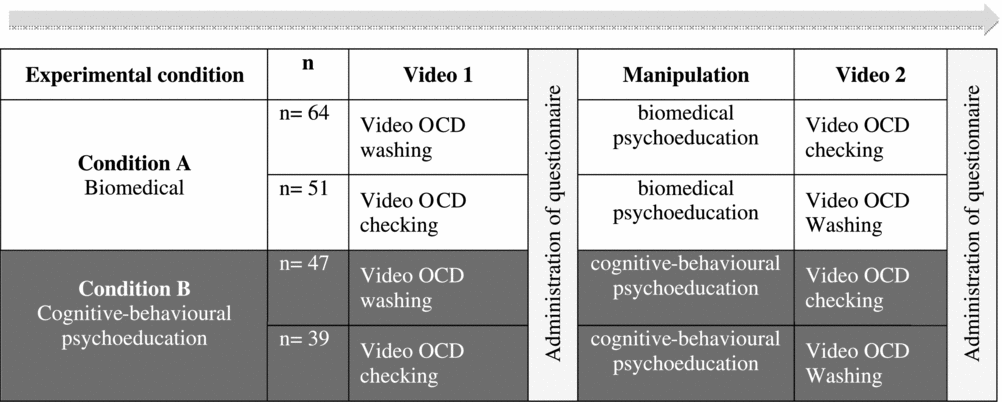
Ethical approval was granted by the University Ethics Committee. The experiment followed a within-subjects and between-groups design (see Fig. 1) and was delivered in a whole-class format. Participants were exposed to a generic emotional wellbeing workshop that had embedded within it an introduction to the use of Likert scales and the experimental procedure.
Overview of the experimental procedure.

To establish the participants’ naive causal explanations for OCD and to enable a manipulation check, all participants were exposed to two videos of a young person describing their OCD; first without an explanation, and then with either a biomedical or cognitive behavioural explanation of OCD. After each video, the Child Concepts of OCD Questionnaire was administered. Full electronic copies of the workshops and videos are available on request from the corresponding author.
Experimental manipulation
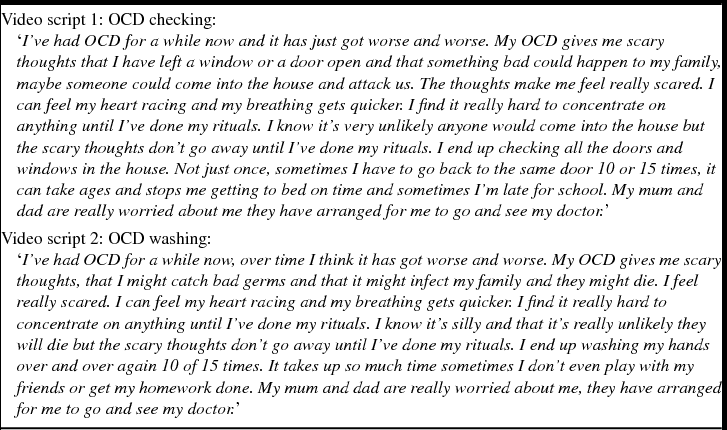
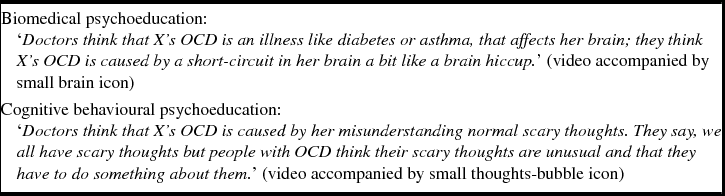
All participants were exposed to two videos of children describing their OCD. To control for order effects, the videos were of two different children describing variations of OCD (one washing, one checking) and their order was counter-balanced (see Fig. 1). The young people in the videos were actors following a script. Their scripts described typical OCD symptoms as defined by the Diagnostic and Statistical Manual V (American Psychiatric Association, 2013) and were equal in length and severity of symptoms (see Table 1). The experimental manipulation was exposure to an explanation for OCD prior to watching the second video. In condition ‘A’, the explanation was biomedical (drawn from March and Mulle, Reference March and Mulle1998) and in condition ‘B’ it was cognitive behavioural (drawn from Waite and Williams, Reference Waite and Williams2009). The explanation was equal in length and strength of assertion and reflected the minimal psychoeducative component advocated by the two approaches (see Table 2).
Video scripts for young people describing their OCD

Psychoeducation provided in the experimental manipulation

Measures
Child Concepts of OCD Questionnaire: the questionnaire is an adapted version of the Brief Illness Perceptions Questionnaire (B-IPQ) (Broadbent et al., Reference Broadbent, Petrie, Main and Weinman2006). The B-IPQ was designed to probe for concepts of illness that have been associated with coping behaviours. Whilst originally developed for the assessment of physical illnesses in adults it is increasingly being used for mental health issues (Petrie et al., Reference Petrie, Broadbent and Kydd1997) and has also been adapted for the use of lay people reporting an illness concern in another (Figueiras and Alves, Reference Figueiras and Alves2007). It has been found to have good test–retest reliability, concurrent, and discriminant validity (Broadbent et al., Reference Broadbent, Petrie, Main and Weinman2006). It has also been found to hold good predictive reliability with item responses showing a significant correlation with coping behaviour engaged in, for example a perceived longer timeline and lower chance of cure has been associated with avoidant coping behaviours (Hagger and Orbell, Reference Hagger and Orbell2003).
The initial section of the adapted questionnaire gathered demographic details: an identifier, age, prior experience of OCD and gender. In order to provide a manipulation check, section A assessed the perceived cause of the young person's OCD. In an adaptation of the B-IPQ, causality was assessed via closed rather than open response items. This adaptation was made to reduce the risk of ‘don't know’ responses otherwise likely in a sample of this age. Six internal and external factors were incorporated, including those provided in the experimental manipulation. Additional causal factors were drawn from items parallel to those used in the study of parental beliefs regarding the cause of their child's mental health difficulty (Reid et al., Reference Reid, Shanley, Goffin, Belle Brown, Evans, Vanier Children and London2008).
Items 2 and 10, and 4 and 6, provided the manipulation check. Items 2 and 10 ‘because she has a brain illness’ and ‘because she has a short circuit in the brain’ were drawn from the language used in the March and Mulle (Reference March and Mulle1998) treatment manual. They probed for a concept of biomedical causality associated with fixed organic factors and associated with disease or a neurological disorder. Items 4 and 6 ‘because she is mistaking normal thoughts as bad’ and ‘because she does not understand her thoughts’ were drawn from the language used in the Waite and Williams (Reference Waite and Williams2009) treatment manual; they probed for a concept of cognitive behavioural causality associated with stable patterns of thinking or erroneous thoughts. In both cases the operative educational components from the respective treatment manuals were maintained, that is OCD being a neurological ‘brain’ condition or a cognitive difficulty brought about from our ‘misunderstanding’ of normal thoughts. Items 8 and 12 ‘because there are lots of arguments at home’ and ‘because her mum or dad had OCD too’ probed for family factors, causality associated with conflict in family or parental OCD. Items 1 and 5 ‘because she is naughty’ and ‘because she doesn't have any friends’ probed social problems, causality associated with social adaptation, being disliked or trouble making. Items 3 and 7 ‘because her mum and dad are nasty’ and ‘because her mum and dad don't care about her’ probed for trauma, causality associated with neglect, or abuse; and items 9 and 11 ‘because she eats too much sugar’ and ‘because she doesn't eat many vegetables’ probed for dietary problems, causality associated with a malnourished or unhealthy diet. Each factor was measured via two 5-point Likert questionnaire items to improve internal consistency. These were added together to provide the overall score for each explanation.
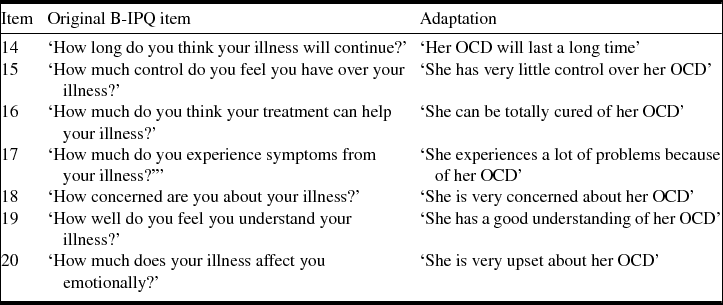
Section B assessed the participant's perception of the prognosis for the young person with OCD in the domains identified in the B-IPQ. Participants were asked to rate how strongly they agreed with statements concerning consequences, timeline, control, curability, severity, concern, level of understanding and emotional impact the young person with OCD was experiencing. Items were adapted for use by child populations who were reporting their concepts of OCD in another young person rather than themselves, were changed from questions to statements and reduced from 10 individuated, to five standardized Likert responses. For example, ‘How much does your illness affect your life?’ on the B-IPQ became item 13 ‘Her OCD affects her life a lot’ on the Child Concepts of OCD Questionnaire (see Table 3). A visual analogue scale was added to aid comprehension, with a tick indicating ‘I agree a lot’, a confused face indicating ‘not sure’ and a cross indicating ‘I really don't agree’.
Adaptations to the B-IPQ

Mary Immaculate Reading Attainment Test (MICRA-T; Fallon, Reference Fallon2004) is a group administered standardized reading test. Scores were extracted from individual pupil files.
Data preparation
Mean imputations were used for a small number of questionnaires (n = 8) that had single incidents of missing data (Ader and Mellenbergh, Reference Ader and Mellenbergh2008) and because of the number of t-tests necessary for this approach, a Bonferroni correction was applied. In order to assess for the magnitude of any difference found, a calculation of effect size was also made using Cohen's d calculation (Cohen, Reference Cohen and Erlbaum1988).
Results
Participants’ naive causal explanations of OCD (pre-manipulation)
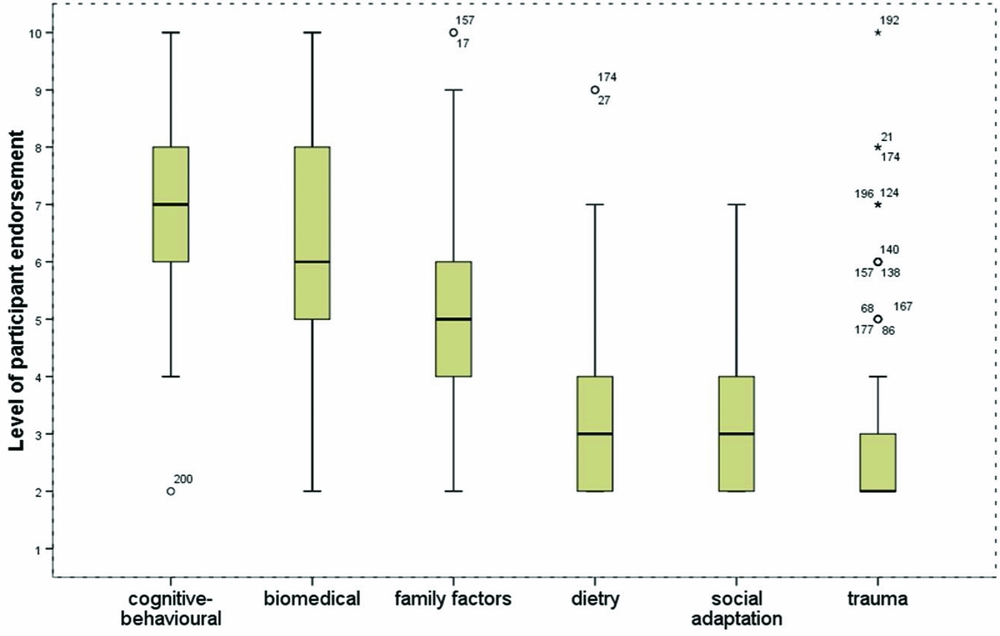
Differences between participants’ naive explanations for OCD were examined using one-way, repeated measures ANOVA. A Greenhouse-Geisser correction was applied to account for a violation of the assumption of sphericity (ε = .81). There were significant differences with a large effect size found between scores for the various explanatory models (F [1,200] = 6475.50, p = <.001, η² = .97.) When sequenced from most to least endorsed, cognitive behavioural explanations were the most popular, followed by biomedical explanations and family factors. Diet, trauma and social adaptation scored below ‘5’, indicating that participants consistently rejected or were unsure about their causality in relation to childhood OCD. Differences between level of endorsement of causal factors were significant (p < .001) in all cases other than trauma and social adaptation (p = .187). Table 3 and Fig. 2 provide means, standard deviations, outliers and confidence intervals set at 95%.
Box plots of participants’ naive concepts of OCD.

Explanatory variables for participants’ naive causal explanations of OCD
One-way ANOVAs and bivariate correlations were conducted to assess for relationships between demographic factors and participants’ naive causal explanations for OCD. No differences between male and female participants were found. Participants who reported prior exposure (n = 29) were significantly more likely than their peers to endorse a biological causal explanation with a small to medium effect size; F [1,199] = 3.96, p = .048, d = 0.38. No correlations were found between participants’ age, gender, or level of literacy and their naive causal explanations for OCD.
Changes in children's concepts of OCD after receiving psychoeducation
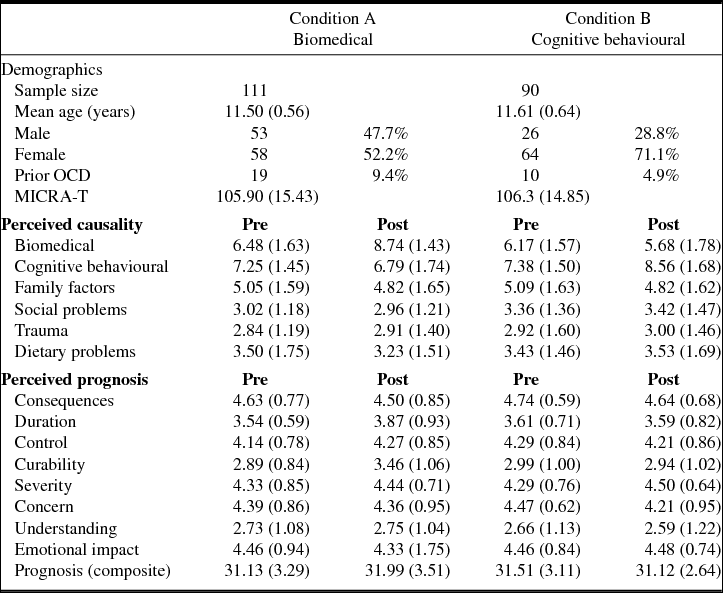
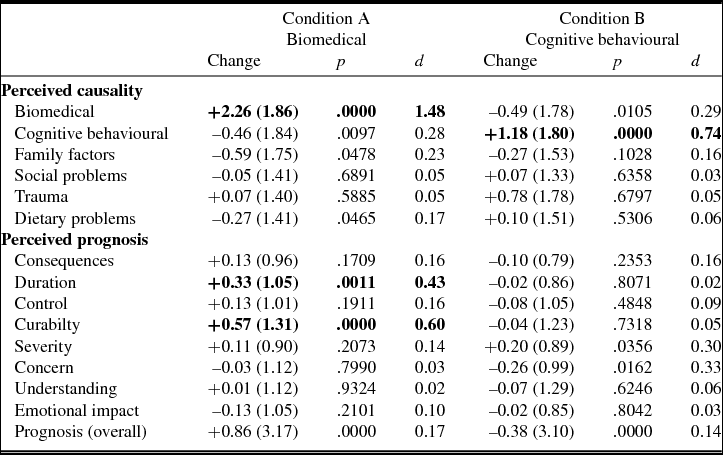
To assess whether the cognitive behavioural or biomedical psychoeducation impacted on each participant's explanation of OCD, a mean explanatory change score was calculated. Differences between pre- and post-manipulation were then examined using paired sample t-tests, per condition. Exposure to both biomedical and cognitive behavioural causal explanations resulted in significant increases in their relative domains of change, with medium to large effect sizes (biomedical: t [200] = –6.42, p = < .0000, d = 1.48; cognitive behavioural: t [200] = −1.95, p = .0000, d = .29). An increase in endorsement of a cognitive behavioural explanation appeared to result in a decrease in a biomedical explanation (–0.49, p = .0105, d = .28) and vice versa (–0.46, p = <.0097, d = .29) whilst all other domains remained largely stable. These results suggest that the manipulations were effective; when participants were told the cause of OCD was biomedical they were significantly more likely to endorse biomedical explanations, and so forth. No relationships between causal explanation change and demographic factors were found. Mean pre- and post-manipulation scores can be found in Table 4. Change scores, their level of significance and the effect size can be found in Table 5.
Means (standard deviations) for the two conditions

Mean change scores, standard deviations, significance and effect sizes by condition

Values that are both significant and of a medium to large effect size are given in bold.
Impact of cognitive behavioural and biomedical psychoeducation on perceived prognosis
To assess how the psychoeducation impacted on the prognosis participants offered, pre- and post-manipulation change scores were calculated per condition and then compared across conditions. Firstly, comparisons were made between overall prognosis and then per domain of change (e.g. severity, consequence, emotional impact, etc.)
The overall prognosis was a composite variable combining items 13 to 20 on the adapted B-IPQ. Independent sample t-tests revealed small but significant differences between conditions (t [190.21] = 2.79 p = .006, d = 0.15). Biomedical explanations appeared to consistently worsen participants’ prognosis for the young person with OCD, but internal reliability for the composite was deemed poor (α = .36), indicating that this child sample did not view these domains as inter-related.
For the domains of severity, consequences, emotional impact, control and concern, participants on average ‘agreed’ or ‘strongly agreed’ that the young person had lots of problems, that were affecting her life a lot, that she was very upset and concerned about her condition, and over which she had very little control. For the domain of understanding participants were ‘unsure’ or ‘disagreed’ that she had a good understanding of her condition. None of these domains changed significantly post-manipulation.
For the duration domain participants were ‘unsure’ or ‘agreed’ that the young person was going to be unwell for a long time. Paired sample t-tests revealed significant changes within the biomedical condition with medium to large effect size post-manipulation (t [110] = –3.35, p = .0011, d = .43). Participants within the cognitive behavioural condition demonstrated no significant change. Change scores were compared between the two conditions using independent sample t-tests. Although not significant at the corrected p value (.005), differences between the conditions were maintained, with medium to large effect size (t [198.95] = –2.64, p = .008, d = .35). This p value is marginally short of the critical level set for statistical significance; however, this is probably due to the high baseline endorsement of cognitive behavioural explanatory beliefs (and therefore lower change score for that condition). Given this consideration, and the conservative nature of the Bonferroni correction, these results suggest that the participants exposed to a biomedical psychoeducation expected that the young person would be unwell for longer than those exposed to cognitive behavioural psychoeducation.
For the curability domain participants appeared ‘unsure’ or to ‘disagree’ that she could be totally cured of her OCD. Paired sample t-tests revealed significant changes in the biomedical condition post-manipulation with large effect size (t [110] = –4.56, p = <.0000, d = .60). Participants within the cognitive behavioural condition demonstrated no significant change. When comparisons were made between conditions using independent sample t-tests, this difference was maintained with medium to large effect size (t [199] = 3.39, p = .0008, d = .41). When exposed to a biomedical causal explanation, participants predicted that the young person had less chance of achieving remission.
Discussion
This is the first study of its kind examining children's concepts of OCD. It has identified children's naive concepts of OCD and compared how they changed under the effect of biomedical versus cognitive behavioural psychoeducation. There is research supporting both models, but we do not know about their clinical utility when provided in psychoeducation to children.
There is reasonable evidence to support all three hypotheses; with psychoeducation the participants became more aligned with the explanation provided, the psychoeducation impacted on the prognosis they offered and the prognosis offered was comparably worse for those offered biomedically orientated psychoeducation. The study provides some useful findings that could have direct implications for clinical practice.
Children's naive concepts of OCD appear to reflect the predominant models prescribed by mental health professionals
Pre-manipulation the children in this study were most likely to endorse cognitive behavioural then biomedical explanatory models for OCD. Generally speaking, these are the two most popular models held in lay adult populations (Schomerus et al., Reference Schomerus, Schwahn, Holzinger, Corrigan, Grabe, Carta and Angermeyer2012); however, this sample of children contrasted in their prioritization of cognitive behavioural over biomedical explanations. Arguably this reflects that, as with other internalizing difficulties, cognitive behavioural models provide a better ‘fit’ than biomedical models with children's intuitive understanding of OCD (Fox et al., Reference Fox, Buchanan-Barrow and Barrett2010). Interestingly, when participants increased their endorsement of a biomedical explanation, they reduced their endorsement of a cognitive behavioural explanation and vice versa. This probably reflects the lingering effects of Cartesian dualism in healthcare, whereby holding OCD as both a mind and body problem feels as uncomfortable for children as it does for some clinicians (Duncan, Reference Duncan2000). From a cognitive behavioural perspective, these findings are largely encouraging; shared conceptualizations between clinician and client are seen to positively impact on treatment outcomes (Horvath and Symonds, Reference Horvath and Symonds1991).
Prior exposure to OCD appears to impact on children's conceptualizations
Although a small number (n = 29), children with prior exposure to OCD were found to be more likely than their peers to endorse biomedical explanations. Despite the recent growth of cognitive behavioural provision, the biomedical model continues to dominate service provision (Harland et al., Reference Harland, Antonova, Owen, Broome, Landau, Deeley and Murray2009) and media portrayal (Lewison et al., Reference Lewison, Roe, Wentworth and Szmukler2012). Under these circumstances personal experience or proximity to another with OCD is likely to increase a child's contact with, and thus endorsement of, biomedical causal explanations. Alternatively it could reflect children's desire to explain internalizing difficulties as, in some way, outside of the control of the individual (Goossens et al., Reference Goossens, Bokhorst, Bruinsma and van Boxtel2002) If so, it may provide support for the notion that biomedical explanations can help reduce blame in the family (March and Mulle, Reference March and Mulle1998).
Children appeared receptive to psychoeducative input, even at the minimal dose
Participants’ favoured naive explanations demonstrated greatest change post-manipulation. This suggests that even relatively strongly held concepts of OCD are amenable to change during childhood. Research in the developmental psychology literature supports this finding, with children capable of abrupt change dependent upon the source of information (Robinson and Whitcombe, Reference Robinson and Whitcombe2003) and the initial level of variability in the child's conceptualizations (Alibali, Reference Alibali1999). Typically periods of conceptual transition are marked by increased variability but this was not found in this study. Causal factors other than biomedical/cognitive behavioural remained fairly stable post-manipulation. This highlights both the potential strength and weakness of clinicians providing children with explanations for their difficulties; they are both receptive and amenable to psychoeducation, but they are likely to assimilate explanations, regardless of their utility and potentially to the exclusion of other plausible explanations. This places an increased burden of responsibility on the clinician.
Children's concepts of illness are less sophisticated than adults
In adult populations, domains of illness have been found to be inter-related (Petrie et al., Reference Petrie, Broadbent and Kydd1997). For example, if an illness is seen to have severe consequences, it is typically seen to have a longer timeline and lower curability. Awareness of these relationships has enabled clinicians to target specific maladaptive beliefs concerning prognosis and in turn improve the client's overall perception of their illness and their coping behaviours. In this study the participants were clearly linking cause and aspects of prognosis but relationships between the domains of prognosis alone were weak. This probably reflects the participants’ developmental stage. ‘Psychological essentialism’, the ability to discern underlying relationships between concepts, is seen to develop with a child's age (Gelman, Reference Gelman2004). From a clinical perspective, this highlights an important area for assessment and intervention with children; how do they understand what they are experiencing and what relationships, if any, do they have between the domains of their perceived prognosis? It is hypothesized that, as in adult populations, helping the child to understand the inter-relation of their concepts of OCD and targeting maladaptive prognostic beliefs may aid recovery.
Being provided with biomedical psychoeducation appears to promote prognostic pessimism
Exposure to biomedical psychoeducation resulted in children predicting a worse prognosis for the young person with OCD; participants predicted being ill for longer with less of a chance of cure. This replicates prior studies in adult populations for different disorders (e.g. Lam and Salkovskis, Reference Lam and Salkovskis2007). It is concerning as negative predictions of cure and timeline are systematically associated with avoidant coping behaviours (Baines and Wittkowski, Reference Baines and Wittkowski2013; Hagger and Orbell, Reference Hagger and Orbell2003). It has been posited that biomedical explanations promote pessimism by locating the problem and (therefore the solution) in genetics or brain functioning – domains that are typically outside of the conscious control of the individual (Deacon, Reference Deacon2013). Future research may benefit from examining this proposition directly.
Age and gender were not found to impact on children's conceptualisations
Typically, children are found to have increasingly complex and pluralistic causal explanations for behaviour with an increasing emphasis on external drivers such as parenting or life experiences for mental health difficulties (Hennessy and Heary, Reference Hennessy and Heary2009; Maas et al., Reference Maas, Marecek and Travers1978). The failure to identify strong demographic trends in this research may reflect a type II error, with a relatively narrow range of ages and no direct examination of variability within participants’ responses. A replication of this study using a broader age range and examining variability in participant responses is warranted.
Study limitations
There are several limitations that should be acknowledged when considering the current findings:
The use of a simple stimuli
The stimuli provided in the manipulation are selected verbatim from two of the leading and contrasting manuals in the treatment of OCD and help delineate the differential effect of the two approaches. However, whilst providing a good analogy for cognitive behavioural and biomedical approaches, they are unlikely to reflect the complexity of providing psychoeducation in clinical practice. For example, many clinicians would adopt a bio-psychosocial approach when providing psychoeducation to young people with OCD (Winters et al., Reference Winters, Hanson and Stoyanova2007). Comparisons with a control group who have received treatment for OCD may help answer some of these questions.
Comparability of language used across conditions
Whilst drawn directly from treatment manuals and matched on word count and strength of assertion, there could have been differences in the conceptual difficulty of the psychoeducation provided in the two conditions. A further potential confound was the adaptations made to the B-IPQ. They were designed to increase accessibility to the child sample and to provide a ‘manipulation check’. However, they must also be considered as a threat to the comparability of the two conditions. The items in the Child Concepts of OCD Questionnaire probing for biomedical conceptualization are quoted verbatim from the manipulation, whereas one of the cognitive behavioural items used the word ‘bad’ rather than ‘unusual’ as prescribed in the manipulation. Future studies may want to avoid this potential confound by ensuring that the language is consistent and that the adaptations are of equal weight across both conditions.
The use of a five-point Likert scale may also have limited the strength of the findings. In a number of the domains that demonstrated no significant change (e.g. consequences, control, emotional impact) many of the participants endorsed a maximal ‘strongly agree’ pre-manipulation, leaving them little room to move in the event that their views became stronger post-manipulation. This could be circumvented with an analogue visual scale in future studies that could provide superior metrical characteristics.
Generalizabilty
It is important to note that how we conceptualize an illness is influenced by the prevailing views within the culture in which we exist (Cameron et al., Reference Cameron, Leventhal, Kelly, Hertel and Saioveyl2003). The participants used in this study were predominantly white and of a ‘above average’ socio-economic status. They are likely to have had prior exposure to cognitive behavioural and biomedical conceptualizations of mental health issues as they tend to predominate in Irish mental health services. However, prevailing views on mental health conditions and their treatment vary from culture to culture. For example, what of more collectivistic cultures where causality is often bound in relationships (Crystal, Reference Crystal2000) or cultures such as the US where biomedical conceptualizations and pharmacotherapy are more widely prescribed (Deacon, Reference Deacon2013). These factors make it difficult to generalize the findings to broader populations and need to be considered in any future research in this field. In particular, future investigations may benefit from exploring the impact of varied models of psychoeducation for a clinical population of varied ethnic backgrounds and cultures.
Notwithstanding these limitations, our preliminary findings throw light on some important questions for clinicians working with childhood OCD. It appears that children are receptive to psychoeducation even at the minimal dose and importantly, it changes the way they view the difficulty they are experiencing. In adult populations, these views have been seen to influence coping behaviours and ultimately treatment outcomes and therefore merit greater attention in the child literature. Biomedical causal explanations for OCD predominate (e.g. RCP, OCD-UK, NIH) yet the current findings call the utility of this practice into question. Whilst further research is required, mental health services and institutions may want to consider a more neutral approach. Comparatively this research suggests that a cognitive behavioural causal explanation will improve the child's perception of their prognosis. Individual clinicians may want to examine children's pre-existing concepts of OCD, its cause and consequences. If causal explanations are offered they may want to be provided tentatively and the consequence of any explanation explored carefully.
Acknowledgements
We would like to thank all participants for taking part in this study.
Conflicts of interest: Ben Butlin and Charlotte Wilson have no conflicts of interest with respect to this publication.
Financial support: This research received no specific grant from any funding agency, commercial or not-for-profit sectors.
Ethical standards: Ethical approval was provided by the Psychology Department Trinity College Dublin with All procedures complying with the ethical standards of The American Psychological Association.’



Comments
No Comments have been published for this article.