Introduction
Modern societies enforce collective action through delegation of sanctioning duties, which relies on the legitimacy of authority to promote socially desired outcomes.Footnote 1 And yet, whether for general economic outcomes or organizational behavior and performance, we know little about “the precise causal mechanisms through which the type of governance affects individual behavior” (Hargreaves Heap, Tsutsui and Zizzo, Reference Hargreaves Heap, Tsutsui and Zizzo2015). In particular, do democratic institutions succeed by selecting the best delegates, or does participative democracy have an effect on accountability beyond selection? In this paper, we experimentally control for this selection effect to examine whether electoral political accountability functions as a source of institutional legitimacy to promote collective action.
Much research on democratic institutions focuses on direct democracy, in which participants vote to directly implement group-wide decisions. Walker et al. (Reference Walker, Gardner, Herr and Ostrom2000) and Kroll, Cherry and Shogren (Reference Kroll, Cherry and Shogren2007) find that direct democracy increases contributions to public goods, though DeAngelo, Dubois and Romaniuc (Reference DeAngelo, Dubois and Romaniuc2018) show that majority coalitions may use direct democracy to exacerbate inequality. A similar strand of research explores direct voting over sanctioning institutions and other consequential actions (Botelho et al., Reference Botelho, Harrison, Pinto and Rutström2005; Ertan, Page and Putterman Reference Ertan, Page and Putterman2009; Cinyabuguma, Page and Putterman, Reference Cinyabuguma, Page and Putterman2005; Tyran and Feld, Reference Tyran and Feld2006; Ambrus and Greiner, Reference Ambrus and Greiner2015). Sutter, Haigner and Kocher (Reference Sutter, Haigner and Kocher2010) compare the effectiveness of sanctions and rewards as determined via exogenous or endogenous selection, finding that both incentives have a larger effect when endogenously chosen by participants (see also Sefton, Shupp and Walker, Reference Sefton, Shupp and Walker2007).
A smaller literature examines democratic and other forms of delegation of authority. Democratic delegation of group contributions in collective action environments has been shown to effectively resolve the free riding problem (Hamman, Weber and Woon, Reference Hamman, Weber and Woon2011; Bolle and Vogel, Reference Bolle and Vogel2011; Fleiß and Palan, Reference Fleiß and Palan2013). Other recent work shows that a centralized sanctioning authority brought in from outside the group can lead to more efficient outcomes than decentralized sanctioning between group members (Andreoni and Gee, Reference Andreoni and Gee2012; Baldassarri and Grossman, Reference Baldassarri and Grossman2011). One question that arises from these studies, which we address using laboratory experiments, is to what extent the method of appointing a central authority or whether the authority is chosen from within the group matters.
Contrary to the common belief about the causal influence of democratic institutions on collective action and economic outcomes, experimental evidence on delegated enforcement remains inconclusive. Baldassarri and Grossman (Reference Baldassarri and Grossman2011) and Grossman and Baldassarri (Reference Grossman and Baldassarri2012) use a lab-in-the-field public goods game with centralized punishment, finding that democratically appointed sanctioning agents brought in from outside the group increase public good contributions relative to randomly appointed external agents. However, Castillo et al. (Reference Castillo, Xu, Zhang and Zhu2018) find no difference between elected and exogenously appointed sanctioning agents in two experimental environments with different levels of sanctions’ efficacy, and Hargreaves Heap, Tsutsui and Zizzo (Reference Hargreaves Heap, Tsutsui and Zizzo2015) similarly find no difference in group outcomes under democratic and dictatorial decision rules. Beyond known experimental nuances, the source of legitimacy in democratic institutional arrangements remains a challenge for causal inference.
In the political science literature, several mechanisms for legitimacy have been analyzed. These include the type of leadership (Grossman, Reference Grossman2014), quality of governance and public information (Adserà, Boix and Payne, Reference Adserà, Boix and Payne2003), and political competition (Zudenkova, Reference Zudenkova2018). Less is known about the influence of the mechanisms of political accountability in building a leader’s legitimacy—in fact, Ferejohn (Reference Ferejohn1999) acknowledges that informational advantages that leaders have can be used to reduce responsiveness without reducing legitimacy. Under representative institutions, political accountability rises as the primary mechanism to hold leaders responsible for their political agenda and assure their actions remain aligned with the public’s best interests (Grossman and Baldassarri, Reference Grossman and Baldassarri2012; Huber and Gordon, Reference Huber and Gordon2004). If citizens dislike the incumbent’s performance, they may seek a replacement in the following election. In line with such retrospective voting, we hypothesize that political accountability builds legitimacy only through a democratic institutional scheme, that is, only if subjects are called to act through voting; hence, they are politically involved in the leader’s selection process, as opposed to an automatic (exogenous) political selection by the end of the incumbent’s term.
To study this relationship between democratic selection and political accountability, we conduct a laboratory experiment using a hybrid two-by-two design where subjects play a public goods game with and without punishment opportunities where the authority is selected from within the group. This captures the fact that in local or municipal government, agents are frequently selected as residents of the area. In one treatment dimension, we vary whether the central sanctioning authority is elected by the group or exogenously appointed. Here, we make a novel contribution to the study of Hobbesian versus democratic institutions by designing this process to control for the selection effects of voting (i.e., signaling). The second dimension varies the frequency with which selections are made, either once for the duration of the session or every three periods. This allows us to study one commonly attributed benefit to democratic processes, in which re-election concern incentivizes the authority to act in the electorate’s best interests (Ferejohn, Reference Ferejohn1986).
We find that democratic selection impacts political accountability only for an official’s actions, but not for the behavior of their constituents. Specifically, when democratically chosen authorities must face repeated elections, they contribute as much as constituents to the public good. In all other treatments, we observe strong free riding by the sanctioning authority. We see no such differences in contributions by other group members across treatments. In line with Castillo et al. (Reference Castillo, Xu, Zhang and Zhu2018) and Hargreaves Heap, Tsutsui and Zizzo (Reference Hargreaves Heap, Tsutsui and Zizzo2015), our results suggest muted effects of democratic systems once we control for the quality of the appointed leader.
In the following section, we provide the details for our experimental design and specify our analytical approach. We report our results in the Results section and offer concluding remarks in the final section.
Experimental Design
The design extends the framework of Fehr and Gächter (Reference Fehr and Gächter2000), using the centralized tax/punishment environment proposed by Castillo et al. (Reference Castillo, Xu, Zhang and Zhu2018) with a hybrid within-between-subjects design.
General Framework
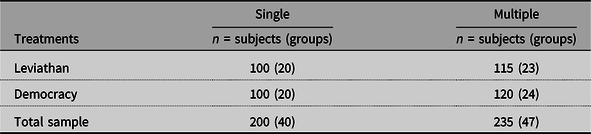
In each session (see Table 1), participants face two stages: first, a standard “linear” voluntary contribution mechanism (VCM, henceforth) that runs for 10 identical rounds, and a centralized punishment institution that runs for 10 rounds in the single-selection treatments and 12 rounds in the multiple-selection treatments. Instructions for the second stage are distributed only after the first stage finishes, to avoid strategic decisions. We have treatments that vary on two between-subjects dimensions for stage 2: the power delegation mechanism and the political accountability institution.
Experimental Design and (Preliminary) Sample Description

Participants in the first stage receive an endowment of
 $w = 20$
experimental units (EU) in each decision round. They can contribute
 $c$
to a “public account” which constitutes a pool with all group members’ contributions, yielding revenue defined by a multiplier (
 $m$
); in our experiment, contributions increase by a multiplier of two (
 $m = 2$
) and are divided equally among
 $n$
group participants (
 $n = 5$
). This implies a marginal per capita return of
 $0.4$
(
 $MPCR(\alpha ) = m/n$
).
Footnote 2
Each subject faces the trade-off between keeping the endowment and free ride on contributions from his partners or contribute to the public account, that is, he faces three alternatives:
 $c = 0$
, which represents the dominant strategy (i.e., Nash equilibrium);
 $c = w$
, which constitutes the socially optimal decision (i.e., Pareto solution), and
 $0 \lt c \lt w$
.
The individual’s
 $i$
payoff function in period
 $t$
can be summarized in the following:
 $${\pi _{it}} = 20 - {c_{it}} + 0.4{C_t},$$
where
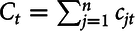 ${C_t} = \sum\nolimits_{j = 1}^n {c_{jt}}$
, the sum of all members’ contributions to the group account.
In the second stage, the centralized tax/punishment institution, each period has two parts. During the first part, subjects face the standard VCM from stage 1. In the second part, one subject, which we call “the manager,” administers the management account funded by a tax of two EU (
 $\tau = 2$
), automatically collected from each group member, that is, there are 10 points available in each round. The manager decides whether to punishment his fellow group members, and if so, how many points to allocate and to whom they will be directed. There is no institutional inefficiency and unused points from the management account return to each group member equally. To allow for better punishment efficacy, punishment points “assigned” are transformed through a convex punishment cost function to punishment points “reduced” as follows
Footnote 3
:

Note that, in extreme cases, negative earnings in a round are possible. To reduce the impact of negative payoffs, subjects are allowed to lose either the payoff result or the number of punishment points assigned (not reduced), whichever is lower in absolute terms. Yet, we do not observe any such instances.
The individual payoff function for the second stage is
 $${\pi _{it}} = \left\{ {\matrix{ {\underbrace {20 - {c_{it}} + 0.4{C_t}}_{{\rm{VCM}}} - \overbrace {2 - p_{it}^* + {1 \over 5}\left( {10 - {p_{jt}}} \right)}^{{\rm{tax/punishmentmechanism}}}}, {{\rm{if}}{\pi _{{\rm{it}}}} \ge {\rm{0}}} \cr {\min \left\{ {|{p_{it}}|,|{\pi _{it}}|} \right\}}, {{\rm{if}}{\pi _{{\rm{it}}}}{\rm{ \lt 0}}} \cr } } \right.$$
The general framework is one of ex-post full information. All group members, including the manager, see their actions and payoffs following each round, including any reduction in earnings resulting from punishment points. Participants also receive feedback about others’ contributions and profits, anonymously in each period. They also observe the total punishment points used in the round, but not to whom they were targeted.
Subjects in this environment may desire to become managers because they can decide over punishment points assigned to others but cannot self-inflict punishment. Hence, they not only avoid the probability of reduction of each round’s gains but avoid any risk of bankruptcy; as a result, they face stronger incentives to free ride. This allows us to observe how they trade off these benefits with long-term incentives to maintain accountability. Footnote 4
Treatments and Procedures
The first treatment dimension corresponds to the centralized power delegation mechanism. Here, we analyze whether the manager selection mechanism affects the behavior of group members. In the exogenous power delegation mechanism, namely the Leviathan, one group member is selected as a manager by the experimenter. The selection process is calibrated in order to isolate the potential effect of the signaling of the manager’s quality on participant’s behavior. Based on calibrations from previous data (Castillo et al., Reference Castillo, Xu, Zhang and Zhu2018), the probability of choosing the highest contributor in stage 1 is 75%. Footnote 5 Subjects are informed of the probability (along with a pie chart of the selection probability as visual aid) and observe a complete contribution history and the average in stage 1 for their group. The second mechanism corresponds to endogenous power delegation, or Democracy. By plurality vote, subjects select one group member, after observing their contributions during the first stage (the VCM). Footnote 6 Votes are cast simultaneously and anonymously, with ties randomly broken by the software.
The second dimension is the political accountability institution, in which we compare Single and Multiple selections. Managers in Single are selected by one of the described mechanisms and, once chosen, they remain in office permanently. Our Multiple framework allows for manager selection every three rounds; to even the decision rounds, we extend the periods to 12. Feedback for these treatments is based on the contribution performance of every player on the previous three rounds, again anonymously, and their average contribution during the first stage, except for the first round of stage 2 where selection information is based on the 10 rounds of the VCM in the first stage (see Appendix in supplementary material for more experimental details).
Sessions were conducted in the Laboratory for Experimental and Behavioral Economics (L.E.E.) at ESPOL-Polytechnic University, in Guayaquil-Ecuador, between January and September 2018. We used O-Tree (Chen et al., Reference Chen, Schonger and Wickens2016) as the computer interface, and the recruitment process was performed through Online Recruitment System for Economic Experiments (Greiner, Reference Greiner2015).
Empirical Analysis
Table 1 summarizes the sample distribution in each cell. A total of 435 subjects were recruited; 200 subjects for the single-selection treatment and 235 subjects for the multiple-selection treatment. Subjects were undergraduate students who had not participated in an experiment before. Footnote 7 Sessions lasted for around 90 min, and subjects received a show-up fee of USD 2.00, for an average total earnings of around USD 13.00. Footnote 8
Empirical Approach
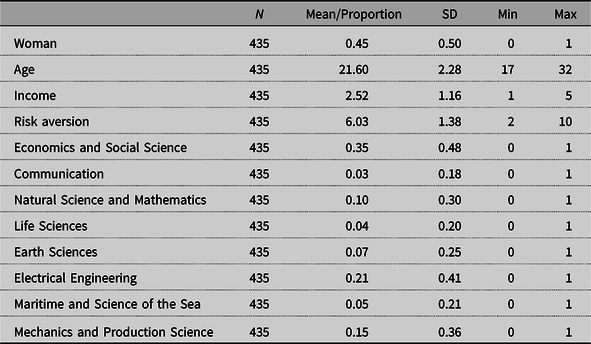
Participants in our experiment are students from a relatively diverse background. Forty-five percent are women with a mean age of 21. Thirty-five percent are economics majors, with the rest distributed among careers in engineering and Science, Technology, Engineering and Mathematics. We also collected some individual information on socioeconomic background and preferences. Footnote 9 Table 2 provides a quick description of the main information.
Data Summary
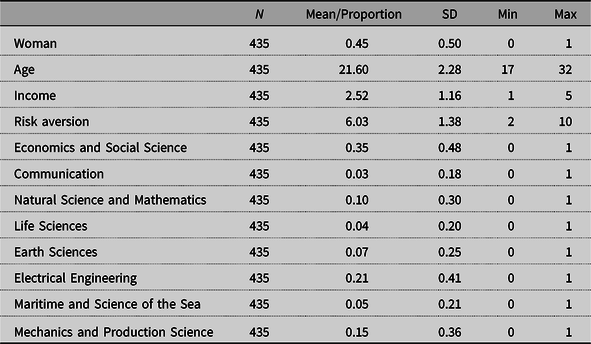
Notes: Income levels (5): 1, i < $ 364; 2, $ 365 < i < $ 600; 3, $ 601 < i < $ 1000; 4, $ 1001 < i < $ 1600; and, 5, i > $ 1600. Risk aversion is the self-reported measure for a 10-point Likert scale, included in the questionnaire.
To provide a complete empirical analysis, we employ both nonparametric tests and formal econometric methods.
Since each treatment is randomly administered by session, we analyze mean differences between treatments and stages, directly through the Mann–Whitney U-test (Wilcoxon–Mann–Whitney) at group level. This is the main approach for our results on the differences between the two political accountability institutions.
We extend the analysis econometrically to control for possible confounds within each treatment of the power delegation mechanism. We include a fully saturated specification with several longitudinal controls and fixed effects at various levels. This is a difference-in-difference approach; to analyze the contribution determinants, we estimate an equation as follows:
 $$\eqalign{{C_{igt}} = \ {\alpha _1}Democracy{(D)_i} + {\alpha _2}Punishment{(P)_t} + {\alpha _3}{(D*P)_{it}} \cr + {X'_{ig}}\Lambda + {Z'_i}Γ + {\phi _g} + {\tau _t} + {\varepsilon _{igt}},$$
where
 ${C_{igt}}$
is the contribution level of subject
 $i$
, in group
 $g$
, in period
 $t$
.
 ${\alpha _2}$
represents the average effect of the democratic power delegation;
 ${\alpha _3}$
is the average effect of a centralized punishment institution. The coefficient of interest for the average treatment effect of the endogenous power distribution under centralized punishment institution is
 ${\hat \alpha _1}$
.
 $\Lambda $
is the vector controls for individual behavior within each group; $Γ is the vector of individual controls (individual fixed effects in the most flexible case);
 ${\phi _g}$
are the group fixed effects;
 ${\tau _t}$
are the dynamic time trends within each stage; and
 ${\varepsilon _{igt}}$
is the
 $i.i.d.$
idiosyncratic error term.
Results
Do democratic elections incentivize collective action?
The first thing to note in our analysis is that an endogenous (i.e., democratic) power delegation does not trigger intrinsic motivation to improve contribution behavior in a centralized management environment, in line with other recent work (Hargreaves Heap, Tsutsui and Zizzo, Reference Hargreaves Heap, Tsutsui and Zizzo2015; Castillo et al., Reference Castillo, Xu, Zhang and Zhu2018).
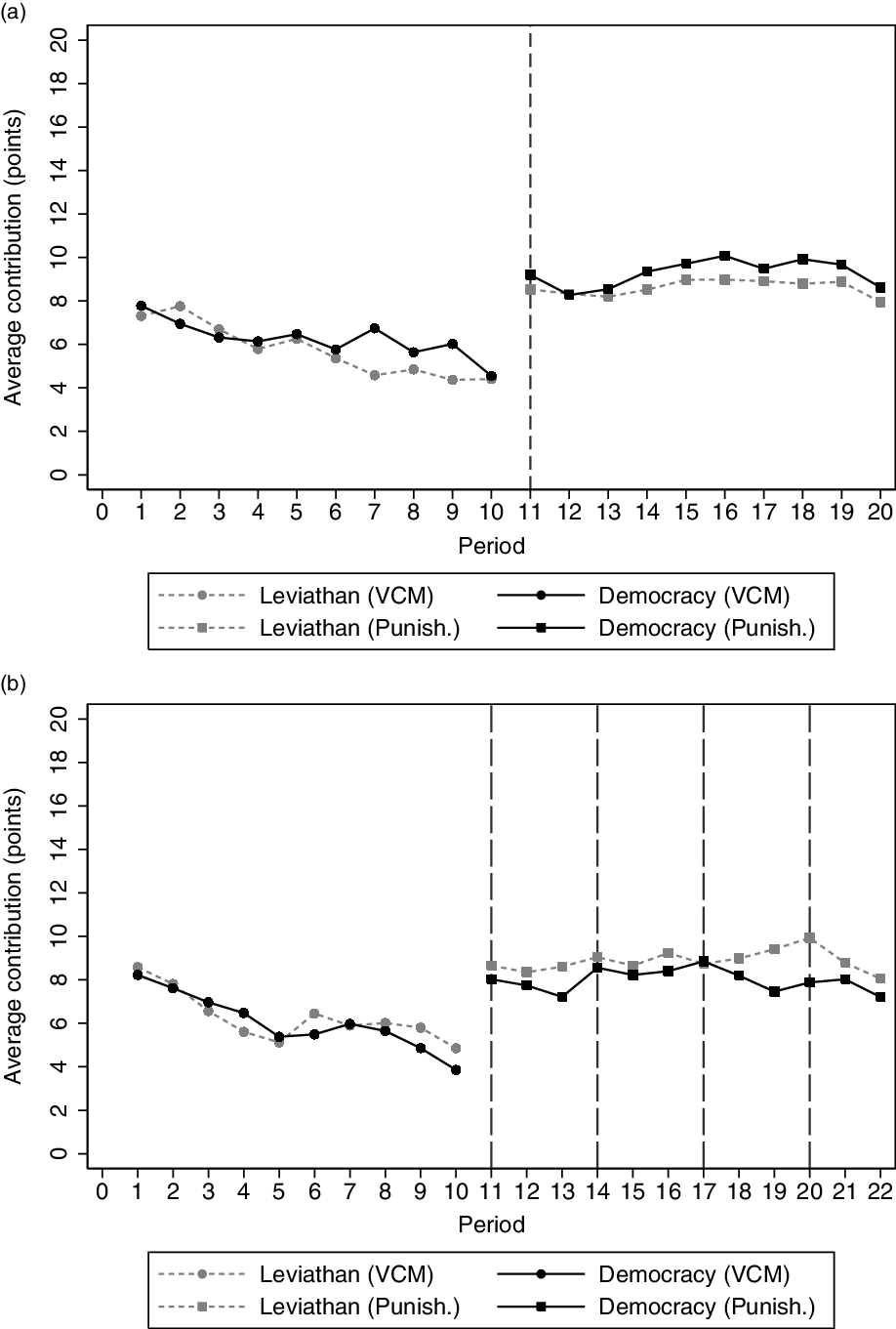
Figure 1 shows the average contribution dynamics of our experiment. Note first that the centralized punishment institution yields results similar to the literature on decentralized punishment (Fehr and Gächter, Reference Fehr and Gächter2000; Ledyard, Reference Ledyard, Kagel and Roth1995; Putterman et al., Reference Putterman, Tyran and Kamei2011; Nikiforakis and Normann, Reference Nikiforakis and Normann2008). Once imposed, the mechanism promotes higher and more stable levels of cooperation than without punishment opportunities. Second, we observe no significant differences between power delegation mechanisms, whether or not the political accountability institution is imposed.
Average contribution dynamics. (a) Single. (b) Multiple.

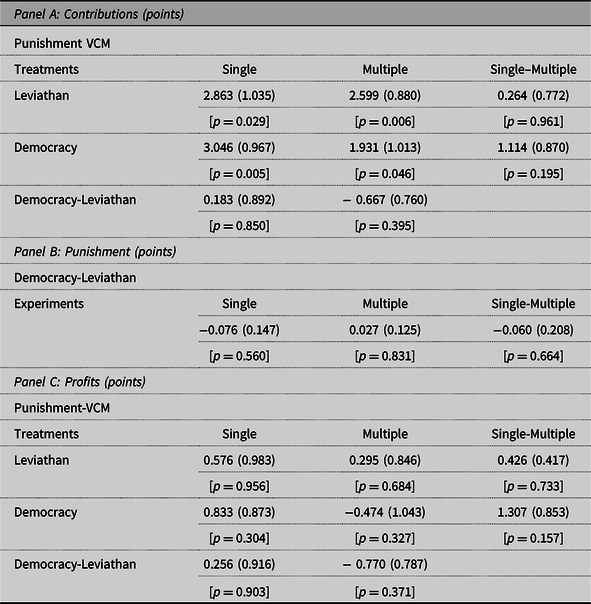
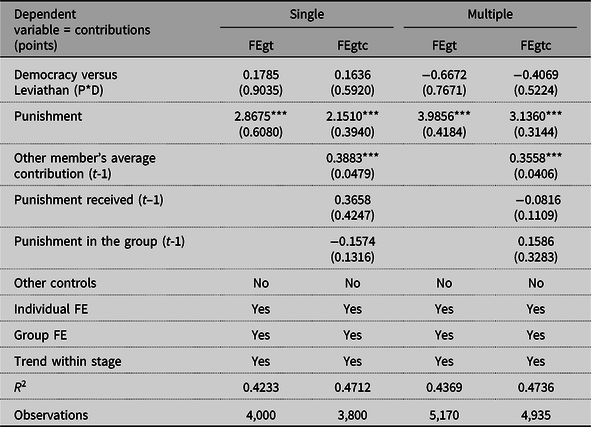
Table 3 summarizes the main results. Each cell of panel A shows the average difference between the centralized punishment institution and the VCM. We answer the first question by comparing vertically. The Democracy-Leviathan row shows the average difference between the power delegation mechanisms. We observe that differences between Democracy and Leviathan are not statistically significant, regardless of the frequency of selections. In Table 4, we extend the analysis econometrically to show that results are consistent under alternative specifications. As in the seminal paper of Fehr and Gächter (Reference Fehr and Gächter2000), a significant effect comes from the punishment institution imposed, but there are no differences of the power delegation mechanism whether in Single or Multiple. Also, the higher the past contributions of others within a group, the higher the observed contribution, which again aligns with prior findings of conditional cooperation as an emergent social phenomenon.
Average Performance Comparison
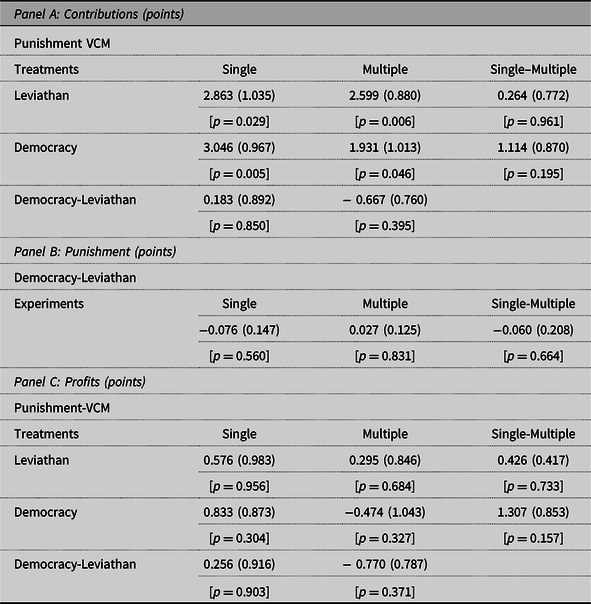
Notes: Panels A and C report within subjects differences between stage 2 (punishment) and stage 1 (VCM). Panel B reports differences between treatments. Group-clustered standard errors in parentheses. p-Values are reported in brackets for a Mann–Whitney U-tests. Two-sided t-tests report similar results.
Determinants of Contributions
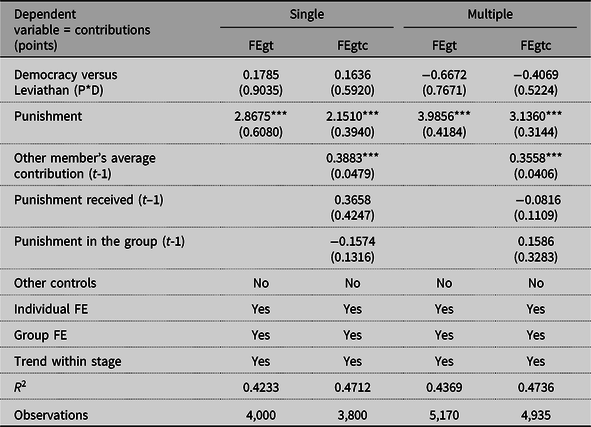
Notes: Dummy variable for the Democracy treatment (D) excluded since it is time invariant; hence, it has a null coefficient for an FE estimation. Standard errors clustered at group level in parentheses.
FE, fixed effect.
* Significant at the 10 percent level.
** Significant at the 5 percent level.
*** Significant at the 1 percent level.
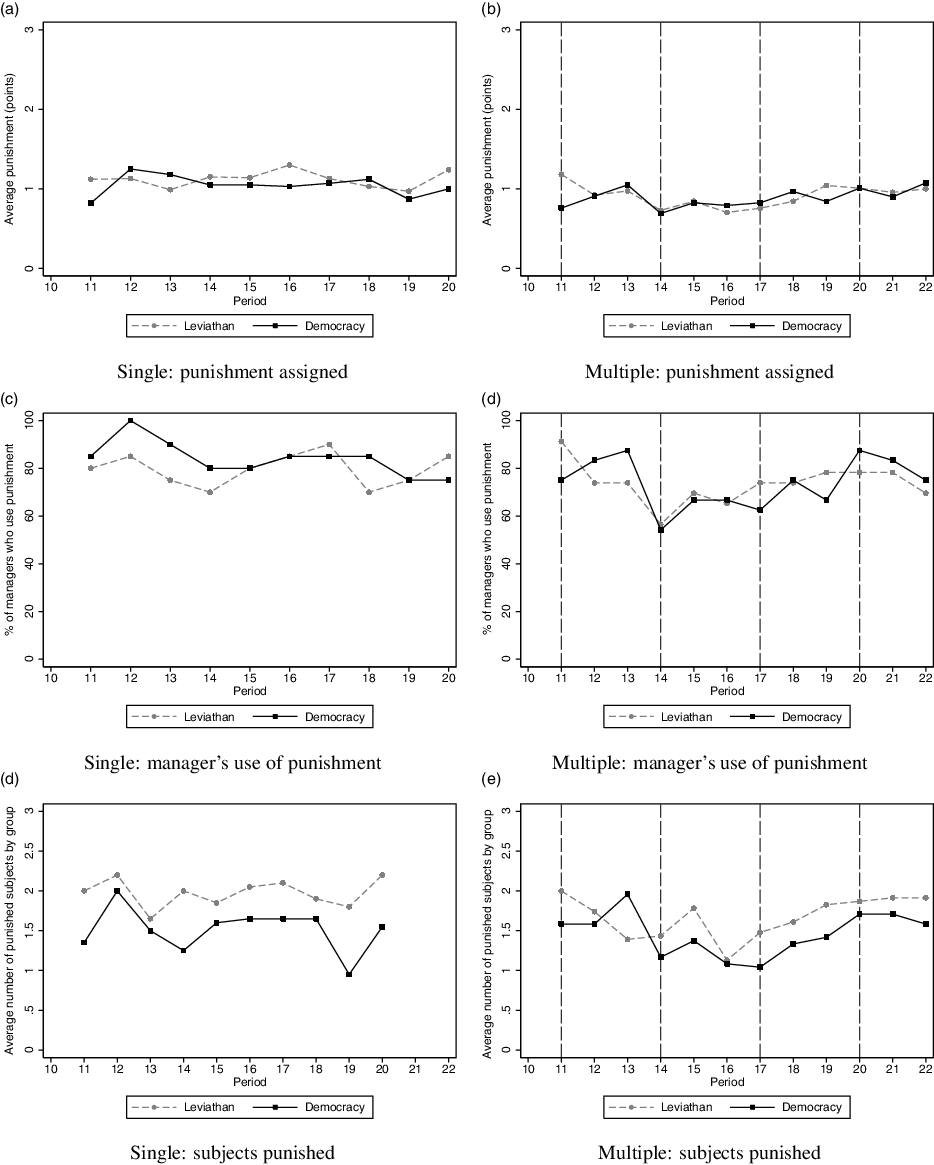
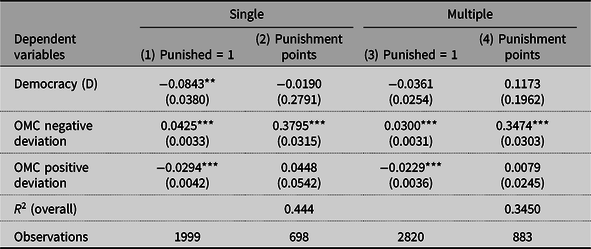
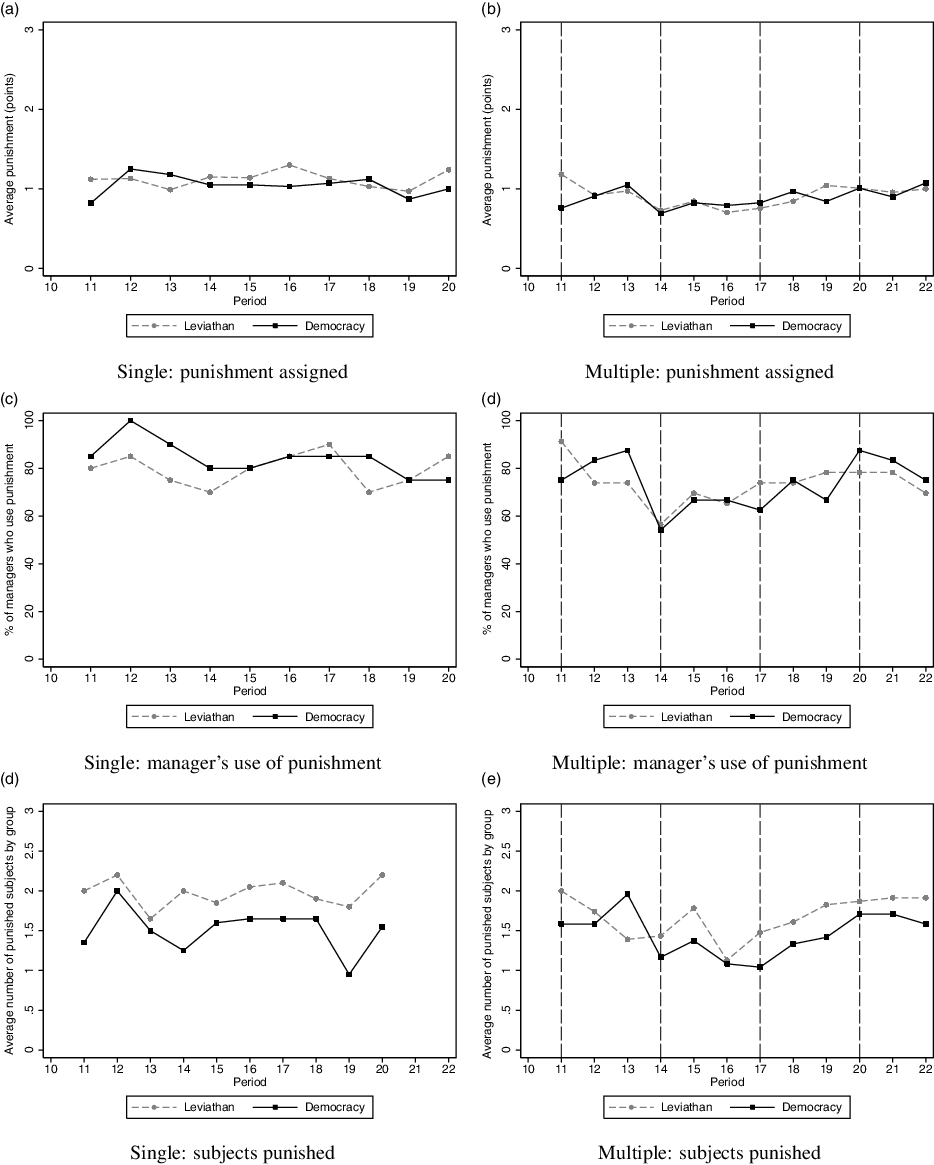
Observed results for the first dimension of the analysis cannot be explained by differences in punishment behavior. Figure 2 shows various punishment measures for both treatments, which reveal no evidence of significant differences. Panel B of Table 3 and Table 5 support this conclusion. The only significant difference observed is on the extensive margin, that is, the probability of being punished slightly diminishes in Single under a democratic scheme; however, this result disappears in the presence of political accountability opportunities (i.e., Multiple; see Figure 2e and f). There are neither differences in the intensive margin, punishment points used are not statistically different between power delegation mechanisms (see Figure 2a and b); nor in the manager’s use of punishment (see Figure 2c and d). Deviations from the social norm (i.e., the group’s average contribution) intervene in the probability of being punished in the expected way; negative deviations increase the probability and intensity of punishment under both Single and Multiple.
Punishment behavior. (a) Single: punishment assigned. (b) Multiple: punishment assigned. (c) Single: manager’s use of punishment. (d) Multiple: manager’s use of punishment. (e) Single: subjects punished. (f) Multiple: subjects punished.
Punishment Decision
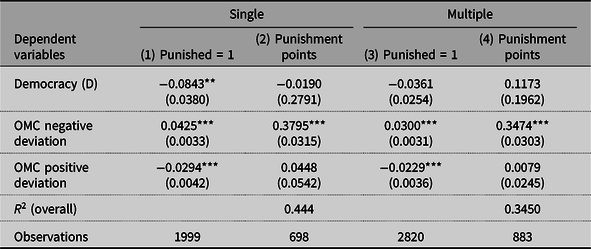
Notes: Coefficients in models 1 and 3 report the marginal effects (at means) of the probability of being punished for a Panel Data Probit model to capture the within-individual correlation.
Standard errors clustered at group level in parentheses for models 2 and 4. Robust standard errors for models 1 and 3.
OMC, other members’ average contribution.
* Significant at the 10 percent level.
** Significant at the 5 percent level.
*** Significant at the 1 percent level.
Putting things together, the welfare measure of our framework can be summarized in the subject’s profit, that is, the net payoff received after punishment. The panel C of Table 3 shows these results. Conclusions remain.
Does political accountability of sanctioning authority affect behavior?
This question can be sliced into two different aspects of the framework’s incentives: contribution behavior of the group and contribution behavior of the managers.
To answer the first part, we return to the main results in Table 3, only this time we concentrate on the comparison across columns. In the previous section, we show that the democratic election has no effect on the general contribution behavior regardless of the frequency of selection; in other words, political accountability does not add any differential incentive to the democratic process to promote collective action. Results in the third column in panel A show whether there are behavioral differences across treatments on the second dimension of the analysis, that is, the institution of political accountability. Reinforcing the previous conclusions, observed differences between Single and Multiple are not statistically significant, regardless of the power delegation mechanism in place.
Political accountability adds little to the contribution dynamics. Every three periods, contributions tend to increase slightly on the electoral period; this is more clearly seen in Democracy (Figure 1b). Given the design conditions, subjects in both treatments can enhance their selection probabilities by increasing their contributions, which signal either their peers, in Democracy, or the experimentalist’s selection rule, in Leviathan. Again, observed differences are not statistically significant, in particular once netting out the first-stage behavior (i.e., VCM). In other words, subjects in both treatments resolve equivalently their social dilemma between contributing—raising the probabilities of being in office—and free riding. Once signaling opportunities are adequately controlled, we argue that Democracy does not offer improvements in institutional legitimacy and incentives toward collective action do not play a differential role.
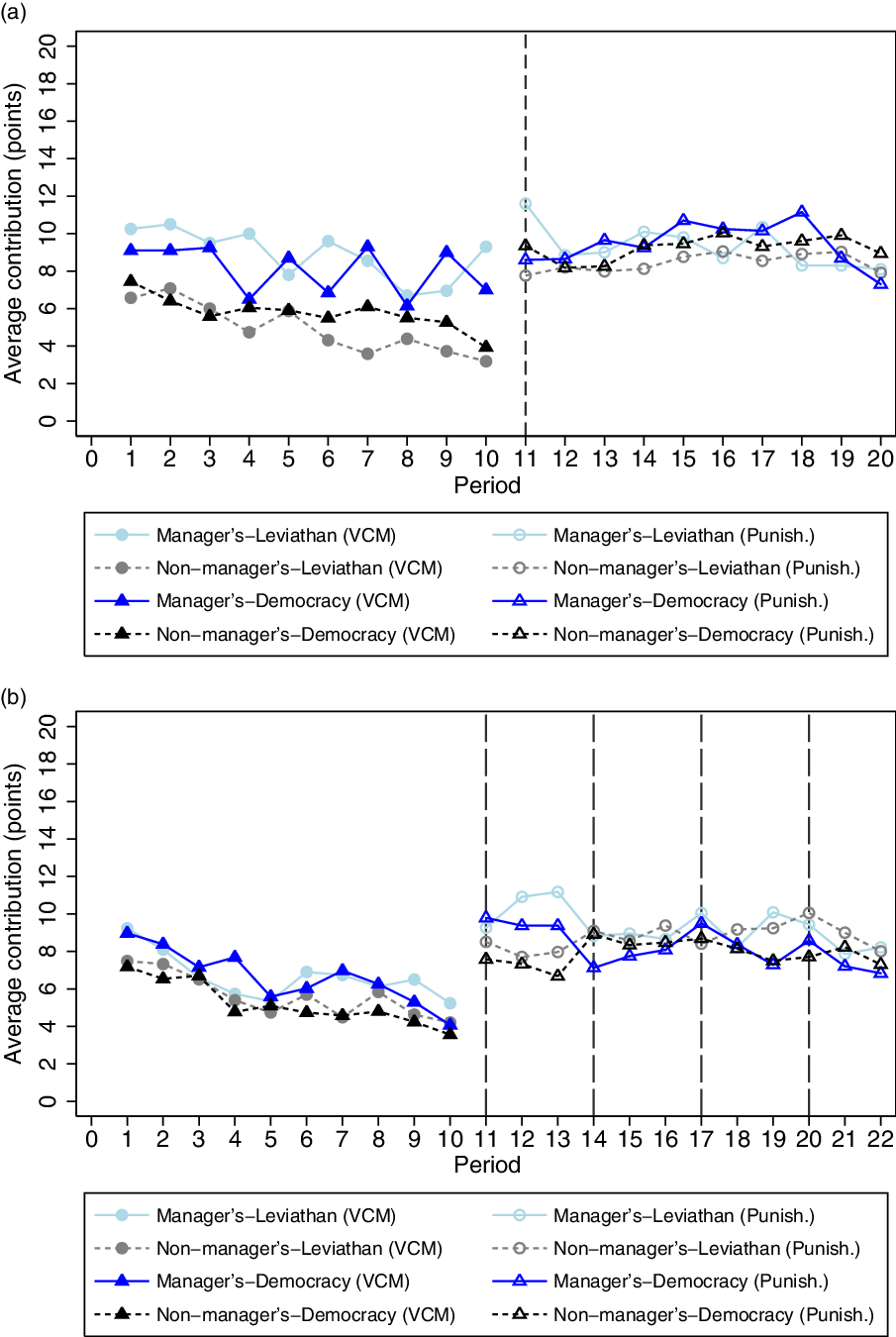
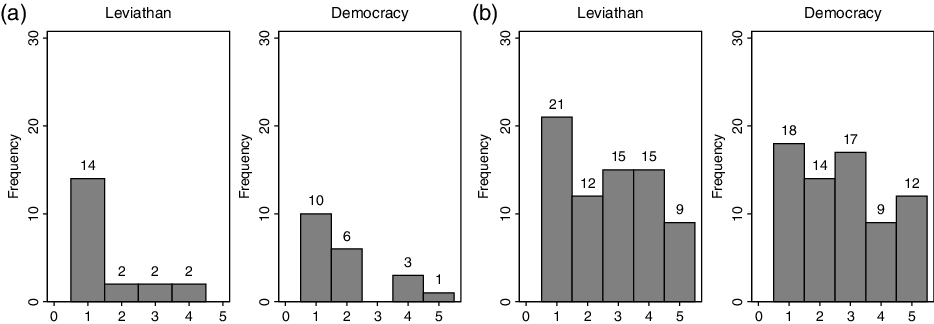
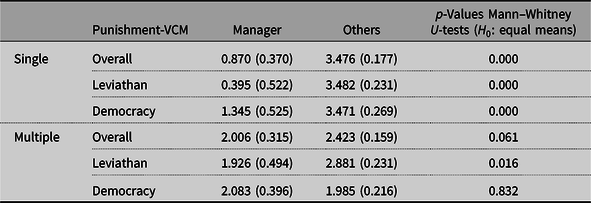
The second part of the question sheds some light on the relationship of the political accountability institution and the manager’s selection mechanism. Figure 3 decomposes the contribution dynamics of managers and non-managers by each dimension of the experimental design. As expected, in the first stage (i.e., the VCM), subjects selected as managers are usually the highest contributors in both power delegation schemes (see Figure 4); on the other hand, manager’s contribution differences, observed in the first stage, do not translate into the second stage for a centralized punishment environment. The contribution dynamics of all treatments shrinks, regardless of the roles of the group members. Table 6 offers a formal test of the mean changes in contribution between stages within the two dimensions of the design, by roles subjects play within the group. The take-away from the table’s results is that managers, on average, exercise their edge in free riding opportunities and contribute significantly less in all treatments, except in the democratic power delegation under the political accountability institution; mean differences between managers and non-managers are not statistically significant in this treatment (last row). In other words, although political accountability does not have an effect on constituents, it does matter in terms of the manager’s behavior, conditional on being in Democracy.
Contribution’s dynamics by roles. (a) Single. (b) Multiple.

Manager’s contribution rank within group. (a) Single. (b) Multiple.

Leadership Contribution Analysis
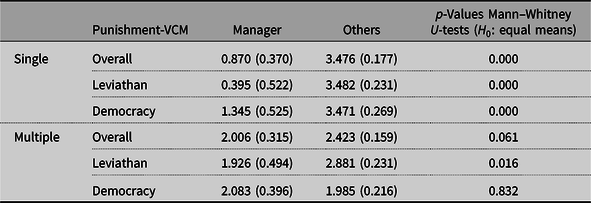
Notes: Standard errors clustered at group level, in parentheses. Multiple has 12 rounds in stage 2; hence, for equal comparison, we only take into account the difference in contribution until round 20.
Conclusion
We contribute to the rich empirical literature studying the benefits of democratic institutions in public goods games by examining the effects of democratic accountability on sanctioning authority. In contrast to democratically determined contributions, we find that democratically elected sanctioning authority has muted effects on group outcomes. When we control for the quality of the authority, we find no difference in group outcomes between democratic and exogenous mechanisms.
While it is tempting to conclude that the lack of selection differences drives these muted effects of democratic appointment, we cannot rule out that certain experimental design elements may also contribute to our findings. For example, our administrator may spend the punishment points in the group pool differently than if they were from a private account, as is done in prior studies. However, we do see punishment used in roughly similar amounts to authorities in Baldassarri and Grossman (Reference Baldassarri and Grossman2011). We simply see no difference in responses to punishment based on institution once selection is ruled out.
Because participants knew the exogenous selection rule, their beliefs about the quality of the chosen candidate may not differ between institutions. While selection criteria can be observed in democratic elections, many non-democratic institutions certainly lack transparency in selecting their leaders, which directly affects their legitimacy. This raises an important question for future study. Namely, would we continue to see similar behavior between institutions if we kept leader quality fixed, but did not make this transparent to voters?
Interestingly, we do find that democratically elected authorities facing repeated elections no longer free ride. Instead, their contributions are in line with those of other group members. In contrast, democratically elected authorities who do not face repeated election (i.e., in the absence of political accountability), as well as exogenously appointed authorities, contribute significantly less to the public good than their fellow group members.
We conjecture that strong beliefs over the advantages of democratic institutions in centralized power environments rely on features that either act jointly or are independent of the power delegation mechanism. One important feature of modern governance is political accountability; when in place, it offers different incentives to the authorities, in particular, what we refer to as a responsibility effect reflected in higher contribution behavior. Important in our study results, this effect arises only under a democracy.
Acknowledgements
We would like to thank fellows at LAWEBESS in Santiago de Chile for their comments. Also, we acknowledge the financial support of the project CIEC-19-2016, the Laboratory for Experimental and Behavioral Economics (L.E.E.), and the Research Funds (R-CD-FCSH-135-2017) of the College of Social Sciences and Humanities at ESPOL. Special thanks to Donald Zhangallimbay and Jonathan Parrales for excellent research assistance and help running the sessions. The data, code, and any additional materials required to replicate all analyses in this article are available at the Journal of Experimental Political Science Dataverse within the Harvard Dataverse Network, at doi: 10.7910/DVN/RIEMMC. The corresponding disclaimer applies. All errors are our own.
Supplementary material
To view supplementary material for this article, please visit https://doi.org/10.1017/XPS.2020.10