We embark on our exploration of why many verbal Chinese idioms are defined in recent Chinese-English dictionaries with misleading parts of speech — they are generally described only as being nouns. We consider this odd situation to have a specific historical origin.
I. “Lisper”: an example of the problem
As an example, consider the word dàshétou 大舌頭, which is defined as “lisper” and “thick-tongued person” (or very similar expressions) in all major Chinese-English dictionaries of Peoples' Republic of China (PRC) origin. Although its internal structure is that of a noun phrase meaning “big tongue”, in living usage this word is generally attested as having verbal sense and meaning “to enunciate language unclearly.” For instance:
(1) 说话大舌头而又口吃 (Zhōu Jiǎnduàn, no date)
he had poor articulation when he spoke, and also stammered
The verbal usage must have developed from out of the literal sense “big tongue” and the dictionaries’ translation “lisper; thick-tongued person” must be a further derivation from the literal noun or the verbal sense. But there is no denying that the verbal usage is prominent in contemporary usage. To illustrate that usage, here are some examples:
(2) 他有点大舌头, 说出来的台词老是让人听不清 (Anon. #003)
[He has a slight speech impediment: when he says his lines, people can never hear them clearly.]
(3) 因长着一双小小的老鼠眼, 说话还大舌头, 我们这些皮女们都很不喜欢他。 (Anon. #005)
[Because he had a pair of beady rat-eyes and didn't articulate clearly when he talked, we mischievous women really didn't like him.]
(4) 又来个大舌头的, 俺听了半天没听懂 (Shaun Weng, Reference Weng2008)
[And then another person came who had a speech impediment — I listened and listened and couldn't make out what he was saying.]
This usage is regular and well attested, it is somewhat strange to find the following published definition of dàshétou, in Wú Jǐngróng's 吴景荣 Hàn-Yīng cídiǎn 汉英词典 (1978), the most prominent of all modern Chinese-English dictionaries:
(5) 大舌头: a thick-tongued person; one who lisps; lisper (Wú Jǐngróng, 1978:127)
So there are two problems: “lisping” is but one of many kinds of speech defect embraced by dàshétou, and Wú Jǐngróng has completely omitted treatment of the verbal use of the word. We regard the imprecision of the definition as a small matter, but the omission of the correct part of speech (POS) is a widespread problem in the book.
Extensive numbers of Wú's idiom glosses have continued to appear in later large Chinese-English dictionaries, because of the common lexicographic practice of cross-consultation. Dictionaries in the Chinese world are often the work of large, semi-official teams, in which there is strong continuity with past editions, even those which appear under the by-line of a different editor. It is not unusual for individual entries in a given dictionary to retain the wording found in earlier works, but the result is the perpetuation of practices inherited from those earlier works.
But a consequence of that influence is that there is a persistent pattern in recent Chinese-English dictionaries to define this word as though it were only a noun. Consider the following examples, taken from a dozen major sources ranging back to the 1870s, of dàshétou 大舌頭, which we find to be in common use as a verb phrase and define ‘to articulate language unclearly’:

Notice Wú's place as the first lexicographer to have introduced the definition and POS that recur in all of the later dictionaries. Although Liang Shih-Ch'iu's definition, seven years before Wú’s, is verbal, that verbal usage does not seem to have been in the collective field of vision of PRC-based Chinese-English lexicographers since Wú Jǐngróng's time.
This issue is compounded by a separate problem, which we treat briefly here. One of the extensive differences between English and Chinese is that many Chinese verbal expressions of description are rendered into English using the verb “to have” followed by a noun of some sort. For instance Chinese says tā dùzi hěn dà 他肚子很大, literally “as for him, the belly is big,” where English says “he has a big belly;” Chinese says tā méimao hěn xì 她眉毛很細, literally “as for her, the eyebrows are thin,” while English says “she has thin eyebrows.” Even though in many ways the two languages seem superficially close in structure, in equivalent expressions it is common to find different constructions in use. In many of the examples that follow, the English translations are of the type “have” plus noun, and these should be recognised as rendering Chinese verbal phrases.
II. The magnitude of the problem
For a verb to have the apparent structure of a noun is common and natural in Chinese; most Mandarin words describing a person's physical appearance are intrinsically nouns but also function prominently as verb phrases, yet the Wú Jǐngróng dictionary usually defines them as though they were nouns alone. Obviously, for both the English-speaking learner of Chinese and the Chinese-speaking learner of English, that could be a confusing situation. Below we document a few more such examples; since Wú does not explicitly name POS, we use the notation “= N” in square brackets to show the POS implied by the wording of his English definitions. Below “N” stands for noun and “VP” for verb phrase, which can function as a whole predicate in Chinese.
For bāoyá 龅牙 and its near-equivalent bàoyá 暴牙, meaning both ‘buckteeth’ (N) and ‘to be bucktoothed’ (VP), Wú gives only ‘bucktooth’ ([ = N]). Here are some contemporary examples, in which the verbal usage is clearly seen:
(7) 他一向是有点龅牙的, 现在也是那样, 寒凛凛的露了两个大门牙在口唇外, 加上他双颊没有肉, 颊下就陷得厉害, 好似两个黑洞, 看久了, 他的脸就真有点像个骷髅, 有点可怕. (Yū Líhuá, 2008)
[He had been a little bucktoothed and he still was, with two front teeth sticking coldly and menacingly outside his lips. And his cheeks had no flesh on them and were terribly sunken — like two dark caverns. If you looked long enough, his face really did look a little like a skull — it was a bit frightening.]
(8) 小野木看出那人比自己稍微年輕一點儿, 大約二十六七歲, 長型臉、鷹鉤鼻子, 有點兒齙牙. (Anon. #001)
[Ōnogi saw that the man was a bit younger than himself, maybe 26 or 27, and had a long face and hooked nose, and was a little bucktoothed.]
(9) 這個男人也是滿臉鬍子, 大而扁的朝天鼻, 還有一點暴牙. (Anon. #002)
[This man also had a beard growing all over his face and a big, flat pug nose, and he was slightly bucktoothed.]
For jiànméi 剑眉, ‘straight eyebrows rising at the outer ends (often associated with men)’ (N) or ‘to have such eyebrows’ (VP), Wú gives ‘eyebrows slanting upward and outward; dashing eyebrows’ ([ = N]). Here are examples of verbal usage:
(10) 讀書的少年約十七八歲, 生得劍眉星目, 唇朱齒皓, 端的是個俊美絕世的佳公子. . . (Guǐyǔ, 2006)
[The young man reading was about 16 or 17. He had eyebrows like swords and eyes like stars, his lips were red and his teeth were white — he truly was a uniquely handsome prince charming.]
(11) 我的男人, 一定是貌若潘玉, 剑眉星目, 玉树临风, 气宇轩昂. (Zǐchāihèn, no date)
[My man will definitely look like Pān Yù: he will have eyebrows like swords and eyes like stars, suave and handsome like trees of jade facing the wind, and a lofty bearing.]
(12) 映入眼[帘]的是个相当俊美的男人, 剑眉星目、唇红齿白, 实在是俊俏极了. (Guǐmiàn Fūjūn, 2003)
[Before her very eyes was a really handsome man, with eyebrows like swords and eyes like stars, red lips and white teeth — he really was extremely attractive.]
For máliǎn 麻脸 ‘pockmarked face’ (N) or ‘to have such a face’ (VP), Wú gives ‘a pockmarked face’ ([ = N]). Here are examples of verbal usage:
(13) 这也是一种牺牲, 她以死腾出了位置, 使其夫可以再顺理成章地娶一个女人, 虽然麻脸却可以生育子嗣延续香火. (Jì Hóngzhēn, 1999)
[This is also a kind of sacrifice: through her death she has vacated her place, allowing her husband to take another wife as a matter of course. Even though the new wife has a pockmarked face, she can still bear sons and continue the family line.]
(14) 这是南池子社区一名居民花了半年时间制作的, 雕像面容全部根据遗留的皇帝画像制作, 但雕像的表情和一些脸部细节却小有不同, 顺治忧郁、康熙麻脸、雍正对眼, 作者表示, 这是自己根据史实略做加工后的效果. (Anon. #004)
[This was made by a resident of the Nánchízi district over the course of half a year. The faces of the sculptures were all modelled on surviving portraits of the emperors, but their expressions and some of the details of the faces are slightly different: the Shùnzhì emperor is downcast; the Kāngxī emperor has pockmarks; the Yōngzhèng emperor is cross-eyed. The artist says that this is the result of slight improvements made on the basis of historical facts.]
(15) 一个不修边幅的男人朝我们迎上来, 伸出手. 他的声音有种怪异但动人的粗哑, 像是不由自主发出的. 一身邋遢的衣服、参差不齐的头发、麻脸, 反倒比较像个可能在伯克利认识的人, 而不像《 纽约时报》的编辑. (Huáng Fāngtián, 2007)
[A sloppily dressed man was coming toward us, extending his hand. His voice had a strange but touching hoarseness about it, as though produced without his control. He had messy clothes, unevenly cut hair, and a pitted face — more like someone I might meet at Berkeley than an editor of the New York Times.]
For jiǔzāobí 酒糟鼻‘grog-blossom: red, bulbous nose’ (N) or ‘to have such a nose’ (VP), Wú gives ‘acne rosacea; brandy nose’ ([ = N]). Here are examples of verbal usage:
(16) 這回大家看清楚了, 這人生得獐頭鼠目, 酒糟鼻, 一把山羊鬍子, 又聳肩, 又縮頭, 生相猥瑣. (Dōngfāng Yù, no date)
[This time, everyone saw him clearly. This man had a narrow head and beady little eyes, a red bloom on his nose, and a goatee. His shoulders were hunched and his head was drawn back — he looked creepy.]
(17) 一張小方案後面站著一個頭戴瓜皮帽的瘦小老頭, 不過五十來歲, 鬥雞眼, 酒糟鼻, 嘴上留了兩撇黃蒼蒼的八字鬍. (Dōngfāng Bái, no date)
[Behind a little square table was standing a skinny little old man wearing a skullcap. He couldn't have been past 50. He was cross-eyed, had a red bulbous nose, and wore a yellowed moustache.]
(18) 五短身材, 胖得像個肉球, 上尖下圓, 尖尖的腦袋頂門光光, 四周[披]下一圈短灰髮, 小眼睛酒糟鼻, 血盆大口露出一口大板牙. (Yúnzhōng Yuè, no date)
[He had short arms and legs and a short body, and was so fat he looked like a ball of flesh. He was pointy at the top and round at the bottom — the pointed top of his head was shiny, with a ring of short grey hair draping down on all sides. He had small eyes and a red nose, and in his big red mouth his big front teeth were visible.]
For guāzǐliǎn 瓜子脸 ‘delicate, oval face’ (N) or ‘to have such a face’ (VP), Wú gives ‘oval face’ ([ = N]). Here are some examples of usage:
(19) 鵝蛋臉過了時, 俏麗的瓜子臉取而代之, 姚太太新添的孩子便是瓜子臉. (Eileen Chang, Reference Chang1943)
[When oval faces are out of style, they are replaced by the cute and pretty melon-seed face. Mrs. Yáo's new child has a melon-seed face.]
(20) 新娘比他高出一頭, 描眉畫目, 瓜子臉兒, 頗有幾分姿色. (Chén Róng, no date)
[The bride was a head taller than him, with her eyebrows and eyes elegantly made up; she had a melon-seed face, and was quite good-looking.]
(21) 我夢見看到東邊天空有一位仙女, 瓜子臉細高個, 穿著粉紅的霓裳. (Zhūgé Jūn, 1999)
[I dreamed I saw a fairy in the eastern sky — she had a melon-seed face and a thin tall build, and was wearing a pink rainbow dress.]
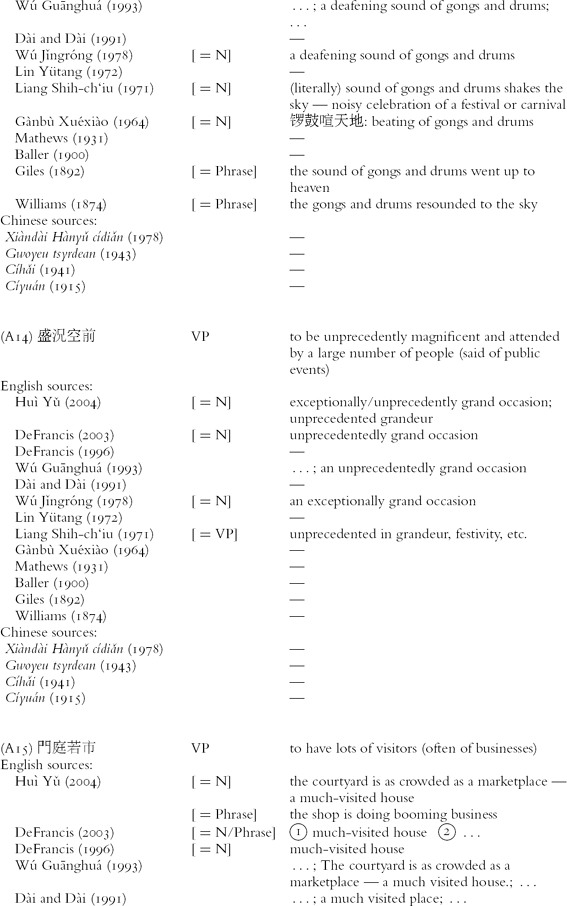
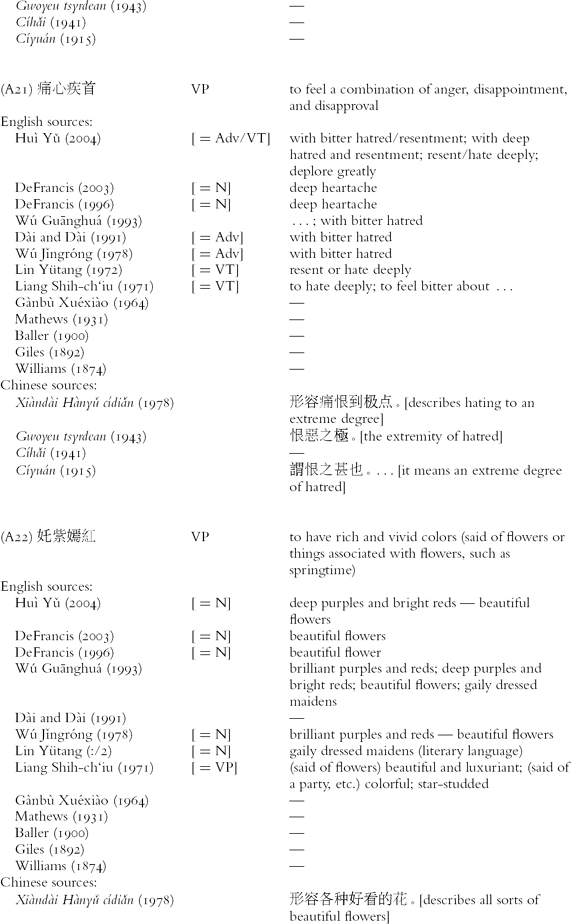
It is not only in the case of physical traits that words functioning as verbs are being defined as nouns; there are numerous examples of more diverse verbal idioms being treated this way, of which we document a small selection of twenty-five in the Appendix. (We separate these materials in order to make the essay proper more compact and readable.) The major Chinese-English dictionaries published in China over the past 30 years tend to define these idioms in very similar language and using the same implied POS.
In other words, these sources constitute a single glossing tradition in recent Chinese-English lexicography, as part of which Chinese POS is persistently misconstrued in the wording of definitions and translations.Footnote 2 How did this situation come into being?
III. Resistance to the inclusion of POS
Why Wú omitted the POS of nouns and verbs in the first place seems to have been a combination of intellectual disagreement together with the result of historical forces unique to his era. We discuss these two issues in turn.
It is clear that Wú himself disagreed with notating the POS that are most crucial in Chinese. He writes:
我们采取标七种词性(助词、象声词、量词、叹词、连词、副词、介词)其余不标的办法。这是因为汉语词性问题比较复杂, 其中最难定的是动词、形容词和名词, 常常要根据一个词在句子里的功能来定。 (1980:35)
[We chose the method of marking seven POS (particles, onomotopœtic words, measure words, exclamations, conjunctions, adverbs, and coverbs) and leaving the rest unmarked. This is because POS in Chinese are rather complicated. The hardest of them to assign are the verb, adjective, and noun. It is often necessary to make the decision based on the function of a word in a sentence.]
We agree that it is often — indeed, almost always — most effective to treat POS not as an intrinsic characteristic of a Chinese word but precisely as a word's syntactic function in a particular context. A given word may therefore have different POS in different contexts and also different corresponding English translations. It is also quite true that verb, adjective, and noun are the hardest POS to assign correctly, and we therefore feel that there is no avoiding the close examination of specific examples in order to make the assignments correctly. By his choice, Wú withheld POS notations of the greatest utility to the dictionary's users; those he did mark are for the most part evident to the user from the content of a definition.
Wú follows this statement with examples of adjectives that can function as verbs or nouns. For hóng 红 ‘red’, the derived verb is ‘to redden’:
(22) 红了樱桃, 绿了芭蕉
[(The flowing moonlight. . .) reddens the cherries and greens the bananas.] (Jiǎng Jié 蒋捷, jìnshì 1274)
Wú also cites a noun usage, ‘redness’:
(23) 林花谢了春红, 太匆匆
[The forest flowers have shed their spring redness — but they are too rushed.] (Lǐ Yù 李煜, 937–978)
(24) 落红不是无情物, 化作春泥更护花
[Falling redness (= ‘red flowers’) is not heartless — it turns to Spring mud, the better to protect the flowers.] (Gǒng Zìzhēn 龚自珍, 1792–1841)
For lǜ 绿 ‘green’, the derived verb is ‘to make green’:
(25) 春风又绿江南岸, 明月几时照我还?
[The spring wind greens again the southern banks of the river; when will the bright moon light my way home?] (Wáng Ānshí 王安石, 1021–1086)
There is another example of “to make green” in the Jiǎng Jié quotation, above. For àn 暗 ‘dark’, the derived verb is ‘to darken’:
(26) 青海长云暗雪山, 孤城遥望玉门关
[Long clouds over Blue Lake darken the snowy mountain; a solitary fort gazes from afar at Jade Gate Pass.] (Wáng Chānglíng 王昌龄, 698–765)
For shú 熟 ‘ripe’, the derived verb is ‘to ripen’:
(27) 湿湿岭云生竹菌, 冥冥江雨熟杨梅
[Damp ridge-clouds make the bamboo-fungus grow; dark river rain ripens the bayberry.] (Wáng Ānshí)
Wú's examples are curious as support for his claim that Mandarin POS is complicated. They come not from Mandarin but from the literary language of poetry, whose grammar is somewhat different from Mandarin's. Though Wú calls them “verbs”, his examples are all adjectives functioning specifically as transitive verbs — “to make red”, “to cause to become green”, and so on — but in Mandarin that is unusual; it is far more common for Mandarin adjectives to function as intransitive verbs — “to grow red”, “to become green”, etc. — as shown below in combination with the completion-aspect particle le 了 and a following extent-complement jǐfèn 几分 ‘by several degrees’:
(28) 女人说完打了一个酒嗝, 脸就又红了几分。 (Sū Xiǎorǎn, 2009).
[When the woman had finished speaking she gave a liquor-sodden belch, and her face became a few degrees redder.]
(29) “天蓝了几许水又绿了几分” (Zhejiang Envi[ro]nmental Protection Bureau, 2005)
[The sky has grown a little bluer and the water has grown a few degrees greener.]
(30) 这种感觉很奇怪, 本来天空就是黑色的, 可是下面的人分明感到黑色的天空暗了几分, 又暗了几分,. . . (Dūnshǒu Xiǎomāomī, 2006).
[This was a strange feeling. The sky had been black, but the people beneath it clearly felt that the black sky had grown a few degrees darker, and then another few degrees darker, . . .]
(31) 父亲并不浪得虚名, 他有自己的绝活:不用手摸, 眼睛一瞅, 就能知道牛肉羊肉熟了几分。 (Lù Quángēn, 2010)
[Father's reputation was not undeserved and he had his own special gift: without touching but just by eye he could tell how fully cooked beef or goat meat had become.]
Usage of this kind is already straightforward in Mandarin and it is curious that Wú turned instead to literary language for illustration.
But he has a second and more interesting reason for avoiding POS notations:
我们说在英语词典里, 通常要标明词性, 因为在英语里功能的变化, 往往引起形态的变化。汉语基本上没有形态的变化。有些同志认为汉语应标明词性。实质上, 这是从英语出发考虑问题。 (Wú Jǐngróng, 1980:35)
[We hold that in an English dictionary, POS usually has to be marked because changes of function in English often cause morphological changes. There are basically no morphological changes in Chinese. Some comrades have argued that the Chinese should have had POS marked. That is essentially the same as to consider the problem by proceeding from English.]
In other words, Wú is resisting pressure from other lexicographers, and he feels their analysis of Chinese is unduly influenced by the example of English.
As a linguistic statement, we consider the reasoning unpersuasive. English differences in function do not necessarily correspond to differences in morphology; there are many examples of nouns and adjectives or verbs in English that are spelled identically (desert, address, record, etc.) and in some cases pronounced identically (list, charge, book, etc.). But in fact any reputable dictionary will distinguish their POS. Furthermore, when English words differ only by morphology, in formal terms they render POS marking less rather than more necessary, exactly because morphology marks syntactic function. Contrary to what Wú says, POS is included in English dictionaries because that information is considered necessary for correct usage. A dictionary is a guide not only to meaning but also to usage, which is itself a normal part of a modern dictionary entry.
Wú's point about “considering the problem by proceeding from English” is an attempt to dismiss Chinese POS as an intrusion of non-Chinese issues. But even if we pretend that POS is not important in Chinese, a bilingual dictionary represents a kind of interface between two languages and cannot avoid treating characteristics of them both. Wú is simply dismissing the issue of Chinese POS by associating it with a foreign influence, a rhetorical trick but one that a part of his Chinese audience must have found very powerful in his day. In other words, it is not exactly a linguistic statement. Wú did have very articulate reasons for omitting POS notations — not long after the dictionary's release, he published a substantial study of POS in Chinese and English, giving full detail to his views (Wú Jǐngróng and Wáng Jiànzhī, 1981). But it is no coincidence that one of his book's most serious errors is precisely in the apparent POS with which Chinese idioms are defined in English. If he had included POS for Chinese verbs and nouns, he would surely not have defined so many of them in syntactically misleading English. The existence of these errors eloquently refutes Wú's linguistic arguments.
To restate the point, Wú's most serious systematic error came about not because POS is a foreign notion unsuited to Chinese linguistic realities, but simply because he should have considered POS and did not. His statement about the use of POS being the result of “proceeding from” a foreign language does not alter the fact that his linguistic philosophy caused him to make a mistake.
Since the POS of a Chinese word must be determined empirically, the process frankly requires a certain amount of hard work. Now, clearly it was Wú Jǐngróng's intellectual resistance to distinguishing POS, rather than a desire to avoid hard work, that prevented him from including them. Wú believed, for example, that examples were necessary in a dictionary:
提供例证主要是要说明词的用法。. . .主要是要说明动词及搭配。. . .有时候, 我们碰到一些词条, 觉得很不好用, 也给例证. . . (Wú Jǐngróng, 1980:40)
[Supplying examples is done mainly to explain usage . . . mainly to explain verbs and collocation. . . . Sometimes, when we ran into certain words and felt they were difficult to use, we gave examples for them, too.]
He was clearly willing to do the hard work of collecting examples, merely not to do it for the purpose of distinguishing POS. In fact, enormously more hard work went into this dictionary than one might guess, for reasons to be explained in Section V below, and those reasons constitute what we consider the “curious” legacy referred to in the present paper's title.
IV. “Giles did not really understand Chinese”
Let us digress for a moment to relate that Wú left records of his experiences and thoughts in compiling the 1978 dictionary. To the contemporary reader of those records, it is surprising how harshly he condemns all of the Chinese-English dictionaries preceding his own (Wú Jǐngróng, 1979, 1980, 1991, 1992). Most especially, he condemns the motives and competence of Western dictionary-makers such as the renowned Herbert Giles (1845–1935). Certainly all dictionaries produced by Westerners in China between the Opium Wars and the Communist revolution may be suspected of having been “为帝国主义殖民主义服务的 [in the service of imperialist colonialism]” (1979:1). As for competence, those dictionaries by all means contain errors and omit important words. Most of the idioms we have listed in the Appendix (because of their apparently incorrect POS) also happen not to appear in older dictionaries of the missionary-consular period. That is rather striking. The large number of errors and perceived omissions is something that Wú interprets, in the case of Giles, as the result of the fact that Giles “没有真正懂得汉语 [did not really understand Chinese]” (1979:1). Giles is an easy target, since even his own “imperialist colonialist” collaborator Edward Harper Parker (1849–1926) had a very low opinion of his ability as a lexicographer (Branner, Reference Branner1999:13–14). Then again, Giles’ Dictionary of Colloquial Idioms in the Mandarin Dialect (Giles, Reference Giles1873) contains a thousand sentences in natural and fluent Mandarin, illustrating different Chinese equivalents of English homonyms and the correct use of vernacular grammar forms troublesome to foreign learners, such as resultative verbs and the shì. . .de 是. . .的 construction. If these sentences can be taken as evidence, Giles’ Chinese was not nearly as bad as Wú makes out.
But as for Wú's larger criticism about the selection of headwords in earlier dictionaries, and what he says that selection shows about the quality of the books and competence of their compilers, we find that the true situation illuminates a fact about Wú's work that is not obvious. In brief, the uses to which Western lexicographers intended their dictionaries to be put were not the same as Wú’s. They were not trying to document the whole of normal Mandarin usage and they did not have access to the resources he did to make that task possible.
This is a subject that deserves comprehensive study, but it is clear that these dictionaries were intended for use in administrative and missionary work; they also drew heavily on previous Chinese-English dictionaries in the same tradition. The needs of administrative work explain the quantity of words for objects and ideas in trade, industry, science, and twentieth-century life generally, especially in Mathews’ 1931 revision of the dictionary of Frederick W. Baller (1852–1922), which added more than 64,000 words to Baller's 40,000. Busy administrators probably had more need of specialised terminology than educated idiom. As for missionaries, we can get some idea of what they were actually reading when they had to use a dictionary from Baller's description of the texts he checked in order to choose the characters for his dictionary:
the Four Books and Commentary, the Sacred Edict, the Three Character Classic and Commentary, the Book of Rewards and Punishments, the Old and New Testaments, Old Testament History, the Pilgrim's Progress, and Martin's Evidences of Christianity . . . (Baller, Reference Baller1900:iii)
That is, the essential reading of the anglophone missionary in the 1890s was Christian translations and a few well-known Classical or literary Chinese texts important in children's education.
It must also be significant that most of these dictionaries emphasised characters over whole words; Baller continues:
The use of these [characters] has been copiously illustrated by examples drawn from Morrison, Williams, Legge, Giles, Mayer, Chalmers, Hirth, Mateer, and others, as well as from the aforementioned and other native books. These examples might easily have been multiplied, but it seemed neither necessary nor advisable to do so. For instance, the names of birds, beasts, fishes and plants alone, would have more than doubled the size of the book . . . (Baller, Reference Baller1900:iii)
Giles makes this interesting comment:
As to number of phrases, it is there, so it seems to me, that the strength or weakness of a Chinese dictionary may be said to lie. It is impossible to exhaust the meanings of a Chinese character by definitions, each word being (to quote from Professor Sonnenschein) “like a chameleon, which borrows its colour from its environment.” (Giles, 1912:viii)
His goal in including so many multi-character words and expressions was “to exhaust the meanings of a Chinese character”, rather than to exhaust the inventory of words and expressions. So the multi-character words he has included are not those he judges most important as words; many of them are there to illustrate the meanings of characters. Mathews restates this idea:
As far as possible, every use of a character has been illustrated by examples. Some of these expressions may have passed out of current use, but their inclusion in a dictionary is warranted by the fact that they occur in the literature of the period. (Mathews, Reference Mathews1931:vi)
Perhaps the competence of Giles and his fellows has, after all, been somewhat misappraised.
In criticising his predecessors, Wú Jǐngróng neglects to mention that he had a great advantage that no Chinese-English dictionary-maker before him ever had, including even Liang Shih-ch'iu 梁實秋 (1971) and Lin Yü-t'ang 林語堂 (1972): he was able to draw heavily on a superb all-Chinese dictionary, the “trial” draft edition (“shìyìnběn 试印本”) of the Xiàndài Hànyǔ cídiǎn (hereafter, “Xiàn Hàn”). Initially compiled in the 1950s and finally published in 1978, after two decades of nationwide comment and discussion, the Xiàn Hàn was the collective work of hundreds of skilled hands and surely the most thorough Mandarin dictionary ever compiled up to that time.
Wú relied on this book for his selection of words and their definitions, a fact that was apparent to at least one early non-Chinese reviewer:
It would have been little additional effort to have added syntactic markers to the stylistic markers usefully provided but since this dictionary is obviously a digest translation of the Xiandai Hanyu Cidian, which does not provide these essential features, it is perhaps unreasonable to expect them here. (Sloss, Reference Sloss1980:782)
Moreover, Wú himself never pretended that his dictionary was compiled from scratch. He describes his debt to the Xiàn Hàn very clearly and gratefully:Footnote 3
我们选择了《现代汉语词典》(试用本)作为选词释义的重要参考(同时我们也参考了《国语词典》、《辞海》、《新华字典》、《同音字典》等等), 因为《现汉》的规模同我们的词典差不多, 同时它也强调现代汉语并使用汉语拼音。我们这样做既可以节省时间, 避免可能发生的重要遗漏, 并可以在汉语释义的确切性上得到比较可靠的保证。例证大部分是根据自己收集的材料加以改写的, 一部分是经过多次推敲集体编写的。
我们也对《现汉》词条作必要的增删。删去的一部分是陈词, 我们认为可以不收的。. . .《汉英词典》作为双语词典很强调实际运用, 这些陈旧而又重复的词条实再没有留存的必要了。(Wú Jǐngróng, 1979:2)
[We chose the trial edition of the Xiàn Hàn as a major reference for the choice of entries and their definitions (we also consulted such books as the Gwoyeu tsyrdean, Cíhǎi, Xīnhuá zìdiǎn, and Tóngyīn zìdiǎn) because it was of about the same scope as our dictionary. At the same time, it also emphasised modern Chinese and used Pīnyīn. By doing this we could not only save time and avoid important omissions, but also get a relatively reliable guarantee as to the accuracy of the Chinese definitions. Most of the examples were rewritten based on materials I collected myself, though a portion of them were compiled collectively through repeated deliberations.
[We also made necessary additions or deletions of entries in the Xiàn Hàn. A portion of the deletions were old words that we thought it would be all right not to include. . . . The Chinese-English Dictionary (i.e., Wú's own dictionary) places particular emphasis on practical usage, and there was no need to hold onto these old duplicate entries any more.]
当时, 《现代汉语词典》(以下简称《现汉》)正由科学院语言所编写, 已近完成, 我们就以《现汉》为蓝本编纂《汉英词典》(《汉英》), 这样省了不少时间与精力, 既可以防止收词的疏漏, 又可以保证释义的可靠, 还可以利用部分体例与例证。当然, 我们不是一切照抄。从收词的角度看, 《汉英》超过《现汉》, 释义也有所取舍, 例证则根据双语词典的特点, 作了不少增删。此外, 汉语拼音方案已经确定, 检字部分也就容易解决了。(Wú Jǐngróng, 1992:57–8)
[At the time, the Xiàn Hàn was being compiled in the Institute of Linguistics at the Academy of Social Sciences and was nearly completed. So we used it as the blueprint for the Chinese-English Dictionary, thus saving much time and effort. Not only could we prevent omissions in our selection of words and ensure the reliability of the definitions, but we could also make use of some of their style guidelines and examples. Of course, we didn't simply copy the whole thing. From the point of view of the inclusion of words, the Chinese-English Dictionary surpasses the Xiàn Hàn; there are differences in the selection of definitions. As for the examples, we made many additions and deletions, in accordance with the particular characteristics of a bilingual dictionary. All this apart, the official Pīnyīn romanisation plan had been finalised, and so the section on character look-up was easy to settle.]
In short, the Xiàn Hàn gave Wú and his team an unprecedented leg up in their own work. It was the first dictionary of its kind, combining literary and vernacular lexicon and defining words in clear colloquial language. Wú is correct when he says that much important cultural and idiomatic lexicon is not found in previous Chinese-English dictionaries. But it is not found in the all-Chinese dictionaries predating the Xiàn Hàn, either. By way of example, the Appendix contains the definitions of the various idioms we have chosen to examine not only in Chinese-English dictionaries but also in the three most important all-Chinese dictionaries published prior to the Xiàn Hàn: Cíyuán 辭源 (1915), Cíhǎi 辭海 (1941), and the Gwoyeu tsyrdean 國語辭典 (1943). Cíyuán documents mainly the traditional literary language. Cíhǎi is concerned with both literary language and the new scientific and other foreign-inspired terms that were rapidly being introduced in its time, while the Gwoyeu tsyrdean describes vernacular Mandarin, paying particular attention to correct pronunciation of the still little-known Běipíng 北平 standard and its mainly non-literary lexicon. Most of the idioms documented in the Appendix happen not to appear in these three books, either. That is surely not because Chinese lexicographers before Wú's time “did not really understand Chinese” but because their interest was elsewhere. And contrary to Wú's contention, the interest of the Western lexicographers was also elsewhere. Most of the more purely cultural and idiomatic lexicon that we find in Wú's dictionary simply could not have been expected to appear in the Chinese-English dictionaries of the consular-missionary period. The compilers of those dictionaries were interested in the illustration of the meanings of characters and in vocabulary of practical interest to missionaries, consular officials, and those foreign residents of China who knew some Chinese. But unlike Wú, they had no all-Chinese dictionaries of idiomatic lexicon to consult — no such dictionaries existed.
In stark terms, in his harsh criticisms of earlier dictionaries, it seems that Wú has forgotten the enormous social change in the use of Chinese during the century prior to the Communist revolution. The “trial” Xiàn Hàn of the 1950s was the first Chinese dictionary to combine literary and vernacular idiom in a single volume, and Wú was the first Chinese-English lexicographer to have access to it for reference. That, and not the imperialism or the incompetence of his Western predecessors, is the reason his dictionary is as good as it is.
V. “Getting rid of filthy junk”
Western imperialism was not the only political issue in Wú's book. There is also an extraordinarily shrill political tone in some of the content, which was not lost on its early foreign readers.
Foreign reviews of Wú Jǐngróng's book were uniformly superlative when it appeared. Its definitions were considered far better and more complete than those of Mathews, Baller, or Giles, which had been the mainstays for decades; they were also better than those of the substantial recent works of Liang Shih-ch'iu and Lin Yü-t'ang. But the lingering Maoist tone of some of the content certainly was and has remained striking even to Western admirers. Robert P. Sloss describes the book as “somewhat excessively sanctified with Marxist theology” (1980:782). Thomas Creamer finds “alarming” the “unnecessary moralizing” (1980–1:160).Footnote 4 Orville Schell, further removed than others from the Cultural Revolution, writes affectionately of the dictionary's “time-warped universe” of “militant language” and “defiant Maoist phraseology” (1987).
A few examples will suffice. Under lāchuqu 拉出去, which the dictionary defines ‘pull out; drag out’, the illustration is:Footnote 5
(32) 拉出去、打进来是阶级敌人用惯的手段 (Wú Jǐngróng, 1978:402)
It's a common practice of the class enemy to drag our people into their camp and to infiltrate our ranks.
Under pī 披, defined ‘drape over one's shoulders; wrap around’:
(33) 一伙披着马列主义外衣的政治骗子 (Wú Jǐngróng, 1978:515)
a bunch of political swindlers who deck themselves out as Marxist-Leninists
Under méiyǒu 没有, defined ‘not have; there is not; be without’:
(34) 没有共产党就没有新中国。 (Wú Jǐngróng, 1978:462)
Without the Communist Party there would be no New China.
(This last is an outright slogan.) Under qǐngwèn 请问, defined ‘we should like to ask; it may be asked; one may ask’:
(35) 请问, 要是不学大寨, 咱们队能有今天吗?。 (Wú Jǐngróng, 1978:557)
I'd like to ask, could our production brigade be what it is today without learning from Dazhai?Footnote 6
Under juédìng 决定, defined ‘determine; decide’:
(36) 思想上政治上的路线正确与否是决定一切。 (Wú Jǐngróng, 1978:374)
The correctness or incorrectness of the ideological and political line decides everything.
In some cases, it is as though someone has conceived of the dictionary not as a guide to meaning and usage at all but as an index of slogans.
But if this operatic style seems awkward or quaint today, consider the following: Wú says he and his team spent two years (!) removing examples that had become ideologically unacceptable by the time the book was to be published. The book that we actually possess today was redacted from a far more politically explicit original:
《汉英》也有它的不利因素, 编写工作始于70年底, 正是“四人帮”猖狂的日子。“四人帮”通过他们的爪牙, 控制了整个文化领域, 包括词典这个领域。他们说“无产阶级专政要落入到每个词条。” 这种荒唐的主张是每个良知的知识分子所不能接受的。但是当时谁也不敢反对, 因为反对的后果肯定是严重的, 说不定词典编辑人员都要戴上修正主义分子的帽子, 而且词典也不会公开出版, 幸而后来,“四人帮”垮台了, 我们又花了两年的时间设法消除他们强加给《汉英》的肮脏货色。即使如此, 《汉英》还是深深地打上了时代的烙印。最明显的是带倾向性的例子太多了, 有些则纯属口号, 基本上起不了例证的作用。. . .词典虽然不能完全摆脱意识形态的支配, 但是词典究竟不是政治小册子, 而且词典使用者思想不尽相同, 不应该把这些豪言壮语强加于人, 何况有的口号还反映出主观唯心主义的思想呢! (Wú Jǐngróng 1992: 58)
[There were also unfavourable factors affecting the Chinese-English Dictionary. Compilation began at the end of 1970, in the mad days of the Gang of Four. Through their lackeys, the Gang of Four controlled the whole cultural realm, including dictionaries. They said, “The dictatorship of the proletariat is to go into every single entry.”
[No conscientious intellectual can stand for an absurdity like that. But at the time, no one could resist them, because the consequence of doing so would certainly have been severe. The whole editorial staff of the Dictionary might well have been accused of being revisionists, and the Dictionary would not have been published. Fortunately, the Gang of Four later fell from power, and we spent two years trying to find ways to get rid of the filthy junk they forced on the Dictionary.
[Even so, the Dictionary bears deep marks of its time. The most obvious is that there are too many tendentious examples. Some are no more than slogans and basically fail to serve as examples of usage. . . . Although a dictionary can never completely escape ideological dictates, after all is said and done it is not a political handbook. What is more, the users of a dictionary do not all think alike, so one should not force these resounding phrases on people — to say nothing of the fact that slogans reflect subjective idealistic thinking!]
It is hard to imagine how much useful revision Wú and his team could have done on the dictionary if they had not had to spend two years cleansing it of “filthy junk.” We suspect that Wú might well then have had the leisure to notice and correct the systematic POS errors we have mentioned, and perhaps even to reconsider his resistance to notating POS. In a very real and causal sense, then, the POS errors in Wú's work may be the residue of political interference during the Cultural Revolution. They are indeed “deep marks of its time.”
VI. Conclusion
Reflecting on Wú's superb dictionary, his lexicographic philosophy, and his reminiscences as a unified whole, we can see today that there is an untoward political element linking them — something other than the overtly political tone of the sentences that remained in the book. Wú had a principled resistance to noting POS for Chinese words, which led him to define many idioms imperfectly in English, failing precisely in the matter of POS. He could perhaps have corrected this error by spending enough time choosing really good examples, but whatever time he had was occupied instead with removing slogans and propaganda, and presumably also with shoring up his own position against the political consequences. If he had been able to choose good examples, he might well have noticed the effects of his decision to omit the main POS and realised that the issue was not one of Chinese versus English needs, after all.
Having purged a part of his book's most objectionable propaganda content, Wú went on to excoriate foreign lexicographers as both imperialist and ignorant, conveniently neglecting to mention that he had had advantages of time and place that they did not, or that the work of his Chinese predecessors also had certain lapses in common with that of the foreigners. There is something disingenuous about this. Wú's book is superb; who would dismiss it because of its peripheral politics, or even because of Wú's own politics, whatever they may have been in 1974? We suspect that the stridency of his criticisms of Giles and the rest has something to do with protecting himself after having taken a strong political stand in 1976–78.
As it happened, Wú's dictionary became so influential that almost all large Chinese-English dictionaries published in China are effectively redactions of it, and his errors in the POS of idioms have found their way into many newer and larger books. Those errors, undiscovered because of two years spent undoing political intrusions, are surviving traces of a sunless era in modern Chinese history. We wonder when those traces will finally disappear for good and a verb will be called a verb.
Appendix
This appendix contains examples of four-syllable Chinese literary idioms whose modern usage is predominantly verbal, but whose definitions in the Wú Jǐngróng Chinese-English Dictionary of 1978, as well as in the majority of large dictionaries following it, appear to be noun phrases.
Since most dictionaries do not explicitly state the POS of a Chinese word, the POS implied by the wording of the English definition is given in brackets. The definition appearing on the same line as the idiom is our own, based on careful study of contemporary usage.
Small and pocket dictionaries are not considered here because they generally lack serious treatment of idioms. Dictionaries of Chinese into languages other than English are not considered because it is the wording of the English definitions that is at issues.
For comparison, definitions are also given from large Chinese-English dictionaries going back to that of Samuel Wells Williams (Reference Williams1874), and from the four major all-Chinese dictionaries that predate Wú's work. The 1993 dictionary of Wú Guānghuá 吴光华 and its enormous 2003 revision (not included here) are not strictly redactions of Wú Jǐngróng's work, as they gather the content of almost all known modern dictionaries, including Wú Jǐngróng's. For that reason, no POS is listed for Wú Guānghuá. Note that the original spelling and punctuation is always supplied; it has not been regularised.
It will be seen that the Chinese-English dictionaries since Wú's time follow Wú's definitions closely and therefore generally fail to correct the apparent POS in Wú's book.
Note that in most of these cases, Wú is the first lexicographer to have included these idioms in a Chinese-English dictionary.