Adolescent aggression is a problem of tremendous social importance and of enduring interest to researchers. Adolescents, particularly males, are at considerable risk from aggressive interactions, and pose a threat to others as well. Aggression resulting from poorly regulated emotion within malfunctioning social relationships is symptomatic of personality disorders (Goodman, New, & Siever, Reference Goodman, New and Siever2004), a set of related psychiatric syndromes that are associated with poor adaptation in adulthood (Johnson, Cohen, Dohrenwend, Link, & Brook, Reference Johnson, Cohen, Dohrenwend, Link and Brook1999). Specifically, aggression is characteristic of antisocial personality disorder (including conduct disorder, its childhood antecedent); in addition, the anger control problems that are characteristic of borderline personality disorder may involve aggression. Aggression in adolescence may represent a risk factor for either of these personality disorders in adulthood or may be an earlier manifestation of personality dysfunction that is linked to long-lasting difficulties in functioning in adulthood. Disruptive behavior disorders in adolescence, which often involve aggressive behavior, clearly predict Cluster B (borderline, antisocial, histrionic, and narcissistic) personality disorders in adulthood (Helgeland, Kjelsberg, & Torgersen, Reference Helgeland, Kjelsberg and Torgersen2005).
The social burden and individual hardships resulting from high levels of adolescent aggression, combined with its association with personality disorders and poor adaptation in adulthood, have focused attention on the origins, developmental course, prevention, and treatment of adolescent aggression. Explanations for adolescent aggression range from those that focus on macrosocial influences such as culture (TV, popular music) and social inequalities (income stratification) to the structure of the genome. Examination of these various accounts reveals simultaneously the multiply influenced nature of aggression as well as the explanatory weaknesses of any single theory.
Similarly, theoretical models for personality disorders posit interactions among biological and social factors (Goodman et al., Reference Goodman, New and Siever2004). Evidence for biological contributions to the emergence of personality disorders can be found in behavioral genetics (Livesly & Jang, Reference Livesly and Jang2008). Social factors seem important as well, because personality disorders, like other psychiatric syndromes, are associated with social class (Regier et al., Reference Regier, Farmer, Rae, Myers, Kramer and Robins1993) in adulthood. Adolescents living with families in the bottom of the social class hierarchy are more likely than those living in affluent families to develop personality disorders, even when childhood symptoms are statistically controlled, suggesting that environmental conditions may contribute to the onset of personality disorders (Johnson et al., Reference Johnson, Cohen, Dohrenwend, Link and Brook1999).
The research presented in this paper focuses on adolescent aggression, because aggression is both a problem in its own right and a frequent constituent of certain personality disorders. We propose that neighborhood characteristics influence change in aggression, with the effects of neighborhoods partially moderated by genetic characteristics of the adolescent. Thus, the goals of this study are to (a) examine the associations between neighborhood characteristics and adolescent aggression and (b) examine the potentially moderating effect of the monoamine oxidase A (MAOA) gene, which appears to relate to the predisposition to be reactive to social threat cues, on these associations. To the best of our knowledge, ours is the first to assess a Gene × Neighborhood Characteristic interaction on aggression development (although there are numerous studies examining Gene × Family Environment interactions). Our explanation is intended to supplement, not replace, theories that emphasize psychological and family mechanisms in the development of aggression. In the discussion, we shall sketch the outlines of how our model might be aligned with others toward providing a full account of adolescent aggression as well as make some suggestions about the origins and ontogeny of personality disorders.
How Do Neighborhoods Influence Aggression?
Models of neighborhood influence
A number of theoretical models have been proposed to explain the mechanism behind the apparent effects of neighborhoods on development. In 1942, Shaw and McKay proposed the community social disorganization theory, which suggested that neighborhood characteristics affect behavior via the formal and informal institutions that they promote (or do not promote). This neighborhood organization could keep order or not, depending on the extent and characteristics of the institutions. In the following decades, other models developed, and in 1990, Jencks and Mayer reviewed five models of neighborhood effects that had emerged by that point. Neighborhood institutional resource models focus on the effects of resources like libraries, parks, community centers, and police. Collective socialization models emphasize the importance of adult role models, socialization, and monitoring. Contagion models posit that the negative behavior of neighbors/peers in the neighborhood can spread, like an epidemic. Competition models highlight the negative effects of having neighbors or peers compete for scarce resources. Finally, relative deprivation models suggest that negatively evaluating one's own situation relative to those of neighbors is harmful. In a recent review, Leventhal and Brooks-Gunn (Reference Leventhal and Brooks-Gunn2003) suggested that researchers should be guided by three prominent theoretical orientations toward neighborhood effects on children's development: (a) institutional resource models, which focus on the effects of the quantity and quality of resources (recreational, educational, health, employment, etc.) in the community; (b) relationships and ties models, which focus on the effects of neighborhoods on behaviors of parents and characteristics of the home; and (c) norms and collective efficacy models, which focus on how much formal and informal institutions in the neighborhood monitor and control people's behavior.
Characteristics of neighborhoods
By far the most frequently investigated characteristic of neighborhoods studied is economic disadvantage. Researchers have variously used the percentage of families living below the poverty line, median household income, percentage of college graduates, and so forth, to indicate the degree to which a neighborhood is thriving or struggling economically. Youth growing up in neighborhoods with low levels of socioeconomic status (SES) tend to engage in more externalizing behavior (Chase-Lansdale, Gordon, Brooks-Gunn, & Kiebanov, Reference Chase-Lansdale, Gordon, Brooks-Gunn, Klebanov, Brooks-Gunn, Duncan and Aber1997), more aggressive behavior (Kupersmidt & Griesler, Reference Kupersmidt and Griesler1995), more severe and frequent delinquent behavior (Loeber & Wikstrom, Reference Loeber, Wikstrom, Farrington, Sampson and Wikstrom1993), and more criminal behavior (Sampson & Groves, Reference Sampson and Groves1989). This association is particularly strong among younger, compared to older, adolescents (Loeber & Wikstrom, Reference Loeber, Wikstrom, Farrington, Sampson and Wikstrom1993). In addition, evidence from a twin study indicates that neighborhood effects influence behavior problems in young children above and beyond heritable liability to problem behavior (Caspi, Taylor, Moffitt, & Plomin, Reference Caspi, Taylor, Moffitt and Plomin2000). Thus, although the evidence regarding causality is not clear, it appears likely that neighborhood SES does influence the aggressive and delinquent behavior of some youth.
Ethnic and racial heterogeneity is a second quality of neighborhoods frequently studied in connection with crime and delinquency. Ethnic and racial groups provide identities for neighborhood members as well as serve as sources of social capital for their members, but can also serve to divide members of neighborhoods into groups competing for resources. Most theorists have postulated that ethnic and racial heterogeneity in neighborhoods is likely to contribute to social strain and social disorganization, and consequently, have predicted that neighborhood heterogeneity ought to be positively related to crime and delinquency. There is evidence consistent with this hypothesis. Neighborhood heterogeneity is negatively associated with social trust (Putnam, Reference Putnam2007); people living in neighborhoods that are ethnically heterogeneous may trust their neighbors less and/or invest less into those neighborhoods, resulting in a “hunkering” phenomenon in which people are isolated from their neighbors. If this occurs, the collective socialization and monitoring of young people may decrease, making them more likely to engage in antisocial behavior. Indeed, research demonstrates that neighborhood heterogeneity is positively associated with juvenile and adult criminality (Bellair, Reference Bellair1997; Sampson & Groves, Reference Sampson and Groves1989; Warner & Pierce, Reference Warner and Pierce1993).
A third characteristic of neighborhoods potentially of consequence is youthfulness. Some areas have populations in which children and adolescents compose large fractions of the total. Such regions have been variously labeled as high in child saturation (Hart, Atkins, Markey, & Youniss, Reference Hart, Atkins, Markey and Youniss2004) or as characterized by youth bulges (e.g., Huntington, Reference Huntington1996), depending upon the researchers' disciplinary affiliations and specific interests. There is a consensus, however, that populations characterized by high percentages of youth may be more prone to social disorganization (Goldstone, Reference Goldstone2002). In the United States, neighborhoods with young populations report more property crimes (Bellair, Reference Bellair1997).
Fourth, researchers in delinquency often examine the degree to which a neighborhood is urban or rural (e.g., De Coster, Heimer, & Wittrock, Reference De Coster, Heimer and Wittrock2006), with observed effects generally suggesting that urban environments foster delinquent behavior (Kauffman, Reference Kaufman2005).
Individual differences in openness to neighborhood influences
Individuals' characteristics may influence their likelihood of being affected by particular neighborhoods. For example, research has demonstrated that physiological (Hart, Eisenberg, & Valiente, Reference Hart, Eisenberg and Valiente2007) and genetic (e.g., Caspi et al., Reference Caspi, McClay, Moffitt, Mill, Martin and Craig2002, Reference Caspi, Sugden, Moffitt, Taylor, Craig and Harrington2003) characteristics of individuals interact with family environment in the prediction of problem behaviors and depression. Similar findings have emerged in the study of delinquency. Lynam et al. (Reference Lynam, Caspi, Moffitt, Wikstrom, Loeber and Novak2000) studied the interaction of impulsivity, a characteristic of the individual, and neighborhood economic disadvantage. They found that impulsive adolescents, in comparison to adolescents low in impulsivity, were particularly at risk to become involved in delinquent activity if they lived in neighborhoods high in economic disadvantage. Impulsive adolescents were only marginally more likely to be involved in delinquent activities than adolescents low in impulsivity if they were living in affluent neighborhoods.
Genetic factors have also been studied in relation to delinquency. For example, Guo, Roettger, and Shih (Reference Guo, Roettger and Shih2007) examined the association of polymorphisms in genes involved in the regulation of the dopaminergic system, and found reliable differences in levels of delinquency among adolescents with different polymorphisms. Guo and colleagues (Reference Guo, Roettger and Shih2007) noted that existing research does not reveal clear relations between the polymorphisms they studied and neurological functioning, and consequently, the reported associations are difficult to interpret. The authors suggested that future work is needed to determine whether the specific polymorphisms they studied are of functional importance or whether these polymorphisms are simply associated with as-yet unidentified genes that are of functional significance in delinquency. Guo, Roettger, and Cai's (Reference Guo, Roettger and Cai2008) more recent paper examined the statistical interactions of the polymorphisms described above as well as those in the MAOA gene with a variety of family, school, and peer variables. They report that interactive effects are often evident with all three genes. As the authors note, however, the gene–environment interactions identified in this study offer little direct evidence of developmental processes. For example, the significant interaction between MAOA polymorphisms and grade retention (repeating a year of school in the same grade for reasons of unsatisfactory academic progress) in the prediction of delinquency is in need of theory and replication before it can become part of the foundation for an understanding of Gene × Environment interactions.
In this study, we examined the interaction of the MAOA polymorphism and neighborhood qualities in the prediction of delinquency. Polymorphisms in the MAOA gene are associated with individual differences in the functioning of the monoamine system (which includes the neurotransmitters norepinephrine, serotonin, and dopamine; Flugge, van Kampen, & Mijnster, Reference Flügge, van Kampen and Mijnster2004). The MAOA gene produces MAOA, an enzyme involved in the catabolism of serotonin and other monoamines. Polymorphisms on the MAOA gene affect transcription, with the short version (allele) of the polymorphism producing less MAOA than the longer allele (Meyer-Lindenberg et al., Reference Meyer-Lindenberg, Buckholtz, Kolachana, Hariri, Pezawas and Blasi2006). Research suggests that the longer allele is associated with advantageous outcomes in response to extreme stress such as child abuse (e.g., Caspi et al., Reference Caspi, McClay, Moffitt, Mill, Martin and Craig2002; Kim-Cohen et al., Reference Kim-Cohen, Caspi, Taylor, Williams, Newcombe and Craig2006), presumably as a result of high levels of MAOA effectively regulating the monoamine system.
An inspection of results reported by Caspi et al. (Reference Caspi, McClay, Moffitt, Mill, Martin and Craig2002) suggests that there may be a cross-over interaction between the MAOA polymorphism and stress. At low levels of family stress, in the absence of child abuse, for example, there is a trend for children with the short MAOA allele to be at lower risk for the development of antisocial behavior in adulthood. One possible interpretation of this finding can be drawn from Boyce and Ellis (Reference Boyce and Ellis2005), who suggested that what appear to be genetic liabilities in some contexts may be strengths in others. Specifically, Boyce and Ellis (Reference Boyce and Ellis2005) proposed that some children may be biologically predisposed to be sensitive to their environments, whereas others may be relatively insensitive. The former type of child, which was labeled by Boyce and Ellis as an “orchid” child, flourishes in contexts in which there are relatively low levels of stress. However, when the environment is unpredictable, stressful, and suboptimal for development, the orchid child may fare poorly. Conversely, children with relatively nonreactive tendencies, called “dandelion” children, may not prosper as much as reactive children in optimal contexts, but they may be more resilient under stress.
Eisenberger, Way, Taylor, Welch, and Lieberman (Reference Eisenberger, Way, Taylor, Welch and Lieberman2007) have proposed that the MAOA alleles may play an important role in social sensitivity. Specifically, Eisenberger et al. (Reference Eisenberger, Way, Taylor, Welch and Lieberman2007) propose that the short allele may potentiate sensitivity to social rejection. In their study, individuals with the short MAOA polymorphism were found to experience more distress as a result of experiencing social exclusion in an experimental task, and this distress was found through functional magnetic resonance imaging to be mediated by level of activity in the dorsal anterior cingulate cortex. These results suggest that MAOA polymorphisms contribute to social sensitivity through neurological mechanisms in the limbic area of the brain. Concretely, then, one might expect those with the short allele to seek to be accepted, and to experience high levels of distress culminating in aggression when they are not.
Current Study: Interactions Between Neighborhood Characteristics and Genes
Two kinds of interactions might occur between neighborhood and genetic characteristics in the prediction of delinquency. First, research has suggested that MAOA polymorphisms may affect individuals' susceptibility to family stress (Caspi et al., Reference Caspi, Sugden, Moffitt, Taylor, Craig and Harrington2003); this finding might be extended to predict that MAOA polymorphisms predict susceptibility to the kinds of stress associated with neighborhood poverty. Specifically, we predicted that the slope of the regression of delinquency on neighborhood poverty would be greatest for adolescents with the short allele of the MAOA gene, which is the polymorphism that in previous research has proven to be associated with developmental liability under high levels of familial stress.
Second, we tested the relation of MAOA polymorphisms with child saturation. If the short allele of the MAOA gene induces fear of social rejection, then those with this allele should show greatest conformity to group norms to avoid rejection. In respect to delinquency, this means that those who are motivated to avoid social rejection are most inclined to avoid delinquent behavior in the presence of many adults, as adult norms generally do not endorse delinquent behavior. However, in the presence of other adolescents, delinquent behavior is likely to be partially decoupled from social rejection, because many adolescents themselves are involved in delinquent behavior, and because teen norms are more accepting of it. We predicted that the slope of the regression of delinquency on child saturation would therefore be greatest for those with the short version of the MAOA gene, as these adolescents would be expected to avoid delinquency at low levels of child saturation (because adult norms prevail in such settings) but participate more in such activities as child saturation increases (and adult norms become less controlling of behavior). We had no theoretical reason to test for interactions between polymorphisms on the MAOA gene and neighborhood urbanicity and neighborhood ethnic heterogeneity, so we did not do so.
Because the MAOA gene is on the X chromosome, males have only one allele, thus simplifying the study of the relation of the allele to mood and emotion (in contrast, females have two alleles). Moreover, there is evidence of a MAOA × Gender interaction (Meyer-Lindenberg et al., Reference Meyer-Lindenberg, Buckholtz, Kolachana, Hariri, Pezawas and Blasi2006), suggesting that MAOA levels affect males and females differently. Consequently, we assess the interaction of MAOA gene alleles and neighborhood qualities only in males.
Current Study: Analytic Plan
In this study, we first examined how neighborhood characteristics (specifically, poverty, urbanicity, child saturation, and racial heterogeneity) were associated with aggression during adolescence, as well as change in aggression over a 1-year period during adolescence. We then focused on a subset of adolescents who moved between the first and second assessments and assessed whether the change in each neighborhood characteristic was associated with change in aggression. Finally, we examined whether individual characteristics (MAOA allele type) moderated the effect of neighborhoods on change in aggression during adolescence. We expected that neighborhood urbanicity, child saturation, and racial heterogeneity, all of which could affect how threatening neighborhoods feel to youth, would be associated with aggression and increases in aggression. We expected that among youth who changed neighborhoods, those who moved to a neighborhood with higher levels of these factors (greater urbanicity, more child saturation, and more racial heterogeneity) would exhibit increases in aggression. In addition, we expected that youth with the short MAOA allele would be particularly reactive (i.e., exhibit increases in aggression) in the presence of high levels of child saturation. We focused on males in the analyses examining MAOA allele types, for the reasons discussed. (Males only carry one copy of the gene; because females carry two copies, it is impossible to know which is active.)
This study has a number of methodological strengths. The use of a large, community-based sample eliminates the biases associated with treatment-seeking populations and provides enough power to examine interaction effects. Neighborhoods from a broad range of socioeconomic strata were included, thereby avoiding the restricted range of neighborhoods found in many studies of neighborhood effects (Brooks-Gunn, Duncan, Leventhal, & Aber, Reference Brooks-Gunn, Duncan, Leventhal, Aber, Brooks-Gunn, Duncan and Aber1997). Within this sample, most participants did not move between the two assessments, whereas a smaller number did move; this allowed us to examine those who moved neighborhoods separately from those who remained in the same neighborhood during the period under study. We rely on census data for our measures of neighborhood characteristics, eliminating the potential correlation between genotype and perceptions of neighborhoods (i.e., if the MAOA gene affects the perception of threat, self-reports of neighborhood characteristics may be confounded with the presence of this allele).
Method
Sample
Participants were drawn from a stratified random sample of middle and high school students in the United States (Waves 1 and 2 of the National Longitudinal Study of Adolescent Health, or AddHealth; Udry, Reference Udry2003). At the first testing time, Time 1 (T1, 1994–1995), 80 high schools were selected to be nationally representative in terms of size, school type, census region, and percent of the student body that was White. Middle or junior high schools that sent graduates to the 80 high schools were then recruited to participate, resulting in 145 high schools and middle schools in the final sample. More than 90,000 students from these schools were surveyed. From this group of 90,000, approximately 27,000 were selected to form a core sample; participants in this core sample completed surveys at home and their parents were interviewed. Of the core sample, there were 17,260 participants (50% female; age range = 11–21) for whom aggression scores, demographic information, and neighborhood data were available. These participants formed the sample for the analyses of the relation of neighborhood characteristics to aggression. One year later at Time 2 (T2), 12,098 of these participants were (a) reinterviewed (N = 14,738, or 71% of the original sample; age range = 11–23) and (b) still living in the same neighborhood as at T1. These participants were the sample for the second analysis, which assessed the time-invariant effects of neighborhood qualities on aggression. There were 579 participants for whom aggression measures were available at T1 and T2 and who were living in a different neighborhood at T2 than at T1. We used these participants for the third, fixed-effects analysis of neighborhood qualities on change in aggression.
Finally, there were 865 males who were (a) reinterviewed at T2, (b) still living in the same neighborhood as at T1, and (c) for whom genetic information was available. The participants in this subsample were full or half-siblings of another participant (only one twin in each monozygotic twin set was included in the present analyses so that we would not examine the same genotype twice). These participants formed the sample for the fourth analysis focusing on the potential interactive effects of MAOA and neighborhood qualities on change in aggression.
Measures
Aggression
Adolescents reported how often (using a 4-point scale, 0 = never, 1 = one or two times, 2 = three or four times, 3 = five or more times) they had been involved in four different activities (e.g., “a serious physical fight”). Scores for the four items were summed (T1 α = .73, T2 α = .75). We used the log of the aggression score in analyses to correct for skew.
Demographic characteristics
Self-report surveys and interviews with the adolescents were used to assess race/ethnicity, age, gender, parental educational attainment (the mean of maternal educational attainment and paternal educational attainment, each measured on an 8-point scale ranging from eighth grade or less to professional training beyond a 4-year college or university), and parental marital status (both parents in the home vs. other statuses). Parents reported whether their families had received any form of public assistance in the last year.
Neighborhood characteristics
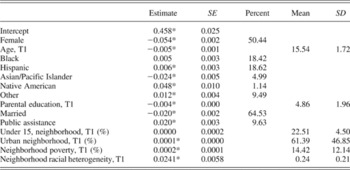
Neighborhood in this study was represented by census tract. Neighborhood child saturation was the percentage of the population in the census tract under the age of 15, according to US 2000 census data. Neighborhood poverty was the percentage of individuals in the census tract living in households with incomes below the federal poverty level. Neighborhood urbanicity was the percentage of the census tract that was urbanized. Racial heterogeneity was the probability that two individuals randomly drawn from the same tract will be of the same racial group. Means and standard deviations for these variables are presented in Table 2, as are percentages for categorical variables.
MAOA
DNA was isolated from buccal swabs and analyzed at the Institute for Behavioral Genetics at the University of Colorado. The MAOA polymorphism was assayed following procedures described by Haberstick et al. (Reference Haberstick, Lessem, Hopfer, Smolen, Ehringer and Timberlake2005). Primer sequences for the 30 base pair variable number tandem repeat in the promoter region were 5′-ACAGCCTGACCGTGGAGAAG-3′ and reverse 5′-GAACGTGACGCGCCATTCGGA-3′. Five possible fragment sizes result from the polymerase chain reactions: 291, 321, 336, 351, and 381 base pairs (two to five) repeats. DNA amplification followed procedures described by Anchordoquy, McGeary, Liu, Krauter, and Smolen (Reference Anchordoquy, McGeary, Liu, Krauter and Smolen2003). Samples were analyzed using an ABI Prism 3100 Genetic Analyzer, following procedures provided by the company.
Because most fragments are either 321 or 351 base pair length (97% of the fragments in the AddHealth sample; Haberstick et al., Reference Haberstick, Lessem, Hopfer, Smolen, Ehringer and Timberlake2005) and the biological activity of these lengths is relatively well known (Widom & Brzustowicz, Reference Widom and Brzustowicz2006), we restrict our sample to individuals with either of these two lengths. For reasons discussed in the introductory section, we used only males in the genetic analyses and compared males with the short MAOA allele (321, 42%) to males with the long allele (351). As noted previously, males only have one copy of this gene, and therefore there were no heterozygous (short/long) participants included in these analyses.
Results
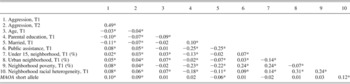
Table 1 presents the correlations among the measures of aggression and individual, family, and neighborhood characteristics. The temporal stability of aggression is substantial (r = .49), but the correlations of aggression with all other variables examined in this study are small in magnitude. The generally modest magnitude of associations suggests that adolescent aggression has multiple origins. The small to moderate intercorrelations between our measures of neighborhood characteristics (r = .14–.31) indicate that although these measures are associated, they are not measuring a single “bad neighborhood” construct.
Correlations among measures of aggression, individual, family, and neighborhood characteristics

Note: T1, Time 1; T2, Time 2; MAOA, monoamine oxidase A.
*p < .05.
Our first set of hypotheses concerned the relation of neighborhood qualities to aggression. In the first analysis, Tl aggression was regressed on individual, family, and neighborhood characteristics. Because participants were nested in neighborhoods, a two-level multilevel model was used (participants nested within neighborhoods). The results of this analysis are presented in Table 2, and they are generally consistent with expectations. Age and gender are associated with adolescent aggression in predictable ways, as are parental marital, educational, and economic statuses. Neighborhood characteristics are predictive as well: urbanicity, poverty, and racial heterogeneity are all positively associated with adolescent aggression at T1. Surprisingly, and contrary to expectations, neighborhood child saturation was not associated with initial status on the measure of aggression.
Multilevel model regressing T1 aggression on T1 individual, family, and neighborhood measures

Note: T1, Time 1; T2, Time 2.
*p < .05.
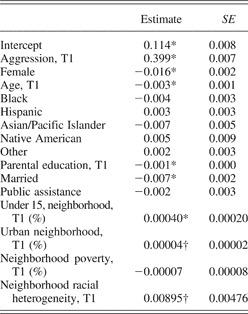
The second analysis predicted T2 aggression, adjusting for T1 aggression, for adolescents who had lived in the same neighborhood at both testing times. Adolescents were again nested within neighborhoods, and consequently, a two-level multilevel model was employed. This model assesses the time-invariant effects (Allison, Reference Allison2005) of neighborhood on changes in adolescent aggression. The results of this analysis are presented in Table 3. Not surprisingly, T1 aggression was a strong predictor of aggression at T2. As in the analyses of T1 aggression, gender, age, parental education, and parental marital status were associated with T2 aggression. However, in contrast to the cross-sectional findings reported in Table 2, child saturation was the only neighborhood characteristic associated with T2 aggression (although the coefficients for neighborhood urbanicity and racial heterogeneity are in the predicted direction and are marginally significant). These results suggest that adolescents living in neighborhoods high in child saturation are likely to be more aggressive at T2, above and beyond the effects of T1 aggression, than are adolescents living in neighborhoods low in child saturation.
Multilevel model regressing T2 aggression on T1 delinquency, T1 individual, family, and neighborhood measures

Note: T1, Time 1; T2, Time 2.
†p < .10. *p < .05.
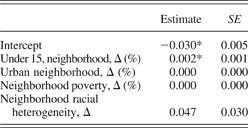
The results of the fixed effects analysis (Allison, Reference Allison2005) presented in Table 4 confirm the relation of child saturation to aggression. This analysis included only those adolescents who moved to new neighborhoods between T1 and T2 and addressed whether change in neighborhood qualities between T1 and T2 was predictive of change in aggression between T1 and T2. Difference scores between T1 and T2 were calculated for aggression and the four neighborhood characteristics. The difference score for aggression was then regressed on the four difference scores for neighborhood characteristics. The results indicated that adolescents whose new neighborhoods were higher in child saturation than were their old neighborhoods increased in aggression between T1 and T2.Footnote 1
Fixed-effects regression of T1–T2 aggression change on change in neighborhood characteristics

Note: Only participants who moved between Time 1 (T1) and Time 2 (T2) are included in this analysis.
*p < .05.
Our final set of analyses focused on the interaction of MAOA allele and neighborhood context in the prediction of change in aggression. As discussed in the introduction, the short MAOA allele is associated with sensitivity to social rejection, and consequently, should deter adolescents from patterns of behavior that may lead to social disapproval such as delinquency and aggression. However, as child saturation in a neighborhood increases, and consequently aggressive behavior becomes both more common and more socially accepted, the risk of social rejection that is associated with aggressive behavior should decrease. The prediction is for an MAOA Allele × Neighborhood Child Saturation interaction, with those adolescents with the short version of the allele living in neighborhoods high in child saturation (low risk of social rejection) expected to be higher in aggression than adolescents with the same allele living in neighborhoods low in child saturation.
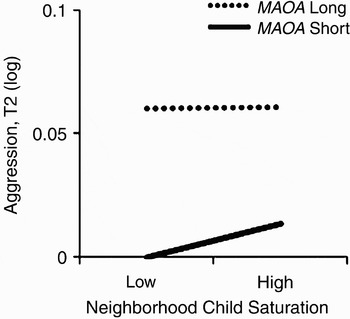
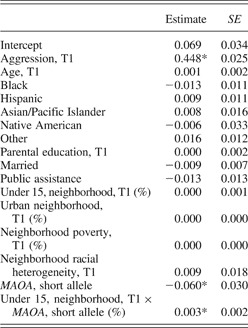
Table 5 presents the results of our analyses. For reasons described in the introduction, we used only males. Because participants in this analysis were nested within families, we used a two-level multilevel model. Our results are consistent with predictions. Of particular importance is the significant interaction between MAOA allele and neighborhood child saturation. Figure 1 illustrates the nature of this interaction, which is consistent with our hypothesis: adolescents with the short MAOA allele living in neighborhoods high in child saturation evidenced more increases in aggression from T1 to T2 than adolescents with the same allele living in neighborhoods low in child saturation. This interaction effect was significant above and beyond the main effects of other neighborhood characteristics (poverty, urbanicity, and racial heterogeneity).
The interaction of the monoamine oxidase A (MAOA) allele with neighborhood child saturation in the prediction of Time 2 aggression. The points in this graph were estimated from the parameter estimates in Table 5, with all dummy variables set to 0, and all continuous variables not illustrated in Figure 1 set to their means.

Multilevel model regression of T2 aggression on T1 aggression, individual, family, neighborhood, and genetic factors

Note: T1, Time 1; T2, Time 2; MAOA, monoamine oxidase A.
*p < .05.
Discussion
The results of this study indicate that neighborhood urbanicity, child saturation, and racial heterogeneity are associated with adolescent aggression, above and beyond the effects of neighborhood and family SES indicators. Specifically, cross-sectional analyses demonstrated that higher levels of urbanicity and racial heterogeneity were associated with higher levels of adolescent aggression. Longitudinal analyses indicated that higher levels of child saturation were associated with increases in adolescent aggression over a 1-year period. Among those adolescents who moved between neighborhoods, those who moved to a neighborhood higher in child saturation tended to exhibit increases in aggression over that 1-year period. In addition, we found a Gene × Neighborhood interaction such that youth with the short MAOA allele who were living in more youth-saturated neighborhoods evidenced more increase in aggression from T1 to T2.
The first set of results, those examining links between neighborhood characteristics and adolescent aggression, highlights the importance of neighborhood factors other than SES. Although other studies have clearly demonstrated links between neighborhood poverty and adolescent delinquency (as reviewed by Leventhal & Brooks-Gunn, Reference Leventhal and Brooks-Gunn2000), the present study indicates that even once neighborhood poverty is adjusted for, the degrees of child saturation, racial heterogeneity, and urbanicity of a neighborhood are associated with adolescents' aggression. It is not clear why we found that urbanicity and racial heterogeneity were associated with aggression cross-sectionally, whereas child saturation was associated with increases in aggression over a 1-year period. However, it is striking that moving from a less youth-saturated neighborhood to one higher in child saturation was associated with increases in aggression over a 1-year period. The collective socialization and contagion models of neighborhood effects would support the notion that child saturation and urbanicity would be associated with increased aggression. Specifically, in an environment with many youths relative to adults, there are fewer adults to make and enforce rules, and more youth to model aggressive behavior that may then be adopted by previously nonaggressive youth. In an urban neighborhood, people live close together, thereby allowing more “contagious” aggressive behavior than in a rural environment, where youths may simply come into contact with aggressive youths less frequently.
As discussed in the introductory section, there is some indication that males having the short version of the MAOA allele are particularly responsive to stress and tend to evidence externalizing behavior in the face of family-based adversity (Caspi et al., Reference Caspi, McClay, Moffitt, Mill, Martin and Craig2002; Foley et al., Reference Foley, Eaves, Wormley, Silberg, Maes and Kuhn2004; Kim-Cohen et al., Reference Kim-Cohen, Caspi, Taylor, Williams, Newcombe and Craig2006; Nilsson et al., Reference Nilsson, Sjöberg, Damberg, Leppert, Öhrvik and Alm2006). Consistent with this possibility, we found an interaction effect between MAOA and child saturation such that among youth with the short MAOA allele, those living in child-saturated neighborhoods tended to increase in aggression more than those living in neighborhoods with lower proportions of children. In contrast, youth with the long MAOA allele did not vary in their level of aggression across levels of child saturation, indicating that their level of aggression was not affected by neighborhood factors.
Our finding regarding the main effect of the MAOA allele on aggression contrasts with the findings of Caspi et al. (Reference Caspi, McClay, Moffitt, Mill, Martin and Craig2002), Foley et al. (Reference Foley, Eaves, Wormley, Silberg, Maes and Kuhn2004), and Nilsson et al. (Reference Nilsson, Sjöberg, Damberg, Leppert, Öhrvik and Alm2006). In those studies, more proximal and noxious environmental factors (child maltreatment and related conditions) were examined, and only interaction effects, showing that under conditions of low risk, those with the long MAOA allele exhibited more delinquency, while under conditions of high risk, those with the short allele exhibited more delinquency, were found. It seems likely that the main effects we found are related to the fact that the neighborhood risk factors that we adjusted for are both more distal (neighborhood, vs. family in other studies) and less severe (neighborhood disadvantage, vs. maltreatment/violence in the family in other studies) than those examined in these other studies.
Of course, this study had limitations. First, there are many influences on adolescent aggression that we did not examine in this study. Most importantly, parent and peer influences could be confounded with neighborhood characteristics; although we controlled for some family characteristics (parental education, receipt of public assistance), parent and/or peer influences may mediate or moderate the associations we found. Nonetheless, if we assume that these effects are time-invariant, that unmeasured individual and family characteristics associated with delinquency are unchanging over the 1-year span between T1 and T2, then the fixed effects analysis controls for such effects and demonstrates that changes in neighborhood context do matter. Second, our measures of neighborhood characteristics were at the level of census tracts; it is not clear how more broad (e.g., county) or narrow (e.g., block) neighborhood characteristics would be associated with aggressive behavior. Third, in our examination of MAOA allele effects, we did not examine females; it is therefore not clear whether our findings would generalize to females or not.
Our work contributes to a new paradigm in developmental psychopathology formed by the synthesis of sociological investigations of neighborhoods with developmental–genetic research. If, as some assert, parental influence on children is largely attributable to genes rather than to parenting behavior (e.g., Turkheimer, Reference Turkheimer2000) then it may be fruitful to seek environmental influences on the emergence and development of developmental problems in the community, rather than within the family system. In this study we examined four qualities of neighborhoods regularly of interest to sociologists and political scientists, and found that these factors were predictably associated with delinquency. Our most robust finding is that child saturation, which is the relative youthfulness of a community, is predictive of increases in delinquency. One implication of this finding is that there are other qualities of neighborhoods beyond economic vitality that are associated with development, an idea that may be a useful complement to the prevailing focus on community poverty in developmental psychology. Our findings also point to the individual variability in openness to community influences, with genes moderating the relation of child saturation to adolescent delinquency.
Our findings also contribute to an understanding of the origins and developmental trajectories of personality disorders characterized by aggression, particularly antisocial personality disorder (as well as potentially others that involve difficulties with anger management and emotional regulation, such as borderline personality disorder). Our work emphasizes that the social context in which personality disorders emerge may include neighborhoods. Much of the research on the developmental origins of personality disorders has focused on families, particularly on parental abuse of children (Goodman et al., Reference Goodman, New and Siever2004); the present study highlights the importance of considering broader contextual factors as well. Personality disorders do emerge in people without childhood histories of abuse and, conversely, among people with histories of abuse, not all evidence psychopathology. It is possible that an understanding of the broad social context, of which neighborhoods are one part, can contribute to a more nuanced understanding of the emergence of aggression-related personality disorders.
This possibility gains credence from epidemiological work suggesting that personality disorders are more common among those from the lower social classes (Regier et al., Reference Regier, Farmer, Rae, Myers, Kramer and Robins1993). The lives of individuals from low social classes differ in many ways from the lives in higher social classes, and consequently, it is difficult to identify plausible single factors for differences in rates of psychopathology. Nonetheless, social class differences in neighborhoods may prove to be part of the explanation for the association of social class and the development of psychopathology.
Finally, our results confirm and extend knowledge about the developmental trajectories of aggression in adolescence. There is abundant evidence (e.g., Koko & Pulkkinen, Reference Kokko and Pulkkinen2005) that there is substantial stability in levels of aggression in childhood, adolescence, and adulthood, and our findings are consonant with this trend. The correlation of aggression at T1 with T2 aggression was .49, suggesting considerable continuity over a 1-year period. Moreover, our findings also confirm that as adolescents get older, they tend to become less aggressive (Brame, Nagin, & Tremblay, Reference Brame, Nagin and Tremblay2001).
Unique to our study, however, are the findings that suggest that changes in aggression levels in adolescence are associated with changes in neighborhoods. The results from our fixed effects regression analysis suggest that an adolescent who moves from a neighborhood high in child saturation (1 SD above the mean, or about 27%) to a neighborhood low in child saturation (1 SD below the mean, 18%) between T1 and T2 can be expected to be 0.1 SD lower in aggression at T2 than at T1. This is an effect size small in magnitude. Nonetheless, it is certainly possible that the effects of moving could be cumulative, with the magnitude of the effect size becoming larger as an adolescent accommodates more fully to a new neighborhood after a period of years, resulting in even larger increments or decrements in aggression, depending upon the child saturation of the neighborhood into which an adolescent moves. Our findings concerning residential relocation and changes in aggression as well as those concerning the moderation of neighborhood effects by allele can contribute to our understanding of the variability in developmental trajectories in aggression noted by others (e.g., Brame et al., Reference Brame, Nagin and Tremblay2001).