


It was Edward Seler (in Códice Borgia 1963:vol. I:25; see also Sullivan Reference Sullivan1966:6) who, more than a century ago, first uncovered that in the cultures of ancient central Mexico, taking an enemy prisoner during war was the symbolic equivalent of giving birth to a child, and that by the same token, the death of a mother during childbirth was her symbolic death on the battlefield. According to the Historia de los mexicanos por sus pinturas (Tena Reference Tena and Tena2011:39), the goddess Xochiquetzal was the first woman to die in “war.” Effectively, as mentioned in the Florentine Codex (Sahagún Reference Sahagún, Anderson and Dibble1950–1982:vol. VI:167; Reference Sahagún, Austin and Quintana2002:vol. II:611), a newborn baby was considered a captive: “And when the baby had arrived on earth, then the midwife shouted; she gave war cries, which meant that the little woman had fought a good battle, had become a brave warrior, had taken a captive, had captured a baby.” However, it was Olivier (Reference Olivier2014–15:67; Sahagún Reference Sahagún, Anderson and Dibble1950–1982:vol. VI:204) who called attention to the fact that the infant was called yaotl or “enemy,” which resulted in the question of why give birth to enemies? Olivier (Reference Olivier2014–2015:66; Sahagún Reference Sahagún, Anderson and Dibble1950–1982:vol. II:54) linked this idea to the fact that captured enemies were referred to as the “sons” of the captors. The father–son kinship construction (a “fusion mystique,” Graulich Reference Graulich2005:165, 349–350) that existed on the battlefield, which partly explains the identification of the captor—the sacrifice—with the victim (Olivier Reference Olivier, Luján and Olivier2010:466–467; Reference Olivier2015:341, 627), is also briefly mentioned by Benavente (Reference Benavente and Dyer1996:486). As we will see, the Cantares Mexicanos provides us with further evidence in support of this interpretation, given that warriors were frequently addressed as children or infants in these songs, gathered in the 1550s, 1560s and 1570s (Bierhorst Reference Bierhorst1985:25).
The assimilation of the Other into the society of the captor by way of kinship is certainly a frequent feature of Amerindian warfare ideology (Vilaça Reference Vilaςa2002; Santos-Granero Reference Santos-Granero2009). In a previous study (Declercq Reference Declercq2020), I described how Nahuatl groups involved in the so-called Flowery Wars exchanged food and participated in ceremonial festivals and major events such as the enthronement or the death of a tlatoani but did not establish marriage relations with each other. Instead of the latter, the taking of captives during warfare seems to have been a means of social reproduction.
However, as stated above, kinship went beyond human beings in Mesoamerica and could involve the material world, as well as the world of invisible spirits and deities. Consequently, in Mesoamerica, “midwifery has no biological determinants” (Joyce Reference Joyce and Klein2001:125). All children—regardless of biological relationships or even raw material—were born in 9 Heaven as fragments of Mother Earth (Sahagún Reference Sahagún, Anderson and Dibble1950–1982:vol. VI:94, 176). An ancestral womb, 9 Heaven, was occasionally described as a place of rocks, because long ago, the ancestors were transformed into monoliths (López Austin Reference López Austin2015; Sahagún Reference Sahagún, Austin and Quintana2002:vol. I:316). Such “metapersons” made of stone play a role in cosmopolitics and bring us to the notion of the birth of “children made of stone,” sometimes with warrior personhoods and forms of intentionality. Central to the twofold notion of considering male adult captives and blade stones as newborn children is the assumption that both are, as Others and outsiders, ontologically less than human. Indeed, as Overholtzer and Robin (Reference Overholtzer and Robin2015:1) observe, “mutually constitutive relationships between people and the material world” can be a clue to understanding Mesoamerican dynamics, and in our particular context, the gestation of children.
The birth of warrior gods
Before I proceed with a discussion of baby warriors themselves, it would benefit us to make some notes on the birth of the gods that the Aztecs worshiped, as recounted in various cosmogonic myths. I will restrict my analysis here only to the war gods. During the minor Feast of Pachtontli and of the goddess Xochiquetzal, at dawn, a group of priestesses from the temple of the Mexica war god Huitzilopochtli would stand guard over a large tub filled with corn dough until they “saw the footprint of a newborn babe impressed in the dough and the dough crumbling. On discovering that sign of the child, the trumpets, conch shells, and flutes resounded, and a great shout went up, announcing the arrival and birth of the warrior, who in their language is called Yaotzin (“Small Enemy in War”)” (Durán Reference Durán, Horcasitas and Heyden1971:241). “And Uitzilopochtli just then was born. Then he had his array with him, his shield, and his darts and his blue dart thrower” (Sahagún Reference Sahagún, Anderson and Dibble1950–1982:vol. III:4). In other words, he “emerged fully armed from the womb of his mother Coatlicue” (Olivier Reference Olivier, García and Mazzetto2021:59). In a song referring to the famous myth of the battle of Coatepec (“Snake Hill”), where Huitzilopochtli defeats his sister and his four hundred brothers or uncles, it was said, “On her shield the virgin girl grows large. At the call to the fray, he is given birth” (Sahagún Reference Sahagún and Sullivan1997:136).
The same was said in a song of the Mimixcoa, “Cloud Serpents,” the first mythical warriors who descended from Seven Caves and had to feed the Sun with their similarly named victims: “I came forth (was born), I came forth (was born) with my spear made of the prickly plant” (Sahagún Reference Sahagún1958:94; Seler Reference Seler and Comparato1990–1998:vol. III:258). As Seler (Reference Seler and Comparato1990–1998:vol. III:260) observes, the Nahua commentator explains that the verb temo (“to descend”) means tlacati (“to be born”) ynotlavitol ynomiuh (with “my bow and arrows”).
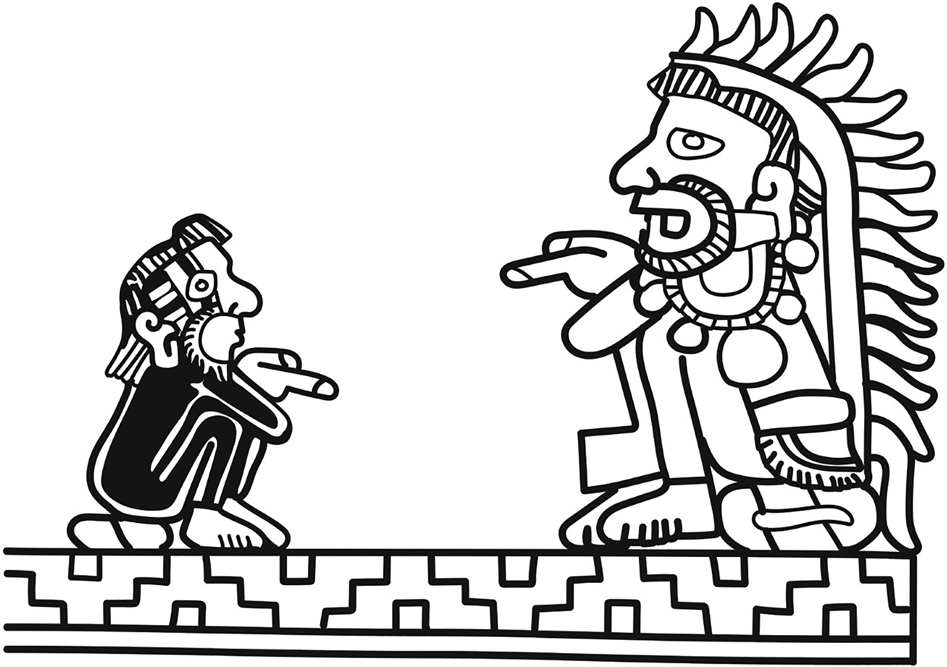
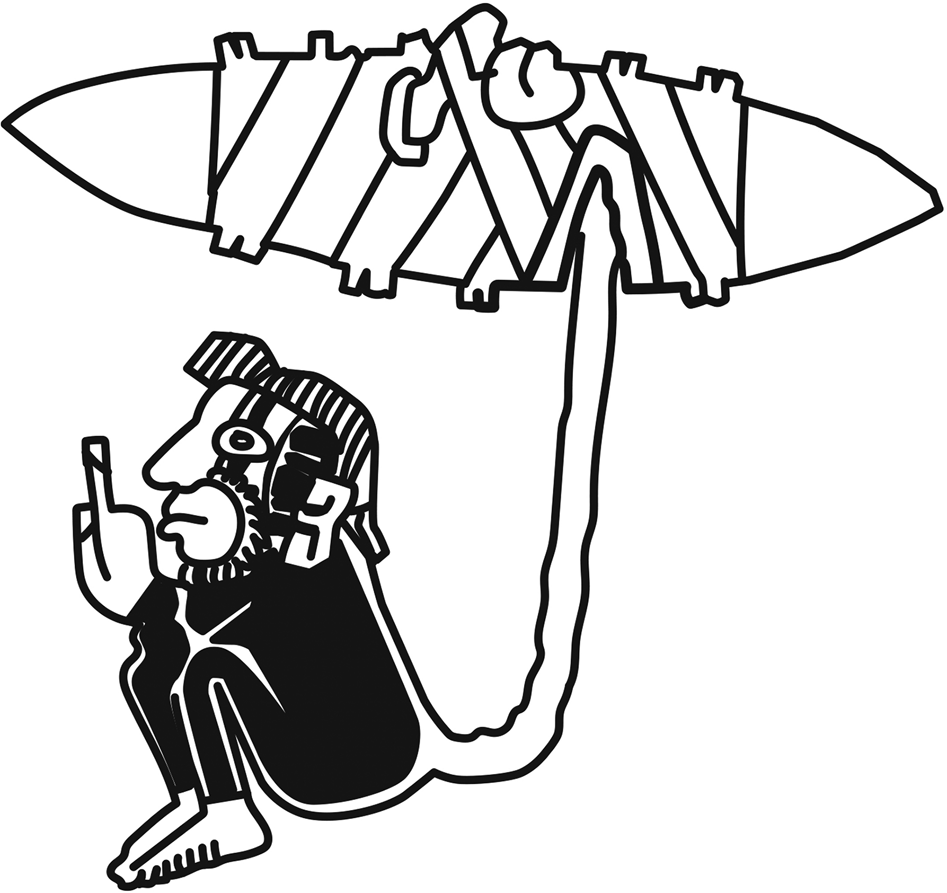
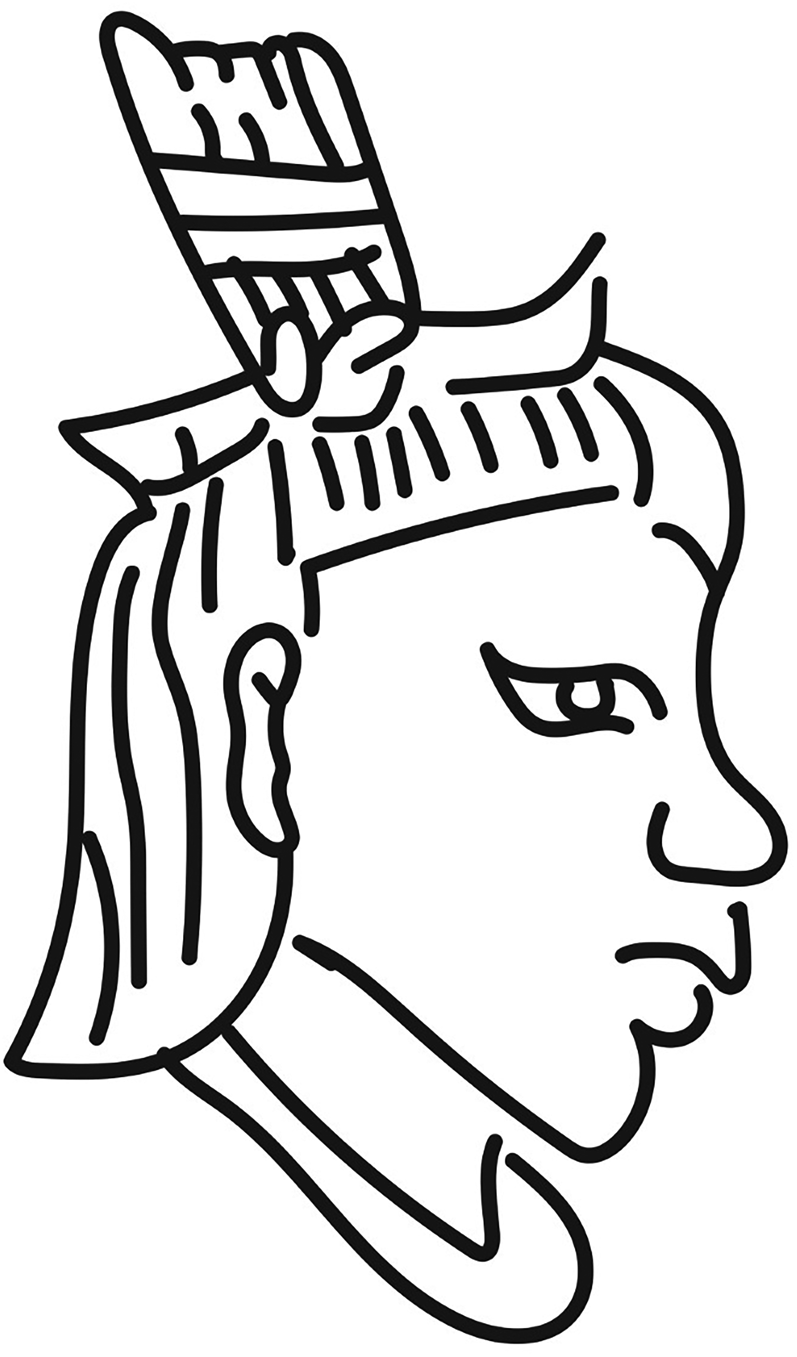
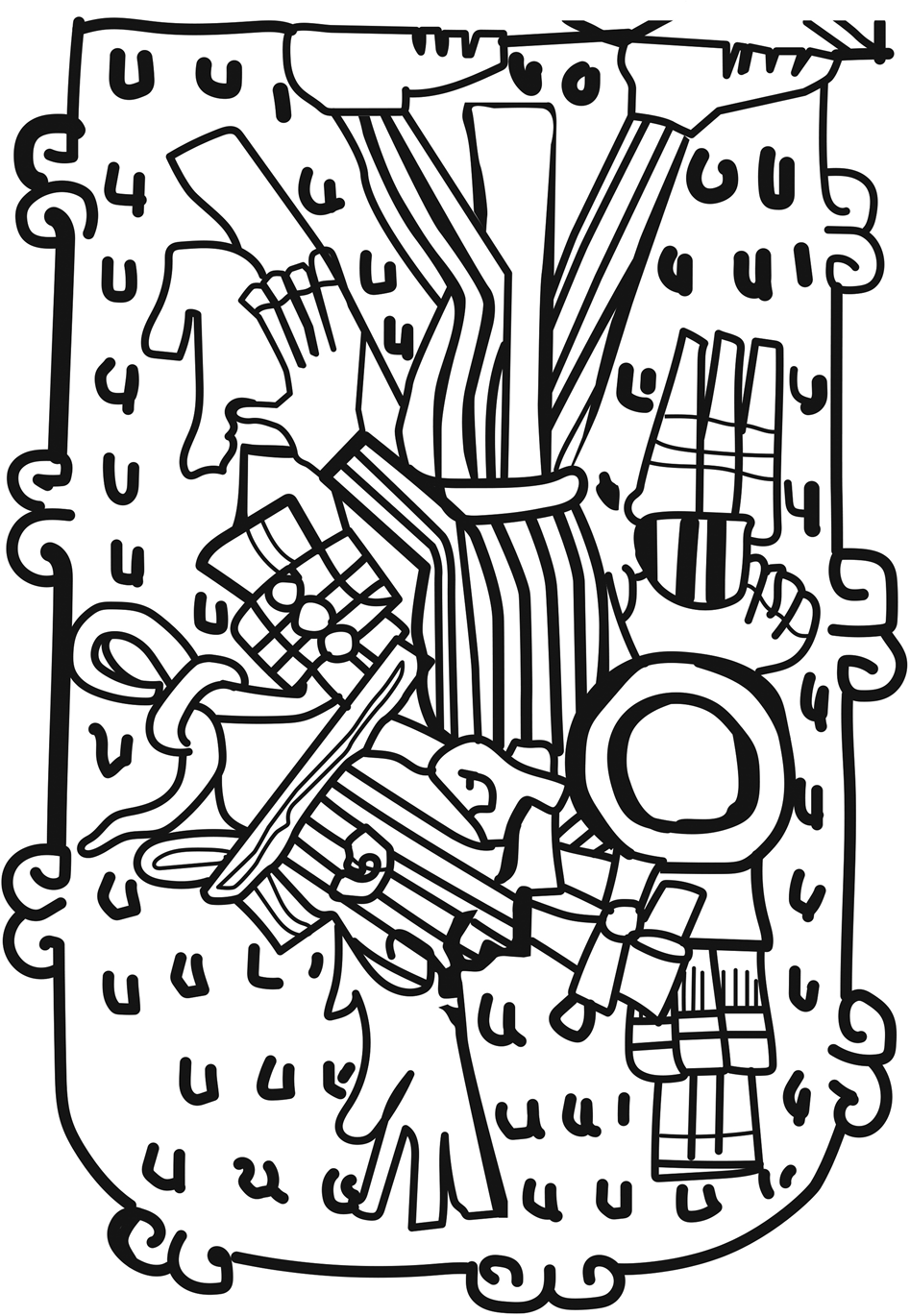
In the Mixtec Códice Vindobonensis (Anders et al. Reference Anders, Jansen and García1992b:Plate 49; Jansen Reference Jansen1982:90; Olivier Reference Olivier, García and Mazzetto2021:60), the Lord 9 Wind (equivalent to Quetzalcoatl) is depicted as a child (characterized by his nakedness and his small size), receiving instructions from his two grandparents just before he leaves the sky (Anders et al. Reference Anders, Jansen and García1992b:92) (Figure 1). He emerges from a flint knife, attached to the latter by his umbilical cord (Figure 2), witnessing a connection between warfare and childbirth that will be discussed further on.
To the left, the God 9 Wind (equivalent to Quetzalcoatl) as a child, receiving instructions from a grandparent (Anders et al. Reference Anders, Jansen and García1992b:Plate 49). Illustration by Fátima Lázaro.

God 9 Wind emerges from a flint knife, attached by his umbilical cord (Anders et al. Reference Anders, Jansen and García1992b: Plate 49). Illustration by Fátima Lázaro.
In Tlaxcala, the patron god of hunting, Camaxtle, was said to be of the size of “tres estados de altura.” Besides him, a small statue of a little god was honored, and it was said to have accompanied the Tlaxcalan people since the first inhabitants migrated and arrived there (Benavente Reference Benavente and O'Gorman1971:78). The indication of the difference in size makes it clear that the small statue is an infant.
In colonial Nayarit, Mexico, the friar Antonio Tello (Reference Tello1968:book 2, vol. 1:pp. 34–35) tells us the story of a Child-god (“Dios Piltzintli, que quiere decir: dios niño”), who, just like the Mexica gods, left his foot- and handprint (“dexó estampados los pies y manos, según la tradición de sus antepasados”), and when needed, appeared “in the figure of a child” (“en figura de un niño”). In order to protect his people in times of warfare, he would appeal to legions of angels from the sky and “infernal demons” for military help: “asking for help, the god Piltzintli showed up with a bow, a shield and arrows invoking the gods of the Sky, asking them to send from their thrones legions of angels, and from hell, demons to help their faithful servants.”
More importantly, among contemporary indigenous West Mexican groups, Piltonte, which means “boy,” is another name for the young “Morning Star” hero of Mexicanero mythology (Neurath Reference Neurath2005:82). In Cora religion, he is a young Indigenous warrior “with bow and arrow, who intercedes with other gods to help the people in their troubles,” and during Cora ceremonies, he is personified as a little boy, as witnessed by Neurath. In songs, they talk about Piltonte's descent to earth (Neurath Reference Neurath2005:80, 97). In the Huichol language, the gods of the Morning Star are either Xurawe Temai (“Young Star” or “Star Youth”), Tamatsi Parietsika (“Elder Brother of Dawn”), or Parikuta Muyeka (“The One Who Walks in the Dawn”) (Neurath Reference Neurath2005:81).
The frequent description of war gods as children, together with the association of the latter equipped with their weapons at birth, suggest an overarching theme. War gods and children do not spend their lives in the celestial realm but are “physically” present on Earth, as testified by their footprints. It is likely that both originate in the sky; abandon it as an infant and newborn, respectively; or in some cases, join a group of emigrants from some ancestral place of origin. At the same time, these gods had the capacity to be reborn again and again (Tena Reference Tena and Tena2011:49).
Child warriors
I will present two examples of “becoming” children on the battlefield. The first tells how four warriors, after having lost in battle, transform into children—meaning, perhaps, that they become adopted sons of their captors. The second focuses on the sudden appearance of a nagual (or “nahual”) baby of a warrior, and likewise ends up with a defeat (for “Nahualli,” see Andrews and Hassig in Ruiz de Alarcón Reference Ruiz de Alarcón, Richard Andrews and Hassig1984). According to Andrews, the word nagual literally means “an entity that can be interposed.” Following Martínez González (Reference Martínez González2011:88–90), nahualli could be understood here as an “accompanying entity” or “coessence”—human or non-human—that could be an ancestor, a protector, or a defender.
According to Alva Ixtlilxochitl (Reference Alva Ixtlilxóchitl and O'Gorman1985:vol. II:186), four esteemed warriors from the reign of Texcoco foresaw their coming defeat in a bad omen, which appeared to them shortly after the Mexica ruler Motecuhzoma betrayed his allied Texcocans by making a deal with the enemies from Tlaxcala. During the last night before the bellicose encounter, very near Eagle Hill, or “Quauhtepetl,” all four of them saw themselves in a dream, and it looked as though they were in their childhood, crying and hoping their mothers would come for them […] and their hearts felt the harm that was so near at hand” (“A un tiempo todos cuatro veían entre sueños, que parecía que estaban en la edad de su niñez, que andaban llorando tras de sus madres para que los recogiesen…y sus corazones conocían el daño que tan próximo se les venía” (Alva Ixtlilxochitl Reference Alva Ixtlilxóchitl and O'Gorman1985:vol. II:186). (All translations from Spanish to English are the author's.)
The Anales de Tepeteopan (2009:31), which refer to Tehuacan, Puebla, tells the story of Xochitecutli and his family, who all claimed to be eagles and jaguars, and how they competed with someone named Ozomatli de Tepexic Atezca. During an encounter between the two, “his [Ozomatli's] nahual came falling at midnight and transformed as a child, with whom he would defeat Xochitecutli, eagle, jaguar” (“a media noche llegó su nahual, vino a caer convertido en niño, con él iba a vencer a Xochitecutli, águila, ocelote”). The child, lying there, was brought to Xochitecutli, who ordered that the infant be killed by shouting, “Hit him with a stick of magnolia” (“ya péguenle con una vara de magnolia [yolloxochitl]”) (Anales de Tepeteopan 2009:31), initiating the start of the battle: “And when they had not yet hit him with a stick in the head, a flower of magnolia burst out [causing a loud echo in the mountains] and warfare started there.” (“Y cuando aún no le pegaban con palo en su cabeza, luego brotó una flor de magnolia, y allá se hizo Guerra”) (Anales de Tepeteopan 2009:33). As Tenorio et alia (Anales de Tepeteopan 2009:27) explain, the opening of a flower—cueponi in nahuatl—refers to something that bursts out or radiates.
A major difference between human and nagual children and Child-god seems to be that the former are portrayed as victims, whereas the latter could also be the victors. Another ritual episode that possibly indicates that a prisoner of war was considered a child describes the presence of a woman with one breast bigger than the other one in Mixcoatl's temple in Tlaxcala (Muñoz Camargo Reference Muñoz Camargo1998:98–103). In the midst of battle, this woman magically produced breast milk to feed and strengthen the arrows as if they were children (Olivier Reference Olivier2015:118–122). Interestingly, a carrier of the skin of the first sacrificed captive was anointed with the same milk.
Song LVII of the Cantares Mexicanos: “cradlesong”
Although different in context, I make a comparative analysis here of two episodes: one on the battlefield, and the other in a ritual setting. Both include the presence of an infant in a cradle and the existence of a virtual kinship relation between two entities. In the former case, the infant is a Mexica tlatoani, whereas in the latter, the hero is a baby-stone knife.
Song LVII of the Cantares Mexicanos (CM) is called “cradlesong” and glorifies the Mexican ruler, “the little jewel, baby Ahuizotl” (Bierhorst Reference Bierhorst1985:263–267). A Mexican girl is carrying a “shield cradle” and is apparently looking for him: “for there beyond is where he lies, this treasure, this little war-flower babe of mine” (Bierhorst Reference Bierhorst1985:263–267). However, her intentions seem to be sexual: “My breasts are popcorn flowers. In bed with raven blooms we've been entwined. O, little young man. O little Ahuizotl” (Bierhorst Reference Bierhorst1985:263–267).
The next episode in the CM evokes the sound of the radiating flower that appeared in the Anales de Tepeteopan: “I heard a song, me, a girl, I carry my younger brother, we will see little Ahuitzotl; a flower tree emerged, a flower rope comes intertwined. Little Ahuitzotl triggers his song” (“Escuché un canto, yo doncella, llevo a cuestas a mi hermano menor, veremos al pequeño Ahuitzotl; vino a brotar el árbol florido, el cordel florido se viene entrelazando. Desata su canto el pequeño Ahuitzotl”) (León-Portilla Reference León-Portilla, Curiel, de León-Portilla and Equiguas2016:book II:vol. 1:chapter LVIII). The precious tree sprouts: “pequeño Ahuitzotl, que te haga yo bailar, ha llegado el niñito en flor” (León-Portilla Reference León-Portilla, Curiel, de León-Portilla and Equiguas2016:book II:vol. 1:chapter LVIII). As Bierhorst (Reference Bierhorst1985:267) renders it, “The dear little flower babe has arrived!” Then, Ahuitzotl gets involved in a battle in Huexotzinco. She tells him not to cry (“I'll lay you in your cradle, little Ahuizotl, your father will come, he will rock you”).
According to Bierhorst (Reference Bierhorst1985:459), the Mexican girl seeks to please him by offering him enemy warriors, for this is what he craved. He is then captured by his “father” in Huexotzinco. Bierhorst (Reference Bierhorst1985:459) positions a warrior opponent as Ahuitzotl's father. We can be sure of this interpretation given that we have more explicit comparable data in the Florentine Codex. The fact that a captive was turned into the child of his captor also implied a cannibalistic prohibition of the captor eating his own prisoner: “Shall I perchance eat my very self?” For when he took [the captive], he had said, “he is as my beloved son.” And the captive had said, “he is my beloved father.” (Sahagún Reference Sahagún, Anderson and Dibble1950–1982:vol. II:54).
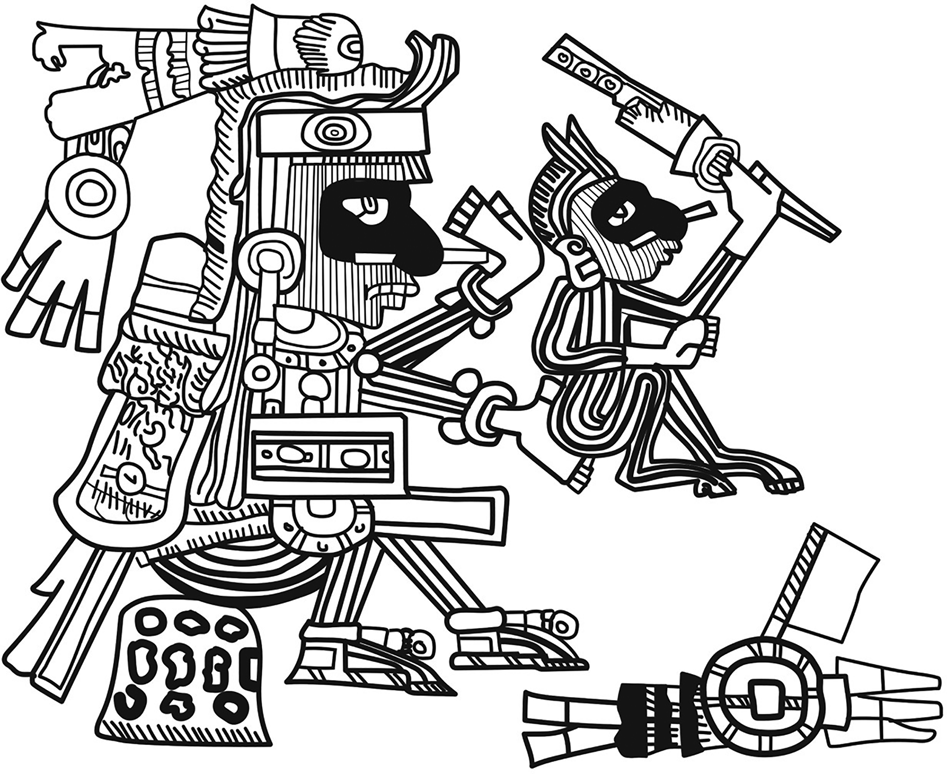
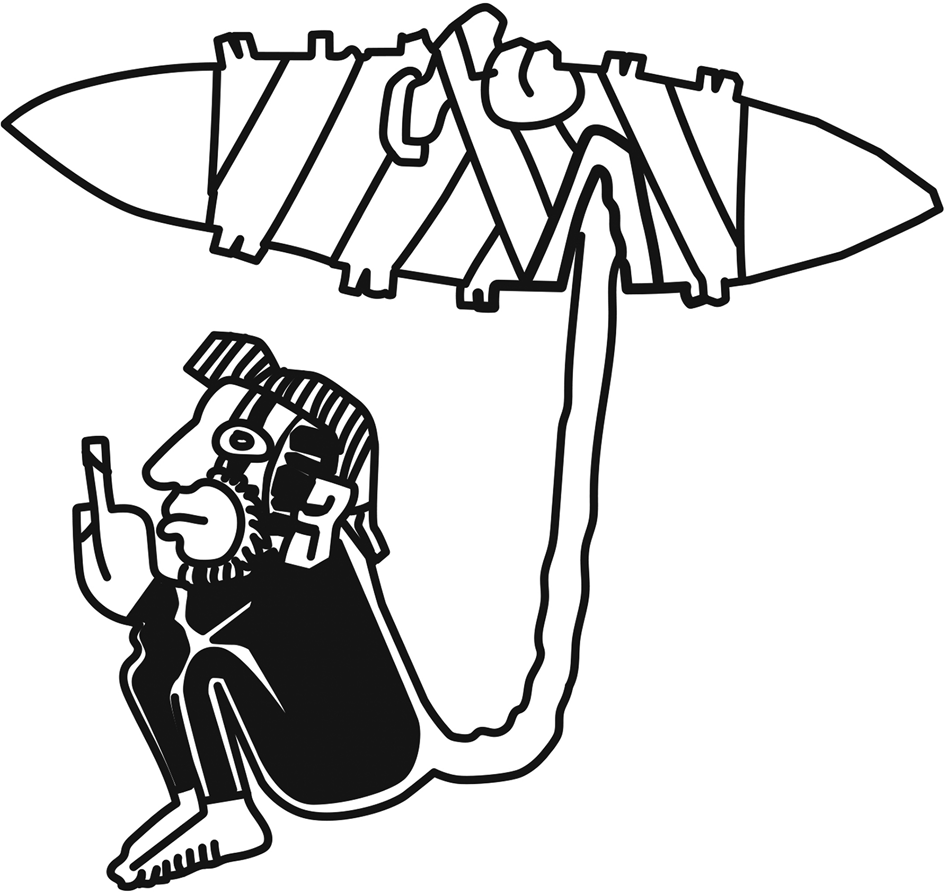
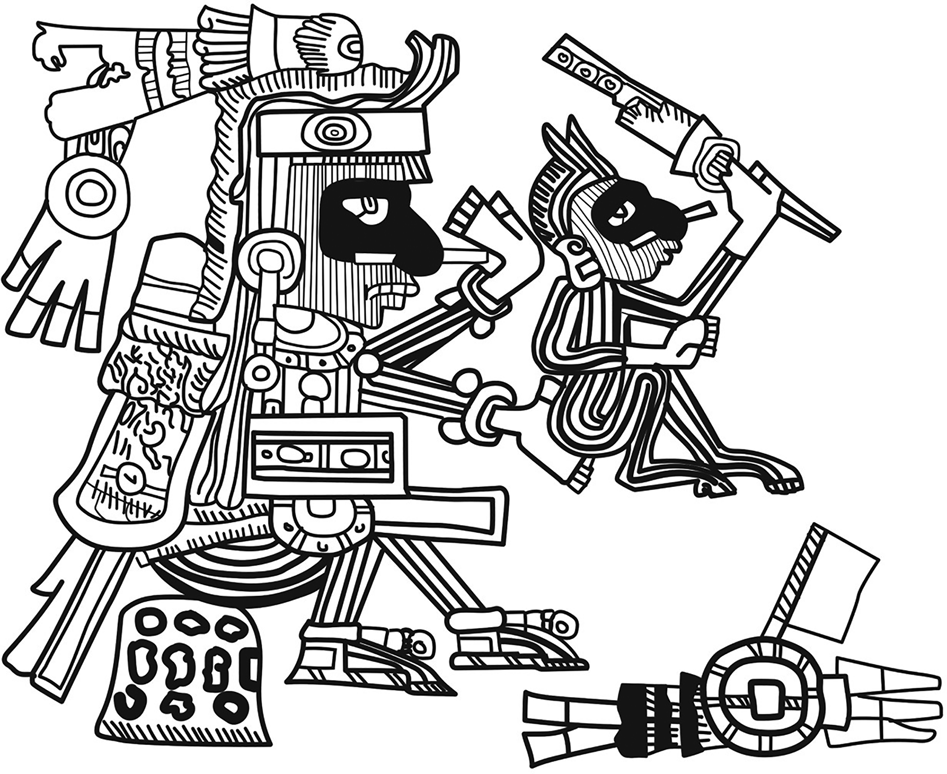
This process of incorporation and mutual identification was visually represented by the adoption, by the victors, of the enemy's black eye-paint circle (indicating a merging of victor and vanquished) for which the victorious warrior received the name Cuixcocatl (or “hombre alcoholado,” which refers to a balsam extract) (Acuña Reference Acuña1986:82–83). According to a Chichimec myth (Anales de Cuauhtitlan Reference Tena2011:25), all the four hundred Mimixcoa (the first mythical warriors) painted their eyes with the ashes of the goddess Itzpapalotl (“Obsidian-Butterfly”) after she was burned. In the Códice Borgia (Anders et al. Reference Anders, Jansen and García1993a:110:Plate 15), Mixcoatl, the Chichimec patron god of hunting, holds a child in his right hand (both the god and the child wearing black eye paint) as an image of himself and a sign of warfare and as part of a series of calendar images related to birth (Figure 3).
Mixcoatl holds a child in his right hand as an image of himself (Anders et al. Reference Anders, Jansen and García1993a:110, Plate 15). Illustration by Fátima Lázaro.
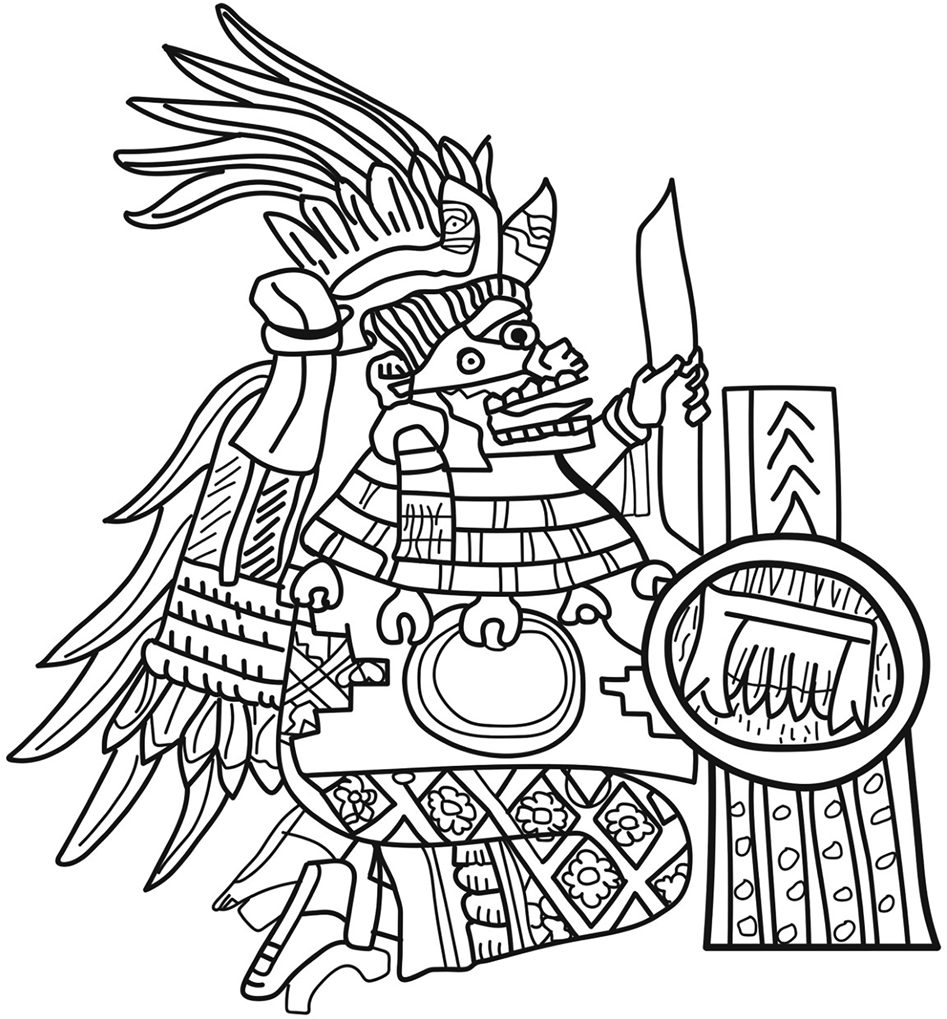
Now why does the Mexican girl lay little Ahuitzotl in a cradle, waiting to be captured by his enemy father? The Dominican friar Diego Durán gives us some hints in his description of the goddess Cihuacoatl (“Woman Snake”), a female warrior and at the same time an old woman (Graulich Reference Graulich1999:240–242). See also Gingerich (Reference Gingerich1988) and Klein (Reference Klein1988) for detailed descriptions of this goddess (Figure 4). This goddess, whose temple was dark and with a small entryway, was accustomed to being fed with sacrificial victims. But after having eaten a thigh, it was said that she would inform her priests that they could take the offering away because she was satisfied (Durán Reference Durán1984:vol. I:130). At certain moments, however, she would crave for more, and it was during one of these moments that her priests decided to seek a cradle. A sacrificial knife was put in it, which received the name the “son of Cihuacoatl.” Then, a girl was sent to the market with the cradle, where it was abandoned. Afterward, it was said that the goddess had appeared at the market with her son. Upon hearing what had happened, the priests, who had been mourning the disappearance of the Knife-son, went to retrieve the cradle and, with much reverence, returned it to the temple.
Cihuacoatl (“Woman-Snake”). (Anders and Jansen Reference Anders and Jansen1996:Plate 45r.) Note the two sacrificial knives in her headband and the weaving batten in her left hand. Illustration by Fátima Lázaro.

This story is significant because we see here again a kinship construction, this time composed of mother and child (a knife), symbolized by a cradle. But why is her son personified as a sacrificial knife (usually made of stone), and why was it sent to the market in the first place? Here, I follow Kay Almere Read (Reference Read1998:133), who symbolically links the market with the battlefield and the hunting grounds, all three being sites of production: “War, hunting and going to the market were equivalent acts because they all produced sustenance.” It is good to remember that when sacrificial victims were needed, the Aztec counselor Tlacaelel (Durán Reference Durán1984:vol. II:232–235) would advise that the troops be ordered to go to the market in Tlaxcala—meaning to go the battlefield—accompanied by their war god Huitzilipochtli to look for prisoners.
Hungry Old Mothers and hungry Baby-Knives
It would therefore appear that the rather strange act of sending her Knife-son to the market expressed the goddess's need for child victims in the form of warriors, and occasionally as human children. According to Sahagún (Reference Sahagún, Austin and Quintana2002:vol. II:28), in the period during which Don Martín Ecatl governed in Tlatelolco, the goddess Cihuacoatl (called a “Devil” by Sahagún) would appear day and night, and that on one occasion, she ate a child from a cradle in the town of Azcaputzalco: “y en tiempo déste, el Diablo, que en figura de mujer andaba y aparecía de día y de noche, y se llamaba Cihuacóatl, comió un niño que estaba en la cuna en el pueblo de Azcaputzalco.” In the Florentine Codex (Sahagún Reference Sahagún, Anderson and Dibble1950–1982:vol. I:11|), she is called Cioacoatl tequanj, “Woman-Snake Eater of Man.”
In the first half of the twentieth century, the German ethnographer Konrad T. Preuss documented various myths or tales in Nahuatl of the Sierra Madre Occidental. In some of these tales, an Old Mother god known as Tepusilam preys on children who are left unguarded in order to feed her appetite for child flesh: “When the parents came back, the child was not there anymore. There was only an impression left” (“Cuando los padres volvían, el niño ya no estaba. Sólo se veía una huella.”) (Preuss Reference Preuss and Ziehm1982:97).
On the other hand, the fact that the goddess Cihuacoatl sends her own son (the Knife-son) to the market introduces some ambiguity. It could mean she “delivers” or abandons her child for warfare so that he can be captured and incorporated into the captor's community. Or by conversely, with his craving mother waiting, is the Knife-son at the market a guarantee for getting her a prisoner? The idea of a child as an animal of prey (and by extension, a warrior) was documented by Torquemada (Reference Torquemada and León-Portilla1975–1983:vol. I:259), and inevitably, it reminds us of the Olmec were-jaguar baby: “It was said of Nezahualpilli [ruler of Texcoco (1464–1515)] that when he was a child, his householders saw him lying in his cradle transformed as different animals; sometimes he appeared as a lion, other times as a tiger or as an eagle flying” (“de su niñez se dice que criándolo sus amas le veían en la cuna en diferentes figuras de animales; unas veces les parecía león, otras tigre y otras águila que volaba”).
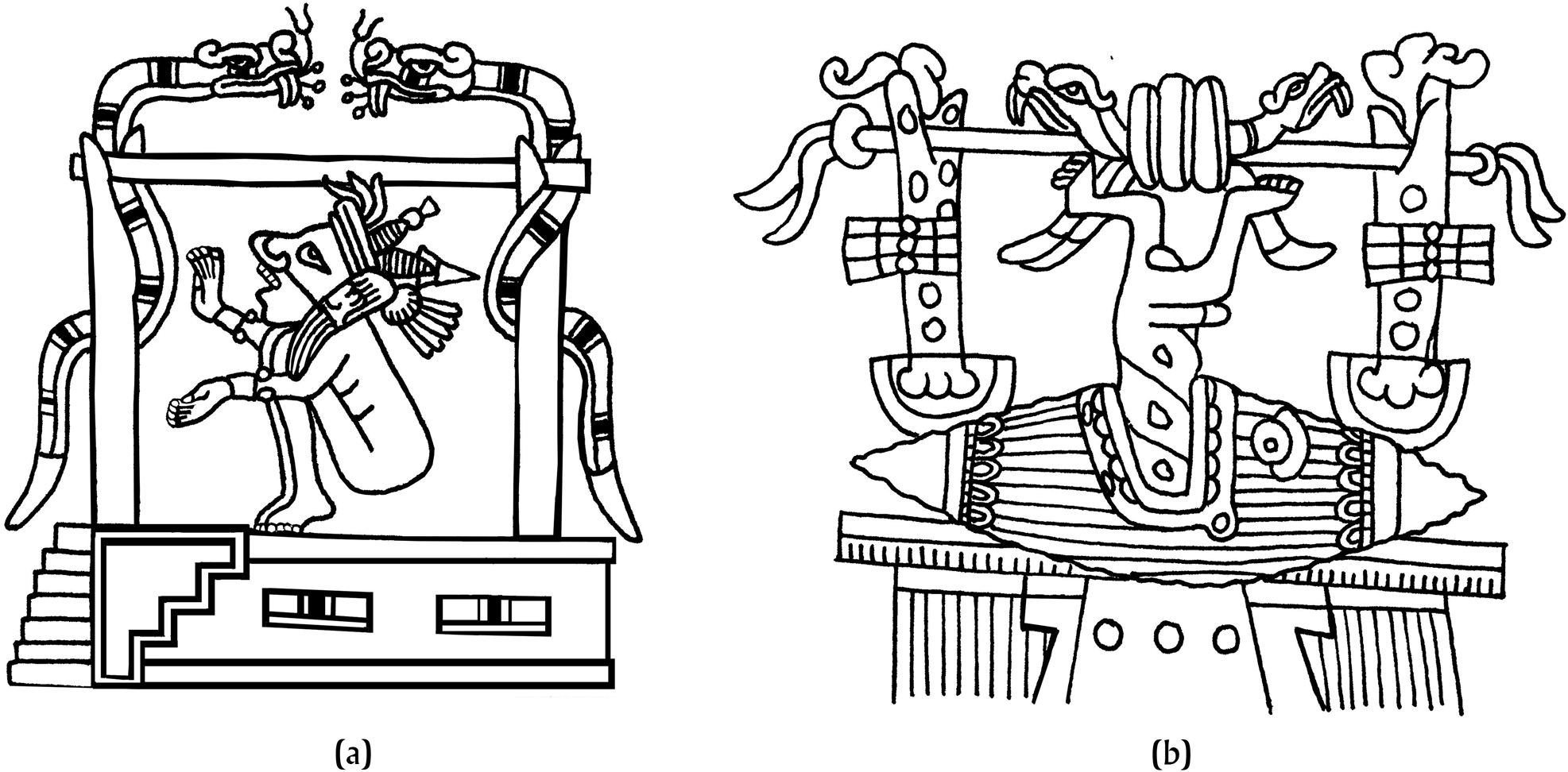
Another relevant association between the mother goddesses and our sacrificial knife has to do with a temple of “Our Grandmother” Toci, likely located in a place called Tocititlan. In the Codex Fejérváry-Mayer (Anders et al. Reference Anders, Jansen and García1994:32), as part of the embellishments that adorn a series of six temples, she sits naked on a platform, with spindles in her headband, surrounded by a wooden framework and two tangled snakes. In the Codex Vaticanus B (Anders et al. Reference Anders, Jansen and García1993b:11), however, in a representation of the same six temples, as pointed out by Mazzetto (Reference Mazzetto2014:208), a red-and-white horizontal sacrificial knife on top of an altar seems to devour a naked human being–like figure (Figure 5a–b). In a recent study, Chinchilla Mazariegos (Reference Chinchilla Mazariegos and Braswell2022:314) expounds the idea of “feeding” the sacrificial blades in Classic and Postclassic Maya war-related phrases, as referenced in the Kaqchikel Chronicles (Reference Maxwell and Hill2006:17): “This is your burden; this you must nourish, you must sustain. It is called the Blade Stone.”
Temple of (a) “Our Grandmother” Toci (Anders et al. Reference Anders, Jansen and García1994:32); (b) a sacrificial knife devours a human being–like figure (Anders et al.Reference Anders, Jansen and García1993b:11) Illustration by Elena Mazzetto (Reference Mazzetto2014).
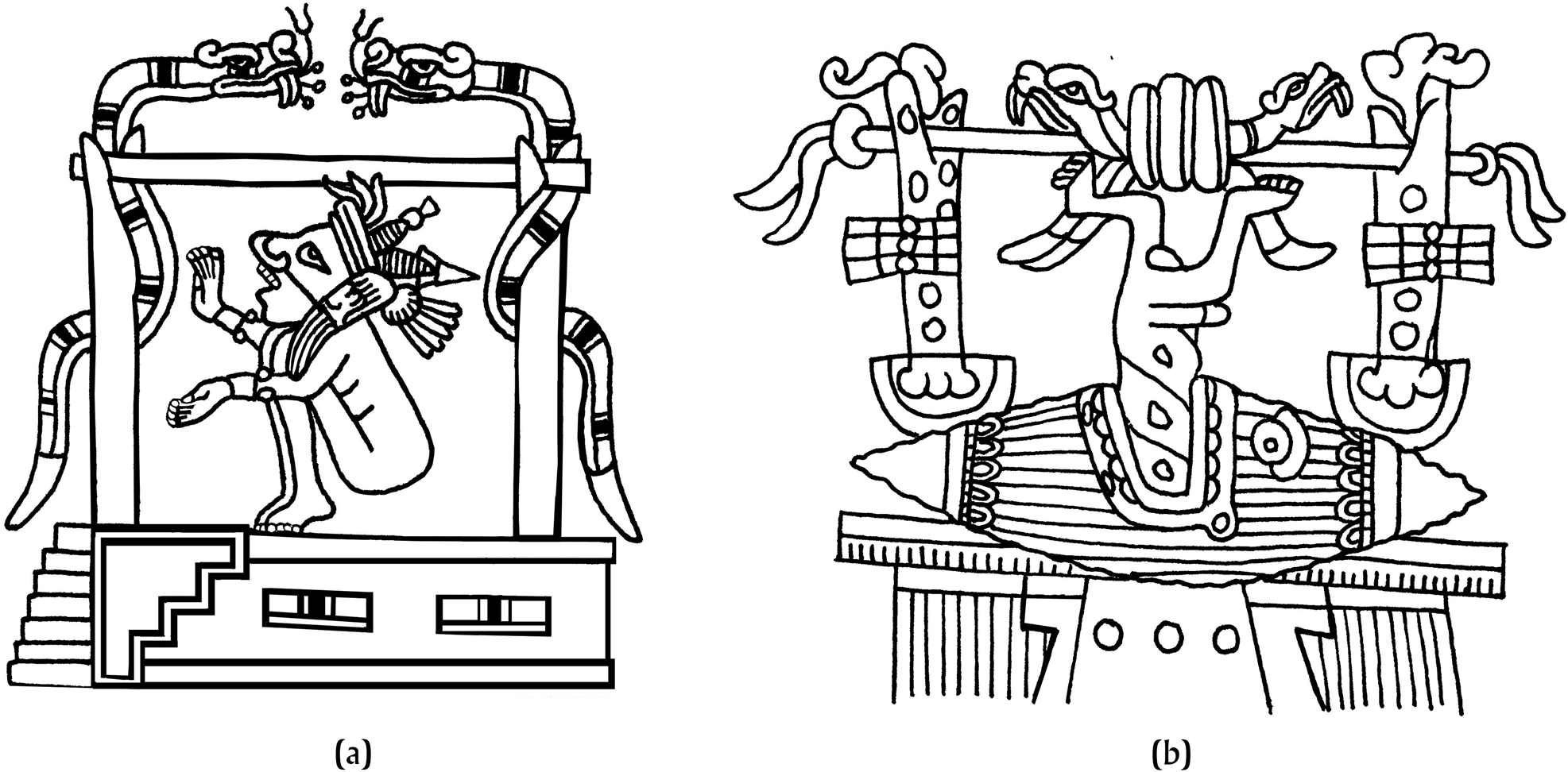
What is most striking is that the goddess's Knife-son exists as both the sacrificial victim and the one who carries out the predatory sacrifice simultaneously, which corresponds to the double destiny of a warrior. What we see is a cosmophagic world where humans and nonhumans can be substitutes for each other. Knife-sons, Warrior-sons, and children can be prey as well as victims (for the relationship between the knife and the warrior, see also Mikulska Dabrowska Reference Mikulska Dabrowska2010: 129, 130). In the temple of the Old Mother, we see a sacrificial knife devouring a being. Blade Stones are also nourished. In another sense, it must be remembered that some gods of death and the earth show protruding tongues associated with food sacrifice. This attribute appears to be intentionally ambiguous, because it is never known whether the mouth swallows the knife or whether the knife serves as a tongue for feeding.
Cradles, hunting nets, and sacrificial knives
Other sources also depict flint knives as captured victims, or with divine power (in warfare): when Itzpapalotl or “Obsidian-Butterfly,” a war and earth goddess, was burned, several knives appeared in the ashes. From these, Mixcoatl took a white flint knife, and with this secret weapon kept in a sacred bundle, he achieved success in warfare (Leyenda de los soles 2011:189; Olivier Reference Olivier, Carrasco and Sessions2007:289, 293). In a cosmogonic myth from the Puebla-Tlaxcala region, the goddess Citlalicue, “Skirt of Stars,” gives birth to a flint knife (“parió un navajón o pedernal”). (Mendieta Reference Mendieta2002:vol. I:181). Curiously, this knife was abandoned by her other children and thrown down to earth, right into the “Seven Caves,” which resulted in the appearance of 1,600 gods.
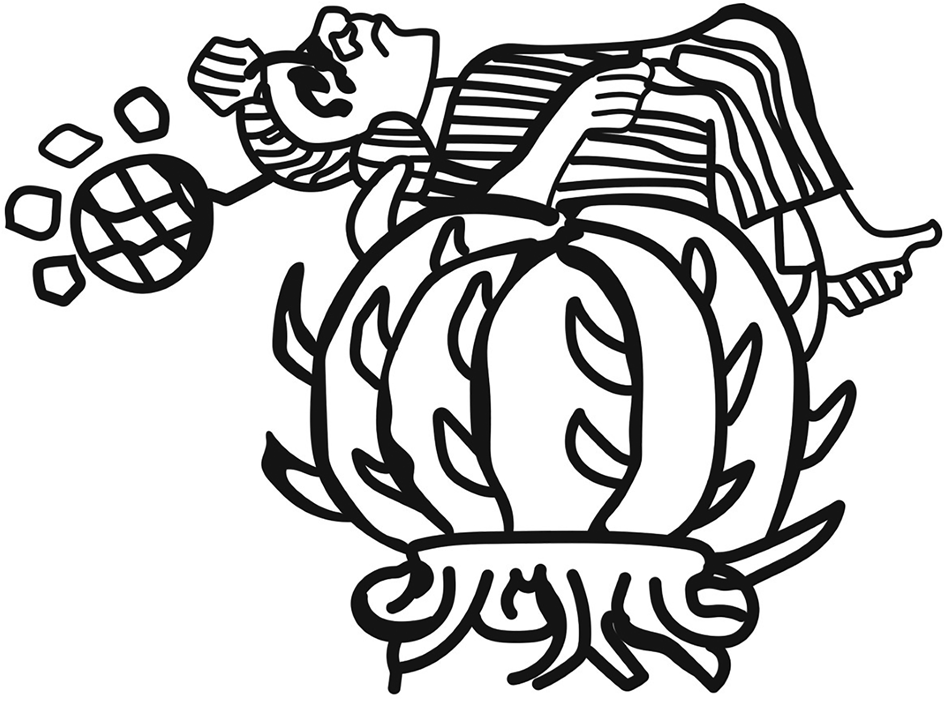
The flint knives falling from the sky are a reference to—or at least an equivalent of—the first mythical warriors, the Mimixcoa, who, in their fall from the sky, landed near some mezquites and bisnagas, and who would become the first sacrificial victims of the Aztecs (Alvarado Tezozómoc Reference Alvarado Tezozómoc1992:23, 25) (Figure 6).
Mimixcoa or mythical warrior on top of a biznaga cactus (Códice Boturini [Tira de la peregrinación] 2015). Illustration by Fátima Lázaro.

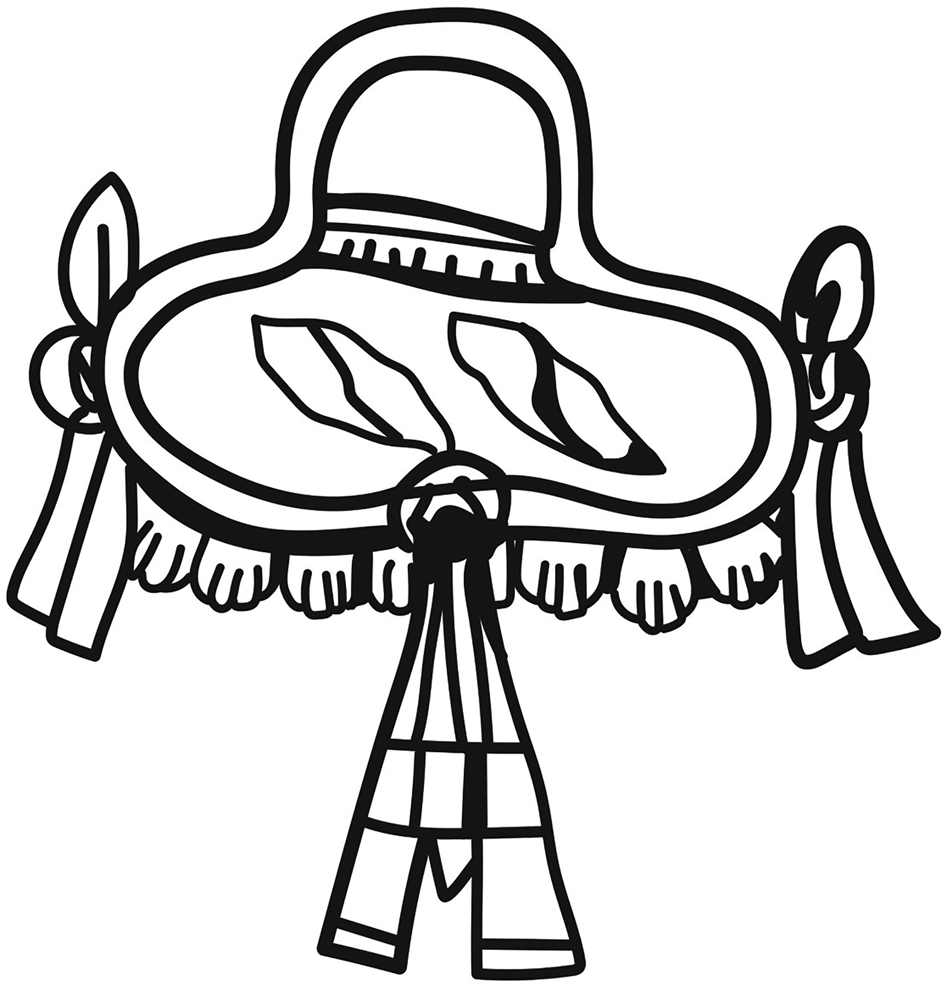
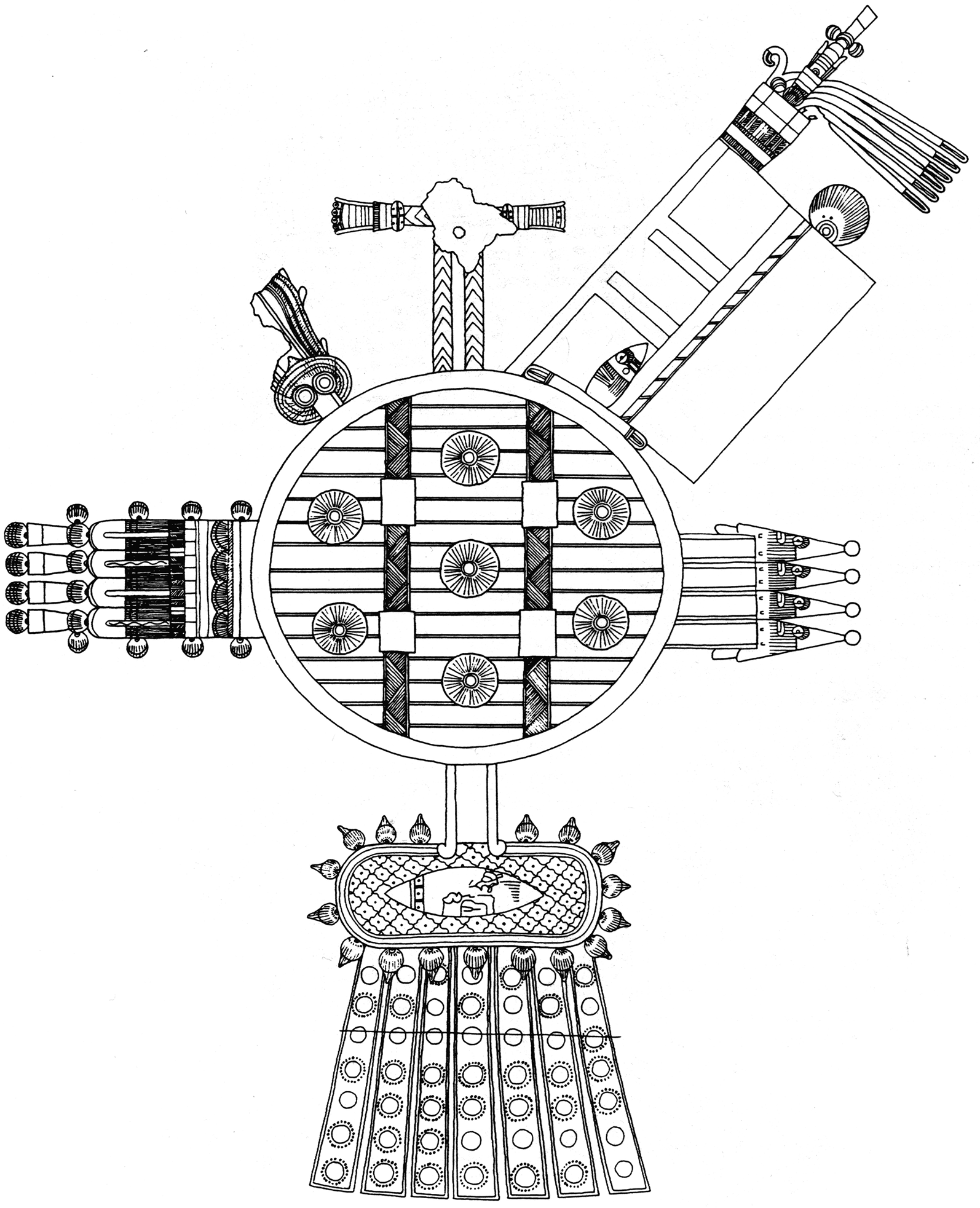
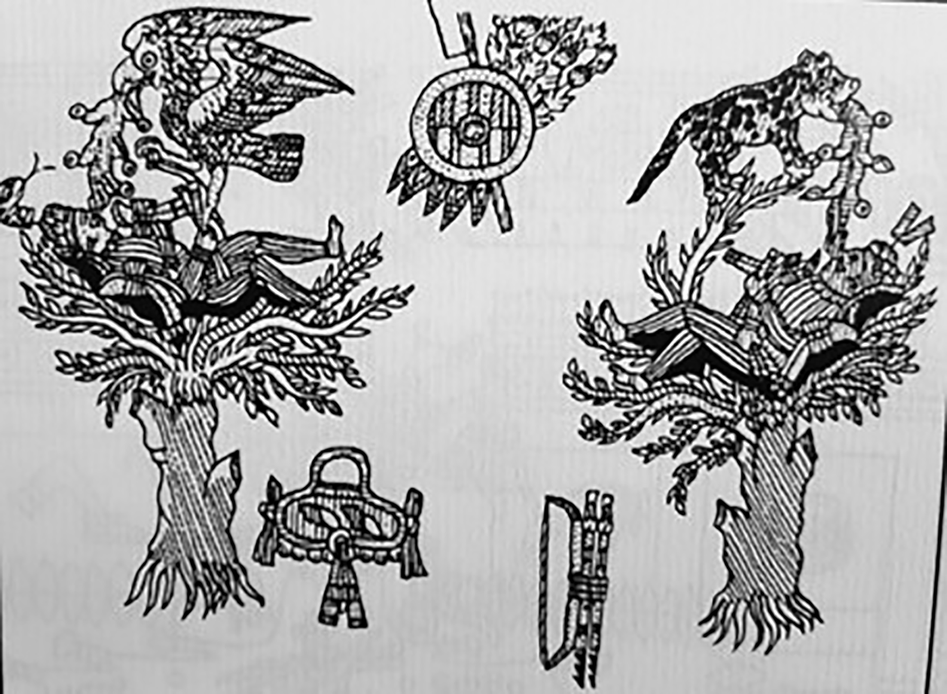
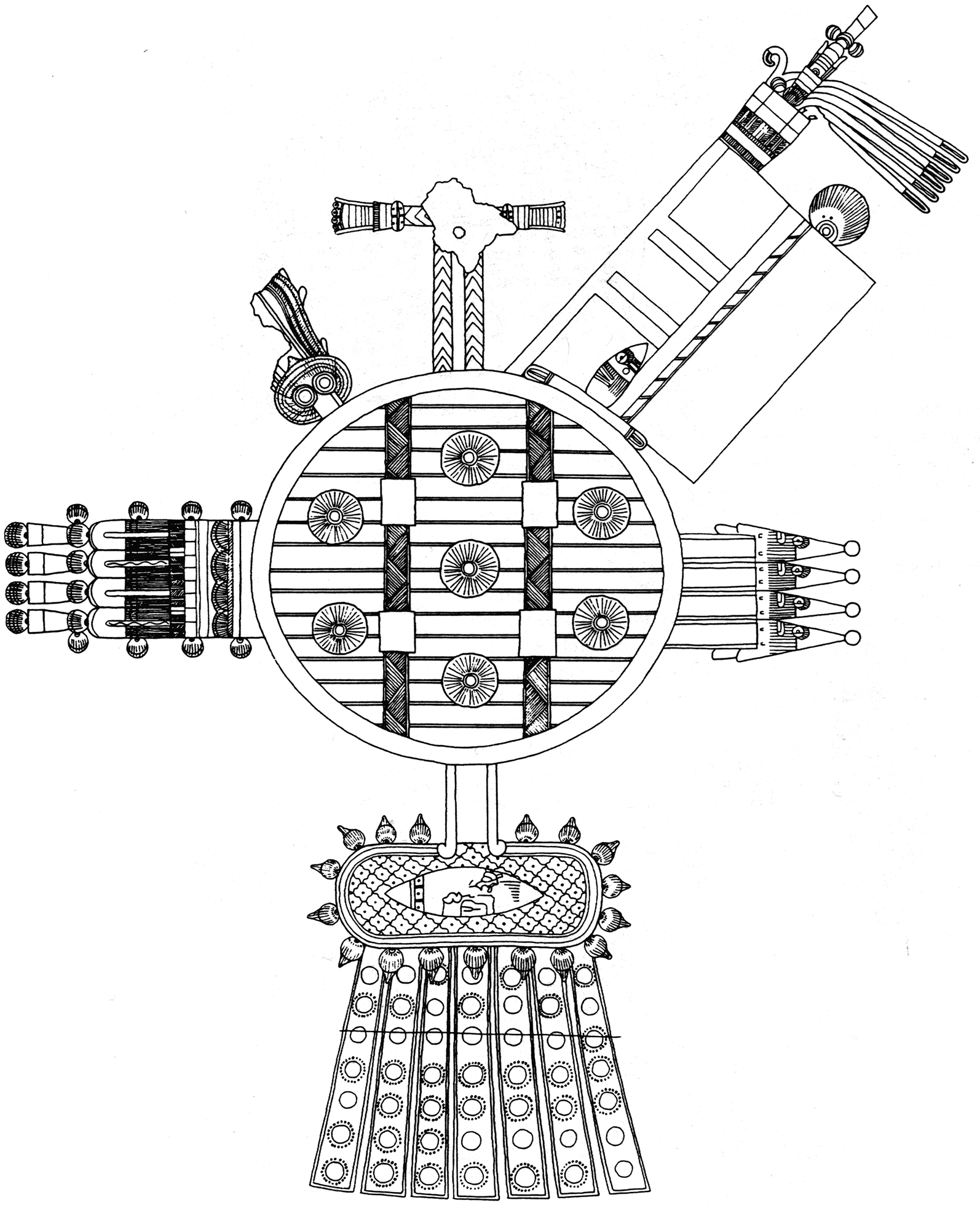
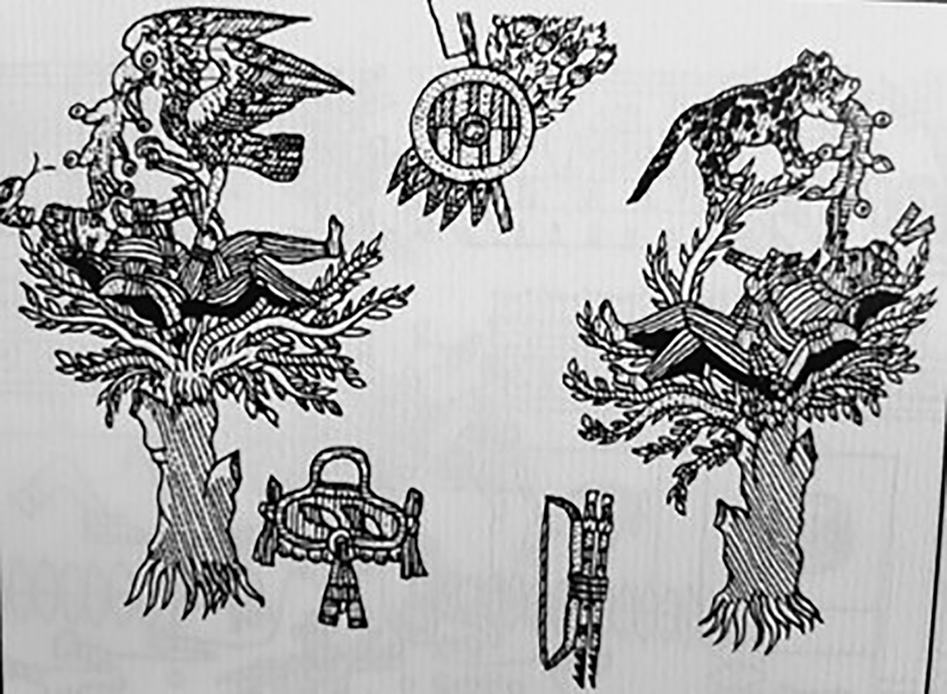
Because of this brave warrior act (the capturing of the Mimixcoa), the Aztecs changed their name to Mexicas, in reference to their merit as warriors, and an eagle gave them bows and arrows and a hunting net so they could shoot what they saw in the sky. In the Historia Tolteca-Chichimeca (Reference Kirchhoff, Güemes and García1976:20r), a similar hunting net with two red-and-white sacrificial knives in it is depicted, the latter of which could represent prey or sacrificial victims (Figures 7 and 8). In addition to the net, two Chichimec warriors are depicted lying in a mesquite tree (as if they came falling from the sky), being “imbued” with warfare by an eagle and a jaguar (Figure 9). Interestingly, two red-and-white stone knives that adorn the front of his headdress are an essential iconographic feature of the Morning Star in Late Postclassic highland central Mexican art (Mathiowetz et al. Reference Mathiowetz, Schaafsma, Coltman and Taube2015:9); these stone knives are also seen in a depiction of the goddess Cihuacoatl (See Figure 4).
Detail from plate 20r. A hunting net with two sacrificial knives in it, as if they were prey (Kirchhoff et al. Reference Kirchhoff, Güemes and García1976:20r). Illustration by Fátima Lázaro.

Note the sacrificial knife in the hunting net, as if it was prey. Shield with iconography related to Mixcoatl and Tlahuizcalpantecuhtli (Tehuacan, Puebla, Postclassic period) (Olivier Reference Olivier2015. Modified from Sisson and Lilly 1994. Illustration by Elbis Domínguez.
Two Chichimecs lying in a mesquite tree, as if they were falling from the sky, are “fed” (“inspirited”) with warfare by an eagle and a jaguar (Kirchhoff et al. Reference Kirchhoff, Güemes and García1976:20r). Illustration by Fátima Lázaro.
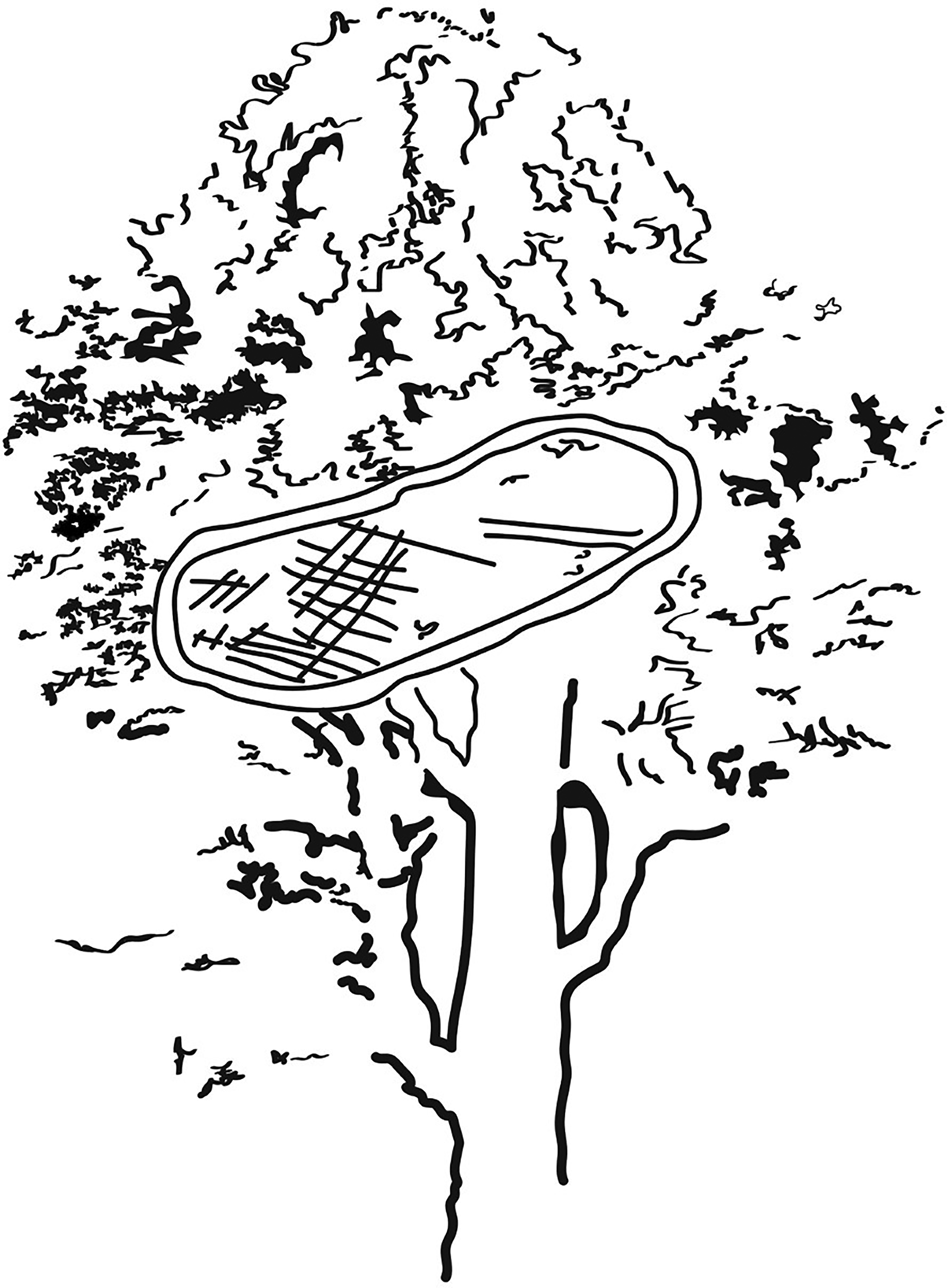
An interesting parallel can be drawn here with the idea of the Seven Caves as the place where newborn warriors appear and are discovered (Figure 10). To reinforce this idea, it is relevant to recall once again the hymn of the Mimixcoa and the Nahua commentator, who describes the descent of these divine warriors: “I came down, I was born in my netted pouch (equipped with it) directly in it (equipped with it) was I born (Seler Reference Seler and Comparato1990–1998:vol. III:258). In the myth of the origin of Sacred Warfare to feed the Sun and Earth, four hundred Mimixcoa threatened their five enemy brothers, but the latter had already left the mesquites and the netted pouches (“huacales de red”) (Leyenda de los soles 2011:187). As observed by Olivier (Reference Olivier, Carrasco and Sessions2007:298, 300), the Mapa de Cuauhtinchan No.2 shows some vegetation with hunting nets (“matlahuacal”) in it, just beneath the Seven Caves, establishing a connection between warriors and prey.|
A net placed in the top of a tree to capture newborn warriors, just beneath Seven Caves (Carrasco and Sessions Reference Carrasco and Sessions2007). Illustration by Fátima Lázaro.

Based on the sources cited above, there seems to be strong evidence that a netted pouch can be understood as the symbolic equivalent of a cradle. Effectively, as Chimalpain Cuauhtlehuanitzin (Reference Chimalpain Cuauhtlehuanitzin1997:67) relates, the son of Quinatzin was the first child to be raised in a cradle, given that the Chichimecs of Texcoco traditionally used a net.
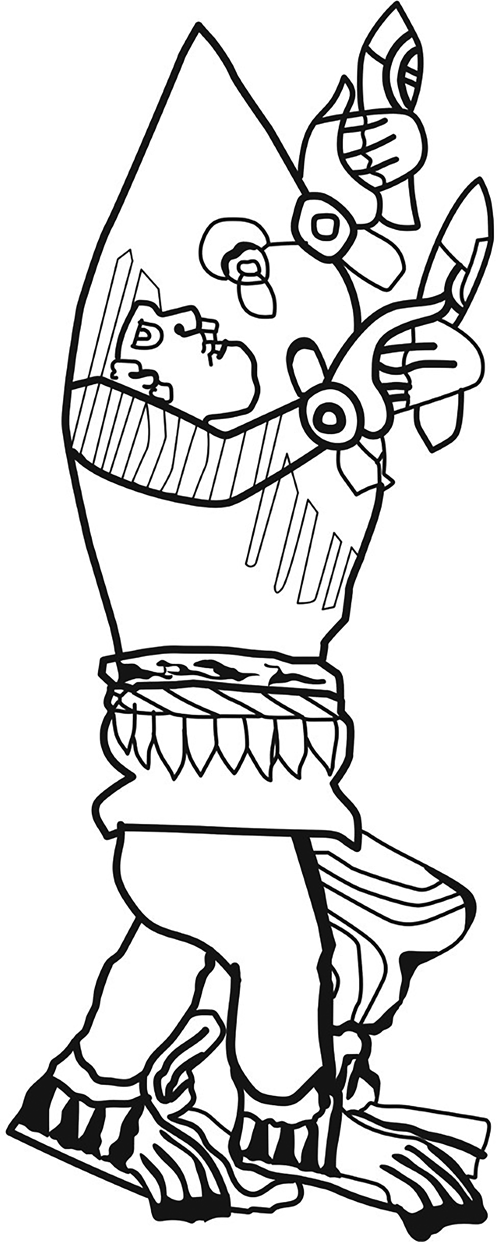
Another mythological figure worth mentioning is Copil, the son of Huitzilopochtli's sister Malinalxoch. Looking to avenge his mother after his uncle abandoned her, Copil transformed himself into a sacrificial knife, Itztapaltetl, at a place called Itztapaltemoc, “Itztapal who descends [who is born]” (Alvarado Tezozómoc Reference Alvarado Tezozómoc1992:41). Itztapaltetl can be considered a variation of the god-knife Itztapaltotec, a personification of dead warriors who would descend to fertilize the earth every year (Graulich Reference Graulich2000:110). In the Códice Tonalamatl de Aubin (Brito Guadarrama Reference Brito Guadarrama2018:Plate 20), Itztapaltotec is depicted with two red-and-white sacrificial knives in his hands (as if multiplying himself?) before the Old Fire god (Figure 11).
Itztapaltotec with two sacrificial knives in his hands, perhaps as if he were multiplying himself (Brito Guadarrama Reference Brito Guadarrama2018:Plate 20). Illustration by Fátima Lázaro.

Chipping and flaking new creatures
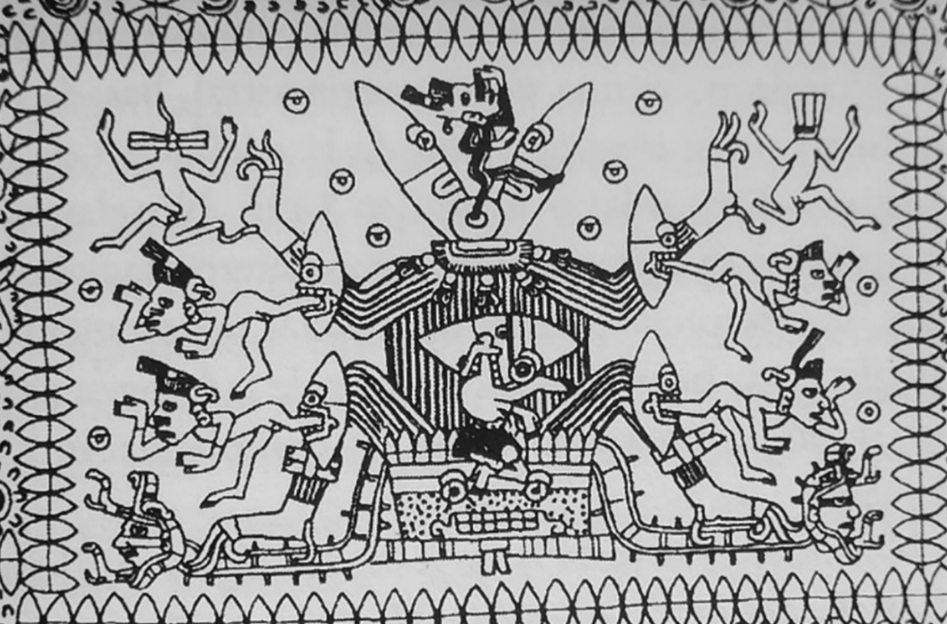
In the Codex Borgia (1963:32), in the House of Knives (“Itzcalli”) (Seler in Códice Borgia 1963:32), we witness the sacrifice of a central figure, “Cuchillo de Pedernal” (“Flint Knife”) (Anders et al. in Códice Borgia Reference Anders, Jansen and García1993a:200): “and two facing flint knives replace its severed head. […] From the mouths of flint knives that appear along the figure's arms and legs emerge five nude males. […] This flint-lines precinct could be an Aztec version of an underworld layer” (Hill Boone Reference Hill Boone2007:183–185) (Figure 12). Pohl (Reference Pohl1998:188) describes the central figure as a “giant decapitated stellar demon, either Itzpapalotl or Citlalicue” (the two goddesses mentioned above). According to Mikulska Dabrowska (Reference Mikulska Dabrowska2010: 131), the flint knife metonymically replaces all the elements that refer to the creative.
Fragment of Códice Borgia (Anders et al. Reference Anders, Jansen and García1993a:32). The birth of the war god Tezcatlipoca, warriors, and Quetzalcoatl, in a flint-lines precinct (Hill Boone Reference Hill Boone2007). Illustration by Fátima Lázaro.
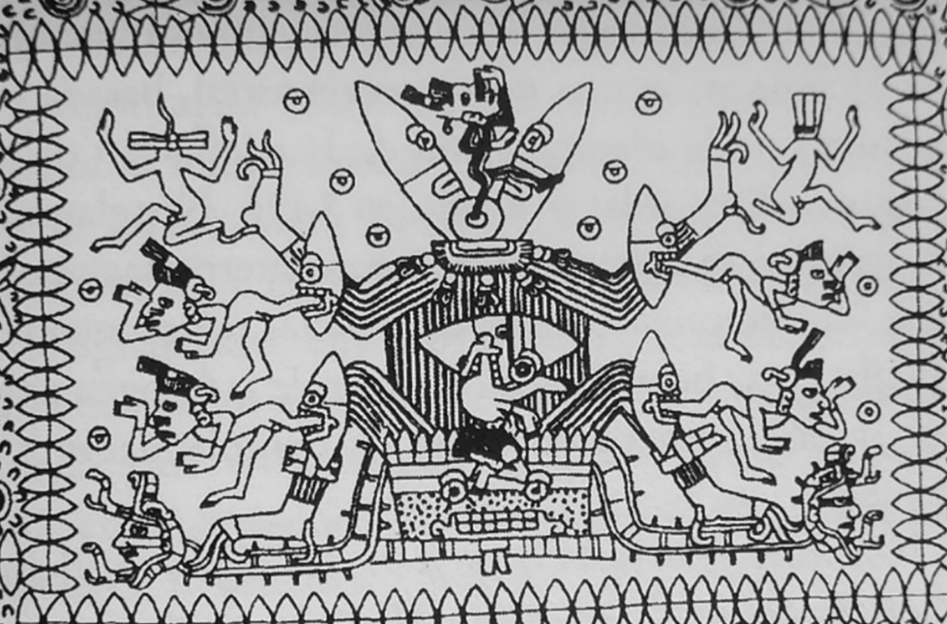
According to Neurath (Reference Neurath2020:127–128), this scene could depict the production of flakes from a core (and in my judgment, has to be considered complementary to other interpretations). In this sense, the Florentine Codex gives us an essential clue. When discussing the birth of newborns, it describes them as being “chipped” or “flaked off” from their ancestors: “the creation of our lord arrived; it appeared on earth. The precious necklace, the precious feather. […] the chip, the flake of those who already have gone to reside in the beyond, the old men, the old women” (Sahagún Reference Sahagún, Anderson and Dibble1950–1982:vol. VI:180–181). Mikulska Dabrowska (Reference Mikulska Dabrowska2010: 141) observes that, although at a speculative level, in the Codex Nuttall (9) a woman is depicted with a flint knife in her lap.
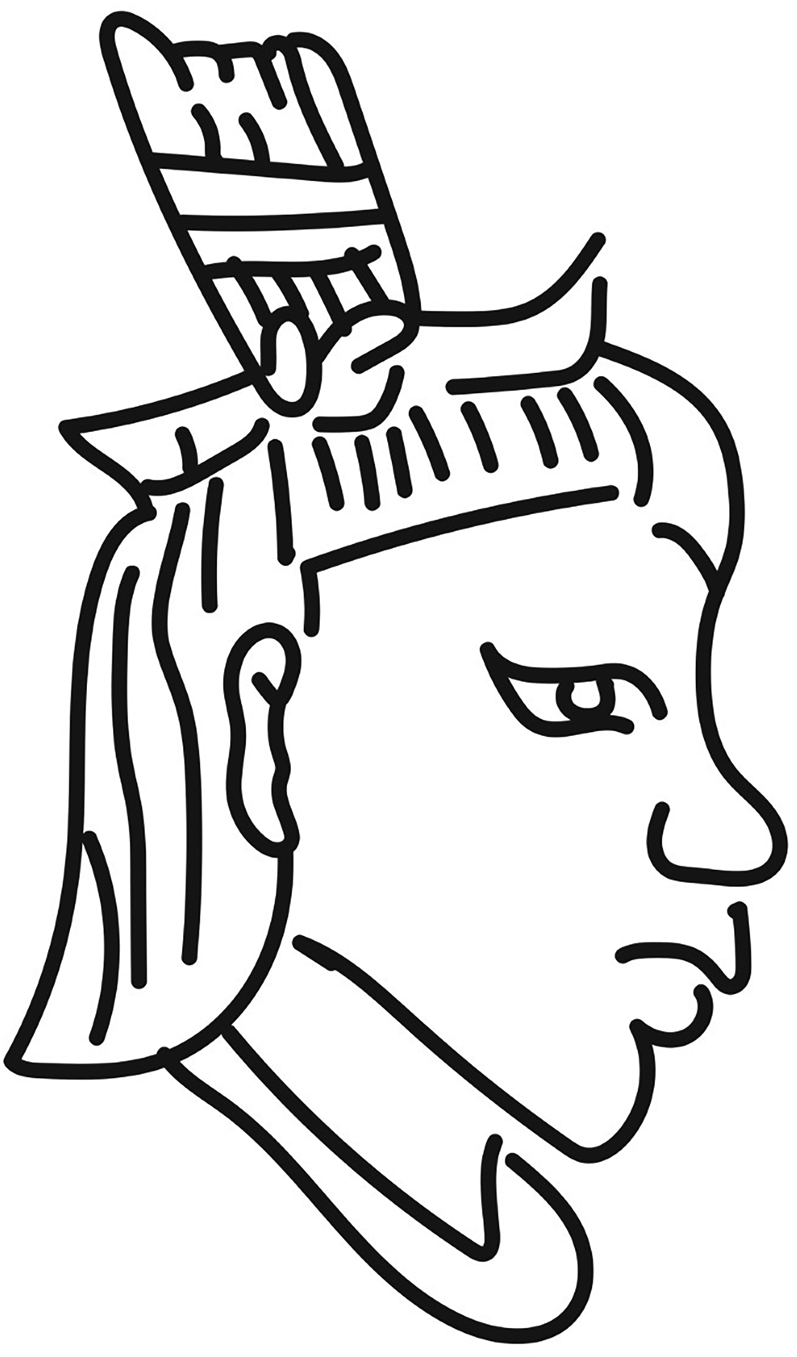
In a recent study on geological symbolism of the Toltec period, Kristan-Graham (Reference Kristan-Graham, Faugère and Beekman2020:318, 319) argues that sculpted pillars and reliefs from Tula represented ancestors. At the same time, she reminds us of the typical haircut of the bravest Mexica warriors, the temillotl (“pillar of stone”), as depicted in several images of the Codex Mendoza (Figure 13). In the Florentine Codex (Sahagún Reference Sahagún, Anderson and Dibble1950–1982:vol. X:23), a brave man is said to be like a stone pillar.
Hairstyle of the bravest Mexica warriors, the temillotl (“pillar of stone”) (Codex Mendoza 62r. Illustration by Kristan-Graham (Reference Kristan-Graham, Faugère and Beekman2020:318).
It is instructive to consider the “birth” of obsidian stone as portrayed in the Kaqchikel (or Xajil) Chronicles (Reference Maxwell and Hill2006:8): “Then the Obsidian Stone is birthed by Raxa Xib'alb’ay [and] Q'ana Xib'alb’ay.” Immediately, humanity was created as sustenance for the Obsidian Stone, which is understood as Blade Stone (Chinchilla Mazariegos Reference Chinchilla Mazariegos and Braswell2022:314). The same source mentions a humanized “stone” group or materialized human beings, or, as Houston (Reference Houston2014: 27) declares, “their identities entwine so closely with other matter as to merge with it.” A group of warriors, the seven amaq's, declared themselves to be the Obsidian people: “These are our identities here: we, those of obsidian; we, those of rope; we, the displayers of our burden” (Kaqchikel Chronicles Reference Maxwell and Hill2006:44). Ambiguously, they bedeck themselves with feather down and white clay, symbols of sacrificial victims.
In the Códice Nuttall (Anders et al. Reference Anders, Jansen and García1992a:Plates 4, 21), three armed persons, painted as sacrificial victims, descend from heaven as allies of the People of Stone, and are then captured (Jansen Reference Jansen1982:346) (Figure 14). In plate 21, the striped person is clearly of smaller size than his captive, indicating he could be a child, whereas in a similar scene in plate 4, prisoners and captives are the same size.
An armed person, painted as a sacrificial victim, descends from heaven (Anders et al. Reference Anders, Jansen and García1992a:Plate 21), with clay or “darkness” (Jansen Reference Jansen1982:346). Illustration by Fátima Lázaro.

The child hero and the Old Adoptive Mother
The birth of child warriors should also be situated as part of a major mythological theme—namely, that of the child hero and the Old Adoptive Mother (“the Old Female Earth”). According to Braakhuis (Reference Braakhuis2010:42), the Old Adoptive Mother plays a crucial role in a wide range of transformations related to nourishment, all of which are related to processes such as adoption, midwifery, sex, cannibalism, hunting, and warfare.
In the Leyenda de los soles (2011:191), we learn that the goddess “Woman Snake,” or Cihuacoatl, was the adoptive mother of Ceácatl or Quetzalcoatl, whose mother had died while giving birth. This child, who appears interchangeably as the Sun, Huitzilopochtli, Santiaguito, Christ, Knife-son, Morning Star, piltontle (“a small child”), among others, should be considered a foundling (abandoned in the market or on the battlefield), rejected by his consanguineal family. He is among “those no longer with mothers, those no longer with fathers, the orphaned” (Florentine Codex, Sahagún Reference Sahagún, Anderson and Dibble1950–1982, VI:84).
Nonetheless, the Old Adoptive Mother plans on eating the child (or, as Braakhuis [2010:49] puts it, a “divine envy of maternal fertility”). As a primeval being, she lives off of her own offspring (Braakhuis Reference Braakhuis2010:45). However, by being burned by fire or boiled in a steam bath, she becomes the goddess of midwifery (Báez-Jorge Reference Báez-Jorge2008:161; Braakhuis Reference Braakhuis2010:41; Olivier Reference Olivier2009). A temazcal (“steam bath”) was considered a womb of the earth, or the equivalent of a volcano—a place where water and fire produce hot steam (in the Kaqchikel Chronicles [2006:76], the bravest warrior and hero, Q'aq’awitz, climbs into a volcano and “captures” the fire as a flint).
Braakhuis (Reference Braakhuis2010:102) explains that “entering and becoming one with the womb of the steam bath implies the realization of Old Adoptive Mother's most ardent desire: She becomes a sort of mother, not by appropriating the children engendered by others, but by bearing and delivering them herself. In terms of the cannibalistic kitchen, she is now no longer obliged to eat her children to get pregnant.”
In the Florentine Codex (Sahagún Reference Sahagún, Anderson and Dibble1950–1981:vol. VI:153), “Grandmother of the Bath” is called Teteo Innan or Yoalticitl, “Mother of the Gods or Midwife of Darkness,” evoking her precosmological origin. As Gingerich (Reference Gingerich1988:225–226) notes, after the child had been put in the cradle, the midwife addressed the cradle as if it were Yoalticitl: “Old Woman, do not do anything to the baby; be gentle with it.”
That Mother Earth's children were made of stone was probably a way to avoid the fact that she would eat them, as is reflected in some contemporary tales in which she breaks her fangs after biting an old stone statue (an archaeological piece considered an ancestor) instead of a human victim (Braakhuis Reference Braakhuis2010:45, 66; Navarrete Reference Navarrete1966:424). The existence of the “son of Cihuacoatl,” made of stone and left as a foundling in a cradle at the market, seems to implicate a pact with human beings: knife sons for human sons—something she could eat without breaking her teeth.
The umbilical cord
Another dimension of the relationships between childbirth, warfare, and blade stones emerges from the sacrifice of the Mother Goddess Toci during the festival month of Ochpaniztli. As part of the ceremony, the ancient Nahuas deposited different parts of the human body—such as hearts, skins, umbilical cords, and possibly placentas—in border areas with the enemy. I observed earlier (Declercq Reference Declercq2022, Reference Declercq and Mazzetto2025) that relationships between different groups were characterized by an “exchange” of body parts or organs, either abandoned or purposefully left as an offering in frontier zones. These body parts were much wanted by enemies (Gómez de Orozco Reference Gómez de Orozco1945:48, f.348r.). Obtaining male umbilical cords and thigh skin (probably a euphemism for placenta, see Declercq Reference Declercq2022) from the enemy could have had regenerative functions.
Sahagún and his informants (Reference Sahagún, Anderson and Dibble1950–1982) give us an intriguing insight on such relational dynamics between groups in a description of a ritual of childbirth. After a child had been given a name (usually of an ancestor), some youths were assembled who apparently represented the enemy: “Then they took up the umbilical cord offering of the baby; they snatched it and ran; they went off eating it […] they went shouting out that which was his name. If his name were Yaotl, they went saying to him: ‘O Yaotl, o Yaotl, know the interior of the plains […] the battlefield.’ […] And they came saying: ‘O valiant warriors, come, eat the umbilical cord offering of Yaotl.’” These young men represented those who had died in war, “because they robbed the umbilical cord offering of the baby” (Sahagún Reference Sahagún, Anderson and Dibble1950–1982:vol. VI:204). Given that Yaotl means “enemy” (Olivier Reference Olivier2014–2015:67), it looks as though these young men imitated the enemy stealing the umbilical cord at the frontier zone. It symbolized the taking of a child captive and maybe the cannibalizing of the victim. At the same time, it seems to express a desire to make a cosmic connection with the “other,” or an act of identification with the enemy. As Alfred Métraux (Reference Métraux2011:11) stated, being captured by the enemy implied a rupture with the “old” community and a process of incorporation in a new “home.”
When a prisoner was about to be sacrificed on top of a round stone (“temalácatl”), he was tied to this monolith with a rope of sustenance (“tonacamécatl”), which could have symbolized an umbilical cord (Graulich Reference Graulich1999:312), to express his new kinship ties. Vail and Hernández (Reference Vail, Hernández, Tiesler and Cucina2008:123, 124) have argued that the rope motif of captives in some Maya iconography might relate to cosmic creation and the idea of a cosmic umbilical cord.
Some final notes
When the son of Tezozomoc, Cuacuauhpitzahuac, was made tlatoani of the Mexicas, the first town he conquered was Chimalhuacan. After this was successfully achieved, a song was intoned: “The child that has been put in his cradle laughs without a doubt to [his father] Tezozomoctli; now there goes Cuacuauhpitzahuac” (“El niño que fue puesto en la cuna sonrió sin duda a [su padre] Tezozomoctli; ahora ya va por allí Cuacuauhpitzáhuac”) (Anales de Tlatelolco 2004:83). We are presented with a (quite contented) baby-warrior here.
In the present discussion, I have focused on the relationship between childbirth and warfare. The essential aspect of children (human and otherwise) is that they all come from the outside, whether they are biological or socially reproduced. At the same time, they can be sent from the sky or be found beneath the face of the earth in materialized form. From the womb of the earth, which is very much a stony essence, they are chipped and flaked from the ancestor's bodies. In hunting nets, they come falling from the sky to land in the mezquites beneath Seven Caves or on the battlefield. In all cases, they are the Other. They all seem to have a predatory aspect: children in cradles or sacrificial knives in a netted pouch behave like animals or symbolize prey.
War prisoners (or warrior nahualli) that are considered children expect their fathers (the enemy warrior) or mothers (Old Adoptive Mother) to come for them, but end up sacrificed and consumed. Knife-sons are sent to the market—a euphemism for the battlefield—in order to find food. Humanity serves as sustenance for stonelike essences.
During war-related ceremonies, the ancient nahuas deposited different parts of the human body in the border areas with the enemy—such as hearts, skins, umbilical cords, and possibly placentas—with regenerative functions in order to reproduce new “children” to maintain a flower war that was never meant to end. Under such a predatory dynamic, they are “vital enemies” within a “political economy based on the widespread notion that vital energy is finite, generally fixed, scarce, unequally distributed, and in constant circulation” (Santos-Granero Reference Santos-Granero2009:14).
Given the relationships between stone knives, babies, and warriors, the presence of blade stones equipped with miniature armament in various offerings of the Templo Mayor of Tenochtitlan (Aguirre Molina Reference Aguirre Molina2021) might be manifestations of “reborn” armed warriors and deities. They might be the baby warriors evoked here. Future research into these relationships might offer new insights into Mexica offerings.
Acknowledgments
I would like to thank Cecelia Klein, the reviewers, and the editors from Ancient Mesoamerica for reading the first versions of this text and for their valuable observations.