


1. Introduction
The Calabrian Arc is an arcuate terrane composed of a pile of pre-Mesozoic polymetamorphic nappes comprising large sheets of Hercynian crystalline basement (forming the Sila and Aspromonte massifs) and local remnants of a Mesozoic to Cenozoic succession, that separates the Ionian and Tyrrhenian basins connecting the NW-trending southern Apennine chain and the E-trending Sicilian Maghrebides (e.g. Bonardi et al. Reference Bonardi, Cavazza, Perrone, Rossi, Vai and Martini2001; Critelli et al. Reference Critelli, Muto, Tripodi and Perri2013; Tripodi, Muto & Critelli, Reference Tripodi, Muto and Critelli2013).
The Calabrian Arc migrated southeastwards from mid-Miocene time onwards in response to the subduction of the Ionian oceanic lithosphere along a deep and narrow W-dipping Benioff zone (among others Bonardi et al. Reference Bonardi, Cavazza, Perrone, Rossi, Vai and Martini2001; Speranza et al. Reference Speranza, Minelli, Pignatelli and Chiappini2012; Zecchin et al. Reference Zecchin, Civile, Caffau, Muto, Di Stefano, Maniscalco and Critelli2013 and references therein); this movement caused a fragmentation of the arc into individual blocks bounded by NW-trending shear zones, which controlled the development of basins located along both the Ionian and Tyrrhenian sides of Calabria (Knott & Turco, Reference Knott and Turco1991).
Among the streams that drain the northern portion of the Calabrian Arc, the Crati and Neto rivers are the main drainage systems connecting the terrestrial source areas to the marine deposits within the peri-Ionian Basin. The main entry points for sediment into the Ionian Basin include several canyons and gullies. Fluvial sediment input is dominant for the entire borderland, whereas biogenic and aeolian inputs are minor. The western portions of the Taranto Gulf are dominated by the Crati Submarine Fan, the largest fan in the northern part of the study area. The Neto River is the most important drainage system of the southern area, which feeds into the Ionian deep Basin through the Neto Canyon to the north of the Luna–Hera Lacinia structural high (e.g. Le Pera et al. Reference Le Pera, Arribas, Critelli and Tortosa2001; Rebesco et al. Reference Rebesco, Neagu, Cuppari, Muto, Accettella, Dominici, Cova, Romano and Caburlotto2009; Zecchin et al. Reference Zecchin, Ceramicola, Gordini, Deponte and Critelli2011; Critelli et al. Reference Critelli, Dominici, Muto, Perri and Tripodi2012; Perri et al. Reference Perri, Critelli, Dominici, Muto, Tripodi and Ceramicola2012b ).
During the last three decades many explorations of the seafloor have illustrated the widespread occurrence of submarine depositional systems. The sedimentary fill of basins is related to several factors based on relationships between source areas and depositional environment. The use of sediment geochemistry and its combination with mineralogical analyses of marine muds represents an important tool for the investigation of the processes that occurred from sediment generation on the uplands to the final accommodation on the bathyal plain. In particular, the distribution of major and trace elements, obtained by X-ray fluorescence spectrometry (XRF), related to the mineralogical variations, deduced from the evolution of the X-ray diffraction (XRD) patterns, of fine-grained sediments is widely used to explain and reconstruct the source area composition and the weathering and diagenetic processes (e.g. Bauluz et al. Reference Bauluz, Mayayo, Fernandez-Nieto and Gonzalez Lopez2000; Perri et al. Reference Perri, Cirrincione, Critelli, Mazzoleni and Pappalardo2008, Reference Perri, Critelli, Mongelli and Cullers2011, Reference Perri, Critelli, Martìn-Algarra, Martìn-Martìn, Perrone, Mongelli and Zattin2013; Mongelli et al. Reference Mongelli, Critelli, Perri, Sonnino and Perrone2006; Critelli et al. Reference Critelli, Mongelli, Perri, Martin-Algarra, Martin-Martin, Perrone, Dominici, Sonnino and Zaghloul2008; Zaghloul et al. Reference Zaghloul, Critelli, Perri, Mongelli, Perrone, Sonnino, Tucker, Aiello and Ventimiglia2010).
The present paper represents a good opportunity to study continental weathering, sediment generation and the depositional processes in the northern Calabrian Ionian Basin through the use of chemical and mineralogical variations in marine muds sampled along the Crati II and Neto VI boreholes.
2. Regional geology
The northern sector of the Calabrian Arc is characterized from west to east by the Coastal Chain and Sila Massif and is separated by a large transversal depression formed in Plio-Pleistocene times (Catanzaro Graben) from the southern sector (e.g. Bonardi et al. Reference Bonardi, Cavazza, Perrone, Rossi, Vai and Martini2001 and many others). To the southeast, the Calabrian Arc is delimited by the Ionian subduction zone (Rossi & Sartori Reference Rossi and Sartori1981), where the Ionian lithosphere is subducted northwestward underneath the Calabrian Arc (e.g. Cavazza & Ingersoll, Reference Cavazza and Ingersoll2005).
The Taranto Gulf is located offshore along the coast of southern Italy between Calabria and Puglia and it characterizes the northwestern portion of the Ionian Sea. The western portion of the Taranto Gulf along the Calabrian margin displays a complex morphology consisting of ridges and basins related to the Neogene–Quaternary geodynamic evolution of the submerged, tectonically active extremity of the southern Apennines (Romagnoli & Gabbianelli, Reference Romagnoli and Gabbianelli1990; Zecchin et al. Reference Zecchin, Ceramicola, Gordini, Deponte and Critelli2011; Perri et al. Reference Perri, Critelli, Dominici, Muto, Tripodi and Ceramicola2012b ; Ceramicola et al. Reference Ceramicola, Praeg, Coste, Forlin, Cova, Colizza, Critelli and Krastel2014). Major NW-SE and minor NE–SW-trending regional faults determine the structural evolution of this area (Romagnoli & Gabbianelli, Reference Romagnoli and Gabbianelli1990; Van Dijk et al. Reference Van Dijk, Bello, Brancaleoni, Cantarella, Costa, Frixa, Golfetto, Merlini, Riva, Torricelli, Toscano and Zerilli2000).
The most important submarine fan of the northern Ionian Basin is the Crati Fan; other smaller fans close to the mouth of the Neto River, developed during Holocene time and connected with the torrential-type deltas on the shelf, further characterize this portion of the Ionian Basin along the Calabrian coast. These fans are related to the developed fluvial systems, the Crati and Neto rivers, and diverse smaller coastal rivers draining both the Calabrian continental block (i.e. Sila Massif) and the southern Apennines thrust belt (i.e. Pollino Massif); in particular, the drainage systems belonging to the Crati River drain both the Calabrian crustal block and the Mesozoic to Tertiary sedimentary terranes of the southern Apennines.
The Sila Massif is composed of plutonic–metamorphic rocks with subordinate sedimentary source rocks producing quartzofeldspathic sand, which characterize its sedimentary cover (e.g. Critelli & Le Pera, Reference Critelli and Le Pera1998, Reference Critelli, Le Pera, Valloni and Basu2003; Le Pera et al. Reference Le Pera, Arribas, Critelli and Tortosa2001; Barone et al. Reference Barone, Critelli, Dominici and Muto2008; Critelli et al. Reference Critelli, Muto, Tripodi and Perri2013). To the north, the Pollino Massif is an additional source of sediments composed of sedimenticlastic sand reflecting a multi-cycle provenance from siliciclastic and carbonate strata of the platform-basin tectonostratigraphic units, such as the Cilento Group and younger sequences (e.g. Perri et al. Reference Perri, Greco, Aldega, Corrado, Critelli and Di Paolo2012c ; Critelli et al. Reference Critelli, Muto, Tripodi and Perri2013 and references therein). Submarine structural highs, such as the Amendolara embankment which borders the Corigliano Basin and produces reworked intrabasinal carbonate detritus (e.g. Critelli et al. Reference Critelli, Le Pera, Galluzzo, Milli, Moscatelli, Perrotta, Santantonio, Arribas, Critelli and Johnsson2007), and a series of Pleistocene terraces along the promontory of Capo Colonna enriched in carbonate strata, constitute additional sources of Quaternary sediment for the Ionian Basin margin (e.g. Zecchin et al. Reference Zecchin, Ceramicola, Gordini, Deponte and Critelli2011 and references therein).
2.a. Crati and Neto drainage systems
Sediments in the northern portion of the Ionian Basin are mainly supplied by the Crati River and many small coastal drainage systems such as the Trionto and Saraceno Fiumara rivers. The Crati River occupies the eastern sector of the Crati Basin, which is bounded by NW–SE-trending left-slip faults (Van Dijk et al. Reference Van Dijk, Bello, Brancaleoni, Cantarella, Costa, Frixa, Golfetto, Merlini, Riva, Torricelli, Toscano and Zerilli2000); the Crati Basin further collects all the small streams that drain the Coastal Range to the west and the Sila Massif to the east. Among the small streams, the Saraceno Fiumara drains the Pollino Massif and reflects a multi-cycle provenance from siliciclastic and carbonate strata of the Panormide, Liguride and Sicilide complexes, as well as the Cilento Group and younger sequences. The Trionto River drains the northeastern sector of the Sila Massif, which is composed of low- to medium–high-grade metamorphic rocks intruded by plutonic rocks (‘granitoids’ of the Sila Batholith) with a sedimentary cover (Longobucco Group), and the Miocene–Pleistocene sedimentary successions of the northern Ionian coast (e.g. Barone et al. Reference Barone, Critelli, Dominici and Muto2008; Corbi et al. Reference Corbi, Fubelli, Lucà, Muto, Pelle, Robustelli, Scarciglia and Dramis2009; Robustelli et al. Reference Robustelli, Lucà, Corbi, Pelle, Dramis, Fubelli, Scarciglia, Muto and Cugliari2009) (Fig. 1).
Geological sketch map of the northern sector of the Calabria–Peloritani Arc and the investigated area in the northern Ionian Basin (Taranto Gulf). The positions of the Crati II and Neto VI boreholes are also shown. 1 – Sedimentary rocks (Pliocene to Holocene); 2 – clastic rocks and evaporites (Serravallian to Messinian); 3 – Cilento Group (Middle Miocene); 4 – Apennine units of the Pollino Massif (Triassic to Miocene); 5 to 7 – Liguride Complex: 5 – Calabro–Lucanian Flysch Unit (Upper Jurassic to Upper Oligocene); 6 – Ophiolitiferous blocks and melange; 7 – Frido Unit (Upper Jurassic to Upper Oligocene); 8 – Longobucco and Caloveto Groups (Lower Lias to Lower Cretaceous) and Paludi Formation (Upper Oligocene); 9 – Malvito, Diamante–Terranova and Gimigliano ophiolitiferous units (Upper Jurassic to Lower Cretaceous); 10 – Sila, Castagna and Bagni basement units (Palaeozoic); 11 – plutonic rocks (Sila Batholith, Palaeozoic). Modified from Critelli et al. (Reference Critelli, Muto, Tripodi and Perri2013), Perri et al. (Reference Perri, Cirrincione, Critelli, Mazzoleni and Pappalardo2008) and Perri et al. (Reference Perri, Critelli, Dominici, Muto, Tripodi and Ceramicola2012b ).

Sediments in the southern portion of the Ionian Basin are mainly supplied by the Neto River and many small coastal drainage systems. The high Neto drainage system is mainly constituted by highly weathered gneiss and plutonic rocks of the Sila Unit (e.g. Scarciglia, Le Pera & Critelli, Reference Scarciglia, Le Pera, Critelli, Arribas, Critelli and Johnsson2007), phyllites and micaschist, and Mesozoic sedimentary cover (Longobucco Group). The lower source area is chiefly composed of conglomerate, sandstone, calcarenite, marl and clay, and minor evaporites (gypsarenite, carbonate and halite) of Neogene–Quaternary age (e.g. Lugli et al. Reference Lugli, Dominici, Barone, Costa, Cavozzi, Schreiber, Lugli and Baçbel2007; Perri, Dominici & Critelli, Reference Perri, Dominici and Critelli2014).
3. Sampling and methods
Samples analysed in this study are collected from two different boreholes (Neto and Crati boreholes) that were cored through the seabed sediments of the northern Ionian Basin (Fig. 1) on board R/V OGS-Explora during the western Gulf of Taranto (WGDT) cruise (21 August – 1 September 2005). The Crati borehole is approximately 200 cm in length with a diameter of 12 cm; the Neto borehole is approximately 180 cm in length with a diameter of 12 cm. Subsampling was carried out at intervals of 10 cm. Based on the grain-size analyses of these 38 samples (20 samples from the Crati borehole and 18 samples from the Neto borehole), it is possible to classify these sediments as muds (Fig. 2). In particular, the Neto muds are coarser than the Crati muds (Fig. 2). The bulk samples were crushed and milled in an agate mill to a very fine powder; the powder was successively placed in an ultrasonic bath at low power for a few minutes for disaggregation. The mineralogy was obtained by XRD using a Bruker D8 Advance diffractometer (CuKα radiation, graphite secondary monochromator, sample spinner; step size 0.02; speed 1 sec for step) at the Università della Calabria (Italy). Semiquantitative mineralogical analysis of the bulk rock was carried out on random powders measuring the principal peak areas using the WINFIT computer program (Krumm, Reference Krumm1996), according to the methods proposed by Cavalcante et al. (Reference Cavalcante, Fiore, Lettino, Piccarreta and Tateo2007), Perri (Reference Perri2008), Perri, Muto & Belviso (Reference Perri, Muto and Belviso2011) and Perri et al. (Reference Perri, Critelli, Cavalcante, Mongelli, Dominici, Sonnino and De Rosa2012a ).
Sand–silt–clay ternary diagram of the studied samples from the Neto and Crati boreholes.

Elemental analyses for major and some trace elements (Nb, Zr, Y, Sr, Rb, Ba, Ni, Co, Cr, V) were obtained by X-ray fluorescence spectrometry (XRF) using a Bruker S8 Tiger spectrometer at the Università della Calabria (Italy), on pressed powder discs of whole-rock samples, and compared to international standard-rock analyses of the United States Geological Survey. The estimated precision and accuracy for trace-element determinations are better than 5%, except for those elements having a concentration of 10 ppm or less (10–15%) (e.g. Mongelli et al. Reference Mongelli, Critelli, Perri, Sonnino and Perrone2006). Total loss on ignition (LOI) was determined after heating the samples for three hours at 900°C.
In this study, the log-ratio-transformed composition data were used, in order to undertake normal statistical tests and express the results graphically on the Real sample space (Aitchison, Reference Aitchison1986). Statistical confidence regions and compositional linear trends on the ternary diagrams were depicted following the methods of Weltje (Reference Weltje2002) and von Eynatten (Reference Von Eynatten2004).
4. Results
4.a. Mineralogy of marine mud
The Crati and Neto borehole samples are mainly composed of phyllosilicates as the main mineralogical components, ranging from 51% to 56% for the Crati samples and from 40% to 44% for the Neto samples (Table 1). Quartz, carbonate minerals (calcite and dolomite) and feldspars (plagioclase and K-feldspar) represent the non-phyllosilicate minerals for both borehole samples. Traces of gypsum are contained in a few samples. Quartz ranges from 29% to 32% for the Crati samples and from 33% to 36% for the Neto samples. K-feldspar has a lower concentration in the Crati samples than in the Neto samples, whereas plagioclase is present in equal percentages with values up to 6%. Calcite has a higher concentration in the Neto samples than the Crati samples, whereas dolomite is present in equal percentages with values up to 3%. Variation in mineral concentrations is mainly related to the different source areas that influence the mineralogical compositions of the studied muds. The < 2 μm grain-size fraction is mainly composed of 10 Å-minerals (illite and micas) and chlorite for both the Crati and Neto samples. Mixed-layer clay minerals and kaolinite contents are usually low and in equal percentages.
Results of whole-rock mineralogical analyses for the studied samples from the Neto and Crati boreholes

Legend: M-L cl – mixed-layer clay minerals (e.g. illite–smectite, chlorite–smectite and vermiculite–smectite mixed layers); Kln – kaolinite; Phyll – sum of phyllosilicates; Qtz – quartz; Plg – plagioclase; K-Feld – K-feldspar; Calc – calcite; Dolom – dolomite; Gyp – gypsum; Feld – sum of feldspars.
4.b. Whole-rock geochemistry of marine muds
Major- and trace-element concentrations of the Neto and Crati borehole samples are listed in Table 2 and Table 3, respectively. The studied muds are classified using the diagram for clastic rocks (Herron, Reference Herron1988). In this diagram, the SiO2/Al2O3 ratio is the most commonly used parameter to characterize the clastic rock, reflecting the relative abundance of quartz, feldspar and clay minerals (e.g. Potter, Reference Potter1978). The Crati samples are close to the Neto samples and plot in the field of shale indicating variation in the mica/quartz–feldspar ratio in the studied samples (Fig. 3), as shown in the mineralogical and grain-size analyses (e.g. Fig. 2).
Major- and trace-element concentrations and ratios for the studied samples from the Neto borehole

Major- and trace-element concentrations and ratios for the studied samples from the Crati borehole

Chemical classification of the samples from the Neto and Crati boreholes, based on the log(SiO2/Al2O3) v. log(Fe2O3/K2O) diagram of Herron (Reference Herron1988).

Geochemical compositions of the Crati and Neto borehole samples were normalized to the Global Subducting Sediment (GLOSS; Plank & Langmuir, Reference Plank and Langmuir1998), an international standard for marine sediments. This standard is dominated by terrigenous material, and therefore similar to the upper continental crust (UCC; McLennan, Taylor & Hemming, Reference McLennan, Taylor, Hemming, Brown and Rushmer2006) in composition (Plank & Langmuir, Reference Plank and Langmuir1998). The general trends of the Neto (Fig. 4a, c) muds show similar variations to those of the Crati (Fig. 4b, d) muds. The studied samples are characterized by depletion in Si, Mn, Na and P, and enrichment in Ti, Al, Fe, Mg, Ca and K relative to the GLOSS (Fig. 4). Among the trace elements, the muds are enriched in the high-field-strength elements (HFSE), such as the LREEs (light rare earth elements; e.g. La and Ce), Nb and Zr, and in Cr, V and Rb, whereas they are depleted in Ni, Co and Ba relative to the GLOSS; Y and Sr show similar concentrations relative to the GLOSS (Fig. 4). Nevertheless, the Crati muds show marked variations in elemental distribution compared to the Neto muds.
Major- and trace-element compositional ranges normalized to the GLOSS (Global Subducting Sediment; Plank & Langmuir, Reference Plank and Langmuir1998).

The Crati muds show a weak positive correlation between ln(Al2O3/Nb) and ln(CaO/Nb) and a non-correlation for the Neto muds (Fig. 5). In fine-grained sediments Al2O3 monitors clays (Crichton & Condie, Reference Crichton and Condie1993), and this trend may thus account for the competition between mica-like clay minerals and carbonates (e.g. calcite); it also suggests that the Neto samples are relatively richer in carbonates than the Crati samples. The Crati and Neto muds further show positive correlation among ln(Al2O3/Nb) with ln(TiO2/Nb), ln(Na2O/Nb), ln(MgO/Nb), ln(K2O/Nb) and ln(Fe2O3/Nb) (Fig. 5), suggesting that these elements are mostly controlled by the mica-like clay minerals, and are hosted as cations mainly in the structures of chlorite and 2:1 clay minerals (illite and mixed-layer clays) (e.g. Mongelli et al. Reference Mongelli, Critelli, Perri, Sonnino and Perrone2006). Clay's control on element abundances is also evident from the K2O–Fe2O3–Al2O3 ternary diagram (e.g. Wronkiewicz & Condie, Reference Wronkiewicz and Condie1987) where the studied samples plot along a trend defined by chlorite and muscovite–illite end-members (Fig. 6).
Variation diagrams using major- and trace-element ratios for the Neto and Crati muds.

Fe2O3–K2O–Al2O3 diagram where the studied muds plot along a trend defined by chlorite and muscovite–illite end-members. GLOSS – Global Subducting Sediment; PASS – Post-Archaean Australian Shale; UCC – Upper Continental Crust.

5. Discussion
5.a. Source area(s) weathering, sorting and recycling conditions
Chemical weathering strongly affects major-element geochemistry and mineralogical composition of fine-grained sediments (e.g. Nesbitt & Young, Reference Nesbitt and Young1982; Perri & Otha, Reference Perri and Otha2014; Perri et al. Reference Perri, Borrelli, Critelli and Gullà2014 and references therein). Among the weathering indices, the Chemical Index of Alteration (CIA; Nesbitt & Young, Reference Nesbitt and Young1982) is the most useful to quantify the chemical alteration of source rocks. Since the studied sediments show high CaO values, the CIA′ index (e.g. Perri et al. Reference Perri, Borrelli, Critelli and Gullà2014; Perri, Dominici & Critelli, Reference Perri, Dominici and Critelli2014) expressed as molar volumes of (Al/(Al+Na+K))×100 and, thus, calculated without the CaO content, has also been used to evaluate the source area(s) weathering. The marine muds fall in the A–CN–K and A–N–K diagrams (Fig. 7) between the feldspar join and the illite–muscovite field and show uniform CIA (on average 62±0.4 for the Neto samples and 64±0.8 for the Crati samples) and CIA′ (on average 68±0.6 for the Neto samples and 70±0.6 for the Crati samples) values reflecting low–moderate weathering for the source areas. Generally, intense chemical weathering conditions result in the removal of labile cations (e.g. Ca2+, Na+, K+) relative to stable residual constituents (Al3+, Ti4+) during weathering processes (Nesbitt & Young, Reference Nesbitt and Young1982), due to the conversion of feldspars to clay minerals. The marine muds contain abundant mobile elements, such as Ca, Mg and K that are commonly higher than the GLOSS (Plank & Langmuir, Reference Plank and Langmuir1998) composition (Fig. 4). Furthermore, these sediments are characterized by abundant feldspars (on average 10% for the Neto samples and 7% for the Crati samples; Table 1). Thus, the chemistry and mineralogy of the studied marine muds suggest that these sediments have been produced from source areas characterized by low–moderate weathering conditions mainly related to a temperate climate such as that occurring in the Mediterranean (e.g. Perri et al. Reference Perri, Critelli, Dominici, Muto, Tripodi and Ceramicola2012b ).
(a) Ternary A–CN–K (Fedo et al. Reference Fedo, Nesbitt and Young1995) and (b) A–N–K diagrams. Legend: Ms – muscovite; Ilt – illite; Kln – kaolinite; Chl –chlorite; Gbs – gibbsite; Smt – smectite; Bt – biotite; Pl – plagioclase; Kfs – K-feldspar; A – Al2O3; CN – CaO+Na2O; K – K2O; CIA – Chemical Index of Alteration (Nesbitt & Young, Reference Nesbitt and Young1982).

Furthermore, Al/K and Rb/K ratios are also used as a broad measure of weathering, based on the contrasting mobility of these elements in the supracrustal environment (e.g. Schneider et al. Reference Schneider, Price, Müller, Kroon and Alexander1997; Roy et al. Reference Roy, Caballero, Lozano and Smytatz-Kloss2008; Perri et al. Reference Perri, Borrelli, Critelli and Gullà2014 and references therein). The Al/K ratios are low and constant (average = 4.91±0.07 for the Neto samples; average = 5.16±0.13 for the Crati samples) for the studied muds suggesting low–moderate weathering without important fluctuations in weathering intensity. Very low and homogeneous values of Rb/K ratios (< 0.006 for both the Neto and Crati samples) are found in the studied muds, indicating low–moderate weathering in a warm–humid climate (typical of the Mediterranean area) with minimal or negligible variations over time (e.g. Mongelli et al. 2012; Perri et al. Reference Perri, Borrelli, Critelli and Gullà2014 and references therein). The MFW diagram (Fig. 8; Ohta & Arai, Reference Ohta and Arai2007) also suggests that both the Neto and Crati sediments experienced moderate hinterland weathering.
The MFW diagram (Ohta & Arai, Reference Ohta and Arai2007) suggesting moderate weathering conditions. M – mafic source; F – felsic source; W – weathered material. The weathering trends of both the Neto and Crati sediments indicate an intermediate source-rock composition; however, the weathering trends suggest a relatively mafic composition for the Crati sediments. Compositional linear trends were drawn following the method of von Eynatten (Reference Von Eynatten2004).

The Index of Compositional Variability (ICV; Cox, Lowe & Cullers, Reference Cox, Lowe and Cullers1995) uses the weight per cents of the oxides and is applied to muds as a measure of compositional maturity, with values that decrease with increasing degree of weathering. Generally, compositionally immature muds show high values of this index, tend to be found in tectonically active settings and are first-cycle deposits (van de Kamp & Leake, Reference Van De Kamp and Leake1985), whereas mature muds have low ICV values and characterize tectonically quiescent or cratonic environments (Weaver, Reference Weaver1989) where sediment recycling is active, although they may also be produced by intense chemical weathering of first-cycle material (Barshad, Reference Barshad1966). All the studied muds show ICV > 1 (average = 1.60±0.05 for the Neto samples; average = 1.40±0.08 for the Crati samples) typical of first-cycle, compositionally immature sediments, related to tectonically active settings such as those of the Calabria–Peloritani Arc, where chemical weathering plays a minor role consistent with the medium–low CIA and CIA′ values and the trend showing in the MFW diagram.
Ternary Al2O3–TiO2–Zr diagrams are used to identify the occurrence of sorting-related fractionation processes (e.g. Garcia, Coehlo & Perrin, Reference Garcia, Coehlo and Perrin1991) and to discriminate mature sediments, characterized by sediment recycling and showing a wide range of ratio variations, from immature sediments, which show a more limited range of variations. Furthermore, Al/Ti ratios have also been used to give some suggestion about the source signature of fine-grained sediments, since Al and Ti exhibit low solubility during weathering and transport processes (e.g. Schieber, Reference Schieber1992). On the Al–Ti–Zr diagram (Fig. 9), both the Crati and Neto muds studied are clustered in the centre of the plot with a limited range of TiO2/Zr variations, suggesting poor sorting and recycling and rapid deposition of the sediments. This trend indicates that the studied muds are compositionally immature, according to their ICV values previously mentioned. On the Al–Ti–Zr diagram (Fig. 9) the starting points of the recycling trends are different for the Neto and Crati sediments; this indicates that the parent materials of the Neto and Crati sediments prior to the recycling process were different. Furthermore, the 90% confidence regions of the Neto and Crati sediments do not overlap. Therefore, the parent populations of these borehole sediments are different at the 90% significance level.
Ternary 15Al2O3–300TiO2–Zr plot (modified from Garcia, Coehlo & Perrin, Reference Garcia, Coehlo and Perrin1991) showing the confidence regions of the studied muds. 90% confidence regions were drawn following the method of Weltje (Reference Weltje2002). GLOSS – Global Subducting Sediment; PAAS – Post-Archaean Australian Shale.

5.b. Provenance signatures
The Crati muds show higher Ti, Al, Fe, Mg and K values than the Neto samples and some variations in CaO and Sr contents as well as in carbonate mineral (calcite and dolomite) contents (Fig. 10). This composition reflects a multi-cyclic provenance from recycled Mesozoic to Tertiary extrabasinal carbonates of the Pollino Massif and, thus, carbonate strata of the other tectonostratigraphic units of the southern Apennine fold-thrust belt, and from plutonic and metamorphic rocks of the Sila Massif (e.g. Critelli & Le Pera, Reference Critelli, Le Pera, Valloni and Basu2003; Perri et al. Reference Perri, Critelli, Dominici, Muto, Tripodi and Ceramicola2012b ). On the other hand, the Neto muds mainly show high percentages of CaO and Sr as well as high percentages of carbonate minerals (calcite and dolomite) (Fig. 10), with lower Ti, Al, Fe, Mg and K values than the Crati samples. These contents are mainly related to provenance from the Neogene–Quaternary carbonate-rich marine deposits of the Crotone Basin (e.g. Barone et al. Reference Barone, Critelli, Dominici and Muto2008; Zecchin et al. Reference Zecchin, Civile, Caffau, Muto, Di Stefano, Maniscalco and Critelli2013; Perri et al. Reference Perri, Borrelli, Critelli and Gullà2014; Perri, Dominici & Critelli, Reference Perri, Dominici and Critelli2014), which mostly influences the composition of the Neto marine muds, with subordinate sedimentary and metasedimentary source rocks, and plutonic–metamorphic rocks from the Sila Massif (e.g. Perri et al. Reference Perri, Critelli, Dominici, Muto, Tripodi and Ceramicola2012b ). In particular, samples from the upper portion of the Crati borehole (from C10 to C120) contain higher percentages of CaO, Sr and carbonate minerals (calcite and dolomite) than the samples from the lower portion. These variations in carbonate supply suggest major contributions, in the upper portion of the borehole, from Mesozoic–Cenozoic carbonate rocks of the southeastern flank of the Pollino Massif. The Neto borehole samples show quite homogeneous values of CaO, Sr and carbonate minerals (calcite and dolomite) testifying to a mixed source from carbonates of the Neogene–Quaternary marine deposits of the Crotone Basin with subordinate siliciclastic sedimentary, metasedimentary and plutonic–metamorphic source rocks from the Sila Massif.
Main chemical and mineralogical variations through the samples from the Neto and Crati boreholes.

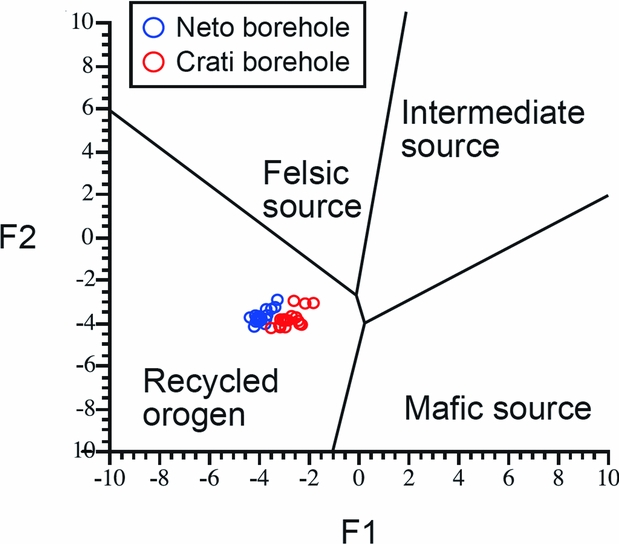
Table 4 shows the results of the Mann–Whitney U-test conducted on some incompatible (Y, Zr and Nb) against compatible element (Ni, V and Cr) log-ratios. All three log-ratios identified statistically significant differences between the Neto and Crati samples, and the Crati samples are always enriched in compatible elements. The discriminant diagram of Roser & Korsch (Reference Roser and Korsch1988) suggests that both the Neto and Crati sediments are related to a recycled and reworked orogen, but the Crati sediments are more dislocated towards a mafic source domain (Fig. 11). In addition, the Neto and Crati sediments depict different weathering trends on the MFW diagram, and the source-rock composition for the Crati sediments indicates a more mafic source composition compared to the Neto sediments (Fig. 8). All these facts suggest that the hinterland composition of the Crati drainage area was on average more mafic in composition than the Neto drainage area.
Mann–Whitney U-test of incompatible and compatible trace-element log-ratios

*Statistically significant p-values are marked in bold
Discriminant diagram of Roser & Korsch (Reference Roser and Korsch1988) suggesting that the studied sediments are related to a recycled orogen. F1 and F2 are discriminant functions using the chemical composition of the studied samples.
Different provenance proxies, including triangular relationships of V–Ni–La*4 (e.g. Perri, Muto & Belviso, Reference Perri, Muto and Belviso2011), have been commonly used to evaluate the source area(s) composition. The V–Ni–La*4 ternary diagram shows the fields representative of felsic, mafic and ultramafic rocks plot separately (e.g. Bracciali et al. Reference Bracciali, Marroni, Pandolfi, Rocchi, Arribas, Critelli and Johnsson2007; Perri, Muto & Belviso, Reference Perri, Muto and Belviso2011) and shows the fields of the main tectonic units of the northern Calabria–Peloritani Arc (Fig. 12); the studied muds plot close to the felsic composition and also to the compositions of the main units of the northern Calabria–Peloritani Arc, with the Crati sediments being slightly dislocated towards a mafic source domain (Fig. 12). Thus, the Crati drainage area is on average more mafic in composition than the Neto drainage area, according to the previous considerations. The studied samples show higher Fe content compared to the global average Fe content of riverine sediments (4.81±0.19 wt%; Poulton & Raiswell, Reference Poulton and Raiswell2002). In particular, the Crati samples have higher Fe content than the Neto samples; the high Fe content in the Crati muds can be related to some contribution from the Fe-rich mafic source rocks in the catchment area.
V–Ni–La*4 ternary diagram, showing fields representative of felsic, mafic and ultramafic rocks plot separately (e.g. Bracciali et al. Reference Bracciali, Marroni, Pandolfi, Rocchi, Arribas, Critelli and Johnsson2007; Perri, Muto & Belviso, Reference Perri, Muto and Belviso2011). The studied samples plot close to the felsic composition and to the Palaeozoic basement rocks and Mesozoic sedimentary covers. UCC – Upper Continental Crust; PAAS – Post-Archaean Australian Shale.

The higher mafic concentration of the Crati mud samples is probably related to the Malvito, Diamante–Terranova and Gimigliano Ophiolitiferous units (see Fig. 1) that are exposed in the Crati drainage basin (e.g. Critelli & Le Pera, Reference Critelli and Le Pera1995, Reference Critelli, Le Pera, Valloni and Basu2003).
High Al concentrations in sediments compared to those of the UCC (McLennan, Taylor & Hemming, Reference McLennan, Taylor, Hemming, Brown and Rushmer2006) is indicative of high detrital input. In particular, the Crati muds show higher Al contents than the Neto muds; this distribution may be attributed to the higher erosion rates of the Crati River drainage system than those of the Neto River drainage system, since a general increase in the concentration of Al is frequently indicative of high erosion rates (e.g. Karbassi & Amirnezhad, Reference Karbassi and Amirnezhad2004; Perri et al. Reference Perri, Critelli, Dominici, Muto, Tripodi and Ceramicola2012b ).
For the discrimination of island and continental arc, within-plate (continental rift and ocean island together) and collisional tectonic settings, a new diagram obtained from linear discriminant analysis of natural logarithm transformed ratios of major and trace elements has been used (Fig. 13) (e.g. Verma et al. Reference Verma, Pandarinath, Verma and Agrawal2013). This diagram indicates that the studied samples are related to a collisional setting (Fig. 13).
Diagram of the tectonic settings (modified from Verma et al. Reference Verma, Pandarinath, Verma and Agrawal2013). ARC – island and continental arc; RIFT – within-plate (continental rift and ocean island together); COLL – collisional setting. DF1 and DF2 are discriminant functions using the chemical composition of the studied samples.

6. Concluding remarks
The Ionian coast of the Calabrian region represents an excellent area to study the relationships between source areas and deep-marine basins, using the mineralogical and chemical compositional signatures of marine muds. The northern Ionian Basin is mainly characterized by two submarine fans, the Crati, to the north, and the Neto, to the south, related to the Crati and Neto river fluvial systems, coupled to diverse smaller coastal rivers, draining the southern Apennines thrust belt (i.e. Pollino Massif), the Calabria continental block (i.e. Sila Massif) and the Plio-Pleistocene marine deposits of the Crotone Peninsula, from north to south.
The deep-marine muds, collected from the Crati II and the Neto VI boreholes, show a similar mineralogical distribution, dominated by phyllosilicates over quartz, carbonates (calcite and dolomite) and feldspars (plagioclase and K-feldspar). The geochemical proxies of the studied muds, based on the V–Ni–La*4 and other discriminant diagrams and some incompatible/compatible element ratios, mainly reflect a provenance characterized by felsic rocks with minor mafic–ultramafic supply. In particular, the hinterland composition of the Crati drainage area is on average more mafic in composition than the Neto drainage area. A significant variation in the carbonate input is further recorded, mostly for the Crati muds. The values of the CIA and CIA′ indices and the trend showing in the MFW diagram, suggest low–moderate source area weathering. The low and constant Al/K and Rb/K ratios further suggest low–moderate weathering conditions without important fluctuations in weathering intensity. The ICV values and the distribution of both the Crati and Neto muds on the Al2O3–TiO2–Zr ternary diagram indicate that the studied samples are first-cycle, compositionally immature sediments, related to tectonically active (collision) settings such as those of the Calabria–Peloritani Arc, where chemical weathering plays a minor role.
Acknowledgements
This research has been carried out within the OGS funded projects WGDT (Morphology and Architecture of the Western Portions of the Gulf of Taranto: A Study of Submarine Instability in a Tectonically Active Margin; Resp. S. Critelli), and MIUR-UNICAL (Relationships between Tectonic Accretion, Volcanism and Clastic Sedimentation within the Circum-Mediterranean Orogenic Belts, 2006–2011; Resp. S. Critelli). The authors are grateful to Tohru Ohta for his help and contribution to the statistical tests and analyses of the compositional data and for reviewing an early version of the manuscript. The authors are indebted to Gert Jan Weltje and the Editor Juergen Schieber for their reviews and suggestions on the final version of the manuscript.



