Introduction
The effect of low temperatures on stored-product insects is well studied (Fields Reference Fields1992; Banks and Fields Reference Banks and Fields1995; Mason and Strait Reference Mason and Strait1998; Burks et al. Reference Burks, Johnson, Maier and Heaps2000; Fields et al. Reference Fields, Subramanyam and Hulasare2011) in part because low temperature is used extensively to control stored-product insects. It provides several advantages over chemical control; (i) effective against insecticide resistant strains, (ii) absence of residues on the product, and (iii) low risks to applicators (Fields Reference Fields1992; Arthur Reference Arthur1996; Fields et al. Reference Fields, Subramanyam and Hulasare2011). There are many factors that determine the survival of insects at low temperature: temperature, duration of exposure, species, developmental stage, acclimation, diapause, relative humidity, strain, and age (Lee Reference Lee1991; Fields Reference Fields1992; Mason and Strait Reference Mason and Strait1998; Andreadis et al. Reference Andreadis, Milonas and Savopoulou-Soultani2005; Eliopoulos et al. Reference Eliopoulos, Prasodimou and Pouliou2011; Fields et al. Reference Fields, Subramanyam and Hulasare2011).
There are over 40 species of Dermestidae (Coleoptera) beetles that feed on stored-products (Bousquet Reference Bousquet1990). In addition to the damage caused by feeding, cast skins of dermestid larvae can lead to respiratory ailments of workers (Bernstein et al. Reference Bernstein, Morgan, Ghosh and Arlian2009). Many of these dermestids feed on animal products such as; dried meat, fur, pet food, wool, and dried insects; making them significant pests in pet food manufacturers, feed plants and museums. However, there are other dermestids, such as Trogoderma variabile Ballion (Coleoptera: Dermestidae) (warehouse beetle, synonym T. parabile Beal) that also feed on seed or processed foods and are pests in bulk grain, warehouses and retail food stores (Loschiavo Reference Loschiavo1960; Burges Reference Burges1961; Partida and Strong Reference Partida and Strong1975; Olson et al. Reference Olson, Bryce, Lara, Madenjian, Potter and Reynolds1987; Wright and Cartledge Reference Wright and Cartledge1994). It originally had a Holarctic distribution (Beal Reference Beal1954; Bousquet Reference Bousquet1990), and since 1977 it is also found in Australia (Wright and Morton Reference Wright and Morton1995). Adults can fly, which may have enabled it to spread rapidly across Australia. The natural history of T. variabile is similar to Trogoderma granarium Everts (Coleoptera: Dermestidae) (khapra beetle). Trogroderma granarium is found throughout the Middle East and the Indian subcontinent (Eliopoulos Reference Eliopoulos2013) causing significant damage to cereals in storage, and it is a quarantine pest in the Americas, Europe, Australia, and Africa (Banks Reference Banks1977; Eliopoulos Reference Eliopoulos2013). Given the difficulties of working with quarantine insects, knowledge of the closely related T. variabile may provide insights into the natural history of T. granarium.
Unlike most stored-product insects, Trogoderma have a diapausing stage (Bell Reference Bell1994; Eliopoulos Reference Eliopoulos2013). Trogoderma diapause as late-instar larvae, occasionally feeding, moulting and can survive for several years (Burges Reference Burges1962; Wright and Cartledge Reference Wright and Cartledge1994; Wright et al. Reference Wright, Sinclair and Annis2002). Diapause can be induced by several factors; rearing density (isolation or crowded), food scarcity, low temperature, short photoperiod, or disturbance (Loschoavo Reference Loschiavo1960; Burges Reference Burges1961; Partida and Strong Reference Partida and Strong1975; Bell Reference Bell1994; Wright and Cartledge Reference Wright and Cartledge1994). Diapause can increase tolerance to low temperature (Loschiavo Reference Loschiavo1960; Elbert Reference Elbert1979a), however it reduced heat tolerance at 56 °C in T. variabile (Wright et al. Reference Wright, Sinclair and Annis2002). Diapause also reduces sensitivity to insecticides (Banks and Cavanaugh Reference Banks and Cavanaugh1985). Diapause can be terminated spontaneously, or due to changes in density (reduction or augmentation), increases in temperature or fresh food (Nair and Desai Reference Nair and Desai1973a, Reference Nair and Desai1973b).
There is only cursory information on the cold hardiness of T. variabile. Loschiavo (Reference Loschiavo1960) showed that diapausing larvae had no mortality after six days at −1 °C, 10 °C, or 20 °C. Elbert (Reference Elbert1979a) showed that diapausing larvae had less mortality (9%) after four months at 9 °C than non-diapausing larvae (43%). The goal of this study was to determine: the most cold-hardy stage of T. variabile, durations needed to control this stage at different temperatures, the supercooling point (SCP) as well as the effect of diapause and cold acclimation on survival at low temperatures. Diapause and cold acclimation can increase cold tolerance (Denlinger Reference Denlinger1991; Fields Reference Fields1992), however cool temperatures are sometimes needed to induce diapause (Wijayaratne and Fields Reference Wijayaratne and Fields2012), making it difficult to determine the effect of diapause independent of cold acclimation on cold hardiness. As T. variabile can be induced into diapause at warm temperatures by rearing in isolation, it makes this insect an ideal subject to study the effects of diapause and cold acclimation independently or in combination with cold hardiness.
Materials and methods
Insect culture
For all studies, we used one strain of T. variabile which was obtained from a mill at Yorkton, Saskatchewan, Canada in 2008 and cultured on a mixture of dog food (Dog Chow®, Nestlé Purina Petcare, Mississauga, Ontario, Canada), instant skim milk powder (Saputo Inc., Montréal, Québec, Canada), wheat germ and brewer’s yeast (ICN Biomedicals Inc., Aurora, Ohio, United States of America), (ratio by weight of food media was: 47.5, 17.5, 17.5, and 17.5%, respectively), ground and passed through 850 µm sieve. All rearing was done at 30±1 °C and 60±10% relative humidity in constant darkness. The following stages were used: eggs (one day after egg laying), young larvae reared in groups (20–24 day-old after egg laying), old larvae reared in groups (30–34-day-old after egg laying), old larvae reared in isolation (57-day-old after egg hatching), pupae, and unsexed adults (1–5 days after emergence). For insects reared in groups, 500–1000 adults were placed on 300 g of diet, adults were removed after three to four days, and the diet kept for varying times to obtain the different stages. Insects were reared on a high protein diet, in a warm and humid environment.
To obtain diapausing larvae, we held 500 adults for 24 hours on 250 g wheat flour (pre-sieved through a 250-µm mesh sieve), and then we collected eggs by sifting flour with a 180-µm mesh sieve. Individual eggs were transferred to 24-well multiwell plate (Falcon®, Durham, North Carolina, United States of America) under microscope with a fine paint brush (1 egg/1 well) with 2 g of ground diet (passed through a 850-µm mesh screen). The insects were held at 30±1 °C and 60±10% relative humidity in constant darkness for 57 days to obtain diapausing larvae (Wright and Cartledge Reference Wright and Cartledge1994; Wright et al. Reference Wright, Sinclair and Annis2002). Isolated larvae always had food, but most eventually died without pupating.
Development of isolated larvae
Eggs (n=66) were placed individually in a cell of a 24-multiwell plate with 2 g of ground medium and held in at 30±1 °C and 60±10% relative humidity in constant darkness. The cells were checked daily for the first 70 days, two times a week for the next 60 days and once a week in the last 20 days. After each moult, dorsal head widths of live larvae were measured using a micrometer with a binocular microscope.
Cold tolerance of different life stages
Various life stages of T. variabile reared in groups were placed in glass vials (29×80 mm) with screened lids and 5 g of ground diet. There were 20 individuals per vial. Vials were held at 0.0±0.02 °C, (under crushed ice in an insulated box held at 2.5 °C). Eggs were held for 0, 2, 3, 4, 5, or 6 days and returned to 30 °C, while young larvae, old larvae reared in groups, pupae and adults were held for 0, 4, 7, 10, 14, 17, 21, 28, or 35 days and returned to 30 °C. Adult survival was assessed after 24 hours. For the other life stages, after two weeks, the life stage and the number of live and dead were noted. There were four vials for each time-temperature combination taken at the same time.
To measure the SCP, various life stages were attached with petroleum jelly to a fine thermocouple (0.26 mm in diameter; Omega Engineering Inc., Stamford, Connecticut, United States of America), placed in a small vial, placed in an insulated Styrofoam box in freezer at −50 °C and the temperature decreased by ~1 °C/minute until −30 °C. Temperatures were recorded data loggers (Hobo, Onset Computer Corp., Bourne, Massachusetts, United States of America) measured temperature at one-second intervals. The temperature just before a sudden rise in temperature, heat of crystallisation, was taken as the SCP.
Effect of rearing density and acclimation on cold tolerance
Late-instars were used in the subsequent tests because of their ability to diapause and they were the most cold-hardy stage at 0 °C. We examined the effect of cold acclimation and diapause on the cold tolerance at 0 °C in all possible combinations. Larvae were cold acclimated by being held successively at 15±1 °C, 10±1 °C, or 5±1 °C for two weeks at each temperature before cold exposure. Non-acclimated larvae were always held at 30 °C before cold exposure. Diapause was induced by rearing larvae in isolation (see above). Non-diapausing larvae were reared in groups at 30 °C.
Grouped non-acclimated larvae were held at 0 °C for; 7, 10, 14, 17, 21, 28, or 35 days. The isolated non-acclimated larvae were held for; 7, 14, 21, 28, 35, 49, 56, 63, or 70 days. Grouped acclimated larvae were held for; 21, 35, 49, 63, 77, 91,105, 119, or 123 days. Isolated acclimated larvae 57-day-old were held for; 56, 84, or 224 days. After the cold exposure, survival was assessed as above. There were four replications for each time-temperature combination, and controls that were never placed in cold temperatures.
Cold tolerance at various low temperatures
We examined the cold tolerance of what we presumed would be the least and most cold tolerant late-instar larvae. For the least cold tolerant larvae, we used 30–34-day-old larvae reared in groups at 30 °C. We designated these insects as grouped non-acclimated. For the most cold tolerant larvae, we used 57-day-old larvae reared in isolation (mostly in diapause) at 30 °C, put in to vials with 20 larvae on 5 g diet, then acclimated to cold as above. We designated these insects as isolated acclimated.
Grouped non-acclimated 30–34-day-old larvae reared at 30 °C were held at; −5 °C (4, 7, 10, 14, 17, 21, 28, or 35 days), −10 °C (4, 7, 10, 14, 17, 21, or 28 days), −16 °C (2, 4, 6, 7, 10, 12, 14, 17, or 21 days), or −19 °C (1, 2, 3, 4, 5, 6, or 7 days). Isolated acclimated larvae held at; −5 °C (28, 56, 84, 112, or 140 days), −10 °C (7, 14, 21, 28, 35, 42, 56, or 110 days), −16 °C (7, 14, 21, 28, 35, 42, or 49 days), or −19 °C (2, 4, 6, 8, 10, 12, or 14 days). The vials were placed in an insulated Styrofoam box in cold rooms at −5.0±0.1, −10±0.1, −16±0.2, and −19±0.1 °C.
After cold treatments, vials were held at 30 °C for two weeks, insects were shifted out of the ground medium, and the number of live and dead larvae, pupae, and adults were noted. Live larvae were considered to be in diapause, insects that had pupated or emerged as adults were considered to not be in diapause. The diapause status of dead larvae could not be determined. Data loggers measured the temperature at one hour at each temperature. Average temperatures were; 0.0, 5.2, 10.4, 15.8, 19.0 °C. There were three vials for each time-temperature combination, and controls that were never placed in cold temperatures.
Data analyses
The time-mortality data of each T. variabile stage at low temperatures were subjected to probit analysis to estimate the time required to kill 50% or 95% of the insects (Polo Plus 2.0, Finney Reference Finney1971; LeOra Software 2007). For cases that the probit analysis did not estimate the LT50 and LT95, these were estimated graphically by drawing a line through points and extrapolating to LT50 and LT95 if needed. Duration of each immature stage and for the egg-to-adult development and head widths among larval instars were subjected to one-way analysis of variance (SigmaPlot 12.0, Systat Software Inc. 2012). To normalise data and equalise variance, we transformed the head width data using a logarithmic scale.
Results
Development of isolated larvae
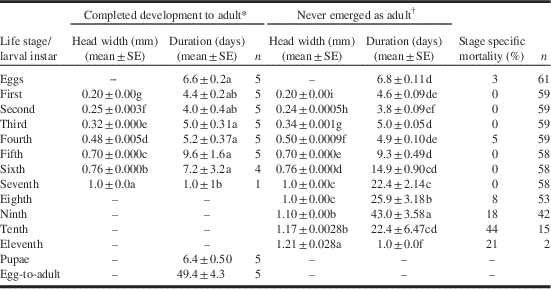
Only five of the 66 individuals emerged as adults, taking an average 49±4 days, and five to seven instars to reach the adult stage (Table 1). The other 61 larvae never pupated, and were considered to be in diapause. These larvae had 4–11 instars (mean 10.0±0.5 instars) before dying. For the first six instars, both groups of insects had similar durations of larval instars. The larvae that never emerged as adults had larval instar durations of over 20 days for the seventh to 10th instars. The average age of mortality for these diapausing larvae was 142±4 days. The larval head widths did not increase greatly after the seventh instar. There was a high level of mortality after the eighth instar. Young larvae used in subsequent tests were probably in the fourth or fifth larval instar, old larvae reared in groups were probably in the fifth or sixth larval instar and old larvae reared in isolation were probably in the seventh or eighth larval instar.
Head capsule widths of Trogoderma variabile larvae and duration of stages for insects reared in isolation at 30 °C, 60% relative humidity.

* For a given column, means with the different letter are significantly different, Tukey’s multiple range test, P<0.05. Completed development to adults, n=5,
† Never emerged as adults, n=61, mortality as % of never emerged as adults.
Cold tolerance of different life stages
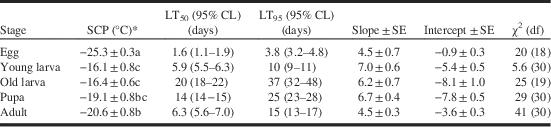
The susceptibility to low temperatures was affected by developmental stage. The cold tolerance at 0 °C of different stages reared in groups (non-diapausing) from highest to lowest was; old larvae>pupae>adult=young larvae>eggs (LT50, Table 2). Old larvae were the most cold-tolerant stage at 0 °C. Mean SCP of different stages from lowest to highest was eggs<adult=pupae=old larvae=young larvae (Table 2). Supercooling point of life stages was not correlated with cold tolerance (LT50), as the old larvae had the highest SCP, yet the longest LT50.
Supercooling points and lethal time to kill 50 or 95% of the population of various life stages of the Trogoderma variabile reared at 30 °C in groups (non-diapausing) and exposed to 0 °C.
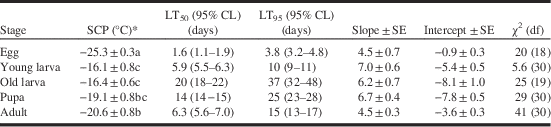
* One-way analysis of variance (ANOVA), F=19.7; df=4, 63; P<0.001), means followed by different letters are significantly different, Tukey’s multiple range test P<0.05.
Effect of rearing density and acclimation on cold tolerance
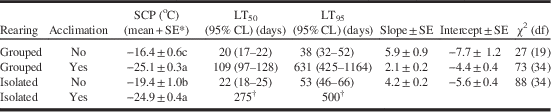
The susceptibility to low temperatures was affected by diapause and cold acclimation. The cold tolerance of old larvae from least to greatest at 0 °C was; grouped, non-acclimated<isolated, non-acclimated<grouped, acclimated<isolated, acclimated (LT50, Table 3). Acclimation alone had a greater effect on cold tolerance (LT50 ~5.4 times grouped, non-acclimated larvae), than diapause alone (LT50 ~1.1 times grouped, non-acclimated larvae). Isolated, acclimated larvae had much higher level of cold tolerance (LT50, Tables 2–3) compared with all life stages, ranging from 14 times more cold tolerant for grouped, non-acclimated old larvae to 172 times more cold tolerant than eggs.
The effect of cold acclimation (two weeks/temperature at 15 °C, 10 °C, 5 °C) and diapause (non-diapausing; reared in groups for 30–34 days at 30 °C, diapausing insects reared in isolation for 57 days at 30 °C) on supercooling point and lethal time to kill 50% or 95% of the population of old larvae of the Trogoderma variabile exposed to 0 °C.
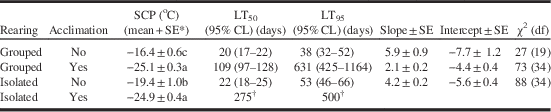
* One-way analysis of variance (ANOVA), F=35.7; df=3, 50; P<0.001, means followed by different letters are significantly different, Tukey’s multiple range test, P<0.05
† Estimated graphically (Fig. 1), as after 224 days there was only 37% mortality.
Diapause and acclimation affected supercooling capacity of larvae. Mean SCP of different stages from lowest to highest was isolated acclimated larvae=grouped acclimated larvae<isolated non-acclimated larvae<grouped non-acclimated larvae (Table 3). The lowest SCP for any individual was −26.4 °C for an isolated acclimated larvae.
The mortality of larvae increased with time (Fig. 1A–1D). At day 0, before being placed at various low temperatures, grouped non-acclimated larvae had 12% diapause of survivors (Fig. 1E), compared with 72% diapause of survivors for larvae reared in isolation at 30 °C (Fig. 1F). Acclimated larvae had increased diapause of survivors compared with non-acclimated larvae, both in grouped (21%, Fig. 1G) and in isolated larvae (100%, Fig. 1H). With grouped non-acclimated larvae, diapause of survivors increased with time at 0 °C, reaching as high as 55% (Fig. 1E). This was not the case with grouped acclimated larvae, the diapause of survivors remained constant at around 30% for the first 77 days at 0 °C (Fig. 1G). The percent of diapause in survivors increased with time for grouped larvae. This suggests that diapause increases cold tolerance, as seen in other experiments (Table 3).
The mortality (%) (A–D); and diapause of survivors (%), (E–H) (n=3, 20 insects/vial, mean±SE). Insects were reared either in groups (30–34-day-old larvae, mostly non-diapause) or in isolation (57-day-old larvae, mostly diapause). There was two types of acclimation; non-acclimated (held at 30 °C before exposure to low temperatures) and acclimated (two weeks/temperature at 15 °C, 10 °C, 5 °C before exposure to low temperatures). Trogoderma variabile larvae were considered in diapause if after cold exposure and being held at 30 °C for two weeks they were alive and had not pupated. Non-diapause was measured by larvae that had pupated during the two weeks. Mortality (%)=(dead larvae×100)/20; and diapause of survivors (%)=(live larvae×100)/(live larvae+live pupae+live adults).
Cold tolerance at various low temperatures
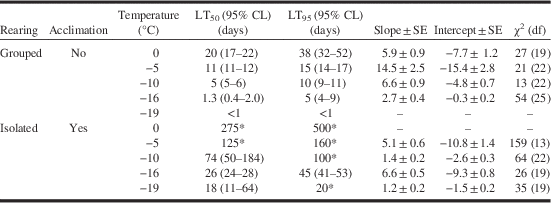
As expected, rearing and acclimation affected survival at low temperatures (Table 4). In general, the grouped (non-diapausing) non-acclimated larvae were less cold tolerant than the isolated (diapausing) acclimated larvae at all temperatures. The lower the temperatures, the faster the larvae died. Unfortunately, we underestimated the cold tolerance for the isolated acclimated larvae, so we do not have good estimations of the time required to control larvae at some temperatures. The highest mortality for the isolated acclimated larvae were; 37% mortality after 224 days at 0 °C, 73% after 140 days at −5 °C, 48% after 56 days at −10 °C, 100% after 49 days at −16 °C and 57% after 14 days at −19 °C (Fig. 1D).
The lethal time to kill 50% or 95% of the old larvae of the Trogoderma variabile reared in groups (non-diapausing) and non-acclimated or reared in isolation (diapausing) and acclimated (two weeks/temperature at 15 °C, 10 °C, 5 °C) at different low temperatures.
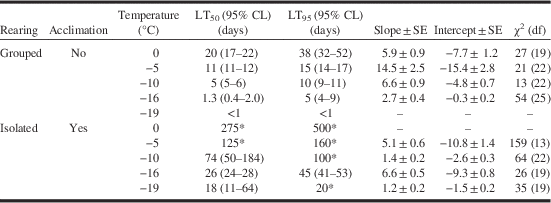
* Estimated graphically (Fig. 1).
Discussion
As seen with other species (Nagel and Shepard Reference Nagel and Shepard1934; Smith Reference Smith1970; David et al. Reference David, Mills and White1977; Fields Reference Fields1992; Imai and Harada Reference Imai and Harada2006; Abdelghany et al. Reference Abdelghany, Awadalla, Abdel-Baky, EL-Syrafi and Fields2010), the development stage affected cold hardiness of T. variabile. In our study, eggs were the most cold-susceptible stage, as is the case with several other stored-product insects (Fields Reference Fields1992); Sitotroga cerealella (Olivier) (Lepidoptera: Gelechiidae), Plodia interpunctella (Hübner) (Lepidoptera: Pyralidae) (Vincent et al. Reference Vincent, Rust and Lindgren1980), Lasioderma serricorne (Fabricius) (Coleoptera: Ptinidae) (Imai and Harada Reference Imai and Harada2006), Stegobium paniceum (Linnaeus) (Coleoptera: Ptinidae) (Abdelghany et al. Reference Abdelghany, Awadalla, Abdel-Baky, EL-Syrafi and Fields2010), and Callosobruchus maculatus (Fabricius) (Coleoptera: Chrysomelidae) (Loganathan et al. Reference Loganathan, Jayas, Fields and White2011). For T. variabile, the late-instars were the most cold-hardy stage. There are several other stored-product insects in which the larval stage is the most cold-hardy stage; Ephestia kuehniella Zeller (Lepidoptera: Pyralidae), L. serricorne, Rhyzopertha dominica (Fabricius) (Coleoptera: Bostrichidae), Sitophilus oryzae (Linnaeus) (Coleoptera: Curculionidae) (Fields, Reference Fields1992), T. granarium (Elipoulos et al. Reference Eliopoulos, Prasodimou and Pouliou2011), P. interpunctella (Fields and Timlick Reference Fields and Timlick2010), and L. serricorne (Imai and Harada Reference Imai and Harada2006).
Trogoderma variabile old larvae were relatively more cold tolerant than most stored-product insect species. For example, at 0 °C, LT50 value of T. variabile non-diapausing (grouped) non-acclimated old larvae was 16 days, whereas for S. oryzae adults it was three days (Stojanovic Reference Stojanovic1965), for Tribolium castaneum (Herbst) (Coleoptera: Tenebrionidae) it was four days (Wijayaratne and Fields Reference Wijayaratne and Fields2010), for L. serricorne it was four days (Imai and Harada Reference Imai and Harada2006), for S. paniceum adults it was five days (Abdelghany et al. Reference Abdelghany, Awadalla, Abdel-Baky, EL-Syrafi and Fields2010), for R. dominica adults it was six days (Stojanovic Reference Stojanovic1965), for Cryptolestes ferrugineus (Stephens) (Coleoptera: Cucujidae) adults it was seven days (Khan Reference Khan1990), adults for Sitophilus granarius (Linnaeus) (Coleoptera: Curculionidae) was 12 days (Fields et al. Reference Fields, Fleurat-Lessard, Lavenseau, Gérard, Peypelut and Bonnot1998). Dermestids are some of the most cold-hardy stored-product insects (Solomon and Adamson Reference Solomon and Adamson1955; Strang Reference Strang1992). From the limited information on the cold hardiness on T. granarium (Voelkel Reference Voelkel1924; Zacher Reference Zacher1938; Eliopoulos et al. Reference Eliopoulos, Prasodimou and Pouliou2011), it appears that T. variabile is the more cold hardy of the two. At −16 °C, unacclimated larvae of T. granarium have an LT50 of under four hours (Eliopoulos et al. Reference Eliopoulos, Prasodimou and Pouliou2011), whereas in our studies they survived over a day. It appears that T. granarium can also acclimate by comparing the results in Mathlein (Reference Mathlein1961) with moderate cold acclimation giving 98% mortality after 30 days at −10 °C compared with 50% mortality after one day at −10 °C (Zacher Reference Zacher1938). Whereas acclimated T. variabile had 50% mortality after 125 days, and unacclimated insects had 50% mortality after 25 days. More extensive work is required to compare the cold hardiness of these two species.
Our results indicate that SCP is a stage-dependent parameter in T. variabile. The same has been seen for other stored-product pests such as; T. castaneum (Carrillo et al. Reference Carrillo, Kaliyan, Cannon, Morey and Wilcke2004), Tenebrio molitor Linnaeus (Coleoptera: Tenebrionidae) (Constantinou and Cloudsley-Thompson Reference Constantinou and Cloudsley-Thompson1986) and P. interpunctella (Carrillo and Cannon Reference Carrillo and Cannon2005). However, SCP is not directly related to the cold hardiness, as eggs had a very low SCP, but were the least cold hardy stage. This is seen with other insects (Denlinger Reference Denlinger1991). However, within the late instar larvae across the different diapause states and acclimation, the SCP was approximately related to cold tolerance. Similar trends were seen with other insects (Fields et al. Reference Fields, Fleurat-Lessard, Lavenseau, Gérard, Peypelut and Bonnot1998; Carrillo and Cannon Reference Carrillo and Cannon2005; Fields and Timlick Reference Fields and Timlick2010), perhaps this is due to an increase in cyroprotectants associated with cold acclimation.
As in previous studies (Loschiavo Reference Loschiavo1960; Wright and Cartledge Reference Wright and Cartledge1994), rearing T. variabile in isolation gave rise to a high percent of larvae in diapause. We saw five to seven instars for non-diapausing T. variabile and as many as 11 instars for diapausing larvae. This is similar to previous studies on T. variabile (Loschiavo Reference Loschiavo1960; Burges Reference Burges1961; Partida and Strong Reference Partida and Strong1975). However, in previous studies larvae continued to survive from 11 to 19 months with as many as 28 moults (Loschiavo Reference Loschiavo1960), whereas in this study, larvae in diapause died after five months. The time to develop from egg to adult for non-diapausing insects was 10 days longer in this study than compared with Burges (Reference Burges1961). These differences could be due to differences in strain, environmental conditions or diet. As T. variabile can be induced into diapause by rearing in isolation even at warm temperatures, it makes this insect an ideal subject to study the effects of diapause and cold acclimation independently or in combination on cold hardiness. We found that diapause alone did not increase cold tolerance, cold acclimation in non-diapausing insects caused a much greater increase (fivefold) than diapause alone, however the combination of diapause and cold-acclimation showed by far the greatest increase in cold tolerance compared with non-diapausing non-acclimated controls (14-fold). These data support the model that cold hardiness can increase without diapause, but the highest levels of cold hardiness are seen with diapausing insects (Denlinger Reference Denlinger1991). There are several other species showing similar patterns of linking diapause and cold hardiness (Tzanakakis Reference Tzanakakis1959; Denlinger Reference Denlinger1991; Fields and Timlick Reference Fields and Timlick2010), however with these insects, the diapause is induced with short photoperiods and cool temperatures (Wijayaratne and Fields Reference Wijayaratne and Fields2012).
Trogoderma variabile geographical distribution is Holarctic (Bousquet Reference Bousquet1990), although it has been recently introduced into Australia (Wright and Morton Reference Wright and Morton1995). This suggests that the diapause was an adaptation to overwintering in temperature regions in the ancestral habitats, which are thought to be bird and mammal nests (Beal Reference Beal1954). Short photoperiod and reduced food also increased diapause (Loschiavo Reference Loschiavo1960; Burges Reference Burges1961; Elbert Reference Elbert1979a, 1979Reference Elbertb; Wright et al. Reference Wright, Sinclair and Annis2002). Further studies could determine the effect of diapause on cold hardiness when induced by photoperiod or food. Also the effects of diapause termination and deacclimation on cold tolerance (Fields et al. Reference Fields, Fleurat-Lessard, Lavenseau, Gérard, Peypelut and Bonnot1998) would be of interest from both a biological and insect control perspective. There are similarities between the diapause seen in T. variabile and T. granarium. Both diapause in an instar just before pupating (Loschoavo Reference Loschiavo1960; Burges Reference Burges1962; Wright and Cartledge Reference Wright and Cartledge1994). The diapause in both T. variabile (Loschoavo Reference Loschiavo1960; Burges Reference Burges1961; Partida and Strong Reference Partida and Strong1975; Bell Reference Bell1994; Wright and Cartledge Reference Wright and Cartledge1994) and T. granarium (Burges Reference Burges1959, Reference Burges1962) can be induced by a number of factors, short photoperiods, low food, crowding, or isolation. Our studies showed that diapause did not increases cold hardiness, and diapausing cold acclimated larvae are the most cold tolerant of all insects tested. Similar work needs to be done with T. granarium and the other dermestids with diapause to see if similar trends exist. This data is needed to use low temperature to control T. granarium using low temperature. Trogoderma granarium can complete its development between 24 °C and 41 °C (Sinha and Watters Reference Sinha and Watters1985), whereas T. variabile can develop between 21 °C and 35 °C (Partida and Strong Reference Partida and Strong1975), suggesting T. granarium is better adapted for warmer climates.
There are several factors; life stage, diapause and acclimation, that affect the cold tolerance of T. variabile, making it difficult to make simple recommendations for using low temperature to control T. variabile. The simplest approach would be lower all product and all areas that T. variabile could be found to below −27 °C for at least a few minutes. This is the lowest SCP measured for a diapausing acclimated larva. As T. variabile does not survive freezing, this would control all stages. Trogoderma variabile could be controlled at temperatures higher than the SCP with longer durations. Non-diapausing, non-acclimated insects should be controlled (upper confidence interval for LT95) with 52, 17, 11, 9, or 1 day at 0 °C, −5 °C, −10 °C, −16 °C, or −19 °C, respectively. Unfortunately, our experiments were not long enough to control all diapausing acclimated insects, and therefore we can only make rough estimations of the durations needed to control these most cold tolerant insects: 500, 175, 100, 53, 20 days at 0 °C, −5 °C, −10 °C −16 °C, or −19 °C respectively. In these tests we used only a single strain that had been reared in the laboratory for several years. Strain has been shown to affect diapause and cold hardiness (Fields Reference Fields1992; Wijayaratne and Fields Reference Wijayaratne and Fields2012), thus different regions may have different temperature requirements to control insects. Finally, laboratory rearing may inadvertently select for non-diapausing populations (Nair and Desai Reference Nair and Desai1973b; Wijayaratne and Fields Reference Wijayaratne and Fields2012), as diapausing insects are eliminated for the populations or do not have as many generations as non-diapausing insects. In this study, this strain readily diapaused when reared in isolation.
Additional experiments are required to get a more accurate estimate of durations required to control T. variabile at various low temperatures. Cold acclimation temperatures and durations in warehouses and granaries would be different than what we used to acclimate insects in the laboratory, and could increase the cold tolerance even further, as the cold acclimation regimes can affect cold tolerance (Fields Reference Fields1992).
Acknowledgements
The authors thank Tannis Mayert, Daphne Jalique, and Zoe Rempel for technical assistance and Robert Laird for comments on the manuscript.