Mainstay therapies for Clostridium difficle infection (CDI) are oral metronidazole monotherapy for mild-to-moderate CDI or vancomycin monotherapy for severe CDI or a combination therapy with intravenous metronidazole plus oral vancomycin with or without vancomycin enema (ie, for severe complicated cases).Reference Cohen, Gerding and Johnson 1 However, the benefit of combination therapy relative to CDI severity and recurrence is unknown. Recurrence remains a challenge with CDI.Reference Hensgens, Goorhuis and Dekkers 2
Anecdotal experience at our facility demonstrated high use of combination therapy. The rationale for combination therapy were hypervirulent C. difficile, decreased response to metronidazole,Reference Musher, Aslam and Logan 3 and emergence of metronidazole resistance.Reference Pelaez, Alcala and Alonso 4 In this study, we evaluated the impact of combination therapy versus monotherapy for CDI in severe and nonsevere cases with regard to time to resolution of diarrhea (TTROD), clinical cure, duration of therapy (DOT), length of stay (LOS), recurrence, and mortality.
METHODS
Study Population
We conducted a retrospective study at a 689-bed academic medical center. We defined CDI as ≥3 unformed stools within 24 hours and glutamate dehydrogenase (GDH)/toxin enzyme immunoassay (EIA) (C. Diff Quik Chek Complete, TechLab, Blacksburg VA)5 positive for C. difficile toxin or colonoscopic or histopathologic findings demonstrating pseudomembranous colitis. All inpatients (≥1 year old) admitted between April 2008 and March 2010 with CDI who received ≥24 hours of metronidazole, vancomycin, rifaximin, or nitazoxanide alone or in any combination were included in this study. Exclusion criteria included isolation of other infectious diarrhea pathogens, pregnancy, >1 CDI recurrence, colectomy for toxic megacolon or perforation at baseline, ileostomy, or discordant assay result (GDH positive and toxin negative). This study was approved by our institutional review board.
Data Collection
We collected the following data for each patient included in the study: demographics, comorbidities, EIA result, treatment, concurrent antibiotics (categorized into high, medium and low risk for CDI),Reference Mullane, Miller and Weiss 6 immunocompromised status (ie, absolute neutrophil count <1,000; hematologic malignancy; receiving chronic systemic corticosteroids ≥20 mg/day prednisone equivalent, cancer chemotherapy; HIV positive), and anti-peristaltic agents administered for ≥24 hours.
Severity of CDI at the time of C. difficile assay was assessed by assigning points as follows: 1 point each for age >60 years, temperature >38°C, albumin <2.5 g/dL, SCr≥1.5 times the premorbid level, and WBC>15,000 cells/mm3; 2 points each for pseudomembranous colitis, ileus, and hospitalization in the ICU. We used the following definitions to categorize CDI severity: (1) mild-to-moderate, score ≤1; (2) severe, score ≥2; (3) severe complicated, score ≥2 plus hypotension (blood pressure ≤90/60, or drop in blood pressure; systolic pressure >20 mmHg or diastolic pressure >10 mmHg, or on vasopressors), toxic megacolon, perforation, or colectomy. The underlying severity of illness at the time of CDI assay was assessed by adapting a grading system that includes several additional factors: mental status (disoriented, 1 point; stupor, 2 points; coma, 4 points); fever (≥38°C and <40°C, 1 point; ≥40°C, 2 points); hypotension (blood pressure ≤90/60 or drop in blood pressure; systolic pressure >20 mmHg or diastolic pressure >10 mmHg, or on vasopressors, 2 points); mechanical ventilation, 2 points; and cardiac arrest, 4 points. Patients that scored ≥4 points were considered severely ill.
Outcomes
Our primary outcome was TTROD, ie, time to return of daily bowel movements to ≤2/day, with censoring at death. Secondary outcomes were clinical cure, DOT, LOS, recurrence, and mortality. Clinical cure was defined as resolution of diarrhea (ROD) or discharge by day 10 of treatment.Reference Zar, Bakkanagari and Moorthi 7 Failure was persistent diarrhea (≥3 unformed stools/day); colectomy due to CDI unresponsive to therapy, toxic megacolon or perforation not present at baseline; or death by treatment day 10.Reference Zar, Bakkanagari and Moorthi 7 CDI recurrence was defined as CDI occurring ≤60 days following completion of therapy and resolution of clinical signs and symptoms of the previous episode.Reference Musher, Aslam and Logan 3
Statistical analysis
Combination and monotherapy groups were compared using Wilcoxon rank-sum tests for continuous variables and χ2 test or Fisher’s exact test for categorical variables. Values <1 were rounded to 1. Cox proportional hazards regression adjusting for underlying severity of illness, CDI episode, CDI category, immunocompetence, concurrent antibiotics, and age were used to evaluate time-to-event outcomes (TTROD, time to death, time to recurrence), and group differences were compared using the log-rank test. Logistic regression was used to evaluate clinical cure, and negative binomial regression for LOS and DOT accounted for the confounders. An α value of 0.05 was considered significant.
RESULTS
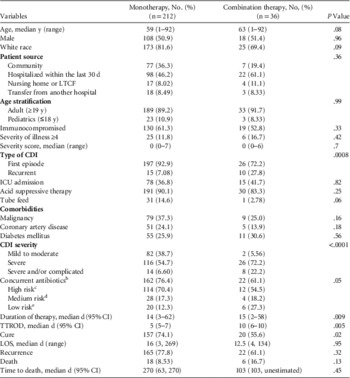
Of 263 patients evaluated, 248 records were available for analysis (8 were duplicates, 5 had >1 recurrence, 2 lacked outcome information). Among them, 36 (14.5%) received combination therapy and 212 (85.5%) received monotherapy. Severe or severe complicated CDI (P<.0001) and recurrent disease (P=.0008) were more likely in combination group (Table 1). Metronidazole monotherapy was used in 176 of 212 cases (83%), and vancomycin monotherapy was used in 36 of 212 cases (17%). Of 176 case patients, 25 (14.2%) were switched from metronidazole to vancomycin due to lack of response. Metronidazole plus vancomycin was the majority of combination therapy in 34 of 36 patients (94.4%), and the remainder were treated with vancomycin, metronidazole, and rifaximin triple therapy. Median DOT was significantly shorter in the monotherapy group than in the combination therapy group: 14 versus 15 days (P=.009). Of 221 patients given acid suppressive therapy, 206 (93.2%) were given proton pump inhibitors. Overall, 177 of 248 patients (71.4%) achieved clinical cure.
Characteristics of Monotherapy Versus Combination TherapyFootnote a

NOTE. LTCF, long-term care facility; ICU, intensive care unit; CI, confidence interval; TTROD, time to resolution of diarrhea; CDI, Clostridium difficile infection; LOS, length of stay.
a All values are n (%) unless otherwise indicated.
b Adapted from Mullane et al.Reference Mullane, Miller and Weiss 6
c ≥1 dose of high-risk antibiotic (carbapenem; second-, third-, or fourth-generation cephalosporin, fluoroquinolone, clindamycin).
d ≥1 dose of medium-risk antibiotic (penicillin, penicillin combination, first-generation cephalosporin, macrolide, monobactam, or streptogramin).
e ≥1 dose of low-risk antibiotic (all other systemic antibiotics).
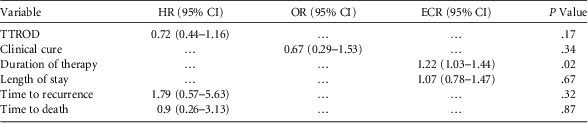
After accounting for confounders, there were no differences in TTROD, clinical cure, LOS, recurrence, or mortality, but the combination therapy group had longer DOT (expected count ratio, 1.22; 95% confidence interval [CI], 1.03–1.44; P=.02) than the monotherapy group (Table 2). Those with recurrent disease versus first episode had longer TTROD (OR, 0.52; 95% CI, 0.27–0.98; P=.04), lower clinical cure (OR, 0.29; 95% CI, 0.12–0.74; P=.009), and longer DOT (expected count ratio [ECR], 1.21; 95% CI, 1–1.45; P=.05). Clinical cure was less likely in those with severe complicated CDI (OR, 0.19; 95% CI, 0.06–0.64; P=.007).
Multivariate Analyses for Combination Therapy Versus Monotherapy
NOTE. TTROD, time to resolution of diarrhea; ECR, expected count ratio; HR, hazard ratio; OR, odds ratio.
DISCUSSION
The treatment of CDI with combination therapy has been debated due to a paucity of well-controlled studies.Reference Cohen, Gerding and Johnson 1 Experts suggest that a switch in treatment (usually around day 5) is more prudent when a treatment fails rather than adding to baseline therapy.Reference Cohen, Gerding and Johnson 1 However, no study has formally evaluated changes in CDI therapy; thus, no criteria are available to guide changes in therapy.
A recent meta-analysis showed no difference in the rate of clinical cure between monotherapy and combination therapy for mild-to-moderate CDI (OR, 1.07; 95% CI, 0.58–1.96; P=.83) or CDI recurrence (OR, 0.91; 95% CI, 0.66–1.26; P=.56).Reference Li, Lu, Lin, Wang and Liu 8 The rate of adverse drug events was lower for monotherapy compared than for combination therapy (OR, 0.30; 95% CI, 0.17–0.51; P<.0001). Another study evaluated patients with severe CDI treated with vancomycin (n=35) versus vancomycin plus metronidazole (n=43); the results showed no difference in time to clinical cure (HR, 0.58; 95% CI, 0.31–1.09; P=.10).Reference Bass, Bauer, Neuner and Lam 9 A third study evaluated intravenous metronidazole plus oral vancomycin (n=44) compared to vancomycin monotherapy (n=44) in critically ill patients with severe CDI.Reference Rokas, Johnson and Beardsley 10 Only 2 factors were associated with survival: increasing albumin (OR, 0.87; 95% CI, 0.78–0.97; P=.11) and intravenous metronidazole (OR, 4.54; 95% CI, 1.48–14; P=.008]. Like our study, those on combination therapy tended to be sicker, and no benefit was demonstrated, even after adjusting for potential confounders. Nevertheless, our study provides additional information in that we compared treatments across the spectrum of CDI severity: mild-to-moderate, severe, and severe complicated.
The results of our study should be interpreted within the context of the study limitations. This was a single center, retrospective study, which may affect generalizability. Our institution had an antimicrobial stewardship program, as well as strict infection control policies; nevertheless, lack of EIA confirmation with PCR may have resulted in the exclusion of false-negative results. The criterion of ≤2 stools per day for the entire study assessment, compared to that of other studies (≤2 stools/day for 48 hours), may have been stricter, which may have contributed to our lower cure rate of 71.4%.
In conclusion, after accounting for confounders, TTROD was not different between combination and monotherapy groups. No differences were apparent in clinical cure, LOS, or mortality, but combination therapy group had a longer DOT. No benefit from combination therapy was apparent in this study.
ACKNOWLEDGMENTS
Financial support: No financial support was provided relevant to this article.
Potential conflicts of interest: Trevor VanSchooneveld, MD, reports grant support from Rebiotrix, and Actelion. Elizabeth Hermsen, PharmD, MBA, reports personal fees and other payments from Merck & Co., Inc. All other authors report no conflicts of interest relevant to this article.