In farming societies, hunting is generally a highly ritualized social action, bound up with power, landownership and the communication of identity. This was certainly the case in the later medieval period, as is reflected in the art, literature and material culture of the time. Traditionally, the Norman Conquest has been stressed as a watershed in hunting terms, the new elite using wild-animal exploitation to legitimize their control over the conquered land and people.Footnote 1 Without doubt, 1066 impacted dramatically on the evolution of British hunting, with the introduction of a new quarry (the fallow deer), new hunting landscapes (the forest and the park) and new hunting practices (the highly ritualized chasse par force de chien); but the drama of the transition has diverted attention from the pre-Conquest situation, a period in which hunting is likely to have been just as socially important. Within the last few years historians, landscape researchers and place-name scholars have given increasing attention to Anglo-Saxon hunting, even raising the possibility that many of the purported Norman introductions (especially parks and fallow deer) were actually legacies of the pre-Conquest period.Footnote 2
Understanding the nature of pre-Conquest hunting has, however, been complicated by the comparative lack of evidence – by contrast with the later medieval period, documents mentioning wild animals and hunting are rare and their details sketchy, whilst information relating to landscape organization and the existence of hunting reserves is difficult to extrapolate from archaeological, charter and place-name evidence.Footnote 3 One source of information available for the entire medieval period is that derived from archaeological animal bones, a category of finds recovered from the majority of excavations. Although the interpretative value of animal bones can be compromised by factors of preservation and recovery, these problems are reduced when data from large numbers of assemblages are synthesized, allowing even subtle patterns of behaviour to be detected and explained. For the later medieval period the zooarchaeological record has preserved striking evidence for the social rituals surrounding the procurement, distribution and consumption of venison, and there is every reason to suspect that, if we look for them, similar patterns will be discernable for the earlier medieval period.Footnote 4
In an attempt to highlight the existence of pre-Conquest hunting rituals and explain their meaning this paper will examine data derived from fifty-eight assemblages of red-deer and roe-deer bones, recovered from sites of different ‘type’ (low status rural, ‘urban’, secular elite and religious houses) dating to between the fifth and mid-eleventh centuries (see table 1 for sample sizes). The difficulties of classifying sites in this period are well known, particularly with respect to the differentiation between high-status secular and ecclesiastical settlements.Footnote 5 Here sites have been categorized based on the weight of evidence: thus sites such as Ramsbury (Wiltshire), Wicken Bonhunt (Suffolk), Goltho (Lincolnshire), Bishoptone (Sussex) and Portchester Castle and Faccombe Netherton (Hampshire) have been classified as ‘secular elite’, whereas those such as Brandon (Suffolk), St Albans Abbey (Hertfordshire), Hartlepool Monastery (Cleveland), North Elmham (Norfolk) and Westminster Abbey have been categorized as ‘religious houses’. Some sites, including Eynsham Abbey (Oxfordshire) and Flixborough (Lincolnshire), are thought to have changed status during their lifetime and these shifts in character are recognized by the dataset.Footnote 6
Number of assemblages for each period and site type analysed in figs 1–4. Source: Sykes Reference Sykes2007a

Here emphasis will be placed on elucidating the treatment of deer carcasses and determining whether practices of venison distribution and consumption changed through time and, if so, what this might reveal about the dynamics of social structure. Less attention will be given to the methods and practicalities of hunting, which are discussed elsewhere.Footnote 7 Of necessity this paper will focus on the evidence from high-status settlements (both secular and ecclesiastical), where deer remains are generally found in their greatest abundance.Footnote 8 The very association between deer and elite residences is interesting and it is a relationship alluded to in the story of Beowulf, when Hrothgar names his great hall ‘Heorot’, the hart (a male red deer). Few commentators have seized upon the significance of this name but Marvin has argued persuasively that ‘Heorot’ would have carried real meaning, demarcating the hall as a masculine space and symbolizing it as an arena for the cutting-up and sharing of venison – rituals that, Marvin argues, would have paralleled the giving and distribution of war spoils.Footnote 9 Whilst the symbolism of the hall is clear from Old English literature, the texts are almost completely silent about the food consumption and meat-eating that occurred within their walls.Footnote 10 Zooarchaeological data therefore provide an insight into the halls’ role and function and may reveal something of the world views that would have been played out within them. Animal bones should never be considered in isolation, however, and this study draws together evidence from landscape research, weapon studies and anthropology with the aim of revealing the changing way that people perceived and engaged with wild animals, with the landscape but also with each other.
A culture of cutting up?
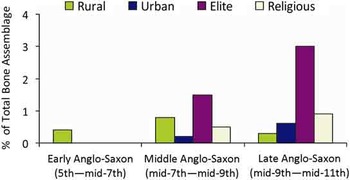
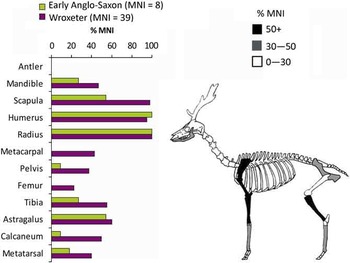
In his History of the English People Bede suggested that, following the departure of the Romans, hunting became vital as a subsistence strategy as ‘the whole land was left without food and destitute except for such relief as hunting brought’ (Bk 1, 12); however, his claim is not entirely supported by the zooarchaeological record.Footnote 11 Whilst some ‘Dark Age’ sites do suggest that wild animals were exploited to a greater degree than in the Roman period, overall their remains are rare on settlements that date from the fifth to the mid-seventh centuries (fig 1).Footnote 12 And where wild animals are present, their remains do not generally appear to represent food waste: most bones and teeth seem to have been viewed as ‘objects’ in their own right, often being incorporated into human burials and cremations, perhaps as amulets.Footnote 13 In the few instances where deer were seemingly hunted and eaten, such as at West Stow (Suffolk), the assemblages show an over-representation of meat-bearing bones, with heads and feet being present only in low frequencies (fig 2: here heads are represented by the jaw bone because skulls do not preserve well and are recorded inconsistently by zooarchaeologists). This body-part pattern is consistent with a logical, functional approach to hunting whereby deer carcasses were dressed in the field with ‘low-utility’ portions discarded at the kill-site. Certainly there is no evidence for the kind of ‘unmaking’ rituals seen in the later medieval period, although this is not to say that no rituals existed, and there is little to suggest that venison distribution and consumption were used as mechanisms for social differentiation; for instance, the recently studied red- and roe-deer assemblage from the palatial complex at Wroxeter (Shropshire) exhibited almost identical anatomical patterning to that seen on lower-status sites.Footnote 14 To this extent the zooarchaeological evidence may indicate that hunting was undertaken, as Bede suggests, during times of need as a form of ‘risk buffering’.Footnote 15 Whatever the case, hunting was clearly not common practice until at least the seventh century, when the zooarchaeological record shows an increased representation of game mammals, particularly on rural and elite settlements.
Variation in the representation of game mammals – red deer, roe deer, wild boar, hare – on sites of different type, from the fifth to the mid-eleventh century, as a percentage of the total bone assemblage, excluding fish. Graph: author

Relative frequency of body parts of deer (red and roe) recovered from Early Anglo-Saxon period sites, shown as a percentage of the minimum number of individuals (MNI). Graph: author

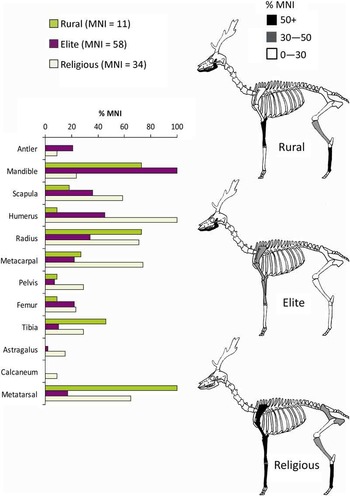
That the remains of game animals are comparatively more abundant on high-status sites of Middle Anglo-Saxon date suggests that hunting was beginning to gain clear elite associations, the new kings and princes perhaps employing the hunt as a mechanism for social display. The possibility that hunting was becoming less an act of subsistence and more a social performance is also indicated by the deer skeletal representation data. Figure 3 shows a dramatic shift away from the functional, uniform patterns of the Early Anglo-Saxon period to a complex situation of inter-site variation that cannot be explained in purely economic terms. For instance, the anatomical patterning for elite sites contradicts what might be ‘expected’ for a high-status residence. Rather than containing large quantities of meat-bearing bones, the deer assemblages from sites such as Ramsbury (Wiltshire) and Wicken Bonhunt (Suffolk) are dominated by heads (again, here represented by the mandible).Footnote 16 Meat-bearing elements, particularly from the hind-limb, are noticeably under-represented. It seems unlikely that this is an artifice of preservation, recovery or identification because many of the ‘missing’ elements – in particular, the metapodia, humerus, radius and tibia – not only have high structural density (so preserve well and are resistant to fragmentation) but are also highly identifiable. As such, their poor representation in elite assemblages would appear to be genuine, indicating that these particular elements were discarded elsewhere.
Relative frequency of body parts of deer (red and roe) recovered from Middle Anglo-Saxon period sites, shown as a percentage of the minimum number of individuals (MNI). Graph: author

With this in mind, it is interesting to note that assemblages from religious sites show a contrasting pattern, with an abundance of meat-bearing bones from the fore-limb, a large number of foot bones but very few mandibles. Again, however, meat-bearing elements from the hind limb are poorly represented, the scarcity of the durable tibia suggesting that the pattern reflects actual absence rather than preservation bias. Clues to the whereabouts of the missing haunches are provided by the skeletal data for rural settlements, which highlight the tibia as one of the best-represented elements, the high frequency of metatarsi also indicating presence of the lower hind-limb. Bones of the lower fore-limbs (notably the radius) are also comparatively well represented.
Whilst these site-specific anatomical patterns are clear to see, understanding their meaning is an entirely different matter. One compelling explanation is that the zooarchaeological data are reflecting meat redistribution, a practice whereby slaughtered animals are butchered and specific parts of their body are given to particular individuals or groups. Such traditions are common in modern pastoral societies, especially where the concept of meat retail is absent and so the easiest way to utilize the considerable amount of meat produced by a single carcass is to share it out, most often during a communal feasting event.Footnote 17 The possibility that a similar tradition was established in Middle Anglo-Saxon England should come as no surprise given that the period’s economy was based on the accumulation and redistribution of food rendered through different forms of ‘hospitality’.Footnote 18 The fine details of how the system operated are unclear, but there is sufficient textual evidence to indicate that landholders were paid in kind for the use of their land, with portions of these food renders given over to support kings and their court as they toured their kingdoms. Kings could, in turn, transfer accrued provisions to religious institutions that, unlike the itinerant royal court, were stationary and depended on supplies gravitating towards them.Footnote 19 Lower down the social scale, estate workers could expect to receive food payments in return for their services.Footnote 20
An arrangement of this kind would certainly account for the deer body-part patterns shown in Figure 3. The skeletal distribution for religious houses suggests that ecclesiastics were taking receipt of pre-butchered venison shoulders, and it is feasible that these were given by the king or local nobility in return for pastoral care. The over-representation of heads on elite sites finds resonance with the practices of modern hunting and pastoral societies, where crania are frequently conferred with special significance: amongst the Ngarigo of Australia and NgTurkana of Kenya, for instance, crania are seen as representing the animal in its entirety, and are either claimed by the head of the community or returned to the individual who ‘donated’ the animal for consumption.Footnote 21 For Middle Anglo-Saxon England, there is some evidence that the preponderance of crania on elite sites is seen not only for deer but also for domestic animals: the cattle, sheep and pig assemblages from Portchester Castle (Hampshire), Ramsbury and Wicken Bonhunt all show an over-representation of head bones.Footnote 22 Cattle crania are particularly abundant at the earlier (sixth/seventh century) royal site of Yeavering, where the famous ‘skull stack’ was interpreted as feasting waste.Footnote 23 Similar ‘special’ deposits of cattle, caprine and pig skulls are rare for the Middle Anglo-Saxon period and, in general, anatomical patterning for domestic animals lack the inter-site variation exhibited by deer assemblages. This is probably because livestock meat, although a desirable premium food, would have been eaten in a variety of social situations, so blurring the anatomical signature. Venison, by contrast, as a product of the hunt is more likely to have been divided and consumed in a restricted range of contexts (notably feasts) following particular sets of rules.Footnote 24 As such, deer assemblages provide more tangible evidence for social performance and, if considered alongside anthropological data, they offer clearer insights into the meaning behind the actions.
Even a cursory examination of the anthropological literature demonstrates that the feast-time meat redistribution represents more than the simple allocation of nutrition; the breaking of an animal’s carcass and the sharing of its meat are acts laden with rhetoric.Footnote 25 Communal consumption is an expression of group ideology and identity; however, because an animal’s carcass comprises portions of varying (perceived) value, the giving and receiving of meat often plays an important socio-political role, with cuts of different ‘quality’ being given to individuals as a meaty symbol of their status, gender, wealth or power.Footnote 26 If, as it seems, heads were deemed to represent high status in the Middle Anglo-Saxon period, the lower-limb bones recovered from rural sites may reflect the lower social position of these settlements and their occupants.
Nevertheless, it is important to recognize that the inhabitants of these rural sites had a position within a community, something that was of fundamental importance in Anglo-Saxon society: according to Magennis, Old English literature is preoccupied with the concept of community and frequently uses the imagery of the hall to express ideas about the maintenance of social order and rule.Footnote 27 Admittedly, Magennis’s study focused on Late Saxon texts, but if the minds of the Middle Anglo-Saxon population were similarly occupied with thoughts of community, their concerns could have been met in a very potent way through the public breaking and redistribution of meat. The coming together in a hall for the collective consumption of a single animal would have bound the participants together whilst simultaneously defining their social positions through the allotment of specific portions. Certainly this is true of the modern NgTurkana, for whom ‘the identity of participants at meat feasts is based on the interpretation of ordered rules, and since the format is religiously followed, the community maintains control over its members and ensured perpetuity of its identity’.Footnote 28
Symons has argued that the division of food goes hand in hand with the division of labour and others have shown that acceptance of a portion invariably carries an obligation of reciprocity, be it the requirement to return hospitality or to carry out specific duties.Footnote 29 In both early medieval Wales and Ireland, meat was redistributed according to social role and it is reasonable to assume that the same was true in England, especially since Old English texts refer to people having to ‘earn their mead’.Footnote 30 The idea that meat was a currency of social obligation supports Marvin’s suggestion that meat redistribution was the food-based equivalent of the gift-giving that took place within the hall, where retainers pledged service to their lord or king in return for weapons and treasure. Generosity in gift-giving was deemed to be the mark of a good leader and it seems likely that open-handedness was desirable in terms of food as well as material goods. Indeed, the importance of the leader as a supplier of sustenance is indicated by the etymology of the word ‘lord’, which has been traced to ‘hlafweard’, or ‘loaf-keeper’.Footnote 31
In a situation where the control and redistribution of foodstuffs is equated with power and authority, it stands to reason that the knives used for cutting up and sharing may also have become iconic as symbols of the distribution process. Härke’s study of Anglo-Saxon grave goods has shown that knives are the most common object found in fifth- to eighth-century burials of males and females of all ages.Footnote 32 To some extent their ubiquity is unsurprising, since knives are utility tools and were presumably owned by all members of society, employed to assist with daily tasks and for use in dining. That said, age- and sex-based variation in knife size (Härke has shown that only adult men were accompanied by knives with a blade in excess of 128mm) suggests that these implements had more than a utilitarian function, perhaps playing a role in social display. This is corroborated by the prominent position in which they were worn, located on the belt where other items of display (such as combs and girdle hangers) were suspended.Footnote 33 Ethnographic parallels for sex-related variation in knife size are not difficult to find. For instance, Härke refers to the comparable situation of the Sami of Finland.Footnote 34 Likewise, Symons highlights the gender difference in knife use amongst the Aboriginal groups of Australia, where small knives are used by women in domestic settings but the knives of men are substantially larger, employed to great spectacle during the public distribution of meat resulting from kangaroo hunts.Footnote 35
The ownership and display of a large knife can be seen as a statement that the owner possesses both resources and the power/generosity to divide and redistribute them. It may be no coincidence, therefore, that where we see the appearance of deer body-part patterns indicative of meat redistribution, we also see the emergence of a fashion for wearing long knives. According to Härke, knives with a blade length in excess of 130mm are rare for much of the Early Anglo-Saxon period but are found regularly in the seventh and eighth centuries. Links between large knives and hunting are provided by the seax – a single-edged knife or short sword, some examples of which exhibit highly decorated blades, more suggestive of ceremonial than functional use.Footnote 36 The chronological distribution of the seax is identical to that of other long knives but, importantly, it also mirrors the increased representation of wild animals on rural and, in particular, elite sites.Footnote 37 When considered in conjunction with the deer body-part data and anthropological evidence, there is a strong supporting case for Gale’s suggestion that, rather than being a weapon of war, the seax was principally a hunting tool, employed for the ritual dispatch and unmaking of the quarry.Footnote 38 Evidence from both anthropology and later medieval texts suggests that these ceremonial hunting tasks would have fallen to the highest-ranking individuals among the party; it is fitting therefore that, as grave goods, seaxes are found almost exclusively with elite males.Footnote 39 Graves of high-ranking males also contain the greatest proportion of drink vessels which, Härke suggests, may symbolize hospitality and the feast.Footnote 40 As a tool of division and redistribution, the seax may have carried similar connotations, perhaps gaining added significance from its use in hunting which would have invoked concepts of landownership.
Hunting and land-rights are inextricably linked; just as venison was carved up and redistributed as a currency of social obligation, so too was the land.Footnote 41 Through the course of the Middle Anglo-Saxon period, territories were increasingly ceded to the Church and lay lords, who in turn leased smaller parcels of land in return for service.Footnote 42 Unlike meat, however, the giving of land is unsustainable. Although attempts were made to ‘recycle’ land, by granting it for a limited period (usually between one and three lifetimes only), multiple estates were gradually broken into smaller and smaller pieces.Footnote 43 As land and power were carried permanently into the hands of the emerging thegnly class, this set in motion the transformation of Anglo-Saxon society, evidence for which is also clear in the zooarchaeological record.
The closing of the Anglo-Saxon period
Several scholars have introduced ‘closure theory’ as a way of explaining the social changes of the later medieval period, but the idea that exclusionary rules developed in response to a shift in world image seems equally applicable to Late Anglo-Saxon England.Footnote 44 In many respects the widespread social, economic, political and landscape transformations observed for the ninth to the eleventh centuries are consistent with ‘formal rationalization’, the dynamic process of social change created through the pursuit of mastery over nature and other people.Footnote 45 Through this process the exclusionary rules of ‘traditional society’ (usually linked to the collectivity within which one was born) become replaced by more individualist criteria, based on the achievement and demonstration of material goals.Footnote 46 Although social theorists would, no doubt, baulk at the application of this concept to the early medieval period, the society of Late Anglo-Saxon England does demonstrate traits typical of social closure. For instance, the ninth-century proliferation of wills and charters suggests a growing concern with property and with the individual’s possession of objects, land and resources. That resource ownership, rather than connections to the king, was beginning to mark social position is also clear and may explain the rise of the so-called ‘thegnly culture’, with its exclusionary rules based on wealth display, particularly through the media of food, textiles and architecture.Footnote 47
Hunting can be seen as the nexus that would have connected many of the thegns’ most pressing priorities (landownership, resource control and power-display) and in the socio-political climate of Late Saxon England it is perhaps unsurprising that hunting became a defining marker of elite identity. Ælfric Bata’s colloquies refer to hunting as an activity of ‘kings and great men’ and Asser repeatedly mentions Alfred’s hunting skills, presumably as a widely understood metaphor for the king’s wider merits.Footnote 48 Zooarchaeological evidence supports the idea that the Late Anglo-Saxon period saw hunting become an activity symbolic of the social elite: Figure 1 shows how the representation of game animal doubles on high-status settlements but drops by more than half on rural sites, perhaps suggesting that the peasant’s hunting rights were beginning to be curbed.Footnote 49 Undoubtedly the lower classes were still involved with hunting, but their role within the hunt seems to have moved from centre to periphery as they became the faceless supporting cast for the elite stars – the lords and their well-rewarded professional huntsmen.Footnote 50 Frequently within Late Saxon texts there are references to the peasant’s hunting duties. Bishop Oswald required his tenants to send ‘hunting spears to the chase whenever the lord bishop wishes’ and the Domesday Book records that the citizens of Hereford, Shrewsbury and Berkshire were obliged legally to act as drivers.Footnote 51 By the Late Saxon period, hunting was, for most people, a chore rather than a pleasure and, although it would still have brought communities together, the purpose seems to have been less a performance of group identity and more a display of individual (royal or thegnly) power, the hunt demonstrating the elite’s ability to muster resources and manpower.
Elite anxiety about the monopolization of hunting rights and resources is increasingly apparent in Late Anglo-Saxon texts. Whereas in the previous period perceptions of game had followed the Roman concept that, until caught, wild animals were res nullius (property of no one) and could be chased freely across the landscape, the Late Anglo-Saxon period saw the establishment of exclusionary rights over both wild animals and the landscape.Footnote 52 These are made explicit in article 80 of Cnut’s laws (ad 1018) in which he stated that ‘it is my will that every man shall be entitled to hunt in the woods and fields of his own property’ but that ‘everyone, under pain of incurring the full penalty shall avoid hunting on my preserves’.Footnote 53 In these few lines, not only is the relationship between landownership and hunting articulated, but there is also an indication that hunting landscapes were becoming socially exclusive. Recently it has been suggested that this exclusion took the form of park creation.Footnote 54 The possibility that parks existed in pre-Conquest England remains controversial but there is sufficient documentary and place-name evidence to be certain that areas, such as the siluis uenationibus, ‘woods for hunting’, in Grimley (Worcestershire), were set aside for wild animals;Footnote 55 indeed, it is possible that woodland was allowed to regenerate specifically for aristocratic hunting.Footnote 56
Thegnly investment in hunting landscapes is indicated by the large numbers of place-names including the element haga (enclosure) and haie (hedge), often found associated with woodland and specifically mentioning deer – as in the haiae capreolis, ‘hays for taking roe deer’, in Cheshire and Shropshire and the derhage, at Ongar, in Essex.Footnote 57 These features were clearly deemed to be elite assets, with estate workers being required to make and maintain them on behalf of their lord or king – the duty is mentioned by Bishop Oswald in his letter to King Edgar (c 963–72) and is set out in the Rectitudines Singularum Personarum (c 1000).Footnote 58 Liddiard has highlighted the similarity between these obligations and the manorial labour services of the later medieval peasants, who were required to maintain the pales of their lords’ parks. However, we should perhaps be wary of applying identical interpretations to these temporarily disparate landscapes.Footnote 59 Even where there is continuity in the enclosures named haga before 1066 and ‘parks’ in the post-Conquest period (as has been shown for Ongar) the same spaces would have been very different places, Anglo-Saxon enclosures lacking the fauna (fallow deer, pheasants and peafowl) that typified the later medieval parks – for while Hough has recently used place-name evidence to claim that fallow deer were established in Anglo-Saxon England, the etymological argument is weak and is not supported by the zooarchaeological evidence.Footnote 60 Regardless of whether Anglo-Saxon England possessed parks per se, it does seem likely that, as with later medieval parks, haga and haie served as symbols of social division, demarcating aristocratic land and access to resources.
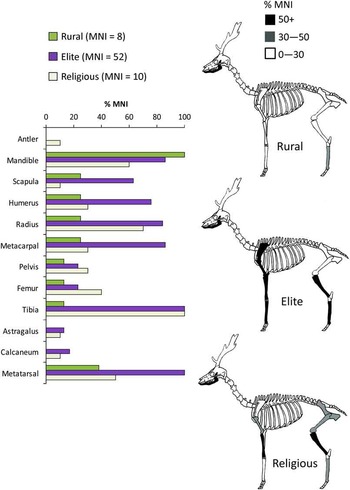
Practices of food distribution and consumption tend to mirror processes of procurement, so the Late Saxon ‘closure’ of both hunting landscapes and the hunt itself is likely to have been reproduced in the distribution and consumption of venison.Footnote 61 Certainly the skeletal representation data for Late Saxon deer assemblages suggest a change in the treatment of deer carcasses. Figure 4 demonstrates less inter-site variation in deer body-part patterns, particularly when assemblages from elite settlements and religious houses are compared. Indeed, the similarity in the skeletal profiles for these site types reinforces the well-known problems of differentiating between the secular and the ecclesiastical in this period.Footnote 62 In sharp contrast to the preceding period, the anatomical profile for elite sites (such as Faccombe Netherton and Portchester Castle in Hampshire and the Cheddar Palaces in Somerset) shows a good representation of most body parts, the meat-bearing elements and feet being equally abundant.Footnote 63 From this it may be conjectured that deer were brought back to high-status settlements complete, where they were then butchered, consumed and their remains discarded – there is little evidence that portions were redistributed or given away. The only element that is less abundant than might be expected is the mandible, previously the signature of high-status assemblages. Interestingly, body-part patterns for domesticate assemblages from elite sites also show a decline in jaw representation, suggesting that practices of carcass distribution may have changed at a wider level. This is seen particularly at Flixborough. In the assemblages from the site’s earliest phases of occupation (phases 2–3b, dating from the seventh to the early ninth centuries) cattle, sheep/goat and pigs are represented by little other than jaw bones, but the deposits of later date (phases 4–6iii, from the ninth to eleventh centuries) contain far higher frequencies of post-cranial and, in particular, meat-bearing bones.Footnote 64 Returning to deer, Figure 4 shows that the reduced representation of jaws on elite sites is compensated by a rise in their frequency on rural settlements.Footnote 65 Meat-bearing bones are scarce in assemblages from rural sites which, together with the overall reduction in game representation seen for lower-status settlements (fig 1), hints that the peasants were being excluded from hunting culture and, presumably, also from the halls where venison was divided and consumed. True, the sample size for lower-status settlements is low (table 1) but a more extensive zooarchaeological study, currently being undertaken by Poole, supports the idea that low-status exploitation of wild resources fell by half between the Middle and Late Anglo-Saxon periods.Footnote 66
Relative frequency of body parts of deer (red and roe) recovered from Late Anglo-Saxon period sites, shown as a percentage of the minimum number of individuals (MNI). Graph: author

Exclusion of the peasantry from the aristocratic world is suggested by the character and layout of Late Saxon elite settlements. By contrast to high-status sites of the Middle Anglo-Saxon period, evidence for agricultural and industrial processing is absent, suggesting that these activities had been pushed outside the physical boundaries (ditches, fences and hedges) that now defined royal and thegnly residences, separating these arenas of elite consumption from the surrounding landscape of rural production.Footnote 67 Privatization of the Late Saxon hall is also alluded to in Old English literature, for although poetic texts focus on ideals of community, Magennis has demonstrated that depictions of the hall are overwhelmingly aristocratic in nature and show little interest in the lower social echelons or the world beyond the hall.Footnote 68 Whilst it should be expected that elite activities will always figure large in ‘high’ literature, when viewed in conjunction with the zooarchaeological data it seems possible that the social exclusion evident in the texts may reflect more than a literary tradition. The idea that halls were gradually ‘closed’ through the course of the Saxon period is supported by Gautier’s recent study of Anglo-Saxon feasting, which concluded that the activities of the hall became less accessible and more hierarchical during the Late Saxon period.Footnote 69 These changes were seemingly concomitant with wider transformations in the system of food renders; by the tenth and eleventh centuries many food rents had been commuted for cash payments, so releasing landlords from the responsibility of hospitality and the public feasting it entailed.Footnote 70 As the market economy developed, the functional necessity of communal feasting as a mechanism for meat redistribution would have been reduced as aristocratic households could obtain meat as required, rather than having to eat up the glut received at particular times of the year, such as at Martinmas.Footnote 71 More importantly, the need for feasting as a performance of social obligation and community order would also have diminished because, by the Late Anglo-Saxon period, everyone knew their place and their duties – these were laid out formally within such charters and documents as the Geþyncðo and the Rectitudines Singularum Personarum.
It is interesting to note, too, that there is less tangible evidence for the symbolic significance of the knife in the period when food rents and meat redistribution were abandoned in favour of monetary exchange. Although this is presumably an artifice created by the decline of the weapon-burial rite, Owen-Crocker has highlighted the fact that knives are rarely depicted in Late Saxon art.Footnote 72 For instance, although dress is illustrated in great detail in the Bayeux Tapestry, knives are not shown as being part of the attire and they do not hang from the belt, where they might be expected. In the tapestry, the only clear depictions of knives are in the scene of the Normans’ meal, where three are shown laid at table, perhaps suggesting knives were beginning to be viewed as cutlery rather than personal appendages. Another indication that the ‘cutting up’ culture of the Middle Anglo-Saxon was on the wane is provided by the decline of the seax, which fell out of fashion during the tenth century, possibly indicating that the ‘loaf-keeper’s’ ability to provide and redistribute resources in general and meat in particular was less of an issue now that power was displayed through social exclusion and personal possessions.
Discussion And Conclusion
Food, landscape and social order are inextricably linked and their complex inter-relationship, although articulated in many different ways, is expressed very eloquently through hunting and the redistribution and consumption of venison. These symbolic, ritualized actions are, essentially, performances of a world view and, because they leave distinct patterns in the zooarchaeological record, animal-bone studies offer one of the best opportunities to understand the structure and ideology of the societies responsible for their creation.
For the Anglo-Saxon period, the zooarchaeological data show clear evidence for temporal changes in social practice, evidenced by inter-site variations in both the level of wild animal exploitation and the methods by which deer carcasses were treated. Between the fifth and seventh centuries, hunting does not seem to have carried great social cachet and may have been undertaken as a risk-buffering strategy rather than as a method for acquiring prestige foods. Indeed, the idea that venison was not considered a ‘luxury’ in the Early Anglo-Saxon period is supported by the evidence from sites such as Yeavering, where the preponderance of cattle skulls suggests that social display was based on the feast-time redistribution of meat from domestic, rather than wild, animals. This conforms to the anthropological observations made by Goody, who argued that in ‘hieratic’ societies (those lacking institutionalized forms of social ranking) episodes of conspicuous consumption are based on the usual fare, just eaten in far greater quantities.Footnote 73 On the basis of anthropological evidence, it also seems likely that the redistribution of meat from domestic animals would have played an important role in social structuring, helping to define age, gender and power relations.Footnote 74
It may be assumed that, as in modern-day pastoral societies, public feasting in the Early Anglo-Saxon period was a male-orientated form of display. This paper has focused particularly on the role of men in food redistribution but, for future studies, food allocation as a female-centred social action would be a subject worthy of exploration.Footnote 75 Within the domestic setting, for instance, responsibilities for breaking carcasses and sharing meat are more likely to have fallen to women, perhaps explaining the high incidence of knives in female burials and possibly even accounting for the strong association between women and Style 1 art, which is characterized by disarticulated animals.Footnote 76
Whilst in the domestic realm women may have been involved in the distribution of meat from cattle, sheep/goat and pig, this is less likely to have been the case for wild animals – it has been shown repeatedly that, in pastoral societies, hunting and the public redistribution of venison are male domains.Footnote 77 Given this association between hunting and masculinity, it is interesting that the Middle Anglo-Saxon increase in wild-animal exploitation and the appearance of deer skeletal patterns indicative of meat redistribution are coincident with the emergence of a male fashion for wearing large knives, especially the seax which has been linked specifically to hunting. This would seem to suggest that venison was becoming something of a ‘luxury’ foodstuff, with male prestige being constructed and communicated through its procurement and distribution, social performances that the knife came to symbolize. According to Goody, the very concept of luxury suggests the emergence of an elite subgroup; but the fact that deer bones are found on Middle Anglo-Saxon sites of both high and low status suggests that, between the seventh and ninth centuries, venison was not socially exclusive, but rather a veneer of egalitarianism was maintained through the actions of cutting up and sharing.
When the zooarchaeological data and the evidence for knife symbolism are combined with the documented Anglo-Saxon tradition of gift-giving, in which treasure, weapons and land were handed out in return for service, the overriding impression is that redistribution permeated every aspect of Middle Anglo-Saxon culture. Organization of the economy, landscape and community, from the highest to lowest social position, all were negotiated and structured through acts of giving and receiving. Redistribution was the mechanism by which community was ordered and controlled. Ultimately, however, power derived from giving is unsustainable, especially where resources, in particular land, are redistributed on a permanent basis.
The carving-up and redistribution of the multiple estates led inevitably to social change and from the ninth century onwards a new concern with self-sufficiency and the retention, rather than ‘sharing’, of possession is apparent in the archaeological and historical record. Gone is the tangible evidence for meat redistribution: deer body-part patterns provide no indication of venison sharing and the large male knives and seaxes, so symbolic of the acts of cutting up and allocation, become scarce. Instead we see the rise of exclusivity and a shift in wild-animal representation through the decline of game on rural sites, but the dramatic rise on settlements of high status, suggesting privatization and elite monopolization of the landscape and its resources. These are traits consistent with ‘social closure’ and, whilst the application of this theory to early medieval society may seem inappropriate, its relevance is suggested by the tone of some of the Late Saxon texts, for instance the apparent anxiety about the moral status of the country’s elite: this, together with the resurgence of monastic asceticism, is a typical reaction to capitalism and the process of social closure.Footnote 78
It has long been recognized that, between the fifth and eleventh centuries, Anglo-Saxon society underwent remarkable political and economic transformation. The discussion in this paper has, therefore, hardly covered new ground. However, what it has shown is the contribution that animal bone studies can make to our understanding of social (as opposed to purely economic) structure and change, especially when zooarchaeological data are combined with other sources of information. Indeed, perhaps the most important aspect of this paper is that it has highlighted the inter-connected relationship between people, land and their food. Any one of these themes can be examined as a proxy measure for understanding developments in the others but, taken together, this tripartite approach has considerable potential to enhance our understanding of social dynamics.
Acknowledgements
I am indebted to my many zooarchaeological colleagues who have so kindly provided me with their unpublished data. Special thanks go to Andy Hammon, Sheila Hamilton-Dyer, Pam Crabtree and Kristopher Poole – the last two also commented upon an earlier version of the text and I am grateful for their comments. David Hinton provided invaluable feedback on the first draft, including the provision of a copy of Gale’s article. I gratefully acknowledge both the University of Nottingham and the AHRC who funded the period of leave in which this paper was researched and written up. Finally my thanks go to this Journal’s anonymous reviewers, one of whom made me aware of Anne Williams’s 2008 publication, for which I am very grateful.