When one is in love, one always begins by deceiving one's self, and one always ends by deceiving others. That is what the world calls a romance.
Oscar Wilde (1890), The Picture of Dorian Gray
Although lying has a negative stigma and is largely denounced, it is a prevalent feature of everyday life (DePaulo, Kashy, Kirkendol, Wyer, & Epstein, Reference DePaulo, Kashy, Kirkendol, Wyer and Epstein1996; Gordon & Miller, Reference Gordon and Miller2000; Tosone, Reference Tosone2006). Interpersonal deception is a nearly universal human behavioural pattern that seems to emerge at an early age (Sodian, Reference Sodian1991) and persist throughout adulthood (DePaulo et al., Reference DePaulo, Kashy, Kirkendol, Wyer and Epstein1996). Despite widespread encouragement to be honest, and cultural sanctions against deception, people often engage in lying and other forms of deception. In one study, people reported telling an average of two lies each day (DePaulo et al., Reference DePaulo, Lindsay, Malone, Muhlenbruck, Charlton and Cooper2003). People deceive and tell lies to all manner of people, including close acquaintances, dating partners, and spouses (DePaulo, Reference DePaulo2009).
Taken broadly, deception can be defined as ‘a successful or unsuccessful deliberate attempt, without forewarning, to create in another a belief which the communicator considers to be untrue’ (Vrij, Reference Vrij2008, p. 15). These attempts to create false beliefs in others range from outright lies to omissions (DePaulo et al., Reference DePaulo, Kashy, Kirkendol, Wyer and Epstein1996; Vrij, Reference Vrij2000). Reasons for lying vary as well (Vrij, Reference Vrij2008). Some deceit is exercised as an act of self-preservation, in order to spare embarrassment, avoid punishment, or conceal transgressions (Vrij, Reference Vrij2000) Alternatively, some deception is not self-oriented, but is motivated by more prosocial goals, such as the protection of another individual's feelings (DePaulo et al., Reference DePaulo, Lindsay, Malone, Muhlenbruck, Charlton and Cooper2003; DePaulo & Kashy, Reference DePaulo and Kashy1998; Kaplar & Gordon, Reference Kaplar and Gordon2004; Tosone, Reference Tosone2006). These benevolently focused lies are not malicious in nature (Watt, Reference Watt2008, p. 44), and facilitate or improve social functioning, limiting the potential for interpersonal tension and social awkwardness (Tosone, Reference Tosone2006, p. 336).
Lies vary in their magnitude, from the relatively innocuous everyday lies to more serious lies (DePaulo et al., Reference DePaulo, Kashy, Kirkendol, Wyer and Epstein1996; DePaulo, Ansfield, Kirkendol, & Boden, Reference DePaulo, Ansfield, Kirkendol and Boden2004). Many everyday lies are seemingly harmless to the receiver and are told for the sake of the lie-teller's impression management (Goffman, Reference Goffman1959) and self-presentation (DePaulo et al., Reference DePaulo, Kashy, Kirkendol, Wyer and Epstein1996). Cultural norms begin to influence and shape dialogue with others from a very early age, and people learn to exercise sensitivity and discretion in what they disclose to others (Watt, Reference Watt2008). This discretion can sometimes involve deceit in order to comply with social standards (Asch, Reference Asch1955). In some cases, overly honest deviations from social norms can ironically be viewed as suspicious or deceptive (Bond et al., Reference Bond, Omar, Pitre, Lashley, Skaggs and Kirk1992). Everyday lies are usually told with a lower frequency in close relationships than in less intimate relationships (DePaulo & Kashy, Reference DePaulo and Kashy1998). On the other hand, people are more apt to tell serious lies within the context of close relationships in order to conceal relational misdeeds and transgressions (DePaulo et al., Reference DePaulo, Ansfield, Kirkendol and Boden2004). People who were asked to recall lies told by their romantic partner often reported a serious lie, such as infidelity, rather than everyday lies (Kaplar & Gordon, Reference Kaplar and Gordon2004). When people in relationships discover serious deceit by their partners, the reaction can be severe, sometimes resulting in dissolution of the relationship (DePaulo et al., Reference DePaulo, Ansfield, Kirkendol and Boden2004; Kaplar & Gordon, Reference Kaplar and Gordon2004). When lies are told to conceal transgressions within close interpersonal relationships, they are often perceived as reprehensible, and consequently often lead to difficulty in restoring trust (Schweitzer, Hershey, & Bradlow, Reference Schweitzer, Hershey and Bradlow2006).
Due to the negative interpersonal consequences of serious lies, people value honesty within relationships. Boon and McLeod (Reference Boon and McLeod2001) found that most people believe that total honesty is an important and virtuous component of romantic relationships; however, it should be noted that fewer than 30% of their participants felt honesty was absolutely vital for a successful romantic relationship. In addition, 65% of individuals viewed the importance of honesty as more situational, and participants preferred to lie to their partner if the deception would prevent relationship damage or if it would increase their partner's self-esteem (Boon & McLeod, Reference Boon and McLeod2001). Thus, how honest or deceptive one is with their romantic partner at any point seems to hinge on whether their honesty or deception will benefit the receiver or benefit the relationship. In other research, Steen (Reference Steen2003) found that when people describe themselves to prospective dating partners, honesty is frequently listed as one of their central character traits. Steen also found that people typically list honesty of their romantic partner as a significant contributing factor in successful romantic relationships. These results seem to suggest that honesty is a valued trait in romantic relationships.
Despite the premium placed on honesty in relationships, deception in romantic relationships is commonplace. DePaulo and Kashy (Reference DePaulo and Kashy1998) found that people lied in 30% of their interactions with romantic partners and in 10% of interactions with spouses. Guthrie and Kunkel (Reference Guthrie and Kunkel2013) found that, on average, people deceived their romantic partners five times per week, and the deceit was most often intended as a strategy for avoiding fights and unwanted reactions. While the closer and more intimate relationships are associated with lower levels of lying (Williams, Reference Williams2001), Knox, Schacht, Holt, and Turner (Reference Knox, Schacht, Holt and Turner1993) reported that 92% of college students lied to their current sex partners. Similarly, Saxe (Reference Saxe1991) found that 85% of college students reported lying to their partners, and almost half of those lies were about some form of infidelity. Interestingly, many of Saxe's participants excused their lies by reasoning that they were protecting their partners’ feelings. Metts (Reference Metts1989) also found that protecting a partner's feelings was the most common justification for using deception in romantic relationships. Other researchers have suggested that most commonly told lies within romantic relationships are altruistic or white lies (DePaulo & Kashy, Reference DePaulo and Kashy1998; Peterson, Reference Peterson1996).
White lies are deliberate attempts to mislead for the purpose of protecting another person (Linskold & Walters, Reference Lindskold and Walters1983). White lies are viewed as the most acceptable type of deception to use in intimate relationships (Peterson, Reference Peterson1996). Furthermore, white lies are thought to be beneficial to a relationship, while other types of lies, such as self-serving distortions, blatant lies, half-truths, and omissions, are considered more harmful to relationships (Peterson, Reference Peterson1996). Kaplar and Gordon's (2004) research expanded on the justification of benevolent deception such as white lies, suggesting that despite widespread disapproval of lying in general, benevolent deception is often perceived as appropriate in order to prevent suffering on behalf of a romantic counterpart. They also noted, however, that lie-tellers viewed the white lies as more helpful than lie-receivers in most cases (Kaplar & Gordon, Reference Kaplar and Gordon2004). The mismatch in perceptions of virtuousness between the lie-tellers and lie-receivers is perhaps an example of moral hypocrisy (Batson & Thompson, Reference Batson and Thompson2001; Batson, Thompson, Seuferling, & Strongman, Reference Batson, Thompson, Seuferling and Strongman1999). That is, people often have a double-standard in which they judge themselves less harshly for moral transgressions than they judge others for engaging in the same moral violation.
Kaplar (Reference Kaplar2006) investigated the role of altruistic lies within romantic relationships. She constructed the lying in amorous relationships scale (LIARS) to measure participants’ attitudes towards telling altruistic lies in romantic relationships. The results revealed that people generally held open attitudes about using altruistic deception with a romantic partner; however, more positive attitudes toward deception were negatively correlated with relationship satisfaction (Kaplar, Reference Kaplar2006). It should be noted that Kaplar's study addressed only the participants’ attitudes about being the lie-teller in the relationship, not their attitudes about being the receiver of altruistic deception from their romantic partners.
Several researchers have examined gender differences in deception. DePaulo et al. (Reference DePaulo, Kashy, Kirkendol, Wyer and Epstein1996) found that while men and women did not differ in the frequency with which they lied, men were more likely to engage in self-oriented lies, while women were more likely to engage in altruistic or other-oriented lies. DePaulo and Bell (Reference DePaulo and Bell1996) also demonstrated a pattern of women telling more altruistic lies than men do. Furthermore, Saarni (Reference Saarni1984) found that the tendency for females to tell more altruistic lies than males was already present in young children. In contrast to those previous findings of gender differences, Kaplar (Reference Kaplar2006) found no such gender differences in attitudes about benevolent deception in relationships.
The current study was designed to expand on this previous research by exploring participants’ attitudes towards altruistic deception within romantic relationships as both the teller of lies and also as the receiver of lies. Based on prior research on altruistic deception, we predicted that people would endorse some altruistic deception in romantic relationships, both as the lie-teller and as the lie-receiver. However, based on previous investigations of moral hypocrisy, we predicted that individuals would report significantly more acceptance of deception in romantic relationships when they were the lie-teller rather than the lie-receiver. Given the number of findings indicating that women are more likely to engage in benevolent deception, we predicted that women would be more tolerant than men of benevolent deception in romantic relationships, both as the lie-teller and as the lie-receiver.
Method
Participants
Participants were a convenience sample taken from both the general population and from the student body of a small southern university. Recruitment occurred through social media and email. There were 255 participants between the ages of 18 and 71 (M = 30.64, SD = 11.08). Of the participants, 100 were male (39%) and 155 were female (61%). All participants indicated ‘yes’ when asked if they were currently in a romantic relationship.
Materials
The survey was a 26-question online survey that asked participants about their preferences and attitudes about the use of altruistic deception within their romantic relationships. The survey included demographic questions, the Lying in Amorous Relationships Scale (LIARS; Kaplar, Reference Kaplar2006), and the Reversed LIARS scale developed by the researchers. The initial LIARS scale was 12 items that surveyed the lie-teller's preferences and attitudes about deceiving their romantic partners with altruistic white lies, asking the participants to rate statements such as: ‘There are some things my partner is better off not knowing’ and ‘I believe that lying to my romantic partner is the best thing to do if it means sparing him or her unnecessary pain’.
Responses were recorded on a 5-point Likert type scale where 1 = completely disagree, 3 = neutral, and 5 = completely agree. The Reversed LIARS scale was based on the original LIARS scale and was also 12 items. The Reversed LIARS scale surveyed the lie-receiver's perspective, asking participants to rate statements such as: ‘I see nothing wrong with my romantic partner lying to me as long as it is in my best interest’ and ‘I believe that it is better for my romantic partner to tell me a little white lie rather than risk hurting me by telling me the truth’. The Reversed LIARS scale was developed by taking each item from the original LIARS scale and rewording it to switch the respondents’ perspective from that of the lie-teller to that of the lie-receiver.
In Kaplar's (2006) original research, the LIARS scale demonstrated high internal consistency (α = .89) and test-retest reliability, r(74) = .91, p < .001. In the current study, the LIARS scale had high internal consistency reliability (α = .88), as did the Reversed LIARS scale (α = .88).
Procedure
Participants completed the survey online by following a link provided through social media or email. The survey was completed in approximately 10 minutes. Informed consent was obtained. Participants answered questions regarding demographics, then completed the LIARS scale and then the modified LIARS scale. No incentives were offered to participants.
Results
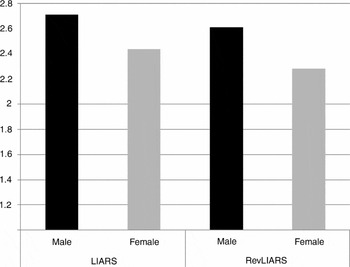
We analysed the data from the study using a mixed factorial ANOVA with participant sex as a between-groups factor and survey type (LIARS vs. Reversed LIARS) as a repeated measures variable. In support of our hypotheses, there was a significant main effect of survey type, with scores being significantly higher on the LIARS scale, M = 2.54, SD = 0.83, than on the Reversed LIARS scale, M = 2.41, SD = 0.82; F(1,253) = 16.67, p <. 001, partial eta squared = .062, indicating that participants were more supportive of telling lies than of being lied to by their romantic partners (see Figure 1). In contrast to our hypothesis on gender differences, there was a significant main effect of participant sex in the opposite direction that we had predicted, F(1,253) = 9.21, p = .003, partial eta squared = .035, with males more strongly endorsing benevolent deception, M = 2.66, SD = 0.83, than females, M = 2.35, SD = 0.80. As expected, there was no significant participant sex by survey type interaction, F(1,253) = 0.81, p < .370, partial eta squared = .003. There was a strong positive correlation between scores on the LIARS scale and scores on the Reversed LIARS scale, r(253) = .829, p < .001.
Mean values for males and females on both the LIARS scale and the Reversed LIARS scales.

Discussion
Our study was designed to explore people's attitudes about benevolent deception within romantic relationships. We found, as expected, that people are more supportive of deceiving their romantic partners than they are of being deceived by their partners. However, people generally held moderate attitudes about deception, whether they were the ones deceiving or the ones being deceived. Interestingly, we found that men, not women, were more accepting of benevolent deception in their romantic relationships, both as the deceivers and as the ones being deceived. Furthermore, we found that people's attitudes about deceiving their partners were highly correlated with their attitudes about being deceived by their partners.
The central finding in this study was that people exhibited moral hypocrisy in the domain of benevolent deception. People viewed their own deception as more justified and appropriate than their partners’ deceit. Moral hypocrisy seems to be prevalent across many domains of deception and other social processes (Batson & Thompson, Reference Batson and Thompson2001; Batson et al., Reference Batson, Thompson, Seuferling and Strongman1999; Gordon & Miller, Reference Gordon and Miller2000; Kaplar & Gordon, Reference Kaplar and Gordon2004), so it was not entirely surprising to find evidence of it within the context of deception in romantic relationships. Trivers (Reference Trivers2011) argued that people often use a self-deceptive process that alleviates the discomfort of moral hypocrisy. According to Trivers, people regularly and unknowingly convince themselves of false ‘truths’, such as the belief that they are honest, when in fact they are not telling the truth to others. He argued that self-deception is self-serving and can leave people unaware of their hypocritical behaviour. This self-deceptive process may account for the apparent moral hypocrisy in benevolent deception.
Perhaps the term ‘benevolent deception’ warrants further consideration. Trivers (Reference Trivers2011) argued that one consideration is that white lies and other forms of benevolent deception may not be entirely altruistic after all. It could be that people use benevolent deception as tools to shape their partners into people who they like and appreciate more. For example, by deceptively telling a partner that they are beautiful, smart, interesting, and so on, a person may shape their partner into the confident companion they wished to have. Also, seemingly benevolent deception may serve a self-serving goal of conflict avoidance. For instance, by deceptively telling a partner that they had a great time on a date, a person may avoid the conflict or tension that might possibly arise if they were honest. Or, in Saxe's (1991) research, people may convince themselves that lying about infidelity is being done to protect or spare their partners’ feelings. Thus, the term ‘benevolent deception’ may be debatable when probed more deeply.
Contrary to our expectations, we found that men endorsed more deception than women, both as the deceiver and as the receiver. Previous researchers had found that women were more likely to use benevolent deception than men (DePaulo & Bell, Reference DePaulo and Bell1996; DePaulo et al., Reference DePaulo, Kashy, Kirkendol, Wyer and Epstein1996; Saarni, Reference Saarni1984). Perhaps one explanation for our current results is that this study focused on deception within romantic relationships, whereas those previous studies examined benevolent deception in other social relationships. It might be that within the context of their romantic relationships women have a higher standard for honesty than they do in other types of relationships, whereas men might not.
One obvious limitation of this study was that we measured attitudes about deception and not actual deceptive behaviours. What people say they do in their relationships may not exactly match what they do in reality. Future studies examining benevolent deception during actual interactions between romantic partners might be more revealing. Another limitation in our methodology was that all participants completed the two scales in the same order. This could have resulted in an order effect. Another direction for future research should be to examine the relationship between a person's attitudes about benevolent deception and malevolent deception in romantic relationships. It would be interesting to reveal whether or not the attitudes about and practice of various forms of deception operate independently of each other. It would also be elucidative to explore how age, beliefs about their partners, relationship duration, attachment style, and relationship satisfaction interact with interpersonal deception in romantic relationships.
The results of this study suggest that most people are open to some degree of deception within their romantic relationships when the social motives are benevolent. Some studies have suggested that relatively minor forms of deception may be an important element for fostering harmonious relationships, avoiding conflict, and contributing to the overall accord of relationships (Vrij, Reference Vrij2000). DePaulo and Kashy (Reference DePaulo and Kashy1998) suggested that altruistic lies are, at times, received as compassionate offerings that nurture the relationship. However, there is also evidence that benevolent deception might be associated with fractures in relationships (Kaplar, Reference Kaplar2006). Specifically, Kaplar (Reference Kaplar2006) found that benevolent deception was negatively correlated with romantic relationship satisfaction. While these conflicting reports on the value or harm of benevolent deception in relationships leave much ambiguity, it does seem clear that people have less harsh attitudes about benevolent deception than they do about malevolent deception (Peterson, Reference Peterson1996). The participants in our study appear to be tolerant of some benevolent deception in their relationships. Perhaps people are generally willing to forgive or pardon deceit believed to come from a loved one who appears to have their best interest at heart. Regardless of our participants’ somewhat lenient views on benevolent deception, they indicated that they would rather be the ones telling the lies than the ones being told the lies.
AUTHOR BIOGRAPHIES
Christian L. Hart, Ph.D. is an associate professor of psychology at Texas Woman's University. He studies deception from an evolutionary perspective. His email address is chart@twu.edu.
Drew A. Curtis is an assistant professor of psychology at Angelo State University. His email address is drew.curtis@angelo.edu.
Nicole M. Williams recently completed her undergraduate degree in psychology at Texas Woman's University. Her email address is nicolemw07@aol.com.
Marissa D. Hathaway is an undergraduate psychology major at Texas Woman's University. Her email address is mhathaway@mail.twu.edu.
James D. Griffith is a professor of psychology at Shippensburg University. He studies risk taking and sex workers. His email address is jdgrif@ship.edu.