A monastic report in 1951 reveals that Buddhism in northern Thailand was in the midst of a crisis.Footnote 1 Laity were refusing to attend holy days (wan phra), sleeping in separate parts of the temple, and, in some cases, even forcing abbots to leave. The ostensible conflict centred on two main groups of monks, the majority group led by Khruba Khao Pii and the minority group by Phrakhruu Inthacak and his younger brother, Phrakhruu Phrommacak. However, the antagonism had its roots in the process by which the central Thai court located in Bangkok had expanded its control over the northern region in the early decades of the twentieth century. As the central Thai government sought to centralise its authority over the monastic order (sangha), thousands of northern monks created a movement spearheaded by the famous monk, Khruba Srivichai (1878–1939).Footnote 2 Even after Srivichai's multiple arrests and the disrobing of some 1,000 of his disciples in 1936, tensions continued.Footnote 3 The disrobed abbots of temples were gradually replaced by monks who had trained in Bangkok or held positions in the national monastic hierarchy; these monks found themselves encountering widespread hostility from northern villagers. Khruba Khao Pii (1900–1977), who was among the monks disrobed and who thereafter wore white robes, was widely viewed as Srivichai's closest disciple. Phrakhruu Inthacak (1896–1978) and Phrakhruu Phrommacak (1898–1984) were seen as aligned with the central Thai monastic order.Footnote 4
As Michel Foucault has argued, such ‘spaces of dissension’ create opportunities for an archaeology of shifting discursive formations.Footnote 5 The impact of the enforced centralisation of the national monastic order on northern religious practice has received little consideration. The prevailing consensus among scholars appears to be that the mass disrobings of Srivichai's disciples led to no major changes, Charles Keyes suggesting there was ‘a tacit agreement to permit the northern clergy to follow Yuan [northern] customs’.Footnote 6 The 1951 report provides evidence that religious conflicts continued after Srivichai's death and describes various points of dissension. However, these disputes seem minor and even incomprehensible by today's standards.Footnote 7 Curious to gain insight into the underlying ideological issues generating such intense emotions, I turned to oral histories.
One such objection which northerners raised frequently was the rise of a central Thai practice of interring cremains of deceased commoners in funerary chedi (called ‘kuu’ in northern Thai) on temple grounds. These pyramidal structures were typically made of cement and ranged in size from about half a metre to two metres in height. Today, one finds such funerary chedi at growing numbers of northern temples, particularly those located in urban centres; they are no longer a source of particular controversy. However, oral histories reveal that northerners once considered this central Thai custom sacrilegious.
Understanding why such a seemingly benign memorial to the dead should have caused outrage entails a comparative historical analysis of northern and central Thai funerary practices. Drawing crowds of hundreds and even thousands, funerals are often described as the most important of the life-cycle rituals in Thailand.Footnote 8 Anthropologists have often provided descriptions of funerals, but their accounts are typically synchronic and localised.Footnote 9 Once their accounts and those of other earlier observers are embedded in regional and historical context, significant differences in funerary practices are laid bare.
This essay is an ideological archaeology delving into the space of dissension within the Thai Theravada Buddhist formation of the early twentieth century, using a comparison of funerary practices of central and northern Thailand to gain insight into the emotional outrage triggered by funerary chedi among northerners. Overall, funerary practices in both regions reflected major social divisions, differentiating rites for monks, royalty, and commoners. Both regions also differentiated rites according to the manner of death, deaths by accident or in childbirth being considered to be particularly dangerous.Footnote 10 Although other similarities can be found, I will focus this essay on four differences, namely: the disposition of the deceased, the role of temples in funerary practices, attitudes towards corpses, and attitudes towards cremains.
This essay is divided into three parts. The first two parts summarise historical funeral practices in central and northern Thailand respectively. The third section shows how this comparative historical archaeology unearths insights into both the underlying northern ideology that made funerary chedi such an emotionally charged symbol and how this ideology is continuing to shape northern funerary practice to the present. My analysis is based upon the accounts of early observers and anthropologists who conducted fieldwork in the central and northern regions, as well as my own research, drawing upon oral histories and four decades of participant observation. Because northern Thailand has long had particularly close relations with Burma, especially the Shan States, I also include accounts of Burmese funerary rites. This archaeological analysis reveals that northerners and central Thai had very different ideological interpretations of the place of temples in mortuary rites such that whereas central Thais brought their dead to temples, northerners historically kept temples pure of the pollution of death.
Central Thailand
The standardisation of religious practice in the central region has its own complex history, reflecting the growing ascendancy of the court-based Thammayut monastic order over the village-based Mahanikai order over the course of the nineteenth century.Footnote 11 Although cremation has become the norm, its rise as a preferred practice was not inevitable, as the reaction of the French Catholic bishop Jean-Baptiste Pallegoix suggests when he wrote, ‘When the corpse has been placed on the pyre, the fire is lit, the nerves being contracted the dead person appears to move and to roll to the middle of the flames. It is a horrible spectacle to watch.’Footnote 12 Indeed the fifteenth century account of the Chinese voyager Ma Huan suggests that burial was once the norm.Footnote 13 Nonetheless by the early nineteenth century, cremation was becoming increasingly widespread. H.G. Quaritch Wales remarks that cremation was ‘the only means of disposal of the remains of deceased royalty in Siam’; the same was true for clergy.Footnote 14 Burial was practised for those who could not yet afford the costs of cremation. Thus in 1828 John Crawfurd records that if someone cannot cremate the body, ‘either from poverty, or from the party dying at a distance,’ the body is ‘first buried, and afterwards, as soon as convenient or practicable, disinhumed, and consigned to the funeral pile’.Footnote 15
Central Thai cremations often included a component in which the deceased's flesh was offered to vultures and animals. As Wales explains, ‘It used to be the custom in Siam at some time before cremation to cut off part of the flesh of the corpse immediately after death and offer it to the temple dogs and vultures on gold or silver dishes … It was given a Buddhist significance, and considered an act of great merit.’Footnote 16 Thus vultures were a regular sight at temples.Footnote 17 If once a cross-class donation, by the turn of the twentieth century, only the bodies of criminals and the poor were left out for the dogs and vultures. By 1924, as Walter Graham records, the custom ‘has been done away with’.Footnote 18
Thus, by the early decades of the twentieth century, cremation had become ‘the means by which the vast majority of the Siamese people dispose of their dead, the exceptions being criminals, victims of cholera and smallpox, people who have been struck by lightning, and women who have died in childbirth, whose corpses are buried’.Footnote 19 Burial was adjudged appropriate for those with inauspicious deaths because ‘The death of all such is considered as the punishment of some offence in the present or a former state of existence. They are consequently deemed unworthy of regular funereal rites, and buried.’Footnote 20
The spread of cremation across the social classes was likely due to four primary factors: the desire of those seeking upward mobility to mimic elite practices, the negative portrayal of burial, the revulsion of European residents and visitors to Bangkok at flesh-offerings for the vultures, and most importantly, the royally-sponsored Thammayut order was gaining influence over ‘appropriate’ Buddhist practice within the central region. Ernest Young provides a graphic explanation incentivising cremation among the masses, writing that failure to cremate would be ‘fatal to the happiness of the departed soul in its future existence’. He continues:
The soul of the man whose body has not been consumed with fire passes into everlasting and fearful servitude. It becomes the bond-slave of a horrid master whose distinguishing personal characteristics are a dog's head on a human body and a ferocious temple. He sits for all time with his feet in the fires of hell, enjoying the infernal heat, but as his enjoyment would cease were his extremities to be consumed, he requires a body of servants to cool them. The souls of the uncremated are his slaves and it is their duty to carry through the long years of eternity, water in open wicker baskets … When the body is burned the soul is liberated from this terrible bondage.Footnote 21
Meru on temple grounds
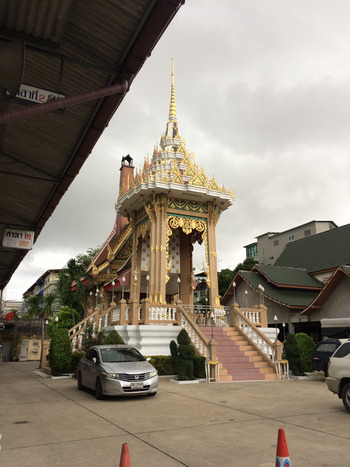
Temples played a primary role in cremations, including also in flesh-offerings. As Lauriston Sharp and Lucien Hanks write, ‘cremation always takes place at a temple’.Footnote 22 More specifically, the cremation takes place at ‘one of the temples which possesses a public “Pramane” [Phra Meru]’ (Fig. 1).Footnote 23 For members of the Bangkok court, special temporary Merus were built for royal cremations. These Merus were built in front of the Grand Palace (an area once called Thung Phra Meru, but now called Sanam Luang).Footnote 24
Mt Meru Crematorium at Wat Suwan, Khlong San, Bangkok. Photograph by author.

Phya Anuman Rajadhon provides a summary of the symbolic meaning of Mt Meru. As he explains,
Meru is the name of the cosmic mountain where the gods of the Buddhists dwell. It forms the center of the universe […] Indra, the King of the gods of Buddhism, lives in his glittering, golden mansion right on the top of the golden mountain, surrounded by similar golden mansions, smaller in size and grandeur, of the lesser gods.Footnote 25
Thus, in royal and monastic cremations, the deceased ‘does not die in the ordinary sense of the word, but translates himself to the heavens’.Footnote 26 A similar logic likely underlay commoner cremations.
Temple storage
With the increasing popularity of cremations, delays became more common since cremations often involved considerable expense.Footnote 27 As Graham writes, the ‘expenditure of money is, in fact, lavish to a degree, and it sometimes happens that the whole of man's estate is dissipated by his heirs in their endeavours to gratify his spirit with a sumptuous burning’.Footnote 28 Similarly, Howard Kaufman comments, ‘So important is it to them that as many as four or five years may elapse between the time of death and the actual cremation.’Footnote 29 Although earlier accounts mentioned that bodies were buried while awaiting cremation, many families, particularly wealthier families with larger houses, often kept the bodies at home.Footnote 30 As Raymond Plion-Bernier explains, ‘Life continues around the corpse which is not an object of fear but of respect and before which one does not pass without making a wai, the hands joined.’Footnote 31
However, it became more common to store corpses at the temples. G.J. Younghusband provides a rather graphic image of the storage scene at the principal temple in Bangkok (likely Wat Saket) in the late nineteenth century, writing ‘a more revolting spectacle it would be difficult to imagine’. He continues:
The place is in the heart of the city, surrounded by a high wall. On entering, two or three corpses, on brick fire rests, are seen opposite, slowly burning. Around are several open sheds. In these were piled up hundreds of boxes of all sorts and sizes, looking like the brickyard of any dry goods man's store. I asked what they were, thinking they were merely old wood used in cremating. To my horror the gentleman answered, they were full of corpses in various states of decomposition. People bring them here and store them until they have money enough to burn them. Sometimes this is never achieved, as one or two shattered old boxes, with skeletons dropping out of them, sufficiently testified. Of course the stench was overpowering.Footnote 32
Treatment of cremains
Following cremation, the cremains were often left at temples.Footnote 33 Wealthy elite had a long-standing practice of building funerary chedi. Already in 1636, Joost Schouten notes that in Ayuthaya, after the deceased is ‘burnt with fire, their collected ashes are afterwards anointed and buried near the Temples, a Pyramid rich and magnificent being erected over them; so that funerals are extremely expensive to the survivors, as well as honorable for the deceased’.Footnote 34 Ordinary people also left cremains on temple grounds. As Phya Anuman Rajadhon writes,
When a person died and was cremated, the ashes and charred bones of common people were buried at the root of a sacred fig-tree in a wat. Such trees are to be found in the grounds of almost every wat. It is a symbol of the Lord Buddha's enlightenment for under such a tree did Buddha sit in meditation and receive his enlightenment.Footnote 35
A second practice, already noted in 1688, was that of putting the cremains into funerary urns (kod) and bringing them home; thus Simon de la Loubère writes, ‘Those that have neither Temple nor Pyramid, do sometimes keep at their house the ill burnt remains of their Parents’.Footnote 36 Crawfurd suggests bringing urns home may have been an elite practice for ‘persons of distinction’.Footnote 37 However, by the mid-nineteenth century, the practice appears to have been widespread, Pallegoix noting, ‘When the combustion has ended, the relatives come to collect the main bones to place them in an urn kept at their house.’Footnote 38 In 1924 Graham records that these urns ‘may be seen in almost every house’.Footnote 39 Furthermore, ‘[o]n very particular occasions these remains are brought out and distributed about the rooms’.Footnote 40
This practice of keeping and reverencing funerary relics continued well into the twentieth century.Footnote 41 Writing of the 1950s, Kaufman details, ‘The urn will be kept in the widow's home. At New Year's, all the households in the village bring their urns to the wat, at which time the monks recite the bangsakun chant in which the spirits of the dead are recalled and asked to bless the living.’Footnote 42 Similarly Barend Terweil explains, ‘The living inhabitants regularly light incense and a candle near where these remains are kept and inform the spirits of their ancestors of all important events in this world.’Footnote 43
Kingkeo Attagara even describes the concern of central Thai villagers to make sure that the deceased's spirit will follow them home after the cremation, going so far as to ‘call the dead man's name all the way, especially when he is crossing a bridge, a stream, or a crooked passage’.Footnote 44 Thus, central Thai saw their deceased as ancestral spirits who, while evidently living in one of Mt Meru's heavens, could continue to play a positive role in their lives.
Northern funerary rites
As in central Thailand, northern monks and royalty were regarded as ‘high-class persons’ who ‘would be reborn in a better world or as a deva at different levels of heaven on Mount Meru’.Footnote 45 Thus, cremations were typical for the funerals of northern royalty and clergy. However, unlike central Thailand in which temples played important roles in funerary rites, in northern Thailand funerary rites — for royalty, monks and commoners — took place outside of temples.
Unlike in the central region, burial was not portrayed as condemning the deceased to becoming ‘the bond-slave of a horrid master' or as necessarily signifying an inauspicious death, but a normal option. Despite the few existing nineteenth century travel accounts suggesting northerners ‘cremate their dead except in cases of violent death’, considerable evidence suggests a widespread practice of burials.Footnote 46 Holt Hallett, while noting cremations among the ‘Ping Shans’, notes that ‘Burial, however, is still observed by the British Shans.’Footnote 47 The northern (or Lanna) region was under Burmese rule for some 200 years, from 1558–1774. Furthermore, northern Thailand was resettled over the course of the nineteenth century by war captives, taken primarily from the Shan States area of Burma.Footnote 48 In Burma, with the exception of monks and royalty, burials were customary.Footnote 49 As Milne summarises, ‘Shans do not cremate their dead, only the bodies of monks are burnt.’Footnote 50
Monks and other villagers I have interviewed in both Chiang Mai and Lamphun provinces (see appendix) confirm that they buried their dead as late as the 1970s. In the area where I conducted fieldwork, I personally attended both village burials and cremations in the 1970s.Footnote 51 The first villagers to adopt cremation appear to have been members of the village elite. Although I can imagine an older generation of villagers criticising commoners aspiring to cremation as appropriating rites associated with monks and royalty, the practice has now become the norm across the north.
Charnel forest, not temple Meru
Temples in northern Thailand have traditionally been considered as sacred grounds, as khuang kaew thang saam, ‘space of the triple gems’ (the Buddha, the Dharma and the Sangha).Footnote 52 Because homes were places of worldly activities, Buddha images were only supposed to be housed in temples. Traditionally, as a mark of reverence of this sacred space, northerners left their shoes outside the temple compound wall. To this day, northerners carry sand to the temple during the New Year celebrations to replace any they may have inadvertently carried out on their feet.Footnote 53
Corpses were seen as fundamentally polluted, inauspicious, and spiritually dangerous; therefore it was taboo to bring them into temple grounds. Although the relationship between phii (spirit or ghost) and winyan (soul) is ambiguous, northerners typically believed that the departed souls were reborn as phii, ‘some for only a short time and others for longer than they would like’.Footnote 54 Phii were terrifying because they were believed to cause illnesses, accidents and other misfortunes. Because it was widely believed that phii cannot enter temple grounds, many northerners specially pour sacralised water (yaat nam; kruat nam) outside the temple compound to ensure the phii will receive the merit accrued by the donors; these offerings of merit are intended to assist in their eventual rebirth.Footnote 55
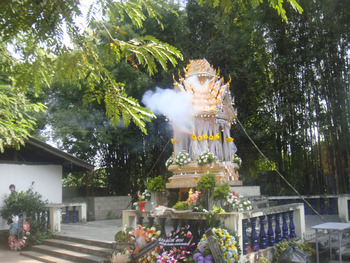
Accordingly, both burials and cremations took place, not in temples, but rather outside the community in the charnel forest (paachaa or paahio); this practice continues to the present day (Fig. 2). The charnel forest is typically a forested area located to the west of the village boundary or at the ‘tail’ of the village (hang muubaan). Similarly, cityfolk also cremated or buried their dead outside the city at the paachaa. In the walled city of Chiang Mai, commoners were taken out through Haiyaa Gate (the southwest gate). These practices were shared by Burmese. Thus, as Shway Yoe writes, ‘The graveyard is usually to the west of the village.’Footnote 56 Similarly in Burmese towns, ‘The dead should all be carried out of a walled town by a gate reserved for this purpose. In Mandalay this a-mingala taga was that to the south-west, and it was avoided by those who had business in the myo as cursed, as indeed its name imports.’Footnote 57
Northern cremation at charnel forest, located outside village on west side. Photograph courtesy of Kongchan Mahakhom.

The same taboo also applied to royalty. Unlike in Bangkok where the royal cremations were held inside the city walls, the cremations of northern rulers (chao) were held outside the city. The earliest account of a northern funeral is found in Pongsawadan Yonok: describing the funeral of the ruling Queen of Chiang Mai in 1578, notes, ‘The city wall was drilled and the corpse was carried through to the Thung Moli ground where the cremation was made.’Footnote 58 However, royalty were not cremated in the same location as commoners, but at a separate area known as khuang men (space of Meru). The royal cremation fields were typically located to the east or north of the city; east was auspicious as the direction of the rising sun and north was understood as the location of Mt Meru.Footnote 59 In Chiang Mai and Lamphun, this field was located east of the city wall.Footnote 60
Not only were the dead to be removed from the community, corpses were not to be brought into it. When Chiang Mai's ruling lord, Chao Kawilorot Suriyawong, died during his return trip from Bangkok in 1870, McGilvary notes that because the city, ‘by inexorable custom, may never open its gate to receive the dead’, the procession travelled outside the city wall to the Prince's summer garden beside the river where his remains lay in state until the cremation ceremony a year later.Footnote 61 Decades later, Konrad Kingshill notes the concern of relatives about a terminally ill man dying in hospital, explaining ‘In such a case the body could not be brought back to the village or to the home for the funeral rites, since then the ghost of the deceased would haunt the vicinity.’Footnote 62 I also recall villagers in the 1970s sharing this concern. This taboo also existed among the Shan in Thailand.Footnote 63 Of Burma, Shway Yoe writes, ‘If the man has died in the jungle, and the funeral has to pass a village, it skirts round the outside of it,’ adding, ‘a corpse must never be carried towards the centre of the town, still less can it be taken into it.’Footnote 64
Monastic cremations were also not carried out in temple grounds, but typically at a special temporary Meru built on a nearby open field to accommodate the large crowds these rites typically attracted.Footnote 65 Monks could also be cremated at the community's charnel forest, albeit often at a separate part.
Rites in homes, not temples
Northern funerals typically took place one to seven days after death. A monk from Srivichai's village said that in Srivichai's day funerals were very simple; the deceased was sprinkled with sompoi water that had been blessed by the monks and removed to the charnel forest, often on the very same day. Keyes also notes that funerals were often held within 24 hours after death.Footnote 66 Although others I interviewed also described simple funerary rites as common in the past, most villagers appeared to keep the corpses an average of three days. As Keyes summarises of the 1960s,
It is not common in northern Thailand to keep the corpse in the house for as long as is done in central Thailand. At most it will be kept only for seven days in order to await the arrival of relations coming from great distances or in order not to hold the funeral on a forbidden day.Footnote 67
Funerals were typically festive occasions.Footnote 68 Relatives and neighbours helped with funerary preparations, many sleeping over to help and to keep the grieving family members company. Men dug the graves or collected the wood needed for the pyre, while women prepared food for all the guests. Monks were invited to chant and give sermons at the home, comic performances of the Jujaka chapter of the Vessantara Jataka being a longtime favourite.Footnote 69 One monk suggested that the monastic services are done at the home, for the benefit of both the living and the deceased whose spirit is assumed to still be lingering around his body; because phii cannot enter temples, the deceased would not be able to hear the sermons or gain from the merit being made. Gambling and drinking helped to ensure a large attendance to scare away any of the other phii the deceased was attracting.Footnote 70 Many villages still maintain funeral societies, to which members contribute to ensure sufficient funds for a grand funeral celebration. In the walled city of Chiang Mai, traditionally bodies of the dead were also kept at home until the time of the final funeral procession to the Haiyaa cremation ground. Corpses of royalty were kept longer, but they were also kept in their palaces and not in the temples.
A mark of their high status, the only bodies that were kept in temples were those of monks (typically not in the central viharn, but in the side salabatr hall). As Keyes explains,
Far from being dangerous, the corpse of a monk is auspicious since it becomes a unique “field of merit” for the lay followers and for Sangha brethren […] While the corpse of an ordinary lay person is conceived of as being dangerous, that of the monk is thought to be just the opposite.Footnote 71
I have visited several temples in the north where the abbot's body was being kept. There are even a few cases of monks who died decades ago, but whose bodies are being kept in glass coffins in special pavilions (sala), drawing worshippers to this day.Footnote 72 Although monks have been known to die in their temples and be kept there until their cremation, it is a telling window into the underlying historical northern Thai worldview that Srivichai insisted on being carried outside the temple to die in order to maintain the temple's purity; he also left strict instructions that his corpse was not to be brought into the temple, but carried around the outside to a sala that had been built outside the temple compound.Footnote 73
Treatment of cremains
Unlike central Thailand, northerners neither took cremains home nor built commoner chedi on temple grounds. Bodies which were buried in the charnel forest remained in unmarked graves; it was not uncommon for villagers who were digging a new grave to stumble across the bones of previous dead. In cases of cremations, the bones were collected and put into a pot. After a final blessing ceremony, the pot was buried in the charnel forest.
Although burying cremains in the charnel forest appears to have been the dominant pattern, other villagers followed different practices. As one former monk suggested, one could return the corpse to any of the four elements, earth, wind, fire, and water; accordingly one could bury the ashes, send them down a river, fire them off in firecrackers or just simply throw the ashes to the wind. Some villagers said they made sand chedi by the riverbanks. One man recalled the authorities (thesabaan) in Phrae forbidding floating cremains in river, but people continued to do it quietly.Footnote 74 According to one abbot I interviewed, the practice of shooting cremains off in rocket-style fireworks ended in the city of Chiang Mai when shopkeepers objected to cremains landing on their roofs.Footnote 75
Northerners kept cremains at a remove from their homes and community. The bodies of the dead were seen as dangerous, essentially transgressing the borders between the world of phii and the world of humans. As villagers explained, phii belonged in the world of phii; humans belonged in the world of humans (phii ko pen khong phii; khon ko pen khong khon). Because it was inhabited by scores of phii, the charnel grounds were seen as particularly frightening. To ensure that phii did not follow them home from the charnel grounds, funeral goers dipped their hands into a bowl of sacred sompoi water that had been set out at the edge of the charnel forest and wiped their heads. Similarly, Nash also notes in Burma, ‘People returning from the cemetery must wash before they go into the village.’Footnote 76
Typically there were no markers for the dead, neither for the graves nor for the location of the pots with the cremains.Footnote 77 One of my friends was able to point to the tree where she had buried the pot containing her mother's ashes about ten years ago, but was not exactly sure where it was located. Although she had initially marked the spot with a paper flag, over time the flag disappeared. When she went to the charnel forest for other funerals, she would stop by the general spot of her mother's ashes and those of other family members to pour sacral water to donate merit to them. Although she thought their spirits had probably been reborn, she figured it could not hurt.
The creation of funerary chedi (kuu) was actively discouraged. Ordinary cremains were not seen as sacred objects of veneration, but rather as housing or attracting dangerous phii. Furthermore, the living must let the deceased move on in the cycle of rebirths. Memorials would discourage relatives from detaching themselves from the deceased, thereby impeding the deceased's ability to stop worrying about the living and move on to its next rebirth (bo mot huang). Kingshill records the response of an elderly monk to a village man who wanted to erect a small funerary chedi for his deceased wife's ashes during his fieldwork in 1953–54. The monk told the husband ‘that it would be improper to build a tomb, since the spirit (winyan) of his wife would then stay at the tomb and would not have a chance to go elsewhere or be reborn’. The remains of this woman were, therefore, ‘also buried in the usual manner in an earthenware jar in an unmarked spot in the cemetery’.Footnote 78
Not only did northerners disapprove of constructing funerary chedi, they also believed that taking the remains of the dead into temples was taboo (khyyt) and a violation of traditions that could lead to misfortune. Confounding the idea that phii could not enter temples, one 86-year-old monk said that bringing the bones of laity into the temple was forbidden because the phii may haunt the monks and novices in the temples, especially if they were relatives. Villagers close to Khruba Khao Pii said someone had once asked him about building a funerary chedi at their temple for their parents’ ashes; he apparently replied that it might seem good, but would only serve to attract lots of phii (phii ca luu kan).Footnote 79
Unlike commoners whose remains were typically buried in the charnel grounds, royal cremains were interred not at a temple, but in chedi built on the royal cremation grounds (khuang men) outside the city. However, in 1908, when Chao Dara Rasmi, daughter of the Lanna king Inthawichayanon and one of the wives of King Chulalongkorn (Rama V), returned after many years in Bangkok for a visit to the city of Chiang Mai, she relocated her forebears’ chedi from the khuang men to Wat Suan Dok. Although Wat Suan Dok was then a deserted temple that lay outside the city walls, this decision and the decision to process the royal cremains through the city, rather than around the outside, caused considerable controversy.Footnote 80
Unlike those of commoners or royalty, the cremains of monks were considered sacred; they were the only ashes northerners considered appropriately kept within temples. Although writing of Burma, Shway Yoe's explanation resonates with the underlying logic of northern Thai beliefs:
The monk does not ‘die’ as a common layman does, he does not even, like the king, ‘ascend to the nat-dewas’ village.’ The holy man in his last existence must have been holy in order to have accumulated the sum of merits which enabled him upon earth to remain steadfast in the sacred order. When he passes away, he ‘returns’ to the highest heavens of nats, or to the meditative states of zan, or perhaps even to the pure and immaterial realms of arupa.Footnote 81
Thus, in addition to the enormous phrathaat (large chedi) at northern temples which are believed to house the relics of the Buddha, many temples have much smaller chedi built to house the cremains of their abbots. In some cases, their cremains are moulded into Buddha images or into statues of the monk or abbot.Footnote 82 The cremains of revered monks were considered highly auspicious and much sought after. After Srivichai's cremation, villagers told me there were so many people trying to get a portion that they had ended up with a hole over a metre deep at his cremation site. His relics are still highly treasured, with ever increasing numbers of temples claiming to have one and ever larger stupas being erected over them.
The relics of abbots have this-worldly afterlives. One such example was a dispute over the cremains of a highly revered monk, Khruba Wilaat, a disciple of Srivichai. Wilaat had specified that he wished his body to be interred at Wat Phrathat Sop Fang, a remote temple he had restored with Srivichai. However, he died en route back to his temple. Despite his wishes, townspeople in Fang planned to install his body at their local temple. However, on the last day of the funeral, one of the electric lights exploded above the monks as they were chanting, showering everyone with glass fragments. Interpreted as a divine sign, Wilaat was interred at his own temple.Footnote 83 In another case, the relics of the former abbot of Wat Sapung were stolen and replaced with sand; after a special ceremony, the 43 bones magically reappeared (sadet maa).Footnote 84 When Phrakhruu Phrommacak's funerary chedi was split in half by a lightning strike, villagers aligned with Khruba Khao Pii avowed it was a sign of karmic retribution.Footnote 85
The deceased spirits of revered abbots were especially venerated, as revealed in Hallett's description of the special bond between an abbot and his disciples:
When an abbot, celebrated for his learning and virtue, dies, it is the custom for those who have spent their monastic life under his instruction, to prepare a shrine for him in some part of their house, or, if still in the monastery, in their dormitory, where flowers and food are placed for the acceptance of the spirit of their deceased teacher. If he is treated with neglect or disrespect, he may become a spirit of evil towards his former pupils.Footnote 86
Just how terrifying such abandoned monastic spirits were to northerners is revealed in Hallett's remarks that:
the Shans [i.e. northerners] are afraid to visit a deserted temple, for the reason that the images of Gaudama are inhabited by Pii Soo-a Wat, the spirits of deceased Buddhist monks, who are the protecting spirits of the temple. If neglected, having nothing to live on, they become savage, and sit like Giant Despair, gnawing their nails; being thenceforth classed amongst demons, or malignant spirits.Footnote 87
Unearthing religious formations
Understanding the differences between central and northern Thai funerary practices provides insight into differing religious formations and helps to explain the conflict generated by the expansion of central Thai administrative control into the northern region. The central Thai practice of building funerary chedi in temple grounds was embedded in a formation that viewed cremation in Merus at temples, storing bodies on temple grounds, and interring cremains on temple grounds or at home as appropriate. In the northern formation, with monks uniquely exempted, temples should be kept pure of the pollution of death.
Because commoner corpses were being brought into temple grounds, central Thai funerary practice had the potential to provoke controversy among northerners. However, the general adoption of cremation appears not to have caused controversy in the north, in part because it was already a high-status practice for royalty and monks; elite families were able to overcome any lingering concerns among old-timers that it was a dangerous violation of taboos for commoners to mimic royalty or monks; and, most significantly, because the cremation pyres were not built on temple grounds but rather at the charnel forest. Corpses were not stored at temples because villagers did not delay funerary rites and royalty kept their deceased in their palaces. Bringing cremains home was an essentially unimaginable practice for northerners; furthermore, the practice was declining in the central region as well because ‘the modern Buddhist abbots do not approve of the family keeping the ashes of the deceased in the home’.Footnote 88
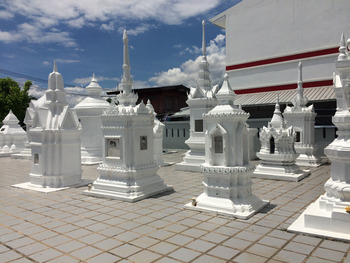
Accordingly, only the issue of funerary chedi became controversial. The conflict over funerary chedi was likely first triggered by Chao Dara's decision to move her ancestral ashes from the khuang men to Wat Suan Dok in 1908. The first northern abbots to allow the building of funerary chedi for commoners at their temples held high-ranking positions in the Bangkok-based monastic hierarchy. These first commoner chedi were typically built for deceased government officials from Bangkok or other major temple donors and their relatives. Thus, for example, the first and only commoner funerary chedi at Lamphun's most famous temple, Wat Phrathat Haripunchai, belong to Phrayar Intaa Notaanon and his descendants.Footnote 89 Born in Burma, Phrayar Intaa became the tax collector (klang cangwat) for Lamphun province; he became very wealthy and was a major donor to Wat Sadyy Muang, now a branch of Wat Phrathat Haripunchai. His funerary chedi was built in 2488/1945 and is now surrounded by smaller chedi belonging to his other family members. Even though this family compound is located adjacent to, but just outside, the temple wall, his funerary compound remains a subject of local comment given the chedi of Lamphun's own former rulers are located outside the city walls (Fig. 3).
Funerary chedi (kuu) of Lamphun's royal family. Located outside old city's eastern wall. Photograph by author.

Gradually more temples allowed funerary chedi not just beyond the temple compound wall, but inside the wall along the outer edge; some allowed cremains to be placed in niches in the outer temple compound wall; and some began to allow larger funerary chedi inside the temple grounds. Because funerary chedi and wall niches involve additional expenses, they were (and are) typically limited to wealthier individuals. Temples aligned with Khruba Srivichai were resolutely opposed to cremains of any person other than those of their own abbots or other respected clergy; to this day temples which maintained their lineages from Khruba Srivichai remain far less likely to have any funerary chedi on their temple compounds.Footnote 90
Inferring religious ideology from funerary practice
These differences in funerary patterns help to shed light on broader historical differences. The major underlying difference was the attitude towards phii; central Thai were more inclined to view the deceased as ancestral spirits than as dangerous phii.Footnote 91 Although central Thai also believed in phii, monks in the royalist-aligned Thammayut order criticised such beliefs. Indeed when the first Thammayut monks became abbots in northern villages, they taught villagers that there were no phii and insisted that villagers remove their village and household spirit shrines. However, to this day, there are very few Thammayut temples in the north. Fear of phii remained particularly strong in the north, Keyes remarking that he found ‘ideas about sorcery and witchcraft were more elaborate in northern Thailand than in northeastern Thailand’.Footnote 92
The central Thai emphasis on Mt Meru implies more of an emphasis on the dead as winyan and a more optimistic orientation towards the heavens. This implication is reinforced by the long-standing central Thai custom of encouraging the dying and their relatives to repeat over and over ‘arahang’ (arahat).Footnote 93 By contrast, the northern view of the dead as phii suggests a less certain outcome, leaving open the possibility that the deceased may descend into one of the hells.Footnote 94 The custom of chanting the Malai Sutra in which Phra Malai visits the hells and the heavens reinforces this uncertainty.Footnote 95 Although an important component of traditional Theravada cosmology, the belief in hells appears to have been a particularly important element in the belief-system of northerners even as late as the 1950s. Khruba Khao Pii's critique of the central Thai belief system is replete with references about how the new religious practices will result in people falling into one of the horrifying hells.Footnote 96
The fact that only monastic cremains could historically be kept in northern temples suggests a much stronger separation of the worlds of laity and monks than in the central region, in turn raising questions about the respective relationships of the monastic order to secular power. Evidence suggests that the northern monastic order was more independent and served as a check on secular power, unlike in the central region where it had become subordinated to state control.Footnote 97 This reverence for the northern monastic order also sheds light on why central Thai efforts to bring northern monks under its administrative control provoked such an intense reaction, leading to thousands of northern monks forming an independent lineage under Srivichai.
Burying tensions
If this historical archaeology helps to explain the conflict that erupted with the advance of central Thai funerary practices in the north, funerary practices also help to explain how tensions were eased. The intervention of the monastic leadership of Chiang Mai and Lamphun provinces in 1951 was an important step in easing the conflict; the leaders at the centre of the conflict each promised to assist in the de-escalation.Footnote 98 However, as a life-cycle ritual drawing huge crowds, funerals themselves have long played an under-appreciated role in the processes of nation-state formation in Thailand. The use of funerals as an extension of ‘soft power’ in northern Thailand can be traced back at least to 1822 and 1825, when the Bangkok court sent royal urns as a mark of favour for the funerals of the ruling chao of Chiang Mai and Lamphun respectively.Footnote 99 Over the course of the early twentieth century, train travel made it easier for members of the northern royal family to travel down to Bangkok for funerals of the Bangkok court and for members of the court and high-ranking members of the central government to attend the funerals of important northerners, thereby further solidifying bonds across the elites. The coup of 1932 overthrew the absolute monarchy and established a constitutional monarchy. The new government's detention of Srivichai and the subsequent arrest and disrobing of hundreds of his followers complicated its hopes of winning hearts and minds of northern villagers. Thus, when Srivichai's cremation took place in 1946, none other than the top coup leaders, General Phraya Phahon and Field Marshall Phibulsongkhram attended in person, together with high-ranking monks from Bangkok. Furthermore, although Srivichai had been stripped of his official monastic rank and hence was not eligible for the honour, his funerary pyre was lit with the ceremonial royal flame bestowed by the palace (fai phra ratchathan); Sommai and Doré note that Srivichai ‘appears to have been the first Lan Na Thai monk to have received such a great honor’.Footnote 100
This pattern of using funerary rites to solidify political relations between the two regions escalated during the reign of King Rama IX (Bhumiphol, r. 1946–2016). The king began bestowing the royal flame for high-ranking monks with the status of phrakhruu or higher. The procession of government officials dressed in white official uniforms led by the provincial governor bearing the royal flame ‘while the modern orchestra played the Royal Anthem in salutation to the King of Thailand’ makes the political messaging clear.Footnote 101 In 1973, King Bhumiphol and Queen Sirikit attended the funeral of the late abbot of Wat Phra Singh, Sommai and Doré noting that ‘This seems to have been the first funeral for a Northern Buddhist monk that the King and Queen attended in person.’Footnote 102 As electoral politics gained currency, funerals have become a major opportunity for political candidates to establish links with their electorates.
Subterranean shifts
Funerary practices are continuing to change. As Sommai and Doré note, ‘Funerals today seem to be much influenced by the standardised patterns observed by Central Thai Buddhists, especially among urban people and government officials.’Footnote 103 The changes are no longer generating emotional outrage. What was once an anathema to northerners is becoming normalised, due to shifting combinations of political overtures, economic incentives, and notions of cultural sophistication. Nonetheless, northern funerary practices continue to be shaped by their underlying religious formation.
Today northern urbanites are increasingly bringing the coffins of their dead to city temples for initial funerary rites rather than keeping them at home. In part this new practice is a matter of convenience because families often do not have much space for large numbers of guests, let alone parking for cars and motorcycles. Furthermore, such temple rites are far less expensive because they do not entail hosting throngs of people eating, drinking, and gambling for several days and nights.Footnote 104 Nonetheless, villagers, while not objecting to this urban practice, are maintaining the village tradition of large festive gatherings to keep the deceased and their relatives company. In urban temples, except for the few hours of formal chanting, the deceased is left alone in the funerary salas.
Funerary cremains are now often being installed in more northern temples, either in chedi or in temple compound walls. Although many of the chedi are unmarked, an increasing number now include the name, birth date and death date; some even include photographs of the deceased. Nonetheless, although funerary chedi can now be found at village temples, they are more commonly built at village charnel grounds.Footnote 105
However, one element has thus far remained resistant to change, namely the central Thai practice of holding cremations within temple grounds.Footnote 106 To this day, there is only one temple with a crematorium in the city of Chiang Mai, namely Wat PaaPhaeng. The temple's monks are quick to note that the land on which their three crematoria are located is separate from the temple land (baeng khaet); these crematoria were built after the Second World War. One temple in Mae Rim district in Chiang Mai province has a newly created crematorium as part of its unique feature of accepting the bodies of those who have willed themselves as hospital cadavers (ajarn yai). Although more villagers are discussing erecting such permanent Merus, they are being built in their charnel forest, and not within the temple grounds.
Illuminating the space of dissension
This essay has explored the space of dissension created as the central Thai government sought to consolidate its administrative control over the monastic order in the northern region of modern Thailand. As the sangha report of 1951 reveals, the replacement of hundreds of disrobed monks after 1936 by monks aligned to central Thai interpretations of Buddhism led to changes in religious practices that caused intense outrage among northern villagers. The logic underlying these emotions became buried under the subsequent process of nation-state formation with its attendant presumption of shared understandings of Thai Buddhism. To exhume this buried logic, this essay focused on understanding one of the changes northerners found abhorrent, namely the construction of commoner funerary chedi on temple grounds. Understanding northern outrage at this seemingly benign practice involved an ideological archaeology of funerary practices in both the central and northern region.
A historical comparison of funerary practices helps to excavate the conflicting religious interpretations that underlay northern discontent. Central Thai mortuary rites were embedded in a formation that centred on Buddhist temples as appropriate spaces for the storage of corpses, cremation, and the final interment of cremains; these practices in turn were embedded in a religious formation that viewed the dead — be they commoners, royalty or monastics — more as ancestral spirits whose winyan the living were guiding to Mt Meru's heavenly realms. By contrast, northern Thai practices were embedded in a religious formation which emphasised a belief in phii, a fear of the hells, a reverence for the monastic order, and a veneration of the sacred space of temples. The corpses of commoners were considered polluting and dangerous, associated with phii awaiting uncertain rebirths. Only monks and royalty could be presumed to await rebirths in the heavens, and only the corpses of monks could be kept in temples. Accordingly, central Thai practices violated northern taboos of the sanctity of temples and the strong separations of laity and monastics.
Determining the fuller role of the Bangkok government in reshaping northern religious practice in the aftermath of the mass disrobings of northern monks awaits further study. However, as this analysis of the controversy over funerary chedi reveals, the central government did not need to actively suppress northern practices in order to generate outrage; merely promoting or tolerating the adoption of central Thai practices through its growing network within the monastic hierarchy was already sufficient. There is evidence to suggest that many of the features of the northern religious formation were once more widely shared by central Thai; however, as the central Thai monastic order solidified its control, the once widespread belief in phii and fear of the hells were buried in deeper historical depths.
This exploration into the conflict of the mid-twentieth century in northern Thailand entombed in funeral chedi suggests the possibility of unearthing other significant historical differences in religious interpretation. Pursuing spaces of dissension provides one inroad into an archaeology of Theravada Buddhism, revealing the tectonics of the ever-shifting religious formations that underlie the edifices of its temples. The invisible realms of ideology can thereby become visible once again.
Appendix: List of oral histories
1. Phra Anon Phromwiso, Wat Chamathevi, Lamphun province, 6 Aug. 2015; 31 July 2018.
2. Phrakhruu Dharmabhirom, in his 80s, Abbot, Wat Nam Bo Luang, T. Nam Bo Luang, A. Sanpatong, Chiang Mai province, 9 Aug. 2015; 13 Feb. 2018.
3. Poh Ui Inpan Maaryan, 80, Wat PhaaNaam, A. Lii, Lamphun province, 9 July 2016.
4. Phrakhruu Worathamthiiraponse, 42, Wat Thaacampii, T. Tungsatok, A. Sanpatong, Chiang Mai province, 13 July 2016.
5. Lung Insuan Sricajphaa, 60s, and Poh Noi Song Pukhampuan, 75, Baan Pong, T. ThaaMaeLohp, A. Mae Thaa, Lamphun province, 29 July 2017.
6. Phrakhruu Panyadhamwat (Inthorn Panyawatano), abbot, 65, Wat SanPaYang Luang, A. Muang, Lamphun province, 31 July 2017.
7. Khruba Sen, 86, Baan Phaa Bang Luang, T. Phaa Bang, A. Mae Phrik, Lampang province, 2 Aug. 2017.
8. Poh Khruu Dusit Chawachaat, 70, Wat Phra Singh, Chiang Mai City, 28 Jan. 2018.
9. Phrakhruu Mangkhalajarn, 67, Wat Thaton, T. Thaton, A. Mae Ai, Chiang Mai province, 2 Feb. 2018.
10. Poh Naan Ong (Naaj Phrommin Jarinthorn), 90, Fang, Chiang Mai province, 3 Feb. 2018.
11. Poh Naan Srilao Ketphrom, Baan Sri Song Muang, A. Saraphi, Chiang Mai province, 24 July 2018.
12. Phra Prakohbbun, Wat Mahawan, Lamphun City, 24 July 2018; 16 July 2019.
13. Phrakhruu Uphatham, 89, Abbot, Wat PaaPhaeng, Amphur Muang, Chiang Mai province, 27 June 2019.
14. Maha Chamluun, Abbot, Wat Chomkhiri Doi Nongkok, San Mahaphon, A. Mae Taeng, Chiang Mai province, 17 July 2019.
15. Khun San Thepmanee, 92 (Phrayar Intaa's grandson-in-law), Lamphun City, 19 July 2019.
16. Sanguan Phongmanee, in his 70s, Lamphun City, 17 July 2019.
17. Poh Moh Karuun, in his 70s, Hang Dong, Chiang Mai province, 22 Apr. 2015.
18. Sulak Sivaraksa, 86, Bangkok, 24 June 2019.