INTRODUCTION
Leaf-cutting ants of the genus Atta are prominent herbivores in the neotropics (Cherrett Reference CHERRETT, Lofgren and Van der Meer1986). These social insects collect and transport large quantities of fresh leaves into their nests that are subsequently degraded by a mutualistic fungus (Hölldobler & Wilson Reference HÖLLDOBLER and WILSON1990) thereby increasing organic matter in the soil. Leaf-cutting ants mix soil horizons and concentrate nutrients locally (Alvarado et al. Reference ALVARADO, BERISH and PERALTA1981, Bucher Reference BUCHER, Huntley and Walker1982, Coutinho Reference COUTINHO1982, Jonkman Reference JONKMAN1978, Jukubczyk et al. Reference JUKUBCZYK, CZERWINSKI and PETAL1972, Petal Reference PETAL and Brian1978, Wagner & Jones Reference WAGNER and JONES2004, Weber Reference WEBER1972). This has been observed in forests (Hudson et al. Reference HUDSON, TURNER, HERZ and ROBINSON2009, Moutinho et al. Reference MOUTINHO, NEPSTAD and DAVIDSON2003, Wirth et al. Reference WIRTH, HERZ, RYEL, BEYSCHLAG and HÖLLDOBLER2003), savannas (Farji-Brener & Silva Reference FARJI-BRENER and SILVA1995, Souza-Souto et al. Reference SOUZA-SOUTO, SCHOEREDER and SCHAEFER2007) and semi-arid regions (Farji-Brener & Ghermandi Reference FARJI-BRENER and GHERMANDI2000) throughout the neotropics.
High nutrient availability in the soil of leaf-cutting ant nests can, among other factors, locally increase plant abundance and diversity as well as accelerate nutrient cycling in otherwise oligotrophic tropical forest soils (Farji-Brener & Medina Reference FARJI-BRENER and MEDINA2000, Garrettson et al. Reference GARRETTSON, STETZEL, HALPERN, HEARN, LUCEY and MCKONE1998, Haines Reference HAINES1978, Lugo et al. Reference LUGO, FARNWORTH, POOLE, JEREZ and KAUFMAN1973). Using leaves labelled with 15N that were transported by ants into their nests, and by subsequently tracing the 15N label in leaves of trees surrounding the nests, Sternberg et al. (Reference STERNBERG, PINZON, MOREIRA, MOUTINHO, ROJAS and HERRE2007) demonstrated that plants near nests did access nutrients from the nests. However, field studies examining the actual response of vegetation to the supposed benefits of the nests in terms of growth and reproduction are few and with varied results. Schoereder & Howse (Reference SCHOEREDER and HOWSE1998) found no effect of leaf cutter ant nests on plant community structure in a savanna in southeastern Brazil. In the eastern Amazon, Moutinho et al. (Reference MOUTINHO, NEPSTAD and DAVIDSON2003) reported higher root density in nest soil and lower predawn leaf water potential values in trees near nests than in trees far away, an indication of possible water stress in near-nest trees arising from increased water uptake. However they also mentioned that most species did not show any significant linear relationships between stem diameter increase and nest proximity, thereby suggesting that other factors apart from nutrient availability influence growth.
This study looked at the influence of leaf-cutting ant nests on plant growth and water relations in an oligotrophic forest to examine whether high nutrient availability results in greater growth and water uptake, the latter as nutrient uptake happens in the dissolved form. Sap flow velocity, leaf water potential and carbon stable isotope ratio were measured as proxies for photosynthetic activity since it is expected that plants accessing high nutrient concentrations would have high levels of photosynthesis. Trees growing near leaf-cutting ant nests were compared with trees far away from nests. The study hypothesized that plants near the nests would exhibit: (1) higher relative growth rates as measured by stem diameter increases; (2) higher sap flow velocities accompanying increased photosynthesis; and (3) lower dry season water stress as measured by less enriched foliar δ13C and higher leaf water potential, as long as water is not limiting. In addition, as water/nutrient uptake and light availability can differ between adult and sapling stages, naturally occurring saplings near and far from nests were counted to examine if the supposedly higher nutrient availability in nest soil would positively influence sapling growth.
METHODS
Study site
The study was conducted between October 2005 and November 2007 at Fazenda Tanguro in the municipality of Querência (13°04′35.39″S, 52°23′08.85″W), Mato Grosso, Brazil. The site lies in a short-stature lowland Amazon rain forest bordering savanna (cerrado) woodlands. The annual average temperature is 23.5 °C with a rainfall ranging from 1800 to 2000 mm. The dry season occurs between May and September and the rainy season between October and April. Soils are oxisols (Balch et al. Reference BALCH, NEPSTAD, BRANDO, CURRAN, PORTELA, DE CARVALHO and LEFEBVRE2008). Three active leaf-cutting ant nests of Atta cephalotes (L.) (Hymenoptera: Formicidae) were chosen; they were located several hundred metres apart, about 100 m from the forest edge and were representative of leaf-cutting ant nests in the area. The percentage of canopy cover at the nests and forest sites without nests were calculated from digital photographs taken at ground level that were converted in Adobe Paintshop Pro to high-contrast black-and-white images from which the proportion of cover (black pixels) was obtained.
Nutrient uptake from nests
15N was used as a tracer to ascertain plant nutrient uptake from leaf-cutting ant nests. Leaves of Citrus aurantifolia (Christm.) Swingle (Rutaceae) and Mangifera indica L. (Anacardiaceae) impregnated with 15N in the form of potassium nitrate (2.5%) were offered to the ants in September 2005 who were observed transporting the leaves to their nests (three nests). Foliar 15N levels in selected trees (14 near nests, 14 far from nests for each species) were observed in samples taken every 2 mo (2005–2006) and analysed by isotope ratio mass spectrometry in the Nuclear Energy Center for Agriculture in Sao Paulo, Brazil and in the Laboratory of Stable Isotope Ecology in Tropical Ecosystems at the University of Miami, USA (Autorização IBAMA; Licença de Exportação: 07BR000346/DF) Nitrogen isotope ratios are expressed as δ15N in ‰ where

Rsample and Rstd represent the ratio of the heavier to lighter nitrogen isotope in the sample and in the standard. Atmospheric nitrogen was the standard for δ15N values. The precision of analysis was ± 0.1‰.
Plant growth
We tested whether plants closer to leaf-cutting nests have higher relative growth rates than those farther from nests. Thirty-one trees established near and far from three leaf-cutting ant nests with diameters (at breast height) ranging from 20 to 25 cm were randomly selected. These trees belonged to the two most common genera within the study area and were Amaioua guianensis Aubl. (Rubiaceae) and Protium sp. (Burseraceae). Individuals occurring up to 10 m from the edge of a nest were considered part of the near-nest group while those further than 10 m from the nest that were also exempt from the influence of any other leaf-cutting ant nests formed the far-from-nest group; an earlier investigation by Moutinho (unpubl. data) found that on average trees up to 10 m away from a nest had their roots in the nest area. A clumped approach was chosen instead of examining growth relationships with nest distance, in order to sidestep other potentially confounding factors that influence growth. Monitoring of the stem diameter of trees was carried out every 2 mo between October 2005 and November 2007, by using an electronic caliper to measure changes in dendrometers (stainless steel bands with a spring attached to the ends) encircling the main trunk at breast height. The dendrometers were installed in September 2005 and adjusted weekly to allow time for them to settle in over the tree bark. Relative growth rate (RGR) over the study period, expressed on a per year basis, was calculated as:

Plant–water relations
Higher photosynthesis is accompanied by increased stomatal conductance that in turn leads to higher transpiration, sap flow velocities, lower leaf water potential (Larcher Reference LARCHER2006) under water-limiting conditions and lower foliar carbon isotope ratios (Farquhar et al. Reference FARQUHAR, O'LEARY and BERRY1982).
Sap flow velocities were measured by the thermal dissipation method (Granier et al. Reference GRANIER, HUC and COLIN1992) in the dry season (July 2007) for a period of seven consecutive days in a subset of the trees selected for growth measurements: 10 Protium sp. trees and six A. guianensis trees that had similar diameters. Five of the ten Protium sp. trees were near one nest, while the other five were located further away (>10 m away) from the nest. Similarly, three A. guianensis trees were near the same nest while the other three were further away. The 2-cm-long probes of a copper-constantan thermocouple were coated with heat-conducting paste and inserted in holes drilled 10 cm apart at breast height along the longitudinal axis of the tree trunk after bark removal. The heated probe was placed in the upper hole while the unheated needle (reference probe) was placed in the lower hole. Sap flow velocity was calculated from the temperature difference-induced voltage as:

Glasswool insulation was placed around the probes and covered in reflective aluminium foil to minimize ambient heat sources and sinks. A CR10× datalogger linked to an AM16/32 multiplexer (Campbell Scientific, Utah, USA) to accommodate 16 probes measured the voltage difference every 30 s and stored the average over a 10-min interval. The probe heater circuits and the datalogger were powered by a 12-V battery charged by a solar panel, with battery voltage monitored at dawn and dusk to guard against voltage dropping below 11 V. Power was supplied at a standard 0.2 W per heater circuit, for which a resistor-based power strip was used. The entire probe and cable assembly was also monitored twice a day along with the data to check for circuit malfunctions due to animal movements tripping cables, moisture accumulation and ants that often chewed cable insulation.
Carbon stable isotopic analysis. For each species, mature leaves were collected from a set of 13 trees near three nests and 13 trees far from these three nests as the growth study on six occasions over 14 mo spanning the wet and dry seasons, dried at 50 °C and ground in preparation for isotopic analysis. Foliar δ13C was analysed by isotope mass spectrometry in the Laboratory of Stable Isotope Ecology in Tropical Ecosystems at the University of Miami, USA. Carbon isotope ratios are expressed as δ13C in parts per thousand (‰) where:

Rsample and Rstd represent the ratio of the heavier to lighter carbon isotope in the sample and a standard. We used Vienna Pee Dee Belemnite (vPDB) with a precision of analysis ± 0.1‰.
Leaf water potential. For each species, predawn and midday leaf water potential were measured in leaves from eight trees near one nest and from eight trees far from the nest in the dry season (July 2007) as per Scholander et al. (Reference SCHOLANDER, HAMMEL, HEMMINGSEN and BRADSTREET1964) using a Scholander Pressure Chamber (PMS Instruments, Corvallis, Oregon, USA). The difference between predawn and midday leaf water potentials (typically more negative values at midday indicating some degree of water stress) indicates the extent of transpiration-caused water stress in the tree. Three branches per tree were cut 1 h before dawn and around midday, bagged and kept in a cooler and transported back to the laboratory for immediate measurement of leaf water potential.
Recruitment
Species composition and abundance of saplings (diameter <5 cm) in the vicinity of the nests were noted in January 2007 at 23 locations on the three nests and 23 locations situated >10 m away from these nests. At each location, three 1-m2 plots were randomly selected and counted.
Data analysis
Relative growth rates (RGR) for the two groups of trees (near nest and far from nest) were compared for each species separately using ANOVA with leaf-cutting ant nests as randomized blocks and the two groups of trees (near and far from nests) as the main effect, to test if RGR was influenced by within-nest and/or by distance from the nest. Sap flow velocity values for each tree were averaged over 7 d (after removing erroneous data when cables were shorted out by ants) to obtain a daily average for each tree. A daily group average (near nest or far from nest for a species) was then obtained by averaging the daily averages for individual trees in the group; sapflow studies were performed around only one nest. The group averages for a species were then compared using the Student's t-test. Foliar δ13C values of near-nest trees were analysed for within-nest variation for each one of six sampling events by ANOVA. Thereafter a repeated-measures ANOVA was carried out to examine the variation of foliar δ13C within six sampling events in a year (as the within-subjects factor) as well as whether this variation of distance from the leaf-cutting ant nests (between-subjects factor). Predawn leaf water potential and midday leaf water potential between near- and far-from-nest groups for each species were compared using Student's t-test, since only one nest was involved. All statistical analyses were performed using SPSS version 13.0 (Chicago, USA).
RESULTS
Plant nutrient uptake from nests
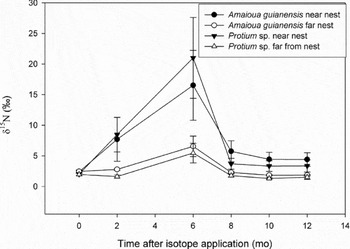
For both the species considered, trees situated near nests had significantly higher foliar δ15N than trees far from nests (Figure 1). For instance, 6 mo after label introduction, near-nest A. guianensis trees had a mean (± SD) foliar δ15N value of 16.5‰ ± 5.7‰ while trees far away had a mean value of 6.6‰ ± 1.7‰ (t = 1.67, n = 14, P < 0.05). Similarly near-nest trees of Protium sp. had a mean value of 21.0‰ ± 6.6‰ while trees far away from nests had 5.5‰ ± 1.6‰ (t = 2.27, n = 12, P = 0.017). Foliar δ15N values in near-nest trees increased approximately 2 mo after label introduction with a peak in 6 mo. Trees far away from nests also exhibited a peak that was smaller in magnitude as compared with near-nest trees.
Foliar δ15N measured from the time of isotopic label application until 1 y thereafter. Filled symbols (▼, ●) refer to trees near leaf-cutting ant nests while unfilled symbols refer to trees far away from the nest. Error bars indicate 1 SE.

Plant growth
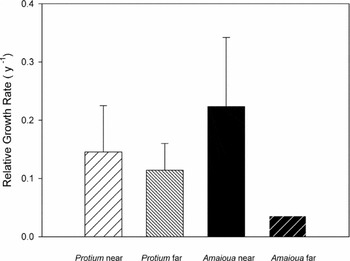
The effect of proximity to leaf-cutting ant nests on plant growth was significant for A. guianensis (F1,15 = 10.8, P = 0.034) with trees near leaf-cutting ant nests exhibiting significantly higher growth rates (0.224 y−1) as compared with 0.036 y−1 for trees far from nests (Figure 2). There was no significant difference in growth amongst the three nests for near-nest A. guianensis trees (F2,13 = 0.996, P = 0.375). For Protium sp., neither the nests (F2,13 = 0.493, P = 0.685) nor distance from the nests (F1,17 = 0.730, P = 0.432) had a significant effect on relative growth rate. There was no significant linear or non-linear relationship between distance to the nest and stem diameter increase for either species.
Relative growth rate (RGR) per year based on stem diameter increases in Protium sp. and Amaioua guianensis trees near and far away from leaf-cutting ant nests over the study period. Error bars signify 95% confidence intervals of the mean.

Sap flow velocity
Over the 7-d observation period, sap flow velocity differences between trees near the nest and trees far from the nest were significant only for A. guianensis where near-nest trees showed a mean sap flow velocity of 16.0 ± 2.14 cm h−1 compared with trees further away that had a mean sap flow velocity 5.41 ± 3.12 cm h−1 (t = 7.36; P < 0.001; n = 3). No significant differences between near-nest trees (16.7 ± 3.98 cm h−1) and trees far from the nest (18.6 ± 11.4 cm h−1; t = 0.407; P ≤ 0.691; n = 5) were observed for Protium sp.
Foliar δ13C
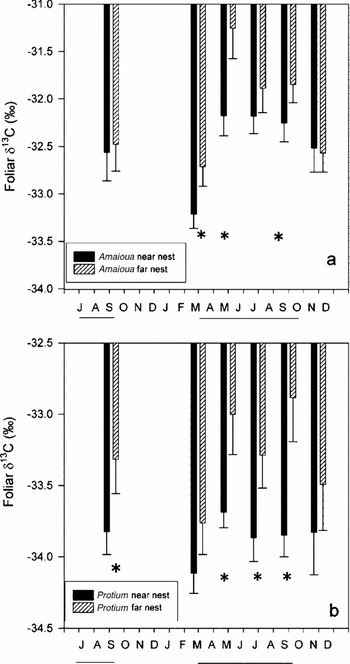
Both species showed higher (less negative or more enriched) foliar δ13C values over the dry season, from March to September (Figure 3). In addition, trees far from nests had, on average, significantly higher foliar δ13C values than trees near nests on several occasions. For Amaioua guianensis, repeated-measures ANOVA indicated significant differences in foliar δ13C within the months of sampling (F = 14.1, df = 5, P < 0.001) while the interaction between time (months of sampling) and the distance of the tree from the nest (whether near or far from the nest) was not significant at P = 0.05, indicating that both groups of trees (near nests and far from nests) had similar patterns over time. For Protium sp., the repeated-measures ANOVA did not find any significant difference in foliar δ13C between months of sampling, nor was there any significant interaction between time and distance from nest. For every sampling instance, there was no significant difference in foliar δ13C values for near-nest trees of either species between the three nests with the exception of November 2005 when a significant difference in foliar δ13C was seen (F2, 24 = 4.86, P < 0.05) for Protium sp.
Average foliar δ13C difference between trees near leaf-cutting ant nests and trees far from the nests for Amaioua guianensis (a) and Protium sp. (b) sampled in September 2005, March 2006, May 2006, July 2006, September 2006 and November 2006. The approximate dry-season months are underlined on the x-axis. n = 13 in each sample. The * indicates significant difference between trees near and far from the nests for a sampling event at P = 0.05. Error bars signify 1 SE.

Leaf water potential
Amaioua guianensis trees showed less negative predawn leaf water potential values for near-nest trees (−0.66 ± 0.10 MPa) than trees far from the nest (–0.98 ± 0.35 MPa; t = –2.56; P = 0.021; n = 9). Midday leaf water potentials in all cases were more negative than predawn leaf water potentials as expected; however there was no significant difference between trees near and far from the nest (near nest = –1.95 ± 0.56 MPa; far from the nest = –2.22 ± 0.55 MPa; t = –1.01; P = 0.328; n = 9). Protium sp. trees exhibited the reverse situation in both predawn (near nest = –1.23 ± 0.62 MPa; far from the nest = –0.81 ± 0.60 MPa; t = –1.76; P = 0.091; n = 9) and midday (near nest = –1.63 ± 0.66 MPa; far from the nest = –1.01 ± 0.48 MPa; t = 2.90; P ≤ 0.001; n = 9).
Seedling abundance and species richness
The density of seedlings was significantly lower near nests (mean ± SD = 9.47 ± 7) than further away (17.8 ± 15) (t = –2.44, df = 31, P = 0.01). Species richness was lower as well (4.76 ± 3) near nests as compared with further away (10.2 ± 4.8; t = 4.57; P ≤ 0.001; n = 23). The forest floor had greater canopy cover (89.7% ± 2.5%) than nest sites (84.7% ± 2.1%), (t = 3.09; P = 0.021; n = 8; data transformed into arcsine of the square root).
DISCUSSION
Leaf-cutting ant nests constitute nutrient-rich patches in oligotrophic forest soils and are thus logically surmised to benefit plant growth (Moutinho et al. Reference MOUTINHO, NEPSTAD and DAVIDSON2003, Sternberg et al. Reference STERNBERG, PINZON, MOREIRA, MOUTINHO, ROJAS and HERRE2007). Foliar δ15N results indicate that trees growing near leaf-cutting ant nests took up nutrients from the nests to a significantly greater extent than trees further away, thereby agreeing with other recent studies (Farji-Brener & Ghermandi Reference FARJI-BRENER and GHERMANDI2008, Sternberg et al. Reference STERNBERG, PINZON, MOREIRA, MOUTINHO, ROJAS and HERRE2007). While this study has found that on average, trees near nests showed a higher relative growth rate (RGR) than trees further away, the extent of this difference in growth and water relations differed with species, at least for the two most abundant species in the forest studied. Seedling abundance and species richness on the other hand was smaller on the nests as compared with further away on the forest floor.
Plant species respond differently to nutrient concentrations in an oligotrophic system
The absence of any significant difference in RGR in near-nest trees between nests suggests that the three nests chosen for this study were adequate. While near-nest trees from both A. guianensis and Protium sp. had greater RGR than trees further away, this nest-proximity-related difference in RGR was significant for A. guianensis but not for Protium sp. This observation is also supported by the water relations results, where A. guianensis trees near nests are more hydrated than trees further away, while there was no significant difference for Protium sp., with the exception of foliar δ13C results.
It is likely that A. guianensis responds to localized increased nutrient availability by growing more roots in those high nutrient patches, as observed for other species elsewhere by Moutinho et al. (Reference MOUTINHO, NEPSTAD and DAVIDSON2003); although field observation of increased root growth requires identification of A. guianensis roots in soil cores that fell outside the scope of this study. Sap flow velocities are higher in near-nest A. guianensis trees as compared with trees further away indicating greater water uptake in near-nest trees. Predawn and midday leaf water potential values are significantly lower (less negative) in near-nest A. guianensis trees as compared with trees further away, indicating lower xylem tension in near-nest trees that results from greater water availability in the soil-plant-atmosphere continuum. This greater water availability in near-nest A. guianensis trees also appears to exist over a longer period across seasons, as seen from the lower foliar δ13C in near-nest trees compared with leaves from trees located far from nests (Figure 3). The difference between trees near nests and trees far from nests increases over the dry season and equalizes over the wet season (November 2006) on account of increased water availability. Apart from increased root proliferation, other factors such as the possibility of higher water-holding capacity of the organic-matter-enriched soil and reduced evapotranspiration from bare nest surfaces could contribute to the greater water availability in nest sites, although Meyer et al. (Reference MEYER, LEAL, TABARELLI and WIRTH2011) observed that soil moisture in nest soils was actually lower than further away in the forest. Thus increased root growth could still be the major reason for the greater degree of hydration, as the limited volume of nest soil may hold insufficient water (even with continual recharge) to account for the higher sap flows in near-nest trees.
Unlike A. guianensis, the Protium sp. does not reveal a clear and consistent pattern. There is no significant difference in growth, sap flow and leaf water potential between near-nest and far-from-nest trees. This suggests that Protium sp. trees do not respond significantly to increased nutrient availability, at least over a time span of a couple of years. However, like A. guianensis, Protium sp. shows lower foliar δ13C in trees located near nests; this suggests the possibility of factors other than water availability affecting foliar δ13C values, such as the ratio of structural and non-structural carbohydrates that can vary over leaf life span.
If these patterns are explained by the relative abilities of A. guianensis and Protium sp. to take advantage of increased nutrient availability by expanding their root networks, then this would be an example of species differences in plasticity of response to high nutrient patches in an oligotrophic system. These differences can result from the range of resource availability encountered by different species over their recent evolutionary history. Vegetation in oligotrophic ecosystems are known to possess conservative resource-use strategies (Chapin et al. Reference CHAPIN, VITOUSEK and VAN CLEVE1986, Valladares et al. Reference VALLADARES, MARTINEZ-FERRI, BALAGUER, PEREZ-CORONA and MANRIQUE2000) while plants that occur in ecosystems with a wide variability of resources can respond quickly to changes in nutrient availability. This study supports the idea that plant communities are overlapping collections of species, each with their own range of water and nutrient requirements and sets of responses.
Leaf-cutting ant nests: subterranean nutrient hotspots but surface bald spots
Interestingly, while most adult trees occurring close to leaf-cutting ant nests showed increased growth in this study, the nests themselves had lower plant species richness and abundance as also noted in Garrettson et al. (Reference GARRETTSON, STETZEL, HALPERN, HEARN, LUCEY and MCKONE1998) and Meyer et al. (Reference MEYER, LEAL, TABARELLI and WIRTH2011). Saplings could face competition for limited water resources in the dry season from well-established adult trees with a high proliferation of roots in the nest waste chambers as shown by Haines (Reference HAINES1978), that could decrease the inherently lower soil moisture in nest soil compared with the forest floor possibly due to canopy gaps allowing in more radiant energy (Meyer et al. Reference MEYER, LEAL, TABARELLI and WIRTH2011, canopy cover results in this study). Another possibility is that nutrients from waste chambers occur deeper in the soil profile in the nests, inaccessible to seedling roots. Moutinho et al. (Reference MOUTINHO, NEPSTAD and DAVIDSON2003) observed a higher concentration of nutrients in nests at depths >1 m along with high levels of Ca, Mg and K. Nest surfaces are bereft of any leaf litter and are essentially piles of low-nutrient soil, which together with the lack of mycorrhizal associations in the early nest stages can affect seedling growth. Yet another possibility is defoliation by leaf-cutting ants as has been observed in Garrettson et al. (Reference GARRETTSON, STETZEL, HALPERN, HEARN, LUCEY and MCKONE1998) and Vasconcelos & Cherrett (Reference VASCONCELOS and CHERRETT1997). Furthermore, as mentioned in Farji-Brener & Medina (Reference FARJI-BRENER and GHERMANDI2000), the excavation activities by ants inside the nest can also affect the root zone of the saplings, although this again depends upon the ant species – this is true for Atta cephalotes while A. sexdens or A. laevigata do not excavate chambers in the root zone of plants. It is the nest mound surfaces that remain bare and free of any vegetation, thereby constituting bald spots on the forest floor. Thus, while adult trees established near nests can access the high concentrations of nutrients in the subterranean waste chambers resulting in greater growth than trees away from nests, the nest surfaces do not encourage colonization by plants (from low species richness and abundance data) on their surface, possibly to prevent roots from colonizing plants entering nest chambers and otherwise affecting the structural integrity of the nest structures.
CONCLUSION
High nutrient concentrations around leaf-cutting ant nests were generally seen to enhance plant growth; however plant species differ strikingly in their ability to respond to and to utilize these localized nutrient concentrations in an oligotrophic ecosystem. Thus an increase in nutrient availability in an oligotrophic ecosystem does not necessarily translate into higher growth and benefits for all plants native to that ecosystem. While the leaf-cutting ant nests constitute subterranean nutrient concentrations, their surfaces are bare of vegetation.
ACKNOWLEDGEMENTS
We thank Elisandra Dias (Nina), Darlisson, Osvaldo Portela, Santarém, Roberto, Clei, Donga, Bibal, Adriano and Elias Schwartzmann for assistance during fieldwork, Gina Cardinot for logistical assistance and Sonali Saha for data analysis. Financial support came from the Scholarship for Amazonian Conservation of the International Institute of Education in Brazil (BECA-IEB), Scientific Development of Bahia State (FAPESB) and US NSF Biocomplexity Project (Grant 0322051). Amartya Saha also thanks the Florida Coastal Everglades Long Term Ecological Research project (NSF DBI-0620409) for supporting manuscript preparation. Lastly we thank Sebastian Meyer for critical comments and suggestions that have vastly improved this manuscript.