Clinical mastitis (CM) poses a significant animal health issue on dairy farms worldwide (Hogeveen et al., Reference Hogeveen, Huijps and Lam2011), but the type and prevalence of causal pathogen varies between farms, management systems and countries. In New Zealand, where pasture-based systems predominate, the pathogens most frequently isolated from intramammary infections (IMI) which lead to CM are Streptococcus uberis, considered an environmental species and Staphylococcus aureus, a contagious bacterial species (McDougall et al., Reference McDougall, Arthur, Bryan, Vermunt and Weir2007). Hygienic milking practices and use of post-milking teat disinfection are reasonably effective in preventing IMI during lactation (Hillerton et al., Reference Hillerton, Staker and Shearn1995; McDougall, Reference McDougall1999), whereas use of long-acting antibiotics and/or internal teat sealants at dry off significantly reduces new infections occurring in the dry period (Williamson et al., Reference Williamson, Woolford and Day1995; Woolford et al., Reference Woolford, Williamson, Day and Copeman1998; Compton et al., Reference Compton, Emslie and McDougall2014). However, selecting for cows with highly effective natural defence mechanisms would be an effective way to further reduce the use of antimicrobials, thereby lessening the risk of antimicrobial resistance occurring and reducing animal health costs (McDougall et al., Reference McDougall, Penry and Dymock2021).
The genetic makeup of the cow contributes significantly to the likelihood of mastitis. A higher prevalence of mastitis has been reported for Friesian cows compared with Jersey cows (Washburn et al., Reference Washburn, White, Green and Benson2002; Bannerman et al., 2008) and sire associations with incidence of CM have been reported (Heringstad et al., Reference Heringstad, Gianola, Chang, Odegard and Klemetsdal2006; Jury et al., Reference Jury, Lopez-Villalobos, Spelman, Arias and Heuer2010). Most cows do not experience CM on well-managed New Zealand farms (McDougall, Reference McDougall1999), despite more prevalent IMI, implying that natural, innate defences against disease differ between cows. The innate mammary gland defences are complex, involving mechanisms that prevent bacterial invasion through the teat duct (Lacy-Hulbert and Hillerton, Reference Lacy-Hulbert and Hillerton1995), and factors that inhibit bacterial growth in mammary secretions (Kliem and Hillerton, Reference Kliem and Hillerton2002; Siebert, Reference Siebert2017) as well as immune responses that respond differently, depending on the type of bacteria present (Sordillo and Streicher, Reference Sordillo and Streicher2002; Rupp and Boichard, Reference Rupp and Boichard2003). Single nucleotide polymorphisms in several bovine genes have been linked to mastitis resistance (Rupp et al., Reference Rupp, Hernandez and Mallard2007; Sugimoto et al., Reference Sugimoto, Itoh, Gotoh, Kawahara, Moriya, Uchimura and Sugimoto2011; Wojdak-Maksymiec et al., Reference Wojdak-Maksymiec, Szyda and Strabel2013) and low somatic cell counts (SCC, as a proxy for IMI: Sharma et al., Reference Sharma, Leyva, Schenkel and Karrow2006; Skelding et al., Reference Skelding, Schenkel, Sharma, Verschoor, Pant, Biggar, Boermans and Karrow2010). Some studies have focused on specific pathogens, particularly those of environmental origin. Littlejohn et al. (Reference Littlejohn, Turner, Walker, Berry, Tiplady, Sherlock, Sutherland, Swift, Garrick, Lacy-Hulbert, McDougall, Spelman, Snell and Hillerton2018) reported genotypes with variants in the IL1 cluster on chromosome 11 that may help explain resistance to Str. uberis mastitis whilst other studies concluded that certain single nucleotide polymorphisms are associated with infection by Str. uberis (Youngerman et al., Reference Youngerman, Saxton, Oliver and Pighetti2004; Pighetti and Elliott, Reference Pighetti and Elliott2011; Siebert et al., Reference Siebert, Staton, Headrick, Lewis, Gillespie, Young, Almeida, Oliver and Pighetti2018). Given the multiplicity of pathogens that can cause mastitis (de Haas et al., Reference de Haas, Barkema and Veerkamp2016) and the complexity of the immune response to specific pathogens (Thompson-Crispi et al., Reference Thompson-Crispi, Atalla, Miglior and Mallard2014), a large number of candidate genes, spanning the entire genome, are probably implicated in conferring resistance to mastitis (Miles and Huson, Reference Miles and Huson2021).
Inclusion of detailed mastitis traits within animal selection and breeding programmes is challenging since new IMI are difficult to detect in the absence of clinical signs, and only a small proportion of IMI may progress to a clinical form of the disease (Martin et al., Reference Martin, Barkema, Brito, Narayana and Miglior2018). Confirmation usually requires bacterial culture of milk, which precludes regular screening of large numbers of animals, and although an elevated SCC is a reasonable proxy, it provides no information on the pathogen. The infrequency of IMI and the costs of testing means that few sire selection systems include pathogen-specific information. Experimental challenge models lack scale and ignore the innate physical and chemical defences of the teat and teat duct (Turner et al., Reference Turner, Williamson, Lacy-Hulbert and Hillerton2013). Hence, selection programmes mostly focus on low SCC or low incidence of CM, but these limitations obscure variations across different pathogens, which differ in their mode of transmission and interaction with natural defence mechanisms (Lacy-Hulbert and Hillerton, Reference Lacy-Hulbert and Hillerton1995).
The Holstein-Friesian × Jersey crossbred model (Spelman et al., Reference Spelman, Miller, Hooper, Thielen and Garrick2001) provided a unique opportunity to investigate sire contribution to the ability of their daughters to resist IMI as well as CM by different pathogens, and test the hypothesis that phenotypes generated under natural conditions would be predictive of their response to a subsequent intramammary challenge with Str. uberis¸ in that sires ranked as conferring more resistance to intramammary infections in their daughter's first 2 lactations would also confer more resistance to an intramammary challenge in the third lactation.
Materials and methods
Animals and experimental design
A Holstein-Friesian × Jersey crossbred pedigree herd, based on an F2 pedigree design with a half-sibling family structure (Spelman et al., Reference Spelman, Miller, Hooper, Thielen and Garrick2001; Berry et al., Reference Berry, Davis, Beattie, Thomas, Burrett, Ward, Stanfield, Biswas, Ankersmit-Udy, Oxley, Barnett, Pearson, van der Does, MacGibbon, Spelman, Lehnert and Snell2009, Reference Berry, Lopez-Villalobos, Beattie, Davis, Adams, Thomas, Ankersmit-Udy, Stanfield, Lehnert, Ward, Arias, Spelman and Snell2010; Karim et al., Reference Karim, Takeda, Lin, Druet, Arias, Baurain, Cambisano, Davis, Farnir, Grisart, Harris, Keehan, Littlejohn, Spelman, Georges and Coppieters2011) was used for this study. Briefly, the pedigree was created by reciprocal crosses of Holstein-Friesian and Jersey animals to produce six F1 bulls of high genetic merit (sires A to F), and F2 female progeny produced through artificial breeding of high genetic merit F1 cows with these F1 bulls. The herd of 808 cows was formed over two seasons from two cohorts of first-lactation heifers. Some 804 cows completed their first lactation (Cohort 1, n = 353; Cohort 2, n = 451), whilst 703 cows completed their second lactation (Cohort 1, n = 309; Cohort 2, n = 394). A total of 612 animals in their third lactation (Cohort 1, n = 264; Cohort 2, n = 348) received a single intramammary challenge with Str. uberis, as described previously (Sanders et al., Reference Sanders, McDougall, Stanley, Johnson, Spelman and Harcourt2006; Littlejohn et al., Reference Littlejohn, Turner, Walker, Berry, Tiplady, Sherlock, Sutherland, Swift, Garrick, Lacy-Hulbert, McDougall, Spelman, Snell and Hillerton2018). More details on the experimental challenge protocol, including distribution of daughters per sire, summarised across cohorts and lactations, are provided in the online Supplementary File and Table S1.
The animals were managed on a single farm in Taranaki, New Zealand under typical commercial dairy farming practices, using a seasonal spring-calving, pasture-based system, and milked twice daily through a rotary parlour, with automated cup removers. Teats were sprayed with an iodine-based sanitiser after each milking. Clinical mastitis was detected by the milking staff, based on visible changes of the milk (i.e. clots or discolouration) or udder tissues (i.e. heat or swelling of the gland) or both, and treated with a cloxacillin-based course of intramammary antimicrobials, as prescribed by the farm veterinarian. All cows received a long-acting cloxacillin-based intramammary antimicrobial treatment at dry off. Approval for the study was granted by the Ruakura Animal Ethics Committee, Hamilton, New Zealand. More details regarding routine animal management are provided in the online Supplementary File.
Milk analysis
Quarter milk samples were collected aseptically by trained technicians at the first milking after calving (M1), at peak lactation (R1; 70 ± 22.5 (mean ± sd) days in milk, DIM), at mid-late lactation (R2; 179 ± 19.6 DIM), and at drying off (DO; 264 ± 27.3 DIM), and by milking staff when CM was detected. All samples were frozen at −20°C within 12 h of collection, prior to analysis at the laboratory (DairyNZ, Newstead, Hamilton) for bacterial speciation, performed using National Mastitis Council recommended procedures (Hogan et al., Reference Hogan, Gonzalez, Harmon, Nickerson, Oliver and Pankey1999; online Supplementary File). Herd test milk sampling occurred at consecutive PM and AM milkings once every two weeks from approximately 10 d after calving until dry off, to determine milk SCC (Fossomatic 5000; Foss Instruments, Hillerød, Denmark).
Definition of infection
A quarter was considered to have an IMI if ≥2 colonies of a known pathogen were cultured from 10 μl of inoculum in a pure or mixed culture, from samples collected at M1, R1, R2 or DO, or ≥1 colony from a cow diagnosed with CM. Quarters were defined as infected (yes/no) based on the bacteriology of one or more of these samples per lactation. A sample was considered contaminated if three or more bacterial species were isolated. Bacteria isolated included S. aureus, Str. uberis, Streptococcus dysgalactiae, Escherichia coli, Klebsiella spp., Pseudomonas spp., other streptococci and yeasts, as well as minor pathogens, coagulase negative staphylococci (CNS) and Corynebacterium spp. A new IMI was defined at the quarter level if no pathogens had been previously isolated from that quarter in the same lactation, or the pathogen isolated differed from the previous result. All infections detected at the first milking (M1) for each lactation were considered as a new IMI. Quarters detected with CM were assigned a binary result (yes/no) for the lactation and considered a new CM if more than 30 d had elapsed between detections. All CM cases recorded by the farm team to have received treatment were included in the analysis, although a proportion (24%) of these were not sampled for bacteriology, so could not contribute to pathogen-specific traits.
Definition of phenotypes
Phenotypes were derived from new IMI on a quarter basis and used to generate a single binary result per quarter for each cow-lactation for the five most frequently isolated pathogens: Corynebacterium spp., CNS, Str. uberis, S. aureus and Str. dysgalactiae, with quarters classified separately for the two lactations (designated pathogen-specific new IMI). For quarters that developed CM, a binary result was generated per quarter for each cow-lactation for the three most frequently isolated pathogens from CM, i.e. Str. uberis, S. aureus and Str. dysgalactiae, with quarters classified separately for the two lactations (designated pathogen-specific CM). All cases of CM were summarised within cow and lactation to identify cows that developed one or more cases of CM across a lactation (designated cumulative incidence of all CM).
Composite cow SCC results were log10 transformed and averaged for each cow monthly. Cows were declared to have an elevated SCC if one or more of monthly average SCC was above 150 000 cells/ml, when back-transformed, with single results generated per lactation (designated elevated SCC). The monthly results were then averaged across a whole lactation to provide a single result for analysis (designated lactational average log10 SCC).
Development of CM following an experimental challenge in the third lactation was analysed as a binomial result for each cow (designated challenge CM). Briefly, a single rear gland of each cows received an intramammary inoculation of Str. uberis on one occasion between the 2nd and 4th month of lactation (Sanders et al., Reference Sanders, McDougall, Stanley, Johnson, Spelman and Harcourt2006). Challenge periods ran for 1 week per cow and a total of 4 challenge periods were conducted per year to accommodate all cows surviving to their 3rd lactation. Cows were assigned to a particular challenge week depending in part, on pre-existing infection status, with cows harbouring pre-existing infections assigned to the 3rd or 4th weeks of the challenge periods. Foremilk samples were assessed visually at each milking for the next 7 d and scored by Californian mastitis test (CMT). Clinical mastitis was declared when clots were detected and CMT result was ≥2.
Statistical analyses
Statistical analysis was conducted using SAS/STAT 14.3 (SAS Institute Inc., 2016). All phenotypes were investigated with a binary logistic regression (Proc GLIMMIX). The model included cohort, lactation, sire, and all two-way interactions as fixed effects and cow as a random effect. Results for the main effects are presented as counts and adjusted percentages, as well as P values and relative risk (RR) for pairwise comparisons (reference being the group with the lowest incidence). Significance was declared if P ≤ 0.05. Radar plots (MS Excel, Microsoft 365) were drawn to compare sire rankings across multiple phenotypes.
Results
Over the first two lactations, 23 996 quarter milk samples were collected for bacteriological analysis, with 23 746 yielding a valid result, and 21 434 samples (90%) determined to be pathogen free (culture-negative: online Supplementary Table S2). From the culture-positive quarters, CNS and Str. uberis were the most frequently isolated pathogens at the start of lactation (M1; 67.6 and 30.0%, respectively) whereas Corynebacterium spp., CNS and S. aureus were the more frequently isolated pathogens at dry off (DO; 53.1, 32.3 and 13.3 respectively). From the 201 cases of CM that were recorded, Str. uberis was the most frequently isolated pathogen from culture-positive samples (40.8%).
Complete datasets for 6,120 quarter-lactations and 1,530 cow-lactations were generated for testing for cohort, lactation number and sire effects. Exclusions included cows or quarters that were not sampled at one of more of the routine sampling occasions or yielded contaminated results, whereas quarters with mixed infections were included as separate pathogen infections. No significant interactions were found for sire by cohort, or sire by lactation, so testing of main effects for sire association could proceed. Significant interactions were detected, however, for cohort by lactation. Specifically, this comprised the rate of new IMI per quarter per lactation for S. aureus (P < 0.01), for Str. uberis IMI (P < 0.001) and for the number of CM due to Str. uberis (P < 0.05). A non-significant numerical interaction existed for new IMI due to Corynebacterium spp. (P = 0.07). These interactions were probably due to the different patterns of prevalence observed for Cohort 2 compared with Cohort 1 as the lactations progressed (online Supplementary Figure S1). A significant interaction (P < 0.001) between cohort and lactation was also observed for cumulative incidence of CM, due in part to a higher incidence of CM recorded in the second year of the study. Further explanation on these interactions, and other associations with cohort and lactation are provided in the Supplementary File.
Association with sire
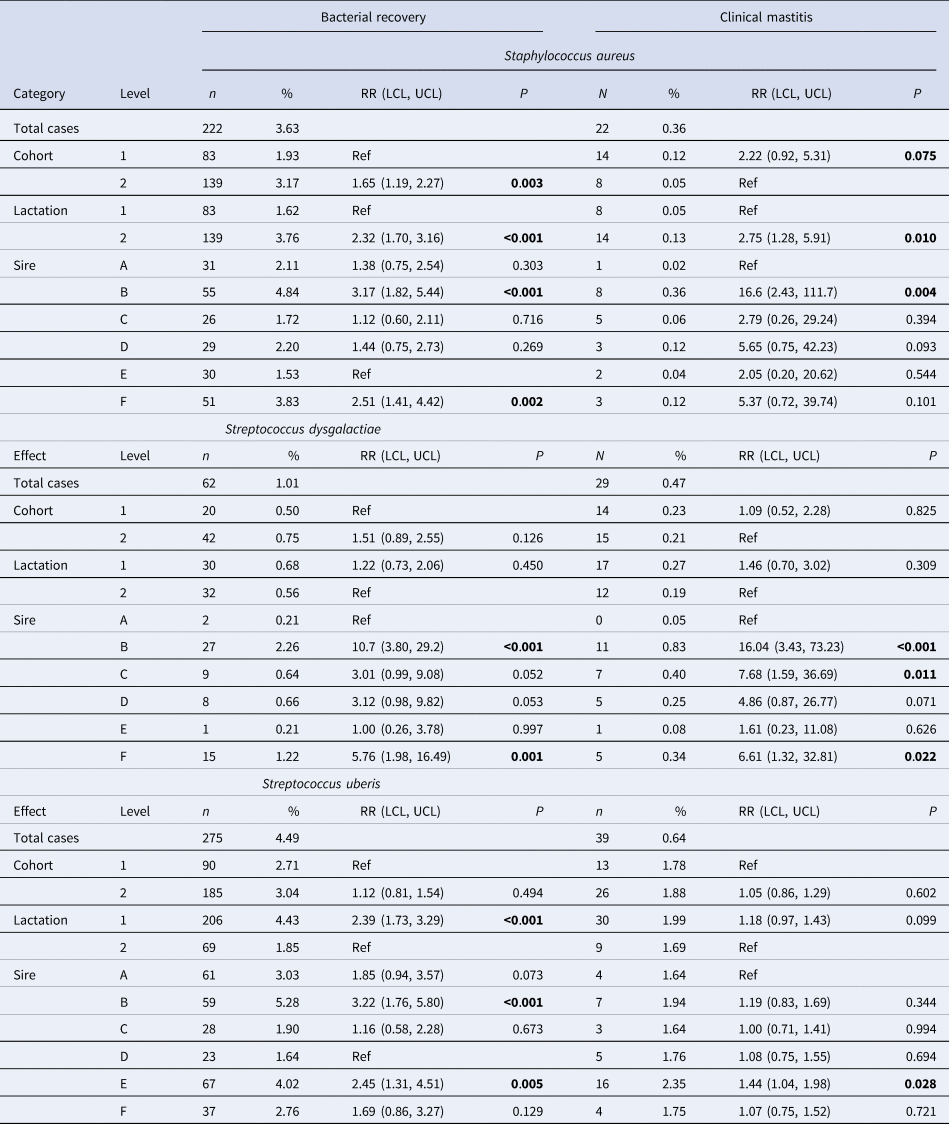
The association of sire with RR of a quarter developing a new IMI per lactation was significant at P < 0.001 for all major pathogens with sufficient data for analysis (i.e. S. aureus, Str. dysgalactiae and Str. uberis) as well as both minor pathogens (CNS and Corynebacterium spp.). For the RR of a quarter developing CM by specific pathogens, the association of sire was significant for S. aureus (P < 0.01) and Str. dysgalactiae (P < 0.001), but not for Str. uberis (P > 0.05).
Rankings of sires by RR differed by pathogen, such that the lowest (and therefore referent) sire was sire E for new IMI by S. aureus, sire D for new IMI by Str. uberis and sire A for new IMI by Str. dysgalactiae (Table 1). Compared with these referents, daughters of sires B and F had a significantly higher RR for new IMI by S. aureus and Str. dysgalactiae (RR > 2.51, P < 0.01), and daughters of sires B and E had a higher RR for new IMI by Str. uberis (RR > 2.45, P < 0.01). For CM cases (Table 1), daughters of sire A had the lowest likelihood of CM by all major pathogens whereas daughters of sire B had a significantly higher RR for CM due to S. aureus (RR = 16.6, P < 0.01). Daughters of sires B and C had a higher RR for CM due to Str. dysgalactiae (RR > 7.68; P < 0.01), and daughters of sire E had a higher RR for CM due to Str. uberis (RR = 1.44; P < 0.05).
Association of cohort, lactation number and sire with number of cases (n) and proportion (adjusted mean %) of quarter-lactations where a new IMI (bacterial recovery) or clinical mastitis involving Staphylococcus aureus, Streptococcus dysgalactiae or Str. uberis was detected

RR = relative risk, LCL = lower confidence limit, UCL = upper confidence limit, and Ref indicates the referent for within-category testing, across 6,120 quarter-lactations.
Values of P that achieve significance are in bold.
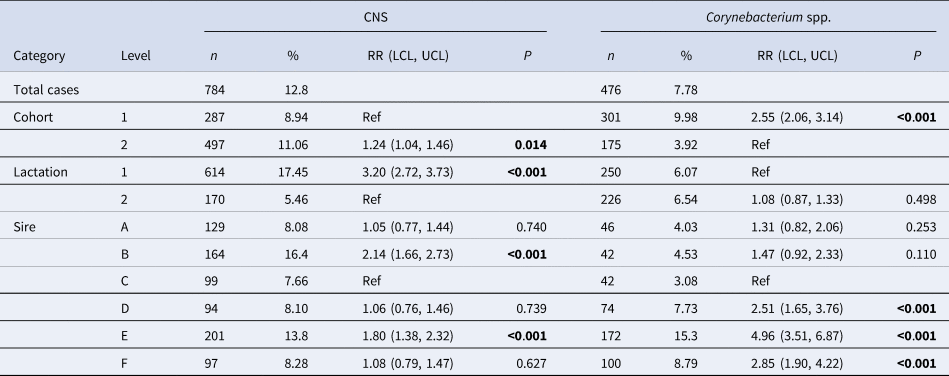
For new IMI by minor pathogens, the referent sire was sire C (Table 2) and daughters of sires B and E had a significantly higher RR for new IMI by CNS (RR > 1.80, P < 0.001), whereas daughters of sires D, E and F had a significantly higher RR for new IMI by Corynebacterium spp. (RR > 2.51, P < 0.001).
Association of cohort, lactation number and sire with number of cases (n) and proportion (adjusted mean %) of quarter-lactations where a new IMI (bacterial recovery) involving coagulase negative staphylococci (CNS) or Corynebacterium spp. was detected

RR = relative risk, LCL = lower confidence limit, UCL = upper confidence limit, and Ref indicates the referent for within-category testing, across 6,120 quarter-lactations.
Values of P that achieve significance are in bold.
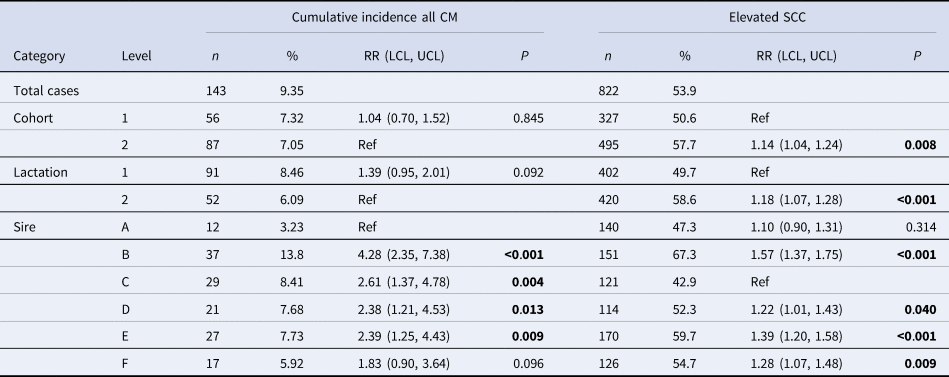
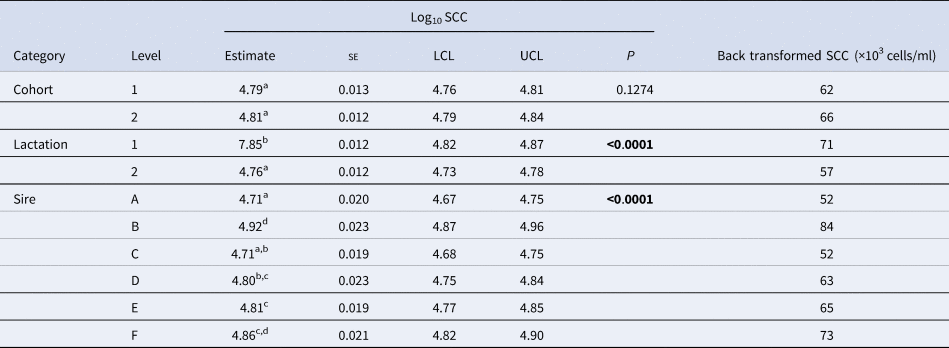
Cumulative incidence of all CM averaged 11.2% of 815 cows in lactation 1 and 7.3% of 715 cows in lactation 2 (non-significant numerical difference, P = 0.09), with similar proportions developing CM across the two cohorts (Table 3). For phenotypes generated at the cow level, there was a significant association between sire and cumulative incidence of all CM per cow per lactation (P < 0.001) and for the risk of a cow developing an elevated SCC during a lactation (P < 0.001; Table 3). Daughters of sire A had the lowest risk of CM, with only 4.2% of animals experiencing CM, whereas daughters of sires D, E, C and B had a two to four-fold higher relative risk of CM (R ≥ 2.38, P < 0.01), with incidences ranging from 9.5 to 16.6% of animals in a lactation. Daughters of sire C had the lowest proportion of cows with an elevated SCC, at 42.2%, whereas daughters of sires D, F, E and B had a significantly higher relative risk (RR ≥ 1.22, P < 0.05) of an elevated SCC, ranging from 52.3 to 67.7% of daughters (Table 3). There was also a significant association of sire with lactational average SCC (P < 0.001; Table 4), such that daughters of sires A and C had the lowest lactational average SCC (52 000 cells/ml when back-transformed), daughters of sires F and B the highest (73 000 and 84 000 cells/ml respectively) and daughters of sires D and E were intermediate.
Association of cohort, lactation number and sire with number of cases (n) and proportion (adjusted mean %) of cows that had one or more cases of clinical mastitis (CM) in their first or second lactation, or one or more elevated (>150 000 cells/ml) monthly somatic cell count (SCC), where monthly SCC results were averaged from 2 or more tests determined each month of lactation

RR = relative risk, LCL = lower confidence limit, UCL = upper confidence limit and Ref indicates referent for within-category testing, across 1530 cow-lactations (CM) or 1526 cow-lactations (SCC).
Values of P that achieve significance are in bold.
Association of cohort, lactation number and sire with lactational average log10 SCC, where monthly SCC results were generated from 2 or more tests determined each month of lactation, to give a total of 1526 cow-lactations

LCL = lower confidence limit; UCL = upper confidence limit.
Estimate is the equivalent test of relative risk for log-transformed data. Superscripts that differ indicate 2 × 2 contrasts that were significant at P < 0.05. Values of P that achieve significance are in bold.
Experimental challenge phenotype
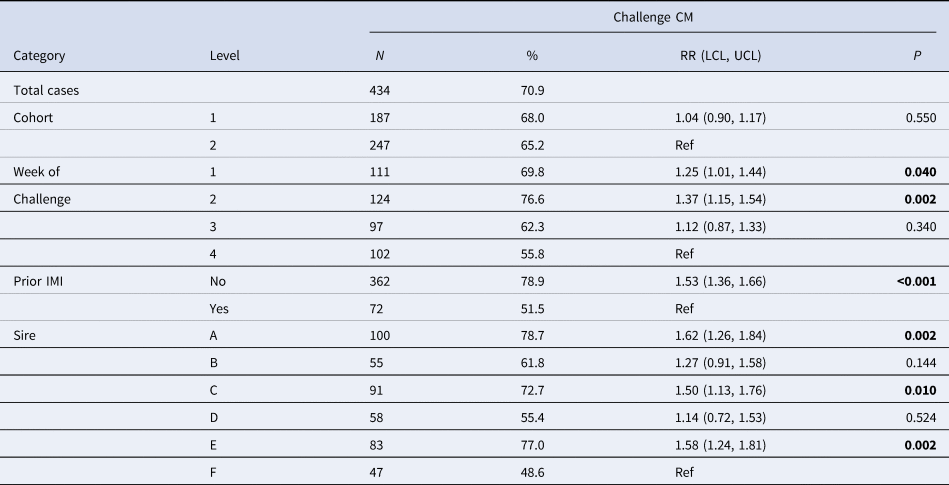
In their third lactation, 434 of the 612 (71%) experimentally challenged animals developed CM, with a similar rate observed across both cohorts (Table 5). No significant interactions were observed so main effects were tested in the RR analysis. Cows receiving their challenge in the 1st or 2nd weeks of the experimental period were more likely to develop CM compared to cows challenged in the 3rd or 4th weeks (RR > 1.25, P < 0.05). Absence of an existing infection detected within the same cow in any of her quarters at 3 d prior to her challenge was also associated with a higher rate of CM (RR = 1.53, P < 0.001).
Association of cohort and sire with number of cows (n) and proportion (adjusted mean %) of cows that developed clinical mastitis (CM) in response to a single intramammary infusion of Streptococcus uberis in one rear quarter, between 60–120 DIM in their third lactation

RR = relative risk; LCL = lower confidence limit, UCL = upper confidence limit, and Ref indicates referent for within-category testing, across a total of 612 cows.
Cows were assigned to one of 4 week-long challenge periods (week of challenge), with cows with longer-term pre-existing infections tending to be allocated to weeks 3 or 4. All cows were assessed for prior infection status (prior IMI) at 3 d immediately prior to challenge. Values of P that achieve significance are in bold.
The association of sire with RR of developing a CM was significant (P < 0.05), with daughters of sire F having the lowest rate of CM (54.7% of cows; Table 5). Compared with this referent, daughters of sires A, C and E had a significantly higher RR (RR ≥ 1.50, P < 0.01), with CM rates ranging from 76.1 to 82.0%, whereas daughters of sires B and D were intermediate, with CM rates of 61.1 and 65.2% respectively.
Sire rankings
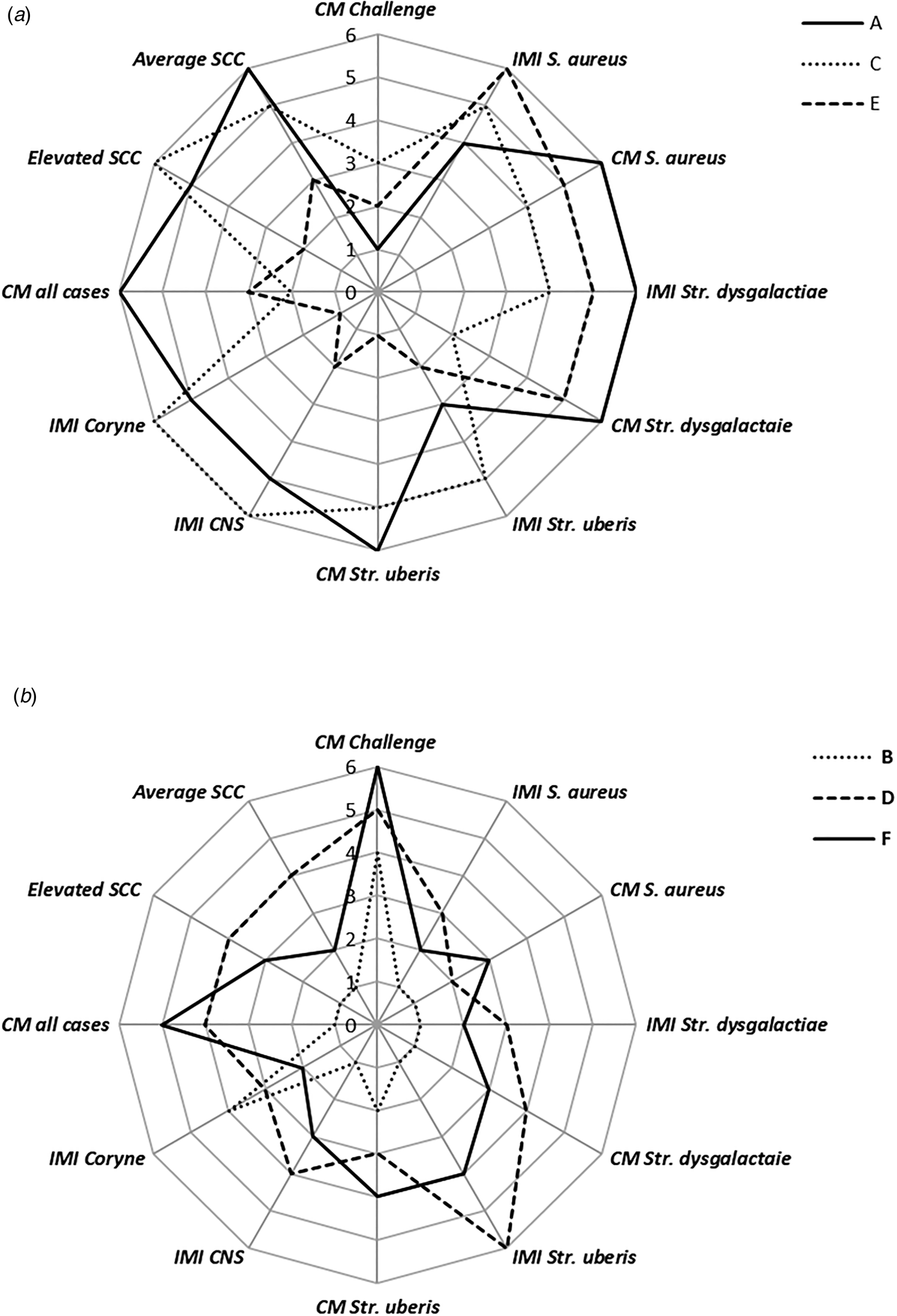
Consistent patterns emerged when sire rankings, based on RR, were compared across all quarter level and cow level phenotypes (Fig. 1). To emphasise the pattern of preferred sires, sires were ranked from 1 to 6, with 1 being assigned to the least favourable and highest RR result, and 6 to the most favourable and lowest RR. Daughters of sires A and C had a higher incidence of CM during the experimental challenge and were, therefore, ranked low (Fig. 1a), but generally performed more favourably for the phenotypes determined during their 1st and 2nd lactations. The converse was observed for daughters of sires B and F, which had a lower incidence of CM during the experimental challenge (Fig. 1b). Rankings for sire E were favourable for new IMI due to S. aureus or Str. dysgalactiae but were less favourable for Str. uberis, whereas the reverse was observed for sire F. Sire rankings for CM all cases generally reflected the pathogen-specific CM rankings, and rankings for SCC-related traits were similar to sire rankings observed for IMI due to Str. uberis, CNS and Corynebacterium.
Sire rankings, based on relative risk (RR), compared across all traits. Sires ranked from 1 to 6, where 1 was assigned to the highest RR result, and 6 to the lowest. Quarter level traits were: proportion of quarters across daughters that developed new intramammary infections (IMI) or clinical mastitis (CM) with Staphylococcus aureus, Streptococcus dysgalactiae or Streptococcus uberis, or IMI with CNS or Corynebacterium spp. in their first or second lactation. Cow level traits were: CM by any pathogen (CM all cases), monthly average somatic cell count >150 000 cells/ml (elevated SCC), lactational average log10 SCC (average SCC) or development of CM following an intramammary challenge with Str. uberis (CM challenge) in their third lactation. Sires that ranked 1, 2 or 3 for CM challenge shown in (a) and 4, 5 or 6 in (b).

Discussion
This unique pedigree-based research herd of crossbred dairy cows enabled testing of the hypothesis that sire rankings for phenotypes derived under natural challenge conditions would be predictive of sire rankings when daughters were exposed to an experimental challenge. Periodic milk samplings in their first two lactations enabled detailed profiling of pathogen-specific intramammary infections and CM in a seasonal pasture-based system, whereas the experimental challenge, applied to all cows surviving to their third lactation, enabled the association with sire to be compared across different disease states.
The results revealed that the opposite was actually true, so the null hypothesis was rejected. Nevertheless, sire rankings developed under natural conditions were somewhat predictive, albeit in a reverse order, for sire rankings for daughters during the experimental challenge. Consistent patterns of sire rankings across different pathogen-specific phenotypes and SCC-related phenotypes provide continued support for use of SCC-related traits as a proxy for pathogen-specific measures in sire selection schemes. Traits that support mastitis prevention will, in turn, support a reduction in antibiotic use on farm, and enhance cow health and welfare.
Use of this specifically bred herd (represented by six half-sibling families and, therefore, six sires and managed on the same farm, with the same parity and lactation stage throughout the monitoring period) reduced, as much as possible, the variation in many factors that contribute to occurrence of mastitis. The scale of the study, in terms of size of daughter families (Spelman et al., Reference Spelman, Miller, Hooper, Thielen and Garrick2001) and prevalence of infection in their first and second lactations proved sufficient to test for sire association effects across five pathogens that commonly cause IMI in pasture-based systems. This is despite second parity animals typically experiencing a lower incidence of mastitis (Steeneveld et al., Reference Steeneveld, Hogeveen, Barkema, van den Broek and Huirne2008), compared with first parity or later parity animals. The lack of interaction observed between sire and cohort confirmed that pathogen-specific differences were consistently exhibited across both cohorts of daughters, whilst the lack of interaction of sire and lactation suggests that beneficial attributes conferred by each sire apply for at least the first and second parities of a cow, which agrees with reports that heritability estimates for clinical mastitis across the first and later lactations are correlated (Martin et al., Reference Martin, Barkema, Brito, Narayana and Miglior2018). The detailed nature of the bacteriology, coupled with the power and rigour of the experimental challenge protocol, which achieved the desired 70% incidence of CM (Sanders et al., Reference Sanders, McDougall, Stanley, Johnson, Spelman and Harcourt2006; Littlejohn et al., Reference Littlejohn, Turner, Walker, Berry, Tiplady, Sherlock, Sutherland, Swift, Garrick, Lacy-Hulbert, McDougall, Spelman, Snell and Hillerton2018), enabled sire association effects to be compared across different aetiologies of the disease, especially for Str. uberis, the most frequent cause of clinical mastitis in pasture-based systems (McDougall et al., Reference McDougall, Arthur, Bryan, Vermunt and Weir2007).
The prevalence of different pathogens indicated that the herd was managed according to typical commercial standards. Streptococcus uberis being the most frequent cause of IMI in the herd was consistent with New Zealand pastoral farming systems (McDougall et al., Reference McDougall, Arthur, Bryan, Vermunt and Weir2007). The growing prevalence of Corynebacterium spp. being isolated through lactation, as well as S. aureus and Str. dysgalactiae, would suggest that mastitis management was of a typical, rather than superior standard. Despite many years of farmer extension about the value of post-milking teat disinfection (Bramley et al., Reference Bramley, Kingwill, Griffin and Simpkin1976; Hillerton et al., Reference Hillerton, Staker and Shearn1995) and teat skin condition (Neave et al., Reference Neave, Dodd, Kingwill and Westgarth1969), these pathogens continue to be problematic for many dairy farms. Identifying sires that confer beneficial attributes across a variety of mastitis pathogens is highly relevant to NZ dairy herds, and for pastoral dairy farming systems typified by early lactation Str. uberis IMI and mid lactation S. aureus IMI.
Variations in occurrence of IMI by cohort and by lactation were expected. Presence of Str. uberis in the environment can vary in relation to season and climatic factors in a pasture-based dairy herd (Lopez-Benavides et al., Reference Lopez-Benavides, Williamson, Pullinger, Lacy-Hulbert, Cursons and Leigh2007), and incidence of CM has been associated with fluctuations in the temperature-humidity index (Morse et al., Reference Morse, DeLorenzo, Wilcox, Collier, Natzke and Bray1988). New IMI profiles for the most common pathogens in NZ followed expected patterns, with CNS and Str. uberis being the more commonly isolated pathogens in the first lactation (Pankey et al., Reference Pankey, Pankey, Barker, Williamson and Woolford1996; McDougall et al., Reference McDougall, Arthur, Bryan, Vermunt and Weir2007) and declining in prevalence in the second lactation. In contrast, the prevalence of infection due to S. aureus, Str. dysgalactiae and Corynebacterium spp. was low in the first lactation (Pankey et al., Reference Pankey, Pankey, Barker, Williamson and Woolford1996; McDougall et al., Reference McDougall, Arthur, Bryan, Vermunt and Weir2007), but was higher in the second lactation (De Vliegher et al., Reference De Vliegher, Fox, Piepers, McDougall and Barkema2012).
Prevalence of new IMI (regardless of pathogen) was significantly influenced by sire, thus supporting a genetic basis for likelihood of new IMI. Daughters of sire B were consistently more at risk of developing a new IMI or CM, whereas daughters of sire A had the lowest RR for developing a new CM, at least with a major pathogen. The sire that conferred lowest susceptibility across major pathogens was less consistent, but daughters of sires A and C had a consistently lower RR than other sires for new IMI by any of the pathogens. Previous studies have reported that the incidence of CM may be influenced, at least in part, by genetic variation (Rupp and Boichard, Reference Rupp and Boichard2003; Martin et al., Reference Martin, Barkema, Brito, Narayana and Miglior2018). For sires that consistently demonstrated a low RR for new IMI as well as new CM, our results suggest genetic influences may impact both the generic defence mechanisms associated with the teat duct (which prevent bacteria entering the teat duct: Lacy-Hulbert and Hillerton, Reference Lacy-Hulbert and Hillerton1995; Paduch et al., 2013; Smolenski et al., Reference Smolenski, Cursons, Hine and Wheeler2015) as well as the innate immunity, which impacts the inflammatory response and subsequent disease progression. In contrast, daughters of sire E ranked low for RR of new infections by S. aureus and Str. dysgalactiae but ranked high for infections by Corynebacterium spp., as well as infections by environmental pathogens such as Str. uberis and CNS. Contagious and environmental bacteria vary in their ability to colonise the teat canal prior to a gland infection (Bramley et al., Reference Bramley, King, Higgs and Neave1979) hence, for this sire at least, the genetic influence may be operating more at the teat duct level.
Our study outcomes support different genetic-linked mechanisms underpinning natural resistance to infection. Pan et al. (Reference Pan, Yan, Rojas, Shebzukhov, Zhou, Kobzik, Higgins, Daly, Bloom and Kramnik2005) reported a genetic locus, and candidate gene, that was associated with different macrophage responses towards Mycobacterium tuberculosis and Listeria monocytogenes. Narayana et al. (Reference Narayana, Schenkel, Miglior, Chud, Abdalla, Naqvi, Malchiodi and Barkema2021) detected sizeable genetic variation for pathogen-specific IMI phenotypes, indicating that genetic selection for pathogen-specific IMI could improve resistance to a particular pathogen. Additionally, Haugaard et al. (Reference Haugaard, Tusell, Perez, Gianola, Whist and Heringstad2013) determined different genetic correlations for the prevalence of different contagious pathogens, suggesting that pathogen load or teat canal entry mechanisms play an important role. Therefore, genetic influence must vary widely, according to morphology and immune function. Ranking of sires using cow-level SCC and CM phenotypes aligned well with pathogen-specific phenotypes. Despite minor pathogens having a lesser impact on cow SCC compared with major pathogens (Schepers et al., Reference Schepers, Lam, Schukken, Wilmink and Hanekamp1997), the higher prevalence of minor pathogens across a population of cows may account for the strong alignment between cow SCC phenotype and the minor pathogen new IMI phenotypes. Nevertheless, the similarity of pathogen-specific sire rankings to rankings associated with CM and SCC traits validates the inclusion of SCC phenotypes as a proxy for resistance to mastitis in sire selection schemes.
Sire rankings altered considerably for sires A, B and C once cows were exposed to an intramammary challenge with Str. uberis. Progression to a CM following a teat canal or intramammary challenge has been associated with many factors, including presence of elevated SCC or presence of another infection (Sanders et al., Reference Sanders, McDougall, Stanley, Johnson, Spelman and Harcourt2006; Littlejohn et al., Reference Littlejohn, Turner, Walker, Berry, Tiplady, Sherlock, Sutherland, Swift, Garrick, Lacy-Hulbert, McDougall, Spelman, Snell and Hillerton2018), age and other cow-related factors (Turner et al., Reference Turner, Williamson, Lacy-Hulbert and Hillerton2013). The lower ranking of sire B in response to the challenge may reflect a confounding of the susceptibility of his daughters to natural IMI, providing a protective effect against subsequent challenge, whereas the low incidence of prior infections for daughters of sires A and C may have compromised the ability of the immune system to recognise and neutralise bacteria when inserted beyond the protective barrier of the teat canal. Some sires may lead to daughters that are better able to resist infection at the teat canal level, whilst others may be better at influencing the ability of a cow to respond to a challenge in the udder. A preferred sire (e.g. Sire A or C) would be one that provides daughters that can better resist at the teat canal level, and then mount a good and visible, and potentially more effective response in the long term, once bacteria enter the mammary gland.
This study validates inclusion of SCC in sire evaluation schemes to achieve genetic improvements in mastitis resistance, despite mastitis being a disease attributed to many different pathogens. The findings revealed that certain sires were consistently better than others in terms of their ability to influence a cow's ability to resist new infections following natural challenge. Indeed, some years after completion of the study, the Somatic Cell BV for sires A and C remains at −0.33 with >97.4% reliability, in contrast to sire B (0.83 at 96.5% reliability) with sires D, E, and F having intermediate figures (0.21, 0.38 and 0.47 respectively at >95.9% reliability; accessed from NZAEL, May 2022). Based upon these outcomes, we suggest that a significant advantage in minimising IMI would result from using sire A or C, and avoiding sire B, in breeding programmes.
In conclusion, our study indicates that the genetic basis of resistance is generally similar across contagious and environment pathogens and validates inclusion of SCC phenotypes as a proxy for IMI in sire evaluation schemes. It is questionable whether more value would be achieved, in terms of improving selection of dairy cows for improved resistance to CM, by including pathogen-specific phenotypes in herd breeding schemes. Nevertheless, identification of phenotypic variation across different mastitis pathogens and states of udder health, as well as sire association, provided valuable insights to the genetic basis for innate resistance against IMI due to different pathogens.
Supplementary material
The supplementary material for this article can be found at https://doi.org/10.1017/S0022029924000682
Acknowledgements
The study was funded by the New Zealand Ministry of Business, Innovation and Employment (MBIE) and by New Zealand dairy farmers through DairyNZ Inc. The cross-bred trial was funded by Fonterra Co-operative Group and LIC. Scientific collaboration and discussions with Matt Littlejohn (LIC) and Sarah Knowles (Auckland War Memorial Museum) are gratefully acknowledged.