In recent years, teaching has been shown to be one of the professions with the highest levels of job stress (Serrano, Moya-Albiol, & Salvador, Reference Serrano, Moya-Albiol and Salvador2008; Stoeber & Rennert, Reference Stoeber and Rennert2008). Consequently, teachers at primary and secondary schools frequently report experiencing decreased job satisfaction and also burnout (Hakanen, Bakker, & Schaufeli, Reference Hakanen, Bakker and Schaufeli2006; Moya-Albiol, Serrano, & Salvador, Reference Moya-Albiol, Serrano and Salvador2010), with the latter being considered a form of job stress (Hansen, Larsen, Rugulies, Garde, & Knudsen, Reference Hansen, Larsen, Rugulies, Garde and Knudsen2009).
Work-related stress has been amply conceptualized by means of the demand–control model (DC model, Evolahti, Hultcrantz, & Collins, Reference Evolahti, Hultcrantz and Collins2006), which identifies job demands and job control as the two crucial dimensions of the work environment that explain job strain. Specifically, this model proposes that work strain is caused by the combination of high psychological demands and low decision latitude (Karasek & Theorell, Reference Karasek and Theorell1990). According to this model, the negative impact of high job demands on health and subjective well-being could be buffered by high levels of job control (Hausser, Mojzisch, & Schulz-Hardt, Reference Hausser, Mojzisch and Schulz-Hardt2011). In the case of teachers, the job strain seen from the DC model could be understood as a loss of balance between teaching demands, including contents and discipline, and personal teaching resources (Serrano et al., Reference Serrano, Moya-Albiol and Salvador2008).
Another important psychological construct in the work stress literature is burnout. It has been conceptualized as a psychological syndrome that takes place in response to chronic interpersonal stressors on the job (Maslach, Leiter, & Schaufeli, Reference Maslach, Leiter, Schaufeli, Cooper and Cartwright2008). These authors describe it as being composed of three dimensions: emotional exhaustion (feelings of being over-extended and exhausted of one’s emotional resources), depersonalization (negative and impersonal responses to other people) and reduced personal accomplishment (decline in one’s feeling of competence and successful achievement at work). Emotional exhaustion is commonly considered the core symptom of the burnout syndrome (Hokonen et al., Reference Hokonen, Ahola, Pertovaara, Isometä, Kalimo, Nykyri and Lönnqvist2006; Shirom, Reference Shirom, Quick and Tetrick2003). Burnout in teachers is increasingly observed in western countries. It is reflected in negative attitudes and responses toward students and the wish to change or leave their profession (Moya-Albiol et al., Reference Moya-Albiol, Serrano and Salvador2010).
Psychoendocrinological consequences of job strain and burnout
Both job strain and burnout are related to chronic stress. Specifically, working under chronic stressful conditions (job strain) would affect different psychobiological responses (hormonal and cardiovascular) that could lead to different pathologies, such as cardiovascular diseases, endocrine syndromes or burnout (Serrano, Moya-Albiol, & Salvador, Reference Serrano, Moya-Albiol and Salvador2009). For this reason, some studies indicate that both syndromes produce neuroendocrine modifications in men and women, mainly in the hypothalamo-pituitary-adrenocortical axis (HPA) (Moya-Albiol et al., Reference Moya-Albiol, Serrano and Salvador2010), with their final product being cortisol, a reliable marker of the stress response (Dahlgren, Kecklund, Theorell, & Akerstedt, Reference Dahlgren, Kecklund, Theorell and Akerstedt2009) that has been linked to detrimental effects on health (Lundberg, Reference Lundberg2005).
Cortisol
Cortisol follows a circadian rhythm and tends to be higher in the morning than in the evening. However, prolonged and heightened cortisol activation has been found to be associated with several negative effects, including impairments in cognitive processes, such as memory (Almela et al., Reference Almela, Hidalgo, Villada, Espín, Gómez-Amor and Salvador2011; Wolf, Reference Wolf2009) or emotional adjustment (Chida & Steptoe, Reference Chida and Steptoe2009), as well as immune function disorders and hypertension (Leonard, Reference Leonard2000; McEwen, Reference McEwen1998). Although the exact pathways linking cortisol to illness are still unclear, it can be regarded as an important pre-clinical biological marker of ill-health (Gendolla, Richter, & Silvia, Reference Gendolla, Richter and Silvia2008).
A recent review of the association between cortisol, in serum and in urine, and the psychosocial working environment, considering demands and control as important elements of the latter, found inconsistent results (Hansen et al., Reference Hansen, Larsen, Rugulies, Garde and Knudsen2009). Indeed, in most of the studies reviewed there was a lack of association (11 of 23 studies), with a positive one in 9 studies and a negative association in the other 3 studies. Almost all of these studies included men and women, showing that the association between salivary cortisol (Csal) and job stress is inconsistent (Evolahti et al., Reference Evolahti, Hultcrantz and Collins2006; Kunz-Ebrecht, Kirschbaum, Marmot, & Steptoe, Reference Kunz-Ebrecht, Kirschbaum, Marmot and Steptoe2004). Stress symptoms associated with elevated Csal levels in the evening have been described in office workers (Dahlgren et al., Reference Dahlgren, Kecklund, Theorell and Akerstedt2009), and a high daytime Csal level was related to higher ratings of stress in teachers (Davydov, Shapiro, Goldstein, & Chicz-DeMet, Reference Davydov, Shapiro, Goldstein and Chicz-DeMet2007). Negative daily events and stress have been found to affect diurnal patterns of stress hormone levels, as shown by a drop in values to below “normal”, following an increase in values to above normal (Vedhara et al., Reference Vedhara, Miles, Bennett, Plummer, Tallon, Brooks and Farndon2003). Thus, although a positive correlation between job strain and Csal concentrations on a working day has been described (Steptoe, Cropley, Griffith, & Kirschbaum, Reference Steptoe, Cropley, Griffith and Kirschbaum2000), in a population-based study this relationship was not supported (Alderling, Theorell, de la Torre, & Lundberg, Reference Alderling, Theorell, de la Torre and Lundberg2006).
A similar picture appears in the case of burnout studies including participants of both sexes. For instance, higher Csal levels during a working day in people with high burnout scores have been reported (Melamed et al., Reference Melamed, Ugarten, Shirom, Kahana, Lerman and Froom1999), but a lack of relationship between burnout and Csal levels has also been described (Mommersteeg, Heijnen, Kavelaars, & van Doornen Reference Mommersteeg, Heijnen, Kavelaars and van Doornen2007; Moya-Albiol et al., Reference Moya-Albiol, Serrano and Salvador2010). Indeed, methodological differences between studies have resulted in mixed results in the literature, which makes the search for consistent biomarkers for burnout difficult. In this sense, 71% of the studies used a questionnaire, the Maslach Burnout Inventory (MBI), to investigate burnout, while the rest used other surveys with different theoretical bases or the Shirom-Melamed Burnout Questionnaire (SMBQ). Some studies used medically-diagnosed patients, and almost all of them used cross-sectional designs. Moreover, some studies used different sample times and focused on the Cortisol Awakening Response (CAR) rather than on Csal during the working day (Danhof-Pont, Van Heen, & Zitman, Reference Danhof-Pont, Van Heen and Zitman2011). Thus, the inconsistent results make it necessary to further examine the role of job strain and burnout in Csal levels during working days, using homogenous samples and employing follow-up approaches.
Testosterone and ratio Testosterone/Cortisol
However, chronic stress affects many other neuroendocrine systems in addition to the HPA axis, such as the Hypothalamic-pituitary-gonadal (HPG) Axis. Testosterone (T), as a product of the HPG axis, follows a circadian rhythm, and is higher in the morning and lower in the evening. It is also a robust physiological indicator for the anabolic processes that have also been associated with lower levels of job strain. T is expected to decrease in an adverse psychosocial work environment. Hansen et al. (Reference Hansen, Larsen, Rugulies, Garde and Knudsen2009) reported that out of a total of 9 studies, 6 of them, employing men, women or both, found that serum T decreased when the psychosocial working environment was perceived as adverse. However, two longitudinal studies and one cross-sectional study, including men and women, showed no association (Hansen et al., Reference Hansen, Larsen, Rugulies, Garde and Knudsen2009). These authors concluded that the association between T in serum and the psychosocial working environment is quite robust. However, no differences in T have been found when comparing women under occupational stress and controls (Asberg et al., Reference Asberg, Nygren, Leopardi, Rylander, Peterson, Wilczek and Ekman2009). Specifically, no studies with teachers have been performed using T samples. In addition, it is worth noting that the anabolic system goes down when exposed to stress, whereas the catabolic system goes up, and this effect has not yet been tested for work stress. To assess this aspect, the salivary T (Tsal)/Csal ratio could be used as an indicator of the balance between anabolism and catabolism, in line with the research on physical activity, where it is used as a good index of adaptation to the physical stress of the training workload (Adlercreutz et al., Reference Adlercreutz, Härkönen, Kuoppasalami, Näveri, Huhtaniemi, Tikkanen and Kervonen1986; Pablos-Abellá et al., Reference Pablos-Abellá, Navarro-Cabello, Salvador, Benavent-Mahiques, González-Bono, Chillarón-García, Martí-Calatayud and Hernández-Vázquez1999). Nevertheless, to our knowledge this ratio has never been used in work contexts; in our opinion, this index could show a balance in the adaptive process to stress in the job context, and it might be a good tool for showing workers’ physiological adaptation to work stress.
Mood
It is possible that Job Strain and burnout mainly exert their effects by altering the homeostasis of the endocrine system. Thus, the use of self-reports to measure psychological stress during working days, in order to link them to physiological indexes, would provide considerable information about mediators that lead to health changes. Stress perception and mood are affected by daily situations, and teachers have been shown to have worse moods on working days than on non working days (Moya-Albiol et al., Reference Moya-Albiol, Serrano, Salvador, González-Bono and Rodríguez-Alarcón2005; Serrano et al., Reference Serrano, Moya-Albiol and Salvador2008). However, few studies have found a relationship between cortisol levels and mood, even though HPA activation is related to stress (De Vries, Glasper, & Detillon, Reference DeVries, Glasper and Detillion2003). When Csal is measured in job stress studies, teachers exhibit significantly greater cortisol excretion during high stress periods (Ritvanen, Louhevaara, Helin, Väisänen, & Hänninen, Reference Ritvanen, Louhevaara, Helin, Väisänen and Hänninen2006). However, in the case of burnout there has not been much research on the effects of burnout on mood states in teachers during working days, even though burnout syndrome is an emotional syndrome.
The majority of the studies on job stress and burnout have focused on negative aspects, specifically on their negative consequences (Kokkinos, Reference Kokkinos2007; Liu & Onwuegbuzie, Reference Liu and Onwuegbuzie2012, Liu & Ramsey, Reference Liu and Ramsey2008;). In fact, work-stress intervention studies have focused on management programs (including relaxation techniques, anger management, overcommitment or counseling), job redesign or restructuring. However, from a positive psychology point of view it would be interesting to study more positive personal aspects, such as job satisfaction (Demirtas, Reference Demirtas2010) or job control (Chiang, Birtch, & Kwan, Reference Chiang, Birtch and Kwan2010), that would help to neutralize the negative effects of work stress. Thus, it is necessary to examine the roles of positive mood, coping styles or engagement, and how these factors are related to physiological changes.
Gender differences
Most job stress studies have been conducted on men. However, women may experience different stressors, have different stress perceptions, or react differently to stress compared to men (Hallman, Perski, Burell, Lisspers, & Setterlind, Reference Hallman, Perski, Burell, Lisspers and Setterlind2002; Kirschbaum, Wust, & Hellhammer, Reference Kirschbaum, Wust and Hellhammer1992). One of the most consistent findings from studies employing short-term laboratory stress tasks is the significantly larger salivary cortisol response in healthy adult men compared to women (Kudielka, Hellhammer, & Wüst, Reference Kudielka, Hellhammer and Wüst2009). In the case of T, it is well-known that women have less T than men, although the magnitude of the T response to stress is not clear.
Taking all this into account, we aimed to investigate the effects of job strain and burnout on mood and on the activity of the HPA and HPG axes, by means of Csal and Tsal, respectively, in a group of female teachers during two different working days. For this purpose, mood scores, as well as Csal, Tsal and the Tsal/Csal ratio, were measured before and after two working days (one at the beginning and one at the end of an academic year). We hypothesized a specific association between the job strain and burnout subscales and psychobiological indexes during a working day. Thus, negative subscales (demands, emotional exhaustion and depersonalization) would be positively related to negative mood and to Csal, whereas positive subscales (control and personal accomplishment) would be positively related to Tsal and positive mood. Finally, for the Tsal/Csal ratio, as an adaptation index, we hypothesized a negative relationship with the negative aspects of job strain and burnout, and a positive relationship with the positive aspects.
Methods
Participants
The final sample was composed of 34 full-time female school teachers with a mean age of 40.31 years (SD = 9.05) and a mean body mass index (BMI) of 22.77 Kg/m2 (SD = 3.22). With regard to psychosocial characteristics, all the women were civil servants, with a mean of 16.4±9.16 years of teaching experience, and they were married or lived with a partner.
A total of 5 different schools took part in the investigation (11, 7, 7, 5 and 4 teachers per school). The schools were selected by taking into account different criteria such as the educational level of the students and the area in which they were located. Both of these variables could influence the level of stress perceived by the teachers. Thus, all the schools were public schools with similar characteristics, and there were no differences in the sociodemographic level of the students. After contacting the schools, an interview with each principal was held in order to explain the procedure and characteristics of the study. Teachers gave written informed consent for participation in the study and received no monetary incentive. Participants were initially screened using a general questionnaire to evaluate habits, health aspects and drug intake. The sample was selected from a larger one composed of 80 subjects; those who smoked, were not medication-free, used oral contraceptives or had any illness were eliminated. Moreover, two women’s data were not considered because they were pregnant when the experiment was carried out. The age range of the pupils was from 4 to 14 years old.
Procedure
In order to recruit participants, an informative meeting was programmed for teachers from each school, and brief, general information was provided. Afterwards, in each school, appointments were made with the group of teachers who voluntarily decided to participate in the study. The experimental protocol consisted of two working days (WD): one at the beginning and one at the end of an academic year, specifically in November and May. These months were chosen because teachers’ work-loads are similar and both months have the same number of holidays (there are no long holiday periods near these days). All participants were questioned and evaluated on the same psychological and endocrine aspects twice during each WD. Participants were told to arrive half an hour before starting their working day, between 7:30 and 8:30 AM, approximately, depending on their timetables. They did not eat, take caffeine or alcohol or smoke from awakening to the test (and before the second sample), and they did not train or exercise 36 hours before arriving at school. First, participants provided the first salivary sample and indicated their level of positive and negative mood by means of the Positive Affect and Negative Affect Scale (PANAS, Watson, Clark, & Tellegen, 1988). Afterwards, they were informed about the next appointment, which coincided with the end of the working day. From this moment on, teachers carried out their usual work-day activities. Between 16:30 and 17:30 hours, coinciding with the end of the WD, each teacher attended the second meeting, where a saliva sample was collected, along with the evaluation of mood over the last two hours. On both days, a battery of trait questionnaires, which included the Job Content Questionnaire and the Maslach Burnout Questionnaire (MBI), was given to each participant. During both working days, researchers were present in the schools in order to clarify teachers’ doubts or questions.
Psychological measures during the WD
Mood was evaluated with the PANAS questionnaire, which is composed of 20 items. Half of the items yield a global score of positive mood, and the other half measure negative mood. Positive mood refers to feelings of enthusiasm, activity, state of alertness and energy. Negative mood refers to a general dimension of subjective distress, which includes a variety of aversive emotional states, such as discomfort, anger, guilt, fear and nervousness. The questionnaire’s two-dimensionality has been confirmed in Spanish samples (Sandín et al., Reference Sandín, Chorot, Lostao, Joiner, Santed and Valiente1999), with a reliability (Cronbach alpha) of .89 and .91 for positive and negative mood, respectively.
To evaluate job strain, a short form of the Karasek questionnaire was used (Karasek & Theorell, Reference Karasek and Theorell1990), the Job Content Questionnaire (Steptoe, Cropley, Griffith, & Joekes, Reference Steptoe, Cropley, Griffith and Joekes1999). It is divided into two subscales: job demands and job control. A total score for job strain was obtained following this procedure: (job demands/[job control + use of abilities]/2)*10. Cronbach alpha for total score of job strain is .66, while for demands and control are .80 and .70 respectively.
Burnout was assessed by the MBI, composed of 16 items distributed in three subscales: emotional exhaustion, depersonalization and reduced personal accomplishment (Maslach & Jackson, Reference Maslach and Jackson1986). The Spanish version of the Maslach Burnout Questionnaire (MBI) was employed (Moreno-Jimenez, Rodríguez-Carvajal, & Escobar, Reference Moreno-Jimenez, Rodríguez-Carvajal and Escobar2001). Total burnout, emotional exhaustion, depersonalization and personal accomplishment have a validity score of .85, .89, .84, and .85, respectively.
Hormonal Determinations
Participants were informed about the need to follow the instructions about the time schedule for saliva sampling in order to obtain valuable data. Two saliva measures were taken during the WD (at the beginning and at the end). These saliva samples were picked up by an investigator and frozen the same day the sample was taken. Saliva was directly collected from mouth to tube (tube type: Unitek R). Samples were centrifuged (5000 rpm, 15+2°C) and frozen at –20°C until determination by radioimmunoassay (RIA) at our laboratory (Central Research Unit, Faculty of Medicine, Universitat de Valencia, Spain). Samples from each subject were run in duplicate in the same assay.
Csal was determined by a commercial kit adapted as recommended in the protocol (Orion Diagnostica, Espoo, Finland). A 125I-cortisol tracer and a high specific antibody were used. Csal levels were expressed in nmol/l, the sensitivity was 1 nmol/l, and internal and external controls were included in the assays.
For Tsal, RIA analyses were performed using a radioactive tracer 125I with a high specific antibody from a commercial kit (ICN Biomedicals, Costa Mesa, CA). Tsal levels are expressed in pmol/l. Good precision was obtained, with intra and interassay variation coefficients below 5%.
More details about hormonal determination have previously been described elsewhere (González-Bono, Salvador, Serrano, & Ricarte, Reference González-Bono, Salvador, Serrano and Ricarte1999).
Statistical analysis
Taking into account that there was a period of six months between the two WDs, and there were no follow-up measures, we have analyzed each WD separately. Thus, for each WD, repeated-measures ANCOVAs were performed for mood (positive and negative mood) and Csal, Tsal and Tsal/Csal ratio levels during the WD, with ‘time’ (at the beginning (1), and at the end (2) of the WD) as within-subjects factor. Job strain, burnout and their dimensions were included as covariate factors. In tests with endocrine variables, age and BMI were also included as covariates. When covariate factors were significant, Spearman rank correlations were performed in order to explore the direction of the significance. Moreover, repeated measures ANOVAS were performed to compare job strain, burnout, mood, Csal, Tsal and Tsal/Csal ratio levels between two WDs; Greenhouse-Geisser adjustments for degree of freedom were employed where appropriate. Hormonal variables were normalized, and the significance levels for correlations were adjusted for multiple tests, being more conservative, accepting only significance levels under .01. All variables proved to be independent (runs test) and homogenous (Levene test). In the case normality, all variables were normally distributed, except negative mood. For this variable power analyses and effect size have been took into account for interpretation. All analyses were performed by the SPSS 17.0 for Windows. Mean values in the text are expressed as mean + SD. The alpha level was fixed at .05.
Results
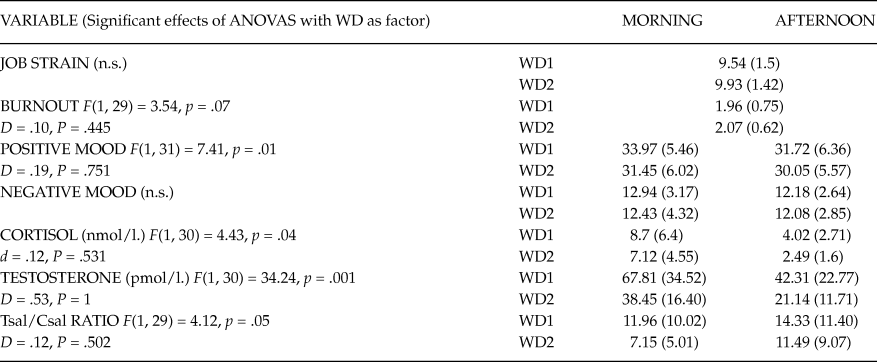
The results are organized in two sections, analyzing the effects of job strain and burnout on mood and hormonal responses to each WD separately. In our sample, validity scores for job strain and burnout were .719 and .898, respectively. General analyses for the total score and for specific subscales of the two psychological dimensions are presented, describing only significant factor effects. Means and SD of job strain, burnout, mood scales and hormones are presented in table 1. There were no statistically significant differences between job strain and burnout between WDs, although both scores were higher on WD2, with burnout showing a marginal effect. However, positive mood and Tsal, Csal and Tsal/Csal ratio levels were significantly lower at the end of academic year (see Table 1).
Mean (SD) of job strain, burnout, mood scores and hormonal levels at the beginning and end of the two WDs

D = effect size; P = power.
Mood and hormonal responses during the WDs depending on the Job Strain scores
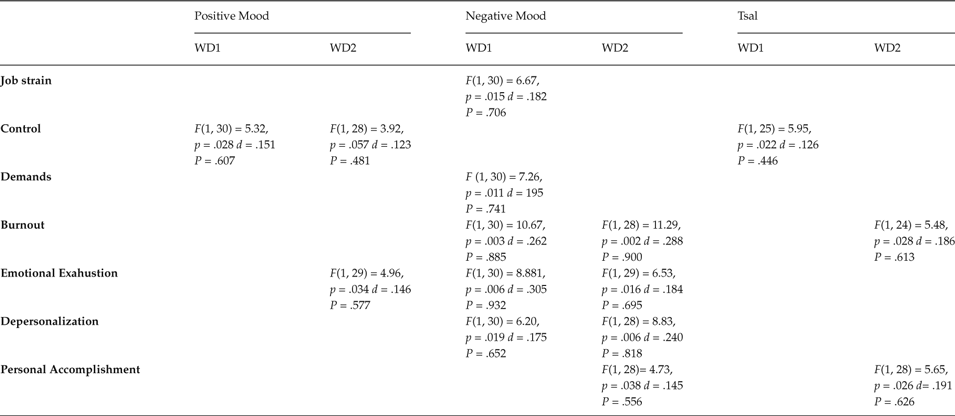
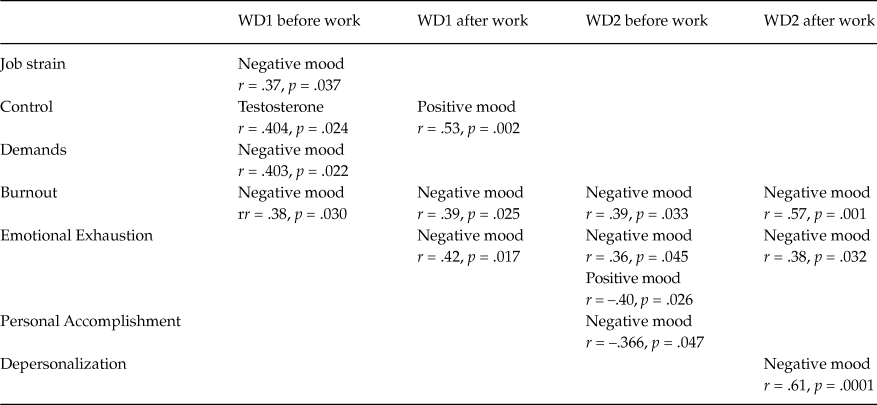
For positive mood, there was a significant effect of the “control” subscale on WD1 and a marginal effect on WD2 (see Table 2). ”Control” correlated positively with mood only at the end of WD1 (see Table 3).
Summary of significant ANCOVAS on the two WDs

D = effect size; P = power.
Summary of covariates that correlated significantly with dependent variables on the two WDs

For negative mood, “total job strain” had a significant effect on WD1, being positively related to mood at the beginning of this WD. When analyzing the two subscales of the questionnaire separately, “demands” proved to also have a significant effect, showing a positive correlation between this subscale and negative mood at the beginning of WD1.
For Csal, no significant effects of Job Strain were found.
In the case of Tsal, the “control x time of day” interaction proved to be significant on WD1. Post hoc analyses showed a positive correlation between Tsal at the beginning of WD1 and the “control” subscale.
Regarding the Tsal/Csal ratio, no significant effects were found.
To summarize, “control” had a significant effect on positive mood and Tsal, while “total job strain” and “demands” had a significant effect on negative mood on WD1. No significant effects were found on WD2 (tables 2 & 3).
Mood and hormonal responses during the WDs depending on the burnout scores.
For positive mood, no significant effects were found for “total burnout” on the two WDs. When each subscale was analyzed separately, a significant effect was found for “emotional exhaustion” on WD2. Post hoc analyses showed that only “emotional exhaustion” correlated significantly and negatively with positive mood, with this correlation being found at the end of WD2. Finally, no significant effects were obtained for the “depersonalization” subscale.
In the case of negative mood, “total burnout” had a significant effect on WD1, with post hoc analyses showing a consistent and significant correlation between burnout and negative mood throughout WD1. Consistent with these results, the “emotional exhaustion” and “depersonalization” subscales showed a significant effect, but post hoc analyses indicated that only “emotional exhaustion” was positively related to negative mood at the end of WD1. In the case of negative mood, on WD2 “total burnout” presented a significant effect, with the post hoc analyses revealing the same consistent and significant correlation as on WD1. When the subscales were analyzed separately, all of them proved to have a significant effect on negative mood. In the case of “emotional exhaustion”, post hoc analyses showed that it correlates significantly with negative mood during WD2. For “personal accomplishment”, post hoc correlations showed a significant negative correlation with negative mood at the beginning of WD2. For “depersonalization”, there was a significant correlation with negative mood at the end of WD2.
In the case of endocrine measures, for Csal, no significant effects were found.
For Tsal, on WD2 the “Total burnout x time” and “personal accomplishment x time” interactions proved to be significant. However, post hoc analyses did not show any significant correlations in any of the cases.
No significant effect of burnout was found on the Tsal/Csal ratio.
Thus, “total burnout” and “emotional exhaustion” were associated with positive and negative mood on both days, while both depersonalization and “Personal Accomplishment” were associated with negative mood (tables 2 & 3).
Discussion
The objective of this study was to analyze the effects of job strain, burnout and their dimensions on mood and hormonal levels during two different working days in female teachers. First, we will discuss results involving job strain and its subscales, then results involving burnout and its dimensions, and finally the relationship between these two related work-stress constructs.
On the whole, job strain seems to only play a role in mood, but not in the endocrine measures. However, if we consider its dimensions, we can obtain a more detailed view. Specifically, control is related to positive mood and to Tsal, whereas the demands subscale is related to negative mood, in both cases on WD1. At first glance, our results highlight the role of the control dimension in positive mood and the anabolic index, which has been related to proactive coping (Salvador & Costa, Reference Salvador and Costa2009). As proactive coping refers to a way of coping before stress occurs, job control could exert this effect in an effort to buffer high demands.
In our study, no associations were found between job strain and Csal. This lack of association could be due to the fact that our sample does not have high levels of job strain. In previous research, samples suffered high levels of stress (Dahlgren et al., Reference Dahlgren, Kecklund, Theorell and Akerstedt2009; Davydov et al., Reference Davydov, Shapiro, Goldstein and Chicz-DeMet2007). Thus, the relationship between job strain and Csal could depend on the level of experienced stress.
Concerning burnout as a whole, our results showed that it is positively related to negative mood on both WDs. When burnout dimensions were considered, emotional exhaustion was related to negative mood (on both WDs) and negatively related to positive mood on WD2. Depersonalization and personal accomplishment were only associated with negative mood on WD2. These results confirm that analyzing dimensions separately provides more information to explain the role of burnout in psychophysiological health indexes, in agreement with Moya-Albiol et al. (Reference Moya-Albiol, Serrano and Salvador2010) and Danhof-Pont et al. (Reference Danhof-Pont, Van Heen and Zitman2011), who recently stated that “it might be more fruitful to dissect the clinical diagnosis in the component parts (for instance, symptom dimensions)”. In addition, some authors have recently concluded that the three burnout dimensions are independent and only share some common variance (Wingenfield, Schulz, Damkroeger, Rose, & Driessen, Reference Wingenfield, Schulz, Damkroeger, Rose and Driessen2009).
More specifically, our results indicate that total burnout and its negative dimensions are related to mood, but not to Csal nor Tsal/Csal levels. Emotional exhaustion is an important dimension of burnout, as Shirom (Reference Shirom, Quick and Tetrick2003) stated, but it is only related to mood and not to endocrine measures, as found by Wingenfield et al., who suggested that exhaustion alone is not accompanied by altered cortisol (Wingenfield et al., Reference Wingenfield, Schulz, Damkroeger, Rose and Driessen2009). In the case of Tsal, a significant effect of was found with burnout and personal accomplishment. Although correlations were not significant, our results showed a relationship between burnout scores and Tsal levels, as was described in most of the studies revised by Hansen et al. (Reference Hansen, Larsen, Rugulies, Garde and Knudsen2009). Thus, emotional exhaustion appears to be highly associated with job stressors or high demands (Garrosa, Rainho, Moreno-Jiménez, & Monteiro, Reference Garrosa, Rainho, Moreno-Jiménez and Monteiro2010; Lee & Ashforth, Reference Lee and Ashforth1996). However, the positive dimension of the MBI, personal accomplishment, is negatively related to negative mood on WD2. Hence, personal accomplishment is associated with reduced negative emotions or feelings. Taking into account that it is a positive dimension, for prevention purposes we suggest promoting teachers’ self-competence as a way to increase their feelings of personal accomplishment.
When job strain and burnout results are considered together, we can see that control latitude and personal accomplishment are the core dimensions related to mood and the physiological measures in this study. Personal accomplishment may be related to self-efficacy, a dimension related to work control. Fernet, Guay, and Senecal (Reference Fernet, Guay and Senécal2004) found that job control increases the relation between job demands and the sense of personal accomplishment, but only for employees with high levels of work self-determination. Our results imply that job strain or burnout in teachers could be reduced by increasing feelings of job control or personal accomplishment. These factors could be encouraged by creating a bank of personal resources for teachers, for example coping skills for the different situations found in schools. In fact, feelings of work inefficacy seem to be a key feature of the burnout syndrome (Wingenfeld et al., Reference Wingenfield, Schulz, Damkroeger, Rose and Driessen2009). In addition, the negative impact of high job demands on endocrinological responses can be buffered by high levels of job control (Hausser et al., Reference Hausser, Mojzisch and Schulz-Hardt2011). Taking into account the relationships between control and positive mood and T, and according to the model, job control could reduce strain by elevating positive mood and increasing T.
The need for longitudinal approaches in future research has been emphasized (Danhof-Pont et al., Reference Danhof-Pont, Van Heen and Zitman2011; Hausser et al., Reference Hausser, Mojzisch and Schulz-Hardt2011). Thus, although our design cannot be considered strictly longitudinal, we have measured two points in time during an academic year, and results showed that job strain and its dimensions are related mainly to mood and physiological measures on WD1. However, burnout and its dimensions are mainly related to emotions on WD2. If we consider that the WD1 sampling took place at the beginning of the academic year and the WD2 at the end, these results cause us to wonder whether the relationship between job strain and burnout and psychobiological indexes depends on the moment in the academic year. In fact, the increase in burnout at the end of the academic year could be responsible for significantly lower scores on positive mood and lower Csal, Tsal and Tsal/Csal ratio levels described on the second working day. Previous results showed differences in psychological variables, Csal and blood pressure between the beginning and the end of an academic year (Serrano, Moya-Albiol, & Salvador, Reference Serrano, Moya-Albiol and Salvador2013). Thus, it is possible that an academic year produces changes in psychobiological variables in teachers, but further research is needed in order to confirm these changes.
Contrary to our hypothesis, neither job strain nor burnout showed a clear relationship with the Tsal/Csal ratio. That is, only statistical tendencies were found in the case of control and demands, making it impossible to confirm whether the Tsal/Csal ratio is affected by job strain or burnout. An explanation for this is that our participants did not suffer from job strain or burnout (none of them had been diagnosed, and questionnaire scores were moderate), as they did not show serious profiles/levels. Clinical samples could allow us to further examine the role of the Tsal/Csal ratio.
This study has some limitations. A larger number of teachers would have been preferable in order to have more powerful statistical results. However, examining a group of women with similar psychosocial characteristics is of great value, even though this selection can affect the ecological validity of the study, due to the fact that a large part of the population smokes, uses medications, takes oral contraceptives and is not married or does not live with a partner. Another aspect to improve would be to study differences in teaching experience that could modulate the stress experience. Additionally, it is important to note that the research protocol was very careful about the time and the way hormonal measures were taken. However, it would also be useful to have more endocrine samples during the WD and on different days, controlling the time of awakening and the menstrual cycle, which are factors that can affect endocrine variables. However, our design respected the timetable of Spanish teachers, in order to detect the idiosyncratic characteristics of this profession in Spain, and we measured two different working days.
Models of stress and health suggest that cognitive appraisal and emotions mediate the effects of stress on health. There is evidence that work stress is related to elevated stress responses in terms of sympatho-adrenal and HPA axis biomarkers (Chandola, Heraclides, & Kurami, Reference Chandola, Heraclides and Kurami2010), but meta-analytic reviews have failed to confirm relationships between negative affect and cortisol (Denson, Spanovic, & Miller, Reference Denson, Spanovic and Miller2009). For this reason, Kudielka et al., (Reference Kudielka, Hellhammer and Wüst2009) stated that the identification of mechanisms underlying a dysregulation of major components of the stress response system is, particularly in humans, a very challenging task. Thus, investigations try to identify the cognitive and affective antecedents of hormonal responses to stress as an important step in determining useful interventions for risk prevention (Denson, Spanovic, & Miller, Reference Denson, Spanovic and Miller2009). In this sense, our results emphasize the importance of studying the dimensions of job strain and burnout in order to have a more comprehensive view of what variables truly intervene in the relationship between work-related stress and health. Thus, our results suggest that job risk interventions should focus on the “positive” dimensions of job strain and burnout (control and personal accomplishment, respectively) because of the relationships found between these factors with mood and Tsal.
This research study was supported by the Spanish Ministerio de Educación y Ciencia (grants no. SEJ2006–14086/PSIC, PSI2010–21343) and by the Generalitat Valenciana (grants no. ACOMP2012–240; PROMETEO2011–048; GV/2007/022). The authors wish to thank Ms. Cindy DePoy for the revision of the English text.