Hematopoietic Stem Cell Transplantation (HSCT) is standard treatment for many high risk hematologic malignancies and non-malignant diseases either as part of overall treatment or after relapse. Both autologous and allogeneic transplant numbers are increasing worldwide (Storb, Reference Storb2004). The procedure for transplantation is complex, can cause intense psychological distress, and extreme social strain on the patient, family members, and friends. There are times when the psychological and social issues can be more challenging for the health care team than the medical issues. Because HSCT is an intense and distinctive experience for patients and families and has the potential to cause prolonged psychological distress unlike other experiences with oncology patients, the issues unique to this population warrant special attention (Andrykowski, Brady, Henslee-Doeney, Reference Andrykowski, Brady and Henslee-Downey1994, Andrykowski, Reference Andrykowski1994).
In 2010, Smilow Cancer Hospital at Yale New Haven (SCH) and Yale Cancer Center (YCC) transitioned from a multi-site cancer care delivery system that was both university- and hospital-based to a new, state-of-the-art, 14-story comprehensive cancer center building. The new hospital includes all services (inpatient and outpatient) and specialties (surgery, radiation, medical oncology, support services). Along with the facility transition, there was also a transition to implementing a new patient/family-centered multidisciplinary team based care delivery model and further developing processes to ensure delivery of high quality care derived from evidence-based standards of practice. The care delivery system is built around 12 multidisciplinary disease-based teams (breast, lung, gastro-intestinal, hematological, etc). Clinicians conduct research and at the same time deliver care that is infused with the core values of communication and coordination and centered on patients and families.
To that end, there was a renewed commitment to provide quality cancer care based on evidence based practice. We undertook to implement the recommendation of the Institute of Medicine report “Cancer Care for the Whole Patient: Meeting Psychosocial Health Needs” to ensure psychosocial care is integrated into the medical standard of care for people with cancer (IOM, Reference Adler and Page2008). A Multidisciplinary Psychosocial Advisory Committee recommended that each disease-based team determine how to implement the standard within their subspecialty. True to the philosophy of cancer care from which the structure arose, the primary role of team members is to work together in a context in which clinical research is conducted and patients and families are central. All members of the team perceive themselves as essential members of the disease-based teams and true partners with their physician colleagues. The core members of the multidisciplinary team integrate medicine, nursing, social work, and chaplaincy. Within the hematological disease group, social work decided to take the lead and to begin to screen all patients undergoing allogeneic transplants.
HSCT patients face physical and psychological stresses of hospitalization and social isolation for weeks to months during their initial recovery. Consequently, a thorough pretransplant psychological evaluation to identify those patients at risk for development of psychosocial morbidity and to initiate timely interventions to optimize adaptation is recommended. Trask and his colleagues (2002) identified that candidates experience high levels of psychological distress at the time of their initial HSCT assessment and consultation. These findings are consistent with our own experiences so we were particularly concerned about how to monitor those patients who qualify for HSCT and in fact make an informed decision to proceed with the transplant. Recognizing the importance of assessing emotional distress at critical points in the patients' HSCT experience, we thought it best to document their distress beginning at the pre-admission talk when they and their family are being prepared as to what to expect during hospitalization, at the time of transplant, and after discharge. Working with the Psychosocial Advisory Committee to implement psychosocial screening as part of quality cancer care, we implemented this project to monitor HSCT patients. The primary purposes of the overall project were three-fold: 1. to monitor patients' self-report psychosocial distress overtime (pre-transplant talk after they had qualified for HSCT and scheduled for admission, hospital discharge, three and six months post discharge; 2. to identify patients' problems related to their distress at the transplant talk, discharge, and three and six months post discharge; and 3. to demonstrate that coordination of services among the multidisciplinary team members helped to relieve patients' distress and reduce problems overtime. This paper is limited to data on the first two purposes; the third purpose is currently being evaluated by an ongoing comprehensive medical record review for quality assurance.
METHODS
Participants
Participants were patients who had met the eligibility criteria for an Allogeneic Stem Cell Transplant (matched related or unrelated donor stem cells program from the national registry), had signed the consent to undergo the transplant, and were scheduled for admission. Participants were eligible for this project if they were an adult over the age of 21 years, had no current untreated or unstable major medical conditions, had no major psychiatric or neurologic disorders, could speak English, had some high school education, and intended to receive follow-up care at the cancer center.
PROCEDURES
All consecutive patients scheduled for an allogeneic transplant between January 15, 2012 and December 17, 2012 were informed about the project by the social worker. After giving their consent, patients were handed a packet that included a short demographic sheet, the distress thermometer, and problem list. Participants completed the measures at the visit and returned them to the receptionist who placed the completed forms in an assigned secure place for the social worker. After reviewing the forms, the social worker shared the information with different team members that same day either in person while rounding on the hospital floor or working side by side in the day hospital. For example, if a referral was needed for a spiritual concern the social worker telephoned the chaplain. While patients were in-patients, their status was reviewed regularly at the morning team rounds. The social worker administered the thermometer and problem list again at discharge, and three and six months post-discharge. These time periods were selected to monitor the patients' status as they were transitioning from the acute phase to the chronic phase of their disease. Although there were routine clinical assessments carried out at each visit, we thought it important to examine whether a brief screening tool like the distress thermometer administered at established time frames would serve as a quality care check to monitor patients' distress and the range of problems that the distress might be related to. As part of standard practice after discharge, patients were followed closely by the team through the day hospital and were seen initially two to three times a week, gradually once to every other week and eventually monthly for approximately four to six months as their condition stabilized. If new symptoms erupted, they were seen more frequently.
MEASURES
Patient History and Clinical Treatment Form was developed by the investigator to obtain patient socio-demographic, cancer treatment, and clinical information.
The Emotional Distress Thermometer, a rapid one item scale, was used to evaluate whether patients indicate they have distress on a scale of 0 to 10 (National Comprehensive Cancer Network, 2011). The measure was initially established to use a mark of 4 or above to indicate that patients have distress indicating a need to be further evaluated by a member of the multidisciplinary team (Roth, Kornblith, Batel-Copel, Peabody, Scher, Holland, Reference Roth, Kornblith, Batel-Copel and Holland1998). The tool has been used widely similar to other rating scales such as pain. The patient is asked “How would you rate your distress today, on a scale of 0 to 10?” We choose the thermometer because there is strong evidence to warrant its use to screen patients undergoing treatment for emotional distress. These prior studies have demonstrated that the single item scale compared well with longer psychological measures to screen for distress (Trask, Paterson, Brines, Griffith, Parker, Weick, Steele, Kyro, Ferrara, 2002; Hoffman, Zevon, D'Arrigo, Cecchini, 2004; Ranson, Jacobsen, Booth-Jones, Reference Jacobsen, Donovan, Trask, Fleishman, Zabora, Baker and Holland2005). The purpose of our project was not to compare how well the tool related to other psychological measures, but to monitor their distress over time and determine whether it changed. We did not want to add to their burden by adding a lengthy measure but rather identify the sources of their distress so our multi-disciplinary team could address their problems effectively. To that end we used the patient problem list.
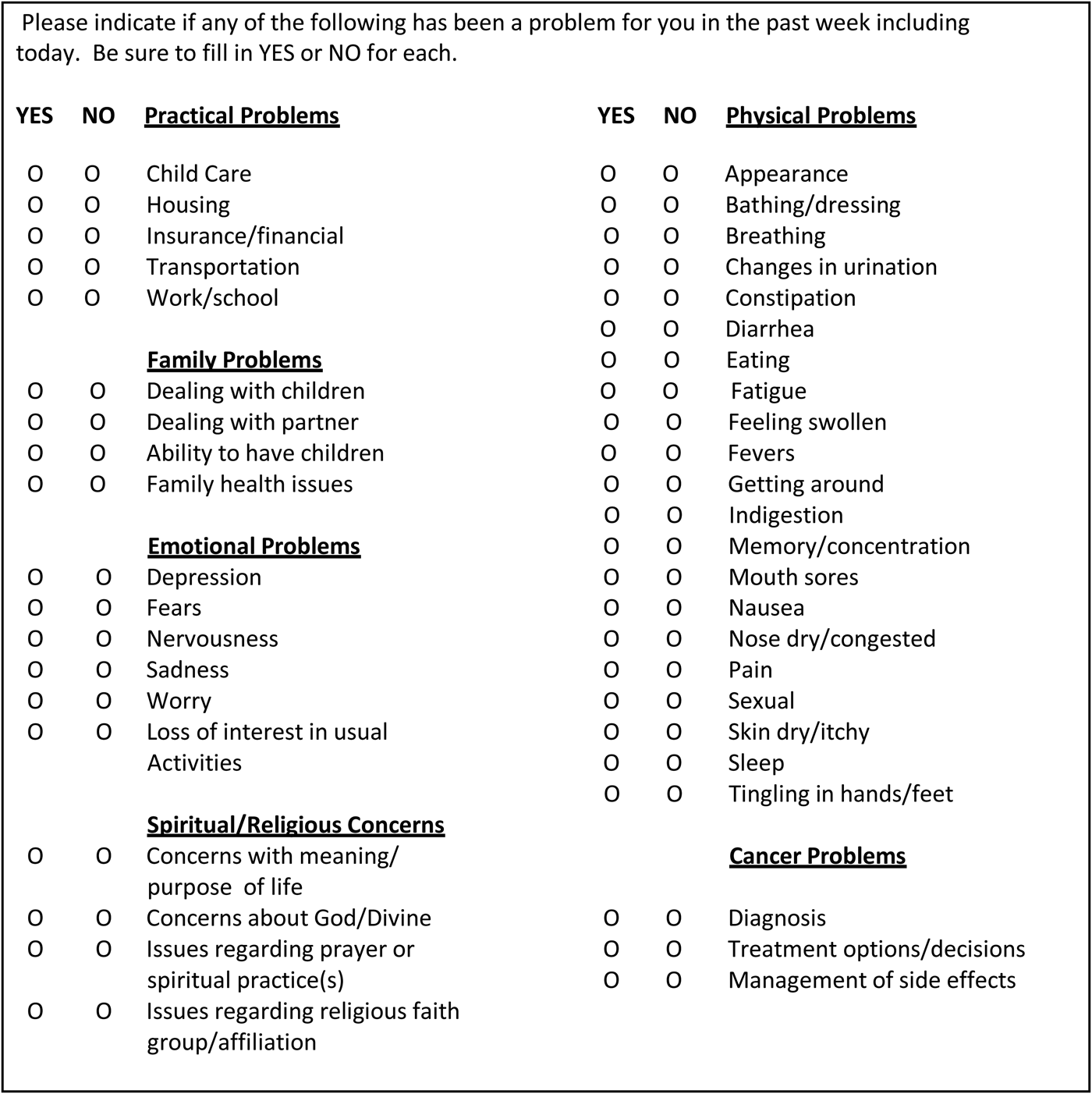
Patient Problem List was developed by the Distress Management Guidelines Panel of the National Comprehensive Cancer Network to accompany the thermometer (National Comprehensive Cancer Network, 2011). The original list comprised 33 problems categorized in six conceptual domains: illness-related, family, emotional, practical, spiritual, or other. After implementing routine screening with two disease-based groups of patients at our cancer center, the Psychosocial Advisory Committee revised the problem list based on the results. The six conceptual domains were expanded, deleting the “other” category and replacing it with cancer problems. The final list of 43 problems consists of six domains: practical (5), family (4), emotional, (6), spiritual (4), physical (21), and cancer (3). See Figure 1. Patients were asked whether they had experienced any of the problems in the past week and were asked to check those items that represented yes or no on the tool.
Modified Patient Problem List

Statistics
Procedures for data analysis were performed using SAS® software. Summary statistics for central tendency (mean, median), and variability were used for the distress measure and categorical variables on the problem list were described using frequency distributions. Repeated measures analysis of variance (ANOVA) with Student-Newman-Keuls Post-hoc Test was used to test the differences between mean distress scores and problem counts over time. Correlations between mean distress scores and total problem counts were tested with Spearman correlation coefficients.
CLINICAL CHARACTERISTICS
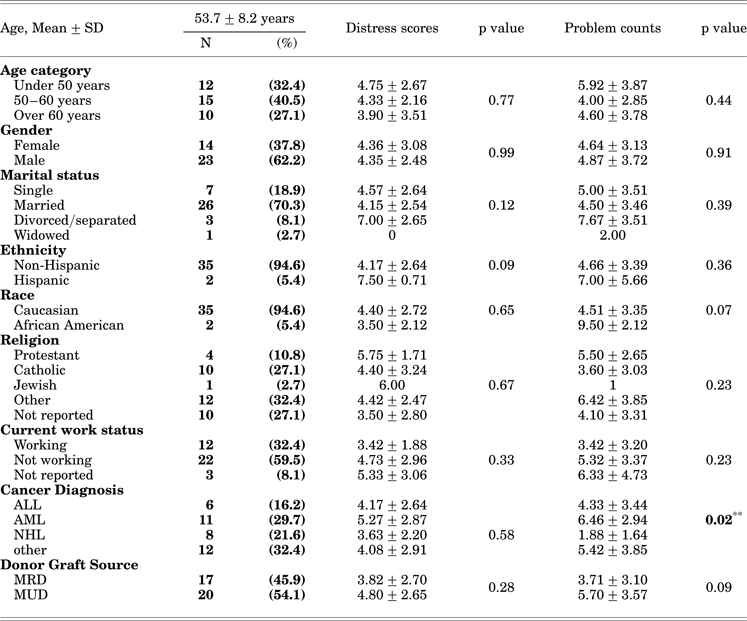
A total of 42 consecutive patients were eligible to participate in this project. Of the 42 patients, four patients did not have a transplant and one patient died prior to transplant therefore the final sample included 37 patients. As shown in Table 1, the sample averaged approximately 54 years of age, range 32 to 66 years, and had more males (62%) than females (38%). Most patients were White (95%) and the majority was married (70%). A variety of cancer diagnoses were represented in the sample, with the greatest number diagnosed with acute myeloid leukemia (30%) followed by non-Hodgkins lymphoma (22%), and acute lymphoblastic leukemia (16%). All patients underwent an allogeneic transplant.
Sample demographic and clinical characteristics (N = 37)
DT = Distress Thermometer; ALL = acute lymphoblastic leukemia; AML = acute myeloid leukemia; NHL = non-Hodgkin's lymphoma; MRD = matched related donor, MUD = matched unrelated donor **Indicates significant difference between cancer diagnosis and problem counts. Post-hoc analysis (Duncan, Student-Newman-Keuls Test, Tukey as well as Scheffe) suggested difference between AML and NHL.
EMOTIONAL DISTRESS RATINGS
Patients averaged 4.35 on the Emotional Distress Thermometer (S.D. 2.68) at the transplant talk prior to admission; 4.42 (S.D. 2.67) at discharge; 3.54 (S.D. 3.00) at their three month clinic visit; and 1.75 (S.D. 1.65) at six months. On average, patient responses to the DT revealed low to moderate levels of psychosocial distress over time and their distress decreased at 3 and 6 months. Patients had significantly less distress at six months. See Table 2. Using the distress cutoff score of 4 as the criterion, 59% had clinically significant distress at time 1, 58% at discharge, 43% at 3 months, and 19% at six months that warranted further evaluation.
Mean distress score and problem counts overtime
Med = Median; Time 1 = before transplant, Time 2 = discharge, Time 3 = 3 months after transplant, Time 4 = 6 months after transplant. Repeated Measures analysis of variance (ANOVA) with Student-Newman-Keuls Post-hoc Test suggest significant difference among different occasions; Means with different superscripts differ significantly at p < 0.05.
To determine whether patients differed in their responses on the Distress Thermometer based on demographic and clinical characteristics over time, bivariate analyses were conducted on the total score. There were no significant relationships among any of the variables at Time 1, 3, or 4 on the total distress score. However there were differences at Time 2, the day of hospital discharge. We found that patients who were under the age of 50 (0.09), were not working (p = 0.05), and had their transplant from an unrelated donor (p = 0.05) had significantly higher total distress scores compared to the other measurement time points. Data not shown.
PROBLEM LIST
Patients reported a mean of 4.78 (S.D. 3.47) problems at the transplant pre-admission talk, 6.39 (S.D. 4.41) at discharge, 3.04 (S.D. 2.41) at their three month clinic visit, and 2.06 (S.D. 2.57) at six months. Using Bivariate analyses, we found no differences on total number of problems by demographic and clinical variables at Time 1, except for cancer diagnosis. Patients with acute myeloid leukemia reported significantly (p = 0.02) more problems, 6.46 (2.94) and non-Hodgkin's lymphoma patients reported the least, 1.88 (1.64) prior to their transplant.
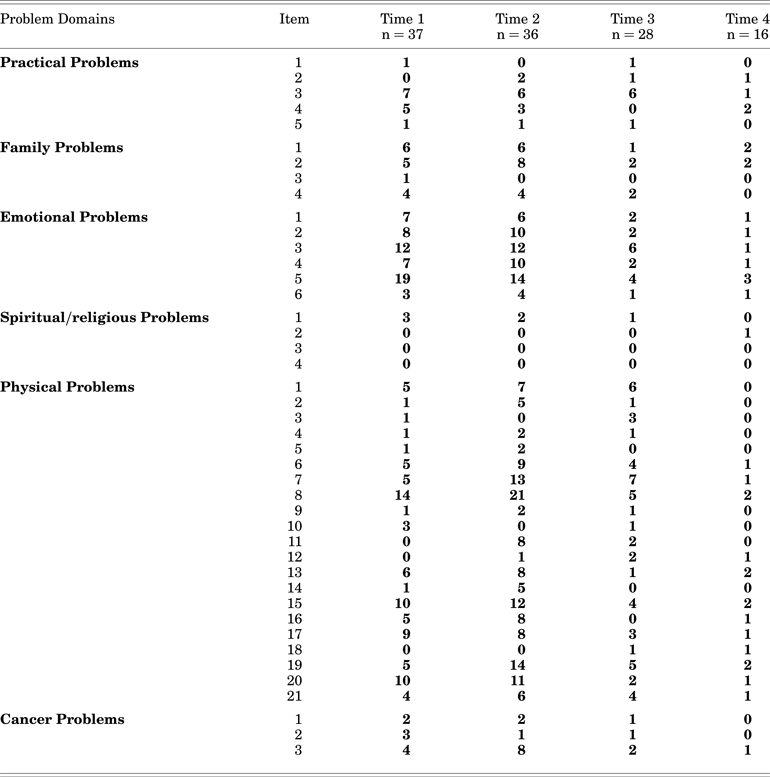
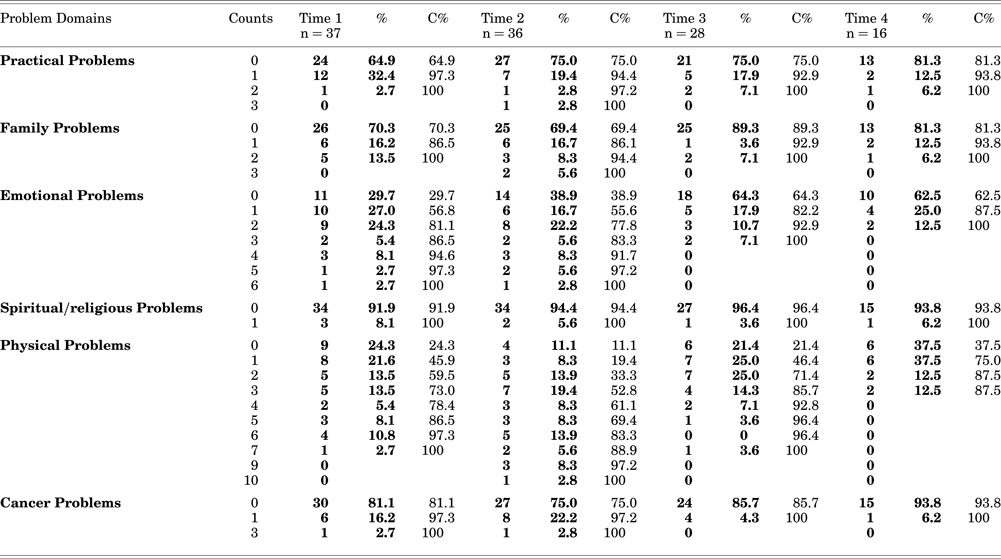
Overall, patients reported significantly more problems at discharge compared to the other measurement time points. See Table 2. As expected, total number of problems decreased overtime after discharge. Table 3 presents the frequency distribution of individual problems by all six domains overtime. Of the 43 problems listed, patients identified a range of problems. Forty-one of the problems were identified by at least one patient throughout the six months of the project. There were no problems identified in the last two items within the spiritual domain therefore these two items could be eliminated in future use. Seventy-one percent (n = 26) of the patients reported having emotional problems and seventy-six percent (n = 28) reported having physical problems prior to their transplant. It was common for patients to be nervous and worried in the emotional domain and tired, nauseated, and unable to sleep in the physical domain. At discharge, these problems continued but they also reported they were sad and fearful. Physically, they were experiencing skin problems, had trouble eating, unable to get around, and were in pain. In Table 4, the frequency distribution of the number of problems experienced by collapsing the domain of problems is presented. This table shows how the number of problems decreased; but thirty-eight percent (n = 8) continue to have emotional problems and sixty-two percent report ongoing physical problems.
Problem item frequency distribution by domain overtime
Practical Problems:1 = Child Care, 2 = Housing, 3 = Insurance/financial, 4 = Transportation, 5 = Work/School
Family Problems:1 = Dealing with children, 2 = Dealing with partner, 3 = ability to have children, 4 = family health issues
Emotional Problems:1 = Depression, 2 = Fears, 3 = Nervousness, 4 = Sadness, 5 = Worry, 6 = Loss of interest in usual activities
Spiritual/religious concerns: 1 = Concerns with meaning/purpose of life, 2 = Concerns about God/Divine, 3 = Issues regarding prayer or spiritual practices, 4 = Issues regarding religious faith group/affiliation.
Physical Problems:1 = Appearance, 2 = Bathing/dressing, 3 = Breathing, 4 = Chances in urination, 5 = Constipation, 6 = Diarrhea, 7 = Eating, 8 = Fatigue, 9 = Feeling Swollen, 10 = Fevers, 11 = Getting around, 12 = Indigestion, 13 = Memory/concentration, 14 = Mouth sores, 15 = Nausea, 16 = Nose dry/congested, 17 = Pain, 18 = Sexual, 19 = Skin dry/itchy, 20 = Sleep, 21 = Tingling in hands/feet
Cancer Problems: 1 = Diagnosis, 2 = Treatment options/decisions, 3 = Management of side effects
Problem counts frequency distribution by domain overtime
C% = cumulative percentage.
Please note: This table represents problem counts distribution in six domains of the distress thermometer (i.e. practical, family, emotional, spiritual physical and cancer) at four time occasions. Counts frequency numbers are discrete for some domains after having deleted those with zero problem counts at all four time points.
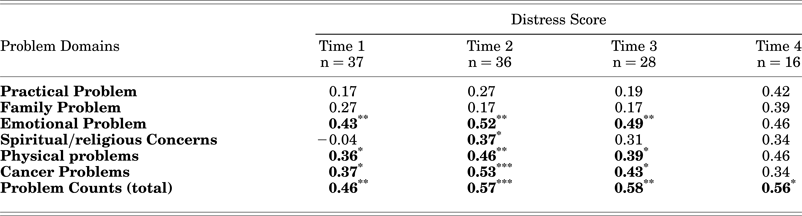
In order to determine the degree of association between mean distress scores and number of problems, a correlation matrix was constructed for the distress scores and total problem count and by the six domains. See Table 5. Distress scores and the number of problems were highly correlated (range 0.46 to 0.58; p = 0.05 to 0.001) at all four measurement points. As distress increased, problems increased and as distress decreased problems decreased. The domains that represented the highest correlations were emotional, physical, and cancer problems at the transplant talk, discharge, and three months after discharge (range 0.36 to 0.53, p = 0.05 to 0.001).
Correlations† between distress scores and problem counts by domains overtime
†Spearman correlation coefficients were presented considering skewed data distributions.
*p < 0.05, **p < 0.01, ***p < 0.001.
DISCUSSION
In this project we sought to determine whether the use of a single item screening tool and a problem list could help to monitor patients' distress and what it's related to over time. The homogeneity of the transplant and the heterogeneity of the types of diagnoses were central in testing our hypothesis that distress and self-reported problems are highly correlated and that distress and problems will lessen over time.
For this sample, we found no differences in mean distress scores at the pre transplant talk on any patient demographic or clinical variables. However, patients with acute myeloid leukemia did report significantly more problems compared to the other diagnoses. This may have been because patients were generally younger, unemployed, and had an unmatched donor. Overall, we expected that distress would be significantly higher at discharge after transplant and improve by six months. This hypothesis was supported.
We also expected the physical and emotional problems would be priorities in the management of the patients throughout their treatment. These results confirm that patients reported higher physical and emotional problems, including fatigue, sleep disturbances, skin conditions, inability to eat, worry, sadness, nervousness, and fear. However, patients also reported problems in the other domains. These included problems with finances, dealing with a partner, children, and whether they could manage their treatment effects long-term. Routinely, the social worker would present patient problems during morning rounds and specific team members were identified to follow-up on finding solutions and helping patients cope with those problems that were more difficult or couldn't be eliminated. Although the team worked well together and each had their specific responsibilities, often some responsibilities overlapped between team members. For example, the social worker has primary responsibility for helping patients and family members understand how they could better communicate with each other and their children, but other team members might also talk to patients with family members as to what to expect, help with misconceptions, and encourage their support of each other.
There were some patients who reported no problems which surprised us. The social worker spoke with them to confirm that they in fact had no problems and they replied they were grateful that a transplant was an option and they felt they had been given a new lease on life. Monitoring patients for distress allowed us to follow these patients closely to problem solve with them even though they were not able to verbalize their problems. We also found there were times when we needed to request a consult for patients such as a psychiatrist to evaluate the use of medication for distress. Members of other disciplines were frequently included in helping to manage complex and challenging problems, including pharmacy, nutrition, dermatology, and palliative care.
In this project we were not concerned with using the recommended clinical cut off of 4 to categorize patients into groups that would indicate further evaluation was indicated. Our team was concerned about all problems these patients were experiencing and the use of the problem list helped us to consider their perspective of what was important and to prioritize the team's focus. We found it essential that one member of the team assumed responsibility for implementing the project and overseeing problems were discussed and followed through. We felt if we could relieve patients' distress by focusing on self-reported problems at their peak that patients' recovery long-term might go smoother. It is premature to know whether monitoring distress overtime will have an impact on their long-term recovery. We plan to continue to monitor these patients at twelve months. In the next phase we plan to use quality indicators to complete a medical audit to see if problems were charted and actions taken to address the problem or no action was taken and why. We will follow the process recommended by Jacobsen and Wagner (Reference Jacobsen and Wagner2012) to formulate questions that can be answered yes or no to measure the indicators.
The strength of this project is it represents a population based sample of patients undergoing an allogeneic transplant at one cancer center over six months. A population for who distress has been documented. Several limitations of the current project are noted. Although the sample is population based, it is predominantly Caucasian and educated. Further use of the distress tool and problem list is recommended with culturally and socio-economically diverse samples. Currently, the thermometer and problem list are not a part of our medical record so the detailed information must be recorded separately; therefore all data might not be included by the social worker. The project was also designed as a single group design with no comparative group available so the findings are not generalizable. And finally, data presented here are not complete; all patients had not reached the six month interview mark at the time of this analysis.
It is well acknowledged that patients are often unprepared and overwhelmed with the long recovery that can take months to years to endure. Our multidisciplinary team undertook a project to integrate distress screening into our routine clinical practice. The results show promise in the use of a one item screening tool and problem list to monitor psychosocial distress over time as a method to coordinate the care to address problems in a timely fashion. The findings from our analysis could serve as a useful model for other multidisciplinary teams to delivering quality cancer care and assist disease-based teams in prioritizing problems in order to maximize the impact of relieving psychosocial distress to improve clinical outcomes.