Introduction
The relationship between industrial policy and corporate strategy has been extensively examined, particularly through the lenses of the institution-based view (IBV; Elango & Dhandapani, Reference Elango and Dhandapani2020; Jain & Sharma, Reference Jain and Sharma2013; Peng, Wang, & Jiang, Reference Peng, Wang and Jiang2008) and institutional entrepreneurship (Dorado, Reference Dorado2005; Jarvis & He, Reference Jarvis and He2020; Leca, Battilana, & Boxenbaum, Reference Leca, Battilana and Boxenbaum2008). These perspectives typically conceptualize industrial policy as a macro-level institutional force that firms can align with to access strategic resources and gain legitimacy. However, in emerging markets such as China, this alignment is far from straightforward. The Chinese government wields substantial allocative power (Zhou, Gao, & Zhao, Reference Zhou, Gao and Zhao2017). Private firms – often resource-constrained and lacking legitimacy – must navigate a policy environment shaped by multiple, overlapping, and continually evolving industrial policies. This generates policy uncertainty, in which firms cannot rely on a single, coherent directive. Instead, top managers interpret shifting policy signals, weigh trade-offs among competing policies, and align them with their strategic objectives through ongoing sensemaking.
Sensemaking – the cognitive process through which individuals interpret uncertain or novel events – is essential for linking change events to organizational response (Maitlis & Christianson, Reference Maitlis and Christianson2014). In institutional contexts, sensemaking helps explain how strategic agency emerges under constraint (Ocasio, Thornton, & Lounsbury, Reference Ocasio, Thornton, Lounsbury, Greenwood, Oliver, Lawrence and Meyer2017). Although prior research has clearly shown that actors possess agency within inter-institutional systems (Currie & Spyridonidis, Reference Currie and Spyridonidis2016; Pallas, Fredriksson, & Wedlin, Reference Pallas, Fredriksson and Wedlin2016), less attention has been given to the specific sensemaking processes through which key actors exercise such agency. This leaves a crucial gap in understanding the role of sensemaking in enabling strategic change amid policy signals that are both pluralistic and dynamic.
To address this gap, we explore how top managers, as key organizational actors, make sense of plural policy shifts and construct strategic responses. This research question is important both theoretically and practically. While prior studies have explored how top managers foster shared understanding during strategic change (Balogun, Bartunek, & Do, Reference Balogun, Bartunek and Do2015; Gioia & Chittipeddi, Reference Gioia and Chittipeddi1991; Kieran, MacMahon, & MacCurtain, Reference Kieran, MacMahon and MacCurtain2020; Rouleau, Reference Rouleau2005), they tend to see strategic change as predetermined. Less is known about how external events trigger sensemaking processes that subsequently shape strategic choices. Sensemaking is a crucial link between external and internal change. Exploring the connections among policy shifts, sensemaking, and strategic change can enhance our understanding of how strategic decisions are formed under dynamic policy pressures. At the same time, such exploration also sheds light on how managers exercise agency in the decision-making process, rather than merely acting as passive recipients of industrial policy.
From a practical perspective, industrial policies in emerging economies such as China significantly shape corporate strategy (Lall, Reference Lall2004). The state’s dominant role in resource allocation compels firms to constantly adapt to a complex and often contradictory mix of sectoral policies (Yi, Murphree, Meng, & Li, Reference Yi, Murphree, Meng and Li2021; Zhou et al., Reference Zhou, Gao and Zhao2017). Such an evolving policy landscape generates both constraints and opportunities for firms operating across multiple industries. Consequently, understanding how top managers of such firms interpret, prioritize, and respond to this policy-induced uncertainty is critical for navigating strategic challenges in emerging economies (Lounsbury & Wang, Reference Lounsbury and Wang2023).
To explore this issue, we conducted a longitudinal narrative case study of Loopmaster Energy Corporation (LE), a private Chinese firm operating in a highly dynamic policy environment. Employing narrative analysis, we developed a process model of sensemaking that links policy shifts with strategic change. Our model identifies two forms of sensemaking – prospective and retrospective – and demonstrates how they differ across each stage of the enactment–selection–retention cycle, which constitutes the sensemaking process. In the context of a highly complex industrial policy regime, top managers’ interpretations of policy signals, their selective activation of institutional logics, and their rhetorical strategies in linking policy to corporate strategy directly influence both the magnitude and pattern of subsequent strategic change.
Our study makes three primary contributions to the literature on sensemaking, institutional logics, and strategic change. First, we show that institutional logics from distinct fields serve as cognitive resources for strategic sensemaking. In contrast to perspectives in neo-institutionalism or the IBV that stress structural constraint (Felsmann, Reference Felsmann2016; Hersberger-Langloh, Stühlinger, & von Schnurbein, Reference Hersberger-Langloh, Stühlinger and von Schnurbein2021), our findings highlight managerial agency in selectively activating economizing or ecologizing logics to interpret policy shifts and craft responses. In doing so, we extend emerging research on institutional logics as strategic resources (Durand, Szostak, Jourdan, & Thornton, Reference Durand, Szostak, Jourdan, Thornton, Lounsbury and Boxenbaum2013; Venkataraman, Vermeulen, Raaijmakers, & Mair, Reference Venkataraman, Vermeulen, Raaijmakers and Mair2016) by illustrating how they operate within the sensemaking process of interpretation. Second, we extend sensemaking theory by incorporating a temporal attribute of sensemaking that differentiates retrospective and prospective orientations. Whereas retrospective sensemaking, tied to existing logics, constrains strategic imagination and results in incremental adjustments, prospective sensemaking facilitates logic switching and narrative reframing, enabling more transformative responses. This expands the enactment–selection–retention framework (Weick, Reference Weick1979, 2001) by foregrounding temporality as a critical yet underexplored driver of heterogeneity in strategic change (Dawson & Sykes, Reference Dawson and Sykes2019; Maitlis & Christianson, Reference Maitlis and Christianson2014). Third, we theorize an iterative loop between sensemaking and strategic change, whereby the outcome of previous actions and evolving policy signals inform subsequent interpretive work. This recursive dynamic resonates with perspectives on the evolution of institutional logics (Thornton, Ocasio, & Lounsbury, Reference Thornton, Ocasio and Lounsbury2012) and responds to recent calls to explain how cognitive activities translate into organizational change (Goto, Reference Goto2022; Weiser, Reference Weiser2021). Collectively, these contributions reposition strategic change as a socially constructed process shaped by the temporality of sensemaking, embedded agency, and recursive feedback, thereby enriching the research on sensemaking and institutional logics.
Theoretical Background
Understanding how top managers interpret plural policy shifts and construct strategic responses is crucial for advancing corporate strategy theories in emerging economies. While existing research has examined the impact of industrial policy on firm behavior (Figueiredo, Reference Figueiredo2008; Lazzarini, Reference Lazzarini2015; Tufa, Söderbom, & Sime, Reference Tufa, Söderbom and Sime2023), much of this work adopts a macro-level perspective, focusing on the outcomes of unitary and static policy frameworks. This overlooks how firms, particularly their leaders, interpret and navigate evolving policy landscapes. Such an omission downplays the agency of firms operating within dynamic and complex policy environments (Greenwood, Raynard, Kodeih, Micelotta, & Lounsbury, Reference Greenwood, Raynard, Kodeih, Micelotta and Lounsbury2011). We argue that top managers acting as interpreters of policy and strategic decision-makers play a central role in linking policy shifts with organizational adaptation. Thus, it is imperative to investigate how their sensemaking processes translate external policy changes into strategic action.
Institution, Corporate Strategy, and Organizational Agency
Scholars have approached the relationship between institutions and firm strategy using various theoretical lenses, including neo-institutionalism, the IBV of strategy, and institutional complexity. Each perspective offers distinct insights into how firms respond to institutional pressures and opportunities, yet they present limitations in accounting for strategic heterogeneity and organizational agency.
Research grounded in neo-institutionalism typically views policy, regulation, and other formal institutions as high-level forces that provide legitimacy and access to critical resources (Elango & Dhandapani, Reference Elango and Dhandapani2020). Within this framework, rational corporate decision-makers are expected to adjust their strategies to maintain alignment with prevailing institutional norms and expectations (Shen, Feng, & Zhang, Reference Shen, Feng and Zhang2016). However, by emphasizing organizational embeddedness, neo-institutionalism tends to underplay firms’ strategic agency and fails to adequately explain why firms operating under similar institutional conditions often exhibit divergent strategic responses.
In contrast, the IBV emphasizes how policy shapes market environments, alters competitive dynamics, and influences strategic outcomes (Jain & Sharma, Reference Jain and Sharma2013; Kim, Kim, & Hoskisson, Reference Kim, Kim and Hoskisson2010). It posits that firms pursue their interests rationally and make different strategic choices within the constraints of institutional frameworks, both formal and informal (Peng, Sun, Pinkham, & Chen, Reference Peng, Sun, Pinkham and Chen2009). While the IBV offers improved explanatory power regarding strategic heterogeneity, it often neglects the interpretive flexibility and creative agency that complex institutional environments can afford (Elango & Dhandapani, Reference Elango and Dhandapani2020).
Further advancing this line of inquiry, the institutional logics perspective relaxes the assumption of institutional uniformity and highlights the multiplicity of institutional logics (Greenwood et al., Reference Greenwood, Raynard, Kodeih, Micelotta and Lounsbury2011; Kodeih & Greenwood, Reference Kodeih and Greenwood2014; Vermeulen, Zietsma, Greenwood, & Langley, Reference Vermeulen, Zietsma, Greenwood and Langley2016). Organizations can draw on competing logics from different levels or fields or synthesize elements from various logics to support organizational change in complex environments (Bitektine & Song, Reference Bitektine and Song2023). For example, Dalpiaz, Rindova, and Ravasi (Reference Dalpiaz, Rindova and Ravasi2016) examine how an Italian manufacturer combined the logics of industrial manufacturing and cultural production to pursue new market opportunities. Similarly, Raaijmakers, Vermeulen, Meeus, and Zietsma (Reference Raaijmakers, Vermeulen, Meeus and Zietsma2015) demonstrate that managers’ responses to institutional complexity are influenced by their interpretations and personal beliefs. Although this literature recognizes the role of actors’ interpretation during change, it remains institution-centered and insufficiently addresses the microfoundation through which organizational agency is exercised.
To address these limitations, we draw on the institutional logics perspective to examine how top managers interpret dynamic and complex industrial policies and adapt firm strategies accordingly. Institutional logics are socially constructed frameworks of rules, practices, and assumptions that guide behavior within organizational fields (Thornton et al., Reference Thornton, Ocasio and Lounsbury2012). In societies characterized by multiple logics, organizational actors with embedded agency can selectively draw from these logics to interpret external events and guide their responses (Dalpiaz et al., Reference Dalpiaz, Rindova and Ravasi2016; Lee & Lounsbury, Reference Lee and Lounsbury2015; Lu, Reference Lu and Lu2017). It is the actors who determine which logic is more important to them (Stevenson, Honingh, & Brandsen, Reference Stevenson, Honingh and Brandsen2024). Thus, we argue that the institutional logics perspective provides a more nuanced explanation than neo-institutionalism or the IBV in understanding strategic heterogeneity under the same policy regime.
Sensemaking, Temporality, and Strategic Change
Industrial policy shifts create a particularly challenging environment for organizational sensemaking. As Kaplan and Orlikowski (Reference Kaplan and Orlikowski2013) note, such changes often prompt strategic reorientations, compelling organizational actors to interpret their implications. Sensemaking – the process through which individuals understand uncertain or unfamiliar events – thus becomes a critical source of strategic heterogeneity and organizational agency (Maitlis & Christianson, Reference Maitlis and Christianson2014; Weick, Reference Weick1988). When faced with uncertainty, sensemaking helps actors answer two foundational questions: What happened? And, what should we do? (Weick, Reference Weick1979; Weick, Sutcliffe, & Obstfeld, Reference Weick, Sutcliffe and Obstfeld2005).
A key function of sensemaking is to link the past, present, and future, thereby bringing order to uncertainty and enabling further action. While early sensemaking research emphasized its retrospective nature, recent studies highlight its prospective orientation – how actors imagine and act upon desired or anticipated futures (Kaplan & Orlikowski, Reference Kaplan and Orlikowski2013; Weick et al., Reference Weick, Sutcliffe and Obstfeld2005). Dawson and Sykes (Reference Dawson and Sykes2019) further argue that temporality in sensemaking is not merely linear but often involves complex, non-linear dynamics as individuals and groups continually reconstruct meaning.
These multidimensional temporal patterns render the process of sensemaking more dynamic and context-sensitive. For instance, Clegg and Biygautane (Reference Clegg and Biygautane2025) examine sensemaking in megaprojects, demonstrating how meaning construction extends beyond implementation to the project’s long-term legacy. Planning documents, for example, may be interpreted differently over time, shaping the project’s evolving direction. Such examples underscore how meaning is continually adapted in response to changing contexts.
Despite these advances, the relationship between the temporal orientation of sensemaking and strategic decision-making remains underexplored (Balogun et al., Reference Balogun, Bartunek and Do2015; Hernes & Obstfeld, Reference Hernes and Obstfeld2022; Logemann, Piekkari, & Cornelissen, Reference Logemann, Piekkari and Cornelissen2019). In dynamic environments, top managers may navigate external changes by applying retrospective and prospective lenses to rationalize strategic actions (Fischer-Appelt & Dernbach, Reference Fischer-Appelt and Dernbach2023; Sonenshein, Reference Sonenshein2010). This calls for a temporal model of sensemaking that can explain how firms initiate and implement strategic change in response to evolving industrial policy.
To address this gap, we integrate the institutional logics perspective with sensemaking theory to develop a conceptual framework that explains how top managers make sense of plural policy shifts and construct strategic responses. By analyzing the content and temporality of managerial sensemaking, we show how institutional logics serve as cognitive resources for sensemaking. Furthermore, we propose an iterative process model that connects retrospective and prospective sensemaking to the magnitude and pattern of strategic change.
Methods
We conducted a longitudinal narrative case study of LE, a medium-sized, privately owned Chinese firm. This research setting was chosen for three reasons. First, China’s rapidly evolving institutional environment offers an ideal context for studying strategic adaptation in emerging economies (Ahlstrom & Bruton, Reference Ahlstrom and Bruton2010; Lin, Peng, Yang, & Sun, Reference Lin, Peng, Yang and Sun2009; Wang, Lounsbury, Chen, & Ren, Reference Wang, Lounsbury, Chen and Ren2025). Second, LE’s involvement in real estate and renewable energy subjects it to frequent and complex policy shifts, providing exposure to plural and evolving industrial policies. Third, as a privately owned enterprise, LE faces more resource constraints and legitimacy challenges than state-owned counterparts, making its top managers particularly attentive to policy dynamics (Ahlstrom & Bruton, Reference Ahlstrom and Bruton2010). These conditions provided a rich context for examining our core research question about sensemaking and strategic change.
Drawing on Balogun et al. (Reference Balogun, Bartunek and Do2015), we adopted a single-case analysis approach (Eisenhardt & Graebner, Reference Eisenhardt and Graebner2007; Quan & Qi, Reference Quan and Qi2020), which is well-suited for in-depth exploration of complex organizational phenomena. We employed a narrative approach commonly used in sensemaking studies (Vaara & Tienari, Reference Vaara and Tienari2011) for three key reasons. First, sensemaking is a cognitive and interpretive process (Maitlis & Christianson, Reference Maitlis and Christianson2014), which cannot be observed directly. Narratives provide a valuable lens for understanding how individuals perceive and understand uncertain events, particularly in rapidly shifting environments. Second, unlike content analysis, narrative analysis reveals both what is said and how it is conveyed (Franzosi, Reference Franzosi1998; Smith, Reference Smith2016), enabling a deeper understanding of managerial sensemaking. Third, a narrative approach highlights temporal fluidity and enables the examination of how the past, present, and future are interconnected – rendering it particularly effective for tracing the temporality of sensemaking.
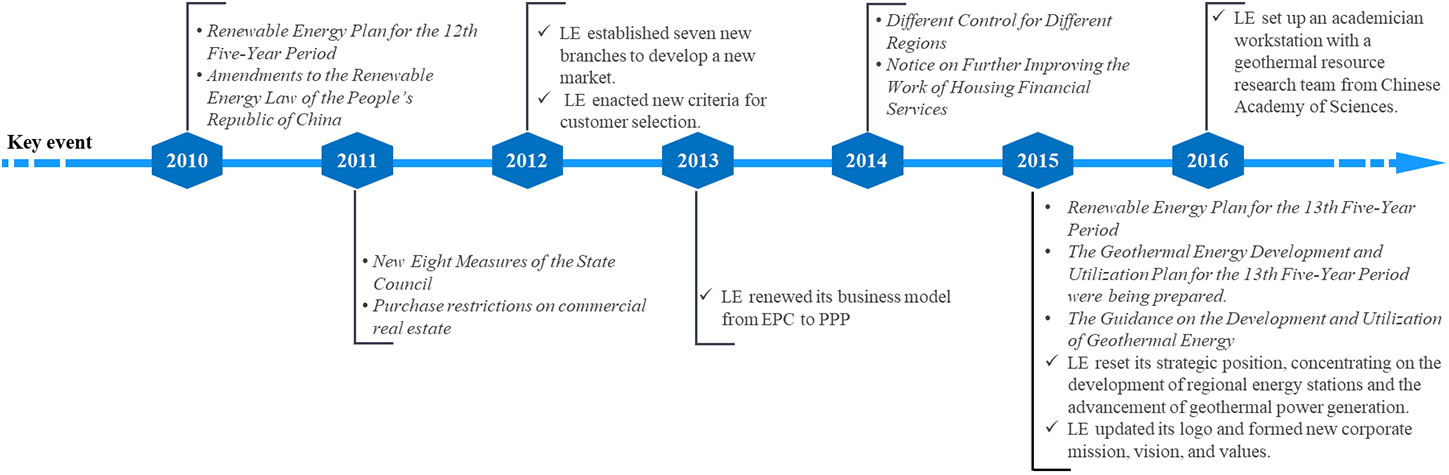
Building on previous research (Langley, Smallman, Tsoukas, & Van de Ven, Reference Langley, Smallman, Tsoukas and Van de Ven2013; Smets, Morris, & Greenwood, Reference Smets, Morris and Greenwood2012; Wang, Raynard, & Greenwood, Reference Wang, Raynard and Greenwood2021), we conducted a process study that chronicled key events related to changes in industrial policies and corporate strategy over time (see Figure 1). Our embedded case design incorporated multiple levels of analysis – organizational, managerial, and institutional (Yin, Reference Yin2009). Our study focused on two consecutive episodes of strategic change at LE, which served as embedded units of analysis (Eisenhardt, Reference Eisenhardt1989). Through this focus, we traced the process by which external pressures were interpreted and converted into concrete actions. At the unit level, we used Pettigrew’s (Reference Pettigrew1990) context–process–outcome framework to examine how managers responded to policy signals. At the holistic level, we compared different sensemaking forms across the two periods to understand variation in strategic responses.
Timeline of key events in the evolution of industrial policies and corporate strategic changes from 2010 to 2016

Figure 1 Long description
In 2010, the Renewable Energy Plan for the 12th Five-Year Period was introduced, along with the announcement of the Renewable Energy Law of the People's Republic of China. In 2011, new regulations for commercial real estate were introduced. By 2012, LE established new business divisions and a new sales team for customer education. In 2013, LE revised its business model to BIPV and BWP. The year 2014 saw the release of the 'Opinion on Further Improving the Work of Removing Backward Services.' In 2015, the Renewable Energy Plan for the 13th Five-Year Period was released, along with the 'Guidelines on Energy Development and Utilization Plan for the 13th Five-Year Period.' In 2016, LE set up an installation verification team and a specialized service team for the maintenance of distributed photovoltaic systems and the 'Guidelines on the Development and Utilization of Distributed Energy' were released. The timeline is marked with arrows indicating the progression of events over the years.
This design enables us to examine how evolving institutional logics influence managerial interpretations and how sensemaking serves as a mechanism linking policy changes to firm-level strategic transformation.
Research Setting
LE was established in 2005 as a provider of ground source heat pump (GSHP) systems in China. The company focused on designing and installing GSHP-based central air-conditioning systems for residential buildings, using shallow geothermal energy for heating, ventilation, and air-conditioning (HVAC) systems. LE operated mainly in real estate construction and renewable energy. While most developers had relied on electric-powered systems, the advantages of geothermal energy – energy efficiency and pollution reduction – began attracting attention around 2007. As China’s real estate construction industry expanded, LE quickly grew into a technology leader in the GSHP segment, extending operations across central and eastern China within seven years.
The real estate construction industry’s rise was guided by an economizing logic, emphasizing economic efficiency and rapid growth. However, between January 2010 and November 2012, the government implemented strict macro-control policies to manage the overheated property market. The most notable were the ‘New Eight Measures’ introduced in 2011, which aimed to curb housing inflation and promote stable development. These policies slowed residential construction, which in turn affected LE’s growth. In 2012, LE failed to meet its growth targets for the first time. Two main factors caused this: a shrinking client base due to the real estate slowdown and reduced access to bank loans, which created cash flow problems for real estate developers and decreased demand for LE’s services. In response, LE’s top managers initiated a strategic change to adapt to the sudden onset of stringent macro-control policies.
From late 2013, China increasingly emphasized ecological protection, prioritizing environmental sustainability and harmony between humans and nature. The central government rolled out policies to support clean and renewable energy. LE’s top management recognized these shifts and reevaluated their corporate strategy. They launched a second wave of strategic change to reposition LE as a national leader in green energy. This transformation enabled the company to pursue emerging opportunities in the renewable energy sector, aligning with the state’s new development priorities.
Data Collection
Following previous studies (e.g., Smets et al., Reference Smets, Morris and Greenwood2012; Wang et al., Reference Wang, Raynard and Greenwood2021), we collected a wide range of data, including interviews, archival materials, meeting observations, and public speeches. We coded data from various sources (see Table 1). These diverse data sources enabled triangulation, enhancing the reliability of our findings (Eisenhardt, Reference Eisenhardt1989). For example, statements made by top managers regarding strategic changes and performance outcomes were cross-verified using secondary sources, including annual reports and media articles. Consistent with Wrede, Velamuri, and Dauth (Reference Wrede, Velamuri and Dauth2020), we identified ten key interviewees as top managers based on their titles (e.g., Chief, President) or responsibilities equivalent to executive roles (e.g., CFO, CTO), even if officially titled as ‘department managers.’ Interviews were conducted between 2013 and 2016, either face-to-face or via instant messaging tools.
Summary of data collection

Table 1 Long description
The table details data sources and their use in analyzing changes in industrial policy and corporate strategy. Interviews with top managers provide insights into their perceptions of policy changes in real estate and renewable energy sectors. Archives, including annual reports and strategic planning documents, are used to triangulate interview data and code for changes in corporate strategy. PowerPoint documents and newsletters further support strategic change analysis, focusing on core business and firm culture. Policy documents from the government are analyzed for their type and intensity, while meetings and public speeches offer additional evidence on strategic outcomes and social influence. The data sources collectively contribute to understanding the impact of policy changes on firm strategy and performance.
Notes: The code for the interview(ee) or document from which each exemplary quote in Table 3 is drawn is in square brackets.
During these three years, we maintained regular contact with LE’s top management and staff across departments. We visited the firm one to two times per month, typically spending a whole day on-site. Each visit included informal conversations with managers on a range of topics such as performance, strategy, project updates, industrial policies, market conditions, and competitive threats. These discussions typically lasted for an hour. We also observed construction sites, attended company exhibitions, and collected both public and internal documents. Additionally, we attended internal meetings, listened to speeches by executives at conferences, and watched televised interviews with the president. These ongoing interactions helped us build rapport and gain real-time insights into how top managers interpreted and responded to policy shifts. Whenever we observed notable changes in their narratives about policy or strategy, we followed up with formal interviews to explore these changes in depth.
As a result, we conducted two rounds of formal, in-depth interviews with top managers: the first from November to December 2013, and the second from April to May 2015. These interviews explored how managers perceived national industrial policies, especially within the real estate and renewable energy sectors. We investigated how they framed evolving policies as opportunities or constraints and what strategic responses they considered appropriate.
Interviews usually began with open-ended prompts such as, ‘What is your opinion on the policy environment’? and ‘Have you been following new industrial policies’? Managers were encouraged to elaborate freely, often linking their policy interpretations to broader business and strategic concerns. If responses remained general, we probed further with questions like, ‘How do you think this policy will affect your business or strategy’? We minimized interruptions to capture authentic views and emotional undertones. Only when vague terms arose – for example, ‘customer compliance issues’ – did we ask clarifying questions such as ‘What types of customers’?
Data Analysis
In line with prior research (Balogun et al., Reference Balogun, Bartunek and Do2015; Smets et al., Reference Smets, Morris and Greenwood2012; Wang et al., Reference Wang, Raynard and Greenwood2021), we employed a four-stage, open-ended analytical approach to categorize and synthesize raw data into core concepts. Stage 1 involved constructing narratives of top managers’ sensemaking and strategic change, drawing on interviews, archives, public speeches, and meetings. These narratives helped reconstruct how managers interpreted industrial policies. In Stage 2, we identified institutional logics – specifically, economizing and ecologizing – as foundational to how policies were understood and used as sensemaking feedstock. In Stage 3, we conducted narrative analysis to explore how sensemaking occurred and took shape. We addressed two key questions: ‘Are there discernible forms of top managers’ sensemaking regarding industrial policy’? and ‘How does the sensemaking process unfold’? Finally, Stage 4 examined how different forms and contents of sensemaking influenced strategic change and its outcomes. The stages are detailed in the following sub-sections:
Stage 1: Creating narratives of both sensemaking and change in corporate strategy
We began by constructing narratives of top managers’ sensemaking using two rounds of interviews and supplementary data. Simultaneously, we developed a chronological account of key events and actions related to changes in corporate strategy at LE from 2010 to 2016 (see Figure 1). Using the composite narrative approach (Vaara & Tienari, Reference Vaara and Tienari2011), we integrated interview data with archival records, observed meetings, and public speeches to trace the change in national industrial policies, the sensemaking process, and strategic change. Final narratives were constructed from data across all sources, summarized in Table 1. Two critical junctures divided the timeline into distinct strategic periods, serving as embedded units of analysis. These two periods enabled a comparative study of different sensemaking forms, processes, and outcomes.
Stage 2: Identifying available institutional logics as resources for sensemaking
In our constructed narratives, we observed that LE primarily operated in the real estate construction and renewable energy industries, with industrial policies in these industries playing a dominant role in shaping corporate strategy decisions. Economizing logic and ecologizing logic are the dominant institutional logics in the real estate construction and renewable energy sectors, respectively. The two logics are the socially constructed, historical patterns of material practices, assumptions, values, beliefs, and rules by which field members in these two industries produce and reproduce their material subsistence and provide meaning to their social reality (Thornton & Ocasio, Reference Thornton, Ocasio, Greenwood, Oliver, Sahlin and Suddaby2008). In other words, institutional logics work as cognitive-cultural elements and material practices used in sensemaking (Haveman, Joseph-Goteiner, & Li, Reference Haveman, Joseph-Goteiner and Li2023). Therefore, we determined which logic – economizing or ecologizing – was activated during top managers’ sensemaking (Thornton et al., Reference Thornton, Ocasio and Lounsbury2012; York, Hargrave, & Pacheco, Reference York, Hargrave and Pacheco2016), and examined the extent to which the central government recognizes these logics and communicates its attitude through industrial policy.
Building on previous studies of these two logics (Reay & Jones, Reference Reay and Jones2016; York et al., Reference York, Hargrave and Pacheco2016), we identified them in terms of cultural symbols and material practices (see Table 2). We further categorized the two types of industrial policy using the terms ‘supportive’ and ‘restrictive’, based on their alignment with these institutional logics. Two criteria were employed to evaluate the intensity of industrial policies: subjective assessments from managers about whether policies were favorable and confidence-inspiring, and objective indicators such as policy volume and the administrative authority of issuing bodies.
Logic ideal types and implications for the geothermal energy industry

Table 2 Long description
The table examines two institutional logics—economizing and ecologizing—within the geothermal energy industry, focusing on cultural symbols and material practices. Economizing emphasizes rapid development, efficiency, and cost advantages, suggesting widespread adoption of geothermal systems in real estate to reduce energy bills. In contrast, ecologizing prioritizes sustainable development and energy conservation, advocating for geothermal energy in building air conditioning and national renewable energy planning. The comparison highlights differing priorities: immediate economic benefits versus long-term environmental sustainability.
Stage 3: Coding the forms, processes, and contents of sensemaking
As noted earlier, sensemaking has traditionally been seen as a retrospective process, where actors rationalize their actions by looking to the past (Maitlis & Christianson, Reference Maitlis and Christianson2014; Weick et al., Reference Weick, Sutcliffe and Obstfeld2005). More recent work, however, highlights prospective or future-oriented sensemaking (Gephart, Topal, & Zhang, Reference Gephart, Topal, Zhang, Hernes and Maitlis2010; Gioia, Thomas, Clark, & Chittipeddi, Reference Gioia, Thomas, Clark and Chittipeddi1994; Kaplan & Orlikowski, Reference Kaplan and Orlikowski2013). We categorized these two forms as ‘retrospective’ and ‘prospective’, based on whether meaning was drawn from past experiences or imagined futures.
Building on Weick’s enactment–selection–retention framework (Weick, Reference Weick1979, Reference Weick2001; Weick et al., Reference Weick, Sutcliffe and Obstfeld2005), we developed an analytical process model to examine the contents and forms of top managers’ sensemaking at LE. We employed two narrative approaches proposed by Lieblich, Tuval-Mashiach, and Zilber (Reference Lieblich, Tuval-Mashiach and Zilber1998): the ‘categorical-content’ approach to identify key themes within each phase and the ‘holistic-form’ approach to analyze the temporality of sensemaking.
In the enactment phase, top managers identified constraints and opportunities within the current policy environment, which is often characterized by conflicting institutional demands. We coded these as central elements (Greenwood et al., Reference Greenwood, Raynard, Kodeih, Micelotta and Lounsbury2011; Thornton et al., Reference Thornton, Ocasio and Lounsbury2012). During the selection phase, top managers created narratives to interpret evolving policies, choosing between extant logics within the industry or new logics from other fields (Gephart et al., Reference Gephart, Topal, Zhang, Hernes and Maitlis2010; Thornton et al., Reference Thornton, Ocasio and Lounsbury2012; Weick, Reference Weick2001). In the retention phase, the stories of change are typically solidified through various rhetorical strategies, and the chosen institutional logic is integrated into the organizational guiding principles for subsequent strategic actions (Thornton et al., Reference Thornton, Ocasio and Lounsbury2012; Weick, Reference Weick1979, Reference Weick2001; Weick et al., Reference Weick, Sutcliffe and Obstfeld2005).
Top managers often use rhetorical expressions such as ‘good past/bad present’ or ‘bad past/great future’ to either resist or advocate for change (Carlsen, Reference Carlsen2006; Cox, Reference Cox1997; McDonald, Waring, & Harrison, Reference McDonald, Waring and Harrison2006). Nostalgia is a rhetorical strategy that conveys feelings of loss, lack, and longing, emphasizing the ‘good past/bad present’ (Pickering & Keightley, Reference Pickering and Keightley2006). In contrast, postalgia reflects an idealized future and disdain for the past, highlighting the ‘bad past/great future’ (Ybema, Reference Ybema2004). Following Ybema (Reference Ybema2010), we coded nostalgia and postalgia as rhetorical strategies in the retention phase.
Stage 4: Coding the action and outcome of change in strategy
Based on Ginsberg’s (Reference Ginsberg1988) framework, we conceptualized the strategic change at LE along two dimensions: ‘change in strategic position’, which reflects the firm’s choices regarding its product/market domains and competitive advantages, and ‘change in strategic perspective’, which pertains to the integrated set of ideas (norms and values) through which problems are recognized and interpreted. We then coded the intensity of the change using two indicators: ‘magnitude’ (changes in degree) and ‘pattern’ (changes in state). Additionally, we assessed the corresponding outcomes of strategic change by analyzing the narrative materials. To evaluate these outcomes, we used the ‘stated goal’ of LE as a reference point, measuring whether the firm achieved its economic performance (financial returns) and social performance (awards and honors) following the implementation of changes in corporate strategy.
Findings
The narrative materials from LE’s top managers indicate that the firm underwent two rounds of sensemaking in response to shifts in industrial policy for real estate and renewable energy during Periods 1 (2010–2013) and 2 (2014–2016). Each round of sensemaking followed a similar cognitive process – enactment, selection, and retention – but differed in meaning content and temporal forms.
Our in-depth analysis reveals that, while the three phases of sensemaking remained consistent, the content and temporality of sensemaking influenced the intensity of strategic change. When managers perceived a negative policy shift, they relied on the extant logic within familiar industries, leading to retrospective sensemaking. This past-oriented framing limited innovation and kept strategic change anchored in old patterns. In contrast, when policy signals were perceived as positive, managers adopted a new logic from adjacent industries, prompting prospective sensemaking. This future-focused framing enabled the firm to make bold, transformative strategic changes by freeing it from historical constraints.
We present our findings in two periods, comparing how sensemaking unfolded in each and how the surrounding policy environment shaped it. Table 3 summarizes key concepts and data excerpts from which these concepts were distilled. We then propose a holistic model illustrating how top managers at LE interpreted plural and evolving industrial policies and linked them to changes in corporate strategy.
Summary of core concepts and data illustrations

Table 3 Long description
The table compares industrial policy contexts, top managers' sensemaking, corporate strategy changes, and outcomes for LE during two periods: 2010-2013 and 2014-2016. In the first period, real estate faced strong policy restrictions, while renewable energy had weak support. By the second period, renewable energy policies strengthened, and real estate restrictions moderated. LE's strategic focus shifted from economizing to ecologizing, emphasizing green energy and low-carbon development. Economic performance was mixed, with revenue goals unmet in 2013 but significant capital raised in subsequent years. Social performance was consistently strong, with awards and recognition in both periods. The data suggests a strategic pivot towards sustainability and innovation in response to evolving policy landscapes.
Period 1 (2010–2013)
Shifts in industrial policy
In the 1990s, the State Council of China introduced two landmark policies: the Regulations on Urban Real Estate Development and Management Control and the Notice on Further Deepening the Reform of the Urban Housing System and Accelerating Housing Construction. These policies marked a significant shift, as a market-oriented housing system replaced the previous welfare-based model. This transition invigorated the housing market, with commercial housing prices rising by more than 7% annually between 2004 and 2008. LE, an early mover in the GSHP segment of the HVAC industry, benefited from the boom and experienced rapid growth.
However, from 2010 to 2012, the government implemented strict macro-control measures to cool the overheated market. Among these, the 2011 ‘New Eight Measures’ was especially severe and is considered the most stringent in China’s housing policy history. These restrictions significantly slowed real estate development and residential construction. As a result, LE’s performance suffered. In 2012, the company’s revenue fell by 32.8%, marking its first major financial setback. Reduced customer purchasing power and declining demand led to capital turnover problems, placing LE in a financially vulnerable position.
On the other hand, from 2005 to 2013, China’s renewable energy policies were shaped by the 2005 Renewable Energy Law. The National Development and Reform Commission introduced two major plans: the 11th Five-Year Plan (2006–2010) and the 12th Five-Year Plan (2011–2015), released in 2008 and 2011, respectively. These plans promoted hydro, wind, solar, and biomass energy but did not prioritize geothermal energy. As a result, the geothermal industry, though part of the broader renewable energy sector, received limited policy support during this period. It was not until 2014 that geothermal energy began to gain meaningful attention from policymakers.
Top managers’ sensemaking
The promulgation of stringent policies, including the New Eight Measures of the State Council, prompted a process of sensemaking among LE’s top managers. This process unfolded as they sought to clarify two core questions: ‘What is happening’? and ‘What actions should we take’? (Weick et al., Reference Weick, Sutcliffe and Obstfeld2005).
Before 2012, LE’s main revenue came from designing and installing GSHP-based air-conditioning systems in luxury residential projects. However, declining performance and increasing customer contract defaults led top managers to recognize a growing tension between their profit goals and China’s restrictive macro-control policies in the real estate sector. As LE’s vice president put it:
These most severe macro-control policies implemented in real estate markets work to slow down the increase in housing prices… Hence, real estate developers must react quickly to reduce planning projects when they predict less demand in the future. This situation makes it difficult for us to carry out new construction projects.
The president added:
In the coming years, the global economy will spend its days in a predictable depression, and the government’s macro-control of the real estate construction industry will continue, seeking stability and balance by slowing down the rate of economic growth.
Top managers framed the situation as a ‘constraint’, focusing almost exclusively on unfavorable real estate policy shift and rarely mentioning renewable energy policy, which, at the time, provided minimal support for companies like LE. Having long defined itself as a real estate construction firm, LE interpreted the new policy environment as one that rendered them ‘victims’, reinforcing their reliance on economizing logic.
In conversations with researchers, the president emphasized shifting their market focus rather than their technological foundation:
We need to expand our GSHP-based central air-conditioning system services from high-end residential buildings into other types of buildings, including public, industrial, and even agricultural buildings, which have hardly suffered from the constraints of the most severe macro-control policies… We will not explore and exploit geothermal energy technology prematurely before our country promulgates substantially favorable policies related to its development.
These statements indicate that LE placed significant importance on the economizing logic of the real estate construction industry. At that time, the president did not abandon the prevailing logic of achieving and increasing economic profitability, particularly as a company focused on constructing GSHP-based air-conditioning systems, just as it had in the past. The solidification and retention of this logic are evident in the descriptions of other top managers. For instance, the R&D manager of LE stated:
…Doing business is not as easy as they have been in the past, but our core technology accumulation in GSHP-based central air-conditioning systems will help us go through the darkness.
The marketing manager of LE continued:
Yes, indeed. The golden age has passed; we must capture other market opportunities for GSHP technology to survive in the real estate construction industry…
LE’s sensemaking also drew on advice from external actors. Through technical collaborations with top Chinese universities, LE sought insights into renewable energy. During one such exchange, a geothermal professor cautioned:
The renewable energy industry still needs overall planning and consideration at the national level, and the current market is not something that one company can do alone.
President Xia responded with a revealing metaphor:
Half a step earlier makes a pioneer; one step earlier makes a martyr.
LE also gathered intelligence through its membership in the Zhejiang Energy Industry Association, which enabled it to monitor competitors and track market trends. A senior R&D manager stated:
By participating in industry associations, we can conduct market research and discover what our peers are doing… As things stand now, we do not think it is the right time to enter the renewable energy industry.
Overall, LE executives concentrated their attention on policy constraints within the real estate industry. Their continued self-identification with this industry led them to insist on economizing logic during the selection phase of sensemaking. They constructed meaning by linking policy shifts to their past growth trajectory, thereby emphasizing the legitimacy of staying aligned with the real estate sector. Consequently, their narratives reflected both pride in past achievements and concern about present constraints, marked by a nostalgic tone that characterizes a retrospective form of sensemaking.
Strategic change actions
Following the sensemaking process initiated by LE’s top managers in response to policy shifts, the firm began implementing a series of strategic actions between late 2012 and 2013. Notably, in response to these shifts, LE’s CEO established seven regional branches, each granted operational and managerial autonomy. This decentralization allowed the company to respond more swiftly to emerging market opportunities. Additionally, LE’s top management revised its customer selection criteria, prioritizing clients with strong creditworthiness and reliable payment capacities – such as hospitals, schools, and local government entities. These institutional clients subsequently became the company’s primary customer base.
In parallel, LE undertook a significant transformation of its business model, shifting from a traditional engineering, procurement, and construction model to a public–private partnership (PPP) framework. This strategic shift aimed to attract and retain major institutional clients, while also supporting long-term collaboration. To facilitate this transition, LE created a dedicated organizational unit, the ‘Department of Low-Carbon City Development’, tasked with overseeing its initial PPP project with a local government. For the urban planning and infrastructure initiative ‘New District of Sanshui’, LE adopted the PPP model and integrated water-source heat pumps and water thermal storage systems to provide comprehensive heating and cooling solutions for the district’s core areas. Building on this experience, LE subsequently expanded into the public infrastructure sector, completing multiple similar projects.
As one senior project manager at LE explained:
We have successfully applied our firm’s technologies to multiple types of buildings beyond residential buildings… Developers of public facility buildings value energy saving and environmental protection effects more than those of residential buildings. Our service can meet customers’ dual demands for air-conditioning and environmental protection.
Outcome of strategic change
Through the first round of strategic changes, LE achieved better economic outcomes and notable social performance between late 2012 and 2013. Economically, LE gained large public sector clients, reduced payment risk, and stabilized its cash flow. In 2013, LE’s operating income rose 16.8% from 2012, the year China implemented its strictest real estate controls. Although operating income fell short of its target, this result was acceptable under the ongoing macro-control policies. Furthermore, LE’s emphasis on service excellence was recognized through multiple awards, including the 2013 awards for ‘The Most Influential Green Small and Medium-Sized Enterprise’ and the ‘Shen’an Cup’ for quality installation.
This strategic transformation laid the groundwork for LE’s later entry into the renewable energy sector. Participation in PPP projects enhanced its ability to work with public stakeholders and expanded its technological expertise in applying ground- and water-source heat pumps in large-scale settings. LE’s collaboration with government and research institutions also deepened ties with officials and geothermal research teams, strengthening its entrepreneurial social capital.
Additionally, the improved cash flow eased LE’s financial pressure and increased investment flexibility. Its recognized performance in regional energy projects further enhanced its reputation and credit rating, which in turn facilitated financing for future change initiatives.
Period 2 (2014–2016)
Shifts in industrial policy
Between 2010 and 2013, stringent regulations curbed China’s real estate sector. By 2014, investment growth had declined by 9.3 percentage points, reaching its lowest level since 1998, while the unsold commercial housing stock had risen to 622 million square meters. In response, the central government shifted toward a stabilization strategy in 2014, easing purchase restrictions and promoting localized housing policies. After September 30, 2014, financial measures such as relaxed provident fund loan requirements and lower interest rates were introduced to boost demand.
Simultaneously, significant developments occurred in the renewable energy sector. On March 13, 2014, the National Energy Administration officially identified geothermal energy as a key renewable sub-sector. This prompted multiple ministries to jointly draft the Geothermal Energy Development and Utilization Plan (GEDUP) for the 13th Five-Year Period. GEDUP marked the first national plan targeting geothermal energy, positioning it as a strategic emerging industry and laying the groundwork for substantial government support between 2016 and 2020.
Top managers’ sensemaking
In Period 2, evolving policies in the real estate and renewable energy sectors triggered a new round of sensemaking among LE’s top managers. Their narratives began to frame the geothermal energy policy (2016–2020) as a strategic opportunity. While real estate regulation had somewhat loosened in 2014, LE’s president noted:
Although the central government released a signal of market rescue, the macro-control is not removed… Our firm cannot wait for the next boom in real estate markets.
During participation in the drafting of the GEDUP, LE’s president emphasized:
…Our top managers must firmly believe that LE’s future strategy should follow the changing trend of the geothermal energy industrial policy and fully leverage the company’s existing resources and capabilities to sustain its growth. Geothermal energy can provide power to HVAC systems used in buildings and has more extensive applications in other areas.
LE acknowledged that the central government planned to promote three main geothermal applications: shallow geothermal heating/cooling, hydrothermal heating/cooling, and deep geothermal power. The first two aligned with LE’s existing GSHP-based services. Accordingly, the president proposed expanding into regional energy stations and geothermal power generation. He believed that closer alignment with the geothermal energy industry would secure more policy support. The vice president added:
The timing of change is the key problem. Being too early means wasting resources, and being too late means losing the market… Now, the big time is coming for the geothermal energy industry.
Other executives shared this view. LE thus began to adopt the ecologizing logic of the renewable energy industry. Their guiding principles solidified around this shift. As one marketing manager stated:
…We have full credit for our capability to seize promising opportunities in the future geothermal energy industry.
The president affirmed:
We are sure that our selection is right, and that our firm will rapidly become a leader in providing comprehensive solutions for developing and utilizing geothermal energy in China.
The CEO of LE stated:
Strategic planning for regional energy planning and low-carbon eco-city construction will be the road to healthy development for Chinese society in the future, and will provide a new impetus for LE to take off again.
Meanwhile, instability in the real estate sector further motivated the firm to pivot. A senior marketing manager observed:
It is just the time for the industry to be reshuffled. We will be much stronger if we can get through this period.
LE’s confidence stemmed from strong relationships with local governments, cultivated through earlier PPP projects. These collaborations enabled LE to earn the trust of public-sector stakeholders and gain valuable insights into the government’s long-term planning for the renewable energy industry. As the vice president noted:
Renewable energy projects require government-issued qualifications. We have performed well in previous regional energy projects and are well-positioned to obtain the necessary qualifications. From what I have learned, the government will emphasize renewable energy and environmental protection more and increase investment in this sector.
Despite eased restrictions in the real estate industry, LE’s executives chose not to re-engage with it. They remained wary of potential policy reversals. The marketing director explained:
The real estate industry is now a key regulated sector, closely tied to the housing needs of the general public. The central government’s intervention will become more stringent when a real estate bubble re-emerges.
Additionally, they believed the real estate sector had matured, with limited room for future growth. To achieve long-term gains, LE would need to enter emerging industries. LE’s leadership recognized China’s strategic shift toward environmental priorities and further identified green energy as an area of great investment potential. LE had already been investing in source heat pump technology – closely aligned with green energy applications – and saw this as a strategic opportunity it could not afford to miss. As Mr. Xia, the company president, put it:
Even if real estate policies continue to ease, the industry will not return to its former level of growth in the coming years. That is a structural issue tied to the broader stage of national economic development… We are now fully prepared to enter the renewable energy field.
In this round of sensemaking, LE’s top managers focused on the opportunities brought by policy changes in the renewable energy sector. They identified it as a promising area for future growth. They adopted the ecologizing logic as their primary interpretive resource, using it to make sense of the evolving policy landscape and to rationalize LE’s attempt into the renewable energy domain. This ecologizing logic also served as the foundation for constructing a forward-looking narrative about the firm’s future, framing LE as an active participant in the broader transition toward renewable energy. In this context, their narratives conveyed strong confidence and a vision for a promising future characterized by a postalgic outlook. In this period, their sensemaking was more prospective.
Strategic change actions
After top managers made sense of the pluralistic policy changes in Period 2, LE implemented a series of strategic actions from 2014 to 2016, following the guiding principles retained during the last sensemaking. For example, the company recalibrated its strategic position, focusing on constructing regional energy stations and generating geothermal power. LE also adopted the energy management contracting business model.
To harness deep-level geothermal energy, LE’s president prioritized investment in R&D to drive technological innovation. As a result, LE’s R&D expenditure increased by 46.8% in 2015. Additionally, LE established collaborative partnerships with scientific research institutes, with a particular emphasis on developing geothermal power generation technologies. In June 2016, the company established an Academician Workstation in collaboration with the Chinese Academy of Sciences, focusing on geothermal resource research.
Significant changes were also made in terms of strategic perspective. For instance, in late 2015, the company updated its logo to reflect its new strategic direction. The redesigned logo, featuring updated colors and fonts, was intended to convey a more technological and forward-looking image. LE’s market managers interpreted this change as an effort to align the company’s identity more closely with its emerging role as a leader in energy technology.
To further consolidate these changes, the company held its highest-level internal training session in January 2016. During the event, senior leaders reinforced LE’s renewed mission, vision, core values, and strategic priorities. In his remarks, the president underscored the firm’s commitment to environmental sustainability through the design, development, and application of renewable energy solutions and advanced technologies.
Outcome of strategic change
LE achieved strong financial performance and a solid social reputation through the second round of strategic change. Many investors recognized LE’s potential for significant growth. For instance, in 2014, the company was listed on the National Small and Medium-sized Enterprise Share Transfer System, raising 162 million yuan, followed by an additional 219 million yuan over the next two years. LE’s president was honored with the ‘Outstanding Innovative Entrepreneur Award of Zhejiang Province’ in 2015 for advancing green innovation within the renewable energy sector. LE ranked first among China’s top 10 GSHP system integrators in 2016.
Holistic Model
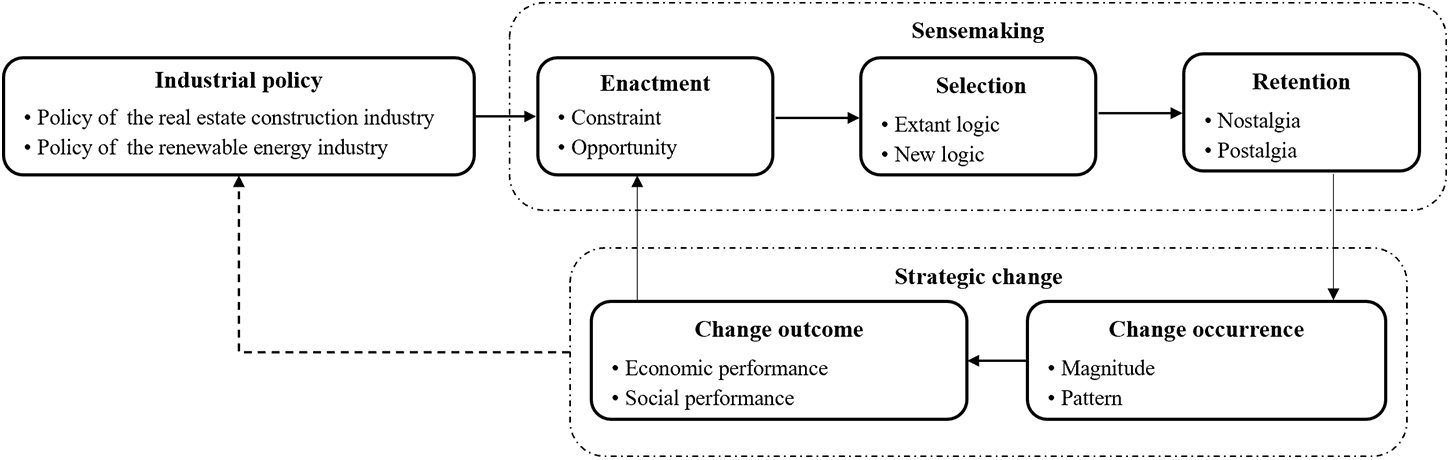
The comparative analysis of LE’s responses to plural industrial policies reveals two distinct forms of sensemaking. In this process, top managers draw on various logics to interpret policy shifts, construct meaning, and formulate strategic principles that facilitate survival and growth. Our study also uncovers an iterative mechanism by which firms balance opportunities and constraints in evolving institutional environments. Grounded in Thornton et al. (Reference Thornton, Ocasio and Lounsbury2012) explanation of institutional logics micro-foundations, this mechanism connects macro-level logics with micro-level sensemaking and subsequent organizational practices and outcomes. These outcomes, in turn, influence the broader institutional landscape. Our findings suggest that top managers selectively activate field logics for sensemaking, shaping strategic responses. Additionally, the temporality of sensemaking – whether retrospective or prospective – affects the intensity of strategic change. These varied outcomes then feed back into future sensemaking cycles. Figure 2 illustrates the theoretical model underpinning this process.
Theoretical model of LE’s top managers’ sensemaking about changes in corporate strategy in response to changes in industrial policy

Figure 2 Long description
The diagram illustrates changes in industrial policy and strategy from 2010 to 2016. It is divided into two main periods: 2010 to 2013 and 2014 to 2016. Each period is represented by three circles indicating stages of sensemaking: enactment, selection and retention. The top section shows changes in industrial policy, with supportive and restrictive policies in various industries. The middle section outlines the sensemaking process and temporality, with retrospective and prospective sensemaking. The bottom section details changes in strategy, including business model shifts and strategic actions. Outcomes are noted for each period, highlighting economic and social impacts.
Sensemaking with different institutional logics
LE needs to navigate the high uncertainty of industrial policies in emerging economies, such as China. While the instability of the policy environment is generally seen as a risk, it also presents opportunities for constructing meaning around change. Top managers, as change agents, perceive and interpret regulations and policies, redirecting firm strategy according to their interpretations. They frame policy shifts as either ‘opportunities’ or ‘constraints’. This stage highlights how top managers identify and frame information from the institutional environment. In the next stage, they need to select an appropriate institutional logic to rationalize their categorizations from the previous stage. In this ‘selection’ phase, institutional logics are no longer merely forces shaping individual cognition; instead, they become raw materials that top managers use to construct meaning. Over time, different logics are solidified and preserved through nostalgic or postalgic rhetorical strategy, which then serve as sources of guidance for future actions.
Another notable finding is the high degree of consistency exhibited by LE’s top managers across both rounds of sensemaking. This consistency can be attributed to three main factors. First, LE’s relatively flat organizational structure and compact top management team facilitate the development of a unified strategic mindset. In addition, although the company has a few regional branches, top managers work closely on the same floor of a single office building, further enhancing communication and alignment.
Second, as a private firm, LE is tightly controlled by its founder and president, who has maintained direct leadership since its inception. Rather than delegating authority to a cadre of professional managers, core decisions remain centralized within the firm. This leadership structure encourages other top managers to align with the president’s strategic vision. Mr. Xia has said in an interview:
As the chairman and president, I oversee human resources, finance, and strategy. Our company is still in a growth phase, so the Taoist principle of ‘wu wei er zhi’ is not yet feasible for me.
Third, during interviews, top managers appeared motivated to preserve a unified corporate image. In doing so, they downplayed internal differences and presented a coherent account of the firm’s strategy to the interviewer. This communicative alignment may also contribute to the appearance of internal consensus, even if some divergence exists beneath the surface.
The relationship between the temporality of sensemaking and the intensity of strategic change
Through the two rounds of strategic changes at LE, we identified two distinct forms of sensemaking – retrospective and prospective – based on their temporal orientation. We further assess the change intensity during each period to explore how temporal orientation relates to the intensity of strategic changes. Our findings show that retrospective sensemaking leads to strategic changes at the magnitude level, while prospective sensemaking drives changes at the pattern level. A more detailed analysis of the sensemaking process uncovers the mechanism underlying this relationship. Although actors are embedded within the inter-institutional system, they are not entirely constrained by specific institutional logics, as the embedded agency assumption suggests. Instead, actors exercise their agency in making sense of how external changes relate to internal transformations. Top managers’ perceptions of policy shifts, the selection of relevant institutional logics, and the construction of connections between the past, present, and future ultimately shape LE’s new strategic direction. As metaphorically expressed by the vice president:
Just like driving in a traffic jam. Our directions fluctuate all the time, although the destination is determined. The adjustments are based on consideration of navigation data, experience, and car performance.
An iterative process of sensemaking and strategic change
In this study, we identified an iterative process that links sensemaking, strategic change, and its outcomes in a continuous loop (see Figure 3). Following the first round of strategic change, LE made some progress in both economic and social dimensions, but had yet to achieve its intended goals fully. This negative feedback and stronger policy support for the renewable energy industry triggered a new round of sensemaking. Additionally, we found that during the second strategic change, LE helped to develop industry standards and actively participated in shaping local and national plans for the geothermal energy industry. Top managers at LE further drew the attention of the local government through channels such as participating in government meetings and collaborating with governmental agencies. LE indirectly influenced the future direction of industrial policy in the renewable energy sector by lobbying the local government and emphasizing the advantages of geothermal energy.
An iterative process of industrial policy change, sensemaking, and strategic change

Figure 3 Long description
The diagram shows a flowchart connecting industrial policy, sensemaking and strategic change. Industrial policy includes the policy of the real estate construction industry and the policy of the renewable energy industry. Sensemaking is divided into three sections: enactment, selection and retention. Enactment involves constraint and opportunity. Selection includes extant logic and new logic. Retention covers nostalgia and prestige. Strategic change is linked to change outcome and change occurrence. Change outcome involves economic performance and social performance, while change occurrence includes magnitude and pattern. Dotted lines connect these elements, indicating their relationships.
Discussion
We summarize the findings of narrative analysis and integrate them with existing theoretical frameworks to construct a holistic model that links dynamic industrial policy environments to strategic change via top managers’ sensemaking. The sensemaking process unfolds across three interrelated phases – enactment, selection, and retention – reflecting the foundational framework established in previous research (Weick, Reference Weick1979, Reference Weick2001; Weick et al., Reference Weick, Sutcliffe and Obstfeld2005). However, our analysis reveals that the temporal orientations of two rounds of sensemaking differ substantially, leading to variations in both the magnitude and pattern of strategic change.
Our two-stage model highlights the salient differences between retrospective and prospective sensemaking in both form and content. Although the sequence in which these two forms of sensemaking occur may vary across firms, the contrast between them is conceptually significant. This distinction enables a theoretical extension of the enactment-selection-retention framework by deepening the understanding of temporality in sensemaking and its effects.
Institutional Logics as Cognitive Resources for Strategic Sensemaking
Another key finding of this study is that institutional logics from distinct fields can serve as cognitive resources, or ‘feedstocks’, for sensemaking, thereby contributing to strategic change. In LE’s case, the differences between economizing and ecologizing logics offered top managers alternative cognitive frames for interpreting policy shifts and crafting responses. Contrary to perspectives in neo-institutionalism or the IBV, which emphasize the constraining role of institutional structures, our model highlights managerial agency in selecting which logic to activate. This logic selection process enables top managers to exercise creativity and adaptability within an inter-institutional system.
Although several researchers have examined institutional logics as strategic resources (e.g., Durand et al., Reference Durand, Szostak, Jourdan, Thornton, Lounsbury and Boxenbaum2013; Venkataraman et al., Reference Venkataraman, Vermeulen, Raaijmakers and Mair2016), relatively less is known about how these logics function within cognitive processes such as sensemaking. Our study answers this question by illustrating how decision-makers actively choose and mobilize institutional logics during critical interpretive junctures. Meanwhile, our findings underscore that sensemaking is not solely determined by structural forces; it is also shaped by individual will and their agency. While our single-case design limits broader generalization, we observed in both rounds of sensemaking that decision-makers deliberated over which institutional logics to activate. Top managers’ ability to switch between economizing and ecologizing logics illustrates the dual embeddedness and agency inherent in institutional work. In doing so, we move beyond simplistic dichotomies of compliance versus resistance, revealing how strategic heterogeneity emerges through situated and interpretive agency.
Temporality of Sensemaking in Complex Industrial Policy Systems
Our findings on the temporality of sensemaking reveal a contrast between retrospective sensemaking, anchored in economizing logic and nostalgic discourse, and prospective sensemaking guided by ecologizing logic and postalgic discourse.
This finding expands Weick et al. (Reference Weick, Sutcliffe and Obstfeld2005) model by integrating temporality into the sensemaking process, and suggests that policy interpretation is not temporally unidirectional. Although existing literature on temporal sensemaking recognizes these two modes (Dawson & Sykes, Reference Dawson and Sykes2019; Maitlis & Christianson, Reference Maitlis and Christianson2014), few studies have considered the contextual triggers that lead actors to favor one orientation over the other. Our study contributes to this literature by identifying how a complex industrial policy system provides interpretive space for both orientations. It is the dynamic and diverse nature of such a policy system that situates decision-makers in an institutional environment always characterized by simultaneous opportunities and constraints. Decision-makers leverage this complexity by framing policy shifts as either a constraint or an opportunity, depending on their needs and interests, thereby shaping the temporal direction of sensemaking. We acknowledge the shaping influence of industrial policies while recognizing sensemaking as a source of agency that allows decision-makers to interpret policy in ways aligned with their strategic intent. This finding complements recent calls for greater attention to sensemaking, which emphasizes how sensemaking processes reconstitute and instantiate institutional meanings and practices within organizations (Purdy, Ansari, & Gray, Reference Purdy, Ansari and Gray2019).
Moreover, our findings indicate that the selection of temporal orientation and institutional logics is neither automatic nor arbitrary, but rather a deliberate response to contextual contingencies. Instead, it reflects a calculated response to environmental cues and internal goals. The retrospective mode, as tied to extant logics, tends to constrain strategic imagination, leading to incremental adjustments. In contrast, prospective sensemaking facilitated logic switching and narrative reframing, enabling more transformative strategic responses.
Our model links this temporal dynamic to the intensity of strategic change, offering novel insights that have been largely overlooked in prior research. While existing research has explored sensemaking in strategic change – primarily focusing on actors’ roles, interpretive contexts, or observable actions (Balogun et al., Reference Balogun, Bartunek and Do2015; Kieran et al., Reference Kieran, MacMahon and MacCurtain2020; Weiser, Reference Weiser2021) – our findings emphasize the role of temporal orientation in shaping sensemaking outcomes, thereby complementing and extending prior work. Our findings on the relationship between the temporality of sensemaking and the magnitude and pattern of strategic change advance the understanding of strategic change as a socially constructed process, while also responding to recent scholarly calls to explain how cognitive activities translate into practices of organizational change (Goto, Reference Goto2022; Weiser, Reference Weiser2021).
Iterative Loop Between Sensemaking and Strategic Change
We theorize an iterative loop between sensemaking and strategic change. Outcomes from previous strategic actions, such as performance feedback and evolving policy shifts, influence subsequent interpretive works. This recursive dynamic aligns with Thornton et al. (Reference Thornton, Ocasio and Lounsbury2012) perspective on the evolution of institutional logics. It further reinforces the notion that sensemaking is not a one-off event, but rather a continuous organizational process.
Our study underscores sensemaking as an ongoing process in organizational change, thereby extending the causal mechanisms traditionally considered in change models. Instead of viewing sensemaking as a one-off reaction to a policy shift, we found that managers engaged in iterative sensemaking before, during, and after strategic change initiatives. This sustained interpretive process weaves disparate actions into a coherent trajectory of change. It further elucidates how change unfolds by illuminating the cognitive and interpretive work that links initial triggers to longer-term outcomes. In our case, top managers continually revisited past performance and envisioned future goals, adapting their strategies as new environmental cues and information emerged. This pattern is consistent with the idea of sensemaking as a continuous cycle of hypothesizing and refining meanings (Turner, Allen, Hawamdeh, & Mastanamma, Reference Turner, Allen, Hawamdeh and Mastanamma2023).
Our findings extend existing change theory by incorporating an explicit sensemaking mechanism into the explanation of how and why certain strategic changes become established. In essence, we contend that strategic change is not merely a reactive response to institutional or performance pressures (Clemens & Douglas, Reference Clemens and Douglas2005; Tarakci, Ateş, Floyd, Ahn, & Wooldridge, Reference Tarakci, Ateş, Floyd, Ahn and Wooldridge2018) but a product of ongoing interpretive work, through which decision-makers continuously reframe change in ways that realign the organization with an evolving institutional environment.
Limitations, Boundary Conditions, and Future Directions
Despite its theoretical contributions, this study is subject to several limitations that open avenues for future research. First, our empirical context is limited to a privately owned Chinese firm, which constrains generalizability. The sensemaking processes and strategic priorities of top managers in state-owned enterprises may differ significantly due to their unique legitimacy advantages, which often prioritize social responsibility over profitability (Greve & Zhang, Reference Greve and Zhang2017). Future research may compare sensemaking dynamics across different ownership structures to gain a deeper understanding of institutional heterogeneity.
Second, our focus is on a firm that successfully navigated policy-induced strategic change. Firms that failed to do so either declined participation or were unavailable for study. Comparative research including such cases could yield valuable insights into how failure to make sense of policy shifts affects strategic behavior. A dual-case design could help uncover variables like attentional framing, relational context, or organizational slack that shape different trajectories of sensemaking (Balogun et al., Reference Balogun, Bartunek and Do2015; Nigam & Ocasio, Reference Nigam and Ocasio2010).
Third, LE’s operations across two industries provided a fertile setting for observing hybrid sensemaking. Hybrid organizations or firms with multiple identities (Kodeih & Greenwood, Reference Kodeih and Greenwood2014; Saetre, Reference Saetre2023) are particularly susceptible to policy-induced temporal sensemaking. Future studies could focus on such organizations or firms to unpack the processes and outcomes of policy-induced temporal sensemaking, thereby testing the broader applicability of our framework.
Conclusion
This study advances understanding of how top managers respond to complex policy systems by integrating the institutional logics perspective with sensemaking theory. Drawing on a longitudinal case study of a Chinese private firm, this study demonstrates how managers interpret evolving and diverse industrial policies, mobilize multiple institutional logics, and drive strategic change. Our process model underscores the temporal nature of sensemaking and illustrates how managers’ embedded agency translates evolving policy signals into heterogeneous strategic responses. By integrating institutional logics, sensemaking, and strategic change, this research advances the literature on strategic change within complex institutional environments.
Data availability statement
The data supporting this study’s findings are available from the author, Y. Li, upon reasonable request.
Acknowledgements
We gratefully acknowledge the in-depth and constructive comments from the editors and three anonymous reviewers. This research was partially supported by the National Social Science Foundation of China (Grant no. 25BGL058) and the Humanities and Social Sciences Fund of the Chinese Ministry of Education (Grant no. 24YJC630116).
Yang Li (lesley618@hdu.edu.cn) is an assistant research fellow at Zhejiang Informatization Development Institute, Hangzhou Dianzi University, China. Her research interests include innovation management, institutional logics, and strategic change. Her research has been published in academic journals such as Journal of Technology Transfer and China Industrial Economics.
Jingjiang Liu (liujingjiang@zju.edu.cn) is an associate professor at the School of Management, Zhejiang University. His research interests include technological innovation management, technology entrepreneurship management, strategic science and technology human resource management, and the application of artificial intelligence in management research and organizational practice. His research has been published in academic journals such as Journal of Product Innovation Management, Strategic Entrepreneurship Journal, Human Resource Management, Management and Organization Review, and International Journal of Technology Management.