Introduction
Suicide is a transdiagnostic mental health problem with severe public health consequences. Biologically-based dispositions clearly contribute to suicidality, as demonstrated by family, twin, and adoption studies documenting appreciable heritability for suicidal ideation and behavior (Brent & Melham, Reference Brent and Melham2008). Innovative research approaches are needed to clarify the nature of dispositional liabilities, and how they contribute to psychological states that drive suicidal action (Joiner, Reference Joiner2005; Van Orden et al. Reference Van Orden, Witte, Cukrowicz, Braithwite, Selby and Joiner2010). One novel research strategy is to quantify liabilities for suicide using trait indicators from different assessment domains – including neural reactivity and behavioral performance indicators along with psychological scale variables (Turecki, Reference Turecki2005; Brandes & Bienvenu, Reference Brandes and Bienvenu2006; Van Orden et al. Reference Van Orden, Witte, Cukrowicz, Braithwite, Selby and Joiner2010; Anestis et al. Reference Anestis, Soberay, Gutierrez, Hernandez and Joiner2014; Venables et al. Reference Venables, Sellbom, Sourander, Kendler, Joiner, Drislane, Sillanmäki, Elonheimo, Parkkola, Multimaki and Patrick2015). The current study used data from a sample of adult twins to test the hypothesis that combined psychological/neurophysiological (psychoneurometric) assessments of core liability dimensions would predict suicidal behavior – and to evaluate the etiological basis of the expected associations.
Two core biobehavioral constructs, threat sensitivity and inhibitory control (Kozak & Cuthbert, Reference Kozak and Cuthbert2016; Nelson et al. Reference Nelson, Strickland, Krueger, Arbisi and Patrick2016), appear particularly relevant to suicidal behavior. Evidence for a role of threat sensitivity comes from research demonstrating positive relations of negative emotional traits with suicidality and clinical conditions associated with suicide (Brandes & Bienvenu, Reference Brandes and Bienvenu2006; Rappaport et al. Reference Rappaport, Flint and Kendler2017). Further, a recent study demonstrated in a sample of military veterans that enhanced startle reactivity during aversive picture viewing was associated with a history of suicide attempts and was predictive of subsequent attempts (Hazlett et al. Reference Hazlett, Blair, Fernandez, Mascitelli, Perez-Rodriguez, New, Goetz and Goodman2016). Evidence for a role of low inhibitory control comes from research showing predictive relations for impulsive-aggressive traits (Turecki, Reference Turecki2005; Anestis et al. Reference Anestis, Soberay, Gutierrez, Hernandez and Joiner2014). Venables et al. (Reference Venables, Sellbom, Sourander, Kendler, Joiner, Drislane, Sillanmäki, Elonheimo, Parkkola, Multimaki and Patrick2015) demonstrated that threat sensitivity (THT) and weak inhibitory control (disinhibition; DIS), assessed using psychological-scale measures (Kramer et al. Reference Kramer, Patrick, Krueger and Gasperi2012; Patrick et al. Reference Patrick, Venables, Yancey, Hicks, Nelson and Kramer2013), predicted suicidality (referring to a continuum of suicidal behaviors including ideation, plans/preparations, and prior attempts) in clinical and nonclinical samples – uniquely, and also interactively (i.e., individuals high on one or the other disposition reported elevated suicidality, and those concurrently high on both traits showed the greatest levels).
However, it remains to be seen whether THT and DIS are predictive of suicidality when assessed using neurophysiological indicators combined with report-based scales. Recent published work demonstrates that measures of these traits that incorporate both psychological-scale and neurophysiological-response indicators [i.e., psychoneurometric measures (Patrick & Bernat, Reference Patrick, Bernat, Million, Krueger and Simonsen2010; Patrick et al. Reference Patrick, Durbin and Moser2012)] robustly predict DSM-defined fear disorders (Yancey et al. Reference Yancey, Venables and Patrick2016; Venables et al. Reference Venables, Hicks, Yancey, Kramer, Nelson, Strickland, Krueger, Iacono and Patrick2017) and externalizing disorders (Patrick et al. Reference Patrick, Venables, Yancey, Hicks, Nelson and Kramer2013; Yancey et al. Reference Yancey, Venables, Hicks and Patrick2013; Venables et al. Reference Venables, Hicks, Yancey, Kramer, Nelson, Strickland, Krueger, Iacono and Patrick2017), respectively – and, at the same time, greatly enhance prediction of physiological criterion measures. More specifically, recent published work has shown that: (a) psychoneurometric THT substantially outperforms self-report THT in predicting brain and facial criterion measures of fear-cue reactivity, with no decrease in prediction of fear disorder symptoms (Yancey et al. Reference Yancey, Venables and Patrick2016); and (b) psychoneurometric DIS substantially outperforms self-report DIS in predicting cognitive-brain criterion measures, while predicting externalizing disorder symptoms to an equivalent degree (Patrick et al. Reference Patrick, Venables, Yancey, Hicks, Nelson and Kramer2013). These results demonstrate the potential value of a cross-domain (‘multi-unit’) approach to assessing psychopathology relevant constructs: As individual-difference variables that predict robustly across diagnostic and biological domains, psychoneurometric measures of core dispositional liabilities can serve as innovative targets for biobehavioral research on clinical problems.
The aims of the current study included: (1) testing whether THT and DIS predict suicidality in phenotypic analyses when assessed using self-report and neurophysiological measures combined, and (2) evaluating the etiological overlap between traits assessed in this manner and suicidality. Thus, the current study extended prior work by testing whether predictive relations of THT and DIS with suicidality are observed when these two biobehavioral constructs are quantified as composites of neurophysiological and psychological-scale indicators (Patrick et al. Reference Patrick, Venables, Yancey, Hicks, Nelson and Kramer2013; Yancey et al. Reference Yancey, Venables and Patrick2016). A further aim of the current work was to evaluate the etiologic bases of observed biobehavioral trait/suicidality associations through use of a twin sample novel to this line of research. The composite (psychological/neurophysiological) index of THT, referred to hereafter as THTPsyNeuro, combined a scale measure of dispositional fear/fearlessness (Kramer et al. Reference Kramer, Patrick, Krueger and Gasperi2012) with three physiological indices of reactivity to aversive visual images within a picture-viewing task (Yancey et al. Reference Yancey, Venables and Patrick2016). The composite DIS measure, referred to henceforth as DISPsyNeuro, was quantified by combining two scale measures of weak inhibitory control – a 30-item disinhibition scale from the Externalizing Spectrum Inventory (Krueger et al. Reference Krueger, Markon, Patrick, Benning and Kramer2007; Patrick et al. Reference Patrick, Venables, Yancey, Hicks, Nelson and Kramer2013) and an impulsive-aggression scale from a broad-band personality measure (Patrick et al. Reference Patrick, Curtin and Tellegen2002; Tellegen & Waller, Reference Tellegen, Waller, Boyle, Matthews and Saklofske2008) – with two indicators of brain response to stimuli from separate experimental tasks [i.e., oddball, picture-viewing (Patrick et al. Reference Patrick, Venables, Yancey, Hicks, Nelson and Kramer2013)]. Other recent research has demonstrated that P3 brain response relates to disinhibitory traits and problems as a function of shared genetic influence (Yancey et al. Reference Yancey, Venables, Hicks and Patrick2013), and that it covaries as well with performance on cognitive-executive tasks (Venables, Reference Venables2016) that also relate to disinhibitory traits and problems as a function of shared genetic influence (Young et al. Reference Young, Friedman, Miyake, Willcutt, Corley, Haberstick and Hewitt2009).
We hypothesized that higher scores on each of these psychoneurometric trait measures would be associated uniquely with suicidal behaviors assessed jointly through questionnaire-report and clinician-interview, and that an interaction term reflecting the synergistic influence of the two dispositions would contribute incrementally to prediction of suicidality, over and above main-effect terms for each trait variable (Venables et al. Reference Venables, Sellbom, Sourander, Kendler, Joiner, Drislane, Sillanmäki, Elonheimo, Parkkola, Multimaki and Patrick2015). Importantly, participants in the current study were identical and fraternal twin pairs, allowing us to also evaluate the etiological basis of observed associations of psychoneurometric traits with suicidality. Based on the concept of these traits as core biobehavioral dispositions that confer risk for diverse mental health outcomes, including suicidality, we predicted that observed covariation of psychoneurometric traits with suicidal behaviors would be largely attributable to common genetic influences.
Method
Participants
The base sample for the study consisted of 508 adult twins, each paid $100 for participating. Thirty-two were excluded from analyses due to missing questionnaire data, and another 32 were excluded due to missing or invalid data for two of three physiological indicators of threat sensitivity or both brain response indicators of inhibitory control.Footnote † Footnote 1 These exclusions resulted in a final N of 444 for analyses: 122 female monozygotic (MZ), 107 female dizygotic (DZ), 114 male MZ, and 101 male DZ participants (M age = 29.5, s.d. = 4.83). Procedures were approved by the University of Minnesota's Institutional Review Board and all participants provided informed written consent.
Scale and physiological measures of threat sensitivity
Psychological-scale assessment of threat sensitivity
The psychological measure of THT was a ‘trait fear’ scale developed to index the general fear/fearlessness dimension from a structural analysis of multiple questionnaire measures of this dispositional domain (Vaidyanathan et al. Reference Vaidyanathan, Patrick and Bernat2009; Kramer et al. Reference Kramer, Patrick, Krueger and Gasperi2012). The scale comprises 55 items from these various inventories that, in aggregate, correlate over 0.9 with scores on this general trait dimension (Vaidyanathan et al. Reference Vaidyanathan, Patrick and Bernat2009). Internal consistency reliability for the scale in the current sample (Cronbach's α) was 0.95.
Physiological indices of threat sensitivity
Physiological indicators of THT consisted of three variables from an affective picture-viewing task that included intermittent noise-probe stimuli: (a) aversive startle potentiation, quantified as enhancement of electromyographic (EMG) eyeblink response to noise probes occurring during aversive compared to neutral pictures; (b) differential corrugator ‘frown’ EMG reactivity to aversive pictures v. neutral; and (c) mid-latency heart rate (HR) acceleration to aversive pictures. Further details regarding recording and quantification of physiological response variables are provided in Yancey et al. (Reference Yancey, Venables and Patrick2016).
Scale and physiological measures of weak response inhibition
Psychological-scale assessment of weak response inhibition
Two scale measures of DIS were used: (a) a subset of 30 items from the Externalizing Spectrum Inventory [ESI (Krueger et al. Reference Krueger, Markon, Patrick, Benning and Kramer2007)] that index proneness to disinhibitory problems (Patrick et al. Reference Patrick, Venables, Yancey, Hicks, Nelson and Kramer2013; Yancey et al. Reference Yancey, Venables, Hicks and Patrick2013), and (b) the 12-item Aggression scale of the brief-form Multidimensional Personality Questionnaire (MPQ). The MPQ aggression scale was used along with the ESI-DIS scale because it operates as a strong indicator of general disinhibition (Patrick et al. Reference Patrick, Venables, Yancey, Hicks, Nelson and Kramer2013) and correlates robustly with reduced P3 brain response (Venables et al. Reference Venables, Patrick, Hall and Bernat2011). Internal consistencies (α) for these scales in the current sample were 0.88 and 0.81, respectively.
Physiological indicators of weak response inhibition
Following prior work (Patrick et al. Reference Patrick, Venables, Yancey, Hicks, Nelson and Kramer2013), two brain ERP (event-related potential) measures were used as neurophysiological indicators: (a) amplitude of P3 response to novel picture stimuli within a visual oddball task, and (b) amplitude of P3 to unwarned noise probes occurring in the above-noted picture-viewing task. Details regarding recording and quantification of these P3 variables were reported by Patrick et al. (Reference Patrick, Venables, Yancey, Hicks, Nelson and Kramer2013).
Psychoneurometric measures of threat sensitivity and weak response inhibition
Psychoneurometric scores for THT and DIS (THTPsyNeuro, DISPsyNeuro) were computed according to procedures used in prior work with the current participant sample (Patrick et al. Reference Patrick, Venables, Yancey, Hicks, Nelson and Kramer2013; Yancey et al. Reference Yancey, Venables and Patrick2016; Venables et al. Reference Venables, Hicks, Yancey, Kramer, Nelson, Strickland, Krueger, Iacono and Patrick2017) – i.e., as composites of scale and physiological indicators for each trait, weighted according to their loadings on the common factor emerging from a factor analysis of the four indicators of each. Weightings for the THTPsyNeuro indicators were as follows: trait fear scale = 0.48, corrugator EMG differentiation = 0.35, HR acceleration = 0.33, startle potentiation = 0.26. Weightings for the DIS indicators were: ESI-Disinhibition scale = 0.54, MPQ-Aggression scale = 0.56, novel stimulus P3 = −0.39, noise-probe P3 = −0.36. When operationalized this way (i.e., as psychoneurometric composites), THT and DIS were uncorrelated (r = −0.07, p > 0.14).
Suicidality measures
Indicators of current and lifetime suicidal behaviors consisted of relevant items from the Structured Clinical Interviews for DSM-IV-TR Axis-I Disorders [SCID-I (First et al. Reference First, Spitzer, Gibbon and Williams2002)] and Axis-II Disorders [SCID-II (First et al. Reference First, Gibbon, Spitzer, Williams and Benjamin1997)], and from the SCID-II Personality Questionnaire screener [SCID-II-PQ (First et al. Reference First, Gibbon, Spitzer, Williams and Benjamin1995)] and the Inventory of Depression and Anxiety Symptoms [IDAS (Watson et al. Reference Watson, O'hara, Simms, Kotov, Chmielewski, Mcdade-Montez, Gamez and Stuart2007)]. Details regarding diagnostic interview procedures are detailed elsewhere (Nelson et al. Reference Nelson, Strickland, Krueger, Arbisi and Patrick2016; Yancey et al. Reference Yancey, Venables and Patrick2016; Venables et al. Reference Venables, Hicks, Yancey, Kramer, Nelson, Strickland, Krueger, Iacono and Patrick2017). Two indicators of suicidal behavior were derived from the SCID interview protocols: (a) presence v. absence of suicidal ideation, plans, or attempts as covered in the major depression module of the SCID-I protocol (current and lifetime), and (b) presence v. absence of suicidal and self-harm behavior as addressed in the Borderline Personality Disorder (BPD) section of the SCID-II. Two other indicators of suicidal behavior were taken from the questionnaire inventories: (a) the item from the SCID-II-PQ BPD section pertaining to suicidal behaviors (‘Have you tried to hurt or kill yourself or threatened to do so?’), and (b) scores on the Suicidality Scale of the IDAS (six items; α = 0.73) indexing suicidal ideation and acts of self-harm during the past 2 weeks. In the remainder of this paper, we use the term suicidality to refer to a continuum of suicidal behaviors that includes recent and lifetime engagement in a range of behaviors, including ideation, plans and preparations for suicide, and attempts. We quantified suicidality as a dimensional composite reflecting shared variance among relevant measures, derived using a factor analytic approach.
Data analyses
Suicidality indicators were combined into a dimensional composite by conducting a principal axis factor analysis, and computing scores on the common factor reflecting their shared variance. Then, Pearson correlations were used to quantify associations of the two psychoneurometric trait variables, THTPsyNeuro and DISPsyNeuro, with this suicidality composite. In addition, a hierarchical regression analysis was performed in which THTPsyNeuro and DISPsyNeuro scores were entered as individual predictors of suicidality at step 1, with a term consisting of the product of mean-centered THTPsyNeuro and DISPsyNeuro scores entered at step 2 to test for an incremental contribution of the interaction of the two traits to prediction of suicidality. The interaction effect was probed for regions of significance using the Johnson–Neyman procedure (Johnson & Neyman, Reference Johnson and Neyman1936; Preacher et al. Reference Preacher, Rucker and Hayes2007), a continuous-score method for evaluating moderating effects of one predictor variable on the relationship between a second predictor and a criterion measure.
In addition, we used standard twin-modeling (biometric) analyses to quantify additive genetic (A) and shared and non-shared environmental (C, E) influences contributing to scores on the suicidality variable, and to evaluate the contributions of these etiological sources to the observed covariation between suicidality and psychoneurometric traits. Biometric analyses of the two psychoneurometric traits have been reported previously (Venables et al. Reference Venables, Hicks, Yancey, Kramer, Nelson, Strickland, Krueger, Iacono and Patrick2017), so the current analyses focused on new aspects of the data pertaining to suicidality scores and trait/suicidality associations. Based on the observed twin correlation patterns, we fit full information maximum-likelihood estimation models using the computer program Mx (Neale et al. Reference Neale, Boker, Xie and Maes2002). Following analytic approaches used in prior work (Yancey et al. Reference Yancey, Venables, Hicks and Patrick2013; Venables et al. Reference Venables, Hicks, Yancey, Kramer, Nelson, Strickland, Krueger, Iacono and Patrick2017), we computed univariate biometric models for suicidality scores. An ACE model was first fit, and then to determine whether the A or C paths contributed significantly, we compared the goodness of fit for alternative AE and E models with that of the ACE model using the −two times log-likelihood (−2LL) statistic. The difference between −2LL values for nested models approximates the χ2 distribution, which allows for computation of a likelihood ratio test to compare the relative fit of competing models. We also used Akaike's Information Criterion (AIC) to evaluate model fit. The AIC fit statistic balances overall fit with model parsimony and penalizes fit for unnecessary parameters (χ2 −2df), with lower values indicative of better fit. Lastly, the sample-size adjusted Bayesian Information Criterion (BIC n adj.), for which lower values indicate better fit, was included as an additional index of model fit.
Biometric models can readily be extended to the multivariate case using a Cholesky decomposition to distinguish genetic and environmental influences that are unique to a given phenotype and those that are shared with other phenotypes. Estimates of the genetic covariance can then be standardized to quantify the genetic correlation between two phenotypes, which provides an index of the amount of heritable variance that is shared between the phenotypes (i.e., the magnitude of shared genetic covariance). Similar correlations can be calculated to index the amount of overlapping environmental influences across traits. Finally, the Cholesky decomposition can also be used to partition the extent to which the phenotypic associations (however large or small) are attributable to genetic and environmental influences.
Results
Correlations among suicidality measures and computation of a dimensional composite
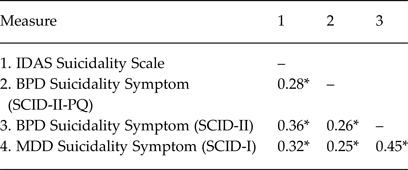
The four suicidality indicators were significantly intercorrelated (rs = 0.25–0.45; see Table 1), and a principal axis factor analysis of these indicators revealed one dominant factor (eigenvalue = 1.97) accounting for 49.3% of their variance. Loadings on this common factor were: SCID-I depression suicidality symptom = 0.63; SCID-II BPD suicidality symptom = 0.68; SCID-II-PQ BPD suicidality symptom = 0.42; IDAS Suicidality scale = 0.55. Consistent with current movements in the field toward operationalizing clinical problems in dimensional terms (Kozak & Cuthbert, Reference Kozak and Cuthbert2016; Kotov et al. Reference Kotov, Krueger, Watson, Achenbach, Althoff, Bagby, Brown, Carpenter, Caspi, Clark, Eaton, Forbes, Forbush, Goldberg, Hasin, Hyman, Ivanova, Lynam, Markon, Miller, Moffitt, Morey, Mullins-Sweatt, Ormel, Patrick, Regier, Rescorla, Ruggero, Samuel, Sellbom, Simms, Skodol, Slade, South, Tackett, Waldman, Waszczuk, Widiger, Wright and Zimmerman2017), we quantified suicidality in terms of scores on this common factor, computed as a loading-weighted composite of the four individual indicators. Scores beyond 4 s.d. from the mean were winsorized (‘reined-in’) to this threshold to reduce the impact of potential outliers, and raw scores were then log-transformed and adjusted such that a score of 0 denoted negligible suicidality.
Correlations (r) among indicators of suicidal behavior

IDAS, Inventory of Depression and Anxiety Symptoms; BPD, Borderline Personality Disorder; MDD, Major Depressive Disorder; SCID-I, Structured Clinical Interview for DSM-IV Axis-I Disorders; SCID-II, Structured Clinical Interview for DSM-IV Axis-II Disorders; SCID-II-PQ, Structured Clinical Interview for DSM-IV Axis-II Disorders Personality Questionnaire.
* p ⩽ 0.001.
Psychoneurometric trait measures: associations with suicidality
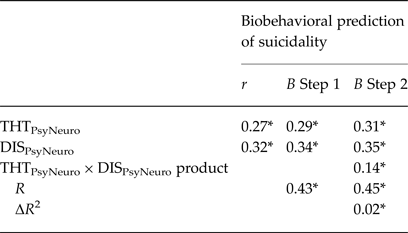
As shown in Table 2, THTPsyNeuro and DISPsyNeuro were each positively correlated with suicidality, and each contributed distinctively to prediction when entered together in the first step of the regression analysis. Further, when a product term reflecting the interaction of the two traits was entered in the second step of this analysis, it contributed incrementally to prediction of suicidality.Footnote 2
Bivariate correlations (r) and regression coefficients (B) for prediction of suicidality from psychoneurometric trait measures

THTPsyNeuro, threat sensitivity assessed using neurophysiological and self-report indicators; DISPsyNeuro, weak response inhibition assessed using neurophysiological and self-report indicators; THTPsyNeuro × DISPsyNeuro product, interaction term, computed as the product of mean-centered scores for DISPsyNeuro and THTPsyNeuro; r, Pearson correlation coefficient; B, standardized regression coefficient; R, multiple regression coefficient; ΔR 2, change in R 2 (i.e., change in proportion of variance accounted for in the criterion measures).
Note: Suicidality is quantified as a dimensional composite of self-report and interview-rating indicators.
* p⩽0.001.
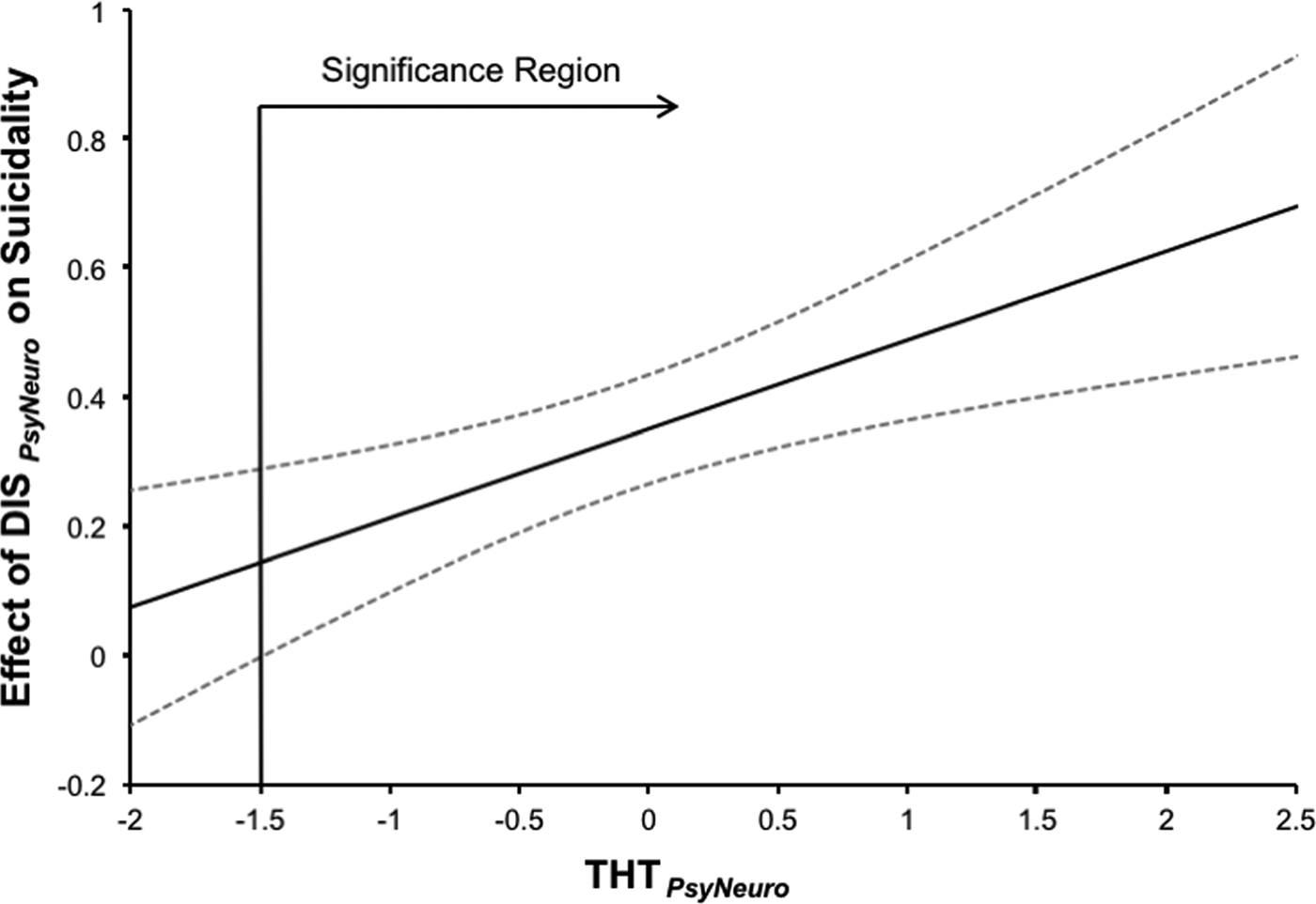
The interaction between psychoneurometric indices of DIS and THT was probed using the Johnson–Neyman technique (Johnson & Neyman, Reference Johnson and Neyman1936; Preacher et al. Reference Preacher, Rucker and Hayes2007). This method identifies values of a moderator variable (designated as THTPsyNeuro in the current analysis) at which the interaction effect is statistically reliable (i.e., p < 0.05) – reflecting the region of significance for the interaction, along with confidence intervals (CIs) for the effect of a predictor of interest (DISPsyNeuro, in this case) on the dependent variable (suicidality) across levels of the moderator (THTPsyNeuro). As depicted in Fig. 1, a synergistic effect of DIS on suicidality was evident for participants with THT scores ⩾−1.5 s.d.s below the mean (i.e., above which CIs for effect of DIS do not cross zero). Results from this analysis indicated that the effect of DISPsyNeuro on suicidality was systematically amplified as a function of increasing THTPsyNeuro scores, and was evident across much of the range of this latter trait.Footnote 3
Depiction of interaction between psychoneurometric measures of threat sensitivity (THTPsyNeuro) and weak response inhibition (DISPsyNeuro) in predicting suicidality. Values along the y-axis reflect variations (in relative, standard-score units) in the predictive relationship between DISPsyNeuro and suicidality as a function of increasing levels of THTPsyNeuro, reflected by values (also in standard-score units) along the x-axis. The solid line reflects point estimates of the DISPsyNeuro/suicidalityrelationship at differing levels of THTPsyNeuro; the dashed lines reflect upper and lower 95% CIs for these estimates. The point of intersection of the angled arrow labeled ‘Significance Region’ with the x-axis denotes the level of THTPsyNeuro at which DISPsyNeuro begins to interact significantly with THTPsyNeuro in predicting suicidality.

Etiological overlap between psychoneurometric traits and suicidality
Venables et al. (Reference Venables, Hicks, Yancey, Kramer, Nelson, Strickland, Krueger, Iacono and Patrick2017) reported univariate biometric models for THTPsyNeuro and DISPsyNeuro. To summarize, each trait was appreciably heritable (estimates of additive genetic influence = 0.68 and 0.45, respectively), with the remaining phenotypic variance in each attributable to non-shared environmental influences (including measurement error). Twin correlations for the suicidality composite indicated a role for genetic influences, in that the coefficient for identical twins (rMZ = 0.53) exceeded that for fraternal twins (rDZ = 0.27). However, given that rMZ was <1, a role for non-shared environmental influences was also indicated. To formally evaluate the contributions of genetic and environmental influences, an ACE model was fit to suicidality scores (df = 437, −2LL = 767.88, AIC = −106.1, BIC n adj. = −125.5) along with more parsimonious AE (df = 438, −2LL = 768.01, AIC = −107.0, BIC n adj. = −126.6), and E (df = 439, −2LL = 811.01, AIC =−67.0, BIC n adj. = −106.1) models. Comparison of these models revealed a non-significant difference in model fit between the ACE and AE models (Δχ2 = 0.12, p > 0.72), indicating that the C path could be dropped without a significant reduction in model fit. However, comparison of the AE and E models revealed a significant decrement in fit for the latter (Δχ2 = 43.01, p < 0.001), indicating a significant contribution of additive genetic influences. Standardized parameter estimates (and 95% CIs) for the AE model of suicidality were: A = 0.52 (0.38–0.62) and E = 0.48 (0.37–0.62).
Next, we fit two bivariate Cholesky models to derive estimates of the genetic and environmental influences on the covariance between each psychoneurometric trait variable and suicidality. Table 3 presents estimated phenotypic, genetic, and non-shared environmental correlations for the associations of psychoneurometric indices of DIS and THT with suicidality. Robust genetic correlations were observed for associations of THTPsyNeuro and DISPsyNeuro with suicidality and in each case a substantial proportion of the phenotypic association was attributable to genetic influences. Additionally, evidence was found for overlapping non-shared environmental influences between DISPsyNeuro and suicidality.
Phenotypic, genetic, and nonshared environmental correlations (and 95% confidence intervals) for each psychoneurometric variable (DISPsyNeuro, THTPsyNeuro) with suicidality

THTPsyNeuro, threat sensitivity assessed using neurophysiological and self-report indicators; DISPsyNeuro, weak response inhibition assessed using neurophysiological and self-report indicators.
Suicidality was computed as a factor composite reflecting covariance across diagnostic and self-reported suicidal behavior. Bolded coefficients are significant at p < 0.05.
Note. r values reflect correlations (estimated using Mx) between total observed variance (r phenotypic) in trait and suicidality, and between portions of variance in each attributable to genetic influences (r genetic) and to non-shared environmental influences (r non-shared environmental). Percent covariance estimates reflect the proportion of phenotypic associations due to additive genetic (A) and non-shared environmental (E) influences.
Discussion
The current work extends findings prior from predictive studies with outpatient clinic and general community samples (Venables et al. Reference Venables, Sellbom, Sourander, Kendler, Joiner, Drislane, Sillanmäki, Elonheimo, Parkkola, Multimaki and Patrick2015) by demonstrating robust prediction of suicidality from THT and DIS, operationalized jointly using neurophysiological and self-report indicators, in an adult twin sample (Patrick et al. Reference Patrick, Venables, Yancey, Hicks, Nelson and Kramer2013; Yancey et al. Reference Yancey, Venables and Patrick2016). The two psychoneurometric trait variables predicted interactively as well as individually: The association for each with suicidality became stronger as a function of increasing levels of the other, such that participants with high levels of both THTPsyNeuro and DISPsyNeuro showed markedly amplified suicidal behaviors relative to other participants (Fig. 1). This finding dovetails with other work demonstrating high rates of suicidal behavior in conditions such as borderline personality that involve impulsive–aggressive tendencies together with high negative affectivity. The presence of both THT and DIS may confer a distinct liability to the act-oriented type of emotion dysregulation that characterizes suicidal behavior and psychological processes closely related to it (Van Orden et al. Reference Van Orden, Witte, Cukrowicz, Braithwite, Selby and Joiner2010).
In addition, findings from the present study provide the first demonstration that psychoneurometric measures of THT and DIS share appreciable genetic variance in common with suicidality, lending support to the idea that these traits represent biologically-based liability factors for suicidal behavior (Anestis et al. Reference Anestis, Soberay, Gutierrez, Hernandez and Joiner2014; Buchman-Schmitt et al. Reference Buchman-Schmitt, Brislin, Venables, Joiner and Patrick2017). In other recent work, we have shown that these two traits, when operationalized psychoneurometrically, show appreciable genetic overlap with other clinical conditions as well – THT with focal fear problems especially, DIS with substance-related problems in particular, and both to some extent with distress-related problems as well. Of note, while highlighting the transdiagnostic importance of these dispositional constructs to an understanding of psychopathology, the evidence for cross-associations also raises the question of what determines the specific manner in which these liabilities are manifested clinically.
Our view is that these biobehavioral traits are best conceptualized as distal risk factors that contribute, together with other constitutional factors and life experiences across time, to the emergence of pathogenic processes more proximal and unique to problems of particular types. In the case of suicide, distinct proximal processes of thwarted belongingness, perceived burdensomeness, and capability for lethal self-harm are thought to be operative (Van Orden et al. Reference Van Orden, Witte, Cukrowicz, Braithwite, Selby and Joiner2010). Viewed in this way, the investigative task becomes one of clarifying how and under what circumstances general (i.e., transdiagnostic) trait liabilities contribute to the formation of cognitive-motivational states that are distinctly suicidogenic, as opposed to states that uniquely characterize other clinical problems (Buchman-Schmitt et al. Reference Buchman-Schmitt, Brislin, Venables, Joiner and Patrick2017). Further research should also be undertaken to clarify the extent to which trait liabilities are specifically predictive of suicidal behaviors with intent for self-harm, or if they operate as predictors of non-suicidal self-injurious behaviors as well.
Of note, DIS in the current study also showed a non-shared environmental correlation with suicidality, suggesting that experiences unique to individual siblings from the same household contribute in part to DIS/suicidality associations. It will be important in future research to systematically evaluate possible contributions to this association, including ways in which disinhibitory tendencies may increase exposure to interpersonal-affective experiences that, in turn, foster psychological states that immediately precede lethal or near lethal suicide attempts (Anestis et al. Reference Anestis, Soberay, Gutierrez, Hernandez and Joiner2014; Buchman-Schmitt et al. Reference Buchman-Schmitt, Brislin, Venables, Joiner and Patrick2017).
Our finding that biobehavioral traits quantified using neural-response indicators along with psychological-scale measures predict robustly to suicidality is important both conceptually and practically. Conceptually, traits defined in this way differ from traits assessed using scale measures alone: They reflect dispositional tendencies as expressed both in reported attitudes/behaviors and online physiological/neural reactions (Patrick et al. Reference Patrick, Durbin and Moser2012, Reference Patrick, Venables, Yancey, Hicks, Nelson and Kramer2013; Yancey et al. Reference Yancey, Venables and Patrick2016). As such, psychoneurometric trait assessments provide an interface between phenomena in the psychological domain (e.g., clinical problems and problem-related attributes) and phenomena in the biological domain (e.g., brain systems and neural processes). In the case of suicidal behavior, findings from the current work indicate that genetic liability to this clinical outcome is traceable substantially to genetic variation in threat sensitivity and inhibitory control, quantified psychoneurometrically. That is, individuals who exhibit maximal genetic risk for suicidal behavior are those with the highest genetic proclivity to express these dispositional tendencies in both their reports and their neural responses. Other recent work by our group has shown that these two traits account for variance in suicidality largely through their relations with suicide-promoting processes of thwarted belongingness and perceived burdensomeness (Buchman-Schmitt et al. Reference Buchman-Schmitt, Brislin, Venables, Joiner and Patrick2017). Considered together with current findings, the implication is that genetic liability for suicidality lies in core biobehavioral tendencies that contribute, in conjunction with relevant shaping effects of experience across time, to the development of distinct psychological states that directly fuel urges toward lethal self-harm.
Practically, the psychoneurometric approach to assessing trait dispositions is advantageous in that it augments predictive relations with biological variables without loss of power to predict clinical outcome variables. Prior published work has shown, for example, that scale/neurophysiological assessments of THT and DIS greatly outperform scale-only assessments in predicting relevant criterion measures of brain and bodily response [e.g., indices of defensive reactivity to aversive stimuli in the case of THT, and impaired cortical-elaborative processing in the case of DIS (Nelson et al. Reference Nelson, Patrick and Bernat2011; Patrick et al. Reference Patrick, Durbin and Moser2012, Reference Patrick, Venables, Yancey, Hicks, Nelson and Kramer2013; Yancey et al. Reference Yancey, Venables and Patrick2016)]. Given these results, it can be expected that psychoneurometric assessments would also show more robust associations with brain reactivity during relevant cognitive and emotional tasks within neuroimaging paradigms (e.g., Foell et al. Reference Foell, Brislin, Strickland, Seo, Sabatinelli and Patrick2016; Vizueta et al. Reference Vizueta, Patrick, Jiang, Thomas and He2012), and potentially with clinically-relevant neuroanatomical and neurochemical variables.
As such, psychoneurometric measures of clinically-relevant traits can serve as uniquely valuable targets for experimental, genetic–etiological, and longitudinal investigations of premorbid risk for clinical problems (including suicidality) and emergent pathophysiologies. Work of this type, including longitudinal investigations, will be needed to evaluate whether our finding that high levels of both traits predict amplified suicidality reflects a distinct, early-identifiable process associated with their co-occurrence, or synergistic effects of their separate influences that emerge across time. It will also be important in future work to incorporate neurobehavioral indicators of other types (e.g., brain-activation scores from neuroimaging paradigms; performance scores from laboratory-based tasks known to index relevant neuropsychological processes) to further elaborate on neural circuits and processes related to THT and DIS.
Related to the preceding point, the current work highlights some important advantages of quantifying biobehavioral constructs using multiple methods (‘units’) of measurement – an approach that has been advocated in recent writings by mental health experts (Hyman, Reference Hyman2007; Kozak & Cuthbert, Reference Kozak and Cuthbert2016; Kwako et al. Reference Kwako, Momenan, Litten, Koob and Goldman2016). In particular, our work illustrates how joint psychometric-neurophysiological assessment of basic trait dispositions can shift how we think about liabilities for mental illness, and provide novel insights into specific clinical problems such as suicidal behavior. Assessments of this type can serve as valuable referents for linking clinical outcomes to neural systems, advance understanding of how heritable proclivities contribute to distinct psychological processes associated with specific clinical conditions, and inform efforts to develop effective biologically-oriented approaches to treatment and prevention.
Acknowledgements
This work was supported by the National Institute of Mental Health grants (Nos MH072850 & MH089727); US Army grants (Nos W911NF-14-1-0018 & W81XWH-10-2-0181). The content of this paper is solely the responsibility of the authors and does not necessarily represent the official views of the U.S. Government, Department of Defense, Department of the Army, Department of Veterans Affairs, or U.S. Recruiting Command. Funding sources had no role in the study design in the collection, analysis and interpretation of data, in the writing of the report, or in the decision to submit the article for publication.
Declaration of Interest
None.
Ethical standards
The authors assert that all procedures contributing to this work comply with the ethical standards of the relevant national and institutional committees on human experimentation and with the Helsinki Declaration of 1975, as revised in 2008.