Introduction
The spread of invasive destructive pests has been causing damage to the environment as well as agricultural production, with consequent socio-economic impacts that need to be confronted by the public, policy-makers, governments and international agencies (Vitousek et al., Reference Vitousek, Dantonio, Loope, Rejmanek and Westbrooks1997; Pimentel et al., Reference Pimentel, Lach, Zuniga and Morrison2000; Poland and Mccullough, Reference Poland and Mccullough2006; Kovacs et al., Reference Kovacs, Haight, McCullough, Mercader, Siegert and Liebhold2010; Aljaryian and Kumar, Reference Aljaryian and Kumar2016; Hulme, Reference Hulme2017; Staentzel et al., Reference Staentzel, Combroux, Barillier, Grac, Chanez and Beisel2019). Recent high profile examples include emerald ash borer (Agrilus planipennis Fairmaire) in the USA (Poland and Mccullough, Reference Poland and Mccullough2006), tomato pinworm (Tuta absoluta (Meyrick)) across the world (Biondi et al., Reference Biondi, Guedes, Wan and Desneux2018), brown marmorated stink bug (Halyomorpha halys (Stål)) in the USA (Kistner, Reference Kistner2017; Kriticos et al., Reference Kriticos, Kean, Phillips, Senay, Acosta and Haye2017) and fall armyworm (Spodoptera frugiperda (J.E. Smith)) in Africa (Goergen et al., Reference Goergen, Kumar, Sankung, Togola and Tamo2016) and Asia (Baloch et al., Reference Baloch, Fan, Haseeb and Zhang2020; Li et al., Reference Li, Wu, Ma, Gao, Wu, Chen, Liu, Jiang, Zhai, Early, Chapman and Hu2020). Being able to accurately estimate the potential geographical ranges under current conditions and estimate how they might shift with global warming between now and 2100 will enable mitigation strategies for such pests to be better informed and prepared (Kriticos et al., Reference Kriticos, Agathe, Palmer, Cook, Brockerhoff, Stephens, Watt and Alex2013).
As climates warm, empirical evidence on herbivorous insects indicates a higher frequency of outbreaks for some species (Ayres and Lombardero, Reference Ayres and Lombardero2000; Logan et al., Reference Logan, Reniere and Powell2003), expansion of geographical range (Battisti et al., Reference Battisti, Stastny, Netherer, Robinet, Schopf, Roques and Larsson2005; Engelkes et al., Reference Engelkes, Morrieen, Verhoeven, Bezemer, Biere, Harvey, McIntyre, Tamis and van der Putten2008; Bebber et al., Reference Bebber, Ramotowski and Gurr2013), phenological asynchrony between some plant hosts and herbivores (Singer and Parmesan, Reference Singer and Parmesan2010; Foster et al., Reference Foster, Townsend and Mladenoff2013) and increasing prevalence of insect viral vectors and plant disease epidemics (Kriticos et al., Reference Kriticos, Darnell, Yonow, Ota, Boykin, Sutherst, Parry, Mugerwa, Maruthi, Seal, Colvin, Macfadyen, Kalyebi, Hulthen and De Barro2020). However, some consequences of climate change for herbivores are unpredictable due to cryptic biological characteristics (Deutsch et al., Reference Deutsch, Tewksbury, Huey, Sheldon, Ghalambor, Haak and Martin2008; Jaric et al., Reference Jaric, Heger, Monzon, Jeschke, Kowarik, Mcconkey, Pysek, Sagouis and Essl2019), resistant responses to global warming (due to behaviour, physiological fitness or immigration) (Li et al., Reference Li, Feng, Liu, You and Furlong2016) and changes in interactions between trophic levels (Furlong and Zalucki, Reference Furlong and Zalucki2017). Thus, while there are general patterns (Sutherst et al., Reference Sutherst, Baker, Coakley, Harrington and Scherm2007), there may be uncertainty in how an individual invasive pest's geographical range might shift due to global warming (Chaves, Reference Chaves2016; Gillard et al., Reference Gillard, Thiebaut, Deleu and Leroy2017; Hulme, Reference Hulme2017).
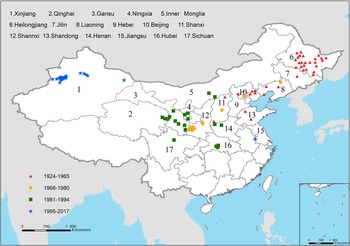
The apple buprestid, Agrilus mali Matsumura (Coleoptera: Buprestidae), was originally described as restricted to the Russian Far East (Amur Province, Primorskii and Khabarovskii territories), north-eastern China and Korea (Sun et al., Reference Sun, Liang and Sun1979; Zhang et al., Reference Zhang, Zhang, Zhang, Cui, Han, Gao, Poland, Zalucki and Lu2021). Around the 1950s, A. mali established and became locally distributed in Liaoning, Jilin, Gansu, Heilongjiang, Hebei, Shannxi, Inner Mongolia, Shandong, Henan, Sichuan and Hubei provinces in China (fig. 1), where it was considered a secondary pest of domesticated apples, causing little damage in well-managed orchards (Sun et al., Reference Sun, Liang and Sun1979). Agrilus mali continued to spread from north-eastern China in 1950s–1990s to southern China in 1990s–2000s (fig. 1); it was accidently introduced to orchards in the Yili valley, Xinjiang Uyghur Autonomous Region (XUAR) in northwest China with apple seedlings in the 1990s. Catastrophically, it moved from local domestic apple orchards into natural populations of wild apple, Malus sieversii (Ledeb.) Roem (Yi et al., Reference Yi, Liu, Cui and Shang2016; Zhang et al., Reference Zhang, Jiao, Li and Li2018). Agrilus mali is now widespread in wild apple forests in the Tian Shan Mountains in XUAR (Cui et al., Reference Cui, Liu and Liu2015; Zhang et al., Reference Zhang, Lu, Zhang, Zhao, Zhang, Tanabeko, Bagila, Zhanera and Cui2019). It has caused severe damage to M. sieversii populations, posing a threat to this rare and valuable source of apple germplasm in XUAR and central Asia (Zhang et al., Reference Zhang, Lu, Zhang, Zhao, Zhang, Tanabeko, Bagila, Zhanera and Cui2019). Agrilus mali is oligophagous, and utilizes numerous species in the genus Malus (Li and Zhang, Reference Li and Zhang2017). Other wild apple species at risk if this pest continues to spread include M. orientalis Uglitzk. in Armenia and Turkey, M. baccata Borkh. across Siberia and South Asia (India, Pakistan and Nepal) and M. sylvestris Mill. in Europe. All four wild apple species are the ancestors of domestic apples, with the major genetic contribution from M. sieversii (Harris et al., Reference Harris, Robinson and Juniper2002; Velasco et al., Reference Velasco, Zharkikh, Affourtit, Dhingra, Cestaro, Kalyanaraman, Fontana, Bhatnagar, Troggio and Pruss2010; Cornille et al., Reference Cornille, Gladieux, Smulders, Roldán-Ruiz, Laurens, Le Cam, Nersesyan, Clavel, Olonova, Feugey, Gabrielyan, Zhang, Tenaillon and Giraud2012).
The current distribution of Agrilus mali and invasion history in China from 1920′s to date based on GBIF, published papers (Zhang et al., Reference Zhang, Lu, Zhang, Zhao, Zhang, Tanabeko, Bagila, Zhanera and Cui2019) and our own collections. Key provinces mentioned in the text are numbered.

The spread of A. mali within XAUR had disastrous consequences and cascading effects in the local forest ecosystems. More than 95% of the wild apple forest in the Yili valley became infested, and 40–50% of trees in this valley were killed (Cui et al., Reference Cui, Zhang, Luo, Ma and Lu2018). Following the invasion by A. mali, production of wild apple fruits per hectare was reduced from 9 tonnes in healthy areas to 1.5 tonnes in infested areas, greatly reducing the forest seed bank. This insect pest is of economic importance in domesticated apple varieties and ornamental Malus plants in parks, windbreak forest, hedge-rows and gardens (Li and Zhang, Reference Li and Zhang2017).
Worldwide, more than 8 million ha of apples are harvested annually, yielding 124 million tonnes, with more than 30% of the apple production from China (http://www.fao.org/faostat/en/). The USA, Poland, Turkey, India, Iran and Italy are also major apple producers. Elsewhere, for example, Australia and New Zealand, apple production is an important contributor to national or regional economies. Given the severe impacts observed in China from the invasion of A. mali, understanding the potential distribution of this pest in relation to apple production areas is likely to be of global interest to many bio-security agencies and horticultural industries.
Climate change has produced global temperature increases of approximately 0.7°C throughout the 20th century, with temperatures expected to continue to increase throughout the 21st century (Walther et al., Reference Walther, Post, Convey, Menzel, Parmesan, Beebee, Fromentin, Hoegh-Guldberg and Bairlein2002). The effect of climate change on the distribution of invasive pests such as A. mali will be crucial, especially for the prosperity of apple production and associated industries at risk. Bioclimatic niche modelling exercises have repeatedly found that the potential distribution of invasive organisms is sensitive to climate change scenarios for the 21st century (Kriticos et al., Reference Kriticos, Sutherst, Brown, Adkins and Maywald2003, Reference Kriticos, Watt, Potter, Manning, Alexander and Tallent-Halsell2011; Sutherst et al., Reference Sutherst, Baker, Coakley, Harrington and Scherm2007; Olfert et al., Reference Olfert, Weiss and Kriticos2011; Guichard et al., Reference Guichard, Guis, Tran, Garros, Balenghien and Kriticos2014), with the potential to affect biosecurity policies in nations and states that are at the margins of climatic suitability under historical climate conditions.
In this study, we assess the geographic area at risk of invasion by this pest under historical climate conditions and a business-as-usual global climate scenario, with special emphasis on China, the world's largest producer of apples. We use the results to highlight areas of current and emerging biosecurity concern to domesticated apple industries and for conservation of apple germplasm resources.
Methods and materials
Agrilus mali: background biology and ecology
Agrilus mali has a univoltine life cycle with an obligatory diapause for overwintering in China. There are five larval instars with diapausing larvae (mostly first-second instars) occurring in the shallow phloem of Malus spp. (Sun et al., Reference Sun, Liang and Sun1979; Li and Zhang, Reference Li and Zhang2017). The first-four instars feed on phloem and cambium. Pupation occurs when the fifth instar drills into the shallow xylem (Wang et al., Reference Wang, Zhang, Yang and Wang2013). In China, adults emerge at the start of May and persist until the end of August or September depending on pupal development, and the peak time for adults is mid-July in most regions in China (Li and Zhang, Reference Li and Zhang2017; Cui et al., Reference Cui, Zhang, Luo, Ma and Lu2018). Adults are active flyers, mating around noon (Liu, Reference Liu2010). Their feeding on leaves causes minor damage to the tree. Females prefer to oviposit in the scar crevices of younger branches and buds, and a female usually lays 40–60 eggs over her life time (Bozorov et al., Reference Bozorov, Luo, Li and Zhang2019).
A distinctive feature of this pest is that it only infests a narrow range of branch sizes (diameter ranges: 2–9 cm) in the field (Zhang et al., Reference Zhang, Zhang, Zhang, Cui, Han, Gao, Poland, Zalucki and Lu2021). Similar to other Agrilus species (Haack and Benjamin, Reference Haack and Benjamin1982; Poland and McCullough, Reference Poland and Mccullough2006), it feeds in the cambial region on phloem and outer sapwood forming S-shaped or irregular galleries that disrupt nutrient and water flow within the host plant. High infestations can result in the death of trees after 3–5 years, usually because of water and nutrient deficiencies (Zhang et al., Reference Zhang, Cui, Xu, Ali and Lu2020). Early larval instars are cryptic, and the movement of infested seedling apple trees is regarded as the main means by which A. mali has spread within China (Cui et al., Reference Cui, Zhang, Luo, Ma and Lu2018; Zhang et al., Reference Zhang, Lu, Zhang, Zhao, Zhang, Tanabeko, Bagila, Zhanera and Cui2019).
Location records
Geographical locations of A. mali, as well as the year it was reported, were sourced from GBIF (https://www.gbif.org), CABI (https://www.cabi.org/) and references and reports in China (Cornille et al., Reference Cornille, Giraud, Bellard, Tellier, Le Cam, Smulders, Kleinschmit, Roldan-Ruiz and Gladieux2013; Kumar et al., Reference Kumar, Singh, Pramanick, Verma, Srivastav, Singh, Bharadwaj and Naga2018; Zhang et al., Reference Zhang, Cui, Xu, Ali and Lu2020). In addition, our colleagues across China offered new sites and our team recorded sites based on field surveys. In total, 95 sites were used in this study (fig. 1, Supplementary table 1).
Meteorological data
We used the CM10 1975H dataset within the CliMond database (Kriticos et al., Reference Kriticos, Webber, Leriche, Ota, Macadam, Bathols and Scott2012), comprising 30-year averages centred on 1975 at 10′ spatial resolution of monthly mean values for daily minimum and maximum temperature (°C), relative humidity (%) at 09:00 and 15:00 and monthly rainfall total.
The A1B greenhouse gas emissions scenario describes a world with a balanced use of fossil and renewable resources resulting in an estimated temperature rise of 2.8°C (range from 1.7 to 4.4°C) (Nakicenovic et al., Reference Nakicenovic, Alcamo, Grubler, Riahi, Roehrl, Rogner and Victor2000). In this study, we use the results of a model forced with the A1B greenhouse gas emissions scenario for global climate change in current and 2100 obtained from the CliMond dataset (https://www.climond.org) to project the species potential distribution worldwide. This emission scenario was chosen because it represents a ‘business as usual’ emissions scenario, similar to the RCP 8.5 scenario in CMIP5 (Taylor et al., Reference Taylor, Stouffer and Meehl2012). Its inclusion in this analysis is not intended to support a prediction of what will happen in the future. Rather, it is used here as a means of stress-testing the baseline potential distribution model, to highlight areas of concern for future potential range expansion by A. mali.
Modelling strategy
Based on the known distribution records and its biology from our own field studies during 2016–2018 (Cui et al., Reference Cui, Zhang, Zhang, Luo, Zhang, Golec, Poland, Zalucki, Han and Lu2019), a CLIMEX model (Sutherst and Maywald, Reference Sutherst and Maywald1985; Kriticos et al., Reference Kriticos, Ota, Hutchison, Beddow, Walsh, Tay, Borchert, Paula-Moreas, Czepak and Zalucki2015) was developed for the potential distribution of A. mali. The stress-related parameter values were adjusted to fit the known distribution records of A. mali in China, bearing in mind the need for parameters to be biologically reasonable (Kriticos et al., Reference Kriticos, Ota, Hutchison, Beddow, Walsh, Tay, Borchert, Paula-Moreas, Czepak and Zalucki2015). The aim was to achieve perfect model sensitivity and good specificity using parameters that were consistent with the known biology of A. mali. The Ecoclimatic Index (EI) was classified into four arbitrary classes to display potential geographic distributions for mapping in ArcGIS (ESRI company, version 10.2): not suitable (EI = 0), marginal (0 < EI< 5), low suitability (5 < EI< 15) and highly suitable (EI > 15). Plots of the weekly growth index (GIW) with time of year indicated seasonal suitability for the species. By comparing these to assessments of phenology, we are cross-validating the model growth parameters.
Model fitting
The CLIMEX parameter set (table 1) was iteratively fitted to the current known distribution based on the biology of this pest (Cui et al., Reference Cui, Zhang, Zhang, Luo, Zhang, Golec, Poland, Zalucki, Han and Lu2019; Zhang et al., Reference Zhang, Lu, Zhang, Zhao, Zhang, Tanabeko, Bagila, Zhanera and Cui2019). The EI describes the potential geographical distribution of persistent populations, while the GIW describes the potential for population growth seasonally. The details of equations and parameters are described in the CLIMEX User Manual (Kriticos et al., Reference Kriticos, Ota, Hutchison, Beddow, Walsh, Tay, Borchert, Paula-Moreas, Czepak and Zalucki2015). In brief, the EI is a function of the GIW, and the combined stresses, where the stresses can be thought of as growth losses. If stresses reach a value of 100, they are lethal, though if the potential growth during the year is limited, then little stress is needed to make the location unsuitable for population persistence. The stress indices (and special requirements such as diapause and the minimum annual heat sum (PDD)) play the largest role in defining the potential range for establishment, while the growth indices define the relative climate suitability patterns within this range (Kriticos et al., Reference Kriticos, Ota, Hutchison, Beddow, Walsh, Tay, Borchert, Paula-Moreas, Czepak and Zalucki2015).
The fitted CLIMEX parameters for Agrilus mali (see text for details)

a Threshold expressed as a proportion of soil moisture holding capacity (0, oven dry; and 1, field capacity [saturation]). Values > 1.0 indicate the possibility of excessive amounts of rainfall and soil moisture. 0.1 is wilting point for most plants.
The parameter fitting method aims to define the species potential range in terms of a positive EI, using parameters that are biologically plausible (Kriticos et al., Reference Kriticos, Ota, Hutchison, Beddow, Walsh, Tay, Borchert, Paula-Moreas, Czepak and Zalucki2015). In practice, this means adjusting the parameters, and assessing the fit of the result with known distribution points for the species being modelled. If biologically implausible parameters are required to fit distribution outliers, the modeller is alerted to investigate the discrepancy, considering the veracity, and meaning of the outlying record, the relevance and reliability of the climate data point(s), the presence of synthetic habitat modifying factors such as glasshouses or irrigation, the suitability of the stress or special requirement, and the basis of the biologically reasonable bounds. All the evidence is assessed using the method of multiple competing hypotheses (Chamberlin, Reference Chamberlin1965).
In our simulations, an irrigation scenario of 1.1 mm day−1 in summer was added as top-up to rainfall to capture agricultural practices in arid areas. This level of irrigation is typical in the area inhabited by wild apple (Tao et al., Reference Tao, Li, Chen, Philippe, Xue, Liu, Zhao and Li2019).
Growth indices
The temperature parameters were initially set to values estimated for the closely related species A. planipennis (Duan et al., Reference Duan, Tim, Phil, Kristi and Lelito2013); the lower and upper temperature limits for optimal development (DV1 and DV2) were set to 24 and 30°C and upper temperature limit for development (DV3) was set to 35°C. The minimum temperature for development (DV0) was lowered to 10°C to better fit the known distribution in southern China.
The lower soil moisture for growth (SM0) was set to 0.1 to approximate permanent wilting point. The upper soil moisture level for optimal growth (SM2) was set to 1, indicating that apple trees can grow optimally up to field capacity, with growth diminishing under flooding conditions. SM1 (the lower limit for optimal growth) was set to 0.4, indicating a moist soil.
Stresses
Cold stress
Two types of cold stress were included in the model (lethal low temperature cold stress and a degree-day cold stress). The lethal low temperature cold stress represents direct chilling damage and accumulates relatively quickly. The threshold temperature was set to −34°C which was based on the observed super-cooling point for the closely-related A. planipennis (Mathers, Reference Mathers2005). The stress accumulation rate (TTCS) was set at a high rate (−0.05 week−1). The degree day cold stress function was also used. The degree day threshold (DTCS) was set to 15°C days above a base temperature of 10°C (DV0), and the stress accumulation rate (DHCS) was set to −0.0001 week−1 to make sites north of ‘known’ northern locations (fig. 1) barely suitable. This stress mechanism acts slowly as it represents the effects of constraints on the ability of the Malus spp. plants to produce photosynthate that can be co-opted by A. mali. In essence, it simulates how quickly A. mali will starve when it cannot forage sufficiently to meet its basal metabolic needs.
Heat stress
Above 35°C (the upper thermal limit for population growth = TTHS), heat stress accumulated was adjusted to a rate of 0.001 week−1 to accord with our field observation on the demography and simulation iteration on parameters increment to fit the present known distribution of A. mali.
Dry stress
Below the SM0 dry stress accumulated at a high rate (0.05 week−1) to account for absence of records in non-irrigated desert areas.
Wet stress
Wet stress was accumulated above the upper moisture level (1.75) and adjusted to a rate of 0.02 week−1 to capture the condition such as over irrigation or flood.
Diapause
An obligate diapause function was used to allow A. mali to avoid otherwise lethal low temperature conditions. DPSW was set to 0, indicating a winter diapause. DPD0, the diapause induction daylength was set to 12 h, and the diapause induction temperature (DPT0) was set to 6°C, DPT1 (diapause termination temperature) to 2°C with a minimum duration of 30 days (DPD) to capture the approximate time and indicated that this is an obligate diapause. The development of larvae was observed in the field in our study during 2016–2017 (Supplementary fig. 2).
Minimum annual heat accumulation (PDD)
The minimum annual heat sum (PDD) was set to 450°C days above DV0 (10°C). The PDD limits accord well with the known distribution sites in our simulation and validation.
Model assessment
Due to the limited geographical distribution of A. mali, the modelled potential distribution could not be validated presently using independent data. Hence, we were limited to verifying the model, checking the sensitivity and specificity instead. We were also able to cross-validate the growth index by comparing the species modelled phenology with field observations. This process tests the temperature and soil moisture growth indices and the diapause index.
Sensitivity and uncertainty analysis
Automated sensitivity and uncertainty analyses were introduced in version 4 of CLIMEX (Kriticos et al., Reference Kriticos, Ota, Hutchison, Beddow, Walsh, Tay, Borchert, Paula-Moreas, Czepak and Zalucki2015). The sensitivity analysis highlights the parameters that are of most concern, and the uncertainty analysis provides a measure of the overall robustness of the model given typical parameter uncertainty. The sensitivity analysis systematically adjusts each parameter in turn, in a pairwise manner (upward and downward in relation to the fitted values), assessing the effects of the difference in results for each state variable. The resulting table allows the relative sensitivity for each parameter to be gauged. Some sensitivity patterns are unremarkable (e.g., wet stress is highly sensitive to the wet stress parameters). The sensitivity relationships of concern are those affecting the species potential range (number of locations where EI ≥ 1), the EI and GIA. Parameters for which these state variables are sensitive, and where their estimated values are not known confidently are parameters of concern. The uncertainty analysis is superficially similar to the sensitivity analysis but applies generic confidence limits to each parameter and then samples from uncertainty distributions using an efficient Latin hypercube method to generate a distribution of maps (Kriticos et al., Reference Kriticos, Ota, Hutchison, Beddow, Walsh, Tay, Borchert, Paula-Moreas, Czepak and Zalucki2015). The resulting map portrays the level of agreement between the sampled model parameter sets. High levels of model agreement indicate areas of high likelihood of the climate being suitable for establishment. The parameter increments in this analysis are presented in table 2.
CLIMEX parameter sensitivity values for Agrilus mali parameters listed in Table 1, as applied to the CM10 1975 V1.1 global dataset under a natural rainfall scenario

Core dist'n, core distribution area; TI, temperature index; MI, moisture index; GI, growth index; HS, heat stress; DS, drought stress; CS, coldness stress; WS, wet stress.
In the map figures, the EI values have been classified arbitrarily, though in a manner that accords with the knowledge of some of the authors of the population dynamics patterns of A. mali in its native range. It is possible to fit a classification scheme based on the density of distribution records. However, these records are notoriously biased and incomplete (Hortal et al., 2008), and hence a numerically fitted classification scheme would be fruit of this poison tree. By focussing model-fitting attention on the distribution records on the climatic periphery, CLIMEX is unaffected by biases in distribution data. Likewise, some knowledge of a species biology can overcome limitations from incomplete distribution datasets.
Results
Historical distribution of A. mali and verification of biological parameters
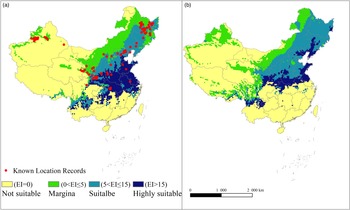
Agrilus mali, having historically been concentrated in north-eastern regions, has expanded its range to mid-China in the 1980s and then to orchards in Xinjiang via seedlings from Shandong province in the 1990s, before invading mountain areas in the Yili Valley and devastating wild apple forests (fig. 1). After many iterations based on biological parameters from our field work, our CLIMEX model (table 1) fits the known distribution sites (figs 1 and 2a). All known distribution records fall within areas that are modelled as suitable to marginally suitable. Simulation with those parameters suggests the species has the potential to become more widespread in the southern mountainous areas of China, as well as north-eastern China, the Huang-Huai-Hai Plain (including Shandong, Henan, Anhui and Jiangsu provinces), parts of the Loess Plateau (Gansu, Qinghai, Shaanxi, Ningxia and Shanxi provinces), some areas of Sichuan basin (including Sichuan and Chongqing), southern areas of Tibet and northern Xinjiang (fig. 2a), if hosts are available. Agrilus mali has not yet been reported from central Asia, though it has been reported spreading towards areas at risk in Kazakhstan (see below).
The change of Ecoclimatic suitability (EI) for Agrilus mali with global warming in China from current conditions (a) and 2100 (d) under CSIRO-Mk 3.0 GCM running the SRES A1B. Points show the known location records of A. mali.

Current population phenology and the distribution in China under climate change
Overall, the potential distribution of this pest lies between latitudes 30° and 50° North, which overlaps with the apple production belt in China. With increasing temperatures to the year 2100, the potential distribution of this pest will likely shift northwards, especially to the northeast, while contracting its distribution in the south (fig. 2). The suitable areas will likely become more extensive in northern Xinjiang and encompass all known wild apple forests (fig. 2 and Supplementary fig. 1).
The phenology of A. mali varies geographically within China (fig. 3), conditions being suitable from the end of March and April (fig. 3) to mid-September and the end of November (site 7, 8 and 9; fig. 3) based on modelled GIW values. The observed phenology is mostly consistent with our projection in various sites (fig. 3). Larvae are present from the previous September to Mid-June, and pupae from mid-June to mid-July in Yili valley. Adults emerge from the start of July to mid-July in site 1 and site 2 (fig. 3). The modelled phenology for site 1, where the phenology of A. mali was assessed in wild apple forest areas during 2016–2017, is similar to our field data (Supplementary fig. 2).
The modelled phenology of Agrilus mali based on weekly CLIMEX growth index (GIW) values under current climate and in the 2100 scenario across nine sites where the species is known to occur in China. The relative EI values are also shown.

The population growth index (GIA) shows the highest potential in Shandong, one of the biggest apple production areas in China. Under the future climate scenario, the modelled growth potential in most sites in China is higher in 2100 except at sites 7 and 8, and the species phenology starts earlier by 1–2 weeks in spring (mostly in March) and persists longer into autumn (ending in November) (fig. 3).
The potential worldwide distribution of Agrilus mali
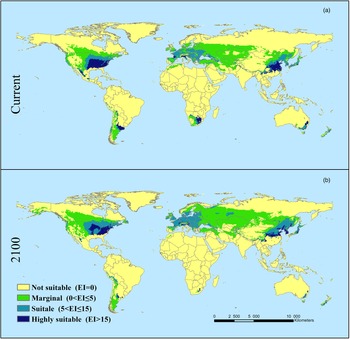
Under current climate conditions, A. mali could potentially expand its distribution in mid-latitudes across the temperate zone in the northern hemisphere (latitudes: 30°N to 50°N) and in some areas of the subtropical, Mediterranean and Temperate zones in the southern hemisphere (latitudes: 23.5°S to 40°S). Suitable areas for this pest occur around the Mediterranean, most of Europe, parts of the Middle East and central Asia, North China Plain, and large areas North America, as well as New Zealand, parts of Australia, parts of southern Africa and the Pampas Steppe alongside the Andes Mountains in the Southern Hemisphere (fig. 4). This potential distribution overlaps known apple production areas (Supplementary fig. 1). Additionally, areas projected to be suitable for A. mali overlap with wild apples in central Asia (M. sieversii), Europe (M. sylvestris), Turkey (M. orientalis) and Siberia (M. baccata) (see Supplementary fig. 1).
The potential global distribution of Agrilus mali under current and future climate scenarios in 2100 under CSIRO-Mk 3.0 GCM running the SRES A1B.

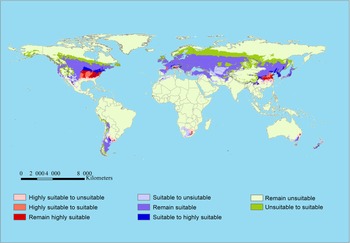
Under the global warming scenario, the potential distribution of A. mali shifted to higher altitudes and latitudes in both hemispheres. The unsuitable area declined by 4%, as did the highly suitable area by 0.8% in both hemispheres (fig. 5). At the same time, the marginally suitable areas (EI < 5) increased by 3.6% with global warming, as did the low suitability area by 2.1% in the same period (fig. 5). The low suitability area in the Northern Hemisphere is more sensitive to global warming, and will increase in the future, especially in the northern Xinjiang, northern Europe and Russia (fig. 5).
The relative change in suitability of Agrilus mail under the climate change scenario (comparison between current and 2100).

Sensitivity and uncertainty analysis
The parametric uncertainty analysis indicated that the potential geographical range is most sensitive to dry stress threshold (SMDS, 2.16%), limiting low temperature for growth (DV0, 1.88%) and minimum annual heat sum (PDD, 1.73%) values, indicating that the model is quite insensitive to variation in all parameters (table 2). The uncertainty around SMDS is likely quite low, as it is guided by the permanent wilting point. Our estimate of DV0 was guided by the model fitting, and in the absence of further corroborating information, should be considered an educated guess. For the EI, no parameters had a sensitivity greater than 1.9% (Supplementary fig. 4). The uncertainty map based on the natural rainfall scenario revealed that the areas of greatest confidence in the model are the temperate climate areas (Supplementary fig. 4). The low agreement areas extended into the lower rainfall areas.
Discussion
Based on our modelling, A. mali presents a serious threat to Malus spp. with the projected geographical range of A. mali overlapping not only all domestic apple production areas, but also wild apple ecosystems – the Garden of Eden of apples in central Asia, Europe, Armenia, Turkey and Siberia (Supplementary fig. 1) (Velasco et al., Reference Velasco, Zharkikh, Affourtit, Dhingra, Cestaro, Kalyanaraman, Fontana, Bhatnagar, Troggio and Pruss2010). With global warming, the projected range of A. mali could extend to higher latitudes and altitudes and possibly lead to greater potential commercial and biodiversity impacts. Improvements in projections for areas with high topographic relief could be achieved by using a finer scale grid for climate variables, though the overall picture will remain similar.
Our simulations and validation fit well the known distribution of this pest, which overlaps with the distribution of domesticated and wild apples across the world (fig. 4 and Supplementary fig. 1). The model growth indices capture known seasonal phenology. Moreover, the parametric uncertainty analysis reveals the model is quite insensitive to variation in most parameters (table 2), perhaps reflecting this insect being buffered by its feeding within host trees. The potential geographical range was most sensitive to dry stress threshold (SMDS). This implies that soil moisture should directly influence the survival of Malus spp. and indirectly determine the distribution of this pest. The obligate diapause in A. mali precludes it from expanding its range into low latitude, mid-altitude areas that may be suitable for Apple production (e.g., southern China and Kenya, Supplementary fig. 1).
Agrilus mali can infest many Malus spp., domesticated varieties as horticultural crops and as ornamental plants in agriculture lands, national parks, gardens and cities across world. Of particular concern are the Malus species ancestors of domesticated apples. Their distribution overlaps with the areas projected to be suitable for A. mali establishment (fig. 4). One interesting feature of this pest is that it prefers feeding on the younger branches or twigs (Zhang et al., Reference Zhang, Zhang, Zhang, Cui, Han, Gao, Poland, Zalucki and Lu2021). Consequently, columnar apple trees and trellis orchards may be at greater risk than standard apple trees.
Climate change is expected to cause most insect species to shift their range to higher altitudes and latitudes (Sutherst et al., Reference Sutherst, Baker, Coakley, Harrington and Scherm2007; Bebber et al., Reference Bebber, Ramotowski and Gurr2013; Virkkala and Lehikoinen, Reference Virkkala and Lehikoinen2014). In both hemispheres, increasing temperatures are likely to enable A. mali to extend its range into higher latitudes, with suitability declining in lower latitudes (fig. 3 such as site 7 and site 8, and fig. 4). This is similar to previous findings for various species of butterflies, beetles, midges, weeds and birds (Parmesan et al., Reference Parmesan, Ryrholm, Stefanescu, Hill, Thomas, Descimon, Huntley, Kaila, Kullberg, Tammaru, Tennent, Thomas and Warren1999; Guichard et al., Reference Guichard, Guis, Tran, Garros, Balenghien and Kriticos2014; Virkkala and Lehikoinen, Reference Virkkala and Lehikoinen2014; Lehmann et al., Reference Lehmann, Lyytinen, Piiroinen and Lindström2015).
Key drivers for A. mali appear to be the obligatory diapause driven by cold temperatures, daylength and the minimum annual heat sum. This implies that milder winters due to global warming will relax diapause conditions, and hence the constraints on A. mali's cold range limits, especially in the marginal subtropical zones (fig. 4b). Diapause intensity has been found to be variable between animal strains and geographic locations which are probably genetically determined (e.g., Kimura, Reference Kimura1988; Koveos et al., Reference Koveos, Kroon and Veerman1993; Huang et al., Reference Huang, Tang, Chen, He, Gao and Xue2020) and may have adaptive significance for this pest to spread southward. Furthermore, if global warming positively affects the prevalence of Valsa canker in wild apple, the combination of impacts from A. mali and Valse canker could be an extra cause for concern for apple production and conservation of wild apple diversity in infested areas.
Our confidence in the model could be improved with validation against independent data sets and further cross-validation with independent measures of biological parameters. Those parameters that had to be borrowed from closely related species or iteratively fitted should be measured as a matter of course. Diapause is particularly understudied in buprestids (Duan et al., Reference Duan, Schmude and Larson2021) and in terms of species distribution modelling in general (Kriticos et al., Reference Kriticos, Kean, Phillips, Senay, Acosta and Haye2017). In addition, the uncertainty of variability in temperature and rainfall (such as the amplitude and frequency of extreme events) is likely to impact the distribution of species at range margins directly, and indirectly by impacting the health of host plants, especially for wild apple, and lead to range shifts.
Because of the potential current threat to apple production and ancestors of domesticated apples worldwide posed by A. mali (Supplementary fig. 3), mitigation measures need to be designed and implemented for the conservation of wild apple forests as a priority. Agrilus mali and other woodborers can rapidly become more widespread where dead trees are harvested and moved as firewood (Haack et al., Reference Haack, Petrice and Wiedenhoeft2010; Kovacs et al., Reference Kovacs, Haight, McCullough, Mercader, Siegert and Liebhold2010; Jacobi et al., Reference Jacobi, Hardin, Goodrich and Cleaver2012; Dodds et al., Reference Dodds, Hanavan and DiGirolomo2017). Consequently, controlling the movement of firewood from infested areas locally, as well as developing suitable phytosanitary protocols for disinfesting seedlings of Malus spp. in national and international trade, has the potential to reduce the spread of A. mali. To protect the biodiversity of Malus spp. and resilience of forest ecosystems, education campaigns targeting the consequences of moving potentially contaminated cuttings and the need for phytosanitation in relation to Malus spp. may be a useful adjunct to local eradication or slow the spread campaigns. Doubtless, there will be a need to monitor these spread pathways and to develop rapid response capabilities in areas at risk of invasion.
Our CLIMEX model is easily reproducible by simply applying the parameters in table 1 to the same climatology and irrigation scenario we used. The reliability of the model should be judged in terms of the description of the fitting procedure, where the rationale for each parameter is described. The justification for each parameter can come from distribution data, phenological observations, experimental data or theoretical expectations. The parameters and functions constitute testable hypotheses about the response of A. mali to each climate variable. In the future, if more distribution, ecophysiological or phenological data become available, the model can be refined. Indeed, the less robust aspects of the parameter selection can guide future research prioritization. The sensitivity analysis however suggests that there may be little to be gained in terms of refining the pest risk area because the most sensitive parameters are well-defined.
Agrilus mali is a clear and present threat to both domestic apples and the ancestral wild apple species in Eurasia, especially in China and in central Asia (Zhang et al., Reference Zhang, Zhang, Zhang, Cui, Han, Gao, Poland, Zalucki and Lu2021). This invasive species seems to be set to join the pantheon of other recently invasive buprestids (A. planipennis, Agrilus biguttatus, Agrilus roscidus) in devastating forest ecosystems in vulnerable regions (Brown et al., Reference Brown, Jeger, Kirk, Williams, Xu, Pautasso and Denman2017; Digirolomo et al., Reference Digirolomo, Jendek, Grebennikov and Nakladal2019; Poole et al., Reference Poole, Ulyshen, Horn, Cram, Olatinwo and Fraedrich2019) worldwide. Measures to mitigate the spread of A. mali need to be implemented sooner rather than later for the conservation of wild apple forests, especially in central Asia.
Supplementary material
The supplementary material for this article can be found at https://doi.org/10.1017/S000748532200013X
Acknowledgements
This research was funded by the National Key Research Project (2016YFC0501502) and the programme of Xinjiang bureau of forest and grassland (2020TG09). We sincerely thank Ma Huailiang and Cui Zhijun for support in the field work and four anonymous referees for their suggestions.
Author contributions
Z. Z. and M. P. Z. designed research. Z. P., W. T. and Y. L. conducted filed experiments and data collection. D. J. K. and M. P. Z. developed the modelling, Z. L. and X. X. prepared the map and figure, Z. Z., M. P. Z., and D. J. K. wrote the manuscript. All authors read and approved the manuscript.