Although Barack Obama's victory in the 2008 presidential election was historic in many ways, his margin of victory was relatively underwhelming. After a grueling primary election battle, many political observers expected the general election to be a walk in the park for the Democratic nominee. An incumbent president facing unprecedented levels of disapproval, two unpopular wars, and a severe economic crisis all came together to aid Obama in the general election. Yet when the votes were tallied, Obama's victory fell short of the landslide that some had predicted (Lewis-Beck, Tien, and Nadeau Reference Lewis-Beck, Tien and Nadeau2010). Why did the Obama campaign seem to underperform in the general election?
Some scholars have suggested that factors such as racial attitudes (Lewis-Beck and Tien Reference Lewis-Beck and Tien2009; Lewis-Beck, Tien, and Nadeau Reference Lewis-Beck, Tien and Nadeau2010; Pasek et al. Reference Pasek, Tahk, Lelkes, Krosnick, Payne, Akhtar and Tompson2009; Tesler and Sears Reference Tesler and Sears2010; Tien, Nadeau, and Lewis-Beck Reference Tien, Nadeau and Lewis-Beck2012) and religion (Barreto, Redlawsk, and Tolbert Reference Barreto, Redlawsk and Tolbert2009; Hollander Reference Hollander2009) played important roles in limiting Obama's victory margin. Although race and religion may have been important, Diana Mutz (Reference Mutz2010) has proposed a particularly elegant and compelling theory that could provide an explanation for the lack of an Obama landslide. In a recent issue of PS, Mutz argues that Obama was penalized to a significant degree because he, quite literally, did not have a dog in the race. The fact that the Obama family did not own a dog during the campaign seems to have depressed his level of support. To make matters worse, Obama unintentionally emphasized this deficiency by publicly vowing to fulfill his daughters' wishes for a dog after the campaign had run its course.Footnote 1
Although some might scoff at Mutz's thesis, her findings regarding Obama's failure to win over the canine constituency hold up, even when controlling for a doggone extensive list of factors known to affect voting decisions. Even when partisanship, ideology, perceptions of the economy, and socioeconomic factors are accounted for, dog ownership remains a statistically and substantively significant predictor of both evaluations of Obama and vote choice. Although we take Mutz's article to be, at least to a substantial extent, tongue in jowlFootnote 2—and a real howler at that—a strong case can be made that Team Obama ought to have thrown dog owners more of a bone in 2012. After all, for a president, years in office are a lot like dog years, and a great deal can happen in a single four-year term; Obama's relatively easy victory in 2008 must have seemed like ancient history to his campaign staff. His honeymoon period long over, President Obama had to defend his leadership in light of an economy that is still struggling, and the bark of conservative Americans certainly increased in volume as the election drew nearer. If Mutz's conclusions are on the mark, although President Obama managed to win reelection in 2012, a more successful appeal to the canine constituency may have left him much less likely to be banished to the electoral doghouse.
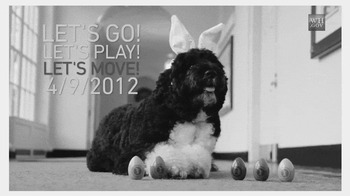
As the as the general election campaign heated up during the dog days of summer, might it have been prudent for President Obama and his advisers to more aggressively pursue the support of dog-lovers? Some anecdotal evidence shows that Team Obama was aware of Bo's potential utility as a campaigner. In 2011, President Obama took Bo on a Christmas shopping trip that received significant media attention, and Bo was also prominently featured on the Obamas' holiday cards and the invitation to the 2012 White House Easter Egg Roll (see figure 1).
Bo Obama on the Campaign Trail
Photo courtesy of whitehouse.gov

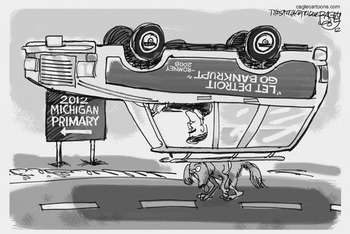
Given what we know about canines and campaigns, though, should Obama's campaign staff also have chastised him when he failed to take Bo out to the Rose Garden with sufficient frequency? If, on the campaign trail, Obama stopped to eat tamales in Texas (preferably with the cornhusks removedFootnote 3), should he have been sure to ask for a doggy bag while the cameras were rolling? When discussing the time he spent in Chicago, might the president have been well-advised to sneak in a reference to the city's famous hot dogs? Should Team Obama have developed a foreign policy plank that highlighted America's ties with Portugal, home of Bo's ancestors? While Portuguese water dogs have, historically, been working dogs and friends of fishermen, maybe the Obama family should have supplemented Bo's presence by acquiring a second dog of a variety more familiar to rural Americans, lest the criticism of “that dog don't hunt!” be levied in key battleground states.Footnote 4 Perhaps most important, the Obama campaign may have been well served by mounting a more dogged attack on Mitt Romney's own pooch problem (see figure 2).Footnote 5
Mitt Romney's Pooch Problem
Pat Bagley, Cagle Cartoons, Inc.

As Mutz noted, “Democrats should be wagging their tails over the arrival of Bo Obama, who could play well to potential swing voters in 2012.” Obama now has a dog to call his own, and hence, ceteris peribus, support for Obama should have increased relative to 2008. But did that happen? We think not. We argue that, in all likelihood, Bo did not fetch many votes for his owner. Indeed, we show that the apparent significance of dog ownership is largely due to key variables omitted from Mutz's analysis. Although we find much to admire in Mutz's analysis, she is probably barking up the wrong tree when it comes to attributing the “dog gap” to dog ownership itself. After sniffing around, we think we are on the trail of the root causes of the dog gap, and these have little to do with Bo, Spot, Spuds, Fido, or Lassie. If Obama's election strategists were counting on a bit of Bo-mentum to increase the president's chances of reelection, they set themselves up to be disappointed. Bo may have barked, but Team Romney should not have worried too much about being bitten.Footnote 6
In reanalyzing Mutz's data, we show that Obama did not have so much trouble with dog owners in 2008 as he had trouble with conservative, southern whites, who, for reasons we discuss, are more likely than other Americans to own dogs. Whereas some may feel that exploring links between pet ownership and political attitudes and behavior is for the birds, the taleFootnote 7 is an important one, and is consistent with recent research linking racial attitudes to levels of support for Barack Obama (Lewis-Beck and Tien Reference Lewis-Beck and Tien2009; Pasek et al. Reference Pasek, Tahk, Lelkes, Krosnick, Payne, Akhtar and Tompson2009; Tesler and Sears Reference Tesler and Sears2010). We also argue that while scholars are often wise to include control variables such as “South” in studies of political attitudes and behavior, it is important to consider the variety of politically relevant characteristics that such variables may be capturing.
THE DOG GAP: THEORY AND EVIDENCE
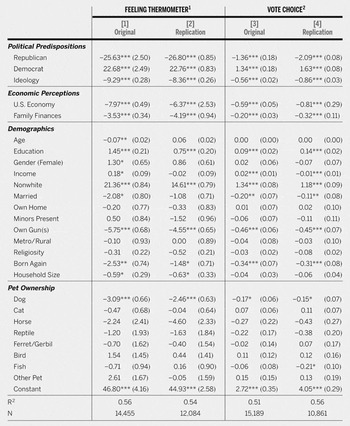
Mutz proposes two potential explanations for the dog gap: a group-identification theory and a congruency-oriented theory. On one hand, according to the group-identification theory, dog owners identify with, and hence feel an affinity for, other dog owners. The congruency-based theory, on the other hand, suggests that if members of the electorate appreciate the characteristics of a certain type of pet, such as loyalty or tenacity, those citizens reward candidates who share those qualities. Mutz finds that, even when a myriad of relevant factors affecting public opinion are controlled for, dog owners were less supportive of Barack Obama than respondents who did not own dogs. This can be been seen in table 1, where Mutz's results regarding the effects of dog ownership, both on respondents' support for Obama relative to their support for McCain and on respondents' voting decisions, are presented in columns 1 and 3.
Replication of Mutz's (Reference Mutz2010) Models

Note: Standard errors are shown in parentheses.
1 OLS regressions
2 Logistic regressions
*** p < 0.001;
** p < 0.01;
* p < 0.05
The coefficients on the dog ownership indicator variables are negative and statistically significant, and the magnitudes of the effects are substantial. Moreover, owners of pets other than dogs did not reward (or punish) Obama as compared to petless survey respondents, a finding which leads Mutz to conclude that the evidence points in the direction of the group-identification theory. Furthermore, Mutz shows that the effect of dog ownership extends beyond thermometer-style approval scores to presidential voting decisions. Our replications of Mutz's results are shown in columns 2 and 4 of table 1.Footnote 8
As is the case with many young theories, the content of the group-identification theory is rather thin. For example, although the owner of a dog of the same breed as the candidate's might be expected to display a particularly strong affinity for that candidate, purebreds play the same role in Mutz's theory as mutts. We do not criticize Mutz on this front, as we feel that imaginative and creative scholars should not be kept on too short a leash when hunting for explanations in previously uncharted territory. We think, however, that as Mutz's theory is such a parsimonious one, empirical tests of the implications of that theory may be particularly vulnerable to omitted variable bias.
The aim of our analysis is not simply to explain away the importance of dog ownership in determining levels of support for candidates, but rather to better understand the variables that were indeed critical to support for Barack Obama, and evaluate how those factors likely played out in 2012. First, we address regional differences in the effects of dog ownership. Then, we more fully incorporate racial attitudes into the analysis. Subsequently, we discuss the issues of urban-rural divisions and differences between hunters and nonhunters, which are related to both dog ownership and cross-regional cultural differences that drive differences in support for Barack Obama.
REEXAMINING THE CANINE CONSTITUENCY
Regional Differences in the Dog Gap
Mutz's models of the dog gap should be applicable to dog owners in a variety of circumstances. More specifically, given Mutz's theory, we see little reason to expect that the effect of dog ownership should vary systematically with the region of the country in which a respondent lives. Although the list of variables included in Mutz's models is comprehensive, the lack of a control for region is what originally started us chasing after alternative explanations for the dog gap. Like many scholars of political science, our graduate school experiences included Pavlovian training in the detection of potential omitted variable bias. Moreover, as we all know, every dog has its day, and in a similar way, almost every model of American public opinion or voting behavior has its “South” dummy variable. Could Southerners be both more likely to have dogs, and, for reasons not directly related to dog ownership itself, less likely to support Obama?
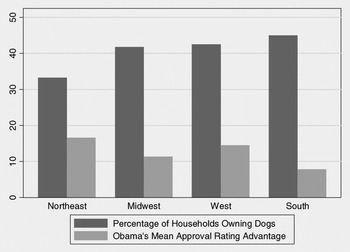
Figure 3 shows the percentage of dog owners by census region, as estimated from the National Annenberg Election Survey (NAES) data that Mutz uses in her analysis,Footnote 9 along with Obama's mean advantage over John McCain in thermometer scores in each region. Rates of dog ownership clearly vary with geographical location. Using census region as the geographical unit, dog ownership is most common in the South and least common in the Northeast.Footnote 10 In addition, regional variation in support for Barack Obama is obvious, with the level of support for Obama being strongest in the Northeast, where dog ownership is least common, and weakest in the South, where dog ownership is most common. Of course, if dog ownership really does drive distaste for Obama, this pattern should not be surprising. We believe, however, that characteristics of the South other than dog ownership, and beyond commonly cited influences on public opinion and behavior such as partisanship, depress support for Obama.
Dog Ownership and Obama's Approval Rating Advantage by Region

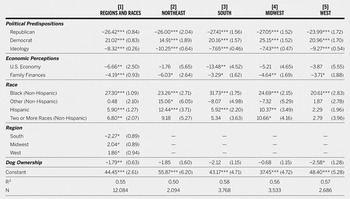
Before discussing these characteristics, we present a modified version of the first of Mutz's models that includes dummy variables representing census regions in the first column of table 2. The Northeast is the omitted reference category. We also include a more precise measure of racial identification in this model; this is particularly important given Obama's status as the first black major-party presidential candidate. The results show that region has a significant impact on Obama's favorability, with the coefficient on South being strongly negative and statistically significant, and the coefficients on Midwest and West being significant in the positive direction.Footnote 11 Even when controlling for partisanship and ideology, region matters. Moreover, as shown by the reduction in magnitude of the coefficient on dog ownership in this modified model, regional differences explain a significant portion of the variance in rates of support for Obama that was previously attributed to the influence of dog ownership. The coefficient on the dog ownership indicator is reduced from −2.46 (in our original replication of Mutz's model) to −1.79, a 27% drop in the purported effect.Footnote 12
Alternative Specifications of Mutz's (Reference Mutz2010) Models: Region, Race, and Obama Feeling Thermometer Advantage

Notes: Demographic and other pet ownership variables from the model are not presented here. Standard errors are shown in parentheses.
*** p < 0.001;
** p < 0.01;
* p < 0.05
To further highlight this point, we present regression results that predict Obama's support levels in each census region individually in columns 2 through 5 of table 2. Here, we see that the effect of dog ownership varies across the different regions. Indeed, in the Northeast, a region in which Barack Obama did well in 2008, the effect of dog ownership on support for Obama is not statistically significant, and is much smaller in magnitude. The effect of dog ownership is strongest in the West, followed by the South, then the Northeast, and finally the Midwest, where the coefficient on the dog ownership indicator is small and far from being statistically significant. Why is this?
What explains the significance of the South dummy, and of the regional dummies more generally? At least two factors contribute to the importance of region. First, for a given self-placement on the liberal-conservative ideology scale, respondents from one census region tend to be more or less conservative in terms of policy preferences than respondents in other regions. The ideological self-placement question provides an imperfect measure of what we refer to as operational ideology,Footnote 13 which we conceive of as the extent to which respondents approve of specific liberal policies and policy goals. Including region in the analysis effectively allows for more accurate measurement of the operational ideologies of respondents. Second, the ideology variable based on self-placement fails to sufficiently tap the racial conservatism that is more pronounced in the South than in other regions of the country.
We certainly are not the first scholars to note that the standard 7-point ideology scale is an imperfect measure of ideology, particularly if a researcher draws inferences related to the types of policy positions that citizens support. The use of an issue-based ideological scale can reduce measurement error (Ansolabehere, Rodden, and Snyder Reference Ansolabehere, Rodden and Snyder2008) and potentially reduce bias. The NAES data allows us to create such a scale. We included survey questions regarding respondents' opinions on the role of government, foreign policy approaches, immigration control, abortion, and gay marriage in a factor analysis to generate a measure of operational ideology, with more positive numbers representing more operationally conservative respondents. As expected, among respondents who place themselves at a given location on the ideology scale, those from the South are more conservative in terms of average operational ideology than respondents from the Northeast and the West for every category on the 7-point scale, and, in most cases, more operationally conservative than respondents from the Midwest, as well. For example, among white respondents classifying themselves as slightly conservative, the mean operational ideology score was 0.52 in the South, 0.40 in the Midwest, 0.32 in the West, and 0.28 the East.Footnote 14
What does the correlation between region and operational ideology have to do with dogs? The answer is straightforward: region is correlated not only with dog ownership but also with operational ideology, and operational ideology is also strongly correlated with support for Barack Obama. The absence of region in Mutz's original regression equation causes omitted variable bias that overestimates the importance of dog ownership; when operational ideology is also included in the analysis, the importance or region declines, suggesting that the region dummies tap, at least to a substantial extent, differences in operational ideology not captured by the self-placement-based ideology measure.Footnote 15
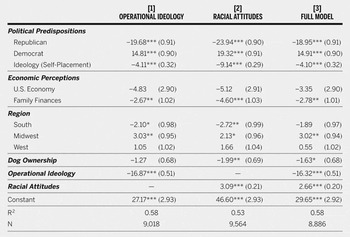
Alternative Specifications of Mutz's (Reference Mutz2010) Models: Racial Attitudes, Ideology and Obama Feeling Thermometer Advantage

Notes: Demographic and other pet ownership variables from the model are not presented here. The models only include white respondents. Standard errors are shown in parentheses.
*** p < 0.001;
** p < 0.01;
* p < 0.05
Race and the Dog Gap
Region is correlated not only with ideology (both self-identified and operational), but also with race. Moreover, in 2008, the presence of a black candidate on the Democratic presidential ticket highlighted the possibility that attitudes related to racial identity would play a major role in deciding the election. While most American politics scholars would likely agree that racial issues are an important part of the political landscape, the results of studies designed to determine whether white voters discriminate against black candidates in a direct way have been decidedly inconclusive, partially because of the correlations between racial attitudes and other politically important variables such as ideology (Hutchings and Valentino Reference Hutchings and Valentino2004). Evidence of the persistence of racial prejudice of other sorts, however, is much more consistent and plentiful (see, for example, Hurwitz and Peffley Reference Hurwitz and Peffley1997 and Kuklinski, Cobb, and Gilens Reference Kuklinski, Cobb and Gilens1997). What role, if any, did race play in the election of Barack Obama, and what does the answer to that question have to do with dogs?
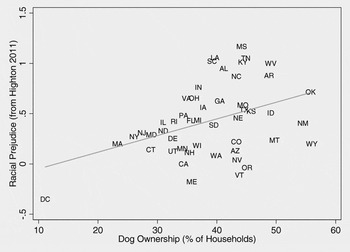
As previously mentioned, several studies have already established that racial attitudes resulted in Barack Obama's margin of victory being smaller than it would have been if race had not played a role. In one such study, Benjamin Highton (Reference Highton2011) shows that even when numerous controls are used, the racial attitudes of white voters are strongly correlated with Obama's state-level vote shares. Although individual-level data is often preferable to aggregate data, regional differences are clearly apparent in Highton's state-level measure of racial prejudice, which is based on respondents' levels of agreement with a statement that it is acceptable for blacks and whites to date. If this measure of prejudicial attitudes is correlated with state-level dog ownership rates, it would suggest that the dog ownership coefficient in Mutz's models might also be biased due to dog ownership unintentionally tapping regional differences in racial attitudes. Indeed, the correlation between dog ownership and Highton's state-level measure of prejudice is a strong 0.40, and statistically significant. Figure 4 plots state-level racial prejudice versus the percentage of households in a state that own dogs. The concentration of Southern states in the upper-right portion of the graph is striking. The cluster of Mountain West states in the lower-right section is also of interest. Were it not for high levels of dog ownership in these states, which is likely due to the large rural areas in these states, the slope of the best-fit line would be steeper, and the relationship between racial attitudes and dog ownership would be even stronger.
State-Level Racial Prejudice vs. Dog Ownership

Of course, Highton's measure of racial prejudice is not likely to perfectly capture racial attitudes. Is there any additional evidence that the dog ownership variables in the Mutz's models might be capturing something other than the importance of dog ownership? As it turns out, there is. If the theory Mutz puts forth is true, it is reasonable to expect that dog owners would not only punish candidates who do not own dogs, but would also reward candidates who do have canine companions. To see if this was the case in 2008, we decoupled the Obama and McCain favorability ratings and estimated models of approval for each candidate separately.Footnote 16 Did respondents reward John McCain for owning not just one, but 14 dogs (Stregowski Reference Stregowski2008) during his candidacy?Footnote 17 The answer is no. When controlling for region and using our more precise measure of racial identification, the coefficient on dog ownership in the model of McCain approval ratings is positive, but small in magnitude, and much smaller than its standard error. The usefulness of dog ownership in predicting Obama's advantage over McCain is almost entirely due to evaluations of Obama.
Perhaps all else equal, dog owners penalize Democratic candidates for some reason other than the lack of a dog or regional differences in ideology and racial attitudes. We also examined this possibility, as respondents in the NAES survey were asked who they voted for in the 2004 presidential election contest between then-president George W. Bush and John Kerry. As it turns out, the coefficient on dog ownership in a logit model predicting votes for Kerry, a dog owner, is actually positive, as it was in the case of McCain, but very small in magnitude and not statistically significant. Dog owners did not reward Kerry to any significant degree for owning Cym, a German shepard, and they did not punish him to any unusual degree for being a Democrat. While many differences exist between the candidacies of John Kerry and Barack Obama, the race of the two candidates is a prominent one. Although the failure of dog ownership to predict votes for John Kerry is not direct evidence of our thesis that dog ownership is partially tapping racial attitudes in Mutz's models, it is consistent with our argument.
Among scholars who have examined the racial aspect of the 2008 election at the individual level, Lewis-Beck, Tien, and Nadeau (Reference Lewis-Beck, Tien and Nadeau2010) find that even when controlling for ideology and other relevant factors, those respondents who felt that Obama would favor blacks if elected president were not only less likely to vote for him, but also less likely to convert dissatisfaction with the poor economy into electoral support for Obama.Footnote 18 In a similar fashion, we incorporated an individual-level measure of racial attitudes into our analysis and observed how it affected both approval of Obama and the coefficients on dog ownership, racial identification, and region. Respondents were asked to rate the characteristics of racial groups (including their own) on a scale from 0 to 100. We created a racial attitudes measure using a principle components analysis of the differences between whites' ratings of their own racial group and their ratings of blacks. The characteristics included whether these racial groups were hardworking, intelligent, and trustworthy. The results of our models that include these individual-level measures of operational ideology and racial attitudes are in table 3.
The first column in table 3 shows that, in addition to self-placed ideology, operational ideology also significantly affects evaluations of Obama. In this model, the effect of dog ownership is not significant. The next two models find significant effects for our racial attitudes measures, while dog ownership shows a significant, but greatly reduced, negative effect among white respondents. Perhaps what remains of the dog gap does actually depend on dog ownership itself. Alternatively, imperfect measurement of factors correlated with both dog ownership and support for Obama may allow dog ownership to maintain its statistical significance. Lastly the coefficients could simply be statistically anomalies, which, as Mock and Weisberg (Reference Mock and Weisberg1992) note, are not always as rare as we might believe.Footnote 19
Region, Race, and Voting Decisions
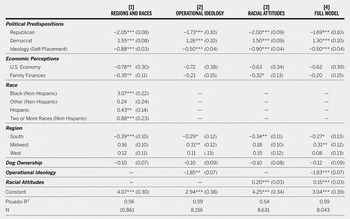
As should be clear from the previous discussion, the effect of the dog ownership variable in Mutz's model of Obama's advantage in approval ratings is, at least, partially due to the correlation between dog ownership and other important variables that affect approval of Obama, but are not included in her analysis. The importance of omitting these variables becomes even clearer when we analyze the voting decisions of respondents. As table 4 shows, after region and racial attitudes are accounted for, dog ownership no longer has a statistically significant effect on the likelihood that a respondent voted for Barack Obama in 2008. Moreover, among white respondents, the coefficient for dog ownership remains insignificant when operational ideology and racial attitudes are added to the models. In contrast, the importance of region, racial attitudes, and operational ideology are clear.
Alternative Specifications of Mutz's (Reference Mutz2010) Models: Region, Race and Vote Choice

Notes: Demographic and other pet ownership variables from the model are not presented here. Models 2–4 include white respondents only. Standard errors are shown in parentheses.
*** p < 0.001;
** p < 0.01;
* p < 0.05
Although we argue that the regional indicators in our models are important because they tap differences in ideology and racial attitudes between regions of the country, we are remiss if we fail to comment on the fact that two of three regional dummies remain significant even when controls for racial attitudes and operational ideology are included in the analysis. Why is region still important? Several likely explanations emerge. First, regional differences likely exist in many politically relevant variables that are still not included in our models of candidate approval and voting behavior during the 2008 presidential election campaign. We have included the major relevant factors, but undoubtedly we have missed something, and we have also omitted some variables for the sake of (relative) parsimony. We suspect, for instance, most of what remains of the coefficient on dog ownership persists because no indicator variable for hunters was included in the analysis. Hunting and dog ownership are positively correlated at the state and regional levels, and hunting is negatively correlated with operational liberalism, racial liberalism, Democratic identification, and state-level support for Obama.Footnote 20
Second, the importance of region is often interactive. In table 2 the effect of many independent variables clearly varies by region.Footnote 21 Being Hispanic, for example, makes more of a difference in approval ratings in the Northeast than it does in the South. If interactive effects had been more fully incorporated in our models, the analysis would be less straightforward, but the importance of the regional dummies would likely have been reduced.
Third, survey measures are imperfect. The standard 7-point ideology scale used by Mutz and countless other scholars (including ourselves) means different things to people from different regions of the country. The inclusion of regional dummies helps the model make up for some of the imprecision and biases that, unfortunately, are common in social scientific research, and perhaps particularly so in survey research. We strongly suspect that the regional dummies we use pick up on regional differences in many of the independent variables in our models.Footnote 22 If we had better measures of all of these variables, the importance of the regional indicators would likely be further decreased.
What, if anything, does our analysis say about the frequent use of variables like the South dummy in political research? We argue that the answer is context-dependent. Including regional indicator variables in analyses of American politics often decreases bias. In short, it is wise to use such dummies. However, simply including a South dummy in a regression analysis and reasoning that “the South is just different” is less than theoretically satisfying, especially given that the political effects of living in the South may work very differently for members of different racial, ethnic, religious, and political groups. We suggest that scholars identify variables in their analyses, such as dog ownership, that may display cross-regional variation. We also suggest researchers carefully consider interacting regional indicator variables with other key explanatory variables. Lastly, we note that developing better measures of politically relevant variables is particularly important when trying to avoid biases related to regional political differences.
WHO OWNS DOGS AND WHY?
Why are there regional differences and racial differences in dog ownership in the first place? According to the American Veterinary Medical Association (AVMA), 37.2% of American households included a dog in 2006 (AVMA 2007). Little existing literature explains why some people seek canine companionship while others do not,Footnote 23 but clear geographic and demographic patterns emerge. Along with the Mountain states, the Deep South (the Census' East South Central and West South Central regional divisions) has the highest rates of dog ownership, while the Mid-Atlantic and New England states have the lowest rates. This geographic pattern of canine affinity mirrors political patterns evident in the American electorate: “Red States” show high dog ownership rates and “Blue States” show low rates. Dog ownership also displays demographic patterns that coincide with political attitudes that favor conservative and Republican candidates. According to the NAES, a large gap in dog ownership exists between black and white respondents. People living in rural areas, gun owners, and homeowners also have higher rates of dog ownership.
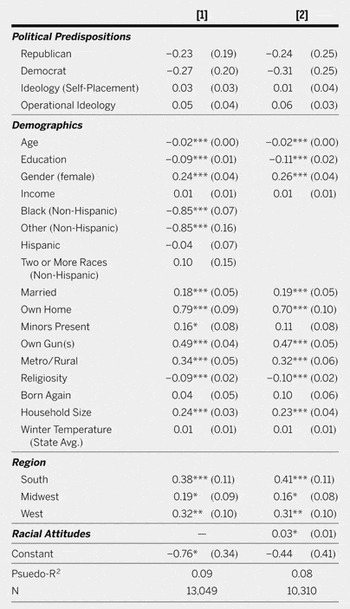
To further explore the determinants of dog ownership, we estimated a logistic regression model including a battery of political, demographic, and regional variables.Footnote 24 The results are presented in table 5. Although demographic patterns of dog ownership correspond well with political patterns that explain Mutz's results, our individual level analysis shows no significant independent effects of political predispositions. Instead, demographics dominate the model. Older, nonwhite men with lower levels of education are less likely to own dogs. Also, large families living in rural areas, homeowners, and gun owners are likely to own dogs. Most of these demographic factors coincide with those that would predict support for conservative and Republican candidates. Although significant bivariate correlations between dog ownership and partisanship and ideology exist, partisanship and ideology offer no independent influence on dog ownership when demographic factors are considered. Lastly, the model reveals strong regional effects. Unsurprisingly, Southern and Western respondents are significantly more likely than their Northeastern and Midwestern counterparts to own dogs.
Determinants of Dog Ownership

Note: Standard errors are shown in parentheses and clustered by state. Model 2 includes white respondents only.
*** p < 0.001;
** p < 0.01;
* p < 0.05
The second model in table 5 includes our measure of racial attitudes for white respondents. Although the results are largely the same as the first model, the added racial attitudes measure shows a significant positive effect on the likelihood of dog ownership. Consistent with our previous analyses, respondents who rate blacks lower on positive characteristics (relative to whites) are more likely to be dog owners. Although little direct relationship between political predispositions and dog ownership is seen, many factors jointly predict both dog ownership and lower evaluations for Obama. As expected, a strong regional component to dog ownership exists, as well as significant positive correlations between dog ownership, conservative racial attitudes, and negative evaluations of Obama.
CONCLUSION
Diana Mutz's discovery of and explanation for an apparent dog gap in American politics is both fascinating and entertaining. Unfortunately, when it comes to American public opinion and voting behavior, the dog gap, while being perhaps the furriest kind of gap, is also largely a spurious gap. When measures of operational ideology and racial attitudes are left out of the analysis, dog ownership taps a good deal of the variation in these variables, thus leading to omitted variable bias. When these variables are included, the importance of dog ownership is reduced to statistical insignificance. In additional, in lieu of including measures of operational ideology and racial attitudes in the analysis, including region in the analysis partially mitigates the bias, but does not remove it.
Still, Mutz may still be on to something. After all, while the inclusion of relevant variables in her model renders dog ownership insignificant as a predictor of voting decisions, the coefficient is a significant determinant of support for Obama relative to McCain, and is negative in all of our models, if small in magnitude in some. It may not come close in importance to, for example, the God gap, but nonetheless, the dog gap may have some small impact on elections. Indeed, in researching this topic, we found that 2008 was not the first time that presidential pets were on the minds of some voters.Footnote 25 After considering all of the evidence, however, we strongly suspect that if Mutz's models are run on data from the 2012 presidential election, Obama's apparent, but spurious, dog deficit will remain, even though the First Family added a First Dog. Bringing Bo into the Obama family probably did little to alter the correlates of dog ownership that seem to be largely responsible for the dog gap, a gap that has been erroneously attributed, at least in part, to dog ownership itself.
Featuring the Baha MenFootnote 26 on campaign rally audio programs might have highlighted the fact that Bo gets to wag his tail in the White House, but it would have been unlikely to change the racial attitudes and ideological leanings of American voters. Bo is now a part of the Obama family, which is likely of great consequence for Barack Obama on a personal level. When it comes to the election of 2012, however, the presence of a pooch that was so sorely lacking in 2008 probably did not do much good for the president.Footnote 27 In the end, our analysis fits well with an already substantial body of research that shows that racial attitudes had a significant impact on many voters' evaluations of Barack Obama, and it shows that these attitudes are responsible for much of the spurious correlation between dog ownership and negative evaluations of Barack Obama. Moreover, Obama undoubtedly continued to have trouble with conservative Southern voters; it is highly unlikely that man's best friend did much to change that.
In all likelihood, Bo did not fetch many votes for his owner in 2012. Despite that fact, we have some advice for the president: Treat Bo well, Mr. Obama. If he is dog tired on a given day, let the sleeping dog lie. Don't skimp on the chew toys or petting sessions. Keep Bo happy. Presidential pets can be wonderful companions, and in Washington, it can be hard to find dependable friends.Footnote 28
ACKNOWLEDGMENTS
We thank Seneca Jacobsmeier and Nora Lewis, our feline and canine friends, respectively, for their companionship and support, which remain unflinching even though we usually leave them at home when attending conferences. They also refuse to talk about politics, which is probably one of the main reasons that they manage to put up with us.