


1. Introduction
Recently Schupbach and Sprenger (Reference Schupbach and Sprenger2011) have introduced measures of explanatory power that satisfy certain conditions of adequacy. This article furthers the development of these measures. Schupbach and Sprenger show that their “conditions of adequacy” lead to a unique measure of explanatory power. Some of their conditions may be too strong to be conditions of adequacy in that measures failing to meet them do not seem inadequate. There are, moreover, other conditions that arguably one would wish a measure to possess. We consider supplementary conditions as well as conditions of adequacy. As in Schupbach and Sprenger (Reference Schupbach and Sprenger2011), this article treats measures of explanatory power that measure the degree to which a hypothesis (explanans) reduces the surprise of an outcome (explanandum).
Schupbach and Sprenger (Reference Schupbach and Sprenger2011, 106) argue for the study of explanatory power as follows: “Humans regularly make judgments of explanatory power and then use these judgments to develop preferences for hypotheses or even to infer outright to the truth of certain hypotheses. Much human reasoning—again, on individual and social levels—makes use of judgments of explanatory power. Ultimately then, in order to understand and evaluate human reasoning generally, philosophers need to come to a better understanding of explanatory power.” Schupbach and Sprenger have made major advances to this study. They develop seven “conditions of adequacy” and show that the measure of explanatory power satisfying these conditions is unique. In fact, they show that any measure satisfying only the first four conditions is a strictly increasing function of the unique measure.
One may doubt, however, that the arguments for all of Schupbach and Sprenger’s conditions of adequacy are compelling and even be skeptical that there is a best measure of explanatory power for all situations. We enhance Schupbach and Sprenger’s work by examining supplementary conditions that may be desirable but not required for adequacy. We also take a closer look at negative explanatory power and address the issue of upward and downward explanatory justice raised recently by Crupi and Tentori (Reference Crupi and Tentori2012).
An achievement of our work is avoiding the analyticity-in-multiple-variables assumption employed by Schupbach and Sprenger. There are competing measures of explanatory power that violate this assumption, for example, the measure of Crupi and Tentori (Reference Crupi and Tentori2012, 372). Moreover, the analyticity assumption does not simplify any proofs; to the contrary, it makes them more complicated. Crupi and Tentori also avoid analyticity assumptions, but their development is a bit different from Schupbach and Sprenger’s and most of ours. It is akin to our corollary 1.
2. Measures of Explanatory Power
A measure of explanatory power of an explanans h over an explanandum e will be denoted by  . The formal structure that
 must obey is given in the first condition of adequacy:
CA-I (Formal Structure): For any probability space and regular probability measure 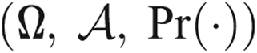 ,
 is a measurable function from two propositions
 to a real number (or extended real number)
 . This pair is defined for all pairs of contingent propositions. We can represent
 as a function of
 ,
 , and
 .
The formal structure is the same as in Schupbach and Sprenger (Reference Schupbach and Sprenger2011) except that the technical condition that  be analytic as a function of
 ,
 , and
 is dropped (and will not be needed in the proofs); also, we do not require that
 only take values in the interval [−1, 1].
The next condition of adequacy on irrelevant conjunction is exactly the same as the one in Schupbach and Sprenger (Reference Schupbach and Sprenger2011). It guarantees that the measure  is not changed when a hypothesis h 1 is augmented by another hypothesis h 2 that is independent of h 1, e, and e ∧ h 1.
CA-II (Irrelevant Conjunction): If  and
 and
 , then
 .
The third condition of adequacy formalizes the notion, already mentioned, that the degree to which h reduces the surprise (increases the statistical relevance) of e should be positively related to the value of  .
CA-III (Positive Relevance): For any fixed value of  , the greater the degree of statistical relevance
 between e and h, the greater the value of
 .
The following definition will simplify the proofs of some of the results.
Definition. The posterior ratio  is defined to be the function
 (in the usual sense) for
 and defined to be the extended real number ∞ for
 and
 . If both numerator and denominator are 0, then the posterior ratio
 is undefined (but by CA-I, the last case is not in the domain of
 ).
We reiterate that when  and
 , the posterior ratio is not undefined; it is ∞. Furthermore, 1/∞ = 0. This usage is common in many areas of mathematics, for example, the theory of fractional linear transformations.
Theorem 1. All measures of explanatory power satisfying CA-I, CA-II, and CA-III are functions of only  and the posterior ratio
 . For fixed
 , the measure is an increasing function of
 .
Proof. By CA-I, the measure  is a function of
 ,
 , and
 . But there is a one-to-one correspondence between the triple (
 ,
 ,
 ) and the triple
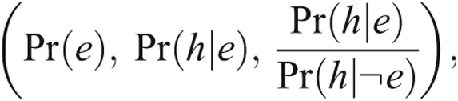
so we may regard  as a function of
 ,
 , and
 .
Suppose  and
 but
 ; say,
 . We must have
 , for otherwise
 , a contradiction. Set
 . Then 0 < a < 1. Choose h 2 such that
 and h 2 is independent of e′, of h′, and of e′ ∧ h′. Then by CA-II,
 .
But,  . Similarly,
 , so
 . Thus
 .
It remains only to show that for fixed  ,
 increases as the posterior ratio increases. Using CA-III, we only need to show that
 increases as the posterior ratio increases. It then suffices to show that
 decreases as the posterior ratio increases. But
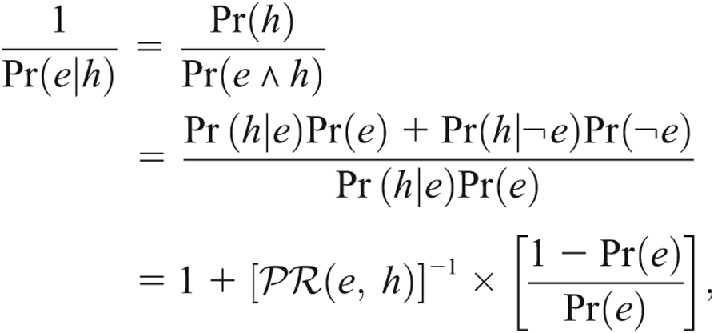
as required. QED
Definition. A measure of explanatory power is said to be posterior based if there exists a function g such that for each pair of contingent propositions e, h and regular probability measure Pr,  .
This definition is based on the condition posteriors of Crupi and Tentori (Reference Crupi and Tentori2012, 369). They use it to prove their theorem 1, a result similar to:
Corollary 1. All posterior-based measures of explanatory power satisfying CA-I, CA-II, and CA-III are functions only of the posterior ratio  .
Proof. By theorem 1 the measure can only depend on  and the posterior ratio
 . But the measure is posterior based, so it does not depend on
 . It therefore depends only on
 . QED
Crupi and Tentori’s theorem 1, unlike Schupbach and Sprenger’s results, is free of extraneous smoothness assumptions. In particular, they were the first to avoid assuming that the measure is analytic in one or more variables. Our corollary 1 is likewise free of such assumptions.
3. Supplementary Conditions
From now on, it is assumed that for any measure of explanatory power  , the three conditions of adequacy, CA-I, CA-II, and CA-III, hold. Other conditions with desirable properties, here called supplementary conditions, are explored. The first such condition is directly about tautologous hypotheses, but we will see in theorem 2 that it is more generally about neutral hypotheses, that is, hypotheses that provide no information about how likely e is to occur, which happens when e and h are independent.
SC-I (Neutral Point): For any measure  , if hT is a tautology, then
 is a constant z 0 not depending on e or on the specific tautology hT.
Theorem 2. If SC-I holds, and e and h are independent, then  .
Proof. Let hT be a tautology. Because  and
 , h is independent of hT and e ∧ hT as well as e. By CA-II,
 . Similarly, hT is independent of e, h, and e ∧ h, so
 . Finally,
 by SC-I. QED
It is often convenient to work with measures  that obey SC-I and the following symmetry condition:
SC-II (Symmetry):  .
Theorem 3. If SC-I and SC-II hold, and e and h are independent, then  .
Proof. If e and h are independent, then ¬e and h are independent. By theorem 2,  . By SC-II,
 so z 0 = 0. QED
Theorem 4. The explanandum e and explanans h are independent if and only if  .
Proof. If e and h are independent, then  . But, if
 , then

so  , and thus
 . Finally,
 , showing e and h are independent. QED
The next condition is based on CA4 of Schupbach and Sprenger (Reference Schupbach and Sprenger2011, 111), there termed “Irrelevance of Priors.” Crupi and Tentori (Reference Crupi and Tentori2012, n. 3) dispute the term. There does not seem to be a good substitute, but we have settled on “Negation of the Explananda Condition.”
The case for CA4 being a condition of adequacy is not conclusive. Schupbach and Sprenger state: “We acknowledge that intuitions might not be strong enough to make a conclusive case for CA4. However, affirming that condition is certainly more plausible than denying it” (Reference Schupbach and Sprenger2011, 111). Crupi and Tentori (Reference Crupi and Tentori2012, 367–68) concur.
SC-III (Negation of the Explananda Condition): Whenever  and
 , then
 .
Note that if a measure satisfies SC-III, then whenever  ,
 depends only on the numerator of
 , namely,
 . In particular, when
 ,
 depends on the hypothesis h only through the posterior probability
 .
It is also worth noting that posterior-based measures satisfy SC-III. For if a measure is posterior based, there is a function g such that  . If
 , then
 . Finally, if
 and
 , then
 .
The next theorem corresponds to theorem 1 of Schupbach and Sprenger (Reference Schupbach and Sprenger2011, 111). Their proof relies heavily on  being a multidimensional analytic function of
 ,
 ,
 , and
 . Crupi and Tentori (Reference Crupi and Tentori2012, 369) and our corollary 1 show without such technical assumptions that the conclusion of theorem 5 holds for posterior-based measures. Theorem 5 itself is also free of such technical assumptions.
Theorem 5. If SC-I to SC-III hold for a measure of explanatory power  , then
 for some strictly increasing function f.
Overview of Proof. Because the proof is very detailed, we will give an overview first. The idea is to take two explanandum-explanans pairs (e 1, h 1) and (e 2, h 2) with the values of their posterior ratios equal and show that their measures are equal. This is accomplished in three steps. In step 1, we find a pair with the same value of the posterior ratio and the same explanandum probability as (e 1, h 1), hence the same measure by theorem 1, but with the denominator of its posterior ratio equal to 1. In step 2, we find a pair with the same value of the posterior ratio as (e 1, h 1) and (e 2, h 2) and with the denominator of the posterior ratio equal to 1 but with explanandum probability equal to  . By SC-III, its measure will be the same as for (e 1, h 1). Step 3 is the reverse of step 1, showing by theorem 1 that the measure from step 2 equals that of (e 2, h 2).
There is a complication to this proof. If the value of the posterior ratio from step 1 is greater than 1, then we cannot find a pair with the same value of the posterior ratio and with the denominator of the posterior ratio equal to 1. We handle this situation by looking at  and
 and showing that the result holds for these measures and then applying Symmetry, SC-II.
Proof. Consider two explanandum-explanans pairs (e 1, h 1) and (e 2, h 2) such that  . We first treat the case a < 1.
Consider  and
 such that
 ,
 ,
 , and
 . Then
 ,
 , and
 . In the same way, consider
 and
 such that
 ,
 , and
 . By SC-III,
 . By theorem 1,
 and
 . Thus
 when a < 1.
Consider now a > 1. Then  , and similarly
 . By the previous paragraph,
 . By SC-II,
 . If a = 1, then
 by theorem 4.
We have shown that  does not depend on
 for fixed
 . Theorem 5 now follows from theorem 1. QED
Corollary 2. If SC-I to SC-III hold for a measure of explanatory power  , then
 takes its maximal value if and only if h implies e and minimal value if and only if h implies ¬e.
Proof. The conclusion of corollary 2 holds for  , so the corollary follows by theorem 5. QED
Definition. Let k be a positive integer and let  be a real-valued function of n variables. Then
 is homogeneous of degree k if for all
 ,
 .
The following condition of Schupbach and Sprenger (Reference Schupbach and Sprenger2011, 112) enforces a kind of simplicity.
SC-IV (Normality and Form): The measure  is the ratio of two functions of
 ,
 ,
 , and
 , each of which is homogeneous in its arguments to the least possible positive integer degree k.
The measure  can be thought of as a function of
 ,
 ,
 , and
 because these four probabilities determine
 ,
 , and
 . But to apply the definition of homogeneity, we have to think of
 as a function of four real numbers, not restricted to be nonnegative, no greater than 1, and to sum to 1.
Theorem 6. The only measure that satisfies CA-I to CA-III and SC-I to SC-IV is

The proof of theorem 6, being somewhat lengthy, is given in the appendix.
4. When Measures of Explanatory Power Are Negative
In this section we will be considering measures of explanatory power  that satisfy SC-I and SC-II so that
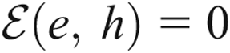 when e and h are independent. We consider the case
 , which has not been discussed as much as
 .
The condition CA-III on positive relevance states that for fixed  the greater that
 is, the greater the value of
 . Noting that
 , we see that if
 is negative but large in absolute value, then
 is positive and large. If SC-II on symmetry holds so that
 , then
 is large in absolute value but negative.
The situation is somewhat akin to (Pearson) correlation  , a measure of linear association. The absolute value of
 indicates the magnitude of the association, whereas its sign indicates whether the association is positive or negative. We argue that the absolute value of
 ,
 , measures the magnitude of the explanatory power, and its sign indicates whether h explains e or ¬e.
Schupbach and Sprenger (Reference Schupbach and Sprenger2011, 114–15 and 124) consider the addition of irrelevant evidence to an explanandum-explanans pair (e, h), where e and h are not independent. Specifically, consider the addition of evidence e′ such that  and
 .Footnote 1 They show that
 . The argument in favor of this result is that the magnitude (absolute value) of the explanatory power of h is reduced when the irrelevant evidence e′ is added because of the failure of h to explain e′.
Here is an example. Suppose that in the past an important astronomical constant has been determined to be approximately 1, but the measurements have not been precise enough to shed much light on whether the constant is greater than, equal to, or less than 1. A research team hypothesizes h 1 that the constant is less than 1. But new evidence e is collected that seems to indicate that the constant is greater than 1; that is,  . Then
 . But some data e′ on the mating habits of the American green tree frog (Schupbach and Sprenger Reference Schupbach and Sprenger2011, 115) are also collected and deemed independent of e and h 1, with
 . So now
 .
Another research team had hypothesized  that the constant is greater than or equal to 1. Thus
 and
 . Moreover
 .
Crupi and Tentori (Reference Crupi and Tentori2012, 369–71) have introduced the concepts of upward and downward explanatory justice as criteria pertaining to the effects of irrelevant evidence. Given an explanandum-explanans pair e and h, let e′ be independent of e, h, and e ∧ h. When  , we have upward explanatory justice if
 . When
 , we have downward explanatory justice if
 . The measure
 exhibits upward explanatory justice but not downward (because of the equality sign in the latter’s definition).
We illustrate the terminology with an example from Crupi and Tentori (Reference Crupi and Tentori2012, 370). A fair coin either is normal or has tails on both sides. Let h 1 be the hypothesis of a normal coin, and let h 2 = ¬h 1 be the hypothesis of a tails-on-both-sides coin. Let e be the evidence of 10 tosses, all tails. Clearly  and
 , so
 and
 . Let e′ be some irrelevant evidence independent of e, h 1, and e ∧ h 1. Because h 2 = ¬h 1, e′ is also independent of h 2 and e ∧ h 2. For the Schupbach-Sprenger measure,
 . This relationship is considered to exhibit upward explanatory justice because it would arguably be unjust for h 2 to get credit for having as much power to explain the larger amount of evidence e ∧ e′ as it has to explain e when it does not explain e′ at all.
Now let’s look at  and
 . Crupi and Tentori argue that if
 , “in these circumstances, then one would be allowed to indefinitely relieve a lack of explanatory power, no matter how large, by adding more and more irrelevant explanada, simply at will. A strongly unpalatable outcome—yet this is precisely what any posterior ratio measure of explanatory power implies” (Reference Crupi and Tentori2012, 370). The posterior ratio measures include
 , so, in their terminology,
 fails to exhibit downward explanatory justice. Our point of view on this situation is different. We have
 , so the magnitude of the power of
 is less than that of
 . If we added more and more irrelevant explananda, say
 , we would drive
 closer and closer to 0, the neutral point assumed when the explanandum and explanans are independent. This behavior is in the spirit of what Schupbach and Sprenger were seeking.
5. Concluding Remarks
It is an overstatement to say that measures of explanatory power not ordinarily equivalent to  are necessarily inadequate. But,
 is a measure with appealing properties that can be proved without cumbersome technical conditions.
Appendix: Proof of Theorem 6
Let  ,
 ,
 ,
 , and
 .
Lemma 1. If e and h are independent,  .
Proof. If e and h are independent,  or
 . Noting that
 , we get that
 when e and h are independent. QED
Lemma 2. If  is the ratio of two polynomials in x, y, z, and t, the numerator cannot be linear.
Proof. If the numerator is linear, then we can write it as  . By theorem 3, the numerator must vanish when e and h are independent, that is, by lemma 1 when
 . Consider the following four values for the vector (x, y, z, t) satisfying
 : (1/2, 1/4, 1/6, 1/12), (1/2, 1/3, 1/10, 1/15), (1/2, 3/8, 1/14, 3/56), and (1/4, 1/4, 1/4, 1/4). These vectors are linearly independent of dimension 4 (the matrix of coefficients has determinant 1/10,080 ≠ 0), so we must have
 . Therefore the numerator cannot be linear. QED
The four-vector example in the proof of lemma 2 was used earlier by Kemeny and Oppenheim (Reference Kemeny and Oppenheim1952, 319) and Schupbach and Sprenger (Reference Schupbach and Sprenger2011, 121).
Lemma 3. For any value of  ,
 .
 ,
 ,
 , and
 . Note that
 . Then
 . Also,
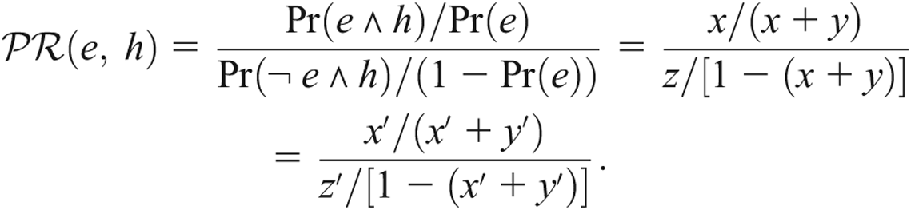
See Schupbach and Sprenger (Reference Schupbach and Sprenger2011, 121–22) for a proof directly from our CA-II (Irrelevant Conjunction). The proof given here shows more clearly why the lemma is a consequence of theorem 1.
Theorem 6. The only measure that satisfies CA-I to CA-III and SC-I to SC-IV is

Proof. This proof is modeled on the proof of theorem 2 of Schupbach and Sprenger (Reference Schupbach and Sprenger2011, 122–23) but we fill in some gaps. Suppose we can write

Consider the numerator when e and h are independent. By lemma 1,  . We first let t = 0 and z = 0. Noting that then y = 1 − x, the numerator reduces to
 . For this one-variable quadratic expression in x to vanish for all x, we must have
 . Similar arguments show that
 . We are left with eyz + ixt in the numerator. Now consider x = y ≠ 0 and t = z ≠ 0. We have xt − yz = 0, but xt = yz > 0. We must then have
 , so e = −i. Also i ≠ 0 because the numerator cannot vanish identically. Now f reduces to

Let us now look at the denominator. By corollary 2,  . Then
 . In order for the identity to hold for all x, we must have
 and
 . Similarly, from corollary 2 again,
 , so
 . In order for this identity to hold for all y, we must have
 and
 . Now f has the form

By corollary 2,  , so
 and thus
 . By setting
 , we see that
 . For y = 1/2, x = 1/3, t = 1/6, we have
 . Thus
 .
From  , we immediately have
 . Now f simplifies to

where  . The remainder of the proof is essentially the same as Schupbach and Sprenger (Reference Schupbach and Sprenger2011, 123). Note that
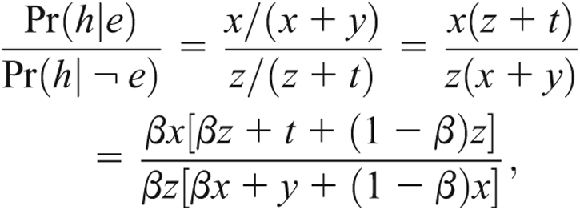
for  . Then by lemma 3 we have
 . Taking
 , we have

Equating the first and last expressions of (A1), we see that  , so
 . Finally,
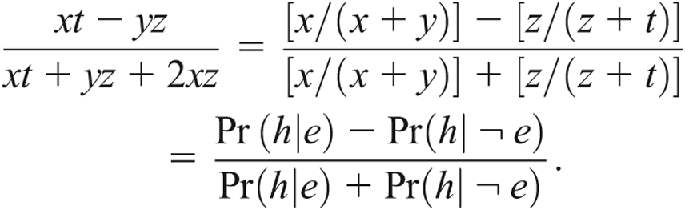
QED
 as an assumption. But the right side of their C1 has the form
 when
 , so the theorem fails in this case. In fact,
 as Crupi and Tentori (
 (i.e., h implies ¬e) does not have to be treated as a special case.


