Introduction
Airway endoscopy has been used as a diagnostic tool for many years. Now, it is also increasingly being used as a therapeutic modality in a variety of airway conditions. A number of factors have made this possible, including improvements in anaesthesia which enable airway access with the child breathing spontaneously, without the hindrance of an endotracheal tube.
As well as the development of microlaryngeal instruments, the adaptation of tools originally designed for use elsewhere has broadened the scope for endoscopic treatment of paediatric airway conditions. Such adapted tools include endoscopic forceps, endoscopic scissors, vocal fold spreaders, the sickle knife, the ‘D’ knife, the microdebrider, drills, angioplasty balloons and lasers. In recent years, there has been a move away from the use of lasers, as these may cause significant scarring which can be minimised by using other modalities, such as ‘cold steel’, the microdebrider or balloon dilatation. These alternatives carry the additional advantages of reduced cost, complexity and preparation time, as well as eliminating the risk of a laser fire.
A number of conditions previously treated by open (and often major) surgery are now treated endoscopically. These include choanal atresia, subglottic stenosis in selected cases, laryngeal webs and scars, and laryngeal clefts. The reduction in morbidity as a result of less extensive surgery is considerable. Other conditions such as recurrent respiratory papillomatosis can be treated more accurately with the improved visualisation afforded by an endoscope, compared with an operating microscope (which gives good views of the supraglottis and superior part of the glottis but not of the inferior surface of the vocal folds, subglottis or trachea).
Choanal atresia
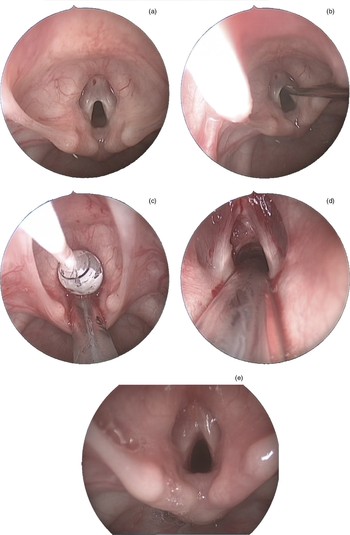
Surgical repair of choanal atresia dates back to 1853, when a seven-year-old boy was successfully treated.Reference Sheehan and Swanker1 However, trans-nasal repair for younger children and particularly infants was limited by the small size of the anterior nares and poor visualisation, resulting in unpredictable scarring and re-stenosis. Thus, the trans-palatal approach was devised. However, with the advent of rod-lens endoscopes the trans-nasal approach has now come back into vogue. We prefer to use the 120° telescope to visualise the choanae via the oropharynx, leaving the nasal cavities free for instrumentation. However, some surgeons prefer 0° and 30° telescopes passed trans-nasally, especially in older children with unilateral choanal atresia in whom there is more space. Puncture of the atretic plate, dilatation and drilling of bone can now be performed under direct vision (Figure 1).
Views of the nasopharynx using a 120° endoscope via the oropharynx showing: (a) bilateral choanal atresia in a 3-day-old infant; (b) passage of a probe (urethral sound) through the membranous stenosis; (c) serial dilatation using urethral sounds; (d) placement of stents; and (e) the appearance three months post-operatively.

Laryngomalacia
In times gone by, the only treatment for very severe laryngomalacia was tracheostomy. Endoscopic excision of redundant supraglottic tissue was first described in 1984 by Lane, while Seid described incision of the aryepiglottic folds in 1985. Since then, a combination of these procedures has become the treatment of choice for patients without a neurological aetiology. Aryepiglottoplasty may be performed either with cold steel or with the CO2 laser, and resolution of stridor with this technique appears to occur in approximately 90 per cent of cases.Reference Toynton, Saunders and Bailey2 Zalzal and Collins have described division of the aryepiglottic folds and excision of redundant mucosa overlying the arytenoids with a microdebrider.Reference Zalzal and Collins3
The alternative technique of laser epiglottopexy, in which laser application to the vallecula results in a more anterior position of the epiglottis, has been described by Whymark et al. Reference Whymark, Clement, Kubba and Geddes4 These authors reported a 73 per cent improvement in 59 children undergoing this procedure over a 10-year period. A similar technique has been described by Werner, in which the laser is applied to the tongue base followed by placement of three sutures to hold the epiglottis anteriorly.Reference Werner, Lippert, Dunne, Ankermann, Folz and Seyberth5 These techniques were described as alternatives to traditional aryepiglottoplasty, but can also be used as complementary treatments for cases in which epiglottic prolapse is a major factor.
Vocal fold palsy
The management of bilateral abductor vocal fold palsy has traditionally involved a tracheostomy to secure the airway.
However, endoscopic techniques to manage this condition include endoscopic laser cordotomy or partial arytenoidectomy,Reference Worley, Bajaj, Cavalli and Hartley6 vocal fold lateralisation by endoscopic placement of sutures to lateralise the vocal process,Reference Rutter, Cohen and de Alarcon7 combinations of these two techniques,Reference Hartnick, Brigger, Willging, Cotton and Myer8 and endoscopic posterior cricoid split with placement of a graft.Reference Chen and Inglis9 The latter two techniques are still in their infancy, and medium- and long-term outcome data are awaited before they become established mainstream treatment modalities.
Recurrent respiratory papillomatosis
The use of a powered resector to excise laryngeal papillomas in children was first described in 1999 by Myer et al. Reference Myer, Willging, McMurray and Cotton10 The microdebrider has rapidly become the modality of choice for the treatment of this condition. In conjunction with endoscopic visualisation, this tool offers faster and more accurate excision of the pathological tissue, with less damage to the normal mucosa, than can be achieved with the CO2 laser. It therefore causes less scarring. Other advantages include shorter operating time, lack of fire risk and a better voice outcome.Reference Rees, Tridico and Kirse11
Adjuvant treatments, such as local injection of the anti-viral agent cidofovir, can also be administered endoscopically.
Glottic web
Glottic webs in children may be congenital or acquired. A congenital web may occasionally present as a thin membrane confined to the glottis, but more often it is thicker and extends down into the subglottis anteriorly. Acquired webs may occur following anterior neck trauma, but more commonly are iatrogenic and often result from the use of the CO2 laser on laryngeal papillomatosis at the anterior commissure.
Thin webs may be managed by endoscopic division followed by balloon dilatation with or without topical application of mitomycin C. A recent, unpublished review of this treatment option as used at Great Ormond Street Hospital for Children demonstrated successful treatment in five of six patients, requiring a median of three endoscopic procedures (Figure 2).
Endoscopic views showing: (a) a thin glottic web; (b) division with a sickle knife; (c) balloon dilatation; (d) the immediate post-operative appearance; and (e) the appearance two months post-operatively.

Thicker webs usually require some form of stenting after division to avoid recurrence. This is usually achieved with a Silastic® or silicone ‘keel’. Keels may be placed endoscopically, but more often are positioned and secured using a combined open (laryngofissure) and endoscopic approach. Regardless of the technique used, recurrence remains a challenge.Reference Nicollas and Triglia12
Very thick webs actually represent the glottic component of a combined glottic web and subglottic stenosis, and require open surgery in the form of a laryngotracheal reconstruction with anterior cartilage grafting.
Subglottic cysts
Subglottic cysts have increased in incidence over the last three decades. In a recent series from Manchester,Reference Watson, Malik, Khan, Sheehan and Rothera13 they represented the fourth most common pathology in children undergoing laryngotracheobronchoscopy for upper airway assessment. They occur almost exclusively in premature infants, and are related to intubation but not to the duration of intubation. Many infants have a degree of subglottic stenosis as well.Reference Johnson, Rutter, Shott and Cotton14, Reference Lim, Hellier, Harcourt, Leighton and Albert15 It has been suggested that subglottic cysts represent an early stage in the pathological process which can eventually lead to the development of subglottic stenosis, in which mucosal damage from intubation heals with obstruction of the ducts of the mucous glands.Reference Duynstee, de Krijger, Monnier, Verwoerd and Verwoerd-Verhoef16 Treatment comprises uncapping or marsupialisation of the cysts under endoscopic or microscopic visualisation using micro-instruments, the CO2 laser, diathermyReference Johnson, Rutter, Shott and Cotton14 or the microdebrider.Reference Rees, Tridico and Kirse11 Some infants may require a tracheostomy or an open laryngotracheoplasty for their associated subglottic stenosis.
Subglottic stenosis
Subglottic stenosis has traditionally been treated via an open approach: a cricoid split in the case of soft or immature stenosis, and a laryngotracheal reconstruction with cartilage grafting for mature stenosis.
Balloon dilatation via an endoscopic approach is a technique that has shown some success in the primary treatment of acquired soft subglottic stenosis. A recent study of 10 infants treated with primary balloon dilatation followed by a period of intubation demonstrated successful avoidance of further procedures or of a tracheostomy in seven patients who had undergone either one or two balloon dilatation procedures.Reference Durden and Sobol17 At Great Ormond Street Hospital for Children, we have treated 12 patients with balloon dilatation for acquired subglottic stenosis, six in conjunction with other endoscopic procedures such as cruciate incisions of the mucosa or division of a scar band. Half of these patients have been successfully treated by endoscopic means alone, while the remainder have subsequently required additional, open surgery. However, there is an advantage to endoscopic balloon dilatation even for those patients in whom further surgery is required, because the degree of subglottic stenosis is often improved to some extent, i.e. the stenosis is downgraded, thereby improving the outcome of subsequent open surgery.
More recently, an endoscopic anterior cricoid split has been used as a primary treatment for soft subglottic stenosis, with some success. This technique involves endoscopic visualisation of the subglottis followed by an anterior split of the cricoid cartilage from within the lumen using a sickle knife. The procedure is followed by a period of intubation, as in the open technique. The advantage is that an external wound, with its inherent propensity for infection and dehiscence, is avoided. In an unpublished series of 14 patients who underwent this procedure at Great Ormond Street Hospital for Children, the need for a tracheostomy or for more extensive, open airway surgery was avoided.
Endoscopic posterior cricoid split and costal cartilage graft insertion has been described as a treatment for posterior glottic and subglottic stenosis in 10 children.Reference Inglis, Perkins, Manning and Mouzakes18 In this technique, the posterior lamina of the cricoid cartilage is divided endoscopically using a laser. The costal cartilage graft is then positioned endoscopically. Two patients with posterior glottic stenosis were successfully treated by this technique alone, while four out of five tracheostomy-dependent children with posterior subglottic stenosis required further adjuvant intervention to achieve decannulation. Three non-tracheostomy-dependent children achieved improved exercise tolerance. The authors felt that the endoscopic approach had obvious advantages over extensive open surgery, but also over other endoscopic but destructive procedures such as arytenoidectomy and cordotomy.
These techniques show promise for the future, but long-term results must be determined before they become accepted mainstream treatments.
Subglottic haemangioma
Subglottic haemangiomas, in common with other congenital haemangiomas, go through a natural process of progressive enlargement up to the age of about one year, followed by a period of involution over the next three or four years. As a result of this natural history, traditional treatment has aimed to secure a safe airway until resolution occurs. A number of techniques have evolved as a result of efforts either to avoid a tracheostomy or at least to reduce the duration for which it is required. These include medical treatment with systemic steroids (despite the risk of significant side effects) and surgical treatment with open excision.
A review of the literature published in 2005 identified 372 patients in 28 series during the period from 1986 to 2002. Open submucosal excision with or without a costal cartilage graft was successful in 98 per cent of cases treated by this method.Reference Bitar, Moukarbel and Zalzal19 This technique also results in negligible rates of post-operative subglottic stenosis,Reference Bajaj, Hartley, Wyatt, Albert and Bailey20, Reference Vijayasekaran, White, Hartley, Rutter, Elluru and Cotton21 and therefore remains the mainstay of treatment, particularly for well circumscribed haemangiomas.
Endoscopic treatment of subglottic haemangioma has for a number of years been conducted with the CO2 laser. This has an 88.9 per cent success rate but a 5.5 per cent incidence of significant subglottic stenosis, and has been found to shorten the duration of tracheostomy by 13.7 months. Intralesional corticosteroid administered via an endoscopic approach followed by a period of intubation was originally described in the Netherlands.Reference Meeuwis, Bos, Hoeve and van der22 In a recent review, this technique of haemangioma management was successful in 86.4 per cent of cases, with a 5.6 per cent complication rate,Reference Bitar, Moukarbel and Zalzal19 but repeated treatment was frequently necessary.
The microdebrider has also been used to debulk subglottic haemangiomas,Reference Pransky and Canto23 but caution must be used if considering this instrument as its use has been associated with significant bleeding.
However, the recent, successful use of oral propranolol to achieve involution of subglottic haemangiomas may mean that this condition will be treated medically in future.Reference Leaute-Labreze, Dumas de la Roque, Hubiche, Boralevi, Thambo and Taieb24
Suprastomal granuloma and suprastomal collapse
Suprastomal granulomas are a common complication of paediatric tracheostomy. The majority are small and self-limiting, but if large enough to cause significant obstruction they require excision prior to a trial of decannulation.
About one-third of patients require multiple excisions.Reference Gupta, Cotton and Rutter25 Soft granulomas can be removed endoscopically using optical forceps, while more fibrous ones may be vaporised endoscopically using a potassium titanyl phosphate (KTP) laser via a fibre-optic laser carrier or a bronchoscope.Reference Shires, Shete and Thompson26 They can also be removed by using punch forceps through the stoma under bronchoscopic control. However, when the granuloma is very large or broad-based, or cannot be accessed endoscopically, then external excision is recommended.
Suprastomal collapse occurs in about 10 per cent of paediatric tracheostomies.Reference Mahadevan, Barber, Salkeld, Douglas and Mills27 Most cases do not require intervention, but severe collapse can prevent decannulation and must therefore be treated. This can be done effectively by endoscopic KTP laser vaporisation if there is just a flap of suprastomal tracheal cartilage.Reference Mandell and Yellon28 If this fails, then open surgery with cartilage graft augmentation of the anterior tracheal wall is necessary (single-stage stomal reconstruction).
Recurrent tracheoesophageal fistula repair
Primary tracheoesophageal fistula repair is carried out via a thoracotomy. However, recurrent tracheoesophageal fistulae may be managed via an endoscopic approach, thus avoiding the potential risks of further open surgery.
The procedure involves de-epithelialisation of the tract, using diathermyReference Richter, Ryckman, Brown and Rutter29 or trichloroacetic acid,Reference Sung, Chang, Hah and Kim30 and application of a tissue adhesive such as Histoacryl®, fibrin glueReference Meier, Sulman, Almond and Holinger31, Reference Yoon, Lee, Lee, Yoon, Choi and Hahm32 or a combination of the two. Success rates are around 60 per cent, with a mean of 2.1 procedures per patient.Reference Meier, Sulman, Almond and Holinger31
Laryngeal clefts
Laryngeal clefts result from a failure of fusion of the posterior cricoid lamina and impaired development of the tracheoesophageal septum. Type I and short type II clefts (Benjamin–Inglis classification) can be treated endoscopically using a one- or two-layer closure, with good success rates.Reference Chien, Ashland, Haver, Hardy, Curren and Hartnick33, Reference Kubba, Gibson, Bailey and Hartley34 Successful endoscopic repair of longer clefts extending through the cricoid plate (type III) has been described in four patients, using ultrapulse CO2 laser and two-layer endoscopic closure.Reference Sandu and Monnier35 Endoscopic repair has the advantage of better voice outcomes, as the anterior commissure is not disrupted by a full laryngofissure, which is required for open surgery.
Conclusion
Endoscopic techniques are increasingly being used as alternatives or adjuvants to open surgery in the treatment of paediatric airway disorders. This is attributable mainly to innovation in instrument design, development of surgical and anaesthetic techniques, and availability of drugs that can be used via an endoscopic approach.