Introduction
A number of studies have shown a link between the social and economic well-being of rural communities and the presence of entrepreneurial, independent small and medium-sized farmsReference Gomez and Zhang1, Reference Lobao2. However, agricultural censuses show a decline in the number of farms across the United States, particularly those between 50 and 1000 acres3. One strategy of agriculture that holds much promise in reinvigorating these small and mid-scale farms is pasture-based livestock production. This model, requiring lower initial investment and debt, offers opportunity for beginning or diversifying farms and the ability to earn a living on a relatively small scaleReference Kriegl4, Reference Honeyman5.
Pasture-based production is associated with many social benefits in addition to offering a more humane alternative to the confinement modelReference Krohn and Munksgaard6, Reference Ostrom and Jackson-Smith7. This system has many potential environmental benefits as well; studies have shown that, compared to row crop production within similar landscapes, pastures can reduce sediment erosionReference Digiacomo, Iremonger, Kemp, Schaik and Murray8, phosphorus runoffReference Bishop, Hively, Stedinger, Rafferty, Lojpersberger and Bloomfield9 and improve carbon sequestrationReference Guo and Gifford10. Thus, for this study, we conducted an intensive investigation of pasture-based animal production, distribution and consumption in Michigan to better understand some of the opportunities for and barriers to the expansion of direct and extended markets for these products, as well as to develop viable strategies for maintaining small and mid-sized farm viability.
Previous Research
This study follows from recent scholarship that has documented the desire to create alternatives to the present industrial-commodity model of agricultural production and distribution. Researchers have identified demands for alternatives to industrialized production as typically stemming from some combination of concerns over food safety and human health, animal welfare and the environmentReference Dupuis11–Reference Phan-Huy and Fawaz15. Murdoch et al.Reference Murdoch, Marsden and Banks16 discuss this as a reaction against the tendency for industrial agriculture to outflank nature, through the appropriation of practices and substitution of ingredients in place of natural ones. Recognition of these issues in industrialized agriculture and its products has resulted in calls for food to be ‘re-embedded’ in nature.
In reaction to the global commodity distribution system, scholars have also called for a ‘re-embedding’ of food in community or society. This often takes the form of demand for locally produced productsReference Winter14, Reference Hinrichs17. The relationships between farmers and consumers, based largely on a shared set of ethical and moral values (e.g. commitment to locality, ecological sustainability and animal stewardship considerations), are critical in adding transparency, trust and, ultimately, meaning to the food systemReference Winter14, Reference Sage18, Reference Goodman19. It is theorized that transactions based on shared values between farmers and consumers will result in food that is re-embedded in both nature and community: what SageReference Sage18 calls ‘good food’: ‘authentic, derivative of a place or person(s), produced with regard to naturalness and animal welfare, which is not only nutritionally sound, which is good to eat but also … food that is “good to think”’ (p. 51).
An obvious question is how can ‘good foods’ reach consumers with their provenance and underlying values intact? Direct markets provide an obvious solution; face-to-face transactions where communication, trust and relationship building can more readily take placeReference Renting, Marsden and Banks13, Reference Lyson20. However, only a limited number of consumers are likely to go out of their way to seek and buy products from direct markets21. As a result, more complex mechanisms are needed to facilitate the transmission of transparency, trust and meaning along with the food products, which may involve more informative labeling efforts and/or the construction of ‘values-based value chains’Reference Barham22–Reference Pirog24.
In this study, we investigated pasture-based livestock production with three main questions in mind: (i) What are the opportunities and obstacles for this form of livestock production from the perspective of farmers, processors and distributors? (ii) What, if any, are the shared values that exist between producers and consumers with respect to pasture-based animal products? and (iii) What opportunities and obstacles exist for the further development of direct and extended markets for pasture-based animal products? To these ends, we conducted in-depth interviews of pasture-based livestock producers, meat processors and buyers to determine their practices, attitudes, beliefs and expectations of livestock production and processing in general, and pasture-based production more specifically. In addition, consumers were polled to determine their attitudes with respect to how animals are raised and treated for their consumption, as well as their receptivity towards products derived from pasture-raised animals. Given the broad international interest in re-embedding food systems in society and nature, as well as in developing networks of ‘quality’ foods, we believe our findings will be broadly relevant to those seeking to identify new strategies for achieving these goals.
Methods
This study used two distinct methodologies to query two main stakeholder groups associated with pasture-raised animal production: those in the supply chain that produce, process and deliver the products, and the end consumers of those products. We utilized qualitative, open-ended interviews of supply chain actors to gather a first hand, in-depth account of their experiences; revealing the attitudes, beliefs, goals and motivations of those operating in this market. In addition, key issues raised during these interviews were used to inform a quantitative telephone survey of a representative sample of Michigan residents with respect to animal products in general, and pasture-raised animal products more specifically.
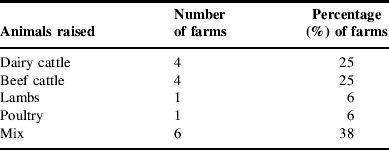
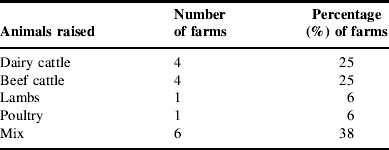
The farmers were selected for interview from a number of sources: (i) those identified by the Chair of Michigan State University Extension's Forage/Pasture/Grazing Area of Expertise Team, (ii) members of the Michigan Hay and Grazing Council, (iii) farms listed on eatwild.com and (iv) peers of those farmers who had been previously interviewed. Interviewees were chosen to ensure a broad diversity of backgrounds, e.g. size of farm, number of years in operation, geographic location in Michigan, animal species raised, as well as age and gender of farmers. A total of 24 farm families were initially identified, and of these the authors were able to arrange interviews with 16 farmers and farm families, all of whom sell some form of differentiated pasture-raised animal products to local markets. Two of the 16 farms in this study use pasture sparingly, but support and primarily utilize a confinement model. Most farms produce a number of livestock products (Table 1) and utilize managed pastures containing grasses, legumes and other herbaceous plants.
Type of animals raised on farms in the study (n=16).
Processors were sampled from those identified by the farmers in this study, plus several others known to the researchers, for a total of eight individuals interviewed (with one refusal from those initially identified). Finally, buyers and distributors were selected from those known to sell pasture-raised products, including two distributors, two chefs and two retailers, for a total of six individuals (with one refusal from those identified initially). While these samples are not statistically representative of any larger group, such ‘purposeful sampling’Reference Maxwell25 brings both the diversity and depth of data needed to understand the questions at hand.
All interviews were conducted by the primary author, and, with two exceptions (one farm family and one processor), the interviews were taped and transcribed. The interviews were conducted from the fall of 2004 to the spring of 2005.
Introductory issues covered during the interviews were initially identified through literature review. All interviewees were asked to identify the strengths, weaknesses, opportunities and threats concerning their businesses, as well as perceived research needs. Specifically, farmers were questioned about production, processing and marketing practices; processors were asked about business history and operations, including the role of inspection regulations. Finally, buyers were asked about their procurement practices, including experiences of working with small or local farmers, and their perception of consumer preferences. Copies of the qualitative interview guides are available from the authors.
Results from the qualitative interviews helped to inform questions for a statewide survey of Michigan residents, the goal of which was to measure consumers' preferences for various attributes of animal products in general, as well as their awareness and behavior concerning pasture-raised products more specifically. The survey included ten questions on consumer preferences, as well as general socio-demographic variables, including age, gender, income, education, marital and employment status, community type (e.g. urban versus rural), race and political affiliation. For six of the survey questions, respondents were asked to rate the importance of a series of food attributes using a 5-point Likert scale. The remaining questions covered consumers' purchasing habits and perceived health benefits of pasture-raised animal products. Copies of these questions are available from the authors.
The survey data were collected as part of the quarterly ‘State of the State’ Telephone Survey administered by the Institute for Public Policy and Social Research (IPPSR) at Michigan State University (MSU) in Fall 2005. A total of 988 Michigan residents were interviewed and the refusal rate was 21.5%, with a margin of error of ±3.1% (at the 95% confidence level)Reference Hembroff and Silver26.
Results
Pasture-based livestock producers
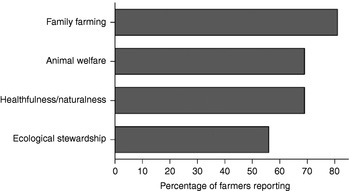
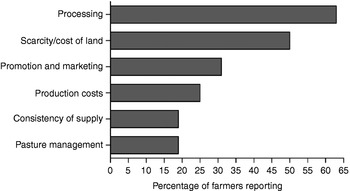
Two main themes emerged from the in-depth interviews with farmers: (i) values of importance to farmers in the production of pasture-based animal products (Fig. 1); and (ii) challenges faced in getting these products to consumers (Fig. 2).
Values associated with pasture-based animal production as reported by Michigan farmers (n=16).

Challenges faced by Michigan farmers in meeting consumer demand for products from pasture-raised animals (n=16).

The ‘Family farming’ category in Figure 1 refers to an array of similar values that are associated with being able to farm as a family, e.g. quality of life, producing products that can be afforded by all and contributing to the well-being of a community. Many have enjoyed relatively long tenures raising livestock on their farms, with little or no off-farm income. For those interviewed, ‘quality of life’ was often derived through doing enjoyable work, and being able to spend time with family. Several of the young farmers home school their children and see the farm as an essential part of their education: ‘there's education going on all the time here’. One respondent expressed the value of ‘not trying to get rich; we're trying to produce a product that almost everyone can afford’, a sentiment echoed by other farmers as well.
Pasture-based farmers also perceive themselves as being embraced by their neighbors, and are happy to be an important part of the rural landscape. ‘Not only do neighbors have no grounds for complaint, many are delighted by the sight of grazing animals’. The interviews also revealed that many farmers were concerned about the welfare of their animals and had taken steps to ensure they were as free from stress as possible; this is often expressed in religious or spiritual terms.
The farmers prided themselves on the ‘healthy’ and ‘natural’ quality of their products, emphasizing the lack of hormones or antibiotics; many of their consumers come to them with pre-existing health concerns, sometimes referred to them by doctors. Raising what they perceive as high quality, healthy and safe products is a key motivation as many farmers emphasized that they feed their families and friends, ‘I know I'm clean, I feed them to my kids’; ‘We don't sell anything in the store that we don't eat’.
Ecological stewardship was another commonly expressed value. One interviewee strongly believed in ‘working with nature instead of conquering her’. Another felt it was important to ‘give back to the land what is taken from it’; meaning that ‘you're sensitive to the inputs and outputs and you're treating the environment and animals with respect … everything works together, you're a steward of the land’.
Despite the benefits these farmers bring to their consumers and communities, they reported numerous challenges faced in bringing products to market, most notably access to appropriate processing facilities (Fig. 2). Farmers often had to drive long distances and schedule processing months in advance; encountering conflict with processors who only want to deal with large volumes of animals, or finding themselves in competition with deer hunters at a time when custom butchering services are most needed.
Finally, many farmers indicated a lack of materials and guidelines for communicating with consumers in the marketing and promotion of their products. Several expressed a need for help with raising public awareness of the importance of supporting local farmers, especially those using sustainable methods like pasture-based management.
Processors
The farmers generally have good relationships with the processors they use. They see the butchers as partners, having an important role in satisfying customers. The processors interviewed for this project are of the scale typically used by farmers who wish to merchandize their own meats (rather than selling them to commodity channels); they process meat from grain-fed as well as pastured animals. These processors either have continued a multi-generational family business, or in some cases, entered this business because they are committed to animal agriculture and saw a need for their services. They generally see farmers as partners and share their commitment to humane and stress-free handling.
Processors work with farmers to ensure high quality products, especially when the meat will be sold at the processor's own business. ‘We know the farmers we do business with. We can tell you what their barns look like on the inside. We do need to know what type of animal they have, how they're fed. We just don't go out and say yes we'll buy it. We need to know its breeding, care, the farm area where it has been living, age, we're very picky.’
The current seasonality of production makes it difficult to retain labor. Many processors discuss being at full capacity only in the late summer and fall. ‘By the time you've got somebody trained, you've moved out of the busy season and you're into the slow time and you can't afford them. So you're understaffed all the time.’ Another says, ‘Every slaughterhouse is backed up at the same time’. This also constrains the ability of processors to buy from local farmers to supply wholesale accounts.
Processors had mixed feelings about pasture-raised animals. A common dilemma is that the meat can be tough, and the lack of fat on the carcass precludes longer aging times. ‘Grass-fed is a very nice animal. It does not have the marbling through it that a grain fed animal would have. It will not last aging as long as a grain fed. And most times it's not as tender.’ Some processors commented that the animals' breed and farmers' practices do help to improve the quality of pasture-raised products.
Buyers and distributors
The buyers generally liked the idea of sourcing from local farmers, but have experienced many problems when trying to do so. These problems include: (i) small farmers and chefs/retailers lacking the time to seek each other out, (ii) finding markets for the whole animal, rather than just steaks and cuts, (iii) fresh, pasture-raised products are available only at certain times of the year and (iv) many consumers consider pasture-raised meat to be gamey and tough.
Consumers
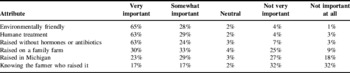
Over 90% of respondents in the phone survey ranked animal products raised in an environmentally friendly and humane manner as very or somewhat important; and 87% responded similarly to the ‘hormone free’ attribute (Table 2). Less than 10% responded that these attributes were not important. Knowing where these products come from was also ranked highly; 63% of respondents thought that it was somewhat or very important that animal products come from a family farm, and just over 50% indicated a desire for these products to be Michigan-raised. In contrast, approximately 64% of respondents said that it was not important to know the farmer who raised the animals.
Ranking of animal product attributes by Michigan consumers (n=988) using a 5-point Likert scale (1=very important, 2=somewhat important, 3=neutral, 4=not very important and 5=not important at all). Note that percentage values may not add to 100 due to rounding.

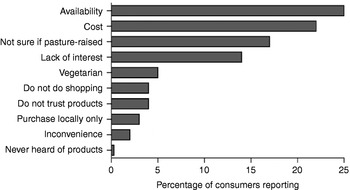
Survey results also indicate that consumers believe they are already buying pasture-raised products; when asked how frequently they buy pasture-raised products, 39% said always or most times, while 35% said sometimes; only 26% said rarely or never. Respondents were also asked to indicate the top reason why they never buy, or do not buy more, pasture-raised products (Fig. 3). The most common reasons given were: lack of availability (25.3%), price (21.5%), not aware or not certain if item is pasture-raised (17.3%) and lack of interest (13.5%).
Most common reason cited by Michigan consumers for not purchasing or not purchasing more pasture-based animal products (n=494, with 145 don't know/refused). Note that those consumers who always buy pasture-raised products were not asked in this question.

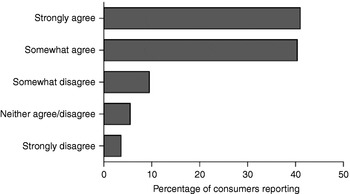
Consumers also associated pasture-raised animal products with healthfulness; with 76% strongly or somewhat agreeing that pasture-raised products are healthier for consumers than those from confinement operations (Fig. 4).
Consumer agreement with the statement ‘Pasture-raised products are healthier for consumers than products from confined feeding operations’ (n=919, with 69 don't know/refused).

Discussion
Reconnecting consumers and producers
Pasture-raised products provide a significant opportunity to reconnect producers and consumers through shared values and a growing commitment to an environmentally, ethically and socially just food system. This is particularly important because of the increasing interest among consumers to reconnect with agriculture and to seek foods that are produced outside of traditional commodity channels and that encompass values that are beyond traditional market considerations. In addition, many farmers are seeking ways to avoid the often adversarial, unreliable and unrewarding relationships that are associated with commodity production. In this study, the values identified as most important by pasture-based farmers were echoed in the top-ranked product attributes identified by consumers: humane treatment of the animals, environmentally friendly production methods, ‘naturalness’ (no hormones or antibiotics) and produced on a family farm. Great opportunity lies in the fact that pasture-based agriculture can bundle these four desirable attributes into a single product. However, given that many survey respondents stated, almost certainly erroneously, that they are already buying pasture-raised products, there appears to be great need for information that helps consumers become aware of the important values associated with pasture-based production as well as to identify them in the marketplace.
These obstacles and concerns can be addressed with a broad consumer education and marketing campaign that highlights the shared values as well as the important social, environmental and health benefits of pasture-based livestock production. However, given the comments of processors and distributors in this study, these efforts should also include issues of seasonal variability in the availability and characteristics of pasture-based animal products in general, as well as appropriate preparation and cooking techniques for pasture-raised meats more specifically.
A recent study indicates that consumers overwhelmingly prefer to obtain this information at the point of purchase, and that the preferred sources of this information are labels, brochures or retail displaysReference Howard27. For pasture-based animal products, these efforts could stand apart from more ‘conventional’ labeling or marketing efforts through a focus on ‘process over product’ as well as encompassing a wider variety of values than those typically found within the marketplaceReference Barham22. However, it is important that this new role for labeling and marketing be supported by a shared commitment to transparency and openness from all elements of the supply chain, or consumer trust in the process will eventually be eroded awayReference McEachern and Schroder28. Value chains show promise in delivering pasture-based products to consumers while retaining the trust and transparency once associated with more intimate farmer–consumer relationships.
Delivering pasture-based products to consumers
As demand for ‘good food’ increases, distribution channels will need to keep pace; both direct and extended markets need to be developed. Farmers’ markets and the like can serve as an entry point to a ‘new food economy’ for consumers; a place to experience the food stories, sample products, get recipes and cooking/handling tips, meet the farmers and form relationships. However, given the habits of modern consumers, the growth of direct markets in meeting this demand will almost certainly have limits; only a small proportion of people will likely go out of their way to shop for and prepare food from these sources21. Addressing what Renting et al. refer to as the ‘contradictory hybrid consumer demands of convenience and quality’Reference Renting, Marsden and Banks13 will require new distribution chains to bring pasture-raised products into more mainstream retail sites like supermarkets, as well as mechanisms, (e.g. labels, as described above) to communicate the ‘story of the food’ and to establish the meaning for and relationships with consumers, thus inhibiting the commoditization of the productsReference Barham22.
The concept of value chainsReference Stevenson and Pirog23, Reference Pirog24 is particularly promising in that it facilitates broader market access while ensuring that the food's provenance is not lost. Value chains are built on long-term interdependent relationships between all elements of the supply chain, from producer to retailer. These relationships ensure a dependable and predictable supply of product, while at the same time sharing risks, information and benefits for a more mutually beneficial and transparent arrangement than that found in conventional supply chainsReference Pirog24. One of the greatest needs appears to be for brokers and distributors who will connect farmers with restaurants and retailers while maintaining traceability, transparency, profitability and trust. Partnerships among supply chain actors may also better coordinate product flow, helping to mitigate product supply and processing issues associated with seasonality. Studies from Europe suggest benefits to farmers and rural communities from short or alternative supply chains such as value chainsReference Renting, Marsden and Banks13, Reference Verhaegen and Van Huylenbroeck29, Reference Marsden, Banks and Bristow30. Renting et al.Reference Renting, Marsden and Banks13 emphasize that these market opportunities ‘result from the active construction of networks by various actors’, and ‘are not the result of some kind of external, elusive “free market”’ (p. 399), suggesting the need for public and private sector engagement to achieve these benefits.
Conclusion
Effective consumer education and the concurrent development of direct and extended distribution channels can have a profound effect on farm viability and our food system in general. The re-embedding of food in nature and society, based on a set of shared valuesReference Sage18, changes the meaning of food, creating opportunity for citizenship and community where individuals express their values in the marketplace and take responsibility for the world around them through their purchase decisions. Certainly, no ecologically regenerative and socially just food and agriculture system is possible without well-informed, dedicated and conscientious consumers supporting it in the marketplace; while no one product or market can independently construct such a system, pasture-raised products appear to possess an appropriate mix of desired attributes to aid this re-embedding process.
Limitations and Future Directions
The interview findings reported in this paper are limited to the comments of the interviewees. The degree to which the interview findings can be generalized to other populations is unknown. Other key players in pasture-based livestock production, input suppliers, breeders, extension educators and other professionals, were not interviewed in this phase of the research.
In the survey portion, space limitations precluded the inclusion of questions on the importance of traditional demand drivers like price, and product quality (e.g. taste, appearance, tenderness, juiciness and safety). These attributes have been shown to be important in many studies and are a prerequisite for any marketable animal product.
As for future directions of research, this paper poses many questions, such as, given the competition in media for consumer attention, how can we most effectively communicate the values and attributes associated with pasture-based livestock production? What can we learn from past success stories of promotional efforts and distribution systems? How are value chains best governed? How can processing barriers be overcome? As farmers, processors, distributors and consumers come together to revitalize the food system, different departments and colleges at universities, including journalism, public relations, business, animal science, food science and agricultural economics, all have vital contributions to make.
Acknowledgements
This research was funded by the endowment of the C.S. Mott Professor of Sustainable Agriculture at Michigan State University.