Most ecological studies of fungi associated with tropical plants have focused on the rhizosphere or phyllosphere of seedlings, saplings and adult trees (Augspurger Reference AUGSPURGER1983, Reference AUGSPURGER1984; Bell et al. Reference BELL, FREKLETON and LEWIS2006, Gilbert Reference GILBERT2002, Gilbert et al. Reference GILBERT, FERRER and CARRANZA2002, Husband et al. Reference HUSBAND, HERRE, TUNER, GALLERY and YOUNG2002, Kiers et al. Reference KIERS, LOVELOCK, KRUEGER and HERRE2000, Mangan et al. Reference MANGAN, EOM, ADLER, YAVITT and HERRE2004). However, fungi also infect the seeds of tropical trees, reducing seed survival and potentially affecting adult distributions (Gallery et al. Reference GALLERY, DALLING and ARNOLD2007a, Reference GALLERY, DALLING, WOLFE, ARNOLD, Wescott, Dennis and Schuppb). Fungicide experiments have shown that fungal and oomyceteous pathogens are the major cause of seed mortality in the soil for a variety of tropical pioneers (Dalling et al. Reference DALLING, HUBBELL and SILVERA1998, Gallery et al. Reference GALLERY, DALLING, WOLFE, ARNOLD, Wescott, Dennis and Schupp2007b, Murray & Garcia Reference MURRAY, GARCIA, Levey, Silva and Galetti2002), which depend on recruitment from seed banks to colonize gaps and other disturbances in mature forest (Alvarez-Buylla & Martinez-Ramos Reference ALVAREZ-BUYLLA and MARTINEZ-RAMOS1990, Dalling et al. Reference DALLING, SWAINE and GARWOOD1997, Hall & Swaine Reference HALL and SWAINE1980). Persistence in the soil prolongs exposure of seeds to infection by soil-borne fungi and is especially problematic for small-seeded species with thin fruit or seed walls (Baskin & Baskin Reference BASKIN and BASKIN1998, Blaney & Kotanen Reference BLANEY and KOTANEN2002, Crist & Friese Reference CRIST and FRIESE1993). At present little is known about the host affinity of fungi associated with seeds of tropical trees, and consequently, whether seed-infecting fungi influence plant species coexistence through differential infection of, or effects on, potential hosts.
We examined the host affinity of seed-infecting fungi by burying seeds of four distantly related pioneer tree species together in the soil at Barro Colorado Island, Panama (BCI; 9°9′N, 79°51′W; for a site description, see Leigh et al. Reference LEIGH, RAND and WINDSOR1996). We recovered seeds after 3 mo, assessed seed germination, isolated fungi in culture, and used molecular sequence data to identify seed-associated fungal communities. Our data indicate for the first time that the dominant fungal genotypes associated with seeds of representative tropical pioneer species are host-generalists.
In March–April 2006, seeds of Cecropia insignis Liebm. (Cecropiaceae), Ficus insipida Willd. (Moraceae), Luehea seemannii Triana & Planch. (Tiliaceae) and Miconia argentea (Sw.) DC. (Melastomataceae) were collected from seed traps or the canopy in primary and secondary forest at BCI, surface-sterilized, and stored in sterile conditions following Gallery et al. (Reference GALLERY, DALLING and ARNOLD2007a). Seed viability was measured as per cent germination for three lots of 30 seeds per species, which were sown on moist paper in sealed Petri plates in April 2006 and incubated for 8 wk in a shadehouse at ambient temperature and under natural light.
Concurrently, eight mesh bags (mesh size = 0.5 mm) containing 10 seeds of each species and 5 ml of autoclave-sterilized forest soil were buried in a 1-m2 grid at a depth of 3 cm directly under each of three female Cecropia insignis trees > 500 m apart (two in primary forest; one in secondary forest). Bags were incubated in the soil for 3 mo and were recovered in late June 2006, c. 1 mo after the onset of the rainy season. Within 24 h of collection, seeds were recovered by washing the contents of each bag through a 500-μm sieve, or by manual removal with the aid of a dissecting microscope (M. argentea).
Seeds were surface-sterilized by sequential washes with 95% ethanol (10 s), 0.525% sodium hypochlorite (2 min), and 70% ethanol (2 min), and placed in 1.5-ml microfuge tubes containing 2% malt extract agar (MEA). Cultures were incubated at room temperature and assessed weekly for fungal growth and seed germination over 10 mo. Vouchers of all fungi were deposited at the Robert L. Gilbertson Mycological Herbarium, University of Arizona (ARIZ).
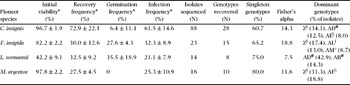
From 960 seeds buried in mesh bags, we recovered 396 intact seeds. Seed recovery differed nearly threefold among species (from 27.5% ± 4.5% for M. argentea to 72.9% for C. insignis; Table 1), and twofold among burial sites (Appendix 1, available online as supplementary material). Because the mesh was sufficiently small to prevent entry by most seed-predating arthropods (Gallery et al. Reference GALLERY, DALLING and ARNOLD2007a), low recovery success suggests complete degradation of most seeds by microbes or nematodes.
Heterogeneity in seed recovery, germination and fungal infection, and in the diversity and composition of fungal communities, as a function of pioneer species (Cecropia insignis, Ficus insipida, Luehea seemannii and Miconia argentea). Data are given as counts (N) and percentages (%), and where appropriate are listed as means ± SE. Germination frequencies are adjusted to reflect initial viability. Asterisks indicate significant differences among species (alpha = 0.05) based on a Wilcoxon test with a χ2 approximation. Genotypes reflect 99% ITS sequence similarity; dominant genotypes correspond to the following: AB, Fusarium sp., AD, Clonostachys sp., AE, Fusarium sp., AF, Alternaria sp., AL, Fusarium sp., AM, Fusarium sp., Z, Botryosphaeria sp.; see also Appendix 2. Symbols indicate the occurrence of each genotype in seeds of all four host species (†), three host species (#), two host species (§), and one host species (°); per cent values indicate the number of isolates of each genotype divided by the total number of isolates recovered from that pioneer species.

Overall, 11.6% of seeds germinated in culture following excavation from the soil. Despite very high initial viability, no seeds of M. argentea germinated after incubation (Table 1). Germination frequency differed more than fivefold among the remaining species (from 6.4% ± 11.1% for C. insignis to 35.5% ± 18.9% for L. seemannii; Table 1) and threefold among burial sites (Appendix 1). Our data suggest a potentially negative relationship between initial viability and germination following incubation, but further sampling is needed to evaluate the robustness of this pattern. We found no evidence for a relationship between recovery frequency (seed survival in the soil) and germination frequency, nor for an interaction of species and burial site.
Fungi were never recovered from germinating seeds or seedlings, but 163 isolates were recovered from ungerminated seeds. Infection frequency differed nearly threefold among species (from 21.1% ± 7.9% for L. seemannii to 61.5% ± 14.6% for C. insignis; Table 1) and nearly twofold among burial sites (Appendix 1). We found no evidence for a relationship between germination and infection frequency, nor for an interaction of species and burial site.
Total genomic DNA was extracted from 141 representative isolates (86.5% of those recovered, including 82–100% of isolates recovered per pioneer species), and the polymerase chain reaction (PCR) used to amplify the c. 600 base-pair nuclear ribosomal transcribed spacer region (ITS) prior to bidirectional sequencing (Arnold & Lutzoni Reference ARNOLD and LUTZONI2007). Sequence data were submitted to GenBank under accession numbers EU 563513–563653. To estimate taxonomic placement, edited consensus sequences were compared against the NCBI GenBank database using BLAST (Appendix 2, available online), and a phylogenetically referenced database of 4175 plant-associated fungi (Arnold unpubl. data), followed by phylogenetic analyses to confirm identifications at the generic level (see Arnold et al. Reference ARNOLD, HENK, EELLS, LUTZONI and VILGALYS2007 for methods). Each sequence was assigned to a genotype group based on 99% sequence similarity (1% divergence over the c. 600 base-pair region), which allows for minor sequencing errors while differentiating distinctive genotypes (Gallery et al. Reference GALLERY, DALLING and ARNOLD2007a). These genotype groups served as operational taxonomic units for estimating diversity (Fisher's alpha) and species richness.
Based on 1% sequence divergence, 40 distinct genotypes were found among 141 sequenced isolates (Fisher's alpha = 18.3; bootstrap estimate of total richness = 49 genotypes). All recovered fungi were Ascomycota, including numerous genera known to include saprotrophs, pathogens and endophytes (Appendix 2). Sordariomycetes and Dothideomycetes were especially well represented, comprising 140 of 141 isolates. Diversity differed more than twofold among pioneer species (from 7.5 for L. seemannii to 18.8 for F. insipida; Table 1) and burial sites (Appendix 1). There was no clear relationship of fungal diversity to infection frequency or germination frequency.
Most genotypes recovered in this study occurred only once (25 of 40 genotypes; 62.5%). Among the 15 genotypes recovered more than once (non-singletons), 80% were isolated from seeds of more than one pioneer species (Table 1, Appendix 2). Similarly, 53.3% of non-singletons were recovered from more than one burial site. Of these, four were found under all three crowns (AB, AD, AE and Z, corresponding to Fusarium sp., Clonostachys sp., Fusarium sp. and Botryosphaeria sp.; Appendices 1, 2).
Our experiment provides a preliminary assessment of how the seeds of four pioneer species vary in survival and susceptibility to fungal infection when planted together in the forest understorey. We found significant differences among tree species and burial sites in the survival, germination and infection frequency of seeds, and in the diversity and genotypic structure of fungal communities associated with each pioneer species and below-crown site. Differences in seed recovery and germination frequency likely arise from differential infection by particularly antagonistic (pathogen and decomposer) fungi, which are responsible for most of the mortality of small-seeded pioneers in seed banks on BCI (Dalling et al. Reference DALLING, HUBBELL and SILVERA1998, Gallery Reference GALLERY2007).
These potentially antagonistic fungi, while diverse, include a large number of host-generalists with wide distributions across the forest at BCI. Evidence for host-generalism is important as it suggests that antagonistic fungi may have a more limited role in determining the recruitment patterns of pioneers than would be expected if host-specialist fungi selectively deplete the seed bank of susceptible species. However our interpretation of host-generalism, and its significance, warrants several caveats.
First, each tree species harboured many singleton genotypes. Consistent with other studies of tropical microfungi (Arnold et al. Reference ARNOLD, MEJÍA, KYLLO, ROJAS, MAYNARD, ROBBINS and HERRE2003, Gallery et al. Reference GALLERY, DALLING and ARNOLD2007a), >60% of the genotypes recovered in this study were found only once. As a result, our analyses are restricted to fewer than half of the fungal genotypes observed. More intensive sampling is needed to determine the host affinities of these rare genotypes. The prevalence of rare taxa suggests that host preference among the numerous infrequently encountered fungi might still influence recruitment patterns for particular plant species.
Second, the presence of particular fungi in seeds of multiple host species does not mean that those hosts are equally susceptible to infection, or that different hosts are equally sensitive to potential effects of these fungi on seed survival. Despite burying seeds of four pioneer species together in the same bags, we found that both the frequency of infection and the rank abundance of fungal genotypes differed markedly among species (Table 1, Appendix 2). The facility with which fungal genotypes infect particular hosts may be dependent on host genotypes or species, or on factors such as seed quality. For example, infection of some hosts may depend on pre-existing seed damage (Shortt et al. Reference SHORTT, SINCLAIR, HELM, JEFFORDS and KOGAN1982), a requirement that may be absent for others. Forthcoming studies will explicitly address the ways in which particular fungi differentially infect, and affect, various pioneer tree species (Gallery Reference GALLERY2007).
Third, our seed burial experiment was limited to sites below C. insignis crowns. If some fungi do show strong host-affinity, then we might expect their local distribution to reflect that of their hosts. It is tantalizing that C. insignis – the only species in this study buried beneath conspecific trees – had both the highest infection frequency and lowest germination frequency: perhaps the fungal strains associated with adult trees indeed are more likely to infect conspecific propagules beneath those trees, in accordance with the mechanisms proposed to underlie the Janzen–Connell hypothesis (Connell Reference CONNELL, den Boer and Gradwell1971, Janzen Reference JANZEN1970; see also Augspurger & Wilkinson Reference AUGSPURGER and WILKINSON2007). However, broader spatial sampling that includes the below-crown sites of additional tree species is required to explore the importance of burial under conspecific vs. heterospecific trees.
Finally, we only assessed fungi associated with seeds that did not germinate in culture. The fungi we recovered may represent the causal agents of seed mortality, or may instead represent secondary infections by generalist saprotrophic fungi. Future studies will benefit from (1) recovering bags at intervals following burial to assess the time course of infection by fungi, thereby creating the possibility to catch seed-killing fungi in the act; and (2) re-inoculation experiments that explicitly test the effects of particular fungi on seed viability. Such experiments will elucidate the ecological importance of fungi associated with seeds of tropical trees – a currently under-studied aspect of tropical plant ecology.
ACKNOWLEDGEMENTS
This research was supported by the National Science Foundation (DEB-0342925 to JWD; DEB-0639048, DEB-0516544 and DEB-0640996 to AEA) and the Arizona Biology Network (CWG). We thank M. Hoffman, J. Amerongen-Maddison, J. Santos R., M. Gunatilaka and M.-M. Lee for assistance in the field and laboratory, two anonymous reviewers for improving the manuscript, and the Smithsonian Tropical Research Institute for logistical support.
APPENDICES
Appendices are available as supplementary material online at http://journals.cambridge.org/tro