In his essay “The Public Face of 9/11,” the photographer Jonathan Hyman optimistically describes witnessing a “new memorial vocabulary of 9/11 that allowed Americans to speak to each other freely,” by capturing a “portrait of post-9/11 society as seen through the American vernacular.”Footnote 1 Similarly, in her book Homeland (2008), a photographic collection interspersed with “essays” belonging to unnamed speakers, Nina Berman presents images demonstrating a decidedly domestic response to 9/11 and its aftermath. This article, the first to extensively think about Homeland, examines how Berman's work illuminates the ways that sociopolitical identities intersect with what I argue are different categories of citizenship following the attacks. Furthermore, the article investigates how Berman's photography interrogates what it means to be “American,” rethinking how the vernacular – that is, the words and images of the everyday, a purportedly “all-American” voice – seeks to both bolster and problematize the idea of a democratic and inclusive national discourse. By illuminating the construction, representation, and perception of “American-ness,” Berman's collection embodies what I argue is a queer topographics of contemporary US culture. Building on the definition of US topographics as outlined in this special issue's introduction – the aesthetic means of shaping and depicting various US landscapes – Homeland’s queer topography is a set of literal and figurative landscapes in which supposedly normative depictions of the United States are undermined through the presence of subjects and markers readable as queer through their oppositional and subversive qualities. While this article builds on previous scholarship around 9/11 visual cultures, it focusses squarely on Berman's collection and its depiction of the aftermath of that event across the nation. While the scope and content are different, my work considers, as Nicholas Mirzoeff does, “people defined as the agents of sight … and as the objects of certain discourses of visuality,” particularly as they are framed by (the threat of) war.Footnote 2 And while other scholarship on memorialization and mourning,Footnote 3 the optics of disaster,Footnote 4 and popular culture's mediation of 9/11's effectsFootnote 5 has emerged in recent years, this article will contribute more precisely to the field of American studies and contemporary visual cultures by showing how Berman's particular collection opens up numerous queer topographies of citizenship, belonging and identification in the ever-militarized US after the 9/11 attacks.
Following 9/11, the nation's sociopolitical terrain was reoriented towards a neoconservative shoring up of borders, mirrored in the jingoistic patriotism of various cultural responses as well as in state rhetoric more broadly.Footnote 6 As Lucy Bond suggests, “the cultural memory of 9/11 generally appeared to exhibit an exemplary form of ‘narrative coherence’” that centered around the “us” or “them” rhetoric that followed the attacks.Footnote 7 Consequently, a Western-centric idealism, as encapsulated in “an all-American wholeness of spirit and a national state of health and happiness,” was created.Footnote 8 Thus, bodies that were marked by difference found themselves further occluded from the nation's normative interior, positioned in the margins. These marginal subjects can be described as queer because they are cast outside the normative sphere. A long history of queer studies, emblematized by Cathy J. Cohen's essay from 1997, “Punks, Bulldaggers, and Welfare Queens: The Radical Potential of Queer Politics?”, identifies queerness not simply as a marker of sexuality and/or gender, but rather as the intersectional position of those exterior to (or sublimated by) heteronormativity.Footnote 9 Anti-normativity – which, in this article, designates various figures, such as children and people of colour – is, in Jack Halberstam's words, “the excess” of a queerness that disrupts “identity and the violence of power and the power of representation.”Footnote 10 Lee Edelman, too, argues that heteronormativity is upheld through the imposing of “an ideological limit on political discourse,” which means that queer alternatives to sociality are “render[ed] unthinkable”.Footnote 11 Queerness, which in Harper et al.’s words cuts across the “interrelations of sexuality, race, and gender in a transnational context,”Footnote 12 is thus a form of social marginalization that both exceeds and disrupts the normative (white) nation. Heteronormative archetypes, therefore, were promoted and acknowledged by normative society as the representation of a US vernacular after 9/11, designed to “reinforce and secure national boundaries at home” whilst locating “the primitive, sexual other” elsewhere.Footnote 13 Berman's images reorient the position of those marked as queer into spaces rendered as heteronormative, thus destabilizing the rigidity of such categories, as well as highlighting the link between queerness and heteronormativity that is tied to figures such as the child and the correlated infantilized citizen.
Focussing on photographs that feature subjects occupying nonnormative identity positions, such as children and people of colour, as well as the recategorization of spaces, such as the school classroom and Times Square, I argue that Berman's images reposition those considered in opposition to the nation's normative core into the foreground. Following numerous critics in queer studies, I attend to those figures in Berman's work that are cast in opposition to a normative white US citizenry. Though this normative America is, of course, multitudinous (there is no singular US centre), and, as Robyn Wiegman and Elizabeth A. Wilson argue, (hetero)normativity by its very nature contains plural alternatives to normativity (thus dismantling the solid binary of normativity/anti-normativity),Footnote 14 I nonetheless want to think through the dominant model of US citizenry after 9/11 that Berman displays and mediates. By closely analysing Berman's photographs, I demonstrate how the images, as objects of remembrance, frame the act of memorialization, and how they can subvert and/or perpetuate various dynamics of nationalist and exceptionalist discourse. In particular, I will show how Berman achieves this by illuminating the infantilization of US citizenry in a variety of banal and everyday settings. A queer topography emerges of the United States following 9/11 as Homeland focusses on the dissonance of bodies in the literal and symbolic landscape(s) seemingly altered by 9/11, marked as queer through their oppositionality to the nation's normative mainstream, and the ways that they either occupy spaces tied to that normativity, or work to highlight the instability of such categorizations.
Berman's use of vernacular culture – that is, a focus on an ostensibly national “everyday”, one textured by routine, ordinariness, day-to-day life for a dominantly white and heteronormative “Middle” America – also allows us to identify “an array of specialized interests that are grounded in parts of the whole,”Footnote 15 the whole being a wider normative US society. Consequently, her images provide us with useful snapshots of moments that allow for an extrapolation of broader national cultural conditions. Despite being attached to a larger public response, vernacular responses to 9/11 tend to merge with official forms of expression – such as the political response of the Bush administration following the attacks – to create forms of wider public, and therefore cultural, memory. Given this relationship, the vernacular thus offers a way to understand “what social reality feels like rather than what it should be like.”Footnote 16 Images that constitute vernacular forms of memory therefore mediate a particular form of patriotism, creating “loyalties” between the localized spaces of the vernacular (such as schools, churches and other community-based organizations), and national imaginaries tied to “official” state responses. By queering responses of these kinds, the notion that vernacular photography upholds the assumptions of a state rhetoric unquestioningly can be explored in a more nuanced way, creating new forms of memorialization in the process.
Interrogating how forms such as photography operate in a broader cultural context, Berman draws attention to how the response to 9/11 is absorbed into, and travels across, various social imaginaries. National imaginaries in the wake of historical events like this can be reevaluated in images read as vernacular; that is, those concerned with public reactions and/or those based in the everyday. Reacting against what Dora Apel describes as the enforcement of “a particular reality while actively excluding any alternative views,”Footnote 17 Berman utilizes a particularly militarized and domestic homeland – displayed in a range of physical and metaphoric landscapes – that is seen to function as the dominant focus of the nation; however, moments of queerness can be seen through markers of nonnormativity that reside in the periphery or are conversely made remarkable by their unexpected relocation at the forefront of the image. Resulting in an increased “photo-based engagement with social and political reality,”Footnote 18 digital photography in particular has facilitated the turn toward everyday presentations of the United States, particularly following 9/11.Footnote 19 In some ways, the digital has acted as a guarantor of democratic involvement in witnessing, renewing an interest in the ways that the vernacular operates.
I argue that Berman remains attuned to the queer dynamics of her work not only through her photographic technique but also in her use of a subversive narrator in essays that accompany each section of Homeland. Comprising three essays over the book's three sections – “Prepare”, “Believe” and “Defend” – the initially unidentified first-person narrator of each section guides the viewer into each themed collection. Combined with the use of vernacular imagery (as we will see, of people in various US settings, such as schools, churches, stadiums and so on), the narrator creates a sense of personability as well as a potential guide to how the viewer should read the images. The use of a narrator is oftentimes deliberately provocative, making statements such as the one in “Defend”: “if we want our police to go head-to-head with Al Qaeda operatives, I want to be sure they have all they need to get the guys dead, and to do it now.”Footnote 20 Or, in “Believe,” the narrator says, “I go to my church for everything, from worship to aerobics. We read the Bible before crunches,” which is both comedic and also homespun and colloquial. The tone approximates a dominantly “all-American” voice (read: white, heteronormative) that is deeply concerned with protecting the Christian nation. The reader is thus invited to assume that the essays comprise Berman's own views and that they provide contextual background for the images.
The titles of each section, “Prepare,” “Believe,” and “Defend,” also function as a form of imperative that interpellates the viewer, asking them to align their own views with the nationalist rhetoric that seeks to shore up the normative core of the nation. However, the collection ends with an essay, “Homeland,” which is directly attributed to Berman, where the others are simply authorless, thus destabilizing the assumption that the artist and the narrators of the other sections necessarily share identities. As she states, the previous narrators are “a fictional creation” comprising photographic subjects, “scenes I witnessed, news reports and on a few occasions, my own musings.”Footnote 21 Mirrored by the unstaged quality of the images, the invitation here is to explore divergent and conflicting understandings of the book, its cultural context, and the participatory aspect of the photographs themselves. Reaching the end of Homeland, after reading three essays that are extremely nationalistic and jingoistic and then encountering Berman's own, the reader must return and read them aslant. In other words, the voice of each section changes with the new information that it is not Berman as author (and photographer) speaking.
Similarly, just as Berman's images can give the illusion of truth in situations where subjects and scenes may well be staged, she draws attention to her own inner contradictions as the author of the book overall. She states that she “abhor[s] the idea of racial profiling” despite having “once found myself looking suspiciously at an Arab man.”Footnote 22 By demonstrating how “feelings and fears could take me in any direction,” with “a certainty that can be quite consuming,” Berman mirrors the perspective that the viewer of the images is encouraged to take, caught up in nationalist discourse that is oftentimes persuasive if deeply problematic. Conversely, Berman also recognizes that to some “the narrator will seem over the top and not to be believed.”Footnote 23 Nonetheless, she “urge[s] the reader to consider a different interpretation” in order to create a space that actively switches between interpretive modes and various subject positions.Footnote 24 Berman's collection is thus contextualized not only through its very visible relation to the trauma of 9/11 but also through an interrogation of how we conceptualize historical events photographically and textually. The interrelations between the complex photographs and seemingly simple essays – one upholding, or undermining, the other variously – and then the final explanation by Berman require the viewer to see Homeland as far from stable. The nationalistic certainty of its title belies the ambiguity within.
As part of the book's interrogation of the visual iconography of 9/11 and its aftermath, Berman uses repeated motifs such as children and the act of play. “Prepare” features images (in southern and mid-western states, in particular) of simulations where local communities and veterans engage in role-play, mimicking people caught up in, or perpetrating, terrorist attacks. These events are branded as “Islamic,” making clear that the religion is synonymous with terrorism. As part of the simulations, mock towns are created, described in captions as “fabricated Iraq” and featuring buildings named “freedom schools.” The definition of the site as an Iraqi space equates the country with a terrorist state, whilst the building implies that terrorist activities form part of Iraqi children's education under the guise of freedom, a word that is reconfigured into one that is oppositional to the actual civilized values of the country. With terrorism purportedly being taught as part of school lessons in Iraq, the photograph articulates how the country supposedly militarizes its children.Footnote 25 Seen alongside the essay that accompanies the section, the reader identifies the rhetoric of the essay as a way to justify the conflation of Iraq with a terrorist state and Iraqi children and schools as sites of potential terrorism. Conversely, the position also invokes a sense of irony, as Berman photographs exercises that render the children militarized.
Under the guise of US nationalism, these depictions articulate an opposition to the so-called “true” qualities of freedom that the United States in fact engenders. Nonetheless, the training scenarios work to cast the terrorist enemy as the “perversely racialized other,” in instances ironically where US citizens take on that role. Consequently, those taking part in the simulations exemplify how non-queer bodies operate in what Jasbir Puar calls the process of “discipling and normalizing subjects” in order to “signal and enforce mandatory terms of patriotism.”Footnote 26 The training scenarios become a way, then, for the participants to carry out their patriotic duty by preparing for a terrorist attack, safeguarding the normative interior of the nation against those outside it that threaten its stability. As the volunteers shown in the photographs play both roles (victim and Iraqi terrorist), their role-play demonstrates the link between the figure, as Puar writes, of “the terrorist and the person to be corrected and domesticated” by the US nation.Footnote 27 In these images, the citizen's body becomes exemplary of the attempt to reinscribe them into certain patriotic norms, whilst simultaneously taking on the role of the queer subject here imagined as terrorist and attacker.
While in the previous quote Puar is not thinking directly about nationalist photographic topographies, her work is useful in understanding the ways that queer bodies are conceptualized to strengthen hegemonic narratives. The image of “Taking Cover” (2008), from Ft. Polk, Louisiana, exemplifies the process by which queerness is absorbed into the hegemonic majority during times of crisis, or states of exception.Footnote 28 The image features a black man – a subject already queered through its disavowal from dominant whiteness as a racially “perverse” body – playing the role of soldier, crouching down with an automatic weapon. An ID badge shows the actor dressed in clothing associated with Islamic religious worship, whilst his uniform has an Iraqi flag sewn onto its shoulder. The costume thus shows the way that both Iraqis and Muslims are folded into a singular imaginary of the terrorist figure, which is only compounded by the fact that a black man in the US South is playing this character; the layers and aggregating of racial othering are clear here, with multiple historical and cultural contexts. Further, the photograph highlights how individuals can move from markers of queerness to those of normativity through an identification with sites and spaces connected with a particular nationalist rhetoric. Through role-play, as an act of “make-believe,” the subjects also undergo a process of infantilization, in which their ability for “reflexive … agency and criticism” is downplayed in favour of membership of the nation-state.Footnote 29
The slippage between the portrayal of military personnel and/or terrorist is further explored in “Explosion” (2008), at the same location in Louisiana, which depicts a row of men performing the role of Arab/Muslim/Terrorist as they stand yelling next to a burned-out truck. Plumes of smoke fill the air, making the background of the image invisible, whilst the viewer cannot see who the “terrorists” are yelling and gesturing toward. One of the men, however, holds a white rag to indicate surrender. The image's ambiguity partly rests on the inability to ascertain who is victim and who is perpetrator. However, the accompanying caption states that the actors (called “locals”) featured are “hired at $12.87 an hour,” reminding the viewer that the roles are interchangeable. Indirectly, Berman, by reinforcing the slippage between the two, undermines the supposedly static binary of (non)normativity. Participation in the events is also rendered as a productive capitalist endeavour: another mode through which those taking part are able to perform a normative and compliant form of citizenship, even in its moral ambiguity.
In capturing the impersonation and role-play of Iraqi citizen terrorists by mostly white men, Berman highlights how people of color are rendered queer through the hegemony of US citizenry and state belonging. As seen by the figure in “Taking Cover,” those roles are subject to a shift dependent on the need of the heteronormative majority to coalesce against another, more exemplary, form of queerness. The racial imbalance of those participating in the activities, as portrayed in Berman's images, demonstrates how power operates within the nation's borders and its effects on those outside them. Furthermore, the scenes depicted through the photographs illustrate the insular and very visceral fear that pervades various domestic landscapes. The local/regional contours of these landscapes – dominantly, in Homeland, but not only, the South, the Mid-west, the mountain West and the rust belt (areas long associated with a Middle American working class of various races) – further complicate and simultaneously uphold a US normative core. Though it should be noted that the geographical settings in the collection are not often recognizable at first glance: we are not always sure where in the US we are, other than through recourse to the image captions. A certain homogenization of topographies thus occurs in the collection, fostering the sense of a singular US landscape even amidst various locations. By highlighting the physical and symbolic displacements that occur, the images exemplify the ways that non-queer bodies override/overwrite queer ones. Fear and division are thus projected from one group (US citizens) onto another (Iraqi citizens configured as “terrorist”); a process that is interrogated through their contradictory proximity within the images. As the viewer witnesses the participants take on the role of military/terrorist, they are able to see the interchangeability of the two subject positions. Whilst Berman's images could be accused of reinforcing division through their remediation of the simulations, Berman presents the reader with an opportunity to reconsider the photographic context, and, as a result, the nationalist ideology that underpins them.
When first encountering the images, the viewer is encouraged to empathize with the nationalist position contained within “Prepare”’s introductory essay, if not actually inhabit its point of view. For instance, the essay begins, “I'm learning how to be safe. I ordered my anti-nuke pills and some for my child,” and later suggests, “What keeps me going is knowing that even an ordinary person like myself can contribute to the success of the GWOT, that's the Global War on Terror.”Footnote 30 This personal and ostensibly “vernacular” voice of an “everyday American” draws the reader into a semblance of identification. The invocation of “safety,” the “child” and “ordinary-ness” is not official state rhetoric, but rather everyday discourse. By the time the reader has reached the end of the collection, they have been invited to consider both viewpoints – either to suspend their incredulity at the hyperbolic nature of the passages’ rhetoric, or to contemplate the inherent contradictions contained within the wider nationalist rhetoric that followed 9/11.
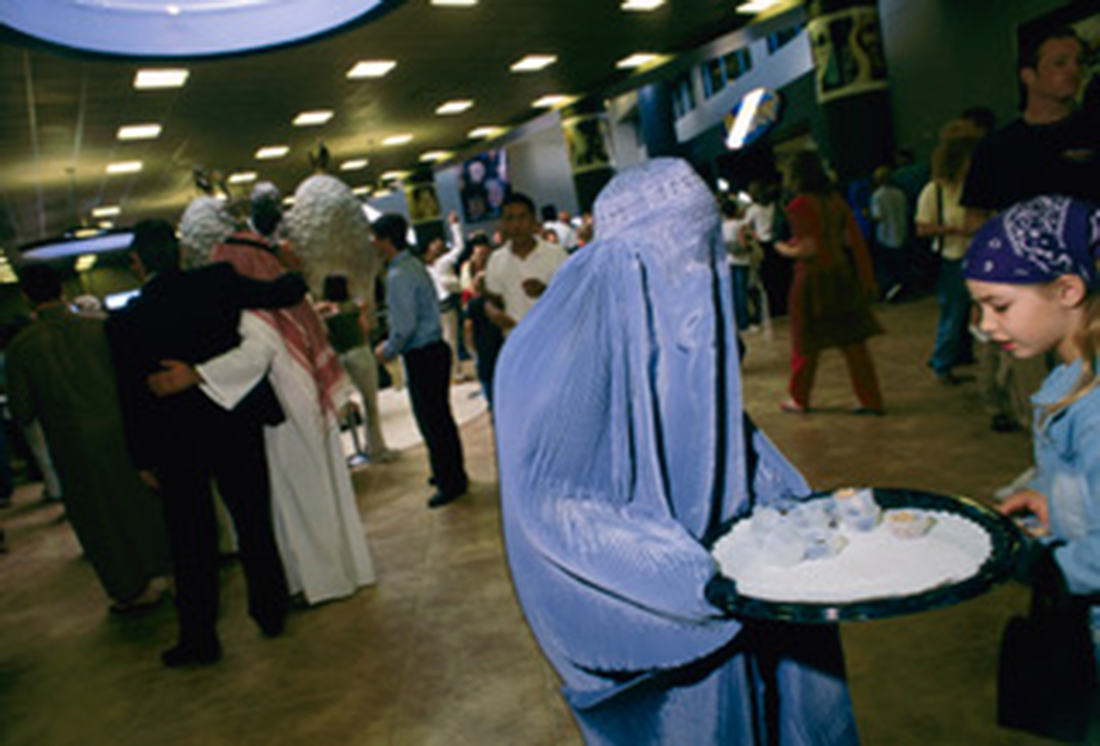
Those contradictions are further emphasized through images that imagine the queer subject within spaces that are deemed non-queer. For instance, the connection between religion and nationhood is examined in the book's following section, “Believe.” The titular essay of the section is accompanied by the first of two images that are titled “Woman in Burqa Serves Peanuts” (2005, Figure 1), in Colorado Springs. The essay opens with the alignment of a US national identity with Christianity, as the narrator states, “I live in a country uniquely blessed. I feel this when I enter my church and see our Christian flag next our American flag.”Footnote 31 Placed next to the image of a solitary Muslim woman, this both creates a juxtaposition and highlights the isolation of her body. That isolation is deepened by the contrast between the photograph's darkened background and the foreground that brightly lights the woman. Similarly, in the other image of the same name, the exterior of mountainous landscape and blue sky are visible through the building's windows, drawing out the dark space between the woman and the background, but also gesturing to the western topography of the frontier and its attendant mythologies of Manifest Destiny, for instance. Further, the viewer's eye becomes drawn toward the woman's body in both images, marking it as extraordinary or out of place in this environment. Standing near the entrance of the building, the obscured signage and doors are eerily reminiscent of an airport – a space of outsiderness – paralleled by the seemingly high altitude of the building. Framing the woman in such a way thus transposes a sense of queerness onto her body, replicating the nationalist tension that occurs around Muslim bodies.
“Woman in Burqa Serves Peanuts,” Missionary Day, New Life Church, Colorado Springs, Colorado, 2005. Credit: Nina Berman/NOOR.

The placement of this image beside the opening essay also undermines the conventional version of the US as a cohesive Christian nation. As the narrator argues: “we are all of one mind … insisting that the sin of homosexuality and other deviations are kept from our midst.”Footnote 32 The assumption of a homogeneous Christian populace, and the adherence to a heteronormative imaginary over an inclusive queer one, is consequently blurred by the presence of a Muslim body within the supposedly Christian space of the nation-state. Moreover, by drawing the “deviation” of the Muslim woman's body into the foreground, Berman's image undermines the Christian fundamentalism invoked by the essay's narrator in the preceding essay. By placing essay and image side by side, Homeland forces the viewer to reflect on the juxtaposition between the two spaces of (supposedly) “here” and “there” as well as the different belief systems that they make visible. The photograph thus highlights the phenomenon outlined by Judith Butler, whereby “the politically induced condition of maximized precariousness” of bodies deemed oppositional means that they “often have no other option than to appeal to the very state from which they need protection.”Footnote 33 Though Butler deals specifically with populations facing war, her argument demonstrates the way that Muslims in the US are subject to violence from within their own nation-state, despite it being their only recourse for protection. The inherent contradiction of the body marked as queer within the domestic (heteronormative) space is further highlighted by the way the image materializes “out of place” within the physical and symbolic context of the wider collection. Consequently, the placement of the image replicates the feeling of being queer in certain spaces, creating the opportunity for empathetic identification. At the same time, the photograph undermines certain notions of what bodies are permitted to appear and in what spaces.
In both this image and the one that follows a few pages later (also in Colorado Springs), the woman's burqa-clad body accentuates various forms of visibility that are connected to spaces associated with the mainstream of Judeo-Christian society. This process is paradoxical in the sense that it arises through the simultaneous visibility and invisibility of the woman. Marked by her clothing, and therefore her religion, a tension is created between the woman's body and the blurred masses of the Christian superchurch behind her. The position of the woman within the overall frame therefore points toward the complexity of being rendered visible precisely because of one's unviewability, engaging with “the epistemological capacity to apprehend a life,” one that is dependent on “being produced according to norms that qualify it as a life, or, indeed as part of life.”Footnote 34 In other words, then, before the viewer can actually perceive the woman, they first must qualify her as apprehendable. The photograph's placement in a section that predominately features Christian locales – indeed, the woman is inside such a locale – interrogates how life and religion are viewed, and whether such viewability is only in relation, or in opposition, to the externalized queer body. Such dissonance exemplifies the collection's queer topographics, and the challenge to the viewer to explore the intricacies underpinning the images. The scene, captioned as “missionary day,”Footnote 35 also recalls the imperialist history of the country as well as the legacies of queer subjugated bodies. The Muslim woman's presence, then, acts as a reminder of those legacies and of how empire and nationhood continue to be in constant negotiation with its subjects.
The second image of “Woman in Burqa” shows the woman offering a young girl peanuts, which ambiguously suggests servitude as well as a reaching-out between cultures. This moment becomes focussed through the queer body of the woman as well as that of the young girl. The juxtaposition between the female figures and the men that can be seen in the image's background demarcates them from one another, suggesting a distinction between the two groups. This distinction thus operates across the intersections of race, religion, and gender, suggesting a complexity to such relations, as well as inviting the viewer to explore what constitutes cultural associations in this context. The men in this image are a collective, one that is shown to be sociable through the arms they have around one another. By using the perspective of the child, which is a queer figure – theorized by Kathryn Bond Stockton – because of its association with the “plain strange” and its out-of-sync time rooted away from adulthood,Footnote 36 Berman presents the viewer with a destabilizing entry point to the nation's heteronormative construction. As Stockton writes at the opening of her book, “If you scratch a child, you will find a queer,” a strange other who is usually cast by normative society as an innocent.Footnote 37 Stockton's point is, amongst others, that we have never understood or seen children properly – that is, literal children, their symbolic function, and representations of them in culture – and that they are, in some ways, the queerest of figures at the heart of society. Children, ostensibly figured as devoid of knowledge, experience or intention, are revealed by Stockton to be queers: askew in normative worlds. The child thus also illuminates the way that queerness is not always in opposition to that heteronormativity but is inextricably linked with it. Both the images and essays in Homeland – particularly “Woman in Burqa” – utilize complex techniques that are encouraged by Berman's ambiguous and slippery aesthetic choices. Thus a myriad of competing cultural associations are presented, replicating the cultural conditions the photographs represent, and which they operate under as well. Whilst the collection highlights how ideologies can compete with one another, Berman also demonstrates the impact that the dominant beliefs of a nation have.
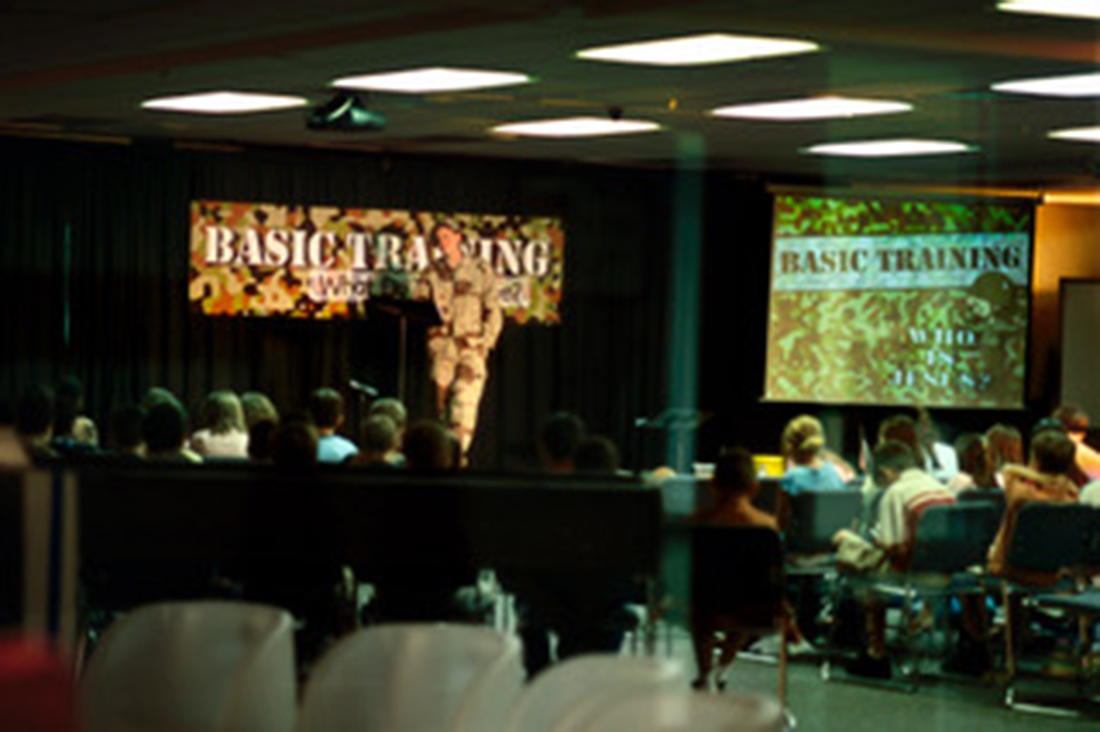
Coupling the themes of religiosity and childhood, the section “Believe” goes on to feature an image titled “Bible Study” (2005, Figure 2), with the caption describing a “Bible studies teacher dressed as an Army soldier in [a] classroom” in Louisville, Kentucky.Footnote 38 The image is captured from the back of the room, behind rows of children facing the teacher, who is on a stage. The room is decorated with projections of camouflage and signage emblazoned with slogans such as “Basic Training,” “Who is Jesus?” and “What Do We Believe?” The position of teacher and children means that only the former is visible to the viewer. By looking outward and over the children, the teacher becomes a force through which the domestic and public spaces (in this case the classroom) become militarized, projecting a form of dominant surveillance. Toward the back of the rows, a young boy can be seen with his head bowed, looking toward his lap. Next to him, another boy holds his hands behind his neck in a stretch or a relaxed gesture. The two boys occupy a space at the edge of the frame whereby they are marked out because of their difference, creating a juxtaposition with the other faceless children. Thus the site, away from the image's centre, presents differing responses (relaxed/subdued) that counterpoint the other children who are seemingly enthralled by the instructive and dominant presence of the teacher. The queer aside of this space contains the tension of Homeland, and the divergent responses to the process of militarization within it.
“Bible Study.” Bible studies teacher dressed as an Army soldier in classroom, Southeast Christian Church, Louisville, Kentucky, 2005. Credit: Nina Berman/NOOR.

What Berman's image suggests, then, is that the ideas that underpin the photograph do not take place at the centre but rather in the periphery. Moreover, the childhood audience points toward the notion of the infantile citizen, as both “audiences” are forced to adhere to codes of US national belonging and patriotism (in this case, a militarized religion, which might be further inflected by the conservative stereotypes of its southern setting) at the cost of “the mediated dispersal of critical national identifications.”Footnote 39 In other words, subjects are forced into participating in a nationalistic hegemony that does not allow for critical intervention and expects full subservience that is coded as patriotism. The children, then, become exemplary of this condition, where they are subsumed to the dominance of the teacher, who is “training” them how to belong and behave as good citizens by telling them what “we believe.” Furthermore, Berman's image denies the viewer's ability to see the children's faces, disrupting the potential for an immediate identificatory discourse, thus creating a kind of detachment that may provoke forms of criticality that some of the other images do not. That is, in refusing the viewer the chance to see the children's faces – and, perhaps, to sentimentalize or “understand” them easily – the viewer is positioned in a way that enables a more critical perspective. While the viewer is positioned in numerous places throughout the collection, allowing disorientation to be one of Berman's visual strategies, this particular image plays with whom we can and cannot automatically identify with. The “we” of the viewer, then, becomes disconnected from the “we” of the photograph, creating the space to suggest that the image does not necessarily form the “we” of the United States. Interrupting the link between spectator and the militarized landscape of the image prevents its naturalization, whilst also indicating the absurdity of children being instrumentalized as new recruits. On top of this, the photograph highlights the contradiction of a Christian “army” that recruits children within an ideology that demonizes Islam for doing the same, namely militarizing children.Footnote 40 The photograph thus operates on multiple levels: images of children are used to articulate a public form of infantilization while at the same time gesturing toward some form of national innocence. This is explored further in Homeland’s third and final section.
The essay that accompanies “Defend” provides a potential justification for the extreme lengths “needed” to protect the country: as the narrator states, “my President says that somewhere in the world, at this very minute, a terrorist is planning an attack on me.”Footnote 41 Bringing together temporality and geography, the threat presented and fostered by US administrations (“my President says”) is continuous and inescapable. Moreover, the potential for contradictory critique is established as ignorance: “how is it my friends that so many people still don't understand what we're up against?”Footnote 42 We are, perhaps, interpellated by this use of “my friends” (casting the viewer/reader as a confidant of the narrator) and the rigid us/them of the US/foreigner binary is reinforced. While some readers may see through the rhetorical question as a form of simplistic nationalism, we might also see the question another way: what “we” are up against is the unquestioning nationalist rhetoric of those photographed in some images by Berman.
The images in “Defend” often use children to relate back to the simplistic definition of terrorism as conveyed by the narrator, that the children are in the need of protection. The narrator clearly draws this relationship, linking it back to religion when they “thank God for all the boys and girls who sign up each day to fight the GWOT.”Footnote 43 Not only are the children related to the country's future; they also become part of how the nation is to be protected and in fact become the very essence of what needs protecting. The idea of the child in need of protection also lays claim to a nostalgia for a past innocence. The assertion of innocence projected through and in the figure of the child is undercut, as Stockton argues, by a child's “sideways movements” (as opposed to growing upwards into adulthood) that lead us to the “cloudiness and ghostliness” they often inhabit.Footnote 44 If all children are queer, in her argument, by their very disturbances of heteronormativity and dominant social fantasies of innocence versus experience, then the invocation of them as nationalist figures brings with it a queer shadow. Attempting to create a static notion of what the child “is” and stands for reveals some of the fictions that arise out of such conceptualizations. Unable to fit within certain imaginaries, the child figure's “strangeness” becomes apparent, the “ghostly” connection between what they are perceived to be and what they actually are becomes – in other words – visible. Again, a queer disjunction is at work here, one in which various forms of national violence create particular imaginaries of how citizens should function, centring it – in this instance – on the role of the child within that ideological framework.
The ghostly quality of the child is invoked in the image that accompanies the essay, “Army Strong Poster” (2008), in San Antonio, Texas. The image contains another image within it, a black-and-white poster of a child with a weapon. The dark, solid lines of the poster contrast with the surrounding bright greens and blues of the shrubbery and cloudless sky. The juxtaposition creates a play between the seemingly idyllic “natural” domestic terrain of San Antonio and the weaponized child. Furthermore, the horizontal poster appears aslant to the viewer, forcing them to consider the action of viewing aslant. To think sideways or aslant is to contemplate across and outside the normative script of our identities across time; in other words, to think laterally or queerly. I am arguing generally that Berman utilizes queer figures and formal strategies to question and destabilize normative viewpoints on the nation. By straddling the (un)naturalized stance of the child soldier within the banal vernacular of an idealized domestic terrain, Berman's photograph reverses assumed positions of landscape and power. Here, the child not so much inhabits the pastoral landscape as they “invade” it. The arranging of the poster amongst its natural surroundings – the child almost hiding in the shrubbery – mirrors the strategic position of fighters during military operations, thus highlighting the insidious nature of children being groomed into young soldiers in the US.
The “Army Strong” slogan alongside the image also suggests that it is necessary to have children who are prepared to become soldiers to uphold the idyllic norms of the nation. To become not just strong, but “Army Strong,” is to function as an obedient citizen, aligning one's self with those values and patriotically upholding them through service to the country. The image consequently presupposes a break from the normative conception of the child, whilst expanding on the notion of young boys who play at being soldiers. As a result, the notion of play is linked to that of being a productive citizen, rendering the relatively harmless concept of childhood play obsolete in favour of a more ideologically loaded form of nationalist labour. By challenging the viewer with the sight of the US army targeting children within the country's borders, Berman ostensibly blurs the cultural boundaries between “us” and “them,” which in this context can be read as the “civilization” of Christianity and “barbarity” of Islam.Footnote 45 The image thus questions that binary through the repeated imagery of militarized children, moments that are often part of organized community events prescribed as leisure activities for families.
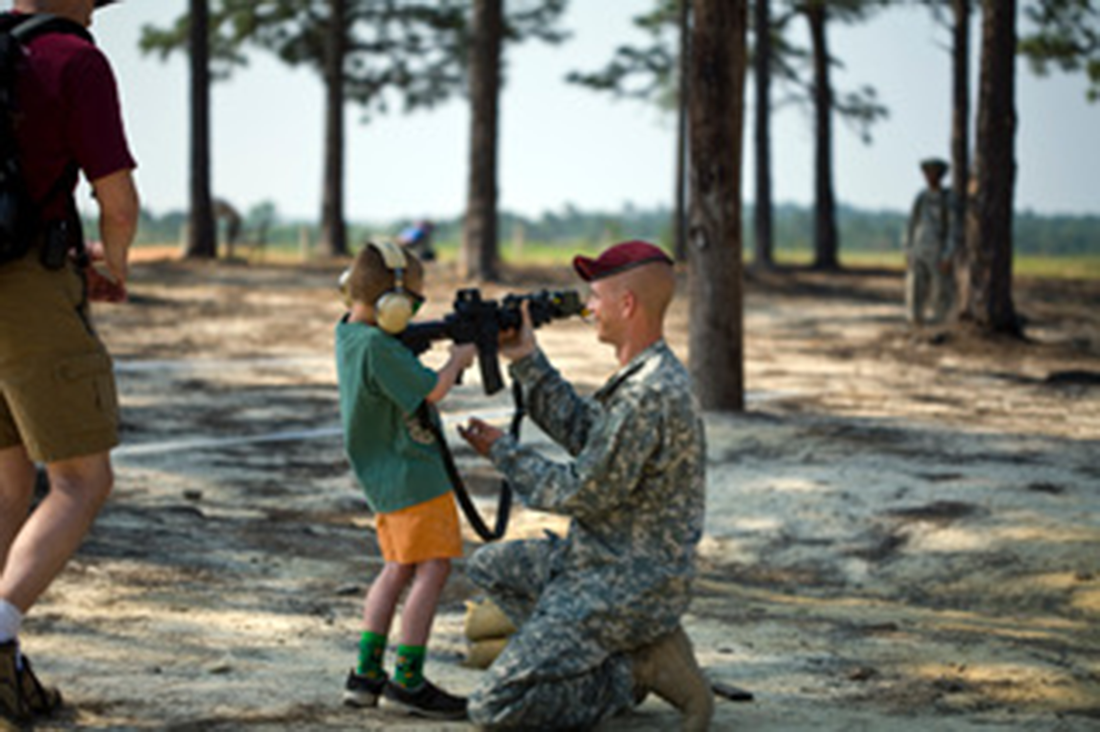
Images like “Human Target Practice” (2006, Figure 3) feature events such as an “All-America day with the 82nd Airborne” in Fort Bragg, North Carolina and show activities that are designed specifically for, or include, children. The photograph shows a soldier as he helps a young boy take aim at an indistinct figure in the background of the shot. The title suggests an activity where members of the public, including children, can take part in a demonstration that provides the opportunity to aim guns at “terrorists.” Despite the blurred appearance of the target, it appears that the figure (presumably a dummy) is wearing a headscarf, whereas the shooter, a child, wears bright shorts and a T-shirt. Helped by a smiling soldier, there is a distinction made between these two figures and the blurred target relegated to the far right of the shot. The framing creates a proximity between viewer, soldier and child, and the distant other of the headscarfed figure, established as a fantasy version of an enemy combatant. The young boy, barely able to hold the weight of the gun, is almost bent backwards as the soldier tries to steady gun and boy, so that he can take aim at the representation of another human being. Given that the colourful clothing contrasts with the sparse woodland that surrounds the scene, the viewer's eye is immediately drawn toward him, making him the subject of the image and reformulating who the human target of the image is.
“Human Target Practice,” All-America day with the 82nd Airborne, Fort Bragg, North Carolina, 2006. Credit Nina Berman/NOOR.

The complicated use of the child-figure is thus a constituent part of Berman's work. As Lee Edelman argues, the figure of the child “serves to regulate political discourse – to prescribe what will count as political discourse – by compelling such discourse to accede in advance to the reality of a collective future whose figurative status we are never permitted to acknowledge or address.”Footnote 46 The continued use of the child-figure in Berman's photograph thus replicates the conditions whereby discourse is overly reliant on a social imaginary that is tied to “our” children's future. In other words, the viewer is reminded of the collectivity of a future that requires the existence and development of children to propagate the nation and the particular imaginaries that are tied to it – that is, heteronormativity. By literally using children to preserve the integrity of the nation (protecting it from terrorist threats, participating in its Judeo-Christian formulation, and so on), Berman highlights their necessity to national imaginaries. Subsequently, the alignment between nation, child, and heteronormativity functions oppositionally to those who do not, or cannot, bear children. Reproduction, then, becomes another way that one can function patriotically by providing security for the nation's future.
Positioning the child as necessary to national defence, Berman's images evoke a literal consequence of that formulation, capturing them as recruits and soldiers. Their very use ironizes the US nation-state's claims to civilization, reminding the viewer that the domestic spaces we see do not conform to such claims. A slippage thus exists between the heteronormative imaginary set out in the essays in Homeland and the subjects of Berman's images. By positioning children as soldiers, the nation is no longer seen to protect them. Instead, through their reconfiguration, the children's futurity becomes terminated in the service of the nation. That proximity to the non-(re)productivity of a non-future demonstrates how queerness is continuously in flux. The spaces that Berman captures therefore enable us to see how entwined normative and queer positions are, further undermining the supposedly pure heteronormative core at the heart of the nation. Therefore queerness is shown to be very much part of national discourse, despite continued attempts to disavow those considered as queer. The claim to “think of the children!” may point toward a universal future, but given their close proximity to queerness in Berman's images, it also points toward a more critical approach to nationalist imaginaries.
Homeland thus satirizes the child figure by pointing to its nonnormative queerness, considered either not to be a threat (because it is upholding the nation) or to have had no future to begin with. What often happens at the edges of the frame is that militarized children become a stand-in for the wider population, underscoring a “special form of tyranny that makes citizens like children, infantilized, passive, and overdependent on … the state.”Footnote 47 Nonetheless, the essay attributed to Berman at the end of the collection, that “urge[s] the reader to consider a different interpretation,” is also crucial.Footnote 48 For Berman, patriotism becomes a vehicle through which people become infantile citizens – figuratively through role-play and literally through the use of child soldiers. This process begins at childhood in Homeland and to “think of the children” is thus to consider the dynamics of such an infantilization and its normalization through right-wing neoconservatism. The collection starts from the point of the nation's supposed heteronormativity and then proceeds to capture an alternative queer topographics that works to undermine it.
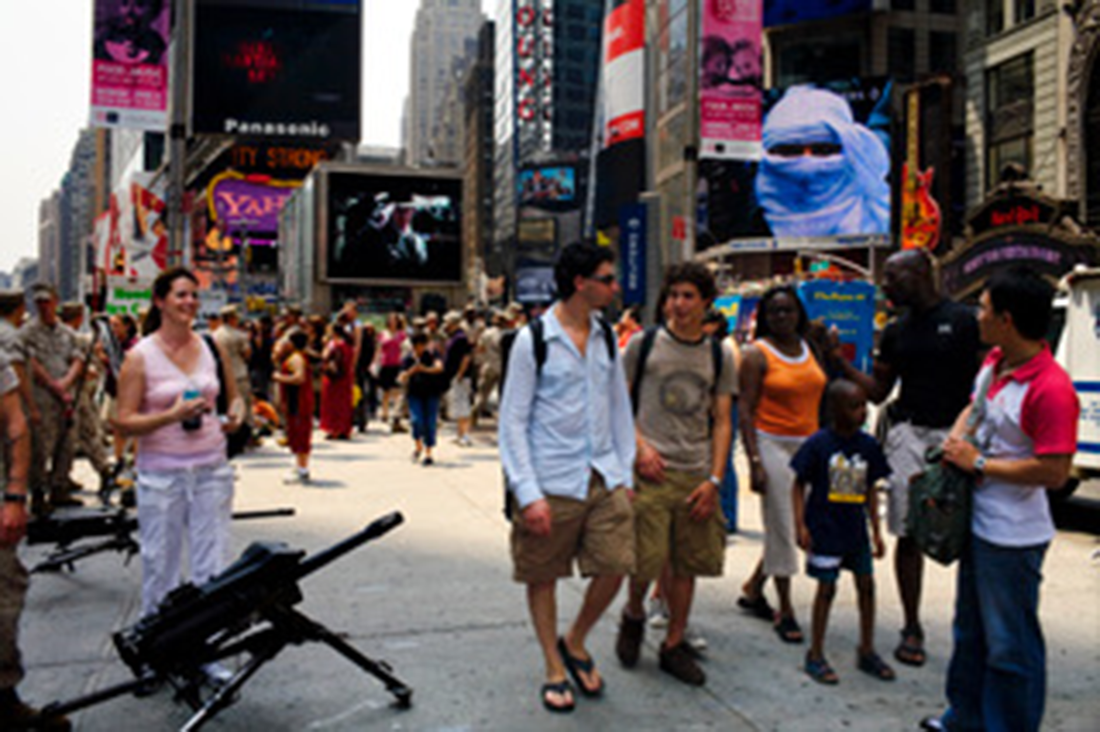
The impact and power that resides in such sites is exemplified by another image featured in “Defend,” “Marine Day” (2007, Figure 4). The image depicts crowds as they gather around a weapons display in Times Square, an area that resonates with a diverse and cosmopolitan population. It is notable that this is one of the few images in Homeland that is not the American “heartland,” and from a recognizable city like New York; as discussed, much of the collection is grounded in various southern and mid-western states. As such, the photograph stands out in its ability to be so placed. The space is imbued with the cultural memory of a physical and psychic landscape that has been directly impacted by terrorism's effects. A central landmark for tourists, the display of military strength and firepower impresses itself upon both the visitors and New York residents who pass by. At the image's forefront, a group of young children and adults are visible, framed so that a large automatic weapon points out at them and the surrounding landscape. Numerous billboards are visible; however, the most striking visual is a screen that features an individual wearing a burqa that overlooks the scene. Framed in such a way by Berman, it appears that the masked – and clearly racially/religiously marked – individual ominously watches over Times Square, transforming the space into a form of battleground. A distinction is created between those protected by the gun (the military and crowd) and those who are in its sights. As the “Defend” essay purports, “who knows when or where a terrorist could appear,”Footnote 49 highlighting the paranoiac idea – mirrored in the photograph – of the ever-present threat of terror's emergence in and on the US landscape. Further, by pointing toward the burqa, a dichotomy is created between symbols of military firepower and Islam, a symbiosis in which the presence of weapons is reliant on the existence of the burqa.
“Marine Day,” Times Square, New York City, 2007. Credit: Nina Berman/NOOR.

The image is tightly framed yet densely populated: groups of people interact with the soldiers, whilst a tour bus drives beneath the screens on buildings. Multiple gazes and faces are visible to the viewer, suggesting the prevalence of Islamaphobic rhetoric that underpins US culture. The setting of Times Square pushes this relationship further, indicating that Islamophobia can infiltrate even the most liberal (as suggested through its visible multiculturalism) of urban spaces, moving away from the rural geographies that have been featured thus far. As a result, the image highlights the contrasting identities that comprise Times Square, as well as the contradictory and opposing values that fortify it. The iconic status of Times Square, representative of New York and perhaps the wider United States, exacerbates these slippages.
The overly masculine imagery of the far left of the image, populated by soldiers, marks a further distinction between them and the crowd, who are mostly young and/or female. This reinforces the binary of the masculine protection of the military and the public who are in need of protection, often women and children. Beside the screen of the burqa is another that features a man in military uniform saluting. His shadowed figure can clearly be seen wearing a Stetson hat, which recalls another figure of masculinity – the cowboy. The scene thus exemplifies “the particular propagation of the United States as empire … that necessitates the margin” of queer bodies but also “the enterprises of the cowboy, ‘rogue’ soldier, and merchant marine … [that] may be recuperated as icons of national masculinity.”Footnote 50 The conflation of masculine ideals of soldier and cowboy that the image engenders recalls how the cowboy is “not one ideal among many, [but] the ideal.”Footnote 51 The various internal screens in the image therefore frame opposing spheres, the patriotic salute of the soldier – for instance – against the threat of Islam codified by the burqa. The notion of masculine protection is solidified by the lines of male soldiers that create a wall in the image's far left, forming an internalized space of protection in the image's centre.
The stability of this image can be further undermined, as the individuals who pass through the image's frame (and the nation's borders) may be either tourists or citizens. Both are in need of protection from external threats; however, their indeterminate origin means they are simultaneously coded as potential threat and/or in need of protection.Footnote 52 Positioned in the space between the two screens in Berman's image, the people highlight how groups contained within the nation's borders can simultaneously be marginalized and rendered queer. Being situated at the frame's edge indicates their liminality, whilst their movement away from the centre demonstrates their transience and precarity. Moreover, the defensive capabilities of the military are shown in close proximity and constant readiness, positioned at the border of the image. The proximity between military and everyday domesticity is clearly evident in the image, demonstrating its pervasiveness whilst reframing the military as akin to a form of spectacle. Embedded within a central tourist location, they become a type of attraction, and thus, similar to the skyscrapers and billboards, a naturalized and intrinsic part of the US landscape. Sites of leisure are thus also subject to a constant remediation through the spectre of domestic militarization.
The conceptualization of bodies within spaces is integral to Homeland, and in particular, the presence of queer bodies in spaces specifically attached to the ideology of various national imaginaries. Locating the queer in non-queer spaces, whether that be a Muslim or a child's body, undermines the heteronormativity of the nation. Despite abstaining from portraying her collection as vernacular, Berman documents how the dominant cultural response to 9/11 operated on the nation and the bodies that occupied it. The use of religion, community, and military in Homeland highlights the tension within particular nationalist imaginaries and their intersection with daily life in the United States. Similarly, in its use of an unreliable composite narrator, Berman's collection simultaneously accepts and critiques the ethical ramifications of an increasingly queer and militarized set of topographies. Rather than explicitly state her artistic intention, Berman nonetheless establishes a narrative through the collection's three sections that appears to uphold the nation's militarization and subsequent infantilization. At the same time, the photographs – as seen – oftentimes question that very militarization.
Thus the collection highlights the contrasting and often hypocritical ways in which such discourse functions, charting the various xenophobic attitudes constructed against Islam, the use of child soldiers, and the blurring between various public and military topographies. Simultaneously micro and macro in scale, the images present localized narratives of domestic responses to 9/11. Focussing in particular on a range of spaces and locations in areas that might be called the American “heartland” (the South, the Mid-west, the rust belt) Homeland thus illuminates the problematic ideology that is perpetuated through the nation's dominant discourse of heteronormative militarization. Even as this heteronormativity is registered, framed and localized in particular ways – gaining further meaning and significance as it plays out among black and white southerners, for instance – Homeland presents dominant normative imaginaries of a nation under the mantle of the “War on Terror.” The book also offers an outward gaze designed, in part, to overcome the limiting consequences of such militarization. The collection's queer topographics thus highlights how 9/11 emphasizes the function of identity – whether it is understood to be “American,” children as ciphers for particular forms of ideology, or the impact of religion on everyday life. While offering us an insight into the constructions that strengthen the nationalist framings of the United States, Berman's Homeland also demonstrates moments of their queer destabilization. The book's final image, before the final essay, titled “Fargo, North Dakota” (2003), features an intersection across two pages. The road is empty apart from a stop sign and another that indicates a left or right turn. It is within this final shot that the power of Berman's collection resides – the offer of a final moment to pause before making a final choice of direction. Rather knowingly, both choices mark a turn away from the centre and toward queer peripheries, suggesting that that is where the nation's journey now lies.