Introduction
The study of host–parasite interactions is essential to understand the dynamics of infectious diseases (Hawley & Altizer, Reference Hawley and Altizer2011). Also, these interactions are, in fact, one of the central foci of interest in evolutionary biology (Johachim et al., Reference Johachim, Little and Ebert2001). The co-evolution of this kind of interaction is considered as a reciprocal natural selection between the resistance of the host and the virulence of the parasite (Thompson, Reference Thompson1994). This type of selection describes how parasites are selected in a way that enables them to overcome the resistance of their hosts. Consequently, the hosts that possess uncommon genes of resistance have a selective advantage (Hamilton et al., Reference Hamilton, Axelrod and Tanese1990). In theory, this selective advantage, in both hosts and parasites, is favoured by sexual reproduction, which tends to produce more genetically diversified offspring, carrying resistance genes. The passage of the parasite through its host may drive both to suffer genetic bottlenecks, resulting in a change of the genotype frequencies and thus affecting their mutual compatibility (Jarne & Théron, Reference Jarne and Théron2001), with a direct effect on transmission.
Fasciolosis is one of the most important re-emerging parasitic zoonotic diseases affecting the human population worldwide (Tolan, Reference Tolan2011), with an increasing impact on animal husbandry (Khan et al., Reference Khan, Sajid, Riaz, Ahmed, He, Shahzad, Hussain, Khan, Iqbal and Zhao2013). This parasitosis is also of concern for public health, since it is considered to be an important food-borne disease (Dorni et al., Reference Dorni, Praet, Deckers and Gabriel2009), highly endemic in regions such as the Bolivian Altiplano (Valero et al., Reference Valero, Perez-Crespo, Khoubbane, Artigas, Panova, Ortiz, Maco, Espinoza and Mas-Coma2012) and Egypt (Esteban et al., Reference Esteban, González, Curtale, Muñoz-Antoli, Valero, Bargues, El Sayed, El Wakeel, Abdel-Wahab, Montresor, Engels, Savioli and Mas-Coma2003). Additionally, fasciolosis is regarded as the best-distributed parasitosis, ranging from tropical to subarctic regions (Mas-Coma et al., Reference Mas-Coma, Valero and Bargues2009), with a substantial prevalence also found at high altitudes (Meunier et al., Reference Meunier, Tirard, Hurtrez-Boussès, Durand, Bargues, Mas-Coma, Pointier, Jourdane and Renaud2001; Fuentes, Reference Fuentes2006). This disease is caused by the helminthic species Fasciola hepatica and Fasciola gigantica. However, both species of flukes are included in the list of ‘neglected’ worms by the World Health Organization (WHO, 2007). This fact, caused partially by resources being allocated for research on other diseases, can be translated into a higher prevalence of fasciolosis in low-income countries (WHO, 2013). These parasites are transmitted by freshwater snails of the family Lymnaeidae, which play an important role in the distribution and diversity of Fasciola spp. (Correa et al., Reference Correa, Escobar, Durand, David, Jarne, Pointier and Hurtrez-Boussès2010). Lymnaeid snails act as intermediate hosts of the parasite where asexual reproduction of the larval stage takes place. Sexual reproduction occurs in mammals, the definitive hosts of Fasciola spp. (Hurtrez-Boussès et al., Reference Hurtrez-Boussès, Meunier, Durand and Renaud2001).
In Cuba, fasciolosis is not considered to be a huge public health problem (although several important outbreaks have occurred; for a review, see Rojas et al., Reference Rojas, Vázquez, Domenech and Robertson2010) but its effect in cattle is devastating for the national economy. Only one species, F. hepatica, is known to occur and it is transmitted by the two species of lymnaeid snails present in Cuba, Galba cubensis and Pseudosuccinea columella (Vázquez et al., Reference Vázquez, Sánchez and Hevia2009; Gutiérrez et al., Reference Gutiérrez, Vázquez, Hevia, Sánchez, Correa, Hurtrez-Boussès, Pointier and Théron2011). Previous experimental infections have shown that G. cubensis can be considered to be the main intermediate host on the island, since its populations showed a higher compatibility to the different populations of the parasite tested (Vázquez et al., Reference Vázquez, Sánchez, Pointier, Théron and Hurtrez-Boussès2014). However, P. columella seems also to play a role in transmission, since several populations proved to be experimentally compatible with F. hepatica and since natural infection has been reported (Gutiérrez et al., Reference Gutiérrez, Vázquez, Hevia, Sánchez, Correa, Hurtrez-Boussès, Pointier and Théron2011; Vázquez et al., Reference Vázquez, Sánchez, Pointier, Théron and Hurtrez-Boussès2014). Domestic definitive hosts of F. hepatica in Cuba are mainly bovines and sheep, which are highly susceptible to infection in the field. In some areas, anthelmintics are used regularly. These treatments are expected to cause strong bottlenecks in parasite populations and to select resistant liver flukes. Cattle in Cuba have suffered prolonged natural selection since Bos taurus was first introduced by the Spaniards at early colonization stages, and may include genes from Bos indicus introduced from Africa (Uffo et al., Reference Uffo, Acosta, Martínez and Ronda2012). The introduction of Bubalus bubalis seems to have originated from Australia and Trinidad and Tobago (Lesser Antilles) in the early 1980s (Mitat, Reference Mitat2009). Infection of water buffalos by Cuban strains of F. hepatica could thus be considered recent compared to that of cows.
The infective capacity of different strains of F. hepatica is expected to be closely related to their genetic diversity which can make them more/less compatible with their hosts (Dybdahl & Storfer, Reference Dybdahl and Storfer2003). It has already been shown that F. hepatica displays important genetic diversity that suggests preferential outcrossing mating in its definitive hosts (Hurtrez-Boussès et al., Reference Hurtrez-Boussès, Durand, Jabbour-Zahab, Guégan, Meunier, Bargues, Mas-Coma and Renaud2004; Vilas et al., Reference Vilas, Vázquez-Prieto and Paniagua2012; Cwiklinski et al., Reference Cwiklinski, Allen, LaCourse, Williams and Paterson2015). The use of microsatellites as genetic markers to explore the genetic structure of a given population is very convenient because of the high polymorphism usually found in their alleles (de Meeûs et al., Reference de Meeûs, McCoy, Prugnolle, Chevillon, Durand, Hurtrez-Boussès and Renaud2007). In the case of F. hepatica, Hurtrez-Boussès et al. (Reference Hurtrez-Boussès, Durand, Jabbour-Zahab, Guégan, Meunier, Bargues, Mas-Coma and Renaud2004) have isolated and characterized microsatellite markers that have been useful in genetic diversity studies (Vilas et al., Reference Vilas, Vázquez-Prieto and Paniagua2012). Here we explore the population genetics of eight populations of F. hepatica from different regions of Cuba in order to better understand the functioning of this host/parasite system, aimed at two specific questions: (1) what are the levels of genetic diversity of Cuban liver flukes, and (2) do liver flukes from different geographical localities, or from different definitive hosts, share the same population genetic structure? This will not only contribute to enhancing our knowledge of host–parasite interactions, but will also help to dictate the politics of cattle husbandry management in accordance with the genetic flow between populations.
Materials and methods
Sampling of F. hepatica
The sampling of eight populations (flukes from a particular locality) of F. hepatica was carried out in slaughterhouses from different regions of Cuba between 2010 and 2012. Sampled populations were: Guane (January 2011), La Palma (two campaigns were conducted in September and December 2010), Loma Candelaria (October 2010) and Bahía Honda (September 2010) in western Cuba; Artemisa (September 2010), Jaruco (February 2012) and Santa Cruz (February 2011) in central-western Cuba; and Sagua (April 2011) in central Cuba. The infection rates at the slaughterhouses were obtained by examining all livers from each locality.
Adult flukes were collected alive from the livers of infected bovines and stored immediately in 80% ethanol until further analyses. For the locality of La Palma, samples were only collected during September 2010. Due to constraints in the slaughterhouse, it was impossible to obtain flukes from one definitive host from Santa Cruz and from seven hosts from Jaruco. For the other populations, we sampled at least one liver fluke per definitive host. Flukes from different host individuals of each population were pooled together. The populations of Artemisa, Bahía Honda, La Palma, Loma Candelaria, Guane, Santa Cruz and Sagua came from infected cows (B. taurus) while the one from Jaruco was recovered from buffalos (B. bubalis).
Molecular analysis
A small piece of tissue from the posterior end of each individual (about 2 mm2) was used for DNA extraction. DNA extraction was performed following the method described by Estoup & Martin (Reference Estoup and Martin1996), adapted for 96-well plates. Briefly, the tissue from each individual was dried and placed in a single well containing 100 μl of 5% Chelex®100 (Bio-Rad Laboratories, California, USA) and 5 μl of proteinase K (10 mg/ml). The content of the plate was vortex mixed and then incubated overnight at 56°C and for 10 min at 95°C. The mixture was then centrifuged at 6000 × g for 6 min and the supernatant was collected and stored at − 20°C until further analysis.
Each DNA extract was diluted 1:2 and used for microsatellite amplifications. Four microsatellite loci (FH15, FH23, FH25 and FH222CBP; GenBank accession numbers AJ508371, AJ508372, AJ508373 and AJ003821, respectively) were amplified through polymerase chain reaction (PCR) according to protocols described by Hurtrez-Boussès et al. (Reference Hurtrez-Boussès, Durand, Jabbour-Zahab, Guégan, Meunier, Bargues, Mas-Coma and Renaud2004). Each locus was amplified using 2 μl of diluted DNA in a 20 μl reaction volume containing 4 μl buffer 5 × (Promega, Wisconsin, USA), 1.2 μl 25 mm MgCl2 2 μl 2 mm deoxynucleoside triphosphates (dNTPs) (Invitrogen/Life Technology, Massachusetts, USA), 1 μl of each primer (10 pmol) and 0.2 μl of 1 U Taq DNA polymerase (Promega). Thermocycling was performed using a 96-well MJ-Research PTC 100 (MJ Research, California, USA) and consisted of 4 min of initial denaturation at 94°C; 31 cycles of 94°C for 30 s, annealing temperature (FH15 = 48°C, FH23 = 50°C, FH25 = 51°C, FH222CBP = 50°C) for 30 s, and 30 s at 72°C; and a final elongation step of 72°C for 10 min. Primers were labelled fluorescently to be used in an ABI automated sequencer (ABI Prism 310 Genetic Analyser, Applied Biosystems, Perkin-Elmer, California, USA). One microlitre of PCR products from each sample was diluted 1:100. A mix containing 3 μl of diluted PCR product, 0.25 μl of internal size standards (GENESCAN 500 LIZ, Applera, Connecticut, USA) and 15 μl of Hi-Di Formamide (20 μl qsp) was used for automated electrophoreses. Readings of allele lengths were performed using the GeneMapper® v. 4.0 software (Applied Biosystems, California, USA).
Population genetics analysis
Current parameters of population genetics, such as the mean number of alleles (a), the observed (H o) and expected (H s) heterozygosities, and the inbreeding coefficient (F IS), were estimated for each locus. Pairwise differentiation between populations (F ST) was also tested. Estimations were computed using the software FSTAT v2.9.3.2 (Goudet, Reference Goudet2001; available from http://www.unil.ch/izea/softwares/fstat.html). Bonferroni corrections were applied for multiple tests (Rice, Reference Rice1984). Identical multilocus genotypes (MLGTs) were identified and the probability of observing n copies of a MLGT based on random mating (P sex values) was tested using GENCLONE 2.0 (Arnaud-Haond & Belkhir, Reference Arnaud-Haond and Belkhir2007). Individuals with statistically significant P sex values (P < 0.05) are to be considered a result of clonal reproduction (Vilas et al., Reference Vilas, Vázquez-Prieto and Paniagua2012). Genotypic diversity was also calculated with this software, using an adapted Simpson index.
Results
Cattle infection rates
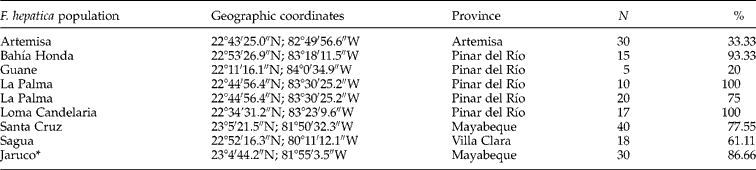
The infection rate observed at successive visits to the different slaughterhouses varied between 20% (Guane population) and 100% (La Palma, Loma Candelaria). Higher prevalences were observed in populations from the western province of Pinar del Río, whereas values of 60–85% were found in the west-central and central region provinces (table 1). Treatments with triclabendazole were reported in La Palma in the second campaign (December 2010) but the sample showed more than 70% infection. Both studied species of bovine (cows and buffalos) were infected.
Prevalence (%) of Fasciola hepatica isolates in cows and buffaloes* from localities in Cuba; N= number of hosts examined.

Population structure and genetic diversity
All four loci were polymorphic in the eight studied populations. A total of 30 alleles were observed among the four studied loci (mean number of alleles per locus: 7.5 ± 3.7 SD). Locus FH222CBP was the most polymorphic, with 12 different alleles, and locus FH25 the least polymorphic (three alleles). No significant linkage disequilibrium was observed for all pairs of loci.
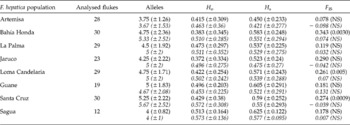
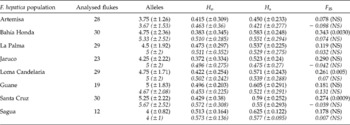
Mean number of alleles, observed (H o) and expected heterozygosity (H s) and F IS values per population are given in table 2. We observed significant deviations from Hardy–Weinberg equilibrium in three populations: Bahía Honda, Loma Candeleria and Santa Cruz. However, strong deviations only concerned locus FH23 (F IS = 1 (P < 0.05), 0.726 (P < 0.05) and 1 (P < 0.005), respectively) whereas none of the other loci presented significant deviations from Hardy–Weinberg equilibrium. These results are consistent with those of Hurtrez-Boussès et al. (Reference Hurtrez-Boussès, Durand, Jabbour-Zahab, Guégan, Meunier, Bargues, Mas-Coma and Renaud2004) who reported the presence of null alleles at locus FH23. We therefore re-analysed the data without locus FH23 (table 2).
Mean number (± SD) of alleles together with observed (H o) and expected (H s) heterozygosities, and F IS values (level of significance after Bonferroni correction) for each Fasciola hepatica population; values in italics are those obtained without locus FH23.
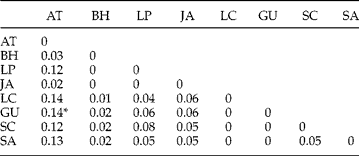
Populations were not significantly differentiated (F ST= 0.05, NS). Table 3 gives F ST values between pairs of populations. Practically any population pair was significantly differentiated, except Guane and Artemisa (Bonferroni-adjusted probability: 0.034).
Estimates of pairwise genetic differentiation (F ST) values between populations. AT, Artemisa; BH, Bahía Honda; LP, La Palma; JA, Jaruco; LC, Loma Candelaria; GU, Guane; SC, Santa Cruz; SA, Sagua.

* Level of significance P < 0.05.
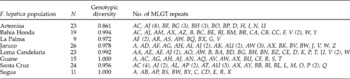
Due to the presence of null alleles, we excluded locus FH23 from the computation of multilocus genotypes (MLGTs). A total of 83 MLGTs were observed among the eight studied populations using only the loci FH15, FH25 and FH222CBP. The mean number of MLGTs per population was 14.87 ( ± 4.29SD) but it was found to depend on the sample size (Spearman correlation R= 0.781, P= 0.012). The names and number of MLGTs in each population, Simpson diversity index adapted for MLGTs and statistically significant P sex values are summarized in table 4. Genotypic diversity was found to be high for every population, with the lowest value of 0.861 in Artemisa. We found 23 MLGTs repeated among different populations, while 60 were observed only within a single population. Only two populations (Artemisa and Santa Cruz) showed repeated MLGTs with values of P sex < 0.05.
Occurrence of multilocus genotypes (MLGT) and genotypic diversity in Fasciola hepatica populations; N, number of analysed flukes after excluding individuals with at least one non-amplified locus, with one MLGT repeat in each of BG, BH (Artemisa) and AC, AT (Santa Cruz) with P sex < 0.05.

Discussion
Although infection rates varied among samples, it is clear that parasitism by F. hepatica in Cuban bovine populations is extended and persistent. All attempts to investigate infection in sacrificed animals at slaughterhouses were positive. However, there were no major differences in infection rates, which were above 70% in most cases. The small differences in infection rates detected can be explained by either different ecological transmission schemes or different susceptibility/infectivity of the host–parasite system. Also, the age of definitive hosts may play an important role, since older individuals are supposed to display higher infections if transmission is granted. Since the ecology of the intermediate host snails usually overlaps with that of the final hosts (bovines) (Vázquez et al., Reference Vázquez, Sánchez, Pointier, Théron and Hurtrez-Boussès2014) transmission can be prompted and thus infection rates would become larger (Hawley & Altizer, Reference Hawley and Altizer2011).
Different definitive host species may differ in compatibility with a particular parasite population. However, liver fluke prevalences in water buffalos were similar to those observed in cattle and F ST values between the buffalo population (Jaruco) and those of cows were non-significant. This fact suggests that genetic exchanges are very common among F. hepatica strains circulating in Cuba. These results are consistent with those of Hurtrez-Boussès et al. (Reference Hurtrez-Boussès, Durand, Jabbour-Zahab, Guégan, Meunier, Bargues, Mas-Coma and Renaud2004) who did not find significant genetic differentiation between liver flukes infecting cows, sheep and pigs. It is noteworthy that slaughterhouses reported that the cattle were treated with triclabendazole, which is the drug of choice for fasciolosis (Fried & Abruzzi, Reference Fried and Abruzzi2010). However, the infection rates were not zero and can actually be considered important (75%). This may indicate that some infrapopulations of F. hepatica (flukes inside one particular host individual) are actually avoiding the effect of the drugs, probably through resistance. Nevertheless, there were no important differences in genetic diversity between treated and untreated areas, which indicates that treatment is not carried out on a large scale or properly. A decrease in the allelic diversity would be expected in the treated area through strong genetic bottlenecks, which were not observed here.
The number of alleles found in the nine studied populations of F. hepatica from Cuba reveals a high genetic diversity, with small variation between populations. However, it is noteworthy that the population that presents the smallest allele diversity (Artemisa, mean number of alleles: 3.67) is also that with the lowest prevalence in definitive hosts (33.33%).
Although this species is known to shift from self-fertilization to cross-fertilization depending on the number of flukes in one liver (Hanna et al., Reference Hanna, Edgar, Moffett, McConnell, Fairweather, Brennan, Trudgett, Hoey, Cromie, Taylor and Daniel2008), the observed absence of deviation from Hardy–Weinberg equilibrium is indicative of a predominance of cross-fertilization (Hurtrez-Boussès et al., Reference Hurtrez-Boussès, Durand, Jabbour-Zahab, Guégan, Meunier, Bargues, Mas-Coma and Renaud2004; Cwiklinski et al., Reference Cwiklinski, Allen, LaCourse, Williams and Paterson2015). When this reproductive strategy is coupled with an important amount of genetic flow (i.e. movement of infected cattle within and between provinces) the outcome is translated into a diverse metapopulation of F. hepatica. Genetic diversity, in this case, may favour adaptation of the parasite to different populations of both intermediate and definitive hosts (Gandon et al., Reference Gandon, Capowiez, Dubois, Michalakis and Olivieri1996; Schulte et al., Reference Schulte, Makus and Schulemburg2013). Besides, there is an increased probability that genetically diversified individuals may escape the effect of anthelmintic drugs such as triclabendazole, turning a particular population of the parasite resistant.
The results regarding genetic diversity are consistent with those observed by Vilas et al. (Reference Vilas, Vázquez-Prieto and Paniagua2012) in terms of allelic richness, although our values are slightly higher. However, the heterozygosity observed in the Bolivian Altiplano by Hurtrez-Boussès et al. (Reference Hurtrez-Boussès, Durand, Jabbour-Zahab, Guégan, Meunier, Bargues, Mas-Coma and Renaud2004), when using the same microsatellite loci, was lower than those reported here for Cuban F. hepatica. Recently, a new panel of microsatellites has been described for F. hepatica using samples from the UK (Cwiklinski et al., Reference Cwiklinski, Allen, LaCourse, Williams and Paterson2015). That study reported higher values of observed heterozygosity and sampled alleles for almost every locus than those described here. The low value of the genetic differentiation coefficient (G ST) observed in our study indicates that only 4% of the genetic differences detected are explained by differences among populations. In fact, F ST values between populations were only statistically significant between Artemisa and Guane, which could be the result of a probable maintained isolation of these strains. This indicates that even if genetic diversity is high, considering the number of alleles sampled and observed heterozygosity, it does not differ much between regions in Cuba. If we take into consideration that Cuba is a narrow island and there is little bovine commerce compared to other countries, the geographic factor is likely to support the fact that most F. hepatica populations are genetically alike. Unfortunately, we could not sample flukes from the eastern region, but future work including such samples will contribute to description of the transmission of F. hepatica in the whole country.
The number of MLGTs observed among the eight studied populations is in accordance with those obtained by Vilas et al. (Reference Vilas, Vázquez-Prieto and Paniagua2012), considering both sample sizes. The latter authors found significant multicopy MLGTs, especially in sheep, that were not observed in the same proportion in cattle. However, despite the fact that we only explored F. hepatica from cattle, in our study only two individuals from two populations can be considered the result of clonal amplification. This result reinforces the idea that sexual reproduction is common in Cuban F. hepatica and suggests the existence of multiple sources of contamination.
Our results suggest a close relationship between parasite genetic diversity and cattle managerial activities, reflected in the infection rates at studied slaughterhouses. Understanding the effect of genetic variability together with host–parasite adaptation at the level of both intermediate and definitive hosts would be crucial to prevent and control fasciolosis in Cuba. Differences in compatibility between F. hepatica and the two lymnaeid snail species existing in Cuba have been explored and discussed (Vázquez et al., Reference Vázquez, Sánchez, Pointier, Théron and Hurtrez-Boussès2014), revealing certain parasite populations to be more/less infective than others. These very same parasite populations are those used in this study, and for which genetic diversity is now unveiled. For instance, the population of Artemisa, with the smallest prevalence in the definitive host and with the lowest allele richness, has been shown by Vázquez et al. (Reference Vázquez, Sánchez, Pointier, Théron and Hurtrez-Boussès2014) to be that with the better infectivity against molluscs but also with the lowest cercarial production and the lowest virulence in lymnaeid snails. Such studies will therefore help us to better understand host–liver fluke interactions. Managers and decision makers must then take into consideration these findings to help mitigate the emergence or re-emergence of fasciolosis in areas at risk.
Acknowledgements
The authors would like to thank the veterinary technicians from the slaughterhouses, who helped in the sampling of infected bovine livers.
Financial support
This work was supported by the Institut de Recherche pour le Développement (BEST grant to A.A.V.). We are thankful to two anonymous reviewers and the editor, who made valuable comments that helped to improve our manuscript.
Conflict of interest
None.