There is increasing awareness of the importance of patient-reported outcomes within the field of congenital cardiology.Reference Moons 1 Although patient-reported outcomes such as quality of life and psychological functioning of patients with congenital heart disease have been extensively studied,Reference van Rijen, Utens and Roos-Hesselink 2 – Reference Schoormans, Mager, Oort, Sprangers and Mulder 5 various other patient-reported outcomes – for example, patient satisfaction with care – have received little attention.Reference Moons 1 , Reference Schoormans, Mulder and Sprangers 6 Patient satisfaction is defined as “the individuals’ positive evaluations of distinct dimensions of health care” (p. 580).Reference Linder-Pelz 7 To our knowledge, only one study researched patients’ satisfaction levels regarding the received care concerning their congenital heart defect.Reference Tomlin and Gosney 8 In addition, three other studies have been published on closely related patient-reported outcomes. Two studies focused on patients’ experiences with the transfer from paediatric to adult cardiology.Reference Moons, Pinxten and Dedroog 9 , Reference Wray and Maynard 10 The third study examined patients’ perception of the expertise and communication skills of the general practitioner and cardiologist, and patients’ perception of the need for health-care improvements.Reference Schoormans, Sprangers and Pieper 11 Studying patient satisfaction with care is of utmost importance as this information provides insight into the impact of treatment and the quality of the provided care, which can ultimately direct the future organisation of care.Reference Acquadro, Berzon and Dubois 12
Thanks to the improvements in cardiac surgery over the past decades,Reference Castaneda 13 today more than 90% of patients with a congenital heart defect reach adulthood.Reference Moons, Bovijn, Budts, Belmans and Gewillig 14 Many patients require re-operations, as most adult patients have residual lesions that negatively affect daily life.Reference Giamberti, Chessa and Abella 15 The number of adult patients undergoing re-operation varies with the type of cardiac defect, ranging from less than 1% for simple defects such as an atrial septal defect to more than 14% for a transposition of the great arteries.Reference Verheugt, Uiterwaal, Grobbee and Mulder 16 Undergoing open-heart surgery has a high impact; patients are likely to experience stress, feelings of fear, anxiety, uncertainty, loss of control, and other emotional problems.Reference Asilioglu and Celik 17 Several studies have demonstrated that such feelings of psychological distress have negative effects on recovery.Reference Contrada, Goyal, Cather, Rafalson, Idler and Krause 18 – Reference Mavros, Athanasiou, Gkegkes, Polyzos, Peppas and Falagas 20 Specialised nurses can have a vital function for patients undergoing open-heart surgery, informing them about the procedure, lifestyle adjustments after surgery, and the recovery trajectory.Reference Baumgartner, Bonhoeffer and De Groot 21 , Reference Moons, De Geest and Budts 22
Given the complex character and high impact of open-heart surgery, high quality of care is of paramount importance. To the best of our knowledge, patients’ level of satisfaction with the care provided when undergoing open-heart surgery has never been studied within the field of congenital heart disease. Moreover, the relationship between counselling by a specialised nurse and patient satisfaction levels has also never been examined. The objective of this study was to evaluate the care as it is provided in daily clinical practice. Hence, we did not intervene in the peri-operative care processes. Our aims were therefore (1) to examine patient satisfaction levels in order to identify the best and worst evaluated aspects of the currently provided care for patients with a congenital heart defect undergoing open-heart surgery, and (2) to examine whether the involvement of specialised nurses is associated with higher levels of patient satisfaction.
Materials and methods
Study population and procedure
Patients who were diagnosed with a congenital heart defect, 18 years or older, mentally not impaired, literate in Dutch, and undergoing open-heart surgery were eligible. All surgeries were performed in a tertiary hospital located in an urban European city. Between January, 2010 and July, 2011, 132 consecutive eligible patients were invited 3–6 weeks after their operation to participate in this study. All patients completed a questionnaire at home and returned it via a pre-stamped envelope. Under Dutch law, ethical approval is not required for questionnaire studies. Therefore, this study was exempt from approval of the Medical Ethics Committee of the Academic Medical Center in Amsterdam, The Netherlands. This study was conducted in accordance with the principles of the “Declaration of Helsinki”.Reference Rickham 23
Measurements
Patient characteristics
Patients’ sex, age, and educational level were measured through self-report. Health status was assessed by the first item of the Short Form Health Survey-36: “In general would you say your health is?”.Reference Ware and Sherbourne 24 Answers were given on a five-point Likert scale with the options: “excellent”, “very good”, “good”, “fair”, and “poor”. Patients’ diagnoses were obtained from their medical record.
Patient satisfaction levels
Patient satisfaction levels were measured by the Satisfaction with Hospital Care QuestionnaireReference Hendriks, Vrielink, Smets, van Es and de Haes 25 consisting of 12 scales addressing different aspects of care – that is, Admission procedure, Nursing care, Medical care, Other disciplines, Information, Patient autonomy, Emotional support, Hotel care, Recreation facilities, Miscellaneous aspects, Ease of access to the hospital, and Discharge and aftercare. Each scale consists of several questions – ranging from two to seven – employing a five-point Likert scale: “unsatisfied”, “moderately satisfied”, “reasonably satisfied”, “clearly satisfied”, and “highly satisfied”, with the added option “not applicable”. Moreover, patients gave overall grades for each scale ranging from 0 to 10, with 10 indicating the highest level of satisfaction. The Satisfaction with Hospital Care Questionnaire was adapted for this study to lower patient burden. The questions of the scales “other disciplines” and “patient autonomy” were incorporated into the scales “medical care” and “nursing care”, respectively. The questions in the “medical care” scale were targeted at open-heart surgery. For example, questions about “the medical specialist” were reformulated into “surgeon”. On the basis of a study by Kleefstra et alReference Kleefstra, Kool and Veldkamp 26 examining the structure of the Satisfaction with Hospital Care Questionnaire, the “emotional support” scale was excluded. The Satisfaction with Hospital Care Questionnaire has good psychometric properties and is found to be a valid and reliable instrument.Reference Hendriks, Oort, Vrielink and Smets 27 The adapted questionnaire thus yields nine scales, assessing patient satisfaction levels with nine different aspects of care and consists of 57 questions in total. In addition, as a general measure of patient satisfaction, we asked patients (a) to rate the overall experienced care by giving a grade, ranging from 1 to 10, and (b) whether they would recommend this hospital to others.
Contact with a specialised nurse
Although a uniform definition of a specialised nurse is lacking, Moons et alReference Moons, Scholte op Reimer and De Geest 28 described that nurses are specialised if they have a certain level of specialization in the field of congenital heart disease, obtained by education and experience. Specialised nurses provide important support for patients with a congenital heart defect, identifying their needs, screening for psychosocial problems, and educating and counselling them.Reference Baumgartner, Bonhoeffer and De Groot 21 , Reference Moons, De Geest and Budts 22 , Reference Moons, Engelfriet, Kaemmerer, Meijboom, Oechslin and Mulder 29 With regard to having open-heart surgery, specialised nurses inform patients about the procedure, lifestyle adjustments after surgery, and the recovery trajectory.
Within the Academic Medical Centre, patients with a congenital heart defect are referred to a specialised nurse by their treating cardiologist if they experience psychosocial problems, or have lifestyle issues that need to be addressed – for example, high glucose levels in patients with diabetes. Hence, whether patients were counselled by a specialised nurse was based on the clinical assessment of their treating cardiologist.
Patients answered the following question to assess whether they had contact with a specialised nurse. Did you have contact with a specialized nurse prior or during your admission in the hospital? An additional question assessed patients’ satisfaction with the care provided by the specialised nurse, and was rated on a five-point Likert scale ranging from “unsatisfied” to “highly satisfied”.
Statistical analyses
Patient characteristics were explored by means of descriptive statistics. Characteristics of patients with and without contact with a specialised nurse were compared by means of chi-squared tests for categorical variables and a t-test for the continuous variable age.
Grades for each scale were provided for the total group of patients and specified by contact with a specialised nurse (yes/no). In addition, the 10 items with the best, that is, the highest percentage of patients who answered “clearly satisfied” or “highly satisfied”, and worst scores, that is, the highest percentage of patients who answered “unsatisfied” or “moderately satisfied” were provided. Moreover, as a general indicator of patient satisfaction, the mean grade for the overall received care and the percentage of patients that would recommend this hospital to others were calculated. Finally, the relationship between contact with a specialised nurse and the level of satisfaction with the nine different aspects of care – the grades for each scale – independent of patient characteristics – sex, age, educational level, and health status – was examined by multivariable linear regression analyses using General Linear Model. Patients’ diagnosis was not included in the analyses because of the small number of patients within each category. Exploring analyses showed that patients’ diagnosis was unrelated to patients’ level of satisfaction – the grades for all nine scales. All analyses were conducted in SPSS 16.0 and tested at a significance level of 5%.
Results
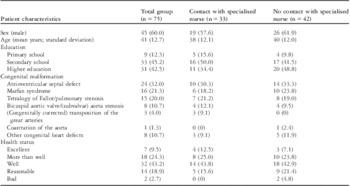
Of the 132 eligible patients, 75 participated in this study, with a response rate 56.8%. Of the included 75 patients, 44%, that is, 33 patients, indicated to have had contact with a specialised nurse before or during hospital admission. Patient characteristics for the total group and specified by contact with a specialised nurse are presented in Table 1. Patient characteristics of patients who had contact with a specialised nurse were not statistically different from patients who did not have contact with a specialised nurse.
Patient characteristics for the total group of patients and specified for the patients with and without contact with a specialised nurse.

Note: Data are presented as mean (standard deviation) or number (percentages)
Patient satisfaction levels
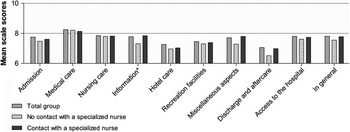
Grades for the nine scales are shown in Figure 1. All grades were higher than 6. Patients were most satisfied with “medical care” (mean grade is 8.18), and least satisfied with “discharge and after care” (mean grade is 6.74).
Grades on each scale for the total group and specified by patients with and without contact with a specialised nurse. Note: *Having contact with a specialised nurse is significantly related to patient satisfaction level, independent of patient characteristics.

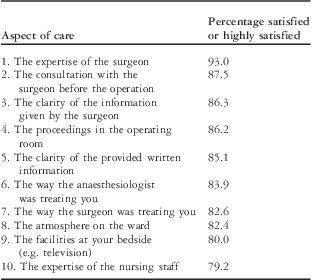
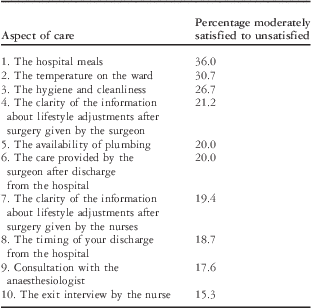
More specifically, a top 10 of the best and worst valued aspects of care is given in Table 2a and Table 2b, respectively. Most patients were satisfied with aspects of care directly related to their operation, for example, The expertise of the surgeon (93.0%), and The consultation with the surgeon prior to the surgery (87.5%). Patients were most dissatisfied with aspects of “hotel care”, for example, The hospital meals (36.0%) and aspects related to “information”, for example, The clarity of information about lifestyle adjustments after surgery given by the surgeon (21.2%) and “discharge and after care”, for example, The care provided by the surgeon after surgery (20.0%). Notably, 25 patients (33.8%) did not have an exit interview with the surgeon. Of the 49 patients who did have an exit interview with the surgeon, five patients (10.2%) were dissatisfied. Patients rated the received overall care a 7.61, and 84% of patients would recommend this hospital to others, indicating a high general level of satisfaction.
Top 10 of the best valued aspects of care by the total group of patients.

Top 10 of the worst valued aspects of care by the total group of patients.

Contact with a specialised nurse
Figure 1 shows the grades on the nine scales, specified for the 33 patients with and the 42 patients without contact with a specialised nurse. Descriptive analysis – frequencies and percentages – showed that 80% of the patients who had seen a specialised nurse were satisfied with the care provided by him/her.
Patients who had contact with a specialised nurse were more satisfied with the received information (mean grade is 7.84) than patients who had no contact with a specialised nurse (mean grade is 7.31), independent of patient characteristics (B-coefficient is 0.497, p-value is 0.038, partial Eta squared is 0.071). In addition, older patients reported higher grades, reflecting a higher level of satisfaction with the provided care.
Discussion
Overall, patients were satisfied with the provided care, with grades ranging from 6.74 for discharge and after care to 8.18 for medical care, as is the case in most satisfaction studies.Reference Kleefstra, Kool and Veldkamp 26 , Reference Pita-Fernandez, Farinas-Garrido and Suarez-Fontaina 30 The lowest grades were for “discharge and after care”, indicating that there is room for improvement. More specifically, 20.0% of patients were dissatisfied with the after care provided by the surgeon, whereas 21.2% of patients were dissatisfied with the clarity of the information about lifestyle adjustments provided by the surgeon. Having contact with a specialised nurse is associated with a higher level of satisfaction with the provided information. In addition, patient satisfaction levels were associated with higher age, which is a common finding in satisfaction studies.Reference Bleich, Ozaltin and Murray 31
The following limitations merit attention. First, we have no information on non-respondents. It is, for example, fair to assume that extremely (dis)satisfied patients participated in this study.Reference Kleefstra, Kool and Veldkamp 26 Second, this study focused solely on patient satisfaction. Additional information is needed to further identify aspects of care that need to be improved. For example, future studies should also address the relative importance that patients attach to certain aspects of care. Moreover, one can debate on whether the high satisfaction scores enable the identification of targets for improvement. Nevertheless, variation in the level of satisfaction with different aspects of care is detected, with grades ranging from 6.74 to 8.18. Third, this is a single-centre study; therefore, results cannot be automatically extrapolated to other hospitals. Fourth, we evaluated current clinical practice; patients were thus not randomly assigned to one of two conditions – that is, contact versus no contact with a specialised nurse. This implies a selection bias and may have affected the found association between having contact with a specialised nurse and patient satisfaction levels. Given that patients who were counselled by a specialised nurse were referred by their treating cardiologist based on their complex situation – for example, having psychosocial problems – one would expect lower satisfaction levels for this group. Yet, patients who were counselled by the specialised nurse reported even higher satisfaction levels than the patients who were not referred. This suggests that if patients were randomly assigned to one of the two groups the association between having contact with a specialised nurse and patient satisfaction levels may be even higher. Finally, information about the frequency of visits to the specialised nurse is lacking. It can be hypothesised that patients’ satisfaction levels may be related to the number of contacts with a specialised nurse.
To our knowledge, this is the first study that examined satisfaction levels of patients with a congenital heart defect undergoing open-heart surgery. Moreover, we are the first to examine the association between having contact with a specialised nurse and patients’ satisfaction levels.
In conclusion, patients with a congenital heart defect are satisfied with the provided care, although results indicate that there is room for improvement in the discharge and after care procedure. In addition, information provided by the surgeon may be improved, as on average 20% of patients were dissatisfied with the clarity of the information and the after care provided by their surgeon. This gap in the current care for patients with a congenital heart defect undergoing open-heart surgery may be compensated for by specialised nurses. For example, informing patients on lifestyle issues can be easily performed by specialised nurses, likely resulting in increased satisfaction levels and quality of care. It is important to note, however, that our results have to be replicated in a larger multi-centre study.
Acknowledgements
The authors are very grateful to all patients. Moreover, they thank Mrs A. Y. Schotanus for her help with the data collection. Source of funding: This study was funded by the Interuniversity Cardiology Institute of the Netherlands (ICIN).