During the 1980s, the cultural reception of comic books underwent a significant transformation. The popular understanding of the comic as a disposable picture book that contained nonsensical cliché-ridden stories for children changed as the medium began to attain new credibility as a form of popular art. The development in the medium's reception was precipitated by the publication of comics such as the Pulitzer Prize-winning Holocaust biography/allegory Maus (1980–91), Frank Miller's Batman story The Dark Knight Returns (1986) and Alan Moore's superhero comic Watchmen (1986–7).Footnote 1 These thematically complex and visually striking works not only were critically and commercially successful, but also invited interpretation as rich texts. The term ‘graphic novel’ gained common currency and was used by comic publishers to emphasize the newly acquired literary kudos of the comic. Nourished by Hollywood's production and reproduction of films featuring comic-book heroes, the popular understanding of the comic as an (at least potentially) artistically significant medium has been sustained to the present day. In keeping with, and symbiotically arguing for, the acceptance of the comic as an artistic form, a body of critical scholarship dedicated to the medium has developed; alongside journals about comics and monographs such as the tellingly entitled Watchmen as Literature, numerous critical studies of comics have been published.Footnote 2 With the emergence of ‘comics studies’ and the now well-established fields of research both into music and literatureFootnote 3 and into music and visual art,Footnote 4 it is appropriate that music in comics now be given consideration in an academic context.
Comics have had a long-standing relationship with music. Popular song lyrics have routinely cited superheroes, primarily for humorous and parodic ends (‘Batman and Robin are saying their prayers’ in ‘Goodbat Nightman’ by the Scaffold, 1966) and/or as ‘symbols of authority’ (‘O Superman’ by Laurie Anderson, 1981).Footnote 5 Comics are also invoked as icons of popular culture more generally: the superhero Dr Strange is referred to in ‘Cymbaline’ by Pink Floyd (1969), and the titular character of David Bowie's song ‘Uncle Arthur’ (1967) reads Batman.Footnote 6 Music videos borrow imagery from comics, such as in the video for A-ha's song ‘Take on Me’ (dir. Steve Barron, 1985), which follows the adventure of a waitress who is transported into the world of a comic. Comics have also been linked to contemporary art music, as in the case of Michael Daugherty's Metropolis Symphony (1993), each movement of which takes inspiration from a character, location or event in the Superman mythos. Daugherty reports that his ‘musical response to the myth of Superman […] use[s] Superman as a compositional metaphor in order to […] expres[s] the energies, ambiguities, paradoxes, and wit of American popular culture’.Footnote 7 It is in popular-music culture, however, that the association between music and comics is strongest: just as superheroes have made the transmedial leap from the comic page to the pop song (albeit primarily as lyrical citation), so pop and rock stars have been represented in comics, either featured as the central protagonists of a comic, or as ‘guest stars’ in an established strip. This example of corporate media synergy is similar to economic motivations behind the use of popular music in film.Footnote 8 The range of musicians who have received fictional depiction in comics is diverse, including the Beatles, Pat Boone, Alice Cooper, Lordi and Kiss; and Rock 'n’ Roll Comics produced in the 1990s unauthorized biographies of pop and rock musicians in comic form.Footnote 9 In the case of artists such as Kiss, who have enjoyed extended lives in comics, the corpus of comic literature serves to form a distinct component of the way in which a fan of the band comes to understand, and engage with, their musical heroes.
Some published research has discussed music and comics,Footnote 10 but as yet no attempts have been made to interrogate the aesthetic effects that are created when comics involve themselves with music. This article seeks to begin the project of understanding comics as a musically significant medium through examining how music is used in, and relates to, the major works of one comic writer. No more suitable starting point presents itself for the exploration of music and comics than the output of Alan Moore, a graphic novelist with a passion for music both inside and outside comics.
Alan Moore (born 1953 in Northampton, England) is one of the most famous comic writers. Several of his books, such as Watchmen, V for Vendetta (1982–9)Footnote 11 and The League of Extraordinary Gentlemen (1999–2012),Footnote 12 are among the best-known ‘graphic novels’, and the positive reception of his work has done much to establish the comic as a form of literature. The images in Moore's comics are created by an artist collaborator. Moore ‘writes’ the comic by describing in prose how, panel by panel, the comic-book page should appear. Moore's descriptions are very detailed: the script received by the artist for the first 34-page chapter of Watchmen consisted of 101 pages of single-spaced plain text.Footnote 13 Although several of his works have been adapted for cinema,Footnote 14 Moore has disowned these films as unfaithful to his intentions. While the films are not the subject of this article, they have further popularized his work and drawn attention to the sources of the adaptations.Footnote 15 Throughout his career, Moore has remained an active performer and composer of music and poetry, usually working in collaboration with other musicians and performance artists. In many cases, Moore's music/performance output has influenced, and explicitly transmedially intersected with, his comic-book writing. In contrast to his attitude towards cinema versions of his work, Moore readily engages with musical adaptations of his comic texts. The popularity and wide dissemination of his works mark them out as significant texts, but it is his attention to music that makes his output a convenient domain to use for the investigation of music and comics. Moore's comics provide instructive examples of a wide spectrum of interactions between music and comics.
In this article, through analyses of selected comic texts, I outline the main ways in which music is involved with comics, and I demonstrate particular methods of analysing music in comics. First, using Watchmen as an example, I discuss instances of music in comics where the music is not directly depicted as sounding or performed in the comic, but is instead cited or referred to in other ways. Even though such musical ‘citations’ are perhaps less striking than direct depictions of musical activity, I argue that this use of music is nevertheless an important part of the narrative apparatus of the comic. Secondly, focusing primarily on V for Vendetta, I consider the three main situations in which music is shown to be performed or sounded in comics, including how this sounding may escape the boundaries of the silent page. Following this discussion, the final part of the article examines notions of comics as musical performance and as virtual musical theatre. This section considers The League of Extraordinary Gentlemen and the relationship between the comic and Brecht/Weill's The Threepenny Opera. Throughout the article, I argue that musical components of comic texts can be a significant part of the comics as readers are encouraged to engage in hermeneutic criticism of musical and musical-literary texts. I avoid extensive theoretical discussion in order to focus instead on textual analyses of the comic sources. The methods for such analysis are developed in response to the comic texts, and summarized at the end of the article.Footnote 16 I begin, then, by considering the most straightforward use of music in comics, and a situation similar to the citations of comics in pop-song lyrics noted above.
Musical citations
As the long list of copyright permission credits at the front of the collected edition attests, the comic Watchmen extensively cites pre-existing music in its dialogue and titles. Such citations are used for a variety of ends, from accentuating the text's literary aspirations to developing characters and building the comic's fictional universe.
Watchmen is set in a world in which masked superheroes not only exist, but have had a long and complicated relationship with political power. The comic's plot is centred on a murder mystery in which retired superheroes are being systematically assassinated. The agent of these assassinations, Adrian Veidt, aims to ‘save’ the world by triggering a cataclysmic act of destruction which will usher in a new era of peace.
The title of each chapter (each issue) of Watchmen is provided by a short quotation, often from a song lyric, which is then contextualized as part of a longer attributed citation in the final panel of the chapter. For example, Chapter 1 is entitled ‘At Midnight, All the Agents …’, an excerpt from the ‘Desolation Row’ song lyric quoted from and attributed to Bob Dylan in the last frame of the chapter: ‘At midnight, all the agents and superhuman crew, go out and round up everyone who knows more than they do.’Footnote 17 Similarly, Chapter 2, ‘Absent Friends’, takes its title from the lyric from Elvis Costello's song ‘The Comedians’: ‘And I'm up while the dawn is breaking, even though my heart is aching. I should be drinking a toast to absent friends instead of these comedians.’Footnote 18 When readers are presented with the contextualized title at the end of the chapter, they are encouraged to consider how the quotation resonates with, or appears to comment upon, the dramatic themes of the chapter. Although these lyrics appear as titles, the effect is similar to the allusive authorial commentary often provided by the lyrics of pre-existing pop songs heard in film (of which more later).Footnote 19 Watchmen's ostentatious use of quotation and the attempt to cultivate more than a prosaic appreciation of the text is part of the way in which the book asserts its wish to be understood as a work of literature.
The prefiguring dimension of the chapter titles taken from pre-existing songs gives the impression that the comic text somehow proceeds from the songs, or song lyrics, that are referenced. Dave Gibbons (Watchmen's artist and co-creator) even reports that ‘the lyric beginning “Now at midnight all the agents”, from Bob Dylan's “Desolation Row”, had been one of the starting points of the Watchmen comic’.Footnote 20 The musical (lyrical) intertextual sources that orbit Watchmen serve to situate the comic in a cultural context that places heavy emphasis on music and its ability to produce and transmit meanings. Through the use of lyrical citation, the book constructs its readership as literate and proficient in interpreting such recontextualizations of musical meaning.
Watchmen takes place in an ‘alternative history’ version of 1980s America. Part of the way in which this fictional world is created is through references to music and musicians that exist in Watchmen's universe, some of whom are famous real-world musicians, while others are fictional. This blending of fictional and real musicians is a microcosm of the way in which Watchmen articulates world history more generally: by blending the historical with the invented, the fictional world is anchored in historical reality, providing a weight and believability to a premiss that marries a fantastic ‘superhero’ universe with more ‘realistic’ concerns. One of the earliest vigilante superheroes recalls his dissatisfaction with the post-war cultural milieu in terms that place superheroes and musicians in opposition:
Partly it was the beatniks, the jazz musicians and the poets openly condemning American values whenever they opened their mouths. Partly it was Elvis Presley and the whole Rock and Roll boom. Had we fought a war for our country so that our daughters could scream and swoon over young men who looked like this, who sounded like that?Footnote 21
Through the reference to a cultural zeitgeist defined primarily through pop and jazz musicians, the reader recognizes real-world history in the fictional Watchmen universe. From the cultural-historical anchor provided by this report, Watchmen's world can diverge while still retaining a sense of authenticity secured by a basis in the real world.
Although characters in Watchmen mention real-world bands such as the Grateful Dead and Devo, Watchmen's world includes a thuggish youth music culture known as ‘top knots’. As Mary Borsellino states: ‘Music that exists in the world of Watchmen but not in our own world serves primarily as a vehicle for foreboding imagery.’Footnote 22 The bands shown to be at the heart of top-knot culture are Pale Horse and Krystalnacht (sic). This pop culture is used to communicate the moral decay from which Watchmen's society suffers, through the use of literary references. As Borsellino explains:
The centerpiece of Veidt's carnage [the villain's attack on the city] is Madison Square Garden, where the bands Pale Horse and Krystalnacht were in mid-concert, their crowds of fans now a horrifying tableau of bodies. […] Literally, ‘Kristallnacht’ means ‘the night of shattered glass’, a name echoed hauntingly by [the] depiction of New York following Veidt's attack, in which the streets are littered with the remnants of broken windows. ‘Pale Horse’ is the literal translation from Greek of the Fourth Horseman of the Apocalypse, as described in Revelation 6:8, commonly referred to as ‘Death’ in English-language media. The lead singer of Pale Horse is named ‘Red D'Eath’, which may be an allusion to the Edgar Allan Poe story ‘The Masque of the Red Death’. The Red Death of Poe's story is an agonizing and gory plague killing those infected almost instantly. Like Moore's novel, Poe's short story utilizes repeated images related to time and blood.Footnote 23
The literary references traced by Borsellino will be recognized by different readers to different degrees, depending on their knowledge and willingness to interpret the text. In any case, the density of resonant meaning, from the more to the less obvious, all works to create a complex fictional universe that acts as part of a ‘thick text’.
Music is also used in Watchmen as part of the description of characters. The book's villain, Veidt, describes his favourite music as ‘electronic music’ and his preference as being for ‘avant-garde music in general. Cage, Stockhausen, Penderecki, Andrew Lang, Pierre Henry [and] Terry Riley’.Footnote 24 Veidt is a modernist who attempts to reform humanity by destroying the existing social structures and architectures. His musical taste for artistic modernism reflects this philosophy by making use of (and simultaneously reinforcing) the reputation of modern art-music composers in the popular imagination. While the composers Veidt mentions are not musically or philosophically identical, the character's depiction as a devotee of twentieth-century art music nevertheless invokes the avant-garde's often anti-populist attitude, high-minded esotericism and reputation as promoting ‘difficult’ and non-expressive music. This received image of modern art music is used to imply Veidt's own lack of empathy, his unshakeable belief in his own radical agenda, and his physical, emotional and social distance from the more sympathetic characters in the book. Veidt also enjoys dub music, but the way in which he appreciates this style – he describes it as a ‘fascinating study in the new musical forms generated when a largely pre-technological culture is given access to modern recording techniques without the technological preconceptions that we've allowed to accumulate, limiting our vision’ – is revealing of his character.Footnote 25 Veidt's description of dub communicates his view of modern society, and even hints at his desire to destroy existing (‘accumulated’) social constructs. Veidt's musical taste provides the reader with insight into his character, and reinforces aspects of his personality and philosophy.
While other superhero comics have made reference to both real-world and fictional music and musicians, these citations are sporadic and usually comedic.Footnote 26 Watchmen's considered, non-humorous, vérité deployment of such citations in the dialogue and the ostentatiously ‘literary’ use of the citations as titles are unusual. The references are sustained throughout the text, and are presented either as a subtle part of the depiction of the world and characters, or in the titles, obviously portentous, in a way that draws attention to the functions that such musical citations can perform in comics. Music in comics is not limited to this kind of reference, however, and Moore's work has included extensive depiction of sounding and performed music.
Sounding music in comics
Comics are famous for deploying onomatopoeia for sound effects, yet music is also depicted as sounding in comics, whether as performed music or recorded music. This kind of music in comics falls into three broad categories: depictions of music that leave details of the musical content primarily to the reader's imagination; music that is explicitly defined by music or lyrics, but does not exist in the real world; and music identified as a piece that exists in the real world. Each of these three articulations results in different aesthetic effects, and may disrupt notions of ‘diegetic music’.
Depictions of musical activity with little or no definition of musical content
The most straightforward of the three categories of sounded music is the case in which the musical content is left primarily undefined. In V for Vendetta, during a scene set in a church service, following the conclusion of a prayer, a single panel shows an organ manual with a chord being depressed by the organist.Footnote 27 The reader is given no information as to the detail of this musical event, beyond the fact that the organ (presumably) sounds in the church. A degree of ambiguity thus arises: is a single chord played in isolation at this moment (such as is often heard at the conclusion of a prayer during a church service), or is this a snapshot of the organist playing a longer piece such as a voluntary? In the case of a minor musical inclusion such as this, the sonic specifics are moot. The reader is free to understand the organ performance however they wish.
A more extensive presentation of music that leaves sonic detail undefined is found in the second volume of The League of Extraordinary Gentlemen. Moore's League of Extraordinary Gentlemen comics bring together famous figures from nineteenth-century fantasy literature (such as Captain Nemo, Jekyll and Hyde, Mina Harker and Allan Quatermain) into one storyline and universe. These hypertextual comics provide opportunities for clever postmodern textual interplay. We will discuss intertextuality in The League of Extraordinary Gentlemen below, but for now it is sufficient to examine a localized musical example. At several moments in the last two chapters of the second volume, Mr Hyde begins to sing and whistle.Footnote 28
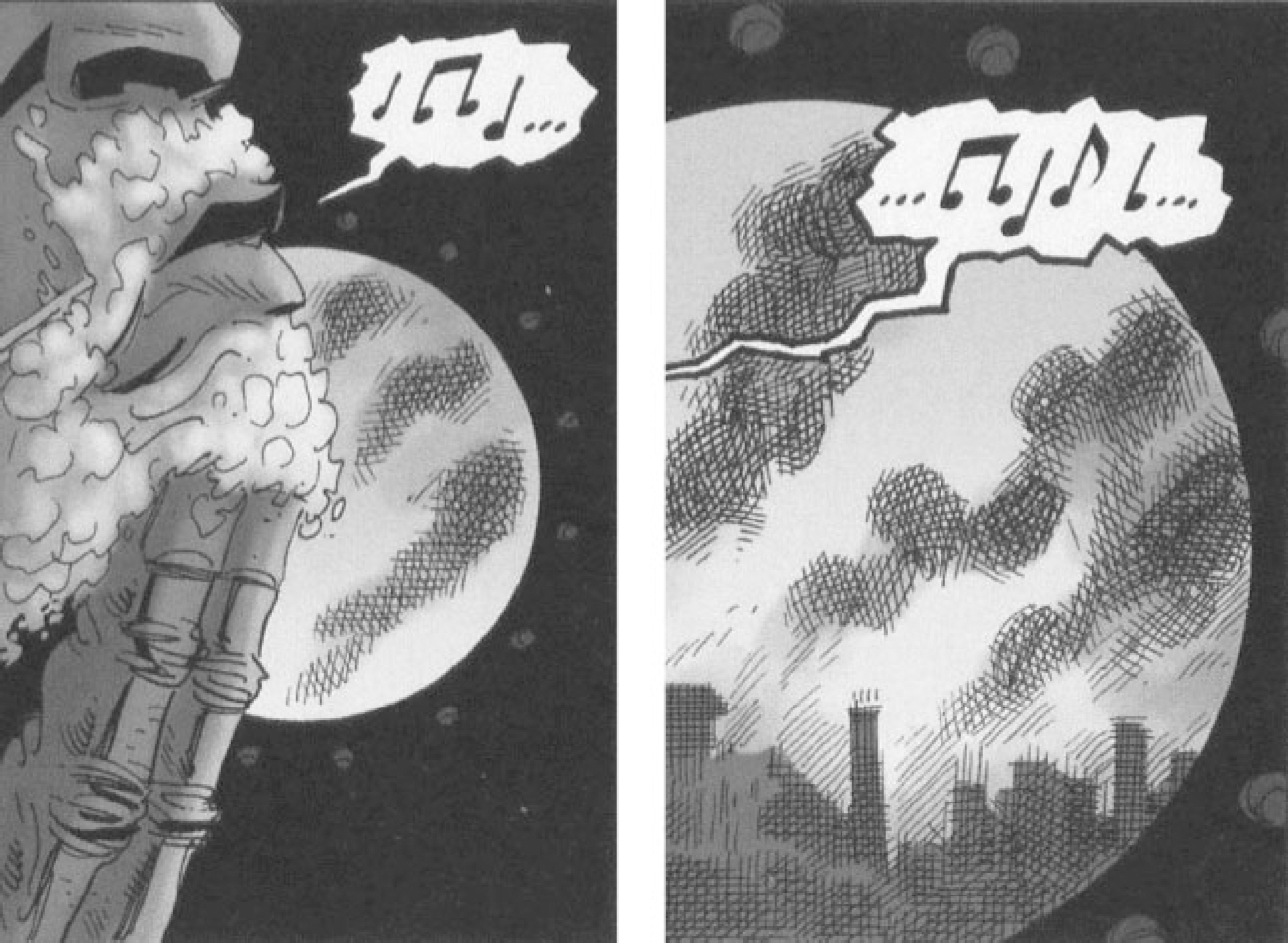
Hyde's whistling is often indicated by musical notes (though not notated score) inside speech bubbles.Footnote 29 This use of musical notes as a symbol of music is similar to the way in which film subtitles sometimes display three crotchets enclosed in square brackets when musical underscore begins.Footnote 30 The jaunty arrangement of the unstaffed, sometimes reversed, quavers and crotchets implies lively whistling, but, as in the inclusion of the organ chord in V for Vendetta, the specific musical content is not significant, and is left to the reader to imagine. Hyde's nonchalant attitude is sometimes given more specific vocalization, with ‘Tum tum tum tum te-tum …’ included in a speech bubble.Footnote 31 More significantly, however, in the first pages of the last chapter,Footnote 32 Hyde's monologue about death is followed by his return to whistling, again indicated by musical notes in a speech bubble.Footnote 33 The visual presentation of these notes creates a sonic layering effect (see Figure 1).

Figure 1 shows the juxtaposition of Hyde's jolly whistling and the apocalyptic chaos of a London under attack by Martians from H. G. Wells's The War of the Worlds. By ‘zooming in’ on Hyde's whistling over two panels, a virtual point of hearing is created for the listener, as this whistling forms an auditory foreground to the burning city under siege in the background. This scene could even be understood to use anempathetic music,Footnote 34 despite the largely undefined musical content.
In this ‘silent’ medium, Hyde's whistling and the organ in V for Vendetta call to mind the depiction of performed music and sound in another ‘silent’ form. Dominique Nasta and Melinda Szaloky have examined ‘visualized sound’ in silent film. The visual representation of a sonic event, such as bells or whistling, prompts viewers to imagine an audio incarnation of the visually depicted sound.Footnote 35 The same processes of inferred or mental hearing occur in the comic. Szaloky describes how ‘visible sounds (i.e., sounds that are unmistakably implied by their source objects) are often explicitly visualized in order to make them more conspicuous and to suggest other meanings beside the obvious, that a certain sound has been produced by a certain object’.Footnote 36 Nasta concludes that such sound elements can be used to ‘increas[e] the degree of audience participation’ as films ‘complicate their legible diegeses with hyperbolic aural figures that would attract the viewer's attention’.Footnote 37 Again, the same can be true of the instances of ‘visualized sound’ in comics. These sounds, as distinct from sound sources that are shown but not narratively highlighted, are ‘visualized and accentuated by the distinctive use of a pictorial cinematic device’ (such as the close-up of Hyde's whistling) and ‘supply a “surplus” of meaning to the aesthetic experience of the film’.Footnote 38 Comics similarly foreground certain instances of sonic, and particularly musical, visualized sound for the same Ricoeurian ‘surplus’:Footnote 39 to create texts that prompt and invite interpretation. Furthermore, and as betrayed by the distinction of two types of ‘diegetic’ audio (the accentuated and the non-emphasized), the notion of ‘diegetic’ music in comics is complex. This issue is often foregrounded when comics use music that does not exist in the real world.
Newly created music in comics
Music in comics does not need to remain unspecific in the manner of Hyde's whistling, and can be musically defined to a greater or lesser extent, even within the same comic. V for Vendetta includes several instances of performed music, with musical detail that ranges from invoking a particular musical genre, to lyric allusion, to the inclusion of notated score in the comic. V for Vendetta follows the activities of V, a revenge-seeking masked terrorist rebelling against a totalitarian regime that controls a dystopian London of the near future. The comic begins with V destroying the Houses of Parliament as an act of protest. A police detective, Inspector Finch, is assigned to investigate V and, in doing so, unravels the mystery surrounding the origins of the vigilante. Finch is a protagonist who finds himself torn between his law-enforcement duties and his growing sympathy with V's cause. A young woman, Evey Hammond, becomes involved with V's activities, and ultimately becomes his successor, adopting V's Guy Fawkes mask as her own.
Lyric pastiche is significant for music in comics, since this is the primary way in which musical genre is communicated. In the church scene from V for Vendetta discussed earlier, the congregation sing a fascist hymn:
Whose glorious feet in iron are shod •
Whose heart is tempered steel •
Him who hath granted us this day •
And at whose throne we kneel.
[…]
One race, one creed, one hope in thee •
Who loved us in our pain, •
Who let us fall not very far •
That we should rise again!Footnote 40
This hymn, clearly a parody of the Blake/Parry ‘Jerusalem’, is presented in a way that leaves less musical detail defined than in other musical performances in V for Vendetta, even if the musical genre is obviously established.
The hymn's text, an original verse by Moore, may be found approvingly cited on the website of the notorious neo-Nazi White Supremacist organization Stormfront. Moore's personal political beliefs, it should be clearly noted, are diametrically opposed to the values of Stormfront, and while its satirical intent was not lost on the Stormfront member who typed out and posted the entirety of its lyrics to the site, the hymn was nevertheless sufficiently striking for the reader to seek to disseminate the lyrics.Footnote 41 Both the strange afterlife of this hymn and a number of audio recordings of performances of other songs from V from Vendetta (discussed below) demonstrate that instances of musical performance and inclusion in comics are perceived by readers as distinct entities, are the focus of active interpretation, are understood as meaningful and can achieve an extra-comic life. It seems that Nasta's hypothesis of ‘visualized music’ as a prompt to active interpretation is as evident, if not more so, in comics as it is in silent film.
A more extensive performance occurs in a cabaret club in V for Vendetta, and is presented in such a manner that the reader is given the architecture of a musical entity. In this situation, readers can elaborate imaginatively as much or as little as they wish upon the scaffold provided. The cabaret song is carefully paced throughout the sequence in the comic so as to imply certain verse and phrase structures. In the Kitty Kat Keller club, a chanteuse performs a cabaret song.Footnote 42 The song performance is distributed through a sequence of panels in such a way as to imply the musical-lyrical structure of the song (see Table 1). The rhyming wit of the Kitty Kat Keller song is part of the way in which the genre of the cabaret song is securely invoked,Footnote 43 just as the lyrical parody of ‘Jerusalem’ implied the musical genre of the hymn, but the layout of the lyrics further defines the musical performance. The Kitty Kat Keller song does not maintain a strict syllabic structure, but the line variation and rhyme scheme create a distinct sense of musical and lyrical phrasing, which is assisted by the spacing and presentation of the text in the panels. What are initially presented as two distinct phrases (p. 125, panel 2, bubble 1; and p. 125, panel 3, bubble 1) are later combined in one bubble, though for the reader the two-period construction of the phrase is retained in the combined instance. Moore uses ‘Dada dada dada da’ to demarcate the chorus and represent a melodic hook (possibly an antiphonal instrumental response to the sung lines), even though, of course, any such melody is only implied and constructed by the reader. Along with the spacing of the ‘da's, hyphens are used to communicate the singer's vocal articulation (‘at-ti-tude’), while ellipses are used to imply first a non-tonic melodic resolution, and second, during the final chorus, a ritardando into the body of the final chorus, in the time-honoured singalong fashion.
| Page | Panel | Bubble | Lyric | Implied structure |
|---|---|---|---|---|
| 125 | 2 | 1 | ‘I'm not politically ticklish and theory makes me weary …’ | verse, phrase A, implied antecedent phrase |
| 125 | 3 | 1 | ‘… and affairs of state aren't my kind of affairs.’ | verse, phrase B, implied consequent/resolution phrase |
| 125 | 4 | 1 | ‘And I'd never bed, nor much less wed the wag whose flag is deepest red. My tastes run more to Londonderry airs …’ |
verse, phrases A and B (implied as duplicate of previous two bubbles combined) |
| 125 | 5 | 1 | ‘But at rallies in the night with all the torches burning bright I feel a stirring in me I cannot neglect …’ | verse, phrases A and B |
| 125 | 5 | 2 | ‘… and I'll grasp with mad abandon any lad with an armband on and whose cute salute is manly and erect!’ | verse, phrases A and B |
| 125 | 6 | 1 | ‘I like the boots (Dada dada dada da) I like the at-ti-tude, I like the point at which the legal meets the lewd.’ | chorus, phrase A |
| 125 | 6 | 2 | ‘I like the thrill (Dadad [sic] dada dada da) of the triumphant will …’ | chorus, phrase B |
| 125 | 7 | 1 | ‘I like the marching and the music and the mood!’ | chorus, phrase C |
| 126 | 2 | 1 | ‘So if some blonde blue-eyed boy would care to teach me strength through joy …’ | verse, phrase A |
| 126 | 3 | 1 | ‘… and see that all my liberal tendencies are cured; if it should be decreed by fate that you invade my neighbouring state …’ | verse, phrases B and A |
| 126 | 4 | 1 | ‘… then you will find my frontiers open, rest assured.’ | verse, phrase B |
| 126 | 5 | 1 | ‘I … like … the … boots! (Dada dada dada da)’ | chorus, phrase A(1) |
| 126 | 6 | 1 | ‘and when they “heil” I smile, and liquefy inside …’ | chorus, phrase A(2) |
| 126 | 7 | 1 | ‘I like their skin (Dada dada da) I like their di-sci-pline …’ | chorus, phrase B |
| 127 | 1 | 1 | ‘… and the enormous sense of licence it provides!’ | chorus, phrase C |
From the visual and verbal architecture that Moore presents to the reader, the musical entity seems to appear almost in contrasting relief, with only the outline of the song in evidence in the text. The reader may create a virtual melody that conforms to the frame provided by the text, but it will probably remain inexplicitly defined and unsounded. For all of the parameters set by Moore in the comic, he encourages the reader to perform an exercise in mental composition – the reader may create any melody that they ‘imagine’ the singer performs. Whereas a novel without images invites a reader to imagine their own visual incarnation of the action, in this visual (but silent) literary medium, the reader imagines their own musical realization of the song.
The Kitty Kat Keller song supplies a musical outline, but another sequence in the comic provides very explicit musical detail. One chapter in V for Vendetta features notated musical score. The chapter, ‘This Vicious Cabaret’, appears a third of the way through the complete comic, and is presented as a song sung by V.Footnote 44 The pages of the chapter include a monophonic vocal line in musical notation that quite literally underscores a montage of scenes in comic panels showing developments in the lives of the book's main characters after the events of the last ‘act’ (Figure 2). For the reader, this five-page chapter approximates a film montage, with a score that simultaneously smooths over disjunctive ‘cuts’ between disparate subjects/locations/points of view and provides a certain perceptual distance from the characters and plotlines. This middle-distance perspective is appropriate for a review of the principal characters and their respective statuses before the next ‘act’ of the narrative commences. Perhaps the most striking component of this ‘underscored’ chapter is the way in which the music serves to apply a temporal and sonic frame to a medium that usually leaves these properties only loosely defined. Particularly for a musician (and to a lesser extent for a reader who is not literate in, or only vaguely familiar with, musical notation),Footnote 45 reading the music and lyrics alongside the images creates a sense of pace, if not strictly rhythm per se, as the panels gain a temporal quality.

Kurt Weill has been an influence on Moore throughout his career, and Weill's spectre can often be detected in the musical inclusions that Moore uses in his comics. ‘This Vicious Cabaret’ takes the form of a Weill-like cabaret song. The song lyrics use theatre (‘cabaret’ and ‘grand opera’) as a metaphor for the lives performed by citizens under the dictatorship of the book's villain, Adam Susan. V's lyrical narration betrays his omniscience as he describes the other characters in the comic and hints at events yet to occur with a degree of insight usually reserved for authorial voices. In articulating V's power through his knowledge and MC-like presentation, the metaphor of the theatrical cabaret is emphasized. V is able to see through the parade of inauthenticity and view the totalitarian dystopia as a macabre musical-theatrical production. V's role as MC is an appropriate allegory of his role as a freedom fighter: he operates as a liminal entity, at once outside the regimented order of musical productions (understood to stand metaphorically for autocratic control) and able to influence the ‘performance’.Footnote 46 V is thus in a position to disrupt the regime's control, just as an MC both is involved in a musical-theatrical production as an actor/performer and mediates between the audience and the fictional narrative, implicitly aware of the inauthentic nature of the performance.
When readers encounter the pages of this chapter, the way in which they engage with the text changes; even the landscape printing of this section's pages in a volume usually viewed in portrait orientation requires a different physical perspective on the text. For many readers, the music printed on the page will sound in their imagination, creating a virtual sonic event.Footnote 47 Even if the reader is not able to understand musical notation, or is unwilling to follow the contours and spaces of the score, the lyrics invoke the genre of cabaret songs, and real-world knowledge of such songs is recalled by the reader. By including a song in the comic text, a rather blunt metaphor is made more compelling as the parallel between musical theatre and totalitarian control is enacted, rather than simply being described; in creating a virtually sounding song in the minds of the readers, V for Vendetta itself is momentarily turned into a musical-theatrical construct, with all of the ironic and self-aware implications this entails for a text that uses cabaret as a metaphor.
Beyond the specific ways in which it can be ‘read’ as narration, and the strong intertextual links to the musical Cabaret (which deals with fascism and cabaret in a different formulation) and perhaps also the song ‘On Broadway’ (The Drifters, 1963), this song serves a more general purpose for the reader. The reader is explicitly prompted to seek meaning from the combination of words, music and images in the text, just as Nasta claims that visualized sound in silent film provokes significant audience engagement with the text and offers a proliferation of possible meanings. ‘This Vicious Cabaret’ is similarly open for interpretation. As with many instances of music in Moore's comics, the reader is not directed to understand the musical inclusion in one specific way. This ambiguity suggests that the reader's act of interpretation is more significant than the particular conclusions they draw. In opening up a text for interpretation in a non-prescriptive way, Moore encourages his audience to engage with the comic in a personal and actively investigative way. He thus emphasizes the hermeneutic possibilities of the text, and of texts more generally, by using music. Perhaps this is part of the reason why Moore's work has been received by readers as more ‘meaningful’ than other, more prosaic, comics.
‘This Vicious Cabaret’ also foregrounds issues connected to the notion of ‘diegetic’ music in comics. The terms ‘diegetic’ and ‘non-diegetic’ music have been used extensively in film criticism as a binary opposition distinguishing between music that is understood to sound in the story world (diegetic) and that which does not (non-diegetic).Footnote 48 Recent scholarship has criticized these terms for being simplistic,Footnote 49 and the nature of the comic medium further complicates notions of such a division. Much of the difference between music in comics and music in film derives from the lack of an actualized soundtrack.Footnote 50 For example, there is much that the reader simply does not know about the performance of ‘This Vicious Cabaret’. Because of the absence of audio, there is no indication of the acoustic space or context in which the song is performed. There is no defined audience for the song, except for the reader, and when the song is later shown in the comic as sounding on a gramophone in a room,Footnote 51 this complicates matters further: who recorded this song? When did V make this recording (if he is singing it on the record)? The song problematizes the non-diegetic/diegetic division and seems to enact Ben Winters's suggestion that even what has been termed ‘non-diegetic music’ should be thought of as ‘belonging to the same narrative space as the characters and their world’.Footnote 52 The moment of music in ‘This Vicious Cabaret’ may be understood as similarly ‘connected’, rather than non-diegetically ‘disconnected’, as narrator and narrated subjects collapse into one another. Unlike in film, where viewers share hearing a ‘diegetic’ song with the characters, the comic reader is not privy to the audio that the characters perform and hear, and the only world in which this character-performed song is heard actually to sound is the reader's world – in their own performance or when listening to a recorded version of the song. To whose diegesis does it now belong? The song problematizes notions of diegetic space and its relationship with narrating music by capitalizing upon one of the differences between film and comics: the lack of audio. The ambiguity, however, is not restrictive, but rather liberatory, as meanings and interpretations are opened for the reader's own imaginative play.
The music for ‘This Vicious Cabaret’ was composed to Moore's lyrics by musician David J (real name David John Haskins). J and Moore have collaborated on a variety of musical and performance art projects, both before and after V for Vendetta. J composed music to Moore's lyrics for ‘This Vicious Cabaret’ under instructions from Moore that dictated the musical style of the song and tempo/pacing during certain sections.Footnote 53 Moore was keen to work in a collaborative way with J: he sought a musically satisfying song, even if his original lyrics had to be changed. In Moore's initial letter of instruction to J, he wrote:
Don't worry about sticking too religiously to the words if you come up with a terrific tune that doesn't quite fit … it'll be easy for me to alter the lyrics after the fact so that they fit into the music that you've come up with. […] I'll no doubt be talking to you over the phone regarding this sometime in the near future, so I'll save any of the more obscure stylistic points until then.Footnote 54
J recorded the song, which was released on a 12-inch EP entitled V for Vendetta, with two compositions that were more generally inspired by the comic (‘V's Theme’ and ‘Incidental’). This record was produced in 1984,Footnote 55 roughly contemporary with the publication of the issue of V for Vendetta that contained the chapter ‘This Vicious Cabaret’.
In 2005, J returned to the comic V for Vendetta. This time, however, rather than being involved with the creation of the comic text, he composed a song based on the Kitty Kat Keller song. In this case, a musical performance in a comic is used as the basis for a musical composition. J, however, takes artistic liberty with the source – while the lyrics from the comic are retained, the gender of the singer is switched from female to male. As an analogue to the setting of pre-existing poems in the art-music tradition, J's ‘Song from the Kitty Kat Keller’ is a musical setting of the comic text.
For those readers of V for Vendetta who listen to J's recordings, the music is provided for an otherwise virtual performance. This epitext (to borrow Gérard Genette's term) may impact upon, and possibly enrich, the reader's/listener's understanding of the comic.Footnote 56 For the reader that hears J's interpretation of the songs, his versions may replace the reader's own creation (in the case of the Kitty Kat Keller song) or their own interpretation of the music (in the case of ‘This Vicious Cabaret’), but this effect probably varies on a case-by-case basis. The recordings could be understood as forming a soundtrack to the comic, as they give a voice to the silent characters and turn the virtual into the sonically real.
The examples of newly created music in V for Vendetta show a range of musical definition, and although the hymn and the Kitty Kat Keller song do not challenge the notions of music in this fictional diegesis in the way that ‘This Vicious Cabaret’ does, each instance nevertheless seeks to prompt the reader to be heavily engaged with the text. This involvement with the performed music foregrounds (and cultivates) the active role of the reader in interpreting and understanding the text. This ‘prompt to interpretation’ is central to Moore's use of music, and he often uses pre-existing music to serve the same purpose.
Pre-existing music in comics
Unlike the cases described in the preceding two sections, if a piece of music exists in the real world, and especially if it is well known, the reader may accurately ‘fill in’ the sound of music in the virtual world by applying their existing knowledge to the world with which they are presented. This approach avoids the ambiguity inherent in the inclusion of new or unspecified music.
In V for Vendetta, V plays to Evey recorded music that has been banned by the government, and explains that the song is ‘Dancing in the Street’ by Martha and the Vandellas. Given this reference, the reader can recall the music and interpret Evey's reaction to the song in relation to this audio stimulus, even though the lyrics of the song are not printed.Footnote 57 Just as when pre-existing music is used in film, pre-existing music in comics engages with the song's extant musical associations and content; in the case of ‘Dancing in the Street’, the song is contextualized so as to emphasize the revolutionary agenda in its lyrics. To dance on the streets of V for Vendetta's London would indeed be an act of defiance – in this situation, the song reads as a call to arms for a coming rebellion that V, in the comic story, will engineer. The totalitarian government in V for Vendetta is characterized as racist and homophobic. The Motown track's status as (primarily) African American music means that, aside from the revolutionary overtones of the song, it is doubly illicit, alluded to when V responds to Evey's comment that Martha's voice ‘doesn't even sound English’ by saying that the government ‘eradicated some cultures more thoroughly than they did others. No Tamla and no Trojan. No Billie Holiday or Black Uhuru’.Footnote 58 ‘Dancing in the Street’, as a song sung by an African American group and released on an African American label, represents that which has been eradicated in V for Vendetta both from the contemporary present and from the historical past. The discussion about ‘Dancing in the Street’ serves as a way of articulating the main themes of V for Vendetta – those of power, censorship and the media.
The ‘virtual soundtrack’ created through using pre-existing music is not always as straightforwardly deployed as in the instance of ‘Dancing in the Street’. In a chapter later in the same book, a brawl breaks out in the Kitty Kat Keller while a singer performs ‘Roll Out the Barrel’.Footnote 59 If Hyde's whistling was implicitly anempathetic, this is explicitly so. ‘Roll Out the Barrel’ is staged in ironic counterpoint alongside a violent fight precipitated by a vocal outburst by Robert (a minor character in the book). Robert succumbs to desperate frustration when a police chief informs him of his intention to send Robert's mother to be executed at a concentration camp. Robert's anger is vented in the form of a tirade at the club patrons: ‘We shouldn't have to live like this! […] I wish the bastard bomb had 'it bastard London! […] I wish we were all dead! It'd be better!’Footnote 60 Such defiance cannot be tolerated, and as off-duty policemen leap to attack Robert, the singer continues ‘Roll Out the Barrel’ undeterred.
The lyrics of the song's performance, and the action of Robert's outburst and the brawl, are synchronized for maximum ironic effect, as shown in Table 2. ‘Let's have a song of good cheer’, for example, is juxtaposed with Robert's cry of ‘I wish we were all dead!’; and the ‘gang’ who are ‘all here’ are seen to refer to the police officers who violently attack Robert.
| Panel | Action | ‘Roll Out the Barrel’ |
|---|---|---|
| p. 129/1 | Robert: ‘You're sorry! I'm sorry! Everybody's sorry! We shouldn't have to live like this!’ | ‘Roll out the barrel, we'll have a barrel of fun …’ |
| p. 129/2 | Gordon: ‘Robert, look, I'm just going …’ | (no lyric) |
| p. 129/3 | Robert: ‘You know what I wish? I wish the bastard bomb had 'it bastard London!’ | ‘Roll out the barrel, let's get the blues on the run …’ |
| p. 129/4 | Robert: ‘That's what I wish. I wish we were all dead! It'd be better!’ | ‘Sing boom tarara, let's have a song of good cheer …’ |
| p. 129/5 | The police officers advance on Robert. | ‘Now's the time to roll the barrel …’ |
| p. 129/6 | Police batons are drawn and strike Robert. | ‘'Cause the gang's …’ |
| p. 129/7 | Chaos ensues as officers pull Robert to the ground. | ‘all …’ |
| p. 129/8 | Several police batons and a gun butt are shown raised in the air, ready to fall on Robert. | ‘here …’ |
‘Roll Out the Barrel’ utilizes careful deployment of lyrics (as in the Kitty Kat Keller song) and pre-known musical sonics (as in ‘Dancing in the Street’). The specificity of the comic's description of the diegetic musical event runs to the definition of the particular piece of music in question and the temporal correspondence of action and music. A sense of dramatic pacing is given to the sequence, most obvious in the final panels of the comic page, where the rate of one word per panel depicts the club's quick descent into chaos. Like ‘This Vicious Cabaret’, temporal specificity is applied to a medium in which time is usually only vaguely defined.
Pre-existing music is a feature of many media, and this moment recalls the use of songs as ironic commentary in films. Jeff Smith assesses such instances in film using three criteria: ‘the pun's perceptual saliency, its narrative function, and its bisociative qualities’.Footnote 61 Regarding ‘perceptual saliency’, Smith comments that in film:
Music and ambient sound tend to be mixed much lower than speech, and thus they often are comprehended by spectators only as part of an overall sound design. Consequently, many spectators pay no specific attention to the music of a film, and will notice these musical puns only as part of a subsequent viewing when their attentions are less directed toward following the narrative.Footnote 62
In a comic, however, where there is no ‘mix’ at all, and musical inclusions do not compete for sonic space, readers may be more inclined to pay ‘specific attention to the music’. Rather than requiring a ‘subsequent viewing’, the reader is given time to appreciate the interrelations between strands of narration and audio material, and to interrogate such complex presentations for possible meanings, on first encounter. Even if a degree of temporal definition of the diegetic action is provided by the comic text (as in the case of ‘Roll Out the Barrel’), the reader is not confined to perceiving the action in the time that it takes for the performance to occur. Nor, as is the case with film (manual intervention on viewing technology aside), is the reader limited to perceiving the narrative in the single temporal definition that the text presents – as in, for example, a slow-motion shot. The temporally unlocked comic reader can move about the page, reading forwards and backwards, and stopping to interrogate any one moment of music/action synchronization.Footnote 63 Thus, while Smith clarifies that he does not ‘mean to suggest here that audiences actively listen and comprehend song lyrics during the course of a film’,Footnote 64 the reader of the comic, with the benefit of the medium's audio and chronological properties, does exactly that. The silent medium of the comic removes the compulsory temporality of sounded music when it is cited on the page, while paradoxically using the associated temporal properties of the musical reference to depict a chronology of events.Footnote 65
‘Roll Out the Barrel’ is well known enough for most readers to be able to conjure the sonic object from their memories and apply it to the sequence (with the temporal qualities this reference brings). ‘Roll Out the Barrel’ is firmly associated with nostalgia, and particularly connected with wartime entertainment. The song is chosen by Moore for the darkly humorous effect that is created when this cheery celebration of comradeship is ironically recontextualized in V for Vendetta's dystopian London during a moment when safety, fun and friendliness are furthest from one citizen's experience of society. It is, to use Smith's vocabulary, heavily narrativized: no ‘throwaway gag’, it serves as a significant moment in the plot and ‘suggest[s] a particular sociocultural milieu’ through its musical generic and historical associations.Footnote 66
This scene is an example of Moore's use of pre-existing songs to create a dramatic moment that portrays, through cold irony, an understanding of a fictional world. Smith's third criterion, ‘bisociative qualities’, relates to such instances of the ‘juxtaposition of lyrics or title of a particular song and the situation depicted in the narrative’.Footnote 67 Bisociation, a term coined by Arthur Koestler, refers to ‘the perceiving of a situation or idea […] in two self-consistent but habitually incompatible frames of reference’.Footnote 68 Koestler and Smith discuss bisociation in puns, where two frames of interpretation are juxtaposed to create humorous incongruity. While such incongruity is evident in the apposition of the jolly lyrics and affect of ‘Roll Out the Barrel’ to the brutal action it accompanies, this idea is also valuable for considering a wider aspect of Moore's work. The presentation of multiple concurrent interpretative frames is a recurring feature of Moore's comic writing. It is often a significant component of his use of music and can even lead the reader to consider the comics themselves as musical-performative.
Comics as musical performance
One of Moore's favourite narrative techniques is to present simultaneously two (or more) distinct strands of action and/or sound, and allow them to exist in ‘counterpoint’ (Moore's term),Footnote 69 with the intention that they create resonances of meaning between each other. In effect, he supplies the reader with the frames of reference for Koestler's bisociation. Moore has commented on this technique:
So there was that particular point in issue #3 [of Watchmen] when I'd suddenly got all these different things going on at once and it suddenly struck me that I could […] kind of get this weird shit going on between these different levels where they're striking sparks of meaning off each other […] and I suddenly realized what a benefit it was having [a] narrative embedded in the overall narrative I could refer to and use as a counterpoint.Footnote 70
Moore's aim of creating ‘sparks of meaning’ between narrative levels has become a mainstay of his use of music. What he calls narrative counterpoint sets the stage for bisociation, and aptly enough, at two points in V for Vendetta Koestler's work is specifically discussed.Footnote 71 Smith writes that ‘jokes may evoke two incongruous chains of associative logic, but they must do so in a manner in which the connection between these different frames of reference remains perfectly understandable’;Footnote 72 however, to create Moore's sparks of meaning, the connection between the ‘frames of reference’, while it may be ‘understandable’, must remain implicit. Rather than the ‘incongruity of these multiple interpretations’ in jokes,Footnote 73 the frames of Moore's narrative counterpoint are instead harmonious and resonant. Meanings and connections between the narrative strands are not explicitly defined, but generated in a way that is attractive to the reader and encourages their bisociative active engagement and interpretation of the text and its open (potential) meaning(s). Moore uses this technique to present a comic within a comic in Watchmen: a child reads a pirate-themed comic called Tales of the Black Freighter. The reader is invited to seek correspondence between the action and themes of ‘Black Freighter’ with that of the ‘real world’ in Watchmen. The title Tales of the Black Freighter is a reference to the ‘Pirate Jenny’ song from the English-language version of Brecht/Weill's The Threepenny Opera. Just as Jenny imagines the freighter will obliterate the town she despises, so Veidt seeks to destroy cities in Watchmen. Borsellino explains: ‘Both Veidt and the central character of the “Black Freighter” are driven to increasingly abhorrent acts in an effort to save civilization, culminating in bloody murder in order to perhaps prevent wider carnage.’Footnote 74 ‘Pirate Jenny’ is only referenced by title in Watchmen, but in Moore's The League of Extraordinary Gentlemen the song is given full sounding in a performance. Before this particular example is discussed, however, it is worth considering a different instance of music in ‘narrative counterpoint’.
Music is frequently depicted as sounding in the worlds created by Moore's comics. Further examples include Neonomicon, in which the musical performance of a goth punk band is the central plot device of the comic,Footnote 75 while in the fantastic worlds of both Halo Jones and Top 10 music is part of the depiction of the society and culture that the characters inhabit.Footnote 76 As with ‘This Vicious Cabaret’, many of the inclusions of music in Moore's comics, however, are presented in order to problematize divisions of diegetic or non-diegetic sounding. In such situations, the comic construct can approach one of a musical-theatrical performance. A straightforward but telling example of this effect is found at the start of the final book of V for Vendetta.
When a comic writer wants to utilize a pre-existing piece of music, particularly when some degree of specific synchronization is desired, it is usually defined either through citation of the lyrics or through a reference in the characters’ dialogue. When V uses Tchaikovsky's overture 1812 to accompany a bombing, a third method of reference is used: the pages of an orchestral score are pictured.Footnote 77
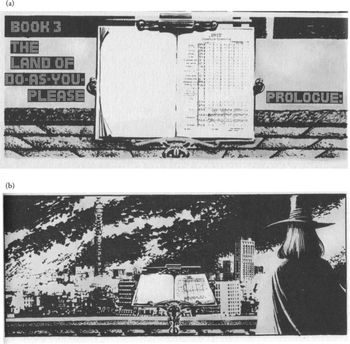
On 5 November, V destroys the Post Office Tower and the fictional Jordan Tower (in the world of V for Vendetta, the cornerstone of the secret police's surveillance capabilities). This act sets in motion the final phase of the narrative and the conclusion to V's master plan. V stands on a rooftop to observe the explosions. As the hour of demolition draws near, V approaches a music stand that he has prepared, which holds an orchestral score of the 1812, open on the first page (see Figure 3). The image is extraordinarily detailed and, even though the score is not legible to the same extent as that of ‘This Vicious Cabaret’, the trajectory of the instrumental parts at the start of the score is clear – the image successfully and explicitly defines a particular moment in the musical score. V proceeds to conduct the score, baton in hand, even though no orchestra is present. He faces the London cityscape over which explosions play, apparently cued by his gestures as he follows the score. Over the course of six pages of the comic, images of V conducting the score against an exploding city skyline are presented at the bottom of the pages while, above these pictures, the panels show the concurrent scenes of chaos and terror throughout the city that V's work has wrought. Once the final page of the score has been ‘performed’, V turns and bows, facing the reader. This action might be understood as a grandiose gesture towards the reader, or merely a private theatrical flourish on V's part. Thus two bisociative frames are created: V conducting the 1812 and the contrapuntal frame of the depiction of the results of his terrorism.

Despite the explicit reference to specific musical material, there is no observable source of musical sound in the scene: no performers are evident, and neither are any methods of sonic reproduction shown. Both at this moment and earlier in the book, when V refers to the destruction of the Houses of Parliament as an ‘overture’,Footnote 78 the explosions are taken as being ‘the music’, or at least ‘the performance’. The musical component of this section of V for Vendetta encourages the reader to understand the comic action itself as musical-performative. As V says, immediately before the ‘performance’ begins, with the score already having been shown to the reader: ‘The ending is nearer than you think, and it is already written. All that we have left to choose is the correct moment to begin.’Footnote 79 This comment implies that the finale is simultaneously the frame of the plot action of the comic and the frame of the 1812. It is likely that the reader familiar with the 1812 will imagine the explosions in the city occurring in synchronization with the famous musical climaxes of the piece, as music and action are mapped onto one another.Footnote 80
The equivalence of sound and action is particularly significant to the plot of V for Vendetta. The comic repeatedly refers to the oppressive ‘silencing’ that the totalitarian government uses to control its citizens, and the need for a rebellious ‘voice’ to break this ‘silence’. The state control of broadcast media (particularly radio) and the censoring of all music but military marches are shown to be part of the government's mechanism of control. Music is presented as a tool for rebellion against the oft-mentioned ‘silence’. The 1812's programmatic connection with combat and nationalistic defence, as well as the cannons that explicitly link musical performance and warfare, make the work suitable for use as an emblem and instrument of revolt. This most famously armed of musical pieces is here a weaponized symbol of revolution. The musical warfare is manifested in real explosions, suggesting that objects of culture can be violent and dangerous entities when used as part of the literal and figurative fight against the silence of oppression.
Whereas ‘This Vicious Cabaret’ challenged a simplistic model of diegetic/non-diegetic music, this 1812 sequence seems explicitly to enact Winters's critical perspective on music and diegesis to an even greater degree: Winters, like Moore, and indeed like V, asks us to accept ‘the presence of music[al underscore] in the narrative space of the film’Footnote 81 and the fact that such
music normally belongs (in our imagination) to the same diegetic realm as the characters: it is part of the story's world, not an invisible means by which the story is narrated. Nor does it seem to […] be normally ‘situated in another time and another place than the events directly represented’, as Michel Chion describes the non-diegetic.Footnote 82
For V, music ‘does issue from that [narrative] world’,Footnote 83 and it is to reaffirm V's power within the world that he is shown as the conductor of this music, acting again to control aspects of V for Vendetta's narrative world. Using Winters's construct, not only does the music ‘issue from that world’, but to control the music is to exercise agency within the world.
The bisociative relationship that Moore calls ‘counterpoint’ is more subtle and less reductive than the now outdated parallel/counterpoint model of analysing film music. The particular relationship between the frame of the 1812 and the frame of the explosive action is ambiguous. Moore's deployment of the 1812, like many of his musical inclusions, is specific enough to encourage rewarding interpretation, but it is not explicitly prescriptive, so that the musical moment is open to multiply valid ways of understanding the passage (including consideration of the 1812 simply as a generalized musical accompaniment to the events; associations with historical wars; recognition of specific moments of music–action synchronization, intertextual references and links with the metaphorical motifs of the comic, and so on). The use of the 1812 creates ‘sparks of meaning’ between the two bisociative frames of the 1812 component and the citywide destruction which make the text rich with semiotic potential, but leave hermeneutic agency with the readers, who are encouraged to seek meaning(s) in the music and narratives with which they are presented, in the process, gaining investment in and ownership of the material. V acts as a model for the interpretation of V for Vendetta and perhaps comics more generally. Moore's protagonist leads by example, understanding (comic-world) action in terms of music, and almost ‘hearing along’ with the 1812, just as Moore seems to hope that the reader will. As V interprets the 1812, so the reader is encouraged to hear the 1812 with V, and bring music to the silent space of the comic.
Apart from ‘This Vicious Cabaret’, Alan Moore has written other song lyrics as part of his literary output and musical performances. In the comic strip Alan Moore's Songbook,Footnote 84 his pre-existing lyrics are set. These lyrics, however, are set not to musical material, as the title of the series might lead one to expect, but rather through realization in comic form. For each ‘song’ a different artist ‘sets’ the lyrics. The lyrics of the song are printed alongside striking art, in a manner not dissimilar to the storyboard of a music video. Each of the items in the series asserts that it is a ‘song’, even though no musical content is immediately evident. In the formulation presented by the series, and with the lyrics clearly printed on the page, the comic action takes the place of music in the song construct. Moore and the artists seem to consider comic art as an analogue for, or even a direct equivalent to, musical performance, just as V considers the explosive action as equivalent to the performance of Tchaikovsky's music. The comic component of the Songbook is in ‘counterpoint’ with the lyrical content, and serves the role otherwise occupied by music.
This kind of understanding of a comic as musical performance concords with a magazine reviewer's description of Watchmen as ‘fugal’,Footnote 85 and particularly with the multi-stranded ‘counterpoint’ of the embedded Tales of the Black Freighter narrative. Moore has also explicitly commented that his understanding of a comic's construction is, at least in part, musical. He describes his comics as ‘subliminally creat[ing] a rhythm, a beat, and a music in people's minds’ and credits his experience in live musical and poetic performance with honing his ability to manipulate an audience through rhythm.Footnote 86 This ‘musical’ quality of the strip is consciously crafted. As Moore puts it, referring to another of his comics,
There's a chapter at the end of [Lost Girls] book one [which] takes place during the first performance of Igor Stravinsky's ‘Rit[e] of Spring’ at the Paris Opera House in 1913. And what I've tried to do, because obviously we can capture, through Melinda [Gebbie]'s artwork, all of the wonders of the stage sets, the costumes and the dance, but we can't get the comic strip to play music. So what I try to do is to actually structure the captions, the rhythm of the captions, so that it echoes the musical phrasing of Stravinsky's ‘Rit[e] of Spring’.Footnote 87
Moore thinks of the comic as having ‘musical’ properties and believes that the reader experiences the text in a kind of musical-performative way: it is this aspect of comics that allowed Moore to use the strip's pacing and rhythm to communicate the musical detail of the Kitty Kat Keller song. Moore's musical-performative dimension of comic action is even more extensively deployed in another example of ‘narrative counterpoint’ that creates ‘sparks of meaning’ between bisociative frames, and approaches what might be most clearly described as a comic that is virtual musical theatre.
Comics as virtual musical theatre
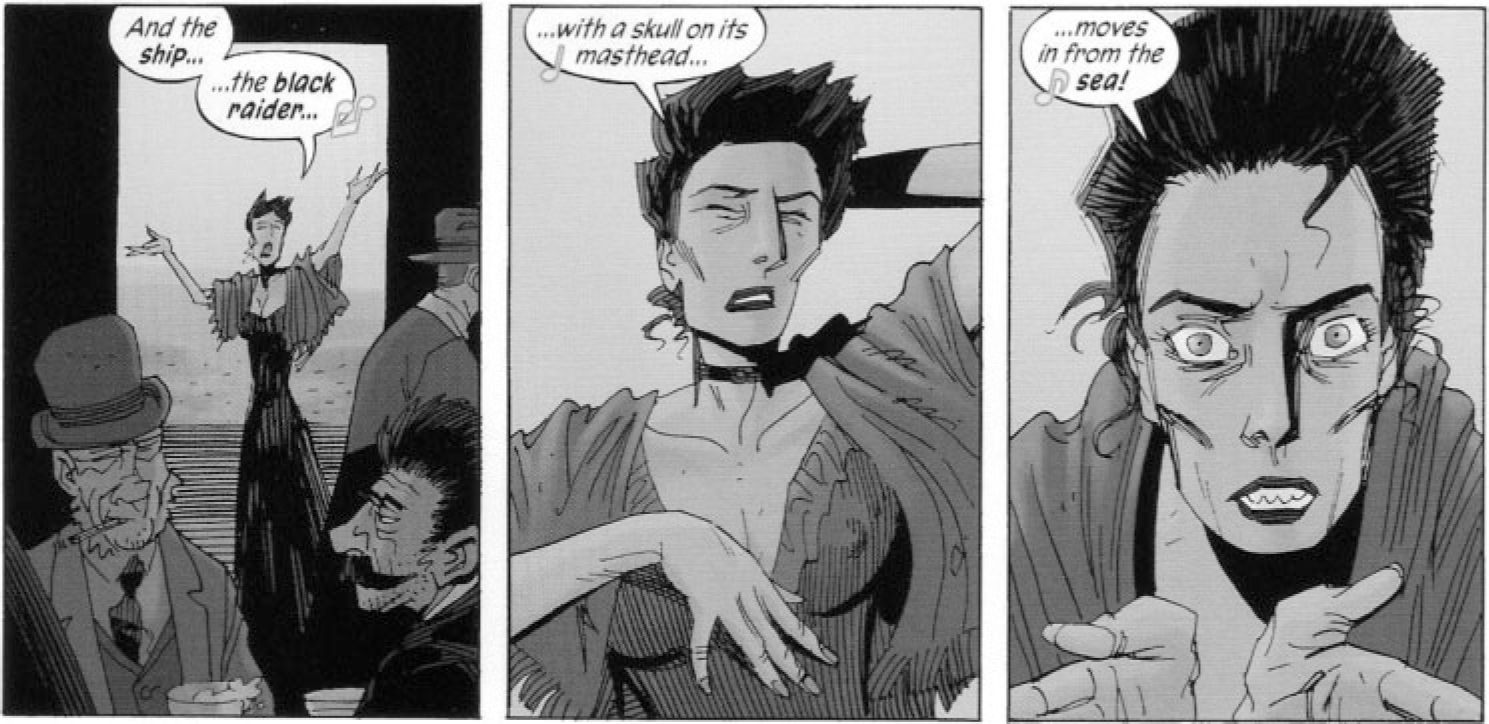
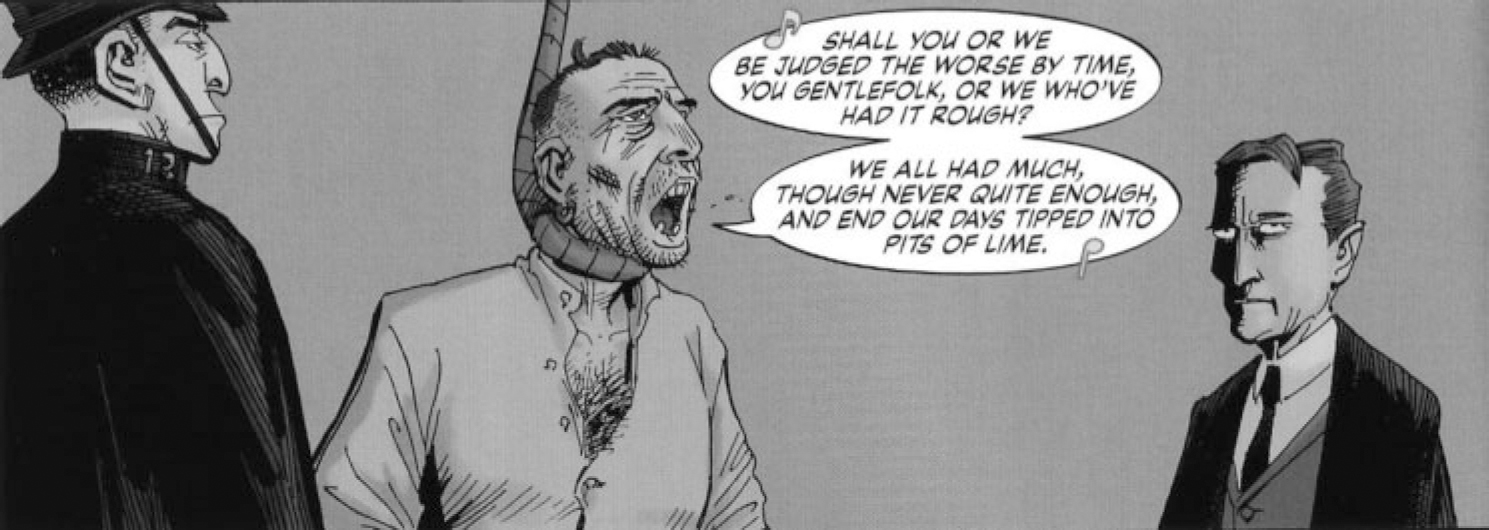
In the third volume of Moore's The League of Extraordinary Gentlemen, subtitled Century, Moore explicitly and obviously constructs his comics as musical-performative, particularly musical-theatrical, entities. Recalling the use of unstaffed notes to indicate Hyde's whistling in earlier issues of the comic, Moore uses quavers and crotchets surrounding speech bubbles to indicate sung texts (see Figures 4–5). The colour of the notes is particular to each singing character. Some of these songs emanate from the unspecific ether, but most are shown to be sung by characters in the comic. Each of the three chapters of Century includes songs that lyrically map onto numbers from Brecht/Weill's Die Dreigroschenoper, though it is the first chapter that is explicitly a reworking of The Threepenny Opera.


In the first chapter of Century, entitled ‘1910’, Moore creates virtual musical theatre through the staging of a reworked version of The Threepenny Opera.Footnote 88 A significant proportion of the dialogue in ‘1910’ is sung; the songs from the opera act as plot nodes that anchor the comic's action. Moore borrows elements of the narrative from The Threepenny Opera, which are intertwined with new plot material featuring the regular League of Extraordinary Gentlemen protagonists. One of Moore's embellishments to The Threepenny Opera, for example, is supplied through the premiss that Jack the Ripper and Macheath are one and the same person. The singular identity of Jack/Mack is explicitly revealed midway through the comic, when Jack walks into Act 3, scene ii of Berg's Lulu singing ‘Mack the Knife’ and kills Countess Geschwitz and Lulu (who screams her Todesschrei, just as she does in the opera).Footnote 89
Moore securely references the Threepenny Opera songs throughout Century by creating lyrics that invoke the Brecht/Weill material. His new sung texts do not replicate the Threepenny Opera lyrics directly, but are similar to the opera's libretto and match the melodic rhythm and repetition schemes of the Weill songs. Just as in the Kitty Kat Keller song, Moore uses the presentation of the sung text in Century not only to suggest the rhythm and phrasing of a song, but also to establish the sung material as mapping directly onto a song from The Threepenny Opera, despite the altered lyrics. It is straightforward to identify the four songs that are used in the first chapter of Century, and the repeated songs use different lyrics upon each reprise (see Tables 3–4). Readers of the comic have easily recognized the songs that Moore used as his models, and their investigation has been assisted by the credit to Weill and Brecht printed inside the front cover of the comic.Footnote 90
| Comic page/panel | Comic character | Threepenny Opera song | Original character |
|---|---|---|---|
| pp. 7/6–7/9 | Disembodied voice (possibly Macheath) | ‘Mack the Knife’/‘Die Moritat von Mackie Messer’ one verse |
Street Singer/Ausrufer |
| pp. 12/2–12/7 | Jack Macheath | ‘Mack the Knife’/‘Mackie Messer’ one verse |
Street Singer/Ausrufer |
| pp. 22/2–24/7 | Jack Macheath | ‘Mack the Knife’/‘Mackie Messer’ four verses |
Street Singer/Ausrufer |
| pp. 25/2–26/7 | Suky Tawdry | ‘Pirate Jenny’/‘Seeräuber-Jenny’ one verse |
Polly or Jenny |
| pp. 36/2–37/7 | Suky Tawdry | ‘Pirate Jenny’/‘Seeräuber-Jenny’ one verse |
Polly or Jenny |
| pp. 42/2–43/7 | Suky Tawdry | ‘Pirate Jenny’/‘Seeräuber-Jenny’ one verse |
Polly or Jenny |
| pp. 47/1–48/1 | Suky Tawdry | ‘Pirate Jenny’/‘Seeräuber-Jenny’ one verse |
Polly or Jenny |
| pp. 54/2–55/5 | Suky Tawdry | ‘Pirate Jenny’/‘Seeräuber-Jenny’ one verse |
Polly or Jenny |
| pp. 57/4–59/4 | Jack Macheath | ‘Grave Inscription’/‘(Grabschrift) Ballade in der Macheath jedermann Abbitte leistet’ whole song: verse A x2, verse B x2, coda |
Macheath |
| pp. 64/2–65/7 | Suky Tawdry | ‘Pirate Jenny’/‘Seeräuber-Jenny’ one verse |
Polly or Jenny |
| pp. 71/1–72/1 | Suky, Macheath and Chorus | ‘What Keeps Mankind Alive?’/‘Denn wovon lebt der Mensch?’ first part of verse repeated, one chorus |
Macheath and Mrs Peachum |
| Moore (pp. 25/2–26/7) Footnote a | Blitzstein Footnote b | Brecht Footnote c |
|---|---|---|
| You gentlemen can peek while she's slinging out the slops and she's slinging out the slops as you're peeking. Or you meet her in the hallway and you wink as you pass and you make some smart remark about her titties or her arse but you'll never know to whom you're speaking. You have no IDEA to whom you are speaking. Too drunk to rut, still you suck in your gut all puffed-up by your own vanity. When you catch her staring at you while she's working and think smugly, ‘She's staring at me.’ And the ship the black raider with a skull on its masthead moves in from the sea! |
You gentlemen can watch while I'm scrubbing the floors and I'm scrubbing the floors while you're gawking. And maybe once you tip me and it makes you feel swell on a ratty waterfront, in a ratty old hotel and you never guess to who [sic] you're talking. You never guess to who [sic] you're talking. Suddenly one night there's a scream in the night and you wonder ‘What that could have been?’ And you see me kinda grinning while I'm scrubbing and you wonder ‘What's she got to grin?’ And the ship a black freighter with a skull on its masthead will be coming in! |
Meine Herrn, heut’ seh'n Sie mich Gläser auswaschen und ich mache das Bett für jeden. Und sie geben mir einen Penny und ich bedanke mich schnell und Sie sehen meine Lumpen und dies lumpige Hotel und sie wissen nicht, mit wem sie reden. Und sie wissen nicht, mit wem sie reden! Aber eines Tages wird ein Geschrei sein am Hafen und man fragt: ‘Was ist das für ein Geschrei?’ Und man wird mich lächeln sehn bei meinen Gläsern und man sagt: ‘Was lächelt die dabei?’ Und ein Schiff mit acht Segeln Und mit fünfzig Kanonen wird liegen am Kai! |
a Alan Moore and Kevin O'Neill, The League of Extraordinary Gentlemen, [iii]: Century, Chapter 1: ‘1910’ (London, 2009).
b [Die Dreigroschenoper]/The Threepenny Opera, trans. Marc Blitzstein. Lotte Lenya; Samuel Matlowsky, cond., Decca Broadway 012 159 463-2.
c Die Dreigroschenoper. Lotte Lenya; Wilhelm Brückner-Rüggeberg, cond., CBS MK 42637.
‘1910’ is a gloss on the Weill/Brecht Threepenny Opera and John Gay's Beggar's Opera before it. It takes the form of a revenge narrative for Jenny Diver, who works at the Cuttlefish Hotel. Jenny's centrality to the text is emphasized by the refrain-like repetition of the ‘Pirate Jenny’ song throughout the comic. Moore's lyrics for the songs are sometimes closer to the German text, and at others more similar to Marc Blitzstein's English-language version. Even when Moore departs significantly from the sentiment of either established version, the strategic use of particular words or phrases links the Century lyrics with those of The Threepenny Opera. Unlike Blitzstein's translation, which moderates the more acerbic parts of the text, Moore accentuates the gritty and vulgar tone of Brecht's lyrics (see Table 4).
Moore's version of The Threepenny Opera seeks to be a substantial reworking and rendering of the source materials, rather than a simple quotation of the songs. He thus places himself alongside Gay and Weill/Brecht/Blitzstein in elaborating upon a central story shared by all three versions of The Threepenny/Beggar's Opera. For instance, Moore creates new histories for characters – Jenny Diver (a character from The Beggar's Opera) is an assumed name in Century: Jenny is Janni Dakkar, daughter of Captain Nemo. The ‘black ship’ in the lyrics of ‘Pirate Jenny’ comes to refer to the Nautilus, which destroys the dockside town in an act of revenge for the mistreatment of Jenny/Janni by the local population. Suky Tawdry is given a greater role in Moore's version of the story: she acts as an omniscient musical narrator, singing of the revenge that will soon be exacted.Footnote 91 Moore elaborates upon the original sources through new lyrics, a refocusing of the plot, providing new backstories to characters and intertextual connections that enrich the characters and situations.
Century is an unusually performative comic. Apart from references to staged works like Lulu and The Threepenny/Beggar's Opera, the comic's sense of performance, of staging the musical, is accentuated by several features of the presentation of the songs. Perhaps most obviously, the characters are distinctly represented as singing, with mouths wide open in expressions of bel canto fortitude (see Figures 4–5). This is no internalized singing monologue – the characters sing out loud, and they are also heard by other characters to be singing. The musical theatre conventions are doubly embodied when Macheath's ‘Grave Inscription’ is introduced by the following text:
executioner: Mr. Macheath, do you have any last words?
macheath: Why, thank you kindly, sir. I do have something to say, as it happens.
macheath (with notes to indicate sung text): You people who live on while I must die …Footnote 92
Not only is this moment a typical (and heavy-handed) ‘cue for a song’, but saying and singing are treated by the principal characters as interchangeable. Both of these theatrical clichés enhance the sense of a staged piece of musical theatre.
The singing characters are carefully drawn to suggest a melodramatic performance. Figure 4, for example, shows the last lyrics of Suky's first rendition of ‘Pirate Jenny’. Her bodily gestures, exaggerated facial expressions and direct gaze towards the reader/audience all suggest a sense of a staged performance, one that has been directorially ‘blocked’. The structure of the comic even seems to approach a musical-dramatic formal arrangement: the last few pages of the comic, which stages ‘What Keeps Mankind Alive’, appears like a traditional operatic finale, featuring solo passages and a duet, and even shows a chorus line of prostitutes singing and dancing to the song.
Century's performative staging of the musical/operatic action of The Threepenny/Beggar's Opera acts as a microcosm of the whole League of Extraordinary Gentlemen project, which is founded upon the concept of an intertextual combination of pre-existing texts. Genette refers to ‘any text derived from a previous text’ as a ‘hypertext’, and distinguishes two types of hypertextual relationship: transformation and imitation.Footnote 93 Century includes both types of relationship, since it both transforms aspects of The Threepenny Opera and includes substantial new material in imitation of the Brecht/Weill style. This variety allows Century to encompass ‘moods’ (as Genette calls them) as diverse as ‘parody’, ‘pastiche’ and straightforward ‘transposition’ of the songs to comic form. For those who have read Century, the comic seems like a supplemental text to the opera, enriching the characters and plots through intertextual elaboration and the variety of hypertextual processes.
The Threepenny Opera songs serve as a recurring theme throughout all three chapters of Century, binding the volume together. The remaining two chapters of Century (‘1969’ and ‘2009’) do not rely on The Threepenny Opera as much as the first, but Weill's songs are in evidence (see Table 5), alongside other musical performances, such as a song modelled on ‘Sympathy for the Devil’ performed by the comic's analogue for the Rolling Stones at a free concert in Hyde Park.Footnote 94 The Threepenny Opera songs are performed in different styles, depending on the chronology of the story: in 1977, the punk group Zuki and the Tawdries sing ‘Immoral Earnings (in the UK)’,Footnote 95 while in 2009, Spooky Tawdry raps a version of the ‘Cannon Song’.Footnote 96 That no music is audible in the comic avoids the potentially awkward, aesthetically risky or complex rearrangement of Threepenny Opera songs into new musical styles. In a similar fashion to Tawdry's performance of ‘Pirate Jenny’ in ‘1910’, in ‘2009’ the three verses of the ‘Cannon Song’ are spread throughout the chapter, as a musical refrain. The rap's lyrics are a direct commentary on the main characters in the comic – Tawdry is once again an omniscient musical narrator. Tawdry's ‘Cannon Song’ demonstrates the privileged status of musical expression in Century, something that is borne out in the final song of Century: when Quatermain and Harker reunite after a 40-year separation, their emotionally charged reconciliation takes the form of the ‘Instead-Of Song’.Footnote 97 Singing is still a significant component of the comic and of the expressive mode of the characters, even if the plot of The Threepenny Opera is left behind in Chapter 1.
| Comic page/panel | Comic character | Comic song title | Threepenny Opera song | Original character |
|---|---|---|---|---|
| Chapter 2 pp. 70/3–72/7 | Zuki and the Tawdries | ‘Immoral Earnings (in the UK)’ | ‘Ballad of Immoral Earnings’/ ‘Zuhälter-Ballade’ 2 verses | Jenny/Macheath |
| Chapter 3 pp. 11/4–12/1 | Spooky Tawdry | ‘Cannon Rap’ | ‘Cannon Song’/‘Kanonen-Song’ 1 verse, 1 chorus | Macheath/Brown |
| Chapter 3 p. 19/7 | Spooky Tawdry | ‘Cannon Rap’ | ‘Cannon Song’/‘Kanonen-Song’ 1 verse, 1 chorus, but last phrase omitted | Macheath/Brown |
| Chapter 3 pp. 26/3–26/5 | undefined, presumably Spooky Tawdry | ‘Cannon Rap’ | ‘Cannon Song’/‘Kanonen-Song’ 1 verse, 1 chorus | Macheath/Brown |
| Chapter 3 pp. 31/7–32/4 | Allan Quatermain and Mina Harker | unspecified | ‘Instead-Of Song’/‘Anstatt daß-Song’ 2 verses | Peachum/Mrs Peachum |
Century draws upon The Threepenny/Beggar's Opera as sources to create a virtual musical-theatrical text. This musical-theatrical performance is played out in the reader's imagination, deployed through Moore's understanding of the ‘musical’ properties of the comic medium. The musical performances interact with the concurrent action of the comic in Moore's well-rehearsed ‘narrative counterpoint’, while the Threepenny/Beggar's Opera source(s) are invoked in order to generate ‘sparks of meaning’ as intertextual reference piles upon intertextual reference and palimpsestic texts are placed in dialogue with each other, to their mutual enrichment. The citation of the Threepenny Opera songs in an ostentatious way (just like the other forms of ‘visualized sound’ discussed earlier) prompts readers to begin active investigative interpretation of the comic: they are encouraged to find associations and resonances between the two bisociative frames of the songs and plots of The Threepenny/Beggar's Opera and the action/songs in Century – the sparks of meaning are created through the dialogue between the sources that feed into the comic.
Moore's version of The Threepenny Opera might be seen to be a fulfilment of Brecht's ‘epic opera’ concept. As Stephen Hinton writes, quoting Brecht, ‘[Brecht's] central idea behind epic opera, which he saw principally in terms of an antithesis to the Wagnerian Gesamtkunstwerk, was the “separation of the elements”.’Footnote 98 What could be a greater process of separation in a piece of musical theatre than to silence the music completely? Hinton continues:
Brecht's model of the epic form of theatre [entails], in contradistinction to the dramatic form, not ‘one scene for another’ but ‘each scene for itself’, not ‘growth’ but ‘montage’, not ‘linear action’ but ‘in curves’, not ‘evolutionary inevitability’ but ‘jumps’.Footnote 99
The nature of the comic medium directly matches these demands for epic opera: it is essentially non-linear, jumpy and montage-like, and involves fixation on individual isolated ‘moments’ or ‘scenes’, as each panel is a discrete entity. Comics may be considered as predisposed to accentuating Brechtian values: as Annalisa Di Liddo puts it, comics are ‘an intrinsically performative medium […] where the illusion of mimesis is incessantly broken by the blatant antirealism of the lines that intertwine on the page’.Footnote 100 Furthermore, the projected ‘inscriptions’ that replace dialogue in Brecht/Weill's Rise and Fall of the City of Mahagonny seem similar to comic speech bubbles. If, as Hinton has suggested, ‘the very idea of opera is at loggerheads with the central notion behind epic Verfremdung [distancing]’, because of the ‘modes of delivery: speech on the one hand and song on the other’,Footnote 101 Moore has succeeded in creating an epic opera through minimizing this distinction in a format that contains no sonic content. Dramatic illusion is thwarted because of the entirely virtual (and silent) nature of this performance.
The musical-performative dimension of Century is deployed in such a way that it becomes a major component of the text, and a significant part of its narrative arsenal. Through the musical performance, Century ‘thickens’ the text through intertextual association, while making explicit the theatrical nature of the comic. Moore's aspirations for the text are also revealed by the choice of The Threepenny Opera: that most highbrow of low art, and lowbrow of high art (to paraphrase Hans Keller).Footnote 102 The Threepenny Opera, itself a distinctly hypertextual work, is the perfect musical source to use and rework in a comic book series that emphasizes the joy of intertextual synthesis and fantastic performance.
Conclusions
This brief and necessarily introductory survey has discussed only a small domain of music's involvement with comics,Footnote 103 but even within this field it is clear that music can be a significant part of a comic text. Music in comics can extend from reference in the dialogue of characters to a song that sounds in the background, or the simple citation of song lyrics to carefully depicted performances and notated music. The musical content of such aspects of a comic can be as specific as including musical scores or as unspecific as the image of a musical instrument being played. Allan F. Moore has used the terms ‘over-coding’ and ‘under-coding’ to refer to the polar extremes of songs ‘whose meaning appears so obvious that no alternative is possible, and tracks whose meaning is entirely open to appropriation’.Footnote 104 In the context of comics, musical inclusions can be extraordinarily ‘under-coded’, when only the existence of a musical source is denoted by the comic, or ‘over-coded’, when notated score is included in the text. Whether empathetic or anempathetic, sonically layered or isolated, specific or unspecific, music in comics has no one single form; Moore uses a variety of techniques to produce a range of aesthetic effects. Some instances, such as Century, use many such techniques simultaneously, encompassing musical citation, visualized sound and pre-existing music that is newly transformed, to establish bisociative frames that form a narrative counterpoint and invite active interpretation by the reader.
Each of the types of intersections between music and comics identified and discussed in this article prompts its own set of questions. Table 6 presents an outline of the ways in which music has been observed to interact with comics and a list of ‘analysis questions’ that proceed from the music–comic situation.Footnote 105 This list of analytical prompts is by no means exhaustive, but it can act as a starting point for the analysis of music and comics, and approximates my own line of enquiry employed when conducting the analysis presented earlier in this article.
| Musical intersection | Analysis questions | |||
|---|---|---|---|---|
| Outside the comic book | Music refers to comics (Metropolis Symphony, lyrical citation in pop songs, music videos use comic imagery) |
|
||
| Records of music produced based upon comics (David J's ‘Kitty Kat Keller’ recording) |
|
|||
| Cited and unsounded music | Reference made to music and musicians from real world in comic (Pop stars in comics, Watchmen citations) |
|
||
| Reference made to fictional music and musicians in comic (Watchmen) |
|
|||
| Performed/ actualized music |
|
|||
| Musical content not specified to any significant degree (League of Extraordinary Gentlemen, ii) |
|
|||
| Newly created music | Notated music (‘This Vicious Cabaret’) |
|
||
| Defined through presentation of lyrics in text (Kitty Kat Keller song, the fascist hymn) |
|
|||
| Transmedial intersections | Pre-existing music (‘Roll Out the Barrel’, 1812 overture, Martha and the Vandellas in V for Vendetta) |
|
||
| Comic ‘setting’ of music (Alan Moore's Songbook) |
|
|||
| Narrative counterpoint (1812 overture, League of Extraordinary Gentlemen, [iii]: Century) |
|
|||
| Comics as musical performance (1812 overture, League of Extraordinary Gentlemen, [iii]: Century) |
|
|||
Music is part of the narrative apparatus of comics, and particularly frequently so in Moore's work. Aside from the use of music to depict characters and locations, and to articulate the themes of the work, music can impart a distinct sense of rhythm, tempo and pace to the action in comics, even if the reader is not bound to perceive the music in that same temporality. Furthermore, Moore's use of music regularly complicates notions of diegetic/non-diegetic music when the action of the comic is equated with music. Di Liddo has discussed the importance of performance and the theatrical tradition to Moore's work in a general way,Footnote 106 but she does not consider music. I claim that music in Moore's comics emphasizes a specifically musical-performative aspect of comics, to the degree (in the case of Century) of becoming virtual musical theatre.
References to music, particularly art music and notated music, may be seen as part of the literary aspirations of Moore's work, but more significantly Moore uses ‘visualized sound/music’ to create a ‘surplus’ proliferation of possible meanings (just as Szaloky argues for silent film) that invite hermeneutic activity on the part of the reader. The ‘thick’ textuality of Moore's comics is further asserted by the practice of ‘narrative counterpoint’ – the establishment of two (or more) bisociative frames which, when presented to the reader, generate what Moore refers to as ‘sparks of meaning’ through their mutual contemplation. The creation of such unbounded ‘meanings’ through music also operates outside the comic text, where musical settings of comics form epitexts to the comic book, and pre-existing music and lyrics are ‘set’ or ‘staged’ by adaptation into comics. Moore himself has been involved with transmedial adaptation, when creating a comic that was packaged with his music single ‘Old Gangsters Never Die’,Footnote 107 and a vinyl record that was included with special editions of a comic.Footnote 108 The use of music in the comic not only asserts the ‘artistic’ status of the text, but also acts as a statement of the comic's willingness to be ‘read’ in a critical manner by the reader. Faced with ostentatious and unusual musical inclusions in the text, the reader is encouraged to engage with the text through undertaking interpretative activity. Readers are prompted to muse on the relevance of The Threepenny Opera to the Century narrative, or ‘This Vicious Cabaret’ to that of V for Vendetta. Such interpretation may be as simple as imagining the synchronization of the musical climaxes of the 1812 with explosions, appreciating the dark humour of ‘Roll Out the Barrel’, or wondering why there is so much singing in Century. At the other extreme, readers may consider the literary resonances of the band names in Watchmen, the aptness of the comic settings of Moore's lyrics in the Songbook, the extent to which the first chapter of Century embodies epic opera, or the compositional merits of David J's songs. In the case of new music in comics, the reader can become a composer, such as in the Kitty Kat Keller song, where the reader may imagine their own music to fit the frame supplied by the comic.
The musical inclusions in Moore's comics mark the text as open, and the medium allows readers as much time as they wish to contemplate and interrogate the interrelations between the narrative and musical threads that Moore weaves. The enactment of reader enquiry is more important than the specific meanings that are drawn from the process: hermeneutic investigation is valued in and of itself. If Moore did intend that particular interpretations of the musical inclusions be made, his ‘sparks of meaning’ would be far more prescriptive and defined than the ephemeral ‘sparks’. Musical meanings remain ambiguous in the comics, to create the potential for open-ended, multiply valid readings, in a context that is sufficiently semiotically rich to ensure that such interpretation is rewarding. The musical inclusions are so pregnant with possible (and multiple) meanings that they encourage the reader to consider questions of the kind presented in Table 6. Readers are implored to interpret the musical moments and exercise their critical faculties. Moore's ‘sparks of meaning’ are attractive, accessible and without a single prescribed ‘correct’ interpretation, but prompt the reader to enact investigative hermeneutics.
The invitation to hermeneutics in Moore's comics resonates with recent debates in the interpretation and analysis of music. As Matthew Pritchard has recently reminded us, hermeneutic musical discussion necessarily involves dealing with metaphor and transduction of some kind, even in apparently more ‘objective’ score-based methods. A musical score is ‘really only another kind of “image”’,Footnote 109 something that is made explicitly clear in the cases of ‘This Vicious Cabaret’ and the 1812 overture. The depiction of music in the critically silent medium of comics makes obvious what is ‘missing’ from representations of music (of any kind), but, wearing its representative qualities on its sleeve, through the non-sounding silence, it also makes the claim for the representation of music in comics as being just as valid an interpretative domain as any other. Like any musical representation, the incompleteness (here, silence) of the music in these images demands the engagement of the human reader (the ‘body’ in Richard Leppert's discussion of music and image).Footnote 110
It is perhaps ironic that the interpretation of music should be so accessible when the sonics of music are silenced. Yet it is that unsounding silence of the music which gives it the potency to beg for the reader's active engagement. Unlike more abstracted or esoteric forms of the discussion of music, these comics offer a way into musical hermeneutics for the layman. Comics have a role to play in modern, particularly popular, musical hermeneutics; they allow non-specialists, and non-notation-literate readers, to conduct musical interpretation in a rewarding way. The (often youthful) comic readers may become critics and composers as they engage with the music in comics. We might hope that the critical sensibility and transferable skills of analysis cultivated by these popular texts would not be limited to the reader's encounter with other comics, but would be retained in their future readings of other musical and other literary texts. As such, music in these comics bestows a (super)power upon the reader, only the very beginning of which is the ability to hear music in a silent medium.
The author wishes to thank Dr Justin Williams for his valuable comments on an earlier draft of this article. There is no definitive convention for referring to panels in comics. Often comics are printed without page numbers. Page numbers in collected editions of material first published as separate volumes may or may not match the original page numbers of the individual issues. I here use page numbers where appropriate, and otherwise describe the page in relation to a distinct chapter mark. Panels are numbered from left to right and from top to bottom of the page.