1. Introduction
Understanding the location decisions of multinationals has been a key issue of concern in international economics (Nachum and Zaheer, Reference Nachum and Zaheer2005). An earlier literature has focused on resource endowments, the product cycle and market size of host countries (Dunning, Reference Dunning1970; Vernon, Reference Vernon1966). A more recent literature has examined the role of institutional quality in explaining cross-country variations in foreign direct investment (FDI) inflows (e.g., Altomonte, Reference Altomonte2000; Bevan and Estrin, Reference Bevan and Estrin2004; Mody and Srinivasan, Reference Mody and Srinivasan1998; Peng et al., Reference Peng, Wang and Jiang2008; Rodriguez et al., Reference Rodriguez, Siegel, Hillman and Eden2006; Tuman and Emmert, Reference Tuman and Emmert1999; Wei, Reference Wei2000). These studies do not find a clear unambiguous positive effect of better institutional quality on FDI inflows. While Globermann and Shapiro (Reference Globerman and Shapiro2003) find that countries that fail to have the minimum threshold level of effective governance are non-recipients of US FDI, Wheeler and Mody (Reference Wheeler and Mody1992) do not find any significant impact of good quality institutions on the location of US multinationals. Using bilateral FDI stocks around the world, Daude and Stein (Reference Daude and Stein2007) explore the role of wide range of institutional variables in determining location of FDI, and find that better institutions have overall positive and significant effect on FDI location choice. In another study, Fukumi and Nishijima (Reference Fukumi and Nishijima2010) find that while better institutions attract more FDI, FDI inflows into the destination country can also improve its institutional quality. Examining the location choice of 6,288 US multinationals in China for 1993–2001, Du et al. (Reference Du, Lu and Tao2008) find that US multinationals prefer to invest in regions that have better protection of intellectual property rights, lower degree of government intervention in business operations, lower level of government corruption and better contract enforcement. On the other hand, Zheng (Reference Zheng2011) finds an inverted U-shape relationship between institutional quality and FDI inflows.
The focus of the previous literature that examines the relationship between institutional quality and FDI inflows is on explaining across-country and over-time variation in FDI inflows. However, within-country variations (across industries) in FDI inflows are large and persistent, which cannot be explained by overall institutional quality. For example, Italy, which is in the second quartile of institutional quality (as measured by the protection of property rights), received four times more US investment in transportation, five times more in food, near about seven times more in chemicals, compared to mining in 1984–2010. In contrast, Venezuela, which is in the bottom quartile of institutional quality, received more US FDI in mining than the aggregate of all other sectors in the same period. Similarly, Singapore (a country with high institutional quality) has nearly double US investment in transportation than Argentina (a country with low institutional quality). In this paper, we look at the institutional determinants of both within- and across-country variations in FDI inflows over time.
Why do we see such wide variations across sectors in FDI inflows for a country with a given level of institutional quality? We posit that countries with better contract enforcement are able to attract FDI relatively more in industries where relationship-specific investments are more important. When investments are relationship specific, industries with such relationship specificity suffer from hold-up problem with suppliers, and if contracts cannot be enforced, under-investments occur (Williamson Reference Williamson1996, Reference Williamson2000). Therefore, in countries with weak legal institutions to enforce contracts, multinationals will be less willing to invest in industries where assets are largely non-deployable (Brouthers, Reference Brouthers2002; Gatignon and Anderson, Reference Gatignon and Anderson1988; Pan et al., Reference Pan, Teng, Supapol, Lu, Huang and Wang2014). In such countries, multinationals will prefer investing in industries or sectors that are not intensive in institutions that are required for investment to take place. In contrast, in countries where legal institutions are of high quality, multinationals are more likely to invest in industries or sectors, which by their very nature have high asset specificity.
In this paper, we focus on the joint impact of the level of contract enforcement quality at the country level with the relationship specificity at the industry level in attracting US FDI inflows to a particular industry in a particular country. Our core hypothesis is that in countries with high quality of contract enforcement, foreign investors are more likely to invest in the industries where by their very nature investments are relationship specific. Conversely, in countries with low quality of contract enforcement, foreign investors are more likely to invest in industries where investments to a large degree are not relationship specific. To test our hypothesis, we examine the determinants of US FDI using a three-dimensional panel data set for 50 countries and 6 sectors for the time period 1984–2010. The strength of our approach is that in contrast to previous work that has focused on average FDI flows across countries, we are able to explain variations in both the FDI flows across and within countries for a given year.
To capture the extent of asset specificity in a particular industry or sector, we use a novel measure of the importance of relationship-specific investments in an industry that has been proposed by Nunn (Reference Nunn2007). The measure captures the proportion of intermediate goods that require relationship-specific investments in each good or industry. Intermediate inputs that are sold in organized exchanges or reference priced in trade publications are assumed not to be relationship specific. These inputs have thick markets with many alternate buyers and sellers. In contrast, if an input is not sold in an exchange or reference priced, it has low levels of market thickness and can be considered to be relationship specific. While Nunn has used the measure to explain the pattern of trade, we use this measure to explain why there are large within-country differences in US FDI, independent of other determinants of US FDI flows across countries and over time. Our unit of analysis is country–industry, and we use the variation in US FDI across industries/sectors and countries over time to identify the joint impact of contract enforcement and relation specificity.
We focus on US FDI, as the United States is the largest outbound foreign direct investor in the world. US MNCs invest in most sectors and across most regions of the world. By focusing on a single source country, we hold constant the latent preferences that multinationals might have in investing in a particular country or sector. We also use country-, industry- and year-fixed effects to capture any unobserved effect specific to individual cross-sectional units or time. Year-fixed effects capture common variations in US FDI flows across countries due to possible common shocks. For example, changes in US interest rate can generate shocks across countries, leading to variations in US FDI flows. Country-fixed effects capture the case in which there may be some innate reasons for US firms to invest in a particular country (for example, for cultural or geographical reasons). Finally, sector-fixed effects capture latent advantages that US MNCs may have in certain industries. For example, as the US financial sector is globally competitive, it is more likely that US multinationals would tend to invest in the financial sector.
We find strong support for our core hypothesis that US FDI inflows are more likely in sectors that are more characterized by relation-specific investments in countries with high institutional quality. In contrast, US FDI inflows are more likely in sectors, that are characterized by low institution intensity in countries with poor institutional quality. Our results are robust to different measures of institutional quality as well as to endogeneity concerns.
Our paper contributes to a larger literature on the role of property rights institutions in explaining cross-country variations in economic development. Scholars such as Acemoglu et al. (Reference Acemoglu, Johnson and Robinson2001), Jones (Reference Jones1981), North and Thomas (Reference North and Thomas1976), North (Reference North1981, Reference North1990, Reference North1994) and Levine et al. (Reference Levine, Loayza and Beck2000) have argued that countries with better institutions are able to achieve higher domestic investment and productivity, and by doing so, achieve higher levels of per capita income. This theoretical perspective has been supported by empirical studies (Hall and Jones, Reference Hall and Jones1999; Knack and Keefer, Reference Knack and Keefer1995; Kovac and Spruk, Reference Kovac and Spruk2016; Mauro, Reference Mauro1995; Rodrik, Reference Rodrik1999; Yaşar et al., Reference Yaşar, Paul and Ward2011). In a recent theoretical study, Chang (Reference Chang2011) critically examines the role of institutions in economic development. Our paper provides an additional mechanism on why better institutional quality leads to higher levels of economic development. If countries with better contract enforcement are able to attract foreign investment in industries that need a higher level of governance infrastructure and also tend to be the more dynamic and have higher technological spillovers, higher institutional quality is likely to attract the type of FDI that is more likely to lead to higher productivity and economic growth (Feinberg and Majumdar, Reference Feinberg and Majumder2001). In contrast, countries with weak institutions are likely to attract FDI in industries or sectors that are not institution intensive such as mining and that are not likely to lead to technological externalities or higher total factor productivity growth (Crespo and Fontoura, Reference Crespo and Fontoura2007; Iršová and Havránek, Reference Iršová and Havránek2013).
The remainder of the article is structured as follows. In the next section, we present our theoretical argument. In Section 3, we briefly discuss patterns in US outbound investment. We then describe our empirical strategy and data in Section 4. In Section 5, we present the empirical results of our analysis and Section 6 concludes.
2. Relationship-specific investments, institutional quality and multinational location
Why should the property rights/contract enforcement environment matter for the multinational that wants to invest in a particular sector? To see this, consider investment made by an input supplier that specializes in a particular input for the needs of a final good producer. For example, this could be a first-tier supplier making car seats for the automobile multinational, General Motors (GM). The investments that the supplier firm makes are relationship specific because the value of the investments in customization is higher within the buyer–seller relationship than outside the relationship (Williamson, Reference Williamson2005). In this environment, if contracts between the supplier firm and GM are imperfectly enforced, there is under-investment ex ante (Bolton and Whinston, Reference Bolton and Whinston1993; Dixit, Reference Dixit2009; Hart and Moore, Reference Hart and Moore1999). Therefore, countries with good contract enforcement will have less under-investment. This would make the costs of producing customized inputs as well as that of the final goods (in this example, automobiles manufactured by GM) less. As this cost advantage will be higher, the more relationship-specific investments (that is, contract intensity) are in the production of a final good (Williamson, Reference Williamson1996). It follows, then, that a multinational that want to invest in a sector that uses inputs requiring relationship-specific investment intensively are more likely to locate in countries with better contract enforcement.
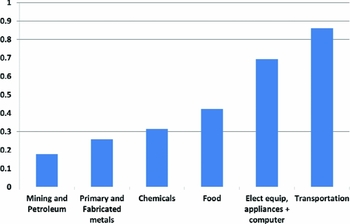
Figure 1 provides the level of contract intensity by industry, taken from Nunn (Reference Nunn2007). It shows that the most contract-intensive industry/sector is transportation (comprising automobiles, pickup trucks and so on) and the least contract-intensive industries/sectors are mining and petroleum. So for a multinational such as GM, it would be cost effective to locate a plant in a country such as Germany, with a high level of contract enforcement, than a country like Venezuela, with a low level of contract enforcement. On the other hand, for an oil multinational such as Chevron, investing in a country such as Venezuela would pose no significant problem.
Contract intensity by industry (averaged over 1984–2010). Source: Nunn (Reference Nunn2007).

3. Patterns in US FDI
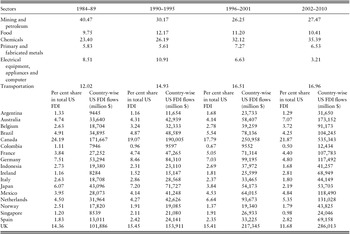
Firms from the United States are the largest FDI investors in the world followed by British and German firms. Currently, about 70% of the total US FDI is located in developed countries, and Europe alone accounts for more than half of the total US investment abroad (Figure 1SFootnote 1 and Table 1). The Asia-Pacific region has taken over from Canada as the second most popular destination for US FDI.
US FDI by industry (% share in total US FDI)

Note: Countries whose per cent share in US FDI is 1% or above are retained and they are arranged alphabetically.
Source: Authors’ calculations from US Bureau of Economic Analysis.
The changing patterns of US investment abroad in different sectors was reflected in the fundamental changes that occurred in the US economy in the same period. Investment was shifting from mining and extractive, processing and manufacturing industries toward high technology industries and these changes were echoed in US direct investment abroad, which are now concentrated more on high technology sectors located in highly developed countries with advanced infrastructure and communications systems. Figure 2S shows cross-sector distribution of US FDI flows for different time periods.
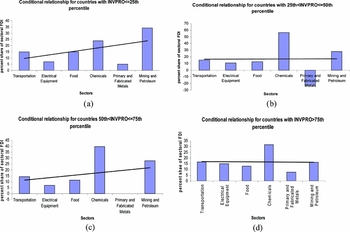
The relationship between sector-specific contract intensities and inflow of US FDI at different percentiles of INVPRO. Source: US Bureau of Economic Analysis and Authors’ calculation.

US direct investment experienced a sharp drop in 2005 due to a fall in the amount of reinvested earnings by the US parent firms and was followed by another fall between 2008 and 2010 as a consequence of the Global Financial Crisis that hit the world economy in December 2007 (Figure 3S). Meanwhile, flows from the developing countries increased from 2.7% of the total global outflows in 1989–1991 to 13% of the total global outflows in 2007.
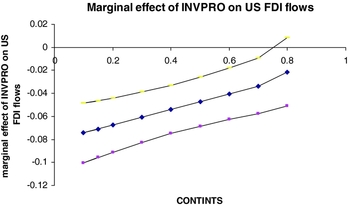
Marginal effect of INVPRO (with confidence intervals) on US FDI flows.

4. Empirical strategy
Our interest centers on the property rights institutions–contract intensity interaction coefficient which captures the role of country-specific institutional quality in negotiating the impact of industry- or sector-specific contract intensities on US FDI inflows. This leads to our core hypothesis.
Hypothesis: Countries with better property rights institutions receive relatively more US FDI in industries that have high contract intensities, whereas countries with low institutional profile receive relatively more US FDI in industries with low contract intensities.
To test this hypothesis, we estimate the following equation:
 $$\begin{eqnarray}
{\rm{FD}}{{\rm{I}}_{c,s,t}} &=& {\alpha _0} + {\alpha _1}{\rm{INVPR}}{{\rm{O}}_{c,t}} + {\alpha _2}{\rm{CONTINT}}{{\rm{S}}_s}\nonumber\\
&& +\, {\alpha _3}({\rm{INVPR}}{{\rm{O}}_{c,t}} ^{*}{\rm{CONTINT}}{{\rm{S}}_s}) + {\alpha _4}{X_{c,t}} + {\lambda _c} + {\gamma _s} + {\partial _t} + {u_{c,s,t}}\qquad
\end{eqnarray}$$
where FDI is the logarithm of real FDI, INVPRO measures property rights institutions, CONTINTS is the measure of sector specific contract intensities, X is a vector of control variables, λ captures country fixed effects, γcaptures sector fixed effects, δ measures time fixed effects and u is a stochastic error term. Subscripts c stands for country, s stands for sector and t stands for time.
Our core variable of interest is the interaction term INVPRO*CONINTS. Consider the coefficient α3 for institutional quality-sector-specific interaction term. A positive coefficient will indicate that countries with better property rights institutions receive relatively more US FDI in industries that have more relation-specific investments. The marginal effect of INVPRO on inflow of US FDI is computed as follows:
 $$\begin{equation}
\frac{{\partial {\rm{FDI}}}}{{\partial {\rm{INVPRO}}}} = {\alpha _1} + {\alpha _3}{\rm{CONTINTS}}{\rm{.}}
\end{equation}$$
Equation (1a) is the marginal impact of INVPRO in the presence of CONTINTS. If α3 > 0, then equation (1a) implies that as property rights institutions of a country improve (i.e., risk in investment decreases), it receives more US FDI for sectors with high contract intensity.
We estimate equation (1) by a panel least squares model for 50 countries and 6 sectors for the period 1984–2010. We use country-, sector- and year-fixed effects.
INVPRO measures risks to investment and we use it as a proxy for the security of property rights. The variable ranges from 0 to 12, with higher values indicating higher protection of property rights. Investors in countries with better quality property rights institutions are less likely to see their investments being expropriated, and such institutions have been shown to be a strong predictor of economic performance (Acemoglu and Johnson, Reference Acemoglu and Johnson2005).
We also use another institutional variable – contract viability (CONTVIAB) – as a robustness check. CONTVIAB measures the risk of unilateral contract modification or cancellation and is constructed from two International Country Risk Guide (ICRG) variables called repudiation of contracts and expropriation risk. The variable repudiation of contracts measures the risk that foreign businesses, contractors and consultants face during fall in income, curtailment in budget, indigenization pressure, a change in government or a change in social and economic priorities of a government. Lower values indicate the risk of modification or repudiation of a contract with a foreign industry. The variable risk of expropriation assesses the risk of complete elimination and forced nationalization of property. Countries with lower values possess the highest risk of expropriation.Footnote 2
We also use Nunn's (Reference Nunn2007) measure of relation-specific investment to construct contract intensities (CONTINTS) for six sectors (mining and petroleum, food, chemicals, primary and fabricated metals, electrical equipment, appliances and computer, transportation). Nunn built these measures from the work of Rauch (Reference Rauch1999), who categorized each of 1,189 industries (according to the 4-digit SITC Rev. 2 codes) according to whether they could be bought on an organized exchange, reference priced or neither. If a product could be bought on an organized exchange, it was taken to indicate significant market thickness (i.e., a large number of buyers and sellers of the good) or a certain degree of homogeneity in the production of that good, and hence a low level of “relationship-specificity” (Amirapu, Reference Amirapu2015). A product that could be reference priced was assumed to have an intermediate degree of relationship specificity, while products that could neither be bought on an exchange nor reference priced were assumed to have relatively thin markets and a high level of relationship specificity. Using Rauch's classification of goods according to their relationship specificity, Nunn created the following industry level measure:
 $$\begin{equation*}
{\rm{CONTINT}}{{\rm{S}}_i} = {\Sigma _j}{\theta _{ij}}\big(R_j^{{\rm{neither}}} + R_j^{{\rm{ref}}\,{\rm{price}}}\big)
\end{equation*}$$
and θij = uij /ui , where uij is the value of input j used in industry i, and uj is the total value of all inputs used in industry i; R neither j is the proportion of input j that is neither sold on an organized exchange nor reference priced, and R ref price j is the proportion of input j that is not sold on an organized exchange but is reference priced.
Nunn created this measure for 381 industries classified according to the US Bureau of Economic Analysis (BEA) Input-Output (IO) industry classification. Nunn reports the measure for the years 1982, 1987, 1992 and 1997. The values of contract intensities for the six sectors for the year 1982 were used for the period 1984–1986. Similarly, contract intensities calculated for 1987 were used for the range 1987–1991, values for 1992 were used for 1992–1996 and lastly the values calculated for the year 1997 were used for the time period 1997–2010. While we use the same value of CONTINTS for more than one year, it is unlikely to lead to a bias in measurement because the values of contract intensities do not change significantly over time (for example, the correlation coefficients between contract intensities for different years is 0.99, suggesting very little variation in CONTINTS in a given sector over time).
Control variables
The choice of control variables is in accordance with the previous literature (see Du et al. Reference Du, Lu and Tao2008). The variables are population size (POP), merchandise trade as percentage of GDP (OPEN), number of telephones per hundred people (TEL), life expectancy at birth (LEB), percentage of urban population to total population (URBAN), inflation consumer prices (INF), real per capita GDP (PCGDP), government final consumption expenditure as a percentage of GDP (GOVT) and per capita electric power consumption (PCEPC). POP, TEL, LEB, INF, PCGDP and PCEPC are in logarithms, while OPEN and GOVT are ratios.
The attractiveness of the host country's market, generally proxied by the country's GDP or PCGDP, has been widely accepted in the empirical literature as a significant determinant of FDI flows (see Chakrabarti Reference Chakrabarti2001, Schmitz and Bieri Reference Schmitz and Bieri1972 and Schneider and Frey Reference Schneider and Frey1985). According to the market-size hypothesis, larger size of the host country's market is associated with higher inflows of FDI, as large markets are necessary for exploiting natural resources and economies of scale. In this paper, we use per capita real GDP (GDPPC) as a measure of market size.
Another variable that the literature has found to attract multinationals is good quality of infrastructure. For example, good-quality infrastructure positively influences inflow of FDI (Wheeler and Mody, Reference Wheeler and Mody1992). We have employed number of telephones per 100 persons (TEL) as a measure of infrastructure development for attracting foreign investment, and this variable is expected to be positively related to FDI.
Openness, measured by the ratio of total trade (exports + imports) to GDP (OPEN), is regarded as an important factor affecting the location choice of FDI, with a country's openness in international trade encouraging FDI (see Morisset Reference Morisset2000 and, Noorbakhsh et al. Reference Noorbakhsh, Paloni and Youssef2001). However, the impact depends on the type of foreign investment. If the investment is of market seeking type, then restricted trade/less openness can have positive influence on inward FDI flows. This is because the multinationals that have the objective of serving the local market now prefer to set up their own subsidiaries in the host market as it is difficult for them to import key intermediate inputs in the host country due to restricted trade. On the contrary, if the multinationals are more export orientated, this may encourage them to locate in a more open economy.Footnote 3 Hailu (Reference Hailu2010) and Leitão (Reference Leitão2010) have found significant positive relationship between trade openness and inward FDI flows. At the same time, Schmitz and Bieri (Reference Schmitz and Bieri1972) and Wheeler and Mody (Reference Wheeler and Mody1992) found a weak link between trade openness and FDI, while Yih Yun, Groenewold and Tcha (Reference Yih Yun, Groenewold and Tcha2000) report a negative relationship between the two variables.
Other control variables that we use are life expectancy at birth (LEB), total population (POP), inflation rate (INF), electric power consumption, general government final consumption expenditure as a percentage of GDP (GOVT) and urban population as a percentage of total population (URBAN). The hypothesis is that higher life expectancy (as a proxy for human capital), a lower inflation rate (as a measure of macroeconomic stability), better electricity provision, a smaller size of the government and greater urbanization (as another proxy for market size) would foster FDI inflows (see Al-Sadig Reference Al-Sadig2008, Noorbakhsh et al. Reference Noorbakhsh, Paloni and Youssef2001, Schmitz and Bieri Reference Schmitz and Bieri1972 and Schneider and Frey Reference Schneider and Frey1985, etc.)
Data sources
Data on US FDI has been taken from US BEA. Data on INVPRO has been drawn from the ICRG database of Political Risk Services (PRS) (https://www.prsgroup.com/). The ICRG index is constructed by PRS and it is available from 1984, which does not allow us to use US FDI data prior to 1984. Data for repudiation of contracts and risk of expropriation, which are used to construct CONTIAB, are also taken from PRS. Data for all the control variables are from the World Bank's World Development Indicators (WDI) database. We use consumer price index (2005 = 100), as the price deflator to obtain real values of US FDI and the data is taken from WDI (2014).
5. Results
We begin our empirical analysis by looking at the bivariate relationship between country-specific investment quality (INVPRO) and aggregate FDI for that country over 1984–2008 (Figure 4S). We see wide variations in the bivariate relationship between US FDI and institutional quality across countries. For example, there is an increasing trend in the inflow of US FDI for countries such as Sweden, Switzerland, Finland and the United Kingdom with improvement in their institutional quality over time. On the other hand, countries like Denmark, Greece and France experience a fall in US FDI in spite of an improvement in their investment quality profile. Further, many of the low-income and middle-income countries are experiencing decreasing shares of US FDI in spite of improvements in their institutional quality profile (for example, Portugal, Colombia, Costa Rica, Mexico, Panama, Dominican Republic, Jamaica, South Africa, Israel, Indonesia and The Philippines). The particular cases of China and Venezuela are noteworthy as both these countries have received a large amount of US FDI in recent years in spite of weak improvement in institutional quality for China and a decline in institutional quality for Venezuela.
Our interest is not in the broad relationship between US FDI and institutional quality, but in the specific issue of whether US FDI flows to less institution intensive sectors in countries with low institutional quality. To see this, we arrange our sample of countries in terms of various percentiles of INVPRO, averaged over 1984–2010, and look at the conditional relationship between US FDI at the sector level and the contract intensity of the sector. This conditional relationship is shown in Figure 2. Figure 2(a) shows that for countries that have weak property rights institutions (INVPRO ≤ 25th percentile), US FDI tends to go to sectors which have low contract intensity. For example, Venezuela, China and Colombia are in this group and receive large amounts of US FDI in mining compared to other sectors. On the other hand, for countries with above average protection of property rights (INVPRO ≥ 50th percentile), US FDI is more likely to go to the sectors with medium contract intensity such as chemicals, though mining remains an important sector to invest even in countries with high institutional quality (Figures 2c and d).
Empirical results
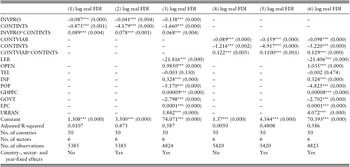
We present the summary statistics of the dependent and independent variables in Table 1S, followed by the estimates of equation (1) in Table 2. We first report an estimate of equation (1) without any controls and without any country, sector and year effects (Column 1). We then include country, sector and year effects (Column 2). Finally, we include all the controls (Column 3). We find that the coefficient of the interaction term INVPRO–CONTINTS is positive and statistically significant in all our estimates. This supports our hypothesis that countries with good institutional quality will receive US FDI in sectors that have high contract intensities, and similarly countries with poor institutional features will receive investments in low contract intensive sectors. We also estimate equation using CONTVIAB instead of INVPRO, as a robustness test as the former variable provides a measure of the contracting environment in a country as compared to INVPRO. We present the results without any controls and without any country, sector and year effects (Column 4), then include country, sector and year effects (Column 5), finally including all the control variables (Column 6). The overall results regarding the interaction term remain same, indicating that our findings on the positive joint impact of institutional quality and contract intensity are not sensitive to the way we measure institutions at the country level.
Regression results

Notes: The numbers in the parenthesis are p values.
***denotes statistical significance at 1% level.
We also find that higher contract intensity of the sector as well as higher institutional quality leads to lower US FDI flows. The first finding is in accord with our earlier finding that a large proportion of US FDI has been going to the mining and petroleum sector (the sector with the lowest level of contract intensity), but the share of this sector in total US FDI has been falling over time. The second finding is surprising, as we have seen no clear relationship between US FDI and overall institutional quality when we looked at country patterns (Figure 3S). The negative effect of institutional quality on aggregate US FDI may reflect the fact that a large amount of US FDI still goes to countries with large natural resource sectors that are characterized by low institutional quality.
With respect to our control variables, we find that the coefficients of the variables like INF, GDPPC, EPC and URBAN are all positive and significant, which implies that increase in inflation, per capita gross domestic product, electric power consumption and urbanization increases the probability that a country will receive more US FDI. On the other hand, life expectancy (LEB), POP and government expenditures (GOVT) have a negative and significant effect on US FDI inflows. The coefficient on TEL has a negative sign but is statistically insignificant.Footnote 4
How does institutional quality affect US FDI flows at different levels of contract intensity? We report the marginal effect of INVPRO on US FDI at different levels of CONTINTS in Figure 3. We see that while the overall effect of institutional quality on US FDI is negative, it increases with higher levels of CONTINTS. The increase is more than four times as we move from an industry/sector with a contract intensity of 0.2 to an industry/sector with a contract intensity of 0.8.
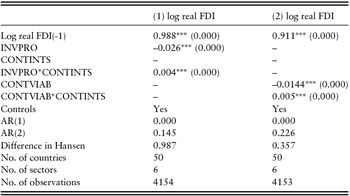
One possible concern with the estimates presented in Table 2 is of reverse causality – greater FDI inflows may improve institutional quality, as foreign firms may demand better quality in the countries in which they are investing, and governments accommodate their requests.Footnote 5 A popular estimator to address such concerns is the system Generalized Method of Moments (GMM) estimator proposed by Blundell and Bond (Reference Blundell and Bond1998), which provides consistent estimates in dynamic panel data models with fixed effects by taking first differences and instrumenting the differenced variables with all their available lags in levels and differences (Caselli and Tesei, Reference Caselli and Tesei2016). However, the GMM estimator is applicable to two-dimensional data (Hall, Reference Hall2005), and in our case we have three-dimensional data. In order to apply the GMM estimator, we collapse the country and sector dimensions to a single dimension – country-sector, so that each cross-sectional observation is at the country-sector level (the other dimension, as is common in panel data estimation, is time). We present the GMM estimates in Table 3. We observe that our variable of interest – the interaction term between the country-level institutional quality variable and the contract intensity of the industry – is positive and statistically significant at the 1 per cent level. This is true whether we use INVPRO or CONTVIAB as our measure of the country-level institutional quality variable (Columns 1 and 2, respectively, of Table 3).Footnote 6 Thus, our findings on the positive joint impact of institutional quality and contract intensity on US FDI inflows is robust to endogeneity concerns.
Test for endogeneity

Note: The numbers in the parenthesis are p values.
***shows the cases in which p < 0.001. Log Real FDI(-1) is the one period lag-dependent variable. The method of estimation in columns (1) and (2) is system-GMM (Blundell-Bond). The values reported for AR(1), AR(2) are the p values for first- and second-order autocorrelated disturbances in the first differences equations. The p values are reported for difference in Hansen statistic. All control variables as in Table 2.
6. Conclusions
In the vast literature that has studied the determinants of US FDI outflows, very little attention has been paid to the large differences we see in US FDI flows across sectors within countries. Yet we observe that US multinationals show preferences to invest in some sectors in one set of countries, and a very different set of sectors in another set of countries. Our paper makes a fundamental contribution to the literature by looking at the institutional determinants of both within- and across-country variations in FDI inflows over time. Using a three-dimensional panel data set of US FDI flows to 50 countries and 6 sectors for the time period 1984–2010, we show that for countries with high quality of institutions, US multinationals are more likely to invest in the industries where by their very nature investments are relationship specific. For example, US multinationals invest a large amount in mining, an industry characterized by arms-length transactions, in countries such as Venezuela where protection of property rights is weak. On the other hand, US multinationals invest significantly in transportation (automobiles), an industry where relation-specific investments are important, in countries such as Germany where the protection of property rights is strong. Our results are robust to alternate measures of institutional quality and endogeneity concerns. Our findings suggest that countries that want to attract US FDI in sectors such as transportation and electronics should improve their property rights environment.