The aim of this paper is to present findings from the CRC-REP's RES project. This project was designed to uncover ways that could contribute to improving outcomes for remote Aboriginal and Torres Strait Islander students and their families. The project team gathered data over three years from school, community, university and government stakeholders. One of our major concerns was to understand what Aboriginal people from remote communities thought about success and how to achieve it. While we are also interested in the views of Torres Strait Islanders, because our work was mainly focused on the Northern Territory, Western Australia and South Australia, we acknowledge that their views are not represented in the data we present here.
We did seek the views of nonremote stakeholders as well. Our data therefore, allows us to compare the remote perspective with those of others. However, our primary concern is to ensure that the voices of those who live in or belong in remote communities, are given priority.
The literature, which we will turn to directly, generally describes success from western and nonremote perspectives. It often treats the concept as a given with little critique or consideration of how a notion of success in education is conceptualised and expressed in multilingual remote communities across Australia. We have described these contexts as ‘red dirt’ contexts, partly because of the ubiquitous nature of red dirt in remote parts of Australia. We want to ensure that success is defined, not just in a generalised way, but in a way that reflects the ‘red dirt’ context in which education is delivered.
Education for Very Remote Aboriginal and Torres Strait Islander Communities
Education for students in remote Aboriginal and Torres Strait Islander communities is often described as problematic, intractable (Wilson, Reference Wilson2014), difficult to manage and resource (Ladwig & Sarra, Reference Ladwig and Sarra2009) and failing (Hughes & Hughes, Reference Hughes and Hughes2012). Attempts to ‘fix’ the problem have often involved investing in programs and strategies with laudable goals and targets but which often fall well short of the anticipated outcomes (see for example Atelier Learning Solutions, 2012; Australian Council for Educational Research, 2013). The expected outcomes generally line up with other attempts to overcome disadvantage (Steering Committee for the Review of Government Service Provision, 2014), close gaps (Department of Families Housing Community Services and Indigenous Affairs, 2013) and promote ‘what works’ (What Works: The Work Program, 2012) as if there were some kind of magic formula that will remove the ‘obstacles to success’ (O’Keefe, Olney, & Angus, Reference O’Keefe, Olney and Angus2012) for Indigenous students.
Seldom in the literature is ‘success’ defined or critically discussed. Success, we are told, is about better NAPLAN scores, improved secondary retention rates, transition into further education, higher education and employment.
What is ‘Success’?
Success, of course is not as simple as the above suggests, let alone in the cross-cultural contexts of communities in remote parts of Australia. In the discussion that follows we will focus on just three aspects of successful education: successful learning, successful teaching and successful systems. We will consider how success is defined, how it is achieved and how it is measured from an Australian system-wide perspective. By ‘system’ in this paper, we mean the supply side of education in its various forms including departments of education, the nongovernment sectors and the various supporting instruments that govern the delivery of education in Australia (see discussion of this in Bat & Guenther, Reference Bat and Guenther2013). These instruments include Acts, agreements, universities which train teachers, curricula, professional standards, funding arrangements, measurement frameworks and policy-makers.
Successful Learning in Australia
To a large extent ‘success’ depends on perceptions of what education is for. In a previous edition of this journal, we have problematised this within the context of remote education in Australia (Guenther & Bat, Reference Guenther and Bat2013). If, as we argued then (see also Guenther, Bat, & Osborne, Reference Guenther, Bat and Osborne2013) — that in Australia at least — a good education leads to economic participation and wealth, capacity to think, individual agency and control, democratic participation and a sense of belonging, then those are the things that we should count as success. The 2008 Melbourne Declaration on the Educational Goals for Young Australians (Ministerial Council on Education, Employment, Training and Youth Affairs, 2008) concurs with these aims, suggesting that successful learners: develop their capacity to learn; have essential skills in literacy and numeracy; are able to think deeply and logically; are creative and innovative; can make sense of the world; and are on a pathway to ‘continued success in further education, training or employment’ (p. 8). The Melbourne Declaration has resulted in a series of actions that are designed to achieve those ends. One of the actions that followed was a Measurement Framework (Australian Curriculum Assessment and Reporting Authority, 2012) which attempts to set out how educational outcomes should be measured according to the National Education Agreement (Standing Council on Federal Financial Relations, 2012). In the end, the Measurement Framework identified four indicator areas: participation, achievement in the National Assessment Program, attainment and equity. The array of indicators for these outcome areas is largely based on test scores, attendance rates and apparent retention rates along with participation in training or employment.
But we question whether or not these indicators and frameworks effectively capture the value of education and whether or not the concepts of success and aspiration are valid constructs in a remote community context (Osborne & Guenther, Reference Osborne and Guenther2013). We also recognise the broader goals of education that may not be imperatives for the system, but which also may contribute to ‘educational advantage’ (Guenther, Bat, & Osborne, Reference Guenther, Bat and Osborne2014) and could (perhaps should) be counted in measures of success.
Successful Teaching
A successful education involves successful teaching as well as learning. In Australia, following on from the Melbourne Declaration’s ‘Commitment to Action’ a number of initiatives were put in place to improve teacher quality. The National Education Agreement (Standing Council on Federal Financial Relations, 2012) specifically committed policy directions toward ‘improving teacher and school leader quality’ (p. 11). In 2010, the Australian Institute for Teaching and School Leadership (AITSL) was formed to promote teacher quality through initial teacher education, better school leadership and support for teachers to maximise their impact on student learning. The Australian Professional Standards for Teachers (APST) (Australian Institute for Teaching and School Leadership, 2011, 2012) follow on from this. According to this framework, successful teachers are those that: know their students; know the content and how to teach it; plan and implement effective teaching and learning; create and maintain supportive and safe learning environments; assess, provide feedback and report on student learning; engage in professional learning; and engage professionally with colleagues, parents/carers and the community. Following on from this, the National Education Reform Agreement (Standing Council on Federal Financial Relations, 2013) reinforced the application of the APST to improve the preparation of teacher graduates, improve the quality of induction and enhance teacher performance and professional development (p. 14). To further reinforce the directions towards national professional standards, two National Partnership Agreements were established to promote the implementation of standards: one on ‘Improving Teacher Quality’ and another one on ‘Rewards for Great Teachers’. The latter is designed to encourage teachers to progress towards recognition as Highly Accomplished and Lead teachers under the AITSL standards. In addition, a Capability Framework — Teaching Aboriginal and Torres Strait Islander EAL/D learners (State of Queensland Department of Education, Training and Employment, 2013) was developed by education departments from four jurisdictions to align with and support the APST.
The point of this discussion is to highlight the significance of standards in Australia, as the determining foundation of teacher/teaching quality and its assessment/measurement. We recognise that quality teaching and quality teachers are determined by a number of factors and could be characterised in ways that go beyond the Professional Standards. They include the evaluative measurement of teacher performance (Organisation for Economic Co-operation and Development (OECD), 2013), recognition of teacher qualities (Vieluf, Kaplan, Klieme, & Bayer, Reference Vieluf, Kaplan, Klieme and Bayer2012), pedagogical practices that directly affect learning outcomes (Hattie, Reference Hattie2009), and the need for contextually sensitive practices and measures to assess effectiveness in different contexts (Burnett & Lampert, Reference Burnett and Lampert2011). While national standards are important, our intent in uncovering what success looks like in remote schools, is to understand what qualitative differences are required for teachers who teach students from remote communities.
Successful Systems
The intent of the current Australian reform agenda is clearly articulated by the Council of Australian Governments:
Raising productivity is a key focus of COAG's agenda, and education and training are critical to increasing the productivity of individual workers and the economy.
COAG is committed to improving education standards and the quality of schools. The education reform agenda is being implemented with unprecedented levels of investment in Australia's schools, and is making an important contribution to promoting social inclusion and Closing the Gap in Indigenous disadvantage, so that everyone has the opportunity to learn and work. (Council of Australian Governments, 2012)
The Australian Government's education policy focus, Students First, largely affirms the 2012 COAG directions. It adds one additional element: Engaging parents in education. The rationale for this is given as follows:
Effective parent and family engagement in education is more than just participation in school meetings and helping with fundraising, it is actively engaging with your child's learning, both at home and at school. When schools and families work together, children do better and stay in school longer. (Department of Education and Training, 2015)
The OECD's recent Policy Outlook (Organisation for Economic Co-operation and Development, 2015) suggests a number of policy areas that contribute to an effective education system. They firstly include policies that improve equity and quality and which prepare young people for the future. Secondly, they include policies for school improvement, evaluation and assessment. And finally, they promote system governance and funding for efficiency and effectiveness. The same OECD report provides a series of snapshots that compare OECD countries and on most measures Australia performs well above the average. In Australia, much attention has been given to what we can learn from, and how we compare with, other high performing school systems, particularly in Singapore, Korea, Shanghai and Hong Kong (Jensen, Reference Jensen2012) and notably also in Finland (ABC, 2012; Council of Australian Governments Reform Council, 2013). Many of the policy reforms and levers noted above and under the sections on successful teaching and successful learning are informed by those learnings.
However, while we recognise the significance of those learnings at a national and international level, how these policy initiatives work at the remote community level is something we question (Bat & Guenther, Reference Bat and Guenther2013). Therefore, if a more nuanced system response is to be successful for remote Australia, it would be helpful to understand what stakeholders see as an appropriate system response to the challenges of remote education.
Methodology
The methodology employed in this research has been underpinned by a number of foundational (paradigmatic) assumptions. Our philosophical position coming into this research draws on a blend of constructivist/interpretivist and participatory paradigms (Lincoln, Lynham, & Guba, Reference Lincoln, Lynham, Guba, Denzin and Lincoln2011). We acknowledge our position as non-Indigenous researchers in community contexts where Indigenous stakeholders are the primary users within the education system. This in itself creates a tension for us as researchers where our goals include the promotion of local Indigenous voices (Guenther, Osborne, Arnott, McRae-Williams, & Disbray, Reference Guenther, Bat and Osborne2014). We acknowledge the risks associated with attempting to portray remote Aboriginal standpoints, as indicated by our research questions (RQs) below. We also recognise that the process of analysis involves bias, because of our inherent non-Indigenous positions. Harding (Reference Harding1992) challenges the notion that the science of knowledge production and the product of knowledge is somehow neutral or objective, and instead argues for ‘strong objectivity’. As researchers engaging in spaces of significant epistemic differentiation, it is important that we are aware of and can, in some way, begin to account for ‘the widely shared values and interests of [our] own institutionally shaped research assumptions’ (Harding, Reference Harding1992, p. 572). We cannot claim to have adopted an ‘objective’ position or impartial methodology, but through understanding our own personal and institutional assumptions and bias and engaging Indigenous researchers, contributors and advisors, we are able to pursue a ‘less partial account’ of the knowledge that is produced through this process with some confidence.
Research Questions
Four research questions underpin the research. We examined qualitative data collected from all sources (see below) to find responses to these questions.
RQ1 What is education for in remote Australia and what can/should it achieve?
RQ2 What defines ‘successful’ educational outcomes from the remote Aboriginal and Torres Strait Islander standpoint?
RQ3 How does teaching need to change in order to achieve ‘success’ as defined by the Aboriginal and Torres Strait Islander standpoint?
RQ4 What would an effective education system in remote Australia look like?
Qualitative Analysis Methods and Foundations
Qualitative data was collected during the period from mid 2012 through to the end of 2014. Sites for interviews and focus groups included Alice Springs, Adelaide, Yulara, Yuendumu, Lajamanu, Wadeye, Darwin, Perth, Broome and two online focus groups with participants coming in from across all Australian states except Tasmania. Data collected from the physical sites included participants from several communities across remote parts of Australia. We interviewed teachers, assistant teachers, school leaders, community members, policy makers, bureaucrats, university lecturers and researchers, VET and higher education students, youth workers, child care workers, education union members and representatives from NGOs.
Data from all sources was incorporated into a single Nvivo™ database. Nvivo™ is qualitative data analysis software that allows ‘references’ (which could be images, text, audio or video) to be ‘coded’ (given a theme). The codes are represented in a hierarchical structure of parent and child ‘nodes’. Audio files created during interviews and focus groups were transcribed before being imported into the database for coding. Images of whiteboards and butchers paper and hand written notes were scanned into the database. Electronic reports with secondary source data were also imported into the database.
The process of ‘coding’ involved several steps and is a highly interpretive task that requires considerable critical reflection. In the first instance, the project team came together to conceptualise a coding structure built on the RQs. Some ‘nodes’ were proposed at this time. Following this, the team worked on coding each document each member was responsible for. Additional nodes were created as required, consistent with a Grounded Theory approach (Charmaz, Reference Charmaz2006; Denzin, Reference Denzin2010). The team then came together for a two day workshop to test the structure and validate coding. Following this, the team finalised the coding of sources and moderated other team members’ codes before coming together again for a further two day workshop to rationalise the structure, check node content and consider implications of the data. The process was completed in February 2015.
Data Sources
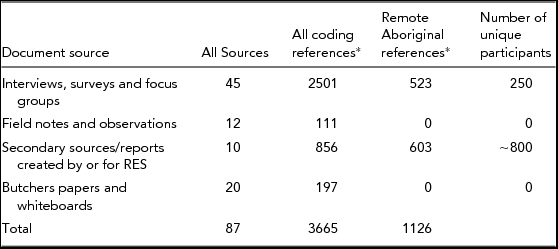
The analysis draws on a range of data sources as tabulated below in Table 1. The largest amount of qualitative data comes from 45 focus groups and in-depth group and individual interviews with 230 remote education stakeholders. Some data were also extracted from reports of additional research either conducted by or for the RES project team. This includes an analysis of 31 very remote schools’ Collegial Snapshots conducted by Principals Australia Institute and the Australian Council for Educational Research. These 10 documents do not include primary source data, but where reference is made to specific responses relevant to our research, they have been coded accordingly. The coding of data included a ‘node’ which identified coding references to remote Aboriginal stakeholders. Hence, we are able to quantify the number of references attributable to remote Aboriginal community stakeholders. We defined these stakeholders as Aboriginal people who resided and came from a remote location, as defined by the Australian Bureau of Statistics (2011) remoteness structure, or with a strong family connection to a remote location. In this report, Aboriginal people from nonremote locations are included with remote and nonremote non-Indigenous people. The reason for this distinction was to ensure that we were better reflecting the positions of remote Aboriginal people in the data.
Document Sources and Coding References
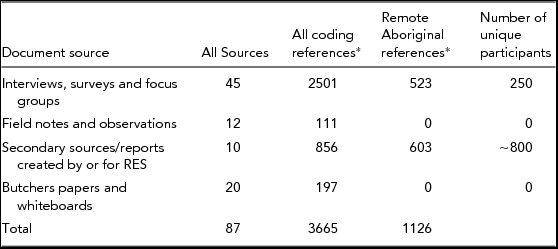
*Includes coding references assigned outside of the research questions ~ note that some survey reports used for this analysis did not detail the participant numbers.
Findings
The focus of this paper is on educational success for remote Aboriginal students. We first consider this from a definitional perspective: what does success look like? Next, we consider it from a teaching perspective: how should teachers teach to those definitions of success? Finally, we consider what a system response might look like to achieve success. There is not sufficient space in this paper to consider findings about what stakeholders thought education is for (our first research question). However, we note that this is important. Understandings of what education is for may well shape how people perceive success. We will briefly touch on this aspect in the discussion.
Remote Aboriginal Stakeholders’ Views of Success
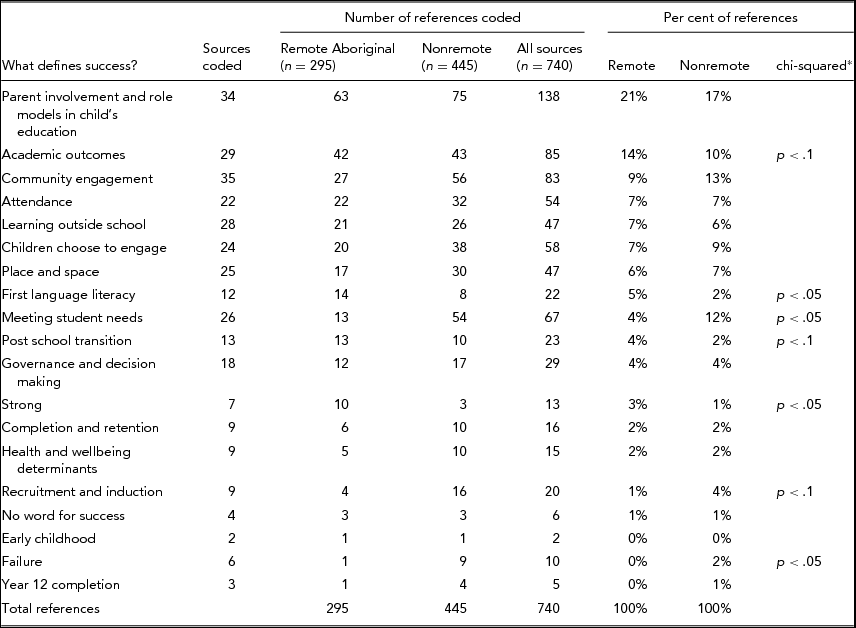
Table 2, below summarises findings from RES qualitative sources (see Table 1). While the research question asked about success from a remote Aboriginal standpoint, we did not exclude nonremote or non-Indigenous views. For most responses, there were no significant differences in the proportional responses for both groups. Probability values in the right hand column indicate where significant differences lie. The themes: ‘academic outcomes’, ‘first language literacy’, ‘post school transitions’ and being ‘strong’ were commented on more often by remote Aboriginal respondents. Nonremote respondents discussed the themes: ‘meeting student needs’, ‘failure’ and ‘recruitment and induction’ more frequently than others.
Stakeholder Responses about Successful Education

*Chi-squared test is used to determine whether there is a statistically significant difference between the number of responses for remote Aboriginal and nonremote stakeholders.
The largest number of responses were coded at ‘parent involvement and role models in child's education’. Respondents talked about parents encouraging their children, acting as role models, building aspiration for their children, being involved at school and supporting their children at a number of levels. In some cases, the role models described were extended family members or significant others in the community, who led the way for students. A few key points stand out from remote Aboriginal respondents. First, they point to the need for parents to support and encourage their children in school, being active and visible role models for their children. Second, they see family involvement in school as integral to successful outcomes for children. Third, they look to family and community members as key to educational leadership (and in many cases, our respondents were key educational leaders).
The second large group of responses, reported more frequently by remote Aboriginal respondents than nonremote respondents, was about academic outcomes. A majority of references here were about basic literacy and numeracy — the importance of being able to read and write English and count, as well as having basic comprehension and competence in speaking English. The references coded in this way did not mention NAPLAN scores though some references were about progress in reading, numeracy or achievement in a general sense.
The third indicator of success was described in terms of community engagement. Respondents articulated this as consultation, community involvement, school community partnerships, good communication between schools and communities and bringing expertise from the community into the school. In brief, remote Aboriginal respondents saw community engagement as a two-way process: school working with and supporting the community and community working with and supporting the school.
A fourth indicator of success was described (mainly by nonremote respondents) as ‘meeting student needs’. Respondents discussed this as knowing students, monitoring progress, identifying student strengths and preparing them for transitions. Many of these comments came from teachers or teacher educators.
Nonremote and remote Aboriginal respondents counted attendance as a definition of success equally. While it was noted under ‘what defines success’, many respondents talked about it as a poor indicator or one which was dependent on other factors. Some respondents employed at schools talked about the need for improved attendance; others talked with some pride about having achieved improved attendance.
Of note too are those themes that did not rate as important for remote Aboriginal respondents: recruitment and induction, Year 12 completion, engagement in early childhood, all of which scored fewer than five responses. However, the latter two themes were mentioned in very few responses overall, as indicators of success in education. While nine nonremote references to ‘failure’ were recorded (as opposed to success), only one remote Aboriginal reference was coded this way.
Teaching to Success
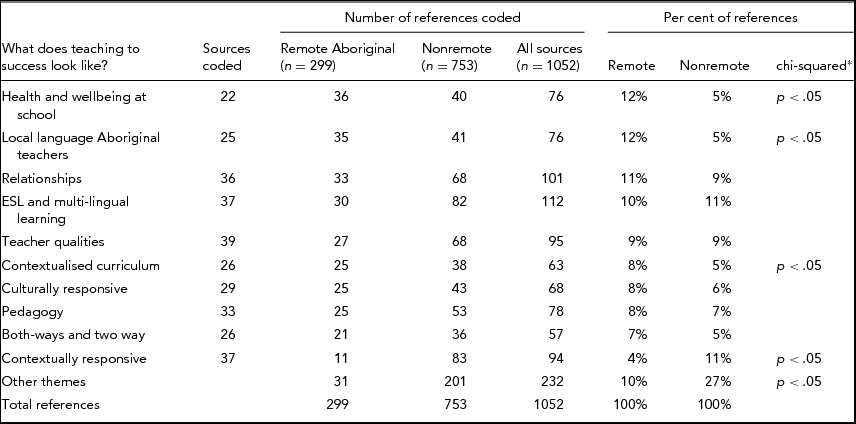
Table 3 lists how teaching should respond to ideas of success offered in Table 2. The right hand column again shows which responses differed for remote Aboriginal and nonremote stakeholders. Remote Aboriginal responses were much stronger for comments about ‘health and wellbeing’ and ‘local language teachers’ and a ‘contextualised curriculum’. Nonremote responses were stronger for comments about ‘contextually responsive’ teaching and for a range of other strategies, which included ‘ESL and multilingual learning’, ‘professional learning’, ‘assessment and progress’ measures, the importance of ‘experience’, the need for ‘informal learning opportunities’ and the need to allow for ‘time’.
Stakeholder Responses about Teaching to Success
*Chi-squared test is used to determine whether there is a statistically significant difference between the number of responses for remote Aboriginal and nonremote stakeholders.
Comments about health and wellbeing at school were discussed in terms of children's wellbeing at school as a priority, teasing, safety, school as a safe place, hearing, mental health, resilience, personal hygiene, healthy food and showing respect. The intent of these comments is not to prescribe these as having to be ‘taught’, but rather taken into account by schools and teachers. Respondents talked about the need for schools to ensure that student wellbeing was a foundationally important consideration for effective teaching and learning to take place.
The discussion about the importance of ‘local language Aboriginal teachers’ focused on their role as brokers and mediators of local knowledge, being an integral part of ‘two way’ learning, being actively engaged in what happens in classrooms, teaching in local languages, and working with staff to ensure student wellbeing and safety. Respondents discussed the importance of relationships at a number of levels. Many respondents saw constructive relationships between teachers and assistants, teachers and students, school and community, teachers and parents as critical to successful teaching. The importance of teachers being part of the community was also emphasised as a prerequisite for effective teaching.
Overall, respondents raised ESL (English as a second language) and multilingual learning as the most important consideration for successful teaching. They articulated this in terms of bilingual programs, teacher first and second language skills, teacher awareness of language and teaching in first language (among other related themes).
Respondents generally, were also concerned about teacher qualities. Note that this was not about teacher quality as discussed earlier in the literature. Rather it was about a range of qualities that teachers need to have to work effectively in a remote school context. They included flexibility, being friendly, kind, the teacher as a learner, being prepared for the environment, being respectful, patient, listening, passionate, having commitment and being dedicated to doing the best for the kids.
Nonremote respondents discussed the importance of teaching in a ‘contextually responsive’ way as being informed, adaptive, flexible in their teaching, using differentiated approaches to teaching, understanding other agencies and supports that are available, understanding complexity in the teaching context, using creative ways to engage and making learning valued by students. The bulk of comments coded this way came from teachers, leaders or school staff.
A Successful Remote Education System?
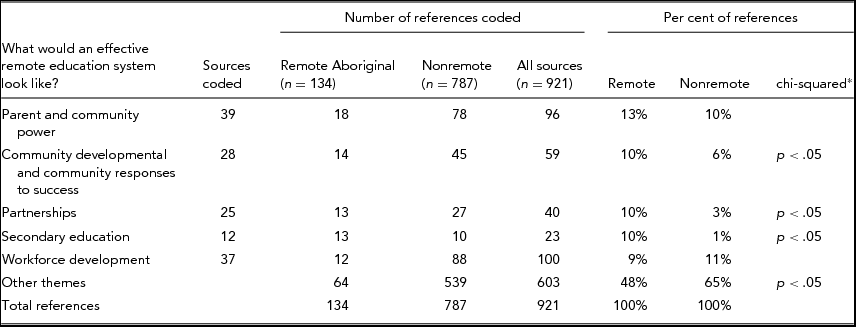
Table 4 below, lists the top five responses in relation to the research question about an effective remote education system. Note that the number of responses from remote Aboriginal participants is much smaller than for those from nonremote respondents. Bearing this in mind, these five themes represent more than half of all remote Aboriginal responses.
Stakeholder Responses about an Effective Remote Education System
*Chi-squared test is used to determine whether there is a statistically significant difference between the number of responses for remote Aboriginal and nonremote stakeholders.
Under ‘parent and community power’ respondents discussed building relationships with community, community (including school) empowerment, supporting community engagement, parental responsibility, local autonomy, giving parents real choices and parents participating in planning. The theme ‘community developmental and community responses to success’ was conceptually connected to ‘parent and community power’. There were important distinctions though. Community and developmental approaches included those that recognised community expectations, were empowering, built a shared language, used developmental approaches, which recognised the incongruence in values between community and the ‘system’. The theme of ‘partnerships’ is also connected to the previous themes. Remote Aboriginal respondents described ways of working together, both within communities and with organisations from outside. They described the need for collaboration, consultation and partnerships for good governance.
Remote Aboriginal respondents had mixed views about ‘secondary education’. Some saw the value of boarding schools as an option. However, more respondents talked about the importance of having local secondary options for young people. They did not provide a lot of detail about this, but some talked about the need for separate spaces for high school aged students and the need for vocational and other training options as part of secondary provision. Nonremote respondents made few comments about secondary schooling. They did describe secondary delivery as somewhat problematic with limited outcomes and low levels of engagement. Some mentioned the challenge of working with secondary aged students in what is mostly a primary school environment with few options for the kinds of programs that would be available in an urban middle school.
Workforce development was the strongest theme when remote Aboriginal and nonremote responses were combined. Remote Aboriginal respondents talked about the need to recruit, train and support local people who could teach in local languages. Some talked about the need to engage community leaders in recruitment processes and more generally to find ways of working collaboratively together. However, the bulk of responses under this theme came from nonremote stakeholders. For these respondents the issues were about undergraduate teacher programs, recruitment, orientation, professional learning and ongoing support. They were concerned about induction processes, mentoring, dealing with staff turnover and having to ‘renew knowledge’.
Synthesis and Discussion
We noted at the start of the Findings section that, while not presented in this paper, the question about what education is for, is important and we have reported findings on this topic elsewhere (Guenther, Reference Guenther2014b). Very briefly, more than half the responses from remote Aboriginal stakeholders were about four main purposes. First, education should help young people maintain their connection to language, land and culture. Secondly, it should build a strong identity in learners. Thirdly, it should help young people become strong in two worlds: both western and local. Fourthly, education should support young people to engage in employment. These resonate with Fordham and Schwab's synthesis of earlier research findings (Fordham & Schwab, Reference Fordham and Schwab2007).
Bringing Together the Findings
In our analysis of the qualitative data, we have considered how definitions of success relate to what education is for, how the system should respond, and what successful teaching looks like. The result of this appears in Figure 1 below. The size of the text within the shapes indicates the strengths of the response associated with each theme. The large, bold font represents 15 or more responses, the smaller font represents between 10 and 14 responses while the smallest sized font represents between seven and nine responses.
How views of success relate to purpose of education, teaching and system response.
Where success is seen as ‘parent involvement and role models in education’, the purposes of education cluster around two key themes of ‘employment and economic participation’ and ‘language, land and culture’. Multiple system responses cluster around a key theme of ‘parent and community power’. An array of teaching responses cluster around a key theme of ‘contextually responsive’ teaching and ‘health and wellbeing at school’.
In comparison, when success is viewed as ‘community engagement’, the purpose of remote education is more narrowly defined around ‘language, land and culture’, and a secondary theme of ‘identity’. The system response, as above, is focused on ‘parent and community power’. The teaching response though, clusters around ‘relationships’.
When success is viewed as ‘academic outcomes’ or as ‘attendance’ there are few corresponding themes that emerge under teaching to success, or a system response. Similarly, when success is seen this way, the purposes of education are only weakly described in terms of ‘learning’ and ‘identity’.
Implications for Measures of Successful Remote Schooling
The data presented here points to indicators of success that go well beyond those described in the literature discussed earlier. There is little congruence between the measures of success prescribed by the various policy documents that have shaped education strategies over recent years in Australia, and those articulated by our remote Aboriginal respondents. While the focus at the policy level since 2008 has been on academic performance (or test scores) and participation (or attendance), those measures of success are not as strongly supported in our data. Attendance and academic outcomes are identified by remote respondents, but there is little connection between these measures and system responses or teaching responses. This does not suggest that attendance and academic performance are not important for remote Aboriginal stakeholders — they clearly are — but the question of how to achieve these aims, either through a systemic response or a teaching response, is not clearly answered.
The other two indicators of success, as articulated by our respondents, deserve consideration. ‘Parent involvement and role models in education’ as an indicator of success in remote education is supported to some extent by the Australian Government's Students First policy initiative, as noted in the literature. This could be seen as a measure of success in its own right or as a precursor to other measures of success. However, in the minds of our respondents, this is what success looks like in remote schools: parents and family members taking an active role, encouraging, leading and supporting their children to do well at school.
The descriptions of ‘community engagement’ as success are largely unsupported in the literature reviewed (Lea, Thompson, McRae-Williams, & Wegner, Reference Lea, Thompson, McRae-Williams and Wegner2011) earlier. However, there are ample references in the broader literature about the role of communities in schooling. The now superseded Parent and Community Engagement (PaCE) program is premised on the assumption that community engagement is important for educational outcomes. Our analysis of data from the Australian Census and publicly available school data from the My School website (Australian Curriculum Assessment and Reporting Authority, 2015) suggests that community factors contribute to school (academic) outcomes as much or more than school-based factors (Guenther, Disbray, & Osborne, Reference Guenther, Bat and Osborne2014). Our qualitative research focusing on the role of schools and families in schools supports this assertion (Guenther, Reference Guenther2014a).
Some might suggest that parental involvement and community engagement are largely qualitative aspects of a community or school's activities. How then could schools measure parental involvement and community engagement? We would like to suggest a number of quantitative indicators that point to success in this way:
• Is there a school council with community representation? How many are involved?
• Does the school have parent-teacher days/events? How many attend?
• Is there a school policy that actively pursues employment of local educators? How many have been employed as a result?
• Do parents meet with teachers? What proportion of parents have contact?
• Are community members involved in extracurricular activities? How often does this occur?
• Are community members employed at the school? What is the ratio of nonteaching staff to teaching staff?
• What practices are in place in the school to build relationships between local and nonlocal staff? How often do dedicated activities take place, such as learning together sessions, team planning?
• Do parents or community members help with reading to children? How many do this?
• Is there local adaptation of curriculum? How many local people are involved in the development and delivery of contextually relevant units and associated activities?
• Are community members involved in recruitment of new staff? How many are involved in this process?
• Are teachers competent with local languages? How many are learning a local language?
• Do teachers and nonlocal staff engage with organisations outside of school? How many are involved in a local church, sporting team or community group?
This of course is not an exhaustive list of indicators. Rather, it simply highlights how aspects of parent and community involvement could be measured and reported as elements of remote school success. The point of measuring these elements of success is not to see them as leading to success, but rather to see them as success in their own right. It could be that they do lead to other elements of successful schooling (such as attendance and academic outcomes).
System and Teaching Responses
It is one thing to recognise a set of indicators that measure an alternative conception of success. It is another to promote an appropriate system response to achieve outcomes that are consistent with those measures. The RES data points to system responses that do just that. Figure 1 suggests two major system responses. The first involves processes that empower communities and parents. The second involves workforce development strategies. Workforce development issues are to a large extent reflected in some of the indicators discussed above. They include employment, support and training of local community members to work in remote schools. They also include training and recruitment of new teachers, and professional development and systemic support of existing staff. They include the adoption and implementation of strategies that work towards local workforce development.
Parent and community empowerment means putting structures in place that allow local decision making, inclusion of contextually and culturally relevant content in curricula, which we have previously referred to as ‘red dirt curriculum’ (Osborne, Lester, Minutjukur, & Tjitayi, Reference Osborne, Lester, Minutjukur and Tjitayi2013). It also means putting systems and structures in place that contribute to local school governance.
We would stress that putting these structures in place is not a kind of magic bullet that will fix the perceived problems of remote education. We believe though, that they will contribute to the kind of success that is desired by remote community members as these types of approaches begin to close the epistemic divide that exists in the remote schooling context by engaging family members (the objects of remote young people's aspiration), elders (the ‘knowers’ in the local knowledge context) and stakeholders in local schools. They will lead to a more sustainable education in remote schools as communities are far more likely to strongly contribute to an approach that better represents local needs and aspirations, rather than resisting, even ignoring efforts that are locally perceived as being of little relevance to Indigenous lives. We would therefore, anticipate that approaches that work to give power to families and communities and which build local capacity in the remote community school workforce, will lead to outcomes that will be desirable for the broader education system, not just the remote education system (if there is such a thing).
Successful teaching, according to the views of our respondents, demands an approach that takes into account the health, wellbeing and safety of students, it is contextually responsive and it works to support constructive relationships with staff, parents, community members and students. Successful teaching is also supported by culturally responsive and two-way teaching and learning strategies. It is built on a foundation of qualified ESL teachers with qualities that fit the remote context, and local language educators. These characteristics of successful teaching and teachers should not be seen as a counter to the Australian Professional Teaching Standards. Rather, they should be seen as additional requirements that are not covered in the Standards, except in a general way. For example, the Standard that calls for teachers to know their students is applicable but knowing students in a remote community requires a lot more from teachers than it would where teachers and students come from similar cultures. This is why, it is so important for schools to engage local staff. They are the community. They know their students.
Conclusions
Data from the RES project presented here, points to findings that run counter to the Australian rhetoric about what educational success means. The formula for success described in the literature, involves meeting the codified requirements of standards and performance of prescribed standards of academic performance. The picture painted in the data presented here is somewhat different.
The picture of success painted through data obtained from those from remote communities, sees parent involvement as the primary indicator. It sees community engagement as another important measure. To achieve these measures, respondents argued for a systems approach that gives power to parents and communities and which builds local and nonlocal workforce capacity in order to deliver a more contextually and culturally responsive education. Successful teaching to achieve these ends requires a set of qualities and skills that may not be found in Professional Standards. Successful teaching will however be found in the collaborative efforts of local and nonlocal staff, in a contextualised curriculum and in two-way approaches that build on and respect local languages and cultures.
The picture of success presented here is not intended to offer a quick fix for remote education. To achieve the measures of success identified here will take a sustained and well-resourced effort.
Acknowledgment
The work reported in this publication was supported by funding from the Australian Government Cooperative Research Centres Program through the CRC-REP. The views expressed herein do not necessarily represent the views of the CRC-REP or Ninti One Limited or its participants. Errors or omissions remain with the author.