Introduction
Prior to this revision, there were six species of Begonia sect. Diploclinium (Begoniaceae) recorded from Palawan (Hughes, Reference Hughes2008). Five new species from the island are described here, whilst one record (Begonia nigritarum) is considered doubtful, giving a total of 10 species, nine of which are endemic (B. mindorensis is the only species to occur elsewhere in the Philippines). The novelty and endemism of the new taxa has been confirmed following consultation with types and specimens for the other Philippine and Bornean species in Begonia sect. Diploclinium in herbaria A, B, BISH, BM, BO, BRIT, E, K, L, MICH, P, PNH, SING and U. All have been assigned to Begonia sect. Diploclinium on account of their rhizomatous habit, cymose bisexual inflorescences and four-tepaled male and female flowers, corresponding roughly to the informal ‘Group I’ of this section defined by Doorenbos et al. (Reference Doorenbos, Sosef and De Wilde1998). In this regard they sit very comfortably with the other Philippine species in this section which as a whole probably represent an endemic monophyletic radiation. However, some of the species differ from the core of species in Begonia sect. Diploclinium in having bilocular, rather than trilocular, fruit. Locule number is an important character in the delimitation of sections of Begonia, but can occasionally be misleading. The species described here having bilocular fruit would phenetically be placed in Begonia sect. Platycentrum, the only section in the genus defined by this syndrome where the bilocular fruit type is likely to be an adaptation for rain splash dispersal (Tebbitt et al., Reference Tebbitt, Forrest, Santoriello, Clement and Swensen2006). However, molecular data (unpublished nuclear ribosomal internal transcribed spacer sequences) obtained for two of the bilocular species described here, Begonia cleopatrae and B. wilkiei, show they are nested within Philippine species in Begonia sect. Diploclinium. The affinity with Begonia sect. Diploclinium and not Begonia sect. Platycentrum is also shown by their smaller flowers, three (not two) non-convolute stigmas, female flowers with four (not five) tepals and anthers without an extended connective. They are likely to be allied to Begonia gueritziana Gibbs (Sabah) and B. anisoptera Merr. (Mindanao) which share these characters; the former was only recently transferred to Begonia sect. Diploclinium (Hughes, Reference Hughes2008: 47).
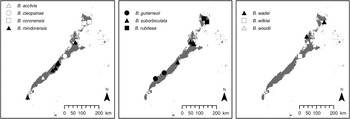
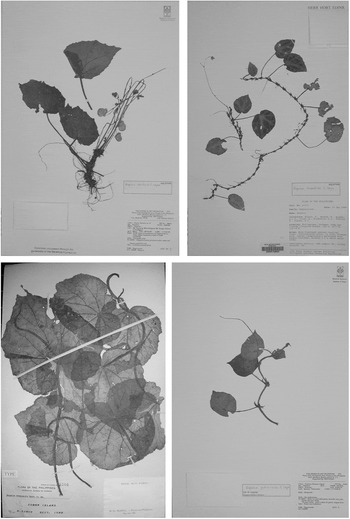
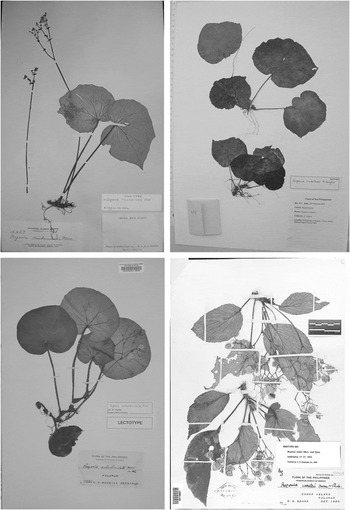
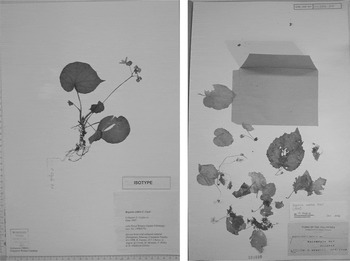
The species concept used here is quite narrow, in keeping with that used by Merrill (1912) who described the majority of Philippine Begonia. Preliminary molecular work (unpublished data) shows a high degree of genetic differentiation between otherwise morphologically quite similar species, which gives the authors a degree of confidence in maintaining this species concept. Distribution maps of all the species are shown in Fig. 1, and types or representative specimens are shown in Figs 2, 3 and 4. All the specimens cited are available online as digital images (Hughes & Pullan, Reference Hughes and Pullan2007).
The distribution of Begonia sect. Diploclinium species on Palawan.

Begonia acclivis (holotype, BRIT; top left), B. cleopatrae (holotype, E; top right), B. coronensis (lectotype, BM; bottom left) and B. gutierrezii (holotype, BRIT; bottom right).

Begonia mindorensis (isoneotype, P; top left), B. rubiteae (isotype, SING; top right), B. suborbiculata (lectotype, BM; bottom left) and B. wadei (lectotype, NY; bottom right).

Begonia wilkiei (isotype, SING; left) and B. woodii (lectotype, L; right).

Key to Begonia sect. Diploclinium on Palawan
1a. Leaves variegated, coriaceous; fruit 2-locular 2
1b. Leaves not variegated, thin; fruit 2- or 3-locular 4
2a. Lamina sparsely hairy above when mature, margin broadly dentate 1. B. acclivis
2b. Lamina glabrous above when mature, margin entire or very shallowly dentate-sinuate 3
3a. Leaves appressed to the substrate, 3–6 cm wide; capsule with 3 wings 2. B. cleopatrae
3b. Leaves erect, 4.5–10.5 cm wide; capsule with 5 wings 7. B. suborbiculata
4a. Stem erect, > 1 cm thick 8. B. wadei
4b. Stem rhizomatous or creeping, < 1 cm thick 5
5a. Lamina peltate 4. B. gutierrezii
5b. Lamina basifixed 6
6a. Lamina very translucent when dry, symmetric to subsymmetric 7
6b. Lamina not very translucent, distinctly asymmetric 8
7a. Leaves usually solitary, ≤ 6 cm long 10. B. woodii
7b. Leaves several, ≥ 6 cm long 3. B. coronensis
8a. Fruit 2-locular, one wing distinctly enlarged 9
8b. Fruit 3-locular, wings equal or subequal 10
9a. Leaves broadly and shallowly dentate to sinuate, with scattered long hairs above 1. B. acclivis
9b. Leaves minutely denticulate with fringing short hairs, subglabrous above 9. B. wilkiei
10a. Petiole with maroon hairs at the apex; bracts caducous 6. B. rubiteae
10b. Petiole without maroon hairs at the apex; bracts persistent during flowering 5. B. mindorensis
Species Descriptions
1. Begonia acclivis C.Coyle, sp. nov. Sect. Diploclinium. Figs 1,2.
A Begonia suborbiculata fructibus alis 3 (non 5) provisis, foliis ovatis supra hirtis differt. – Type: Philippines, Palawan, District of Tindogan, Mantalingajan Mt. Range, Mt. Gantung, 19 viii 1996, 8°59′N, 117°49′E, Pipoly & Romero et al. PPI38054 (holo BRIT).
Rhizomatous herb, c.20 cm high. Stem 4–6 mm wide when dry, internodes c.3 mm apart, rooting at the nodes. Stipules lanceolate or broadly lanceolate, 6–10 mm long, c.6 mm wide at the base, recurved on the older parts of the rhizome, coppery brown on the reverse when dry, hairy, fimbriate towards the tip, persistent. Leaves: petiole 5–10 cm long, densely hairy, becoming less so with age, hairs brown, not appressed, c.2–3 mm long; lamina coriaceous, ovate, asymmetric, basifixed, deeply cordate to cordate at the base, lobes not overlapping or shallowly overlapping, total length 5–14 cm, width 3.5–9 cm, midrib 3.5–9 cm long, venation palmate; upper surface variegated dark and light green (always?), usually with a paler area surrounding the midrib, with evenly scattered 2 mm long hairs; underside glaucous (Pipoly & Romero et al. 37900) or red (Pipoly & Romero et al. 37782), with 2 mm long scattered hairs which are denser along the veins; margin broadly and shallowly dentate to sinuate, with short hairs more closely spaced than on the lamina, apex triangular. Inflorescence cymose, arising from the terminal nodes of the rhizome; scapes 1–7, primary peduncle up to 10–20 cm long, c.10-flowered; bracts obovate, 4 × 2 mm, margin entire, caducous. Male flower: pedicel length up to 10 mm; tepals 4, ‘white suffused with pink’ (Pipoly & Romero et al. 38029), outer tepals suborbicular, subcordate at the base, glabrous, 10 × 9 mm, margin entire, darker than the inner tepals (Pipoly & Romero et al. 37782); inner tepals obovate-spathulate, 12 × 8 mm; androecium symmetric; stamens 40–50; filaments equal, c.1.5 mm long; anther slightly shorter than the filament, oblong, dehiscing through slits the full length of the anther, connective slightly extended. Female flowers unknown. Fruit on a 15 mm long pedicel, red (Pipoly & Romero et al. 38054) drying pale brown, 15 × 15 mm in total, wings 3, upper 2 wings 5 mm wide forming a splash cup, lower wing 10–12 mm, markedly cucullate when dry, locules 2, each dehiscing along a single suture on the upper surface of the fruit, placentae bifid.
Habitat and ecology. Endemic to ultramafic soils on Mt. Gantung at altitudes of c.800 m.
Proposed IUCN category. EN B2a,b(iii). A considerable part of Mt. Gantung is under a mineral production agreement.
Additional specimens examined. Palawan: District of Tindogan, Mantalingajan Mt. Range, Mt. Gantung, 16 viii 1996, Pipoly & Romero et al. 37782 (BRIT); ibid., 17 viii 1996, Pipoly & Romero et al. 37900 (BRIT); ibid., 19 viii 1996, Pipoly & Romero et al. 38029 (BRIT).
The epithet ‘acclivis’ is derived from the Latin for uphill or steep, and refers to the habitat notes on the specimens which indicate that this species grows on ‘steep slopes which are frequently subjected to large landslides’. It differs from the two other species from Palawan which share variegated leaves and 2-locular fruit (Begonia cleopatrae and B. suborbiculata) in having broadly dentate or sinuate leaf margins and hairs on the upper leaf lamina. Begonia acclivis shows some degree of variation in leaf size and possibly variegation, although the latter character is not always preserved on herbarium specimens. One other collection 140 km to the northeast of the type locality possibly belongs here [Puerto Princesa, 20 i 1991, B.C. Stone & D.A. Madulid et al. 34 (BISH, BRIT)], but the upper leaf surface is glabrous; as circumscribed here the species is endemic to Mt. Gantung.
2. Begonia cleopatrae C.Coyle, sp. nov. Sect. Diploclinium. Figs 1,2.
Ab omnibus speciebus Begoniae insulae Palawan fructibus bilocularibus affinis, foliis ad substratum adpressis stipulis pectiniferis differt. – Type: Philippines, Palawan, Cleopatra's Needle, 19 i 1998, P. Wilkie, M. Mendum, G.C.G. Argent, Q. Cronk, D.J. Middleton, R. Fuentes & R.V. Chavez 25373 (holo E).
Low-growing lithophytic herb. Stem thin, c.3 mm wide, rooting at the nodes, internodes c.1 cm apart and quite evenly spaced, with quite dense reddish brown hairs, somewhat appressed. Stipules lanceolate, c.6 × 3 mm, glabrous (but see notes below), with a fimbriate wing-like extension at the base of the keel, tip with a 2–3 mm filiform extension, persistent. Leaves appressed to the substrate; petiole 2–8 cm long, densely hairy, hairs reddish brown and slightly appressed; lamina coriaceous, ovate to broadly subovate, basifixed, cordate with basal lobes overlapping slightly or not overlapping, total length 3.5–6 cm, width 3–6 cm, midrib 2.5–4.5 cm long, asymmetric, venation palmate; upper surface pale to mid green with brownish purple patterning, usually paler along the mid vein, with a small number of 3 mm long hairs scattered between the veins when young, otherwise glabrous; underside red (always?), with a few isolated reddish brown hairs on the veins, margin with scattered hairs up to 3 mm long, very shallowly dentate-sinuate, apex triangular to very broadly triangular. Inflorescence cymose, bisexual, axillary, c.10-flowered, primary peduncle 10–17 cm long; bracts obovate, 3–4 × 2 mm, margin entire, caducous, with a few minute scattered globular hairs. Male flower: pedicel length 10–15 mm; outer tepals 2, suborbicular, glabrous, red on the reverse, pale pink inside, 7–8 × 6 mm, with minute scattered globular fleshy hairs on the reverse; inner tepals 2, white, 7 × 3 mm, obovate-spathulate, sometimes slightly retuse; androecium symmetric; stamens c.50, filaments equal, 1–1.5 mm long; anther slightly shorter than the filament, oval-oblong with an extended tip, dehiscing through slits slightly longer than half the length of the anther, slits moving slightly towards one face at the top of the anther. Female flower: tepals similar to male flower in all respects; stigmas 3, pale yellow, stigmatic surface U-shaped. Fruit red when immature, drying pale brown, 15 × 15 mm in total, wings 3, upper 2 wings 5 mm wide forming a splash cup, lower wing 10–12 mm, locules 2, each dehiscing along a single suture on the upper surface of the fruit, placentae bifid.
Habitat and ecology. Endemic to Cleopatra's Needle at altitudes of c.400 m. The notes on the holotype describe the habit as ‘flattened against vertical rocks’, and the long stems indicate a creeping habit compared with the shorter rhizomes of most other species in this section. It forms a more compact habit when cultivated in a pot.
Proposed IUCN category. VU D2. The Puerto Princesa Subterranean River National Park encompasses the remaining forest of Cleopatra's Needle. Although a protected area, the Vulnerable status is warranted as the species is only known from one locality which is at relatively low altitudes. Although the surrounding vegetation was disturbed at the type locality, the dependence on a cliff habitat rather than a terrestrial one will afford this species some stability.
Additional specimens examined. Palawan: Cleopatra's Needle, culta Royal Botanic Garden Edinburgh acc. no. 19980289, grown on from P. Wilkie et al. 25470, 19 i 1998, vouchered in 2007 as C. Coyle s.n. (E); ibid., 14 ii 2000, L.L. Forrest 127 (E), vouchered from unnumbered living collection grown on from P. Wilkie et al. 25373.
Named after the collection locality. Begonia cleopatrae belongs to the group possessing 2-locular fruit, differing from all of them in its habit and smaller leaves. The fimbriate extrusions at the base of the stipules are another characteristic feature of this species. Some of the stipules on the holotype had minute branched, stiff, black hairs around the keel; these are not present on the other specimens and it is not clear if these are part of the plant or an artefact, possibly of fungal origin.
3. Begonia coronensis Merr. (Sect. Diploclinium), Philipp. J. Sci. 26: 480 (1925). – Type: Philippines, Palawan, Coron Island, ix 1922, M. Ramos 41164 (lecto P, designated here; isolecto BO, L). Figs 1,2.
Rhizomatous herb, 10–25 cm high. Stem c.5 mm wide when dry, appearing quite woody and usually quite short, internodes very compressed. Stipules lanceolate, small, 6–9 mm long, 2–3 mm wide, glabrous, tip with one or more filiform extensions, persistent but becoming tattered quickly. Leaves: petiole 6–15 cm long, with scattered short simple hairs; lamina membranaceous, pale green and translucent when dry, cordiform, symmetric to asymmetric, basifixed, base cordate with basal lobes overlapping or not overlapping, total length 6–18 cm, width 8–15 cm, midrib 6–15 cm long, venation palmate, upper surface with short hairs scattered between the veins, underside with short hairs scattered along the veins, margin erose, apex broadly triangular to rounded. Inflorescence cymose, often appearing monochasial during fructescence, primary peduncle c.13–15 cm; bracts triangular, very small, c.2 mm long, glabrous, margin fimbriate, persistent. Male flower: pedicel length c.8 mm; outer tepals 2, white, orbicular, with short hairs on the reverse, rounded at the base, 6 × 6 mmFootnote 1, margin briefly ciliate; inner tepals 2, white, broadly obovate, glabrous; androecium symmetric; stamens 25–30; filaments equal, < 1 mm long; anther c.0.5 mm long, cordiform, dehiscing through slits almost the full length of the anther, tip retuse when dry. Female flower unknown. Fruit: pedicel c.10 mm long, hair-like; fruit pendent, drying pale brown, wings equal to subequal, broadly triangular with a rounded tip; capsule circular, c.5 mm diameter, with 3 locules, placentae entire.
Habitat and ecology. Endemic to Coron and Culion Islands in the north of Palawan, on rocks and ledges along small streams at c.20 m altitude, on limestone.
Proposed IUCN category. VU D2. Although this species will undoubtedly have undergone a historic reduction in area of occupancy due to deforestation on Coron Island, it currently occurs within the protected area around Lake Danao. As we are aware of no continuing decline being observed, this species does not meet the criteria for the Endangered category. However, given the low number of localities Begonia coronensis must be considered Vulnerable. Any ongoing degradation of habitat for this species surrounding Lake Danao will immediately lead to a category of Endangered or even Critically Endangered.
Additional specimens examined. Palawan: ix 1910, E.D. Merrill 7245 (B, BM[3], K[2], P); Coron Island, ix 1922, M. Ramos 41162 (B, K, P); Culion Island, x 1922, M. Ramos 41304 (B, K, P).
The symmetrical, delicate membranaceous leaves immediately demonstrate an affinity with the earlier described Begonia woodii Merr. It is distinct mainly in the larger size of all its parts, in particular the leaf lamina and thicker petioles. Also distinctive is the habit, as the leaves are borne several together, as opposed to the usually solitary leaves of Begonia woodii. Three collections [Palawan, vii 1912, E. Fenix PNH15512 (BM); Palawan, viii 1913, Escritor 21551 (P); Coron Island, Banwangdaan, 27 ix 1993, D.A. Madulid 11507 (BRIT)] share the short, woody rhizome and membranaceous leaves of Begonia coronensis, but differ in being completely glabrous and having slightly asymmetric leaves. It is possible these represent another taxon either at the subspecific or specific level, but we refrain from describing it here until better material becomes available. The collection E. Fenix PNH15512 is merely labelled ‘Palawan’, but in the same month (July 1912) and shortly later in number series (15540) he also collected Begonia wadei which is only known from Coron Island and the nearby Miniloc Island, so it would seem that his collection is also from this region. Merrill's collection 7245 is preceded by collecting in Malampa Bay in the north of Palawan (7229; Begonia suborbiculata) and Napsahan (7232; B. palawanensis) which is 180 km to the southwest. However, Merrill is thought to have been in Comiran (far south of Palawan) in September 1910 so the locality of 7245 is not clear. This species has only one placenta per locule, and hence is aberrant for Begonia sect. Diploclinium. It may be that it fits better in Begonia sect. Reichenheimia, but as Begonia sect. Diploclinium is so large and polymorphic we refrain from reassigning B. coronensis until molecular data become available.
4. Begonia gutierrezii C.Coyle, sp. nov. Sect. Diploclinium. Figs 1,2.
Ab omnibus speciebus Begoniae insulae Palawan foliis peltatis diagnoscenda. – Type: Philippines, Palawan, Lipuun Point, v–vi 1963, H. Gutierrez & R.A. Espiritu PNH80739 (holo PNH).
Creeping herb < 10 cm high. Stem c.3 mm wide when dry, rooting obviously at the nodes with bundles of thickish roots, internodes evenly spaced c.4 cm apart. Stipules lanceolate, c.10 mm long, 6 mm wide at the base, with long fine hairs concentrated around the edge, persistent. Leaves: petiole 3–6 cm long, covered with long hairs which are reddish brown when dry, giving a shaggy appearance; lamina coriaceous, orbicular ovate, peltate, total size c.5 × 4 cm, midrib c.3.5 cm long, venation palmate, upper surface ‘very dark green’ (Gaerlan et al. PPI13456), glabrous, underside pale green, underside with scattered long hairs on the veins only; margin with scattered long hairs, entire, apex shortly acuminate. Inflorescence cymose, branching 3–4 times, primary peduncle greatly exceeding the leaves, c.18 cm long; bracts unknown, caducous. Flowers unknown. Fruit on a 2–3 cm long pedicel, 3-winged, wings rounded, one wing conspicuously enlarged c.1 cm long, the other two smaller c.4 mm wide, capsule elliptic, 3-locular, placentae unknown, dehiscing on all three faces, slightly pointed at the apex.
Habitat and ecology. Endemic to southern Palawan at quite low altitudes, c.30 m, on limestone.
Proposed IUCN category. VU D2. This species occurs within the Lipuun Point Reservation, but is currently only known from two collections.
Additional specimen examined. Palawan: Tawa-tawa, 2 ii 1994, F. Gaerlan, E. Romero & E. Sagcal PPI13456 (BRIT).
Instantly distinct as the only species known from the island with peltate leaves. The internodes are several centimetres long on both collections, giving the plant a creeping rather than scapigerous habit as in many other Diploclinium. Although the fruits have one elongated wing and two shorter ones as in the 2-locular species, B. gutierrezii has a 3-locular fruit. It is named after H. G. Gutierrez, who was the first to collect this species in 1953. Other Philippines species with peltate leaves are Begonia hernandioides Merr. and B. tayabensis Merr., both from Luzon; both differ from B. gutierrezii in their larger stature and more elongate leaves.
5. Begonia mindorensis Merr. (Sect. Diploclinium), Philipp. J. Sci. 6: 396 (1912 [‘1911’]); Merrill, Enum. Philipp. Fl. Pl. 3: 125 (1923). – Type: Philippines, Palawan, Puerto Princesa, Mt. Pulgar, iii 1921, A.D.E. Elmer 12857 (neo B, designated here; isoneo BM, BO, E, FI, K, MICH, P, U). Figs 1,3.
Begonia pinamalayensis Merr., Philipp. J. Sci. 26: 479 (1925), syn. nov. – Type: Philippines, Mindoro, Pinamalayan, v 1922, M. Ramos 40856 (lecto B, designated here; isolecto L, P).
Rhizomatous herb, 20–40 cm high. Stem 3–5 mm wide when dry, internodes varying from being very congested to c.2 cm apart. Stipules lanceolate, c.1 cm long, glabrous apart from filiform extensions on the keel and apex, persistent. Leaves: petiole 10–25 cm long, hairy, hairs reddish brown when dry and either shaggy (neotype) or closely appressed to the petiole (Reynoso et al. 11328); lamina not coriaceous, drying dull olive green, ovate-lanceolate, basifixed, cordate at base, lobes not overlapping or overlapping slightly (Ramos & Edaño 49764), total dimensions 10–15 × 6–10 cm, midrib 6–10 cm long, venation palmate-pinnate, asymmetric, upper surface glabrous or with a few scattered hairs along the veins, underside hairy on the veins with smaller hairs scattered between, margin broadly and shallowly dentate to shallowly sinuate, with short scattered hairs, apex shortly acuminate. Inflorescence cymose, arising from the terminal node of the rhizome, branching up to 6 times; bracts broadly ovate, 3–9 mm long, reducing in size gradually towards the apex of the inflorescence, margin entire, persistent during flowering and held horizontally or slightly recurved giving a distinctive silhouette when pressed. Male flower: pedicel length c.5–10 mm; outer tepals 2, ovate, glabrous, up to 8 × 6 mm, margin entire; inner tepals 2, obovate, c.7 × 3 mm; androecium symmetric, on a short column; stamens numerous, c.70, small; filaments equal, c.1 mm long; anther c.0.5 mm long, squat elliptic-oblong, dehiscing through slits about as long as the anther. Female flower: pedicel c.1 cm long; tepals 4, similar to those of the male flowers. Fruit drying brown, with 3 subequal broadly triangular wings, slight but distinct asymmetry in silhouette; capsule broadly elliptic, 4–7 × 3–5 mm, 3-locular, dehiscing on all three sides, placentae bifid.
Habitat and ecology. On rocks near streams and waterfalls or on steep slopes in forest at 300–1300 m. Locally common. Also found in Luzon and Mindoro.
Proposed IUCN category. LC. This species is widespread in Palawan and also occurs in Luzon and Mindoro.
Additional specimens examined. Palawan: Iwahig, iv 1906, F.W. Foxworthy 779 (B, BO, P); Balabac Island, 16 x 1906, E.D. Merrill 5375 (B, P); ibid., ii 1927, M. Ramos & G. Edaño 49764 (MICH, SING); ibid., ii 1927, M. Ramos & G. Edaño 49787 (MICH); Mt. Mantalingahan, 11 v 1947, G. Edaño PNH560 (PNH); Mt. Mantalingahan, 11 v 1947, G. Edaño PNH562 (PNH[3]); Iraan Mts, v–vi 1950, M.D. Sulit PNH12531 (PNH); Victoria Mts., iii 1951, G. Edaño PNH14195 (PNH); Puerto Princesa, Mt. Pulgar, iii 1911, A.D.E. Elmer 12857 (B, BM, BO, E, FI, K, P, U); Taytay, 17 vi 1993, Reynoso et al. 11328 (BRIT); Iwahig Penal Colony, 25 v 2007, R. Rubite 354 (E, PNH); Napsan, Puerto Princesa, Salakot Waterfalls, 25 v 2007, R. Rubite 355 (E, PNH).
Good material of this species is easily recognised by its long, small-flowered inflorescence which normally exceeds the leaves, and the presence of persistent bracts, especially on the male part of the inflorescence, which is unusual in Philippine Begonia sect. Diploclinium. The fruits also tend to have a distinctive slightly asymmetric silhouette when pressed. The type designated in the protologue (near Lake Naujan, iv 1907, M.L. Merritt 6867) is neither in PNH nor in US where a set of Merritt's duplicates was deposited. No other material from Mindoro was suitable, so a neotype was chosen from the paratype collection A.D.E. Elmer 12857 (Palawan), as this has nine well-distributed duplicates with good inflorescences. Begonia pinamalayensis is synonymised here as it is patently the same species, sharing the small-flowered inflorescence and persistent bracts, and is known only from the type region of B. mindorensis. Merrill appears to have overlooked his earlier publication, instead diagnosing it against Begonia longiscapa Warb. Begonia sordidissima Elmer from Mindanao has been considered a synonym of B. mindorensis (Merrill, Reference Merrill1923). However, the type differs in having slightly more elongate leaves and fruit wings which appear to be more equal and rounded (although the material is rather poor). Further, this would represent quite a disjunction for the otherwise northerly and western occurrence of Begonia mindorensis. It may be that Begonia sordidissima is nearer to the Mindanao species B. acuminatissima Merr., but further collections are required.
6. Begonia rubiteae M.Hughes, sp. nov. Sect. Diploclinium. Figs 1,3.
A Begonia rhombicarpa A.DC. petiolis ad juncturam cum lamina pilis purpureis instructis differt. – Type: Philippines, Palawan, Busuanga Island, Coron municipality, Mabentangen Forest Park, 28 ii 2007, R. Rubite 357 (holo PNH; iso E, SING).
Rhizomatous herb 10–20 cm high. Stem c.5 mm diameter when dry, maroon to brown in life, internodes usually compressed but may reach up to 9 cm, with scattered brown 3 mm long hairs. Stipules ovate-lanceolate, maroon to light brown, 20 × 7 mm, apex acuminate, margin ciliate, with brown hairs (2 mm) along the keel. Leaves: petiole 7–15 cm long, with fairly dense fine hairs c.2 mm long when young, becoming sparse with age, the junction of petiole and lamina with ring of abundant maroon hairs (2–4 mm); lamina green, basifixed, base cordate, orbicular-ovate, total dimensions 6–9 × 9–13 cm, basal lobes rounded and overlapping slightly in life; apex acute, upper surface glabrous, green with white to light green dots; lower surface maroon with brown 2–3 mm long hairs on the veins. Inflorescence primary peduncle maroon in life, 13–30 cm long, erect, glabrous; bracts green, ovate, 6 × 5 mm, becoming smaller towards the apex, glabrous, caducous. Male flower: pedicel red, c.10 mm long; tepals 4, outer pair orbicular, 10 × 9 mm, dorsal side red, ventral side white, inner pair obovate, white, retuse, 8 × 4 mm; stamens 50–60, yellow, filament c.0.5 mm long, on a short column; anther oval-oblong, c.0.5 mm long. Female flower: pedicel green, 10 mm; tepals 4, outer pair orbicular, 7 × 7 mm, dorsal side red, ventral side pale pink to white; inner pair obovate, white, retuse, 7 × 4 mm; stigmas 3, 2 mm long, stigmas in spiral band. Fruit: pedicel 10 mm; capsule glabrous, brown, pendulous, 8 × 14 mm in total, apex acute and base retuse, wings 3, subequal, rounded, 4 mm wide; locules 3, placentae bifid.
Habitat and ecology. Endemic to Busuanga Island, at streamsides at altitudes of c.100 m.
Proposed IUCN category. EN B2a,b(iii). Mabentangen Forest Park is the sole drinking water catchment for Busuanga Island, and is a protected area. However, the park is being encroached by small settlements which are impacting the habitat of Begonia rubiteae. During the period May 2007 to September 2008 the populations of this species had decreased significantly, necessitating a further 800 m walk upstream from previously recorded plants to locate a healthy population (R. Rubite, pers. obs.). We recommend that the park management needs to reconcile the needs of local people and the protection of the forest if this species is to survive.
Additional specimens examined. Palawan: Busuanga Island, ix 1922, M. Ramos 41222 (B); ibid., ix 1922, G. Lopez 41374 (B, K, L, P).
This species was named and described by the first author of this manuscript in recognition of the dedication of Rosario Rubite to the study of Begonia sect. Diploclinium in both the field and laboratory. Specimens of this species were initially thought to belong to Begonia rhombicarpa (previously referred to as B. nigritarum (Kamel) Steud., but this is a nomen nudum), but closer examination revealed some distinct differences. The species is distinguished by the maroon hairs at the junction of petiole and lamina, and the more rounded blade with white splashes along the midrib. The flowers are similar to those of Begonia rhombicarpa.
7. Begonia suborbiculata Merr. (Sect. Diploclinium), Philipp. J. Sci. 6: 398 (1912 [‘1911’]); Merrill, Enum. Philipp. Fl. Pl. 3: 128 (1923). – Type: Philippines, Palawan, Malampaya Bay, ix 1910, 10°50′35″N, 119°22′14″E, E.D. Merrill 7229 (lecto BM, designated here [barcode 000536921]; isolecto B, BM, K, P). Figs 1,3.
Rhizomatous or creeping herb, 15–25 cm high. Stem c.4 mm thick when dry, with long brown shaggy hairs, internodes either very compressed or up to c.3 cm apart on the type. Stipules large, broadly lanceolate, c.10–15 × 5–9 mm, covered with short brown hairs on the reverse, tip somewhat extended, persistent. Leaves erect; petiole 3–17 cm long, densely hairy with shaggy brown hairs; lamina suborbicular, coriaceous, basifixed, cordate at the base, lobes overlapping slightly, total dimensions 4–9 × 4.5–10.5 cm, midrib 3.5–7 cm long, venation palmate, asymmetric, upper surface usually variegated paler green on dark purple-green background, glabrous except for scattered hairs on the veins; underside with fairly dense short hairs on the veins with scattered hairs between; margin with short brown hairs, entire; apex rounded or acuminate. Inflorescence cymose, axillary, up to c.25 cm long, branching c.4 times; bracts lanceolate, 3–4 mm long, 1–2 mm wide, with a few very short scattered hairs on the reverse, tip and keel slightly fimbriate, margin entire, deciduous. Male flower: pedicel c.1 cm long; outer tepals 2, orbicular, with a few short hairs on the reverse, c.8 × 8 mm, margin entire; inner tepals 2, oblong-ovate, c.8 mm long; androecium symmetric; stamens c.25; filaments subequal, much shorter than the anther; anther just longer than 1 mm, oblong-elliptic, dehiscing through slits almost as long as the anther, connective slightly extended. Female flower unknown. Fruit drying beige; wings 5, the uppermost 2 c.2–3 mm wide forming a splash cup with an equal pair directly beneath, the lower wing much larger (c.1 cm long) and cucullate when dry, all have small brown hairs scattered along the edge; locules 2, dehiscing through slits in the splash cup.
Habitat and ecology. Endemic to northern Palawan at altitudes of c.40 m, on rock ledges in forest.
Proposed IUCN category. VU D2. This species is known from several localities and could be considered to be reasonably widespread compared with most other Palawan Begonia. However, the pressures on low-altitude forest habitats mean the placement in the VU threatened category is warranted.
Additional specimens examined. Palawan: Lake Manguao, iv 1913, E.D. Merrill 9488 (BM[2], BO, K, P); Puerto Princesa, 20 iii 1947, G. Edaño 563 (K); Taytay, iv 1913, E.D. Merrill 9187 (K, P); Taytay, Lake Danao, 22 iii 2007, R. Rubite 352 (E); Taytay, Canique Waterfalls, 23 iii 2007, R. Rubite 353 (E, PNH).
The duplicates of the type collection of this species all have quite long petioles and rounded leaves, and show no evidence of leaf variegation which is also not mentioned in the protologue. However, collections from the north of Palawan in the broad vicinity of the type locality (Rubite 352) show a combination of variegated leaves and 5-winged fruit, the latter a character distinctive of this species. Variegated coriaceous leaves are also found in other species with 2-locular fruit in Begonia sect. Diploclinium, indicating a close affinity of these species (B. acclivis (Palawan), B. anisoptera (Mindanao) and B. cleopatrae (Palawan)). Merrill also observed that this species shares brown setose hairs on the sepals with Begonia anisoptera. Two other collections south of the type locality with slightly more acuminate leaves may belong here, but this cannot be confirmed with certainty as the specimens lack fruit [Palawan, Puerto Princesa, 26 x 1995, Barbon, Garcia & Romero PPI18729 (BRIT); Palawan, Puerto Princesa, 3 vii 1996, Reynoso & Majaducon PPI24416 (BRIT)].
8. Begonia wadei Merr. & Quisumb. (Sect. Diploclinium), Addisonia 17: 57 (1932). – Type: Philippines, Palawan, Coron Island, 24 xii 1929, W.H. Brown BS78801 (lecto NY, designated here). Figs 1,3.
Erect single-stemmed herb to 60 cm tall. Stem fleshy in life, corky when dry, glabrous, 1.5–2.3 cm wide in life, thinner and wrinkled when dry; internodes c.2 cm apart or much more congested. Stipules large and conspicuous, broadly lanceolate, 1–3 × c.1.3 cm, keeled, extended at the tip, glabrous but sometimes with a few short filiform extensions along the keel, persistent. Leaves in a spiral at the top of the stem; petiole 2–10 cm long, glabrous or with a very few scattered short hairs becoming glabrous with age; lamina cordate, basifixed, base slightly cordate to cordate, 6–10(–20) × 3–8(–13) cm, venation palmate-pinnate, symmetric or subsymmetric, upper surface glabrous, underside glabrous or with sparse short hairs on and between the veins; margin sinuate to crenate or sometimes smoothly denticulate; apex triangular to shortly acuminate. Inflorescence cymose, 7–18 cm, branching c.5 times, primary peduncle 5–13 cm; bracts boat-shaped, membranous, deciduous, up to 19 × 10 mm but much smaller towards the apex, margin entire. Male flower: pedicel length 12–15 mm; outer tepals 2, orbicular ovate, 12–20 × 11–14 mm; inner tepals 2, obovate, 8–18 × 7–9 mm, truncate to retuse; androecium symmetric; stamens c.30–40; filaments 1–2.5 mm; anther obovate, c.1.5 mm. Female flower: pedicels longer than on the male flowers; tepals similar to the male in all respects. Fruit drying pale brown, 15–17 × 20–22 mm in total, dehiscent; wings 3, subequal, the smaller 2 c.4 mm wide the larger one up to 9 mm; locules 3, placentae bifid.
Habitat and ecology. Endemic to Coron and Miniloc Islands, at sea level. An ecologically unusual species of Begonia, as it grows near the coast on exposed coralline limestone where it may be subject to salt spray, and where it must endure a dry season of several months (Merrill & Quisumbing, Reference Merrill and Quisumbing1932).
Proposed IUCN category. LC. This species does not depend on a forest habitat, and so is not threatened by the same factors as the other Begonia of Palawan. It is restricted to crevices in coralline sea cliffs, and there are a number of populations on Coron Island. Also, local people appear to be quite protective of this cliff habitat and of this species in particular (R. Rubite, pers. obs.).
Additional specimens examined. Palawan: Coron Island, 27 iii 2007, R. Rubite 356 (E, PNH); Palawan, vii 1912, E. Fenix PNH15540 (B, BM).
Begonia wadei is morphologically very distinct from other Palawan species in Begonia sect. Diploclinium as it has a single erect thick fleshy stem up to 60 cm long with the leaves crowded at the top. The holotype could not be found in PNH and is presumed destroyed, hence a lectotype was designated from the only known isotype in NY. There appear to be two forms of this species, one with glabrous subsymmetric leaves and one with asymmetric leaves with hairs on the veins, which are possibly worthy of recognition at the species rank or below. However, as the type specimen and the photograph in the protologue represent both of these forms, despite coming from the same collection, they have not been formally recognised here. Further fieldwork is required to shed more light on the nature of the variation in this interesting species.
9. Begonia wilkiei C.Coyle, sp. nov. Sect. Diploclinium. Figs 1,4.
A Begonia gueritzianae foliis non coriaceis, petiolis lanatis differt. – Type: Cleopatra's Needle, culta Royal Botanic Garden Edinburgh acc. no. 19980279, grown on from R. Fuentes, R.V. Chavez, G. Argent, Q. Cronk, M. Mendum, P. Wilkie & D. Middleton 25416, 21 i 1998, vouchered in 2007 as C. Coyle s.n. (holo E; iso SING).
Rhizomatous to creeping herb c.15 cm high. Stem thin, c.1–2 mm wide when dry, hairy, internodes usually 1 cm or less apart. Stipules lanceolate, c.8 × 5 mm, usually quite densely hairy on the reverse, the keel with filiform extensions at the tip, persistent. Leaves: petiole 4–6 cm long, with quite dense shaggy brown hairs c.2 mm long; lamina ovate, basifixed, cordate at the base with lobes overlapping slightly, 6–7.5 × 4–5 cm in total, midrib 4.5–5.5 cm long, asymmetric, venation palmate, upper surface dark purple-green, hairy on veins near point of petiole attachment, with scattered very short hairs between the veins when young; underside red, with quite dense brownish hairs on the veins with hairs scattered between, margin minutely denticulate with fringing short hairs, slightly larger teeth at the end of the main veins, apex acuminate. Inflorescence cymose, branching c.4 times; bracts boat-shaped, with a slight keel, 5 × 3–4 mm, caducous. Male flower: pedicel c.15 mm; outer tepals 2, orbicular, glabrous, 10 × 9 mm, margin entire, upper one pink, darker on reverse, lower one paler pink; inner tepals obovate, white, 8 × 5–6 mm; androecium yellow, symmetric; stamens c.35–40; filaments subequal, c.1.75 mm; anther c.2 mm, oblong, dehiscing through slits for most of the length of the anther, slightly hooded, connective extended. Female flower: pedicel c.15 mm; ovary same colour pink as the outer tepals; tepals similar to the male flowers in all respects; stigmas 3, stigmatic surface U-shaped, pale yellow. Fruit: 3-winged, upper 2 wings forming a splash cup, lower wing much longer to c.8 mm long; locules 2, placentae bifid.
Habitat and ecology. Only known from the type locality at c.960 m.
Proposed IUCN category. VU D2. The Puerto Princesa Subterranean River National Park encompasses the remaining forest of Cleopatra's Needle. Although a protected area, the Vulnerable status is warranted as the species is currently only known from one locality which is surrounded by disturbed vegetation giving rise to the possibility of further encroachment.
This species is named after one of the collectors, Peter Wilkie, and is endemic to the type locality of Cleopatra's Needle. Of the other species in Begonia sect. Diploclinium with bilocular fruit, this species is perhaps most closely related to the Bornean B. gueritziana, which it broadly resembles vegetatively, as it lacks the variegated leaves which would link it to other bilocular species from Palawan. It differs from Begonia gueritziana in having leaves which are less fleshy and more markedly ciliate along the edge, with a few sparse hairs on the upper surface along the veins near the attachment of the petiole. The hairs on the petiole are erect rather than appressed lanate as in Begonia gueritziana; also the stipules have much thicker and denser hairs. In living material, the leaf lamina of Begonia wilkiei is very slightly raised between the veins; in mature leaves of B. gueritziana the veins are not as distinct and the lamina is quite flat and more fleshy.
10. Begonia woodii Merr. (Sect. Diploclinium), Philipp. J. Sci. 26: 478 (1925). – Type: Philippines, Palawan, Malampaya Bay, 8 x 1922, E.D. Merrill 11589 (lecto L, designated here; isolecto B, P). Figs 1,4.
Small delicate rhizomatous herb. Stem c.3 mm wide, short. Stipules not seen. Leaves usually solitary; petiole 2–3 cm long, very slender; lamina membranaceous, pale green and translucent when dry, cordiform, symmetric to asymmetric, basifixed, base cordate with basal lobes not overlapping, total length 3–6 × 2.5–5 cm, the sinus c.1 cm deep, venation palmate, upper surface glabrous, underside glabrous, margin erose to crenate-dentate, apex broadly triangular. Inflorescence cymose, up to c.9 cm long, slightly longer than the leaves; bracts not seen. Male flower: pedicel length c.7 mm; outer tepals 2, orbicular, pink, rounded at the base, c.5 × 5 mm; inner tepals 2, broadly obovate, pink, c.4 mm long; androecium symmetric; stamens c.20, very small; anther < 0.5 mm long, obovoid. Female flower unknown. Fruit: pedicel up to 10 mm long, hair-like; fruit pendent, drying pale brown, c.6 mm long and 8–10 mm wide including the wings; wings subequal, rounded, ends truncate to broadly rounded; capsule circular, c.4 mm diameter, with 3 locules, placentae unknown.
Habitat and ecology. Known only from the type locality, in crevices in shaded cliffs in dense forest, at altitudes of c.50 m.
Proposed IUCN category. DD. The exact locality of the only collection of this species cannot be narrowed down.
A very small and delicate species, only known from the type collection. Whether the placentae are entire as in the allied Begonia coronensis and hence aberrant for Begonia sect. Diploclinium remains to be seen. See notes under Begonia coronensis.
Acknowledgements
The support of the M. L. MacIntyre Trust, the Sibbald Trust, NERC Masters Studentships and SYNTHESYS (grants NL-TAF 1608, FR-TAF 1416 and DE-TAF 2181) is gratefully acknowledged. The curators of herbaria A, B, BISH, BM, BO, BRIT, E, K, L, MICH, P, PNH, SING and U are thanked for facilitating access to specimens. Mark Tebbitt and Ruth Kiew are thanked for reviewing and improving the manuscript, and Robert Mill for improving the Latin diagnoses.