


Central retinal artery occlusion (CRAO) is a neurologic emergency that is characterized by retinal ischemia and is recognized as a distinct stroke syndrome. Reference Mac Grory, Schrag and Biousse1 CRAO generally causes permanent and profound monocular visual loss that can significantly impact quality of life and critically is associated with an increased risk of concurrent or future vascular events and death. Reference Quinn2 Thus, timely diagnosis and management of CRAO are critical.
Akin to ischemic stroke in the brain, management of CRAO includes both emergent assessment to mitigate tissue ischemia and urgent secondary prevention strategies for neurovascular events and ocular complications. Reference Mac Grory, Schrag and Biousse1,Reference Dagra, Lucke-Wold and McGrath3 While there is limited but rapidly evolving evidence to support vision-saving treatments in the acute phase, the use of thrombolysis is being explored. Mac Grory et al. (2021) reported that more than half of academic centers within the USA would consider thrombolysis for CRAO in those who present at early time points. Reference Mac Grory, Schrag and Biousse1 Anecdotally, thrombolysis is rarer in a Canadian context, and practice patterns regarding management of CRAO are poorly explored from a neurology perspective. Reference Dagra, Lucke-Wold and McGrath3 In the context of evolving guidelines for CRAO management in other countries, and further studies regarding the efficacy of thrombolysis occurring worldwide, we undertook a survey study with the objective of understanding management perspectives and patterns for acute CRAO among stroke care providers in Canada. Reference Mac Grory, Schrag and Biousse1 All study procedures were approved by the Ottawa Hospital Research Ethics Board. Consent to participate was obtained via an implied consent form prior to participation in the survey.
A 14-question online survey was developed (Appendix A). Questions were distributed in three categories focusing on demographic information (role in stroke care, location and years of practice), considerations relating to thrombolysis including willingness to offer treatment, and diagnostic testing and consultation needed to offer thrombolysis to an otherwise eligible patient. Survey development employed the “Think Aloud” method of cognitive interviewing to improve the quality and comprehensiveness of the survey. Reference Willis and Artino4 This was undertaken by three independent reviewers (two neurologists and one neurology resident), with live feedback to the study team. Distribution of the final survey was electronic, through academic neurology programs via program administrators and through the Canadian Stroke Consortium listserv for neurologists practicing in the management of hyperacute stroke. This survey was distributed and available for a 6-week period between March and May 2024, offering a small draw-based incentive for participation. The primary outcome of this survey-based study was the qualitative evaluation of practice patterns and perceptions among stroke neurologists regarding the management of hyperacute CRAO and the use of thrombolysis.
Sixty-four neurologists practicing in hyperacute stroke responded, of whom 45 had fellowship training in stroke. Respondents included physicians practicing in British Columbia (n = 19), Alberta (n = 8), Manitoba (n = 4), Saskatchewan (n = 4), Ontario (n = 20), Quebec (n = 8) and the Maritimes (n = 1). The time spent in practice for respondents was <5 years for 37.5% (n = 24), 5–15 years for 37.5% (n = 24) and >15 years for 25% (n = 16).
Although most physicians (87.5%) agreed or strongly agreed that CRAO was a form of ischemic stroke, six strongly disagreed. Over half of respondents (57%) had never provided thrombolysis in the setting of acute CRAO; however, if a patient was otherwise eligible for thrombolysis, 15% of respondents would always offer, 30% would often offer, whereas 15% would only consider offering thrombolysis in the context of a clinical trial (note these responses were mutually exclusive). Close to 80% of respondents thought that a period of less than 4.5 hours after vision loss or last seen well would be reasonable to consider thrombolysis for non-arteritic CRAO.
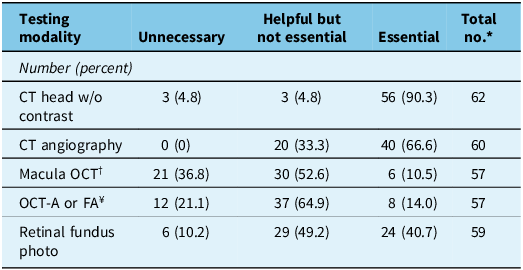
Of possible adjunctive investigations or multimodal ophthalmic imaging such as CT, CT angiography, macular optical coherence tomography (OCT) (structural retinal study), fluorescein angiography or OCT-angiography (retinal perfusion studies) or retinal fundus photo, a CT head without contrast was the only study found to be essential by almost all respondents (90%, see Table 1). Sixty-six percent of respondents indicated that CT angiography was an essential study, whereas all retinal imaging was found to be helpful but not essential by over half of respondents. Retinal fundus photography was thought to be helpful or essential by 90% of respondents. A formal ophthalmological consultation prior to provision of thrombolysis was noted to always be necessary by over half of respondents (53%), with virtual consultation always being sufficient as per 40% of total respondents and sometimes or often sufficient by 37% (see Table 2). The total number of respondents differed due to variable non-response. The percentage of those deeming virtual consultation appropriate out of the group indicating the necessity of ophthalmological examination was not explored. Qualitative content analysis using 2 coders and an open coding technique was used to sort comments regarding perceived barriers to thrombolysis (Cohen’s kappa = 0.81); 28 of 53 comments referred to barriers such as timely presentation to care or ophthalmology evaluation in an urgent manner.
Summary of responses regarding the perception of necessity of diagnostic tests prior to offering thrombolysis for isolated non-arteritic central retinal artery occlusion (of respondents who would offer thrombolysis)
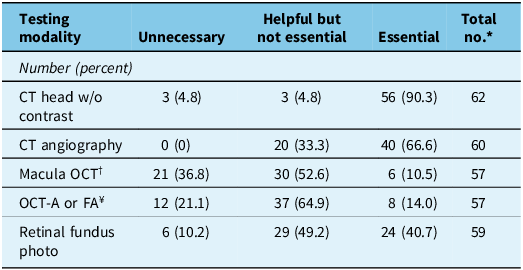
Table 1. Long description
The table presents data on the perceived necessity of different diagnostic tests prior to offering thrombolysis for isolated non-arteritic central retinal artery occlusion. It includes five rows and four columns. The columns are labeled ‘Testing modality’, ‘Unnecessary’, ‘Helpful but not essential’, ‘Essential’, and ‘Total no.’ The rows list different testing modalities: CT head without contrast, CT angiography, Macula OCT, OCT-A or FA, and Retinal fundus photo. Each row provides the number and percentage of respondents who rated the test as unnecessary, helpful but not essential, or essential. For example, 90.3 percent of respondents found CT head without contrast essential, while 66.6 percent found CT angiography essential. Retinal imaging tests were generally considered helpful but not essential by over half of the respondents. The total number of respondents varied due to non-response.
OCT = optical coherence tomography; OCT-A = OCT-angiography; FA = fluorescein angiography.
* Total no. differs due to non-response.
† Optical coherence tomography, a structural study of the retina.
¥ OCT-angiography or fluorescein angiography, perfusion studies of the retina.
Summary of responses regarding the willingness to provide thrombolysis in isolated non-arteritic central retinal artery occlusion and necessity of ophthalmology consult. Of 64 (15.6%) respondents, 10 would only offer thrombolysis in the context of an organized clinical trial (an additional option in the survey for thrombolysis provision inquiry)

Table 2. Long description
A table with three rows and five columns summarizing responses on thrombolysis provision and ophthalmology consultation requirements. The columns are labeled Never, Rarely, Sometimes, Often, and Always. The rows are labeled with statements regarding thrombolysis provision, formal ophthalmological consultation, and virtual ophthalmological consultation. Row 1: Would you provide thrombolysis in a patient otherwise eligible? Values are 1 (1.6 percent), 8 (12.5 percent), 16 (25 percent), 19 (29.7 percent), 10 (15.6 percent). Row 2: Would formal ophthalmological consultation be required prior to offering thrombolysis? Values are 2 (3.2 percent), 1 (1.6 percent), 10 (15.9 percent), 16 (25.4 percent), 34 (54.0 percent). Row 3: Would a virtual ophthalmological consultation be sufficient? Values are 8 (13.1 percent), 5 (8.2 percent), 17 (27.9 percent), 6 (9.8 percent), 25 (41.0 percent).
* Total no. differs due to non-response.
These results highlight willingness to provide thrombolysis for CRAO by the neurology community, although there is a relative lack of experience. Urgent access to ophthalmology (i.e., to confirm the diagnosis) is a perceived barrier in current systems; however, the results outline some willingness to consider virtual ophthalmological consultation for timely provision of thrombolytic treatment in eligible patients. Our recent study examining patients with CRAO at a tertiary care center in Ottawa, Canada, over a 4-year period found that the median time fromvision loss to presentation was 15.0 (interquartile range [IQR] 3.5–48.0) hours and the median time for ophthalmological consultation was 12.0 (IQR 4.6–22.6) hours. Reference Quinn, Liu, Albreiki and Lelli5 This highlights the fact that isolated vision loss is not always recognized as an indicator of stroke by healthcare providers or patients, leading to a delay in appropriate management. Reference Abel, Suresh, Hussein, Carpenter, Montezuma and Lee6 Studies have also highlighted that the delay to ophthalmological assessment after patient presentation is a barrier to optimal CRAO care. Given willingness from survey respondents to use virtual ophthalmological consultation, there may be a role for fundus photography or other ophthalmic imaging in the emergency room, with remote/virtual review of images by ophthalmology to confirm the diagnosis of CRAO.
A study surveying German stroke units in 2021 by Hoyer et al. similarly highlighted the perceived importance of ophthalmology consultation, as more than half of neurologists requested ophthalmic examination for confirmation of diagnosis, with 15 of 163 eligible centers’ responses noting a barrier being lack of ophthalmic expertise available at their institution in a timely manner. Reference Hoyer, Winzer and Matthé7 On the contrary, intravenous (IV) thrombolysis was regularly performed in eligible patients (57.4% of hospitals), whereas over half of respondents (57%) in our survey had never provided thrombolysis, representing a difference in practice in the Canadian context. Reference Hoyer, Winzer and Matthé7 We expect the true frequency of thrombolysis use may be even lower due to sampling bias as those who provide thrombolysis are more likely to respond to a survey such as ours. In the American context, a survey from 2017 noted 15% referral for intra-arterial thrombolysis from neurology and 4% from ophthalmology if a patient presented within 12 hours of vision loss. Reference Abel, Suresh, Hussein, Carpenter, Montezuma and Lee6 These differences may be owing to evidence available at the time of publication and varied administration techniques.
This study provides important preliminary perspectives regarding neurology practices for acute CRAO in Canada; however, limitations exist. Most notably, this study includes response and recall bias secondary to survey formatting. Respondents with interest or experience in CRAO management may overestimate willingness to treat, while physicians who work in smaller centers or view CRAO as separate from stroke practice may not respond. Responses were sampled from different hospital jurisdictions across Canada, including numerous Quebec respondents; however, the response rate was low. The sample was not sufficient to assess regional variation. With an estimated 600 academic neurologists practicing in 2019, according to Canadian Medical Association, we estimate our response rate to be 10.7% or lower. 8 The survey being distributed solely in the English language may have limited responses from French-speaking colleagues.
This survey was conducted in March–May 2024 and only represents perspectives from a single point in time in the context of current evidence in the field of CRAO management. Since distribution of our survey, the results of two randomized controlled trials of IV thrombolysis for CRAO have been published, both showing no benefit over placebo; furthermore, a safety signal was raised by one of the trials. Reference Préterre, Gaultier and Obadia9,Reference Ryan, Jørstad and Skjelland10 Results of a third trial of IV thrombolysis for CRAO are pending. In contrast, a recent meta-analysis of observational studies found a positive association between early thrombolysis and visual recovery. Reference Xie, Zaslavsky and Chaban11 Although these emerging data may influence willingness to provide thrombolysis, the conflicting data mean that equipoise still exists. Safety concerns may reinforce the perceived need for ophthalmology consultation. Comfort with virtual ophthalmology pathways may be enhanced when remote consultation is accompanied by objective documentation of CRAO, such as with fundus imaging in the emergency department.
Overall, this investigation helps to understand recent perceptions of Canadian neurologists providing stroke care in terms of awareness of CRAO as a stroke syndrome, comfort with offering thrombolysis, most useful diagnostic tests and perceived barriers. With this knowledge, and as new evidence presents, stakeholders in stroke and vision care should continue to pursue optimal management for patients with acute CRAO.
Supplementary material
The supplementary material for this article can be found at https://doi.org/10.1017/cjn.2026.10694.
Acknowledgments
Thank you to the Canadian Neurology community and physicians who responded to this survey, who made this exploration possible.
Author contributions
All persons designated as authors on this publication have participated sufficiently in bringing this research work to fruition including study conception and design, drafting and revising the study protocol and manuscript and approval of the final product. Data collection and analysis were performed by VL and ZXF.
Funding statement
We acknowledge the University of Ottawa Department of Ophthalmology Research Fund for providing research support funding to conduct this project.
Competing interests
MPQ has received grants or contracts from Bayer, Canadian Ophthalmological Society and Fighting Blindness Canada, not relevant to this publication. DA, DL, VL and ZXF have no conflicts of interest to disclose. This project was supported by the University of Ottawa Department of Ophthalmology Research Fund, a general fund to support research work for residents in ophthalmology.



 Open access

