Up to two-thirds of children with complex CHD have long-term neurodevelopmental deficits or disabilities.Reference Marino, Lipkin and Newburger 1 – Reference Wernovsky 5 These disabilities partly result from neurologic injury sustained in the perioperative period from the interaction of patient-related factors, surgical-related factors, and pre- and post-operative complications.Reference Wernovsky and Licht 6 – Reference Fogel, Li and Elci 8 Given the complex interplay between limited cardiovascular reserve and cerebral perfusion, most children with CHD are in the cardiac ICU during this period when they are at high risk of acute neurologic injury.Reference Limperopoulos, Majnemer, Shevell, Rosenblatt, Rohlicek and Tchervenkov 9 This neurologic injury may be mitigated with early detection and intervention.
Nurses typically perform serial bedside clinical neurologic assessments, or “neuro checks,” to detect acute neurologic injury. These modified neurologic examinations typically include assessments of consciousness such as the Glasgow Coma Scale, cranial nerves, for example, pupillary light reflex, and sensorimotor function.Reference Teasdale, Maas, Lecky, Manley, Stocchetti and Murray 10 Neurologic assessments of critically ill children are challenging because of the wide age and developmental ranges of the population, many are mechanically ventilated and/or sedated, and cooperation with the examination can be limited. Many patients are post-operative and may have open chests, drainage catheters, and cannulas to support extra-corporeal devices, which can also confound neurologic evaluation. Numerous paediatric coma scales have been developed to address some these issues, although they have not been validated in the cardiac ICU population.Reference Teasdale, Maas, Lecky, Manley, Stocchetti and Murray 10 – Reference Reilly, Simpson, Sprod and Thomas 14 We demonstrated substantial variability in neurologic assessment practices in academic paediatric medical–surgical ICUs throughout the United States,Reference Kirschen, Snyder and Winters 15 although it remains unclear how neurologic assessment is performed in cardiac ICUs.
We sought to describe how physicians perform routine bedside neurologic assessments in paediatric cardiac ICUs and the attitudes of paediatric cardiac intensivists on the utility of these assessments. We hypothesise that substantial variability based on physician reporting exists across academic paediatric cardiac ICUs regarding routine neurologic assessments.
Materials and methods
Survey
An interdisciplinary critical care, neurology, and nursing team developed a 28-question electronic survey (SurveyMonkey, USA). The survey addressed four domains related to cardiac ICU bedside nursing neurologic assessments, including the elements of the neurologic examination, assessment frequency, communication and documentation of changes in neurologic status, and optimisation of assessments that includes adding a measure of pre-illness neurologic function (Supplementary Figure S1). The survey was piloted locally by paediatric and cardiac intensivists.
The survey was distributed by e-mail through the Pediatric Cardiac Intensive Care Society member distribution list in November 2016. Subsequently, the survey was also distributed to the leadership faculty at the top 50 paediatric cardiology programmes listed in the United States News and World Report 2016, who did not respond to the Pediatric Cardiac Intensive Care Society survey request. E-mail recipients were asked to complete the survey as an institutional representative, or forward the survey to another faculty member. The survey request explicitly stated that the aim of the survey was to assess what actually happens in cardiac ICUs with respect to routine bedside nursing neurologic assessments and that consulting with physician or nursing colleagues or the institution’s patient care handbook was permitted and encouraged.
Limited demographic information was obtained about each institution’s cardiac ICU, and no identifying information was collected from survey respondents. The survey took approximately 5 minutes to complete. This study was determined to be exempt by the institutional review board at Children’s Hospital of Philadelphia.
Statistical analysis
A survey was evaluable if the respondent was a faculty member and had answered questions beyond the demographics page. Data were analysed using descriptive statistics. For institutions with more than one response, responses to each question were combined where appropriate, that is, components of neurologic assessments and documentation and communication of neurologic status changes. For responses addressing the frequency of neurologic assessments, analyses were conducted using the most frequent assessment if there were multiple respondents from the same institution, that is, using every 2 hours if there were two respondents, one answering every 2 hours and one every 4 hours. All faculty respondents were included in the analyses for questions regarding the utility of neurologic assessments.
Results
Surveys from 43 of the top 50 paediatric cardiology programmes from United States News and World Report were evaluable (86% response rate). In addition, seven surveys from the Pediatric Cardiac Intensive Care Society distribution were evaluable, which included four international institutions (Canada, Mexico, Argentina, and Kuwait). Of the 50 evaluable institutions, 78% (39/50) were standalone cardiac ICUs and 22% (11/50) were combined paediatric/cardiac ICUs with a median of 20 (interquartile range 14–24) beds. In all, four institutions completed two surveys and one institution completed three surveys.
Elements of bedside nursing neurologic assessment
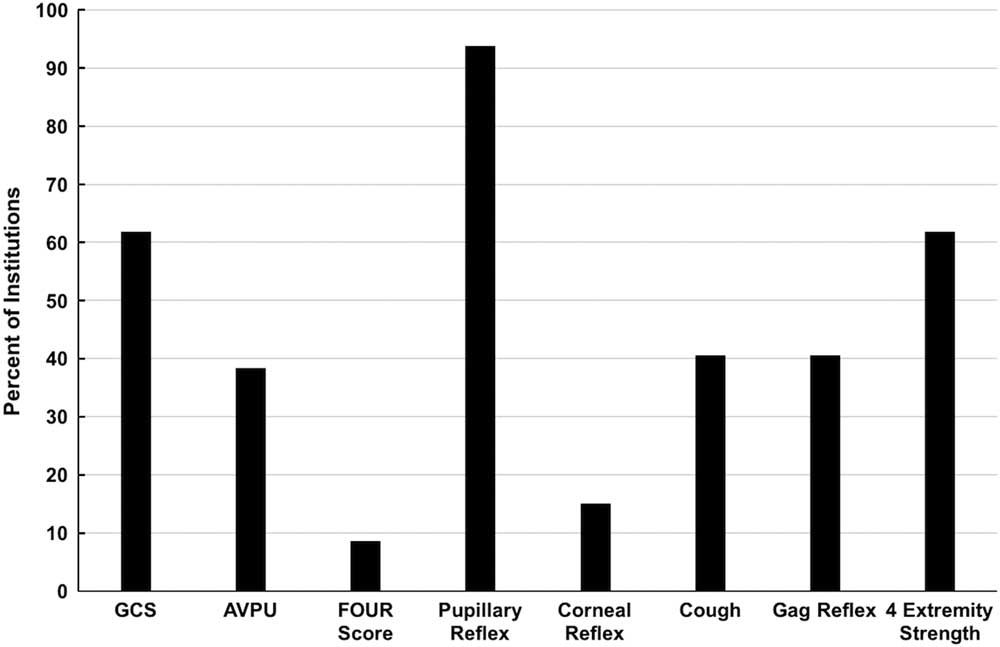
Performance of routine bedside nursing clinical neurologic assessments was reported in 94% (47/50) of institutions and standardised in 56% (28/50). A provider order was required in 58% (29/50). There was significant variability in the elements of reported neurologic assessments between institutions (Fig 1). Pupillary light reflex was routinely performed in nearly all (44/47, 94%) institutions. Of the 77% (36/47) of institutions that used coma scales, the most commonly applied were Glasgow Coma Scale (81%), Alert Voice Pain Unresponsive scale (50%), and the Full Outline of UnResponsiveness score (11%). Of the institutions, 11% (5/47) used neonatal-specific coma scales.
Elements of bedside nursing neurologic assessment performed at responding institutions. GCS=Glasgow Coma Scale; AVPU=Alert Voice Pain Unresponsive scale; FOUR=Full Outline of UnResponsiveness score.

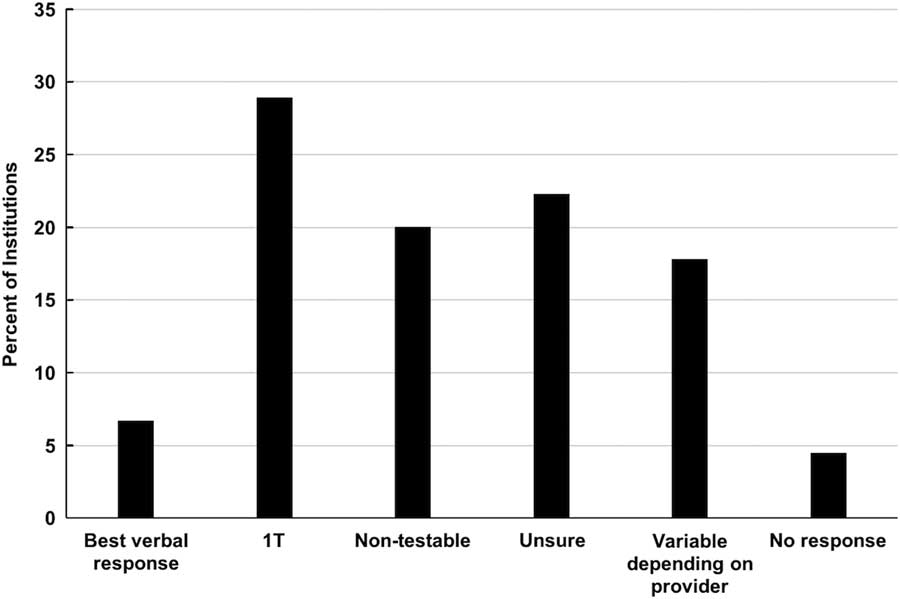
A total of 51% (24/47) of institutions used a paediatric modification of the Glasgow Coma Scale. The age cut-offs reported for the paediatric Glasgow Coma Scale were ⩽1 year (46%), ⩽2 years (17%), ⩽3 years (8%), ⩽4 years (4%), ⩽5 years (21%), and ⩽10 years (4%). Approaches to scoring the verbal component of the Glasgow Coma Scale in intubated patients were variable (Fig 2). In all, 41% (20/49) of physicians characterised Glasgow Coma Scale as a valuable tool for the serial assessment of neurologic function in a critical care setting.
Approaches to scoring the verbal component of the Glasgow Coma Scale in intubated patients at responding institutions. 1 T=Intubated.

Frequency of bedside nursing neurologic assessment
The frequency of bedside neurologic assessments was at the discretion of a physician in 72% (36/50), a nurse in 24% (12/50), and by institutional protocol in 44% (22/50); 28% (14/50) reported multiple methods to determine assessment frequency. Nursing discretion was reported as the sole means to determine assessment frequency at two institutions.
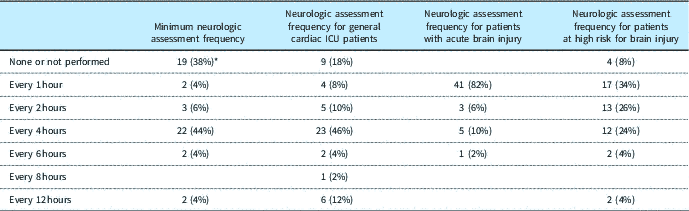
The reported minimum neurologic assessment frequency ranged from every 1 hour to every 12 hours (Table 1), with every 4 hours being the most common. In all, 38% (19/50) of institutions reported no minimum frequency of neurologic assessment. For cardiac ICU patients deemed to be at low risk for acute neurologic injury by the treating physician, frequency of assessments was most commonly reported as every 4 hours (56%). For patients deemed to be at high risk for acute brain injury, but without overt neurologic injury, the reported frequency of neurologic assessments was variable (Table 1). For patients with acute neurologic injury, 82% (41/50) of institutions reported performing hourly assessments.
Neurologic assessment frequency

* Reported as number and percentage of institutions (n=50)
Communication and documentation of neurologic status changes
In total, 89% (40/45) of institutions reported that any neurologic decline detected on routine neurologic assessment was communicated to providers, whereas 11% (5/45) reported that communication depended on the severity or degree of neurologic decline. In all, 69% (31/45) of institutions had more than one trigger for communication; communication was determined by the ICU protocol in 16% (7/45), physician order in 42% (19/45), and nurse discretion in 93% (42/45). Nurse discretion was the only determinant for communication of neurologic change in 24% (11/45). Communication was individualised per patient in 56% (25/45) of institutions. Changes in neurologic status were documented in at least one location – i.e. neurologic assessment section, free text nursing comment, or physician progress note – in the electronic medical record at all institutions.
Optimisation of neurologic assessments
A standardised system to characterise the pre-illness neurologic function of children with developmental disabilities or chronic brain injury was present in 12% (5/41) of institutions. In addition, 91% (41/45) of respondents believed that a standard approach to define pre-illness neurologic functioning would be beneficial.
In all, 84% (38/45) of respondents thought that existing current neurologic assessments were suboptimal to monitor neurologic status in cardiac ICU patients. Respondent comments centred around improvement in standardisation and education of neurologic assessments, standardisation of pre-illness neurological assessments, and development of new tools to monitor neurologic status in ICU patients, particularly those with developmental disabilities.
Discussion
This survey found that only 56% of paediatric cardiac ICUs reported having standardised routine bedside nursing neurologic assessments, and that there was considerable variability in the elements and frequency of these assessments. The majority of respondents reported that nursing neurologic assessments were suboptimal to monitor the neurologic status of critically ill cardiac patients. Most institutions lacked standardised characterisation of pre-illness neurologic function in children with developmental disabilities, and most respondents felt that a system to determine patients’ pre-illness neurologic functioning would be beneficial to their practice.
Bedside nursing neurologic assessments, or “neuro checks,” are standard of care for monitoring the neurologic status of critically ill patients, although limited data exist to indicate the optimal examination elements and assessment frequency. Current literature focusses mainly on predictability and reliability of the Glasgow Coma Scale, with data derived largely from adults with altered consciousness from acute neurologic injury.Reference Teasdale, Maas, Lecky, Manley, Stocchetti and Murray 10 A recent paediatric ICU survey showed that routine bedside neurologic assessments were conducted at nearly all institutions.Reference Kirschen, Snyder and Winters 15 Although examination elements were variable, Glasgow Coma Scale and pupillary reflex were the most commonly performed elements. For patients with acute neurologic injury, nearly all institutions performed hourly neurologic assessments, whereas assessment frequency was more variable for low-risk patients and high-risk patients without overt neurologic injury.
Respondents in the present survey reported that the pupillary light reflex was routinely performed in nearly all cardiac ICUs. Pupillary responses can help differentiate whether the cause of a patient’s encephalopathy is owing to a metabolic or structural aetiology.Reference Posner, Saper, Schiff and Plum 16 However, although pupillary assessments are relatively quick and straightforward to perform, they are inadequate in detecting evolving neurologic injury. The classic pupillary abnormality of a unilateral fixed and dilated pupil from uncal herniation owing to an expanding mass lesion is rare in the cardiac ICU. Small reactive pupils, owing to a metabolic or pharmacologic aetiology, are far more common in the ICU environment. Patients who are more deeply sedated, particularly with opioid-based regimens, may have smaller pupils with limited reactivity. Under these circumstances, changes may be subtler to detect and challenging for clinicians to incorporate into decision-making. Existing data demonstrate only moderate agreement between providers in determining pupil size, shape, and reactivity, and anisocoria was missed 50% of the time.Reference Olson, Stutzman, Saju, Wilson, Zhao and Aiyagari 17 , Reference Couret, Boumaza and Grisotto 18 Pupilometers may be a means of quantifying pupil reactivity to reduce the subjectivity of the examination and provide an earlier marker of brain dysfunction.Reference Olson and Fishel 19 , Reference Zafar and Suarez 20
In all, 77% of institutions in this study used the Glasgow Coma Scale, Alert Voice Pain Unresponsive scale, or Full Outline of UnResponsiveness score in their routine neurologic assessments.Reference Wijdicks, Bamlet, Maramattom, Manno and McClelland 21 – Reference Teasdale, Allen, Brennan, McElhinney and Mackinnon 26 These coma scales are designed to be reproducible, provide longitudinal assessments, and facilitate effective communication between care providers; however, they have significant limitations when used in the paediatric cardiac ICU environment. The utility of most of these scales is limited in intubated and sedated critically ill children.Reference Stocchetti, Pagan and Calappi 27 – Reference Zuercher, Ummenhofer, Baltussen and Walder 29 The location and intensity of noxious stimuli used to elicit a response can be variable, which affects the interpretation of the patient’s neurologic capabilities.Reference Reith, Brennan, Maas and Teasdale 30 The evaluation of infants, young children, and children with neurodevelopmental disabilities is especially challenging, as they cannot reliably follow commands, answer questions, or localise to a painful stimulus owing to brain immaturity or prior injury.Reference Kirkham, Newton and Whitehouse 12 , Reference Simpson, Cockington, Hanieh, Raftos and Reilly 31 Paediatric modifications of these scales exist, although widespread use is inconsistent because many incorporate developmentally inappropriate responses, or rely on subjective interpretation of behaviour states such as irritability. Some infant-specific coma scales have been developed, but reliability is variable, and none have gained widespread acceptance.Reference Durham, Clancy and Leuthardt 11 , Reference Yager, Johnston and Seshia 32 – Reference Raimondi and Hirschauer 34 Less than half of the institutions in this survey used a paediatric modification of the Glasgow Coma Scale, and those that did had variable age cut-offs and inconsistencies in how the verbal component was scored in an intubated child (Fig 2). These deficiencies probably contributed to respondents’ lack of confidence in the utility of existing coma scales and neurologic assessments.
Certain populations of patients cared for in the cardiac ICU may be at higher risk for neurologic decompensation and therefore may require more frequent and focused neurologic assessments to identify early signs of acute brain injury. Many factors including type of CHD or cardiomyopathy, surgical complexity, post-operative complications, and anti-coagulation requirements may predispose children to acute brain injury.Reference Licht, Brandsema, Von Rhein and Latal 35 Acute brain injury in the cardiac ICU may develop owing to many mechanisms including hypoxia–ischaemia, seizures, arterial ischaemic stroke, cerebral sinovenous thrombosis, or intracerebral haemorrhage. This brain injury may manifest as clinical changes in a patient’s neurologic examination.
When asked what could be done to improve neurologic assessments in critically ill cardiac patients, survey physicians recommended more standardised and targeted neurologic assessment tools and communication protocols, education for cardiac intensivists and nurses about the importance of neurologic assessments and interpretation of neurologic exam findings, and tools to determine and document pre-illness neurologic function. Several respondents also advocated for the increased use of non-invasive neuromonitoring techniques such as continuous electroencephalography and near infrared spectroscopy. Thus, further research and quality improvement efforts are needed to determine whether increased standardisation, new screening tools designed to overcome limitations of the Glasgow Coma Scale, and/or standardised tools for reporting pre-illness neurologic function will improve early identification of neurologic decline and functional outcomes.
For a screening neurologic assessments scale to be effective in the cardiac ICU environment, physicians indicated that it should be easy and rapid for bedside nurses to administer, able to discriminate clinically meaningful changes in neurologic functioning, applicable to a broad range of ages including infants, and relevant for children with pre-existing developmental disabilities. The tool should be sensitive to the neurologic signs and symptoms associated with the different mechanisms of acute brain injury that commonly occur in the cardiac ICU. Implementation of a new scale will also benefit from guidance for situations where neurologic decline is expected; for example, after sedative administration, to minimise unnecessary provider notifications. Although patient-specific thresholds for communication may be appropriate, a minimum standard should exist.
Survey respondents indicated that patients’ pre-illness level of neurologic functioning is not typically available in a standardised manner, although it could be documented in the developmental milestones section of the history and physical or on nursing flowsheets. One institution used the Pediatric Cerebral Performance Category Scale for this purpose.Reference Fiser 36 At our institution, we require providers to complete a Glasgow Coma Scale reflecting the patient’s pre-illness neurologic status by caregiver interview on ICU admission. These standardised pre-illness Glasgow Coma Scale values are then compared with Glasgow Coma Scale scores obtained during the hospitalisation to assess for deviations from the patient’s neurologic baseline.Reference Kirschen, Lourie and Snyder 37
This study had limitations. Surveys were self-reported and represent what providers say they do, but may not accurately reflect actual institutional practice. Because the surveys reported neurologic assessments at a subset of mostly large academic centres in the United States with paediatric cardiac ICUs, the results may not reflect practice at non-academic centres and centres outside the United States. Given the small number of combined paediatric/cardiac ICUs in this sample, it was not possible to determine whether neurologic assessment practices were different in combined units. In the combined units, nurses may be more adept at performing neurologic assessments given the higher prevalence of neurosurgical patients and patients with acute brain injury. This study did not assess other neurophysiological monitoring techniques such as electroencephalography or near infrared spectroscopy, which may be used to augment the neurologic examination of patients, particularly in the post-operative period.
Routine bedside clinical nursing neurologic assessments are reported to be conducted in most surveyed paediatric cardiac ICUs, although the assessment elements, frequency, and triggers for communication and documentation of neurologic decline vary greatly between institutions. Most clinicians felt that current practices for neurologic assessments are suboptimal, and believed that increased standardisation and specialised tools to assess children with developmental disabilities are necessary. Further work is needed to develop and implement new neurologic assessment tools that incorporate the unique risk factors and physiology in this heterogeneous population.
Supplementary material
To view supplementary material for this article, please visit https://doi.org/10.1017/S1047951118001634
Acknowledgements
The authors thank the Pediatric Cardiac Intensive Care Society for distributing the survey to its membership, and all cardiac ICU faculty members who responded to the survey.
Financial Support
Department of Anesthesiology and Critical Care Medicine at Children’s Hospital of Philadelphia.
Conflicts of Interest
None
Ethical Standards
The authors assert that all procedures contributing to this work comply with the ethical standards of the Helsinki Declaration of 1975, as revised in 2008. This study was determined to be exempt by the institutional review board at Children’s Hospital of Philadelphia.