INTRODUCTION
Institutional scholars have increasingly conceptualized institutional change as the outcome of conflict among powerful actors. Recent theory has begun examining settlements to conflict (Rao & Kenney, Reference Rao and Kenney2008; Helms, Oliver, & Webb, Reference Helms, Oliver and Webb2012). A ‘settlement’ is the conclusion of a period of conflict in which all direct parties to the conflict concur that an agreement has been reached (Foley, Reference Foley2007). Although traditional scholarship on the settlement of conflict has emphasized that its consensual nature sustains existing conditions between actors in an institutional field (Coser, Reference Coser1956), in this paper, we argue that settlements to conflict are just as likely to be what we call radical in nature and fundamentally alter the way that institutional constituents relate to one another.
On the one hand, settlements to conflict are assumed to be a stabilizing influence on organizational environments. During the development of ISO 26000, for example, the settlement of conflict among different organizations regarding the meaning of corporate social responsibility led to a broadly accepted definition and greater consensus among industry, standards agencies, and governmental bodies on how to engage in corporate social responsibility (Balzarova & Castka, Reference Balzarova and Castka2012; Bres, Reference Bres2013). On the other hand, settlements to conflict can be change inducing – a phenomenon that has been overlooked in the literature on conflict and change in institutional fields (DiMaggio & Powell, Reference DiMaggio and Powell1983). The private settlement of conflict between British Petroleum (BP), the US federal government, and community groups regarding the Gulf Oil Spill led to radical shifts in how oil companies engaged with stakeholders (Rotemberg, Reference Rotemberg2010). An additional example of a radical settlement, the Good Friday Accords, resulting from private bargaining between British and Northern Ireland’s political representatives resolved conflict that had endured for hundreds of years and led to a profound shift in subsequent behaviors not only between the participants to the exchange but also within the broader institutional context, including institutions associated with policing, social services, and the stability of the economy (Honeyman, 2001). These latter two examples illustrate that change in fields can be triggered by an end to conflict. In order to distinguish between settlements that are stabilizing in nature, which represents the traditional scholarly view of conflict, from settlements that are capable of disrupting the status quo, we introduce the concept of radical settlements. We define them as a resolution to conflict between two or more constituents within a field who possess some degree of power, status, visibility, or legitimacy (Oliver, Reference Oliver1991) that significantly affects their pattern of relating to one another. The more radical the settlement, the higher the potential for the settlement to have an influence on an organizational field. In spite of recent acknowledgment that conflict settlement might be a potential source of institutional change (Rao & Kenney, Reference Rao and Kenney2008), how or when these radical settlements emerge remains unknown. We suggest that constituents’ conflict management strategies are a key influence in affecting the probability of radical settlements and significant change in an institutional environment. Conflict management strategies refer to how constituents attempt to resolve conflict among one other.
What also distinguishes the management of radical settlements as a source of institutional change from sources that have received attention in the literature is their endogeneity to the field. Change has been attributed to a range of exogenous phenomena, including new inventions or technological discontinuities that impact the field (Barley, Reference Barley1986; Garud, Jain, & Kumaraswamy, Reference Garud, Jain and Kumaraswamy2002), the transmission or migration of practices from one institutional field to another (Zilber, Reference Zilber2006), and the introduction of social movements into a field (King & Haveman, Reference King and Haveman2008). Although scholars have shown how social activists (Rao & Kumar, Reference Rao and Kumar1999) and institutional entrepreneurs (Khavul, Chavez, & Bruton, Reference Khavul, Chavez and Bruton2013) endogenous to fields can precipitate change (den Hond & de Bakker, Reference den Hond and de Bakker2007), research has not been conducted on institutional change as a by-product of bringing ‘peace’ between two conflicting parties. Settlements as endogenous events within fields address grievances and disputes by means of conflict management strategies directed at resolution between two or more constituents (a settlement between two competitors or between a firm and a powerful lobby group, for example). Based on the argument that radical settlements to conflict between powerful constituents is an important but overlooked endogenous source of institutional change, this paper sought to ask the following: what are the different conflict management strategies that produce radical versus nonradical (nondisruptive) changes to an institutional field and when are these settlements more likely to be radical?
As a means of contributing new insights to both the conflict literature and the phenomenon of institutional change, this paper offers a model that outlines the antecedents and strategies of conflict management between constituents and the resulting probability of radical settlements. This model introduces a proposed typology of strategies used by disputing parties to reach a settlement to conflict and the likelihood that these different strategies will lead to a radical settlement of conflict between constituents in an institutional field.
LITERATURE REVIEW
Radical settlements to conflict as a catalyst to new relational patterns within fields
Both emerging studies and real-world observations demonstrate that settlements to conflict can dramatically change the way institutional constituents in a field relate to one another. Fields are relational spaces composed of ‘sets of organizations that in the aggregate constitute an area of institutional life: key suppliers, resource and product consumers, regulatory agencies, and other organizations that produce similar services or products’ (DiMaggio & Powell, Reference DiMaggio and Powell1983: 148). Whether it is around unions and corporations negotiating labor disputes (Helfen & Sydow, Reference Helfen and Sydow2013), industry and environmental groups in conflict over environmental practices (Hoffman, Reference Hoffman1999), or powerful corporations negotiating with regulators (Maurer & Ebers, Reference Marquis and Lounsbury2006), when institutional constituents resolve conflict in ways that radically alter how they relate to one another, fields change. Settlements to conflict have three profound implications for fields.
First, radical settlements often require conflicting constituents themselves to seek new ways of relating to the rest of the field, thus destabilizing their existing relations with other field members and creating new institutional change patterns (Roulet, Reference Rouletforthcoming). Radical settlements to conflict can generate negative effects for the disputants’ legitimacy or functioning (collaborating with a disreputable combatant, for example), leading to disruptions in an institutional field. This has been demonstrated in research on confrontations around contested practices that have led to the stigmatization of one or both parties (Hudson, Reference Hudson2008), such as Hudson and Okhuysen’s (Reference Hudson and Okhuysen2009: 146) study of negotiations between stigmatized men’s bath houses and public health departments in the United States. The negotiation of settlements led to stigma transference to the latter and altered perceptions in the broader institutional field about the meaning of illegitimate state conduct.
Second, when institutional constituents substantially alter how they relate to one another, they may also significantly influence how other actors make sense of their environment (Spedale, Van den Bosch, & Volberda, Reference Spedale, Van den Bosch and Volberda2007; Keashly & Neuman, Reference Keashly and Neuman2008; Jonsson, Greve, & Fujiwara-Greve, Reference Jonsson, Greve and Fujiwara-Greve2009). Ancillary organizations to the conflict may begin to imitate and model the newly created behavior of the parties to the settlement, causing change in the field (Galaskiewicz & Wasserman, Reference Galaskiewicz and Wasserman1989; Deitch & Hegewisch, Reference De Luca and Sekeris2013). Radical settlements can also lead to major redistributions of power among field members. For example, De Luca and Sekeris (Reference Deitch and Hegewisch2012) found that, following settlements by powerful landlords that led to land inequality outcomes in Latin America, these settlements inadvertently increased conflict intensity in the broader institutional field among organized groups of landless individuals, escalating political violence among marginalized actors at the field level.
Finally, radical settlements set precedents or expectations for how future conflicts will be managed, such as standards for new rules and norms of conduct in a field (James & Wooten, Reference James and Wooten2006; Helms & Webb, Reference Helms and Webb2014). For example, in their study of a 2001 strike in Kukdong, a rural province in Mexico, Knight and Wells (Reference Knight and Wells2007) found that a conflict between a union and manufacturers led to international changes in norms and rules governing union independence from manufacturers. How institutional constituents resolve conflict frequently becomes an exemplar for how other actors should resolve disputes. This is demonstrated broadly in research on the private settlement of litigation between actors, which serves as a mimetic ‘benchmark’ for how other actors ‘should’ settle similar conflict.
These observations on radical settlements are consistent with recent calls for greater attention to ‘interactionist perspectives’ of fields (Barley, Reference Bar-Tal2008; McPherson & Sauder, Reference McPherson and Sauder2013) as contexts of constituents engaged actively in referencing, influencing, and engaging with one another, and to fields as relational spaces (Wooten & Hoffman, Reference Wooten and Hoffman2008) composed of constituents engaged in ideological contestation. Framing fields as relational and contested spaces ascribes agentic power to the interacting field members as managers of field conflict and conflict resolution. However, no theory exists on how conflict management strategies generate radical settlements or what factors might predict when these radical settlements emerge.
Existing theory on conflict in fields
Existing treatments of conflict from an institutional perspective (Seo & Creed, Reference Seo and Creed2002) have tended to overlook two aspects of conflict as a source of change in institutional fields that, we argue, needs to be problematized to generate new insights into how radical settlements emerge. First, the resolution or settlement of conflicts has been presumed to create ideological consensus among institutional constituents (DiMaggio & Powell, Reference DiMaggio and Powell1983; Thornton, Reference Thornton, Ocasio and Lounsbury2002). This paper’s premise, in contrast, is that settlements between constituents can also be the basis for disruption in institutional fields. Therefore, this paper’s emphasis on conflict settlement as a source and antecedent of change in institutional fields (Ansari, Wijen, & Gray, Reference Ansari, Wijen and Gray2013) is diametrically opposite (though not opposed) to the current argument that continuing, unresolved conflict between actors is the source of change and disruption in institutional fields (Reay & Hinings, Reference Reay and Hinings2005; Suddaby & Greenwood, Reference Suddaby and Greenwood2005).
Second, theory and research on institutional fields have viewed conflict from the perspective of agentic actors (institutional entrepreneurs, social movement groups) who instigate or impose conflict on other field members with the intent of precipitating change (Jay, Reference Jay2013; Khavul, Chavez, & Bruton, Reference Khavul, Chavez and Bruton2013; McPherson & Sauder, Reference McPherson and Sauder2013). In contrast, less work has considered how change may be the by-product of solutions – for example, some scholars in the healthcare field have argued that specific dyadic policy settlements that introduced market-oriented reforms to medical practices in given hospitals in the United States led to a dehumanization of the patient by the objectification of the individual (Dolfsma & McMaster, Reference Dolfsma and McMaster2011). Change as a by-product of conflict settlement may or may not be benign to all members of the institutional field – for example, in chronicling the settlement of the ‘Little Steel’ strike of 1937, Dennis observed that ‘while the [management] leaders focused almost exclusively on the achievement of a signed contract’ (2012: 167), the dyadic settlement became the impetus for broader democratic reform and social uprising in the broader institutional field, including a new community of women’s auxiliary members as political activists and the recruitment of African-Americans to the union cause. The settlement or cessation of a dispute between the steel company and the union was, thus, a catalyst for progressive social changes.
By framing fields as relational spaces, we problematize the resolution of conflict as more than the consensual and enduring end point of conflict. Instead, settlements need to be considered as potentially significant triggering events in altering institutional fields.
Conflict and its management
To date, the means by which the management of conflict by institutional constituents affects radical settlements are unknown. Conflict is defined here as arising from struggles between two constituents during interactions regarding relational differences in their ideological preferences or interests (Simons & Ingram, Reference Simons and Ingram1997; Jack & Lagunoff, Reference Jack and Lagunoff2006; Vaara & Tienari, Reference Vaara and Tienari2008). Our conceptualization of conflict emphasizes what Baron calls ‘private politics’ or the private resolution of disputes between two or more constituents:
Private politics address situations of conflict and their resolution without reliance on the law. It encompasses the political competition over entitlements in the status quo, the direct competition for support from the public, bargaining over the resolution of the conflict, and the maintenance of the agreed-to private ordering. The term ‘private’ means that the parties do not rely on public order, i.e. lawmaking or the courts. (Baron, Reference Barley2003: 32)
Ideology is central to any definition of conflict (Thompson & Gonzalez, Reference Thompson and Gonzalez1997; Wade-Benzoni, Hoffman, Thompson, Moore, Gillespie, & Bazerman, Reference Wade-Benzoni, Hoffman, Thompson, Moore, Gillespie and Bazerman2002a; Wade-Benzoni, Okumura, Brett, Moore, Tenbrunsel, & Bazerman, Reference Wade-Benzoni, Okumura, Brett, Moore, Tenbrunsel and Bazerman2002b; Bar-Tal, Reference Baron2007; Friedman, Liu, Chen, & Chi, Reference Friedman, Liu, Chen and Chi2007). ‘If ideology not only shapes cognitions, perceptions and preferences, but also influences any determination of good and bad, true or false, then it is not possible to determine the “real interests” of any group… without specifying the particular ideology framing the argument’ (Fletcher, Reference Fletcher1992: 32). Conflict scholars such as Wade-Benzoni and her colleagues have found that when conflict between actors is highly ideological in nature, it increases the intensity of the conflict – for example, disputes regarding resources that are considered esthetically valuable or ‘sacred’ by conflicting parties can lead to intractable battles in which compromise is not easily attainable (Gray, Coleman, & Putnam, Reference Gray, Coleman and Putnam2007). Similarly, conflict resolution researchers (Deutsch, Reference Deutsch1977; DiStefano, Reference DiStefano1984; Black, Reference Black1998; Rubin, Pruitt, & Kim, Reference Rubin, Pruitt and Kim1994) have suggested that the power dynamics between the disputants also heavily influence how parties to a dispute resolve conflict by circumscribing the repertoire of approaches open to each party. Power is, therefore, strongly linked to how conflict is managed.
Research on conflict substantiates the importance of conflict management approaches as a predictor of settlements. Political (Schelling, Reference Schelling1960; Elster, Reference Elster1989), sociological (Simmel, Reference Simmel1922; Coser, Reference Coser1956), conflict resolution (Deutsch, Reference Deutsch1977), and legal (Cooter, Marks, & Mnookin, Reference Cooter, Marks and Mnookin1982; Mnookin, Reference Mnookin1992) research on disputes has traditionally focused on processes such as collective bargaining, as well as how conflict resolution processes are structured to lead to cooperative norms and utility-maximizing interactions. This work has focused on the equity, transparency, durability, and amicability of dispute resolution rather than its subsequent impact on other constituents in the wider field. The conflict literature has also described formal techniques and mechanisms (mediation, arbitration, collective bargaining) for approaching conflicts rather than identifying the full range of bilateral conflict management approaches that conflicting parties might draw upon to contest and resolve disputes. To answer our research question, we turn to conflict management strategies and their likelihood of leading to a radical settlement. First, however, we consider two antecedents of conflict management that are likely to affect the conflicting parties’ choice of management strategy: the ideological salience of the conflict and the polarization of the surrounding institutional environment around the position of the conflicting parties.
ANTECEDENTS AND STRATEGIES OF CONFLICT MANAGEMENT AND THE EMERGENCE OF RADICAL SETTLEMENTS
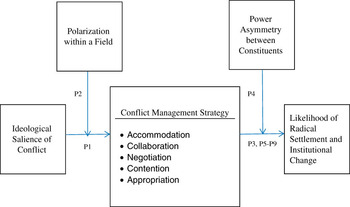
This paper introduces a typology of conflict management strategies that explains variation in the likelihood of a radical settlement to conflict between two constituents. This typology is intended to generalize to any constituents as defined in the introduction, including businesses, interest groups, activist organizations, government agencies, professional or trade associations, or other influential members of an organizational field. To predict the probability that conflict management will be occurring, we make the straightforward argument that constituents are more likely to engage in conflict management strategies when the issue at stake is ideologically salient to the conflicting parties. It is also proposed that the extent to which polarization exists around the issue under dispute in the wider institutional field will moderate the effect of ideological salience on conflict management strategies. In addition, our paper takes its cue from the conflict management literature in arguing that the relative power of the disputing parties will influence the extent to which conflict management results in radical settlements and institutional change. Figure 1 summarizes these propositions.
Conflict management and the likelihood of radical settlement

The ideological salience of conflict and conflict management strategies
Ideological salience is defined as an actor-level measure of how prominently an ideology serves as the point of reference for describing and evaluating an issue involved in a settlement. It is proposed that ideological salience is central in driving the conflicting parties’ approach to managing conflict. We propose this based on the following reasoning.
When conflict is rooted in disagreements around ideology – normative preferences regarding the meaning, rather than exclusively the amount or distribution, of tangible resources – actors are more likely to define the other party and its conflicting preferences as inimical or morally deviant, and to adopt combative patterns of relating (Hoffman & Ventresca, Reference Hoffman and Ventresca1999). When conflict emerges between an environmental activist group and a logging company regarding the sanctity of a forest, for example, ideological salience is likely to be pronounced. Logging companies may view the forest as the key resource from which profit is created, whereas environmental groups view those trees as sacred to the preservation of natural habitats (Zietsma & Lawrence, Reference Zietsma and Lawrence2010).
When conflict is experienced by constituents as highly ideological, it reinforces the ‘mythical fixed-pie’ bias (Hoffman & Ventresca, Reference Hoffman and Ventresca1999), a false belief system by which one constituent’s gain is assumed to be equivalent to the other constituent’s loss. This bias has been shown to diminish the identification of potentially shared interests and norms during interactions between constituents that might serve as the basis for compromise (Troast, Hoffman, Riley, & Bazerman, Reference Troast, Hoffman, Riley and Bazerman2002). Higher ideological salience can also increase attempts to impose losses on the other party – for example, Greenpeace may attempt to impose losses on companies by disrupting whaling boats (Gatehouse, Reference Gatehouse2012) owing to the high ideological salience associated with that issue.
The implications of mythical fixed-pie thinking associated with ideologically salient issues tend to frame the other party as an enemy, and parties are more likely to assume that their ideological differences are irreconcilable when disputes arise, reducing the willingness to collaborate and increasing the potential for aggressive action:
Proposition 1: The greater the degree of ideological salience of conflict between constituents, the higher the probability that conflict management strategies will be noncooperative.
Field polarization and conflict management strategies
Fields vary in the degree to which they are composed of competing logics (Thornton, Ocasio, & Lounsbury, Reference Thornton2012). They also vary in the extent to which actors within them polarize around competing belief systems and exert pressure on the constituents engaged in conflict (Farjoun, Reference Farjoun2002; Kraatz & Block, Reference Kraatz and Block2008). Substantial research on logics (Andrews, Reference Andrews2011; Gray & Stites, Reference Gray and Stites2011; Sauermann & Stephan, Reference Sauermann and Stephan2013) has focused on how institutional constituents polarize around a few (frequently two) logics with opposing ideologies (Purdy & Gray, Reference Purdy and Gray2009). It is proposed that polarization in the broader institutional field (e.g., professional organizations, interest groups, government, businesses) will exacerbate the ideological salience of the issue, increasing the probability of noncooperative conflict management. For example, conflict between a donor firm and a social enterprise about the legitimacy of adopting a business versus charity model of operations can be highly polarizing (Battilana & Lee, Reference Battilana and Lee2014). This may be more acute in fields where social enterprises have been traditionally based on philanthropy and the legitimacy of a more commercial model of social service remains highly contentious. When field actors (e.g., other donors, social activists, government agencies) are more polarized on the issue, they are likely to exert pressure on conflicting parties to support one view over the other, creating more divisiveness within the field and increasing the salience of the issue under dispute.
Meyer and Hollerer’s (Reference Meyer and Hollerer2010) study of the escalation of conflict regarding the meaning of shareholder value in Austria is another example of polarization. In this setting, the intensity of conflict between actors reflected the polarization around two competing field logics, one reflecting the Anglo-American-oriented shareholder model and the other a stakeholder-oriented logic of corporate governance. Although evidence showed increasing Austrian commitment to an Anglo-American model, this consensus remained unstable, ‘a ceasefire, a suspended contestation ready to erupt again with critical events’ (Meyer & Hollerer, Reference Meyer and Hollerer2010: 1259), illustrating how polarization significantly undermined the possibility of authentic consensual resolutions.
However, not all ideologically salient issues are polarizing – for example, Helms, Oliver, and Webb’s (Reference Helms, Oliver and Webb2012) research on settlement around the ISO 26000 standard development process found that organizations that were composed of multiple and broadly pluralistic competing logics were more likely to accept differences in the meaning of the standard. Accordingly, the degree to which the conflicting constituents’ field is composed of polarized rather than pluralistic audiences will moderate the relationship between the ideological salience of the conflict and the conflict management strategies used to address it:
Proposition 2: The polarization of a field’s audiences into two competing factions, reflective of the conflicting parties, will increase the ideological salience of conflict and the likelihood of noncooperative conflict management.
A typology of conflict management strategies, power asymmetry, and the likelihood of radical settlements
Having outlined the role of ideological salience and institutional polarization in shaping conflict management responses, we introduce a typology of five conflict management strategies – accommodation, collaboration, negotiation, contention, and appropriation – in order to explain how constituents manage conflict and the resulting probability of a radical settlement. The application of these strategies is not necessarily mutually exclusive, insofar as actors may choose to engage in more than one strategy during settlement. Based on arguments in the literature that power asymmetries between organizations significantly impact the ways in which organizations respond to conflict with one another (Sebenius, Reference Sebenius1999; Kim, Pinkley, & Fragale, Reference Kim, Pinkley and Fragale2005; Rao & Kenney, Reference Rao and Kenney2008), we propose that power asymmetries between firms will significantly influence the possibility that different conflict management strategies will lead to radical settlements in institutional fields.
We define power symmetry as the inability of either of the two conflicting parties to achieve greater advantage or assert greater control over protecting and promoting their interests relative to the other party with whom they are in dispute. Given the relational nature of settlements, we base our definition of power on sociological interpretations of social exchange theory that define power relatively as the ability to change another actor’s behavior or to punish or reward another actor (Belaya & Hanf, Reference Belaya and Hanf2009: 1042). We follow Lukes (Reference Lukes1974) who asserts that A exercises power over B when A affects B in a manner contrary to B’s interests (Lukes, Reference Lukes1974: 34). Power imbalances contribute to a feeling among actors of vulnerability, injustice, distrust, superiority, and helplessness, and escalate an ethos of conflict among actors (Bar-Tal, Reference Baron2007; Maoz & Eidelson, Reference Maoz and Eidelson2007), shaping the type of approaches that constituents use to manage disputes. Numerous researchers have also confirmed that ‘[a]bsent power imbalances, successful exchanges are more likely to recur and produce cohesive [i.e. non-conflictive] relationships’ (Schaefer, Reference Schaefer2009: 552). Propositions 3 and 4 summarize the relationship among conflict management, power, and radical settlement on which the proposed typology of conflict management strategies is based:
Proposition 3: The likelihood of radical settlement will be influenced by the strategies enacted between constituents to manage conflict.
Proposition 4: The likelihood of a given conflict management strategy leading to a radical settlement will depend on the degree of asymmetry in power relations between conflicting constituents.
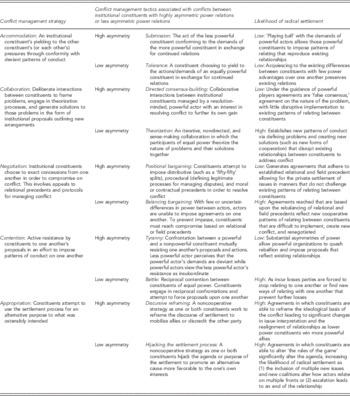
Table 1 summarizes the five alternative conflict management strategies and tactics associated with each strategy that predict the nature of settlements. The first tactic for each of the five responses is predicted to occur when greater asymmetries in power relations exist between two conflicting parties; the second tactic for each of the five strategies identifies the predicted conflict management approach when power relations between conflicting parties are more symmetrical.
Conflict management strategies, power asymmetry between disputing constituents, and the likelihood of radical settlement

Conflict management strategies and the likelihood of radical settlements
Accommodation
The process of accommodation refers to the yielding or acceptance of a constituent to the pressures of a conflicting party. Institutional theorists argue that acquiescence to institutional pressures enhances organizational legitimacy (Scott, Reference Scott2008), whereas conflict scholars argue that yielding often constitutes the most expedient, if not always the most advantageous, means of resolving disputes (Rubin, Pruitt, & Kim, Reference Rubin, Pruitt and Kim1994). Two types of accommodation by constituents – submission and tolerance – are proposed as the most likely accommodation tactics in managing conflict. Neither have a high probability of leading to a radical settlement.
Within highly asymmetric relations, submission reflects a conformity-based tactic in which a less powerful actor decides to succumb to the demands of a more powerful actor in order to preserve the existing relationship. The obverse of submission is imposition by the powerful actor. An example of submission comes from research on bribery (Mutlu, Reference Mutlu2014) during which businesses, such as GlaxoSmithKline in China, conceded to bribe government officials within host-country business contexts (Investors Business Daily, 2014; Jaeger, Reference Jaeger2014). Submission to the deviant demands of organizations or institutional constituents occurs because powerful actors are able to exert coercive influence in contexts where the yielding firm possesses few choices (Rao, Reference Rao1998). Submission to the demands of powerful actors tends to support the status quo.
Within dyadic relationships that reflect more equal power relationships between two constituents, tolerance is a more probable accommodative tactic. Tolerance reflects a constituent’s intentional choice to ‘put up with’ the behavior of another constituent, despite the potential or actual negative impact on autonomy, material resources, or perceived self-interest. Sociological and legal literature on disputing has identified the phenomenon of ‘lumping it,’ in which parties that perceive deviance choose to forego addressing the conflict in favor of tolerating deviant behavior in the hope that the behavior will resolve itself over time (Parsons, Reference Parsons1968; Baumgartner, Reference Baumgartner1984). Unlike in asymmetric fields where less powerful organizations lack choice in how they respond to conflictive practices, organizations in more symmetric power relations may choose to tolerate each other’s deviant conduct in anticipation of predictable, peaceful coexistence or potential long-term gain. For example, in LePoutre and Valente’s (Reference Lepoutre and Valente2012) study of the Belgian horticulture industry, they found that organizations became ‘immune’ to the deviant actions of other players in the sector, choosing to tolerate their deviance and subsequent negative effects that would have potentially led to conflict in other fields. Such tolerance often reflects the judicious decision to preserve existing relations in order to avoid excessively disruptive alternatives (Fuentelsaz & Gomez, Reference Fuentelsaz and Gomez2006). Under conditions of power symmetry, organizational actors are also less likely to attempt to impose new patterns of relating for fear of reprisals from an equally powerful combatant (Reay & Hinings, Reference Reay and Hinings2005). Therefore, acquiescence between two parties with few power advantages over one another tends to preserve and sustain existing relational patterns and limit significant change in the broader institutional field:
Proposition 5: The use of accommodation-based tactics to manage disputes will decrease the likelihood of radical settlements.
Collaboration
Collaboration is a cooperative conflict management strategy in which two constituents proactively engage in sense-making processes in order to generate mutually acceptable solutions. Collaboration involves the creation and debate of meaning while simultaneously institutionalizing or deinstitutionalizing contested norms and practices (Oliver, Reference Oliver1992; Green, Reference Green2004; Maguire & Hardy, Reference Maguire and Hardy2009). Depending on the power asymmetries between conflicting parties, we suggest that collaboration in conflictive situations will take two predominant forms: directed consensus-building and theorization. These two tactics have different implications for the probability of radical settlements.
Directed consensus-building refers to collaboration between parties with asymmetrical power in which a dominant constituent with an interest in addressing conflict uses his or her legitimacy and systemic power to coordinate resolution with another actor. The relational response of the less powerful actor is acceptance. Unlike submission (and imposition), which implies the necessity of yielding, directed consensus-building is more discretionary and cooperative. Greenwood and Suddaby Reference Greenwood and Suddaby(2006) showed, for example, how the ‘Big 5’ dominant firms in Canada’s accounting industry were able to direct consensus around the development of a new multidisciplinary practice in their interaction with the industry’s regulatory agency. In contexts where collaboration occurs under the guidance of powerful players, agreements on patterns of conduct tend to reflect the status quo, as powerful actors will ensure that settled-upon patterns of relationships that emerge reflect established dynamics. This reflects Horst and Irwin’s Reference Horst and Irwin(2010) work on consensus-building processes around science policy (governing research involving stem cells and nanotechnology), which showed that consensus that was directed by powerful organizations frequently lead to ‘false consensuses,’ inauthentic ideological agreements intended to avoid controversy, reproduce stability, and create little actual change in how constituents related to one another. It follows that:
Proposition 6a: When collaboration takes the form of directed consensus-building, the likelihood of radical settlement will decrease.
Theorization is an iterative, nondirected, sense-making interaction between collaborating constituents who possess more symmetrical power relations. Theorization refers to the development of justifications and discussions that allow for new or disputed practices to be reinterpreted, legitimated, and resolved (Greenwood, Suddaby, & Hinings, Reference Greenwood, Suddaby and Hinings2002), a tactic that is less likely to succeed where one party to the settlement is much more powerful. Research by Ansari, Wijen, and Gray (2004), for example, found that theorization, which served as a collaborative means of reframing and promoting a new practice to others of similar power, led to broad changes in perspectives and action taken toward key constituents involved in policy around climate change. This strategy also reflects Lawrence, Hardy, and Phillips’ (Reference Lawrence, Hardy and Phillips2002) research on the development of ‘proto institutions,’ which has described the global, collaborative, consensus-building processes between government ministries, nongovernmental bodies, and universities, among others, to piece together and diffuse radical new practices, training, and educational programs. As Lawrence, Hardy, and Phillips observed ‘interactions associated with these collaborations tend to be more complex and fundamental, leading to new understandings, norms, and practices that, in turn, may be transmitted throughout the field’ (Reference Lawrence, Hardy and Phillips2002: 282). Rather than simply conforming to an existing practice, theorization reflects organizations engaging with one another in reflective processes (Green, Reference Green2004) that ultimately legitimate for both parties ‘the reshaping of what is finally being transmitted’ (Zilber, Reference Zilber2006: 283). Theorization, therefore, increases the potential for more radical settlements.
Theorization of settlements to conflict was exhibited, for example, around the practice of HIV treatment in Canada in which medical professionals, community groups, and public health officials with differing perspectives theorized around the challenges of preventing and treating HIV to overcome those relational differences among them that were inhibiting treatment. Theorization generated collaborations that created novel practices that were subsequently diffused across different health sectors (Maguire, Hardy, & Lawrence, Reference Maguire, Hardy and Lawrence2004):
Proposition 6b: When collaboration takes the form of theorization, the likelihood of radical settlement will increase.
Negotiation
The third of the five conflict management strategies is negotiation. Numerous organizational scholars have found that during conflict, constituents frequently attempt to negotiate an acceptable compromise (Boltanski & Thevenot, Reference Boltanski and Thevenot1991). Negotiation is defined as constituents choosing independently to exact concessions from one another in order to compromise on conflict with an antagonist. The concept of negotiation delineated in this paper differs from more traditional theories of negotiation that focus on the achievement of the most ‘efficient’ or ‘optimal’ agreements (Bazerman & Curhan, Reference Bazerman and Curhan2000). We draw instead on Elster’s more realistic premise that ‘the task [of negotiation] is not necessarily to find the abstractly just outcome, but one that is appropriate [adhering to social norms] given the bargaining power of the parties’ (Reference Elster1989: 58). Unlike traditional theories, Elster (Reference Elster1989) explicitly takes into account norms and values in negotiation and the bounded rationality of negotiation processes. Depending on the relative power of the conflictive parties, it is proposed that negotiation can take one of the two dominant forms: positional bargaining, based on a more powerful constituent’s attempt to employ distributive and procedural norms to achieve compromise, and balancing, in which equally powerful constituents balance multiple and competing norms to negotiate a compromise.
During positional bargaining, powerful constituents impose established distributive norms that define the appropriate distribution of resources (such as a ‘fifty-fifty’ split), relational precedents – including moral obligations and contractual agreements – and procedural norms that define legitimate processes for managing disputes to resolve issues, redistribute resources, and address conflict (Elster, Reference Elster1989). Negotiation studies of contested institutional settings involving environmental and normative disputes, for example, have found that negotiators rely on existing norms and rules shared between the constituents for developing and negotiating settlements in a manner that pacifies the other actor (Hoffman & Ventresca, 1999).
Agreements reached through the positional bargaining of asymmetrically powerful actors reduce the possibility that settlements will reflect new patterns of interacting and tend to reinforce the status quo (Wade-Benzoni et al., Reference Wade-Benzoni, Hoffman, Thompson, Moore, Gillespie and Bazerman2002a). For example, the compromises achieved by organizations in private alternative dispute resolution forums have been criticized for preventing social change by keeping the settlement out of public forums where legal changes might occur that have broader consequences. This maintenance of the status quo via negotiated compromise is substantiated by the arguments of legal scholars who observe that mediated and arbitrated outcomes to disputes between organizations occur in the ‘shadow of the law’ and prevent radical judgments through the legal system (Stipanowich, Reference Stipanowich2004). For example, in pricing disputes, powerful retailers with superior resources and alliances (e.g., Walmart, Costco) can impose legally contractual conditions (such as dispute resolution clauses) on smaller supplier partners or draw from the historical precedent that they have established during previous interactions in the marketplace. Awareness of the negative implications of these power dynamics has been the focus of numerous studies documenting how negotiations between constituents from developing versus developed countries frequently maintain and reinforce the negative extant social and economic issues experienced by the developing country during policy- (Zahrnt, Reference Zahrnt2009), trade- (Spector & Wagner, Reference Spector and Wagner2010), and business-based negotiations (Williams, Reference Williams1965). Overall, positional bargaining reinforces established conditions, reducing the possibility of radical settlement. Specifically, as positional bargaining relies on established norms, it will tend to generate agreements that adhere to established relational and field precedent allowing for the private settlement of issues in ways that do not challenge existing relational patterns:
Proposition 7a: When negotiation takes the form of positional bargaining, the likelihood of radical settlement will decrease.
Constituents of equal power are unlikely to experience one constituent unilaterally capable of exerting his or her will on another to maintain the status quo. Under these conditions, constituents will need to use balancing bargaining tactics that take account of divergent norms and goals between the conflicting parties in an attempt to balance these differences (Oliver, Reference Oliver1991). Examples of this negotiation approach include growing research on international business negotiation in which institutional divergence in rules, norms, and beliefs regarding appropriate patterns of conduct between actors lead to novel agreements (Weiss, Reference Weiss2006). In this literature, firms craft novel agreements established through attempts to balance each actor’s conflicting relational norms (Graham, Mintu, & Rodgers, Reference Graham, Mintu and Rodgers1994).
Settlements reached through negotiations between equal institutional constituents open the potential for more radical settlements, as their implementation is less likely to be imposed and more likely to create tension and jockeying for a favorable position, leading to more contentious patterns of relating between constituents. For example, negotiations between Chinese and US companies are frequently r-opened after an initial settlement is reached. Lee, Yang, and Graham’s (Reference Lee, Yang and Graham2006) research on settlements resulting from balancing negotiation strategies used in international joint ventures between American and Chinese firms showed that the new patterns of relating frequently led to high degrees of confusion and contentious subsequent patterns of relating between constituents as they attempted to implement those agreements. These settlements are frequently unstable in nature leading to their ongoing renegotiation creating disruption, uncertainty, and the potential for more radical settlements to a dispute. Proposition 7b follows:
Proposition 7b: When negotiation takes the form of balancing bargaining, the likelihood of radical settlement will increase.
Contention
The fourth conflict management strategy, contention, involves public contestation between constituents surrounding conflicting interests or deviant ideologies regarding what constitutes an appropriate pattern of conduct. Conflict theorists argue that ‘contention may involve presenting persuasive arguments, making demands that far exceed what is actually acceptable, committing [oneself] to an “unalterable” position, or imposing a deadline’ (Rubin, Pruitt, & Kim, Reference Rubin, Pruitt and Kim1994: 28). As social movement scholars observe, contention between actors often serves as the impetus for institutional change within organizational fields (Durand, Rao, & Monin, Reference Durand, Rao and Monin2007). We suggest that two primary tactics of contention emerge between constituents in response to conflict, depending on the power relations that exist between them.
The first, tyranny, involves confrontation between powerful and less powerful constituents, each attempting to impose unalterable conditions. In contrast to the accommodative tactic of submission, the less powerful party fully lacks discretion, and unlike the positional bargaining of powerful actors (like Walmart) tyranny is reflected in attempts at unilateral demands by the more powerful actor without regard to longer-term ramifications. In the case of tyranny, the less powerful constituent perceives a practice or condition imposed by the more powerful party as deviant, whereas the more powerful constituent views resistance by the other constituent to practices or conditions as unconditionally insubordinate. Substantial asymmetries of power between disputants allow powerful actors to quash disagreement and impose their interests on resistant parties, making changes to the status quo highly unlikely. A dramatic example of tyranny comes from the energy sector. In 1998, economic and environmental protestors publicly demonstrated against the economic and social policies of Chevron in Nigeria. With the assistance of the Nigerian military, Chevron physically dispersed the protesters using gunfire, which led to the deaths of two protestors. Despite the outcome, no substantial changes have emerged in Chevron’s economic and environmental policy in Nigeria (Gold, Reference Gold2008). In this case, the use of tyranny dampened the efforts of the protestors in dispute with Chevron and simply reinforced existing arrangements. Substantial asymmetries of power allow powerful constituents to quash rebellion and impose existing patterns of relating on less powerful constituents:
Proposition 8a: When contention takes the form of tyranny, the likelihood of radical settlement will decrease.
The second type of contention, battle, reflects reciprocal contestation between constituents with more equal power. Ideological battles can be found throughout the research on institutional logics where constituents compete to dominate the relationship through the implementation of a new pattern of conduct (Thornton, Ocasio, & Lounsbury, Reference Thornton2012). For example, Reay and Hining’s (Reference Reay and Hinings2005) research on the healthcare sector in Alberta examined the power struggles that emerged between medical professionals and the government. The authors described the context as a ‘battlefield’ that shifted the power of the field from an existing medical logic to a new dominant business logic.
Battles, thus, tend to lead to settlements that reflect new patterns of relating as actors and others attempt to avoid the crippling deadlock and losses associated with battles in the future. For example, in 1982, when the IBM–Fujitsu conflict over intellectual property rights was resolved after 8 months of bitter dispute between the two parties, the result was a radical settlement that for the first time ‘allowed for each company to examine, under elaborate safeguards, certain parts of the other company’s software’ (Wellington, 2011: 97). This outcome substantially altered the institutional practice of intellectual property protection in the broader institutional environment as actors became more willing to cooperate and collaborate around software. Unlike tyranny, in which oppression by the more powerful actor is inevitable, a battle between equals increases the probability of radical settlements, as significant concessions are often required by both the parties, or both sides are forced to forfeit what they each view as significant legitimate positions in order to successfully craft a novel alternative resolution:
Proposition 8b: When contention takes the form of battle, the likelihood of radical settlement will increase.
Appropriation
The final conflict management strategy is appropriation. Appropriation refers to the use of a conflict management practice for alternative purposes. As Spicer and Fleming explain, ‘following de Certeau’s (1984) notion of “tactics”, resistance is understood as everyday appropriations of powerful strategies, making them into something that they were not necessarily intended for and giving subordinated groups a limited degree of agency’ (Reference Spicer and Fleming2007: 251). Appropriation is especially likely to be used by less powerful actors to an exchange as a way to compensate for possessing less power. We argue that appropriation is more likely to lead to a radical settlement because it involves the objective of subverting the settlement process to achieve more radical ends for the party attempting appropriation. Depending on power asymmetries, two forms of tactics are likely to dominate appropriation strategies: discursive reframing and hijacking the settlement process.
Settlements are not independent of the social constructions that enact and legitimate them. They are also arenas of discourse where two parties interact to shape and reframe the meaning of the settlement process itself (Dawson, Farmer, & Thomson, Reference Dawson, Farmer and Thomson2011). In asymmetrical power relations, where the more marginalized actor has fewer material resources to impose a settlement, discursive reframing gives the less powerful actor an opportunity to engage in discourse as a subversive tactic. The escalation of inflammatory rhetoric may call into question the assumptions on which the original terms of the settlement were based or help mobilize public sentiment in the less powerful constituent’s favor. Discourse alters perceived reality by socially reconstituting the legitimacy (or illegitimacy) of the other party’s claims. This approach is consistent with work on discourse as a resource (Hardy, Palmer, & Phillips, Reference Hardy, Palmer and Phillips2000; Fairclough & Thomas, Reference Fairclough and Thomas2004). For example, using the discourse of ‘globalization’ and ‘a new media environment’ to justify its bid to restructure through outsourcing and job cuts, the Australian Broadcasting Corporation was forced to back down from resistant groups ‘appropriating and using [these] discourses that were part of management’s dominant lexicon’ (Spicer & Fleming, Reference Spicer and Fleming2007: 528). These less-dominant groups used media to justify the need to avoid job and funding cuts, thus turning the dominant discourse back on itself to the disadvantage of the more powerful corporation.
Agreements in which constituents are able to reframe the ideological basis of the conflict lead to significant changes in issue interpretation and the potential for less powerful constituents to win out over powerful allies. Discursive reframing can also draw in other ideologically supportive allies to dramatically increase their perceived superiority. For example, early on in the development of the sport of mixed martial arts, politicians used stigmatizing discourse to ban and almost eliminate mixed martial arts organizations. Subsequently, actors engaged in mixed martial arts overcame constituent resistance that had virtually ‘banned’ their practice by engaging legitimizing discourse of their own and drawing in allies from athletic commissions, the medical community, and sports communities to reframe the practice from ‘human cockfighting’ to ‘combat sport.’ The sport of mixed martial arts is now a multibillion dollar sport reflecting a radically altered set of conditions that now support it (Helms & Patterson, Reference Helms and Patterson2014).
Hijacking the settlement process is the second dominant form of appropriation with potentially radical results. Hijacking occurs when ‘actors make sense of a common, culturally available (rather than situationally constituted) repertoire of alternative models for interpreting a situation and acting upon it’ (Clemens, Reference Clemens1993: 759). A less-dominant party might hijack the process by moving the conflict management process to an alternative venue (on the site of disputed land claims or in a public rather than private setting, for example) to discredit the more dominant party’s claim to moral superiority. Alternatively, they might sabotage or materially tamper with the context of settlement to undermine progress toward a settlement (Morrill, Zald, & Rao, Reference Morrill, Zald and Rao2003) or, alternatively, add allies unexpectedly to the dispute process itself. In challenging the parameters of the settlement process itself, an actor engages in ‘practice work [which] refers to actors’ efforts to affect the recognition and acceptance of sets of routines, rather than their simply engaging in those routines’ (Zietsma & Lawrence, Reference Zietsma and Lawrence2010: 190). Influencing the pacing of the conflict (den Hond, de Bakker, & de Haan, Reference den Hond, de Bakker and de Haan2010: 652) is another way to hijack the settlement process. For example, excessive delay or inaction (Morrill, Zald, & Rao, Reference Morrill, Zald and Rao2003) can increase the potential cost to the more powerful party and incentivize them to accept more radical solutions than they would otherwise consider. More powerful actors may also be tempted to utilize their superior position and resources to hijack the settlement process by reframing the legitimacy of their objectives. For example, although ‘improved productivity’ might be the ostensible objective of a management–labor settlement, the management may intend to hijack the agenda for purposes of introducing layoffs or wage freezes. Hijacking the settlement process, thus, increases the possibility of a more radical settlement:
Proposition 9: When appropriation takes the form of either discursive reframing or hijacking the settlement process, the likelihood of a radical settlement will increase.
DISCUSSION
This paper’s key insight runs counter to the literature on conflict and institutional change in arguing that the settlement or resolution of conflict between two parties is not necessarily the starting point of stability and consensus in an organizational field. Instead, the end of conflict between two parties can be the starting point or catalyst for institutional change and disruption. We refer to this phenomenon as radical settlements.
This paper theorized that radical settlements are a common and neglected source of institutional change. Introducing the concept of radical settlements opened opportunities to contribute new insights into conflict management and resolution processes by offering a novel typology of conflict management strategies that predicts when radical settlements are likely to occur and precipitate change in institutional fields. The impact of radical settlements can be profound. At an international level, the settlement of the Treaty of Versailles after World War I contributed to changes that precipitated the instigation of World War II. The binding settlements to conflict achieved between indigenous cultures and early settlers in many countries were the source of profound subsequent change in the lives of indigenous people. Applied at the organizational field level, the obvious lesson is that settlements achieved by influential institutional constituents bear further scrutiny from institutional and conflict scholars as a potentially significant source of institutional change. Predicting when radical settlements will occur was the intended contribution of this paper. However, there is still much to learn about how and when these radical settlements, as potentially path-breaking events in the lives of organizations, are likely to be benign or harmful not only to the organizations that reach a settlement but also, more importantly, to the surrounding constituents in their field (other businesses, social service organizations, political agencies, consumers) who are likely to be impacted by the settlement.
This paper’s model was developed to provide initial theory on the antecedents and processes of radical settlement across a broad range of fields and contexts. However, its limitation is the neglect of organizational and national differences: it does not take account of the diversity of particular industries, its actors, and national contexts or differences in state and social agency perspectives. Industries, national contexts, and organizations themselves have distinct ideological conflicts that will necessarily play a role in the nature of settlements. Although the present set of conflict management strategies was intentionally theorized as generalizable predictors of radical settlement across contexts, other studies are necessary across a range of settings to further flesh out and test the model. In particular, comparative studies that apply the paper’s propositions to different industries or to developing versus developed countries could contribute to the literature on institutional change across multiple contexts.
This paper has several implications for both conflict and institutional theory. As one of the first to move the study of conflict resolution from a dyadic to a field-level analysis, this paper argues for the necessity to examine the context of conflict to understand organizational action. Radical settlements, by definition, reverberate beyond the direct parties to a conflict, and we suggest that such settlements are critical for understanding the diffusion of conflict resolution influences, despite their relative neglect in the conflict literature. We, thus, address the concern that dispute resolution has developed ‘the wrong mental image of settlement’ in which scholars have failed to adequately address the impact that their negotiated agreements might have on the actors around them (Honeyman, Reference Honeyman2001: 7).
By the same token, our theoretical model implies the critical need for more focus on the postsettlement phase of conflict – another area that has received limited scholarly attention in the conflict literature. Our point is that this phase may often be the most crucial in shaping organizations’ actions and policies. The landmark radical settlement of $16.7 billion (US) between the Bank of America and the Attorney General over fraudulent mortgages subsequently reshaped other banks’ policies and actions on mortgage-backed securities. Intel and AMD’s radical settlement in dropping longstanding, harmful legal disputes and creating cross-licensing agreements not only benefited the conflicting companies but also dramatically freed up companies like HP and Dell to choose their own processors and platforms. The implication is that conflict resolution, viewed as the point of departure for studying the effects of conflict within the context of organizational fields, can reveal profound influences on organizational actions. Future research on postsettlement influence might examine these effects in longitudinal research. Studies to shed new light on mimetic isomorphism could trace the imitative effects of radical settlements on others in the field. Research on competition could follow the effects of radical business settlements on changes in the competitive intensity of industries and on the performance of rivals.
In terms of implications for conflict, the proposed typology also extends the current theory on negotiation and dispute resolution by expanding conceptualizations of settlement strategies to include appropriation tactics. This can involve discursive framing, such as exaggerated stories about the evil actions of businesses or environmentalists in handling environmental disputes, or hijacking the process of conflict resolution, in which attempts are made to subvert the entire apparatus for conducting the conflict management process. The popular press suggests that the use of subversive stories and rhetoric as well as efforts to sabotage or derail conflict resolution or ‘peace talks’ in progress are widespread. If future scholars and practitioners are to understand conflict management and settlement fully, our model suggests that these forms of conduct need to be front and center in our understanding of the portfolio of conflict management tactics used to establish settlements. These subversive strategies also augment suspicion and mistrust, and may therefore be an important predictor of the staying power or transience of a settlement, affecting, in turn, whether the settlement affects the wider institutional environment over time.
With respect to institutional theory, our model emphasizes, contrary to received wisdom, that bringing resolution or ‘peace’ between two or more parties can be a significant catalyst for disruption and institutional change rather than for stability or harmony in an institutional field. This insight sheds new light on theories of deinstitutionalization, which examine the reasons for the erosion or abandonment of previously taken-for-granted and legitimated forms of behavior or practice. To date, causes of deinstitutionalization have been attributed to factors such as undermining discourse or the overall political and social pressures imposed on forms of behavior that forcibly question their legitimacy (Oliver, Reference Oliver1992; Clark & Jennings, Reference Clark and Jennings1997; Hardy & Maguire, 2010; Van Peursem & Balme, Reference Van Peursem and Balme2010). The concept of radical settlements, in contrast, implies that deinstitutionalization at the field level can be the (intended or unintended) by-product of actors seeking resolution on an issue of importance to them alone. For example, resolution of a dispute between Kellogg’s and Nabisco in the 1930s over the proprietary ownership of shredded wheat cereal led to a foundational trademark law undermining longstanding strict trademark laws practiced throughout the field of business in the United States (Dinwoodie, Reference Dinwoodie2015). As a result of this settlement, product designs deemed intrinsic to functionality could no longer be protected under unfair competition or trademark laws, because they were viewed as impeding the ability of competitors to make a rival product. Radical settlements can, thus, be a major force for de-legitimizing certain practices even (and often) among those who were not a direct party to the original resolution. This paper also redirects attention from exogenous to endogenous sources of disruption and discontinuities in fields. Munir has challenged the notion that institutional change often comes from outside the field and that ‘following a “jolt,” new players enter the field, and deinstitutionalization of established practices begins’ (Reference Munir2005: 95). In support of this challenge to an environmentally exogenous explanation of institutional change (Meyer, Brooks, & Goes, Reference Meyers, Brooks and Goes1990), we have argued that ‘jolts’ or shocks to institutional fields may also emerge endogenously from the resolution of dyadic conflict within an institutional field. Child, Rogrigues, and Tse have focused on ‘the coevolution of the firm and the political environment’ (Reference Child, Rogrigues and Tse2012: 247), stressing the relational processes between more micro-level actions and constituents in the political context. Radical settlements as micro-level actions similarly shape the broader political and social environment as evidenced by the examples given in this paper on settlements as a catalyst for social and economic reform. A co-evolutionary perspective on deinstitutionalization as the consequence of conflict resolution might, therefore, be a fruitful line of inquiry for extending our understanding of how and why institutional change occurs at the field level.
This paper also provides insight into the antecedents of institutional change by emphasizing the ideological salience of conflicts experienced between actors and the implications of this salience for settlements. Settlements represent the nexus where individual agentic interests interact with preexisting institutional norms and values that have defined, to the present time, what constitutes legitimate or reasonable interests for both parties. This pivotal point where given interests confront challenges to what is ideologically just or appropriate triggers dilemmas in the interpreted legitimacy of actors’ claims, moving ideological tension to the forefront of dispute resolution. We encourage future scholars to explore the ideological substratum on which dispute resolution tends to be built by all parties to the dispute to gain deeper understanding of the normative and cognitive influences that drive radical settlements.
In terms of practical implications, our theorizing emphasizes the importance of establishing follow-up audits of the outcomes of conflict resolution both between and beyond the involved parties to assess the subsequent impact of resolution at a local, state, or global level. Political and socially sensitive resolutions are especially likely to benefit from such evaluations. Practitioners might also consider the legal or regulatory ramifications of conflict resolution as an outcome of radical settlements. Settlements between firms can affect antitrust regulations or precipitate new legislation to reinforce or expand the objectives of the settlement. Radical settlements might also cause observers in some dispute resolution cases to view conflict resolution between two parties as an opportunity to begin seeking reparations or demands for accountability. (Consider BP’s $13 billion (US) in settlements since the Deepwater Horizon Oil Spill.) Numerous private settlements between companies and victims have led to a surge in demand for reparation by others. Therefore, managers may benefit from considerations of postsettlement risk as an additional and tangible source of risk in managing conflict. Postsettlement risk can range from costly new demands for reparations by previously uninvolved parties to new regulations emerging from a settlement that reduce managerial discretion or increase the performance or competitive pressures imposed on firms.
CONCLUSION
The imagery of settlement or dispute resolution as the termination of conflict tends to become conflated with the termination of change. Consistent with the recent turn toward more conflictive rather than homogenous views of institutional fields (Seo & Creed, 2002; Marquis & Lounsbury, Reference Maurer and Ebers2007), our introduction of the concept of radical settlements contributes to the scholarly conversation on the origins of institutional change but shifts this emphasis from the power of a disruptive technology, social movement, or external environmental shock toward endogenous by-products of conflict resolution in institutional fields. Settlements are often less convergent events than the starting point of other struggles for social control and ideological dominance, and the ratified bargain that emerges from these struggles can sew the seeds of change beyond the parties to the settlement. Given the potential for radical settlements to induce institutional change, it is our hope that future scholars will pay greater attention to the outcome of processes by which conflicts are settled between influential actors.
Acknowledgements
We are grateful for the financial support of the Social Sciences and Humanities Research Council of Canada. This article’s development benefited from the thoughtful comments of numerous individuals at conferences as well as the input from prior reviewers. Finally, we thank Dr. Peter Galvin and our two anonymous reviewers for their excellent insights.