


Introduction
At a time when the importance of giving older people equal access to effective mental health services is being affirmed (Department of Health, 2005; Age Concern, 2007) cognitive behavioural therapy (CBT) might be expected to have a high profile as an intervention with older people. However, CBT has so far failed to achieve the prominence as a treatment with older adults that it has long held with younger people. This review summarizes the background and evaluation of CBT interventions with older people and lays out priorities for its development.
The emergence of CBT interventions with older adults
Much of the pioneering work in developing and promoting CBT with older people was undertaken by Dolores Gallagher-Thompson and Larry Thompson at Stanford University in California. Quick to see the applications of Lewinsohn's work on activity scheduling and Beck's theory of cognitive distortions they developed some of the first interventions for the treatment of late-life depression (Gallagher & Thompson, Reference Gallagher and Thompson1982). Since then, they have continued to take a lead in developing and describing interventions for diverse groups of elderly people and, with their collaborators, they have produced key texts in the field. Following the lead of Gallagher-Thompson and Thompson, many other authors reported developments of CBT methods to suit the clinical needs of older people such as the treatment of depression in people with dementia (Teri & Gallagher-Thompson, Reference Teri and Gallagher-Thompson1991). In 2004 the journal Behavioural and Cognitive Psychotherapy devoted an entire issue to interventions with older people.
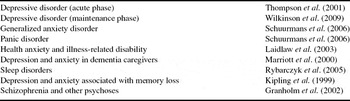
CBT is not a single method. Rather it is a family of related interventions that share underlying principles and assumptions (Gaudiano, Reference Gaudiano2008); nowhere is this more the case than with interventions for older people. Recent years have seen an increase in the range of applications of CBT with older people, reflecting the expansion of mental health services for older people as well as the diversification of CBT interventions with younger adults. These applications are summarized in Table 1.
Applications of cognitive behavioural therapy with older adults

The clinical context of CBT with older adults
Older people cannot be regarded as a uniform group and so, as always in CBT, care should be taken to tailor therapy to the particular problems of individuals (James, Reference James2008). Difficulty in accepting advanced age or coping with family disputes triggered by the dependency of an elder may be reasons for an older person seeking help and these may become the target problems in CBT. Sensory impairment and physical illness often underlie depression and anxiety in older people and it behoves the therapist to have sufficient understanding of these problems to help patients set realistic therapy goals and to use appropriate techniques. There is general agreement that cognitive impairment impacts on the ability to benefit from CBT but no consensus or significant evidence on the nature and degree of cognitive impairment that is important. Many older people receive care from family members or in care homes so therapists need to have an appreciation of carers' roles and how they can work constructively with them (Mittelman et al. Reference Mittelman, Epstein and Pierzchala2003).
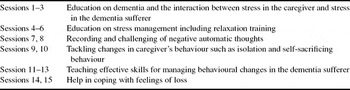
As a result of the changes associated with ageing, CBT interventions developed for older adults often combine standard cognitive behavioural techniques with psychoeducation and specific skills training. Table 2 illustrates this with reference to an intervention designed to help depressed caregivers of people with dementia.
Components of a cognitive behavioural intervention with dementia caregivers

Taken with permission from the therapy manual prepared by A. Marriott and C. Donaldson (unpublished) and used in a trial by Marriott et al. (2002).
Clinical trials of CBT involving older adults
The 1970s and 1980s saw many randomized controlled trials of CBT with younger adults in the management of depressive disorder and anxiety disorders (Clark, Reference Clark, Hawton, Salkovskis, Kirk and Clark1989; Fennell, Reference Fennell, Hawton, Salkovskis, Kirk and Clark1989) and these large-scale trials served to give CBT the prominent position that it holds today. However, most of these trials, excluded older adults apparently on the basis of age rather than the more likely prognostic factors, e.g. the presence of dementia. This reflects a failure to recognize that psychological treatments can indeed be relevant to older people and the problems they face. Data from trials that did include some older people indicate that age in itself does not affect outcome (Gloaguen et al. Reference Gloaguen, Cottraux, Cucherat and Blackburn1998).
The lack of adequate CBT trials with older adults was identified by the 1994 National Institutes of Health Consensus Development Conference on depression (Schneider et al. Reference Schneider, Reynolds, Lebowitz and Friedhoff1994) and since then the situation has barely changed. Trials in the treatment of late-life depression continue to lack validity through the inclusion of participants unrepresentative of everyday clinical populations and small sample sizes result in lack of statistical power (Mackin & Areán, Reference Mackin and Areán2005). Only one randomized controlled trial exclusively with older adults met the methodology quality criteria for inclusion in the National Institute for Health and Clinical Excellence (NICE) Depression Guideline (NICE, 2004a), and from this trial (Thompson et al. Reference Thompson, Coon, Gallagher-Thompson, Somner and Koin2001) it was not possible to determine whether there is a clinically significant difference between CBT and antidepressant medication in reducing depression severity.
Authors of reviews published more recently than the NICE Guideline make stronger claims for the efficacy of CBT in the treatment of depressed older adults (Scogin et al. Reference Scogin, Welsh, Hanson, Stump and Coates2005; Frederick et al. Reference Frederick, Steinman, Prohaska, Satariano, Bruce, Bryant, Ciechanowski, DeVellis, Leith, Leyden, Sharkey, Simon, Wilson, Unützer and Snowden2007). However, the methodologies of these reviews can be criticized for lacking focused clinical questions, reliance on electronic searches for studies and limited assessments of study quality. This increases the likelihood of bias and limits the validity of the reviews (Carney & Geddes, Reference Carney, Geddes, Priebe and Slade2002). The review by Frederick et al. (Reference Frederick, Steinman, Prohaska, Satariano, Bruce, Bryant, Ciechanowski, DeVellis, Leith, Leyden, Sharkey, Simon, Wilson, Unützer and Snowden2007) also relied on a panel assessment of studies; notably, there was a lack of complete agreement on the efficacy of individual CBT. A more rigorous Cochrane review showed benefits of CBT over waiting-list controls in reducing depressive symptoms but only in five trials (Wilson et al. Reference Wilson, Mottram and Vassilas2008). A further trial using a dichotomous outcome failed to show benefit. The interventions in these trials were very varied and sample sizes were small. The authors, therefore, urge caution in extending the findings to clinical populations.
There have been a number of studies evaluating CBT in the treatment of anxiety in older adults but these too have had methodological limitations. Although these studies have shown moderate effect sizes for CBT (Nordhus & Pallesen, Reference Nordhus and Pallesen2003) only two were of sufficient methodological quality to be included in the NICE Anxiety Guideline (NICE, 2004b) and these were still of limited size with high numbers of dropouts. Schuurmans et al. (Reference Schuurmans, Comijs, Emmelkamp, Gundy, Weijnen, van den Hout and van Dyck2006) compared individual CBT with the antidepressant sertraline in older adults with mixed anxiety disorders but this trial also encountered problems with dropouts leading to significant differences between the groups and loss of power. There have been virtually no evaluations of interventions with specific anxiety disorders in older people, such as post-traumatic stress disorder and social phobia (Ayres et al. Reference Ayres, Sorrell, Thorp and Loebach Wetherall2007).
Trials of CBT with dementia caregivers were initially of limited quality but improved in later years (Brodaty et al. Reference Brodaty, Green and Koschera2003). NICE concluded that CBT might reduce depression and anxiety in symptomatic caregivers and that these interventions might also have indirect benefits for dementia sufferers (NICE, 2006). A Cochrane systematic review of trials with caregivers is awaited (Vernooij-Dassen & Downs, Reference Vernooij-Dassen and Downs2005).
Priorities in planning future trials
With the move over recent years towards evidence-based practice, psychological therapists have recognized the importance of delivering well-designed clinical trials of interventions with older adults (Yon & Scogin, Reference Yon and Scogin2007). Future trials need to be large and methodologically robust and priority should be given to targeting therapies at major public health priorities. A National Institute of Mental Health workshop identified research into the prevention of relapse in major depression as such a priority (Segal et al. Reference Segal, Pearson and Thase2003). Interventions for such indications can be brief and simple and easily evaluated in the National Health Service (Wilkinson et al. Reference Wilkinson, Alder, Juszczak, Matthews, Merritt, Montgomery, Howard, Macdonald and Jacoby2009). Outcome measures should be relevant to the older population and avoid over-reliance on physical symptoms (Hammond, Reference Hammond1998).
Lessons can be learned from research into the efficacy of other psychological treatment models. Interpersonal therapy (IPT), like CBT, is a time-limited treatment in which the patient is encouraged to take an active role in identifying interpersonal problems and to use a range of strategies to deal with them. The first major trial with older people of this intervention provided evidence favouring IPT in combination with antidepressant medication over medication alone in reducing recurrence over 3 years (Reynolds et al. Reference Reynolds, Frank, Perel, Imber, Cornes, Miller, Mazumdar, Houck, Dew, Stack, Pollock and Kupfer1999). However, a further study of IPT in patients aged >70 years with comorbid medical illness failed to demonstrate the same benefit (Reynolds et al. Reference Reynolds, Dew, Pollock, Mulsant, Frank, Miller, Houck, Mazumdar, Butters, Stack, Schlernitzauer, Whyte, Gildengers, Karp, Lenze, Szanto, Bensasi and Kupfer2006) thus highlighting the need to evaluate other psychological interventions, particularly CBT.
Psychological treatments have also been used as components of depression care-management interventions. These packages of care have included IPT (Hunkeler et al. Reference Hunkeler, Katon, Tang, Williams, Kroenke, Lin, Harpole, Areán, Levine, Grympa, Hargreaves and Unutzer2006) and problem-solving treatment (Gallo et al. Reference Gallo, Bogner, Morales, Post, Lin and Bruce2007). CBT would also make a suitable brief intervention for evaluation as part of care-management interventions.
In order for large clinical trials to be conducted, standardization of CBT interventions is necessary. This proposal may not be welcomed by all therapists. However, it is only through this approach that the efficacy of therapy can be tested and a case made for wider dissemination. Trials must include participants regardless of whether they appear psychologically minded or able to grasp the cognitive model, although excluding participants with dementia makes sense. Clinical prediction of therapy response is unreliable (Mansfield & Addis, Reference Mansfield and Addis2001) and the use of too many trial selection criteria limits the external validity of trials.
Recruiting older people for involvement in trials of CBT might be thought to be difficult. However, older people often have a preference for psychological treatments (Gum et al. Reference Gum, Areán, Hunkeler, Tang, Katon, Hitchcock, Steffens, Dickens and Unützer2006) and presenting treatments as education rather than therapy can also increase their appeal (Coon & Gallagher-Thompson, Reference Coon and Gallagher-Thompson2002). Accessing potential trial participants in the National Health Service should in future also be aided by the UK research networks (www.ukcrn.org.uk).
It can be argued that advocating treatment trials specifically with older people risks excluding them from research and, as a result, from access to evidence-based therapies. However, there are a number of reasons why separate trials are necessary. Comorbid physical illness and concurrent physical treatments may influence treatment response and older adults with emotional disorders also experience cognitive deficits (Herrmann et al. Reference Herrmann, Goodwin and Ebmeier2007) that may affect their ability to use psychological strategies (Alexopoulos et al. Reference Alexopoulos, Raue and Areán2003). A worthwhile area of investigation would be whether those with cognitive deficits benefit more from treatment methods that use indirect approaches to thought restructuring, the so-called ‘third wave’ of CBT (Hayes, Reference Hayes2004).
Enabling older people to access CBT
While CBT is one of the psychological therapies most frequently offered in the National Health Service, provision is patchy and relies on the availability of clinical psychologists (Evans, Reference Evans2004). If brief CBT interventions are shown to reduce the burden of common mental disorders then models of provision may need to change. This challenge has recently been taken on by the Improving Access to Psychological Therapies Pathfinder programme although, rather disappointingly, older adults have been severely under-represented in referrals made by general practitioners (Improving Access to Psychological Therapies, 2008). It is also unclear whether therapists and supervisors in such a comprehensive programme will have sufficient knowledge of the presentation and management of disorders in older people. Access to therapy might also be helped by technical developments such as computer technology (Marks et al. Reference Marks, Cavanagh and Gega2008) or video (Rybarczyk et al. Reference Rybarczyk, Lopez, Schelble and Stepanski2005) but further evaluation with older people is still required.
Summary
• The principal applications of CBT with older adults include depressive and anxiety disorders and the treatment of symptomatic caregivers of people with dementia.
• Systematic reviews indicate that there are very few methodologically robust randomized controlled trials of CBT with older adults in depression and anxiety but some evidence to support the efficacy of CBT with caregivers.
• Large-scale NHS-based trials of standardized cognitive behavioural interventions with older adults are required. These should address public health problems such as depressive disorders.
Declaration of Interest
None.
Learning objectives
(1) To gain an overview of the development and range of cognitive-behavioural interventions with older people.
(2) To be aware of significant reviews of the efficacy of cognitive behavioural interventions with older people and their limitations.
(3) To identify priorities in the further evaluation of cognitive behavioural interventions with older people.



Comments
No Comments have been published for this article.