Executive functions (EF) refer to cognitive and metacognitive processes underlying the ability to adaptively respond to different situations, primarily those that are new or non-routine (Elliott, Reference Elliott2003; Lezak, Howieson, & Loring, Reference Lezak, Howieson and Loring2004), and include different components that develop throughout childhood and adolescence. Despite some correlation among these components, there is evidence that their developmental patterns are distinct and vary as a function of age and the sociocultural context within which an individual lives. Because EF dysfunction is related to many diverse disorders, including those related to learning (Dias, Trevisan, Menezes, Godoy, & Seabra, Reference Dias, Trevisan, Menezes, Godoy, Seabra and Capovilla2011) and behavior as well as other neurological or genetic conditions (Dias, Menezes, & Seabra, Reference Dias, Menezes and Seabra2010), it is essential to understand normal EF development. Therefore, because the development of EF may differ as a result of cultural factors and the specificity of the tests used, and given the scarcity of Brazilian studies aimed at understanding the development of different EF components in various age groups, this study aimed to investigate whether there are differences in the performance of some EF tests within different age ranges of Brazilian children and adolescents.
EF allows individuals to control and regulate their cognition and behavior, enabling their commitment to self-organized actions for the purpose of addressing goals. There is some consensus that processes involved in these functions characterize distinct, although related, operations, comprising skills such as working memory, inhibitory control, selective attention, planning, cognitive flexibility and monitoring (Fournier-Vicente, Larigauderie, & Gaonac’h, Reference Fournier-Vicente, Larigauderie and Gaonac’h2008; Lezak et al., Reference Lezak, Howieson and Loring2004; Miyake et al., Reference Miyake, Friedman, Emerson, Witzki, Howerter and Wager2000).
There is empirical evidence that EF develops through childhood and adolescence until early adulthood. This development has been related to structural changes associated with neurological maturation and changes to the pattern of function in the prefrontal cortex that mainly occur during adolescence (Durston & Casey, Reference Durston and Casey2006; Estévez-González, García-Sánchez, & Barraquer-Bordas, Reference Estévez-González, García-Sánchez and Barraquer-Bordas2000; Lamm, Zelazo, & Lewis, Reference Lamm, Zelazo and Lewis2006; Papazian, Alfonso, & Luzondo, Reference Papazian, Alfonso and Luzondo2006). Longitudinal studies show that this development begins to occur at an early age. For example, inhibitory control has a large period of development, occurring between 22 and 33 months of age (Kochanska, Murray, & Harlan, Reference Kochanska, Murray and Harlan2000); from the ages of eight months to eight years old, there are qualitative changes in cerebral activity during inhibition tasks, including an increase in the efficiency and functionality of the prefrontal cortex in response inhibition (Bell, Wolfe, & Adkins, Reference Bell, Wolfe, Adkins, Coch, Dawson and Fischer2007). However, few longitudinal studies have focused on middle childhood and adolescence, and most of these studies have been cross-sectional, assessing the EF components in children of differing age ranges. These studies have found improvements in EF task performance with increased age, but the curve of development is not always similar for different skills (Anderson, Anderson, Northam, Jacobs, & Catroppa, Reference Anderson, Anderson, Northam, Jacobs and Catroppa2001; Brocki & Bohlin, Reference Brocki and Bohlin2004).
Simpler abilities, such as those as required in a target detection task, seem to have shorter developmental courses compared to more complex skills, such as working memory (Durston & Casey, Reference Durston and Casey2006). A recent study investigating EF development, specifically that of working memory, inhibition and flexibility, in a sample population ranging from five-year-old children to seventeen-year-old adolescents, found that these abilities develop quickly during childhood, with more modest changes occurring in adolescence; however, these improvements vary among tasks. Despite, the magnitude of this age effect is generally large in younger children (five to seven years old), moderate in older children (between eight to fifteen years old), and quite small after that (fifteen to seventeen years old) (Best, Miller, & Naglieri, Reference Best, Miller and Naglieri2011).
In fact, some studies have suggested that flexibility skills reach their maturity levels during adolescence, at approximately the age of fifteen (Huizinga, Dolan, & van der Molen, Reference Huizinga, Dolan and van der Molen2006). Despite significant advancements between five and seven years old, performance in more complex flexibility tasks tends to show an even greater improvement in older children and adolescents (Best & Miller, Reference Best and Miller2010). A Brazilian study, for instance, suggested that this ability is very immature in younger, six-year-old children, with a significant increase in performance only observed in children nine to ten years old (Capovilla & Dias, Reference Capovilla and Dias2008).
In contrast to flexibility, working memory shows a longer development course that continues up to early adulthood (Davidson, Amso, Anderson, & Diamond, Reference Davidson, Amso, Anderson and Diamond2006; Huizinga et al., Reference Huizinga, Dolan and van der Molen2006). Evidence of age differences in working memory tests that assessed visual working memory in distinct age groups of six, eight and eleven year old children were reported by Injoque-Ricle and Burin (Reference Injoque-Ricle and Burin2008), and Capovilla, Berberian, Rezende, and Trevisan (Reference Capovilla, Berberian, Rezende and Trevisan2008) found increased performance in auditory and visual working memory tests mainly within the seven- to ten-year-old age brackets. Furthermore, more complex tasks of working memory continue to show improvement during adolescence until about 20 years of age (Best & Miller, Reference Best and Miller2010).
In addition, inhibition and selective attention are not fully developed until puberty. For example, the skill of selecting a specific characteristic within a stimulus continues to develop until at least age ten (Sheep, Barrett, & Kolbet, Reference Sheep, Barret and Kolbet1987). Best and Miller (Reference Best and Miller2010) indicated that some studies have found inconsistent results because of the nature of the task. For instance, motor inhibition tasks show a significant improvement in performance at three and four years old, but at this age, tasks such as the Day-Night Stroop are still difficult for children. In fact, in tasks guided by the Stroop paradigm, 11-year-old children still show poorer performance relative to adults (Hanauer & Brooks, Reference Hanauer and Brooks2003). However, the performance in inhibition tasks generally tends to show the most development between three and five years, with more moderate changes occurring between five and eight years and smaller, though continual, changes after this age (Best & Miller, Reference Best and Miller2010).
Regarding planning skills, the results appear highly dependent on the type of instrument used, possibly due to the degree of difficulty and task demand differences. Studies using the Tower of Hanoi Task suggest that, even in adolescence, planning skills are not yet fully developed (e.g., Gonzalez, 2008). However, studies using the Tower of London Task (ToL) have presented relatively consistent results, showing that this skill is already developed by adolescence. There is evidence that planning skills, as assessed by ToL, develop between the ages of seven and either eleven (Anderson et al., Reference Anderson, Anderson, Northam, Jacobs and Catroppa2001) or twelve (Culbertson & Zillmer, Reference Culbertson and Zillmer1998). With another version of tower tests, the task ‘Mexican pyramid’, a more distinct development was found to occur in childhood up to the age of nine and became more gradual in adolescence (Matute et al., Reference Matute, Chamorro, Inozemtseva, Barrios, Rosselli and Ardila2008). However, Huizinga et al. (Reference Huizinga, Dolan and van der Molen2006) have also verified that some measures of performance in ToL (e.g., the number of perfect solutions) continue to increase up to adulthood.
Fluency skills and, more specifically, verbal fluency have been consistently reported to be related to executive functions. Verbal fluency is a complex ability in which additional processes play roles (Dias & Seabra, Reference Dias and Seabra2012; Malloy-Diniz, Sedo, Fuentes, & Leite, Reference Malloy-Diniz, Sedo, Fuentes, Leite, Fuentes, Malloy-Diniz, Camargo and Cosenza2008), and understanding how it develops during childhood and adolescence is equally important. There is some divergence about the improvement of FAS Verbal Fluency performance throughout adolescence, with some studies showing stability in adolescents aged 11 to 17 years old (Anderson et al., Reference Anderson, Anderson, Northam, Jacobs and Catroppa2001), and others reporting that verbal fluency continue to improve beyond 12 years of age (Klenberg, Korkman, & Lahti-Nuuttila, Reference Klenberg, Korkman and Lahti-Nuuttila2001; Korkman, Kemp, & Kirk, Reference Korkman, Kemp and Kirk2001). Matute, Rosselli, Ardila, and Morales (Reference Matute, Rosselli, Ardila and Morales2004) reported that, specific to phonemic verbal fluency, the most important improvements occur between 10 and 15 years of age.
In summary, there is evidence that performances in simpler tests, such as the ToL and tests of basic attention, increase with age from childhood to early adolescence, about 11 or 12 years old, when the performance in these tests trend to stabilize. However, in more complex tasks, including those of working memory, performance does not seem to stabilize until early adulthood. Additionally, performance in tasks of selective attention and inhibitory control, such as the Stroop Test, and tasks of verbal fluency and flexibility appear to continue developing until mid-adolescence.
It is important to note that some differences between the results of these studies may be due to their use of different methods to assess EF, but there is also evidence that EF development varies depending on cultural contexts. For example, studies have shown that Asian children perform better in EF tasks when compared to Western children (Carlson, Reference Carlson, Lewis and Carpendale2009). Accordingly, some studies have found that Korean and Chinese children outperform American or English children in tasks of inhibition, although these differences were not observed in working memory or flexibility tasks. These results suggest an earlier development of inhibition in Asian children. Moreover, differences in the pattern of correlations between EF tests have suggested that the structure of the executive system may not be consistent across cultures, and other evidence points to a difference in electrophysiological patterns related to the execution of EF tests (Lahat, Todd, Mahy, Lau, & Zelazo, Reference Lahat, Todd, Mahy, Lau and Zelazo2010; Lan, Legare, Ponitz, Li, & Morrison, Reference Lan, Legare, Ponitz, Li and Morrison2011; Oh & Lewis, Reference Oh and Lewis2008). These differences are explained by the authors in terms of cultural emphasis on self-control being stronger in Asian countries. Moreover, there is evidence that the parental structure is an additional influencing factor over the development of EF in young children (Bibok, Carpendale, & Müller, Reference Bibok, Carpendale, Müller, Lewis and Carpendale2009), as is their socio-economic situation (Noble, Norman, & Farah, Reference Noble, Norman and Farah2005).
Therefore, because there may be differences in the performance of executive tasks that depend both on the specific task and on the cultural context, the objective of this research was to investigate age differences in executive tests, including auditory and visual working memory, inhibitory control, selective attention, cognitive flexibility, verbal fluency, and planning tasks, in a sample of Brazilian children and adolescents. In addition, gender differences were analyzed. Among the studies we reviewed, not all investigated gender differences in the performance of executive tasks, and among those studies that did, there was generally no gender effect on tasks of working memory, inhibition, flexibility and planning (Brock & Bohlin, 2004; Culbertson & Zillmer, Reference Culbertson and Zillmer1998, Davidson et al., Reference Davidson, Amso, Anderson and Diamond2006; Matute et al., Reference Matute, Chamorro, Inozemtseva, Barrios, Rosselli and Ardila2008). There was a better performance observed with girls, however, in attention, verbal fluency and, specifically, auditory working memory tasks (Anderson et al., Reference Anderson, Anderson, Northam, Jacobs and Catroppa2001; Klenberg et al., Reference Klenberg, Korkman and Lahti-Nuuttila2001), whereas tasks involving speed and arousal showed a better performance among boys in a study by Brock and Bohlin (2004).
Although there are studies about the improvements of EF as a function of age in multiple countries, including Australia (Anderson et al., Reference Anderson, Anderson, Northam, Jacobs and Catroppa2001), Finland (Klenberg et al., Reference Klenberg, Korkman and Lahti-Nuuttila2001), the United States (Best et al., Reference Best, Miller and Naglieri2011; Culbertson & Zillmer, Reference Culbertson and Zillmer1998; Davidson et al., Reference Davidson, Amso, Anderson and Diamond2006; Hanauer & Brooks, Reference Hanauer and Brooks2003; Korkman et al., Reference Korkman, Kemp and Kirk2001), Sweden (Brocki & Bohlin, Reference Brocki and Bohlin2004), the Netherlands (Huizinga et al., Reference Huizinga, Dolan and van der Molen2006), and Mexico (Matute et al., Reference Matute, Chamorro, Inozemtseva, Barrios, Rosselli and Ardila2008), there are few Brazilian studies. Although longitudinal studies are the most valuable design for researching such developmental changes, cross-sectional studies, such as the present one, may offer the opportunity to study age differences and then further clarify some aspects of development. Therefore, we expected to observe differences in the performance of EF tests among different age ranges in Brazilian children and adolescents and specific periods of improvement for the different abilities.
Method
Participants
Initially, 784 children and adolescents aged 6 to 17 years and from two public schools of regular education in a city of the State of Sao Paulo, Brazil were evaluated. Participants were all from two neighboring districts with medium-low or low socio-economic status. Because there were a high number of participants that showed a discrepancy between their age and school grade within the sample, we excluded participants who either repeated grades or entered school late. After boxplot analysis, which is a method of detecting graphically atypical or outlier values, we also excluded the following outlier participants for each test in each school grade: those scoring above the upper limit [Quartile 3 + 1,5*(Quartile3 − Quartile1)] or those scoring below the lower limit [Quartile 1 − 1,5*(Quartile3 − Quartile1)]. Accordingly, the final sample comprised 572 children and adolescents aged 6 to 14 years (M = 9.87; SD = 2.51) who were students in the 1st to 8th grades in two public schools (one was a 1st to 4th grade school and other a 5th to 8th grade school). Of the total participants, 272 (47.6%) were male.
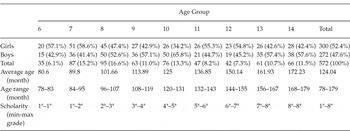
Although no formal testing was performed to rule out intellectual disability beyond the screening for discrepancy between age and school grade (grade retention), there were no students with mental retardation or sensory disorders in the sample based on records and information provided by the participant schools. Table 1 shows the characteristics of the samples divided into age groups. We chose this age range because, according to Best and Miller (Reference Best and Miller2010), EF studies have mainly focused on adults and preschool children, leading to the limited study of developmental sequences or trends due to the small number of studies performed on children and adolescents. Moreover, according to Best et al. (Reference Best, Miller and Naglieri2011), the investigation of executive functions in this age range is important because these abilities are related to academic performance. Our sample was chosen out of convenience and is not representative of Brazilian children and adolescents. However, as a pilot study, it does allow us to make several important conclusions and can be improved in future research on more representative samples.
General Characteristics of the Sample

Tests
Cancellation Attention Test_CAtT (Montiel & Seabra, Reference Montiel, Seabra, Seabra and Dias2012a): The CAtT assesses selective attention in a test of visual search. The test is carried out collectively and consists of three matrices with different types of stimuli and a fixed time (one minute) to identify the targets using the cancellation paradigm. The total number of correct answers was used as the score, which could vary from 0 to 132 points.
FAS Verbal Fluency Test_FAS (Benton & Hamsher, Reference Benton and Hamsher1989): This test evaluates the capacity of verbal fluency. The Brazilian computerized FAS version was used (Seabra, in press). The participant must express the maximum possible number of words starting with F in a one-minute period of time. Then, the procedure was repeated using the letters A and S. In this study, only the total score, which corresponds to the correct number of words given in the three parts of the task, was used for analysis.
Auditory Working Memory Test_AWM (Primi, Reference Primi2002): AWM is a computerized test and evaluates the auditory working memory of the subject. The AWM test is carried out individually. The software emits digitalized voice sequences that consist of two to ten words and numbers. The task is to first repeat the words in the sequence and then the numbers in increasing order. The score was based on the number of correct sequences and could vary from 0 to 27 points.
Visual Working Memory Test_VWM (Primi, Reference Primi2002): The VWM task is a computerized test that assesses the visual working memory of the subject. The VWM test is administered individually. On the computer screen, one to four 3 x 3 matrices are shown, and each contains a stimulus. Then, spatial manipulations, represented by arrows indicating the direction of each move, are shown on the screen. The required task is to select the final position of the stimulus if the moves indicated by the arrows were to occur. The score used was the number of correct answers, which could vary from 0 to 26 points.
Trail Making Test_TMT: The TMT assesses cognitive flexibility. The test is carried out collectively, and the Brazilian adaptation by Montiel and Seabra (Reference Montiel, Seabra, Seabra and Dias2012b) was used. The task is composed of items that must be connected in sequence during a one-minute period. Part A consists of a sheet with letters and another with numbers that must be connected in sequence and is used as a baseline for interpreting the performance in part B, which consists of only one sheet with letters and numbers that must be connected alternately. A derived score was used to estimate the cognitive flexibility (the number of items correctly linked in a sequence in part B minus the same measure in part A of the test). For the calculation of this derived score (TT_B-A), only performances equal or above a 70% success rate in the total score in part A were considered. As the maximum score for each part was 24 points, the derived score could vary from −24 to 24 points, but it was expected that the score would be negative because part B is more difficult than part A.
Semantic Generation Test_SeGeT (Seabra, Cozza, Capovilla, Macedo, & Dias, Reference Seabra, Cozza, Capovilla, Macedo, Dias, Seabra and Capovilla2009): SeGeT is a computerized test that measures inhibitory control ability. The SeGeT is carried out individually and was developed based on work by Thompson-Schill et al. (Reference Thompson-Schill, Swich, Farah, D’Exposito, Kan and Knight1998). The subject is asked to name an action that is semantically associated with the drawings (nouns) appearing on the computer screen. The nouns can be of low selection (60 items), meaning that they evoke just one word (e.g., scissors is usually associated with the verb cut) or of high selection (60 items), meaning that they can evoke a list of words (e.g., string, which can be associated with the words lace, tie, leap or roll up). The differential analysis of the performance based on low- and high-selection conditions (performance in the high- minus performance in the low-selection condition) provides a score and reaction time interference index. Therefore, the measures used were the interference effects for score and reaction time; the greater the interference effect for RT and the lower the effect for score, the more susceptible the performance of the participant is to interference. There is no maximum or minimum measure for the effect of interference on reaction time, and, in relation to the score, the measure of interference can vary from −60 to 60; it is expected that the interference measure would be negative because the high-selection condition is theoretically more difficult than the low-selection condition.
Computerized Stroop Test_Stroop-Comp (Seabra, Dias, & Macedo, in press): The Stroop-Comp test measures selective attention and the ability to control interference and is carried out individually. This computerized version of the Stroop Test was adapted from the Victoria Version (Regard, Reference Regard, Spreen and Strauss1981). In the first part, the participant must read, as quickly as possible, the items on a screen (which correspond to the names of the yellow, blue, green and red colors, all printed in black ink). This part is used to ascertain the reading ability of the participants. In the second part, participants must name the color of the circles that appear on the screen. In the third part, they must name the color of the written words that correspond to the four colors above; however, they are printed in another color that disagrees with their meaning (for instance, the word ¨green¨ is written in blue). The interference effect for word vs. color or the Stroop effect (the performance in part 3 minus the performance in part 2) is analyzed in terms of score and reaction time. Thus, the measures used in this study were the interference effects for score and reaction time; the greater the interference effect for RT and the lower the effect for score, the more susceptible the performance of the participant is to interference. There is no maximum or minimum measure for the effect of interference on reaction time, and relative to the score, the measure of interference can vary from −24 to 24; because part 3 is theoretically more difficult than part 2, it is expected that the interference measure will be negative. To ensure that the effect is due to interference, we only evaluated participants from the 5th to 8th grades (i.e., age 11 and older) because Best and Miller (Reference Best and Miller2010) argued that the performance in this test is highly dependent on reading level; the period between six and ten years old is the period during which word reading becomes more automatic.
Tower of London Task_ToL (Krikorian, Bartok, & Gay, Reference Krikorian, Bartok and Gay1994): This test evaluates planning ability. The task is composed of a wood platform with three vertical rods and three colored spheres (red, green and blue). The participant must transpose the three spheres, starting from an initial position, to reach various final positions. There are 12 problems (target positions) whose level of difficulty increases as a function of the number of movements necessary to reach the final position, with a variation of two to five movements. Due to the length of the test and time restrictions for its execution, it was only applied to students from the 5th to 8th grades (i.e., age 10 and older). The measure used was the total score: for each problem, the participant earned three points if they reached a solution in only one attempt, two points if they required two attempts, one point if they required three attempts, or zero points if they were not able to reach the solution in three attempts. Therefore, the total score could range from 0 to 36 points.
All of the tests described above were selected for this study based their psychometric proprieties, as validated in Brazilian child and teenage samples in studies by Assef, Capovilla, and Capovilla (Reference Assef, Capovilla and Capovilla2007), and Capovilla, Dias, Trevisan, Montiel, and Andrade (Reference Capovilla, Berberian, Rezende and Trevisan2008). We used the original version of ToL, as systematized by Krikorian et al. (Reference Krikorian, Bartok and Gay1994), in an attempt to minimize the difficulty inherent to the use of diverse test versions. Some computerized tests were also used, among them, the Semantic Generation Test and the Computerized Stroop Test that allow for, aside from score registering, additional quantitative measures such as reaction time (RT) and may be the most sensitive measure of the cognitive processes under analysis (Assef, Capovilla, & Capovilla, Reference Assef, Capovilla and Capovilla2007).
Procedure
The project was approved by the Ethics Research Committee. An agreement term was sent to the school board of directors and to the students’ parents asking for their consent to carry out the research. The application of the tests took place in a classroom made available by the schools during normal school hours. Data collection began with the administration of the collective application tests; we initially applied the Cancellation Attention Test and the Trail Making Test in the class itself over two sessions. The other tests were applied in individual sessions, totaling six evaluation sessions for each participant, with an average time of 20 minutes for each session. The order of the application tests was distributed among the participating classes, and only one test per day was applied to each participant.
Statistical Analyses
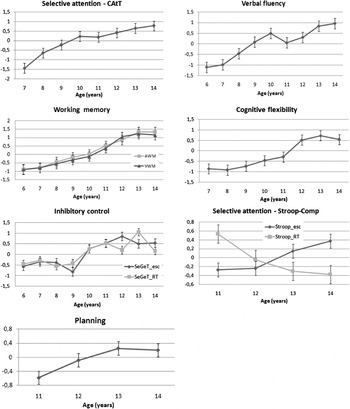
The effects of and interactions between age and gender were analyzed. A Factorial Univariate Analysis (ANOVA) was performed for each test to determine whether EF performance increases and continues to improve into adolescence on AWM, VWM, CAtT, TMT, FAS and ToL. The independent variables were age, with nine levels (from 6 to 14 years old), and gender, with two levels (girls and boys). For Stroop-Comp and SeGeT, Multivariate Analysis (MANOVA) was performed independently for each test because the score and reaction time were measured. Again, age and gender were used as independent variables. For all tests, partial eta squares were used to estimate the effect size (ES), and multiple comparisons between age groups were performed using Tukey’s post hoc corrections to determine which means differed. The level of confidence was set at .05 for all comparisons. Additionally, to facilitate the view and comparison of developmental trends of the measured skills in a graph (Figure 1), the results were all converted into Z scores.
Performance in the evaluated skills (converted into standardized Z score) as a function of age.

It is worth noting that the Stroop-Comp and ToL tests were applied only to participants from 11 years old and above. Therefore, for the Stroop-Comp and ToL tests, four age groups within the 11 to 14 age bracket took part in the analyses. Additionally, six-year-old CAtT and TMT participants were excluded, due to the limited number of children at this age (N = 9).
Results
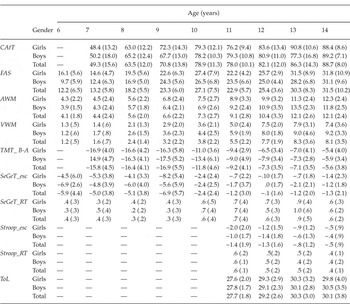
The descriptive statistics (Table 2) show a clear trend toward a better performance with the progression of age in practically all EF tests, despite some variances that occurred in some tests. However, the performances of boys and girls tended to be quite similar.
Means and Standard Deviations for EF measures as a function of gender and age

Note.
CAtT – total number of correct answers in the Cancellation Attention Test; FAS – total number of correct words given in the three parts (F – A – S) of the FAS Verbal Fluency Test; AWM - total number of correct sequences remembered in the Auditory Working Memory Test; VWM - total number of correct items in the Visual Working Memory Test; TMT_ B-A - performance in part B (in terms of sequences) minus performance in part A (sequences) in the Trail Making Test; SeGeT_esc - interference score (performance on high selection minus performance on low selection trials) in the Semantic Generation Test; SeGeT _ RT - interference reaction time in seconds (RT on high selection minus RT on low selection trials) in the Semantic Generation Test; Stroop_esc – interference score (performance on incongruent minus performance on congruent trials) in the Computadorized Stroop Test; Stroop_RT - interference reaction time in seconds (RT on incongruent minus RT on congruent trials) in the Computadorized Stroop Test; ToL - number of attempts needed to reach a solution with a minimum number of movements (1 attempts = 3 points until 3 attempts = 1 point or no solution = 0) in the Tower of London Task.
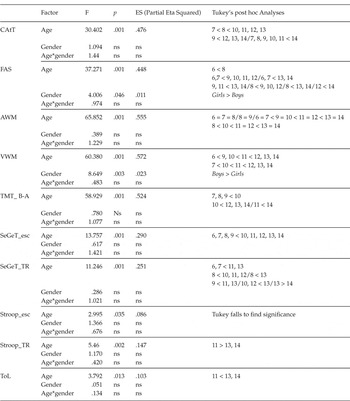
Indeed, a significant age affect was found for all EF measures and Tukey’s post hoc analyses revealed significant differences among several age groups for all tests (Table 3).
Inferential statistics obtained from ANOVA of age and gender effect, Effect Size (ES) and Tukey’s post hoc analyses for all EF measures

Note:
ns – no significant
In terms of the effect of age, in the CAtT, F(7, 249) = 30.402; p < .001]; FAS, F(8, 385) = 37.271; p < .001; AWM, F(8, 439) = 65.852; p < .001; VWM, F(8, 378) = 60.380; p < .001; and ToL tests, F(3, 106) = 3.792; p = .013, there was an almost systematic increase of scores with the progression of age. In the CAtT results, the Tukey’s post hoc analyses revealed greatest differences between the young groups, especially between 6 and 9 years old groups. For FAS, although there were also differences between younger groups, some differences were observed in older groups as well. For WM measures, the pattern in Tukey’s analyses was distinct, with prevalence of significant differences between older groups. For ToL, in which was assessed only 11 to 14 years old groups, 13 and 14 years old had better performance than 11 years old group.
In Stroop-Comp, the interference effect on RT, F(3, 102) = 5.460; p = .002, decreased with the progression of age, with 11 years old group slower than 13 and 14 ones, as revealed by Tukey’s post hoc test. In the same test, the interference effect on scores, F(3, 102) = 2.995; p = .035, diminished, becoming less negative with the progression of age, despite the fact that Tukey’s analyses did not reveal any significant differences. In TMT, the B-A score, F(7, 390) = 58.929; p < .001, also tended to become less negative with the progression of age from ages 6 to 14, showing that, from age ten and on, children and adolescents performed part B with an increasing ability, and the difference in scores in part B vs. part A became smaller. According to Tukey’s analyses, there was prevalence of significant differences between older groups.
All of these results suggest a trend toward better performance with the progression of age. The SeGet results were an exception, showing more complex results. As expected, according to Tukey’s analyses, the interference effect in terms of score was more distinct among children within the six to nine age bracket, F(8, 286) = 13.757; p < .001, with a trend toward becoming less negative from age ten and up. The interference effect on reaction time, F(8, 286) = 11.246; p < .001, however, tended to increase with the progression of age and only decreased in the 14-year-old group, a pattern that was not expected.
An effect of gender was found for only two measures: The score in VWM, F(1, 378) = 8.649; p = .003, in which boys outperformed girls, and in the number of correct answers in FAS, F(1, 385) = 4.006; p = .046, in which girls outperformed boys. No age-gender interaction effect was found in the EF measures.
Figure 1 shows the progression of performance as a function of age for each EF measure. A standard Z score allows a better comparison among the results of different tests, making it possible to infer sequences and differential trends of the EF measure performance. The standard Z score allows a better understanding of where one performance is in relation to others in a distribution. That is, it indicates how close one score is, in terms of standard deviation, to the mean. We calculated the Z score for the performance in each test using this formula: Z = (X – m)/S; where ‘X’ is the raw score, ‘m’ is the sample mean, and ‘S’ is the sample standard deviation. This standard score allows for a comparison of data obtained by different tests, and it specifically allowed us to test one of our hypotheses, which stated that EF performances would show specific sequences of improvement.
In the figure, and with the support of the Tukey’s comparison data, it is possible to note that the performance in the working memory tests and in the FAS fluency measure increased through the age groups, and the changes become less pronounced between 13 and 14 years. Some similar changes occurred with the planning and selective attention measures (including CAtT and Stroop-Comp), in which the performance between 12 and 14 years does not show significant differences. However, the performance of inhibitory control and flexibility appeared to increase significantly only at 10 years. Regarding the interference effects of Stroop-Comp and SeGeT, a lower RT is equivalent to a lower Z score, and a lower effect in terms of score is equivalent to a higher Z score.
Discussion
This study aimed to investigate whether there were differences in the performance of EF tests among different age ranges in Brazilian children and adolescents, with the hypothesis that the performances would increase, with some specific age ranges for different abilities. In fact, the analyses showed that there were significant effects of age in the performance of all tests, and we observed a trend of progressive performance with increasing age. It was further observed that there were no differences in the performance among older groups in some of the measured abilities, suggesting that the development of such skills is more gradual during adolescence, conclusions that are supported by Anderson et al. (Reference Anderson, Anderson, Northam, Jacobs and Catroppa2001) and Best et al. (Reference Best, Miller and Naglieri2011). Therefore, the tests used here were effective in assessing executive function.
Gender effects were found for only two measures: the score for VWM, in which boys outperformed girls, and the score for FAS, in which the girls outperformed boys. The difference in the measure of fluency was expected based on previous reports (Anderson et al. Reference Anderson, Anderson, Northam, Jacobs and Catroppa2001; Klenberg et al., Reference Klenberg, Korkman and Lahti-Nuuttila2001). The gender effect on VWM, although was not reported in similar studies (Brock & Bohlin, 2004; Davidson et al., Reference Davidson, Amso, Anderson and Diamond2006), could be expected since higher scores among males vs. females are usually observed in visual-spatial processing tasks (Lippa, Collaer, & Peters, Reference Lippa, Collaer and Peters2010).
As we had hypothesized, the pattern of differences among performances between ages varied slightly across the tests. Some performances showed differences at early ages, whereas others were consistent at early ages, with differences only appearing among the older age groups.
Selective attention, as measured by the score in the Cancellation Attention Test, was found to show the most obvious differences between the early ages (7–10 years) and little difference between the ages of 12, 13 and 14. These data also suggests that attentional skills, as assessed by this test, show an early course of development. Similar conclusions were reported by Sheep et al. (Reference Sheep, Barret and Kolbet1987) who, in the 1980s, confirmed that selective attention continues to develop until approximately age ten. These results corroborate the conclusions of Durston and Casey (Reference Durston and Casey2006), who stated that simpler skills, such as attentional skills, would present shorter developmental courses relative to more complex abilities, such as working memory. However, these results may be associated to the degree of difficulty of the specific tests used, and generalizations should be made with caution.
In contrast, the verbal fluency abilities showed a slightly different pattern of changes between age groups; despite presenting an increase from ages six to seven, more evident development was observed beginning around age eight, with significant improvement occurring at ten years, after which increases in performance became less evident. This fact may indicate that, from age ten onward, the development of verbal fluency occurs in a slower and less progressive way, a conclusion supported by the results of Anderson et al. (Reference Anderson, Anderson, Northam, Jacobs and Catroppa2001), who found no differences as a function of age in a sample comprising participants within the 11–17 age bracket.
The performance in working memory tests also showed a major increase within older children, in this case, from age nine. The progress in the subsequent age groups follows a relatively well-delimited pattern, and both auditory and visual working memory measures demonstrate a very similar and parallel progress as functions of age. The pattern of development of working memory within more advanced age groups may suggest a long developmental course, which could continue in even older age groups. This conclusion, in which working memory, in relation to other abilities, would have a longer development, up to adult age, remains to be empirically investigated, but there is some support from previous studies, such as Davidson et al. (Reference Davidson, Amso, Anderson and Diamond2006) and Huizinga et al. (Reference Huizinga, Dolan and van der Molen2006).
Cognitive flexibility, as assessed by the Trail Making Test, also does not show differences at earlier ages, with a very minor developmental course from ages seven to nine, a significant gain at age ten, and more gradual progression until age 14. These results, which suggest a plateau at adolescence, are supported by findings from other studies such as Huizinga et al. (Reference Huizinga, Dolan and van der Molen2006), where the performance in flexibility measures at 15 years old was not different from that of adults.
Performance in the Semantic Generation Test, which assesses inhibitory control, also does not differ at early ages, but there were differences between children in middle childhood. The interference effect in terms of score became less negative from age 10 and up, as expected. In other words, older children have more similar scores for the condition of high and low selection. However, the interference effect of reaction time tended to increase with the progression of age and, unexpectedly, only decreased in the age 14 group. In other words, the older participants required more time for high selection relative to low selection when compared to younger children, who showed a smaller difference in reaction times. These results indicate the need to consider both interference performances together (score and RT) for a better understanding of the test performance. Younger children were able to answer more rapidly, likely because they were more impulsive (denoting their undeveloped inhibitory control), and for this reason, they had a more negative interference effect on score (i.e., being more impulsive, they committed more mistakes in the high selection condition). From age ten and on, they appeared to consider task demands more, suffering from a higher interference effect in terms of RT yet presenting a higher level of accuracy. Davidson et al. (Reference Davidson, Amso, Anderson and Diamond2006) also observed that, in a task requiring motor inhibition, there was no decline in the RT of participants with the progression of age, which led the authors to conclude that older participants carry out the difficult items more slowly to preserve accuracy.
Regarding the selective attention, as measured by the Computerized Stroop Test, the interference effect of RT decreased with the progression of age, and the interference effect of score increased, becoming less negative with the progression of age, despite the fact that Tukey’s test did not reveal significant differences in terms of score. These results suggest that older children were less susceptible to interference with performance relative to the neutral condition than younger children, especially in terms of reaction time. In other words, there was a lower cost in relation to the interference situation, allowing older children to solve the task both faster and more accurately. This pattern agrees with data from Hanauer and Brooks (Reference Hanauer and Brooks2003), who also found decreased performance for the Stroop Test in 11-year-old children relative to adult participants.
In the performance of the Stroop Test, the same pattern as the Semantic Generation Test, in which the RT increases with the age progression as a strategy adopted by older participants to preserve their accuracy, was not observed. Instead, RT interference effects on the performance of the Stroop Test decrease with the age, as expected. The distinct patterns of RT for these tests could be due to the cognitive demands involved. Based on this interpretation, the data suggest that the Semantic Generation Test has a higher cognitive demand compared to the Stroop Test.
Planning was measured by the Tower of London Task. Although the sample evaluated with ToL in this study only composed the 11–14 age brackets, it was observed that, in terms of total performance, only 11-year-old participants differed from the others in that they committed more mistakes. From age 12 and up, performances remained relatively consistent until age 14, a similar find to that of Anderson et al. (Reference Anderson, Anderson, Northam, Jacobs and Catroppa2001). Huizinga et al. (Reference Huizinga, Dolan and van der Molen2006), who also used ToL although assessed by other measures such as time of planning and number of additional movements, have shown that the performance of the test by adolescents reached a level equivalent to that of an adult, a similar conclusion to that of Matute et al. (Reference Matute, Chamorro, Inozemtseva, Barrios, Rosselli and Ardila2008), who used the Mexican Pyramid Test, a task analogous to ToL, and of Culbertson and Zillmer (Reference Culbertson and Zillmer1998), who also reported that planning skills develop between ages seven and twelve.
In summary, the data suggest that, as expected, there are slightly distinct improvement trends for the applied testes, which corroborates hypotheses such as those of Miyake et al. (Reference Miyake, Friedman, Emerson, Witzki, Howerter and Wager2000) that are supported by other studies (e.g., Anderson et al., Reference Anderson, Anderson, Northam, Jacobs and Catroppa2001; Davidson et al., Reference Davidson, Amso, Anderson and Diamond2006; Huizinga et al., Reference Huizinga, Dolan and van der Molen2006) regarding the related but distinct operations that characterize EF.
In general, the results of this Brazilian sample were similar to those reported by studies conducted in other countries. Overall, the performance on simpler tests, such as the ToL and tests of basic attention, increased with age progression until around 11 or 12 years, when performance becomes more stable. However, in more complex tasks, including working memory tasks, the performance showed a more continuous improvement.
Therefore, the patterns of differences between age groups in the Brazilian sample were similar to the patterns described in other studies. In fact, the development of EF at these ages is expected because, as previously mentioned, the maturation of the prefrontal cortex occurs in this period and is related to the development of executive functions (Durston & Casey, Reference Durston and Casey2006; Estévez-González et al., Reference Estévez-González, García-Sánchez and Barraquer-Bordas2000; Papazian et al., Reference Papazian, Alfonso and Luzondo2006). Supporting this line of reasoning, Lamm et al. (Reference Lamm, Zelazo and Lewis2006) have also found differences in measures of executive functioning among children and adolescents and verified that these measurements were related to changes in the prefrontal activation patterns among these age groups.
This similarity in the pattern of differences between age groups in the Brazilian sample and other studies may further suggest that Brazilian socio-cultural specificities, at least of the participants of this sample, were not sufficient to reveal a distinct pattern of progression. It should be noted, however, that the tests used in this study are largely different from tests used in other studies. Therefore, it is possible that these tests have different degrees of difficulty and that direct comparisons of performance are not applicable.
In the present study, the absence of participants in the later stages of adolescence and in adulthood prevents a debate about at which age such skills would be fully developed or mature. Thus, the slower rate of improvement in some tests among the older ages does not imply that skill has reached its adult developmental level. It is also possible that the tests used may not be sensitive enough for the evaluation of children in younger age groups. This issue has been verified in recent studies (Seabra, Dias, & Trevisan, Reference Seabra, Dias, Trevisan and Hutz2010; Trevisan et al., 2010), with the objective of developing and adapting tests for the evaluation of executive functions in non-literate children of preschool age and to investigate the precocious development of such skills. It is important that future studies investigate the influence of all of these variables.
Other limitations of this study were the non-application of ToL to younger participants of the sample, which would have provided more complete information about the increase of planning skills during childhood, and the loss of individuals due to the exclusion of participants with a discrepancy between age and school grade or outliers.
This study shows the improvement of several executive skills with the progression of age from ages six to fourteen, with slightly distinct developmental paths for specific skills, similar to what has been observed in other cultures. The study reveals that these tests are appropriate for implementation in Brazilian samples, contributes to the understanding of the development of executive functions in children and adolescents, and helps address the lack of Brazilian studies in this field.