Introduction
Fish provides a number of fatty acids (FAs) with valuable roles in human health. The nutritional significance of fish consumption is closely related to the n-3 polyunsaturated fatty acids (PUFA), in particular eicosapentaenoic acid (EPA) and docosahexaenoic acid (DHA). The consumption of fish and fish oils seems to decrease the risk of coronary heart disease (Kris-Etherton et al., Reference Kris-Etherton, Harris and Appel2002). Recently, there has been a growing interest in the medical and public health communities about the role of highly unsaturated n-3 PUFAs in human health. The health benefits of n-3 PUFA may include the possible reduction of a number of disorders, such as coronary heart disease, inflammation, hypotriglyceridaemic effect, allergies, hypertension, arthritis and autoimmune disorders (Mozaffarian et al., Reference Mozaffarian, Bryson, Lemaitre, Burke and Siscovick2005; Mnari et al., Reference Mnari, Bouhlei, Charaief, Hammami, Romdhane, El Casfi and Chaouch2007; Delgado-Lista et al., Reference Delgado-Lista, Perez-Martenez, Lopez-Miranda and Perez-Jimenz2012).
The quality and nutritional composition of fish are not only associated with type of fish species, but also depend on the nutritional composition of food, habitat, temperature, seasonality, environmental condition, age and sex (Ackman, Reference Ackman1989). The season can be important because it can affect the composition of diets. Differences in the chemical composition of fish are closely associated with feed intake, migratory swimming and sexual maturation in connection with spawning (Tzikas et al., Reference Tzikas, Amrosiadis, Soultos and Georgakis2007). Thus, to establish the nutritional value as well as eating quality of fish in different seasons of the year, it is important to determine the seasonal variations in biochemical composition of fish.
The sobaity sea bream (Sparidentex hasta Valenciennes 1830) is relatively widespread in the Arabian Gulf and eastward to the coast of India.It has been considered a desirable fish for consumption for over a century (Kitto, Reference Kitto2004). The Aquaculture Program of the Kuwait Institute for Scientific Research (KISR), Kuwait has succeeded in developing various technologies related to culture of sobaity bream in tanks and cages (Teng et al., Reference Teng, James, Al-Ahmad, Rasheed and Shehadeh1987; Hossain et al., Reference Hossain, Al-Abdul-Elah and El-Dakour2017). Hossain et al. (Reference Hossain, Al-Abdul-Elah and El-Dakour2017) reported higher content of n-3 PUFA in wild sobaity than in cultured sobaity. However, those researchers evaluated the FA only in one season of the year, pre-spawning. In the other seasons of the year wild sobaity bream and gilthead bream contain less fat compared with cultured fish (Orban et al., Reference Orban, Nevigato, Di Lena, Casini and Marzetti2003; Mnari et al., Reference Mnari, Bouhlei, Charaief, Hammami, Romdhane, El Casfi and Chaouch2007; Hossain et al., Reference Hossain, Almatar, Al-Abdul-Elah and Yaseen2012). No reports are available in the literature on the influence of seasonal variations on the biochemical composition of sobaity bream. Thus, this work aimed at investigating seasonal variations in proximate and fatty acid composition of wild sobaity for a one-year period during (i) pre-spawning (October–December), (ii) spawning (January–March), (iii) post-spawning (April–June) and summer (July–September).
Materials and methods
To investigate the seasonal variations of biochemical composition between male and female fish, monthly samplings of wild sobaity sea bream (S. hasta) were carried out during the months from October 2015 to September 2016 from the Sharq fish market, Kuwait. Marketable sobaity in the size range of 600–900 g were collected from the Sharq fish market and were brought into the Fish Nutrition Laboratory of the Marine Research Station, Salmiya, covered in ice. Fish were measured for their standard lengths (cm) and weight (g). For calculation of gonado-somatic index (GSI), viscero-somatic index (VSI), hepato-somatic index (HSI) and condition factor (CF) fish were dissected and their gonad, viscera and liver were removed carefully and weighed. Five male and five female fish were identified and selected each month for the study. Skinless fillets from both sides of sobaity were taken, chopped, minced and frozen. Frozen samples were dried using a freeze dryer and then finely ground using a grinder mixer (Preeti, Model MG 139, India). Freeze-dried ground male and female fish samples were pooled separately and homogenized for fatty acid analysis.
The fish samples were analysed in triplicate for proximate composition according to the standard procedure (AOAC, 2000). For FA analysis the lipid contents of samples were extracted by the Bligh & Dyer (Reference Bligh and Dyer1959) method. FA methyl ester standard mixtures comprising 25 different fatty acids (ranging from C8 to C22:6) were obtained from Altech Associates, Deerfield, MA, USA. Transesterification of fat in samples was done according to Hartman & Logo (Reference Hartman and Logo1973) with slight modification by using methanolic KOH (0.1 M) to change all fatty acids into methyl ester form. The FA composition was determined by gas chromatography (AOCS, 1992) after preparing methyl esters and analysing them by an HP 6890 gas chromatograph (Hewlett-Packard, Palo Alto, CA, USA) equipped with a chromapack column (CP-Sil 88 50 meter, ID 0.25 mm, Varian Inc, Palo Alto, CA, USA). The oven temperature programme was as follows: initial temperature set at 50°C, with an increment of 10°C every minute reaching a final temperature of 235°C, held for 7 min. The FAs were identified by comparing their retention times with a mixture of standards containing all of the FAs. Each FA was quantified by calculating its peak area relative to the total peak area. The results are reported as a percentage of total FAs. Additionally, whenever necessary the percentage of individual FA content was calculated in absolute value (i.e. g FA/100 g fish muscle) by taking into consideration the fat content in fish muscle as follows:
 $$\eqalign{& \%\; {\rm individual}\;{\rm FA}\;{\rm in}\;{\rm the}\;{\rm sample\ (absolute)} \cr& \equals \displaystyle{ {\% \; {\rm fatty}\;{\rm acid} \times {\rm \%\ fat}\;{\rm in}\;{\rm the}\;{\rm sample}} \over {100}}}$$
Among the FAs total monounsaturated fatty acids (MUFA), total saturated fatty acids (SFA), total polyunsaturated fatty acids (PUFA) and n-3/n-6 ratios in muscles were calculated and used for statistical analysis.
In the Arabian Gulf, the spawning season for sobaity is considered to be between January and March. For better explanation of results, the one-year sampling period (October 2015 to September 2016) was divided into four periods: pre-spawning (October–December), spawning (January–March), post-spawning (April–June) and summer (July–September).
The data were tested for statistical significance using one-way and two-way ANOVA (Duncan, Reference Duncan1955) to see the effects of sex, season and their interactions between treatment means. Where significant differences (P < 0.05) were detected Tukey's test was used to rank the group. Statistical analyses were carried out using Statistical Package for Social Sciences (SPSS, version 20.0).
Results and discussion
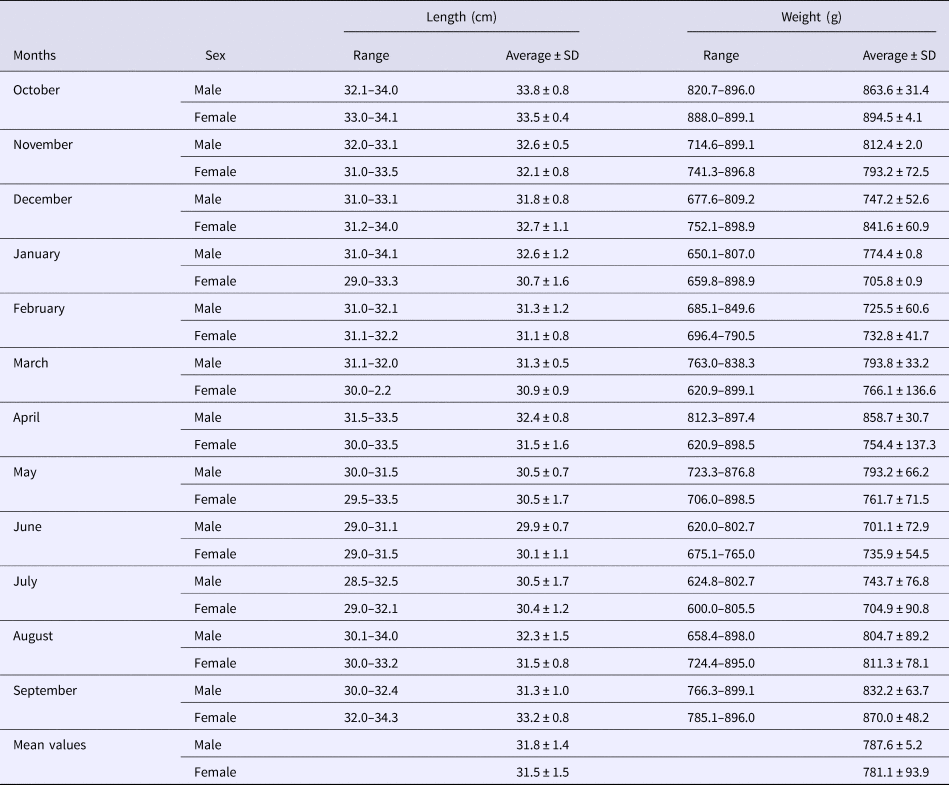
Table 1 shows the standard length, weight ranges and averages of fish used in the study of seasonal variations in nutritive value of wild sobaity. No significant (P > 0.05) differences were observed between the respective lengths and weights of male and female sobaity collected during different months of the year. The average standard lengths of male sobaity in different months ranged between 29.9 and 33.8 cm (mean 31.8 ± 1.4 cm); while it ranged between 30.1 and 33.5 cm (mean 31.5 ± 1.5 cm) for females. The monthly average weights of male sobaity ranged between 701.1 and 863.6 g with a mean value of 787.6 ± 5.2 g; while it ranged between 704.9 and 894.5 g with a mean weight of 781.1 ± 93.9 g for females. It is worth mentioning that attempts were made to collect fish from the fish market within the similar size ranges (600–900 g) each month.
Length, weight ranges and averages (±SD, N = 5) of fish used

No significant (P > 0.05) difference between the mean length and weight of male and female sobaity.
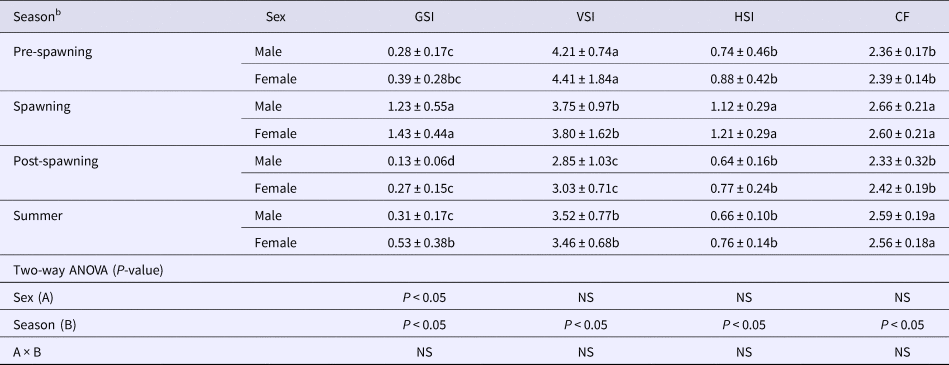
The monthly ranges and averages of GSI, VSI, HSI and CF of male and female sobaity are presented in Table 2. The significantly (P < 0.05) highest average GSI of both male and female sobaity were observed in the spawning season and the lowest in the post-spawning season. As expected, in all seasons the GSI values of females were significantly higher than those of males (Table 2). Almatar et al. (Reference Almatar, Lone, Abu-Rezq and Yousef2004) also found significantly higher GSI value in silver pomfret (Pampus argenteus) during the spawning season. No significant interactive effect (P > 0.05) of sex and season was observed on the GSI, VSI, HSI and CF of sobaity; but, the season did have a significant effect. The significantly (P < 0.05) highest VSI values were observed in both males and females in the pre-spawning season, while the VSI value was lowest in the post-spawning season. No significant (P > 0.05) differences were observed between the HSI values of males and females in different seasons. But, the HSI values of both males and females in the spawning season were significantly (P < 0.05) higher than those in other seasons. Although no significant (P > 0.05) differences were observed between the CF values of respective male and female sobaity in different seasons, the CF values of both males and females in spawning and summer seasons were significantly (P < 0.05) higher than those in other seasons. The better CF of sobaity in spawning season could be related to the availability of food, fat accumulation in the preceding season and enhancement during their gonadal development (Alhassan et al., Reference Alhassan, Abobo, Mensah and Boti2014). On the other hand, in the summer season in addition to common foods, the sobaity has access to plenty of juvenile mullets (Liza macrolepsis) available in the Arabian Gulf that are highly nutritious, which ultimately results in better CF for sobaity.
Seasonal variations in GSI, VSI, HSI and condition factor of male and female sobaity between October 2015 and September 2016a

a Values (mean ± SD, N = 15) in a column with same letters are not significantly different determined by Tukey's test (P < 0.05).
b Pre-spawning = (October–December), spawning = (January–March), post-spawning = (April–June) and summer = (July–September).
GSI, Gonado-somatic index; VSI, Viscero-somatic index; HSI, Hepato-somatic index; CF, Condition factor.
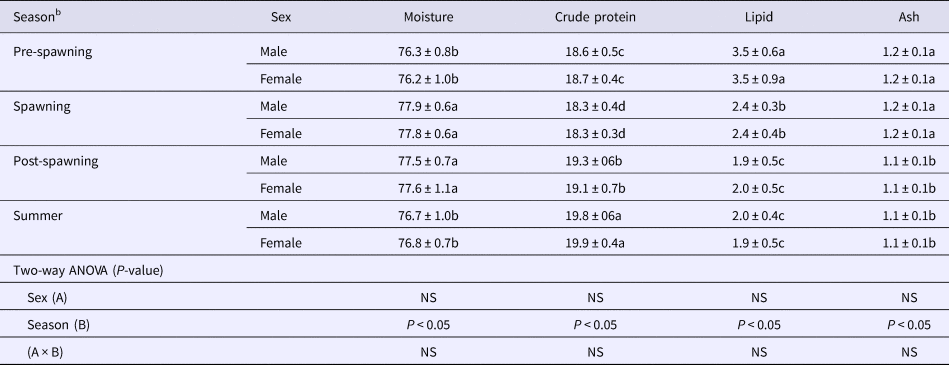
Table 3 shows the seasonal variations in muscle proximate composition of male and female sobaity. The proximate composition of wild sobaity varied significantly (P < 0.05) among different seasons. The muscle moisture content of sobaity varied with the seasons and was inversely related to the lipid content (Orban et al., Reference Orban, Di Lena, Nevigato, Masci, Casini and Caproni2011). In the present study, the muscle protein content (18.3–19.9%) in sobaity was higher than those previously found in wild (17.62%) and cultured (16.25%) sobaity bream (Hossain et al., Reference Hossain, Almatar, Al-Abdul-Elah and Yaseen2012) but slightly lower than that of 20.2% in wild gilthead bream (Grigorakis, Reference Grigorakis2007). The comparatively lower muscle protein observed in sobaity throughout the pre-spawning season might be associated with the synchronized proteolysis of the protein to guarantee access to the essential amino acids for gonadal development for the spawning season (Martin et al., Reference Martin, Houlihan, Talbot and Palmer1993). In the present study, the muscle lipid (1.9–3.5%) level was lower than those observed in wild (4.60%) and cultured (4.14%) sobaity bream (Hossain et al., Reference Hossain, Almatar, Al-Abdul-Elah and Yaseen2012), but higher than that (1.4%) found in wild gilthead bream (Grigorakis, Reference Grigorakis2007).
Variations in proximate composition of male and female sobaity between October 2015 and September 2016 (% fresh matter basis)a
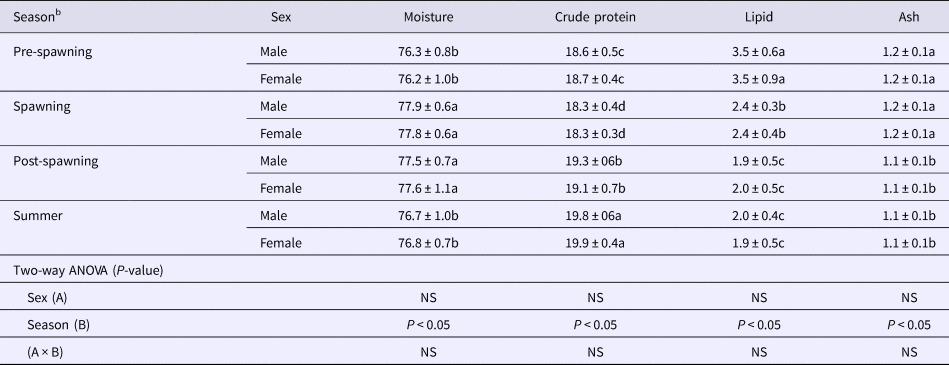
a Values (mean ± SD, N = 15) in a column with same letters are not significantly different determined by Tukey's test (P < 0.05).
b Pre-spawning = (October–December), spawning = (January–March), post-spawning = (April–June) and summer = (July–September).
The higher muscle lipid content observed in both males and females throughout the pre-spawning season could be related to the fact that fish use fat reserves during gonadal maturation and spawning, as well as in winter (Shearer, Reference Shearer1994). Besides, a number of factors, including species, season, age, feeding regime and environment of the ecosystem affect the nutrient composition of the fishes (Shearer, Reference Shearer1994; Orban et al., Reference Orban, Nevigato, Masci, Di Lena, Casini, Caproni, Gambelli, de Angelli and Rampaci2007).
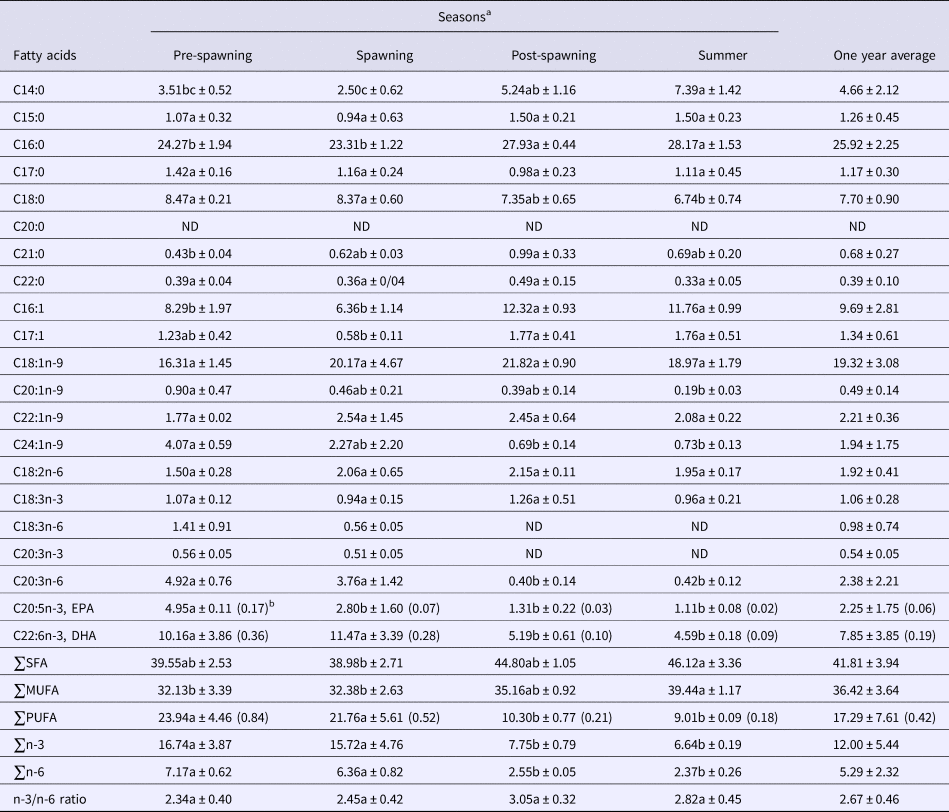
Table 4 shows the FA composition (% of total fatty acids) of the wild sobaity (male and female combined) in different seasons. In the present study, palmitic acid (PA, C16:0) was the major SFA followed by oleic acid (OA, C18:1n-9) which accounted for 23–28% and 16–22% of total FAs, respectively. Muscle OA can be food derived and also the saturated stearic acid (SA, C18:0) synthesized by FA synthetase can be desaturated initially by stearoyl CoA desaturase to form OA (Leaver et al., Reference Leaver, Bautista, Bjornsson, Krey, Tocher and Torstensen2008). Saturated C16:0 and C18:0 FAs can be desaturated initially by steroyl CoA desaturase to form C16:1n-7 and C18:1n-9. These monosaturates may be further desaturated and elongated by specific fatty acyl desaturases and elongases, especially under conditions of essential fatty acid deficiency (Leaver et al., Reference Leaver, Bautista, Bjornsson, Krey, Tocher and Torstensen2008). Muscle PA of sobaity throughout post-spawning and summer seasons was significantly (P < 0.05) higher than those in other seasons. Similar higher muscle PA was observed in wild white sea bream (Cejas et al., Reference Cejas, Almansa, Jerez, Bollanos, Samper and Lorenzo2004), sea bass (Fuentes et al., Reference Fuentes, Fernandez-Segovia, Serra and Barat2010) and sobaity bream (Hossain et al., Reference Hossain, Almatar, Al-Abdul-Elah and Yaseen2012). Muscle linoleic acid (LA, C18:2n-6) content (1.5–2.15%) did not vary among different seasons and these values are similar to that of 1.5% reported for wild sea bream (Hossain et al., Reference Hossain, Almatar, Al-Abdul-Elah and Yaseen2012) but lower than that of 2.73% for wild sea bass (Fuentes et al., Reference Fuentes, Fernandez-Segovia, Serra and Barat2010) and 3.34% for white sea bream (Cejas et al., Reference Cejas, Almansa, Jerez, Bollanos, Samper and Lorenzo2004).
Muscle FA profile (% of total FAs) of wild sobaity (male and female combined) in different seasons (values are mean ± SD, N = 3)

a Pre-spawning = (October–December), spawning = (January–March), post-spawning = (April–June) and summer = (July–September).
b Figures within the parentheses indicate absolute values i.e. g of FA in 100 g of fish muscle.
ND, not detected; EPA, eicosapentaenoic acid; DHA, docosahexaenoic acid; SFA, saturated fatty acid; MUFA, mono-saturated fatty acid; PUFA, polyunsaturated fatty acids.
The differences in muscle FA contents of sobaity bream in the present study could be due to the variations in food availability. In wild, sobaity bream have been observed to feed by grazing for prey on rocky surfaces, consuming a variety of prey, with crustaceans, polychaetes, teleosts and echinoderms as the major dietary group. The prey consumed also varies with fish size: juvenile fish feed on zooplankton (soft-bodied animals such as polychaete larvae, calanid larvae and other small crustaceans) and even on zoobenthos; bigger fish also consume benthic plants and animals (barnacles, bivalves, polychaetes, amphipods and other finfish). These might explain the higher levels of n-3 PUFA in sobaity muscles. In the Arabian Gulf during the summer season, sobaity bream intensely prey on abundant juvenile mullets (L. macrolepsis), which might also resulted in the higher muscle lipid and FA deposition in the pre-spawning and spawning seasons.
In general, the cultured fish show a tendency of having a higher LA than the wild counterpart (Alasalvar et al., Reference Alasalvar, Taylor, Jubcob, Shahidi and Alexis2002.) Plant oil used in fish feed contains a high proportion of LA which is accumulated in cultured fish largely unchanged since the marine fish has a low capacity for chain elongation and desaturation (Yamada et al., Reference Yamada, Kobayashi and Yone1980). However, the presence of low levels of LA in wild sobaity is very important from the human health perspective, as consumption of wild sobaity will lead to an intake of fish with a better n-3/n-6 ratio.
The DHA levels in pre-spawning and spawning season ranged between 10.16 and 11.47% (i.e. 0.36 and 0.28 g DHA per 100 g fish muscle) with a whole year average value of 0.20 g DHA per 100 g fish muscle. Muscle DHA levels in pre-spawning and spawning seasons were significantly (P < 0.05) higher than those in other seasons and no significant (P > 0.05) differences were observed between the muscle DHA levels in post-spawning and summer seasons. The higher levels of muscle DHA in the muscle are in good agreement with the data from wild sea bream (Hossain et al., Reference Hossain, Almatar, Al-Abdul-Elah and Yaseen2012), sea bass (Orban et al., Reference Orban, Nevigato, Di Lena, Casini and Marzetti2003) and gilthead bream (Mnari et al., Reference Mnari, Bouhlei, Charaief, Hammami, Romdhane, El Casfi and Chaouch2007), but these DHA values are lower than those reported for wild white sea bass (Cejas et al., Reference Cejas, Almansa, Jerez, Bollanos, Samper and Lorenzo2004), red porgy (Rueda et al., Reference Rueda, Lopez, Martinez, Zamora, Divanch and Kentouri1997) and sea bass (Fuentes et al., Reference Fuentes, Fernandez-Segovia, Serra and Barat2010). In the present study, the average DHA values (7.85%) observed are higher than the reported values of 3.3% for gilthead bream (Orban et al., Reference Orban, Nevigato, Di Lena, Casini and Marzetti2003) and 6.5% for blue fin sea bream (Hossain et al., Reference Hossain, Almatar, Al-Abdul-Elah and Yaseen2012). The amount of muscle EPA and DHA in pre-spawning and spawning season is much higher than those in other seasons. The higher EPA and DHA in sobaity muscle during pre-spawning and spawning might be related to diverse feeding habits and fat accumulation in the preceding season and enhancement of gonadal development i.e. sexual changes in connection with spawning. Thus, the nutritional value of sobaity sea bream during these months of the year is higher (Mozaffarian et al., Reference Mozaffarian, Bryson, Lemaitre, Burke and Siscovick2005; Mnari et al., Reference Mnari, Bouhlei, Charaief, Hammami, Romdhane, El Casfi and Chaouch2007).
The n-3/n-6 ratio is an indication of the biomedical importance of fish (Chakraborty et al., Reference Chakraborty, Rola, Joy and Makkar2017). Anthropological and nutritional studies indicate that a very low n-3/n-6 ratio in the diet may have adverse effects, while higher levels of n-3/n-6 ratios may be beneficial (Simopoulos, Reference Simopoulos2008). The total n-3 and n-6 FAs in muscle were significantly (P < 0.05) higher in pre-spawning and spawning seasons compared to those in other seasons indicating a better nutritional value of sobaity during these seasons of the year.
Marine fish contain large amounts of n-3 PUFA particularly EPA and DHA. Despite this marine fish can neither biosynthesize EPA and DHA de novo nor from shorter chain precursors such as alpha lenoleic acid (ALA, C18:3n-3). Therefore, they have a dietary requirement for EPA and DHA (Sargent et al., Reference Sargent, Henderson, Tocher and Halver1989). On the other hand, the natural diets of many freshwater fish are not rich in DHA, being rich instead in linoleic acid (LA, C18:2n-6) and ALA and to lesser extent, EPA. Thus, the conversion of LA to EPA to DHA is necessary. As these fish has access to diverse foods containing precursors of long chain PUFA, the conversion process may occur through δ−5 desaturase and δ−6 desaturase enzymes promoting elongation and desaturation (Tocher, Reference Tocher2003).
No significant (P > 0.05) differences were observed between the muscle n-3/n-6 ratios in different seasons, these ranging between 2.34 and 3.05. These n-3/n-6 ratios of wild sea bream are in agreement with other studies of wild sobaity bream (Hossain et al., Reference Hossain, Almatar, Al-Abdul-Elah and Yaseen2012), gilthead bream (Orban et al., Reference Orban, Nevigato, Di Lena, Casini and Marzetti2003), red porgy (Rueda et al., Reference Rueda, Lopez, Martinez, Zamora, Divanch and Kentouri1997) and sea bass (Orban et al., Reference Orban, Nevigato, Di Lena, Casini and Marzetti2003). In general, higher ratios of n-3/n-6 found in wild fish compared with cultured fish indicate that the marine environment offers a better source of n-3 PUFAs for fish as they have access to a variety of food organisms containing high n-3 PUFAs (Grigorakis et al., Reference Grigorakis, Taylor and Alexis2002; Fuentes et al., Reference Fuentes, Fernandez-Segovia, Serra and Barat2010). The n-3/n-6 ratio differences may be because of the variability of the lipid levels in fish muscle, which depend on the species, season, age, size, reproduction period, as well as the FA composition of the eating regimen (Sirot et al., Reference Sirot, Oseredczuk, Bemrah-Aouachria, Volatier and Lablanc2008).
Season is an important factor that could considerably affect the biochemical composition of fish and consequently the nutritional value of the fish to consumers. In the present study, the period of gonadal maturation and spawning extending from October to March corresponded to fish muscle having higher n-3 PUFA, in particular, the DHA indicating a better nutritional value of sobaity sea bream. Similar better nutritional value in terms of n-3 PUFA during the pre-spawning season compared with other seasons was reported for golden grey mullet, L. aurata (Khitouni et al., Reference Khitouni, Mihoubi, Bouain and Rebah2014).
The sobaity bream is a protandric hermaphrodite; the majority of individuals are first males, then become females. Abou-Seedo et al. (Reference Abou-Seedo, Dadzie and Al-Kannan2003) reported that sobaity bream in Kuwait waters spawn from January to April with a February peak in males and a March peak in females and transitional fish. Abu-Hakima (Reference Abu-Hakima1984) also observed that spawning in this species in Kuwait waters begins in January but in contrast, this author observed the end of spawning in March in the wild. For the enhancement of gametogenesis leading to maturity and spawning, the role of temperature has been well recognized. A strong negative correlation observed between the annual variations in GSI and sea temperature confirms that temperature, either alone or in combination with other factors, triggers spawning in Acanthopagrus latus (Abou-Seedo et al., Reference Abou-Seedo, Dadzie and Al-Kannan2003). The spawning temperature for sobaity ranges between 19 and 23°C (Teng et al., Reference Teng, El-Zahr, Al-Abdul-Elah and Almatar1999). In relation to age, spawning generally starts at 20 months and peaks at 21 months in the males, while females and transitional fish start to spawn a month later at 21 months, with a peak at 22 months (Abou-Seedo et al., Reference Abou-Seedo, Dadzie and Al-Kannan2003).
Seasonal variation influences the diet of fish. Petenuci et al. (Reference Petenuci, Rocha, de Souza, Schneider, da Costa and Visentainer2016) observed that the lipid contents of five fish species studied from the Amazon basin were lower in flood periods than in drought periods. These variations were attributed to different causes such as food availability and reproduction. As mentioned earlier, during the summer season the sobaity has an opportunity for intense feeding in particular on the abundant juvenile mullets in the Arabian Gulf enhancing the fat reserves for the pre-spawning and spawning seasons. Seasonality affects life cycles of fish, such as reproduction, body conditions, food intake and their immune response. These may ultimately influence the total lipid and FA composition, since those substances are used as energy sources and are precursors for the production of biochemicals in fish such as eicasonoids and prostaglandins (Tocher, Reference Tocher2003). A review of seafood from the Indo-Pacific region found that with increased latitude there was a concomitant increase in n-3 PUFA with DHA being particularly high in fish from cooler waters (Dunstan et al., Reference Dunstan, Olley and Ratkowsky1999). However, there are some exceptions, with some tuna species caught in warm water showing particularly high absolute values of DHA and therefore of total n-3 PUFA (Visentiner et al., Reference Visentiner, Noffs, Carvalho, de Almeida, de Oleveira and de Souza2007). In sea bass (Dicentrarchus labrax), Cordier et al. (Reference Cordier, Brichon, Weber and Zwingelstein2002) found a significant correlation between water salinity and percentage of DHA in muscle, liver and gill phospholipids, but no correlation was found between per cent DHA and water temperature.
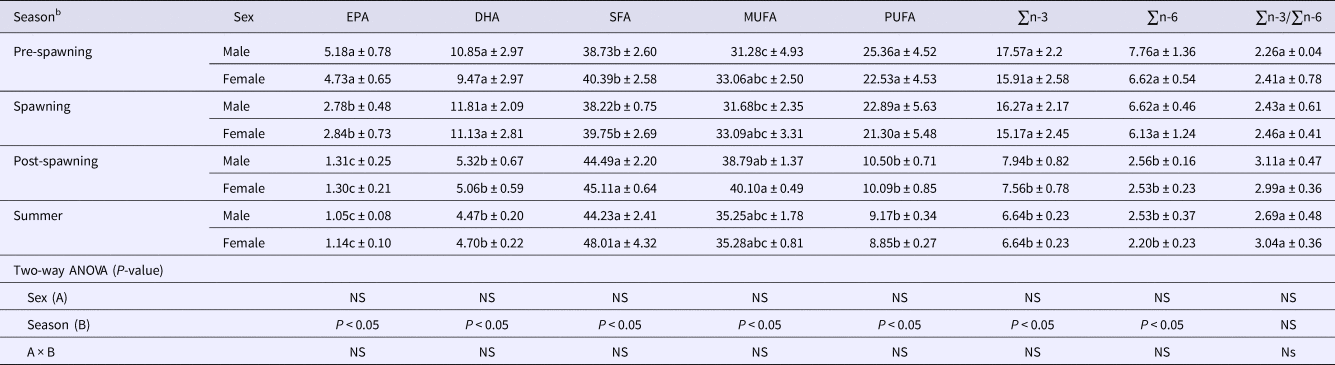
Table 5 shows the seasonal variations in muscle EPA, DHA, SFA, MUFA, PUFA, ∑n-3, ∑n-6 content and ∑n-3/∑n-6 ratios of male and female sobaity. No interactive effects (P > 0.05) of sex and season were observed, but the season alone had a significant effect on EPA, DHA, SFA, MUFA, PUFA, ∑n-3 and ∑n-6 FA contents of sobaity. Both male and female sobaity muscle had significantly higher DHA during the pre-spawning and spawning seasons. Hossain et al. (Reference Hossain, Almatar, James, Al-Yakout and Yaseen2010) also reported similar higher muscle DHA levels in both male and female silver pomfret (P. argenteus) during pre-spawning and spawning season. Muscles of both male and female sobaity bream in the present study demonstrated a higher level of saturation of FAs at the commencement of the post-spawning and summer seasons. Romotowska et al. (Reference Romotowska, Karlsdottir, Gudjonsdottir, Kristinsson and Arason2016) also observed a higher degree of saturation of FAs in Atlantic mackerel at the start of summer. On the other hand, the level of unsaturation i.e. the PUFA profile in muscles of both male and female sobaity bream were higher during the pre-spawning and spawning seasons. The level of unsaturation of FAs in fish might be linked to the seasonal variations in lipid content of fish owing to the environmental conditions, such as water temperature, food availability and food composition (Celik, Reference Celik2008).
Muscle EPA, DHA, SFA, MUFA, PUFA, ∑n-3, ∑n-6 and ∑n-3/∑n-6 ratios of male and female sobaity (% of total FAs) from October 2015 to September 2016a

a Values (mean ± SD, n = 9) in a column with same letters are significantly different as determined by Tukey's test (P < 0.05).
b Pre-spawning = (October–December), spawning = (January–March), post-spawning = (April–June) and summer = (July–September).
The high percentage of ∑PUFA in male (15.51–16.14%) and female (14.40–15.51%) gonads during pre-spawning and spawning seasons was compensated by lower levels of ∑PUFA in the livers of male (7.98–11.15%) and female (7.46–9.06%) sobaity (results not shown in tables). Henderson et al. (Reference Henderson, Sargent and Hopkins1984) postulated that the intervention of the liver in the transformation of FAs from muscle triglycerides into egg phospholipids could easily account for the compositional change in the muscle and ovarian lipid of capelin (Mollottus villosus). It is well known that the liver is the site of biosynthesis of specific lipoproteins for gonads (Plack et al., Reference Plack, Pritchard and Fraser1971). Alamansa et al. (Reference Alamansa, Martin, Cejas, Badia, Jeres and Lorenzo2001) showed that broodstock gilthead sea bream females drew upon their lipid reserves from liver and muscle during ovary maturation, and these lipids contributed to form the lipid reserves of the eggs and serve as an energetic and structural substrate for the specific lipoprotein synthesis, which transports lipids and proteins from the liver to ovaries. Decrease in liver and muscle at the onset of spawning season have been described in several species such as capelin (Henderson et al., Reference Henderson, Sargent and Hopkins1984), Atlantic cod (Love & Black, Reference Love, Black and Mellinger1990) and salmonids (Green & Selivonchick, Reference Green and Selivonchick1987).
Conclusion
The results of the present investigation showed that seasonal variability affected the proximate composition and FA profile of sobaity. These results also demonstrated that sobaity is a promising source of essential FAs. For a direct comparison of the lipid quality of fish from different sources, an estimation of the absolute amount of total n-3 and n-6 PUFAs in fish muscle is important from the point of view of human consumption. Based on the whole year average of PUFA content (17.29%, i.e. 0.42 g PUFA in 100 g fish muscle), sobaity bream can be considered as a nutritionally healthy fish. However, it can be said that sobaity caught during pre-spawning and spawning seasons (October–March) are nutritionally better than those in other seasons because of higher levels (21.76–23.94%, i.e. 0.52–0.84 g PUFA in 100 g fish muscle) of PUFAs, in particular higher levels of DHA. A typical western diet is characterized by a high intake of n-6 PUFA and low intake of n-3 PUFA. According to nutritional advisers, it would be beneficial to increase the levels of n-3 PUFA in diets so as to increase the n-3/n-6 ratio. Consumption of fish with the hope of increasing the n-3 PUFA concentration may not be effective as this may cause an associated increase in the n-6 concentration as well. However, the good n-3/n-6 ratio of 2.26–3.11 observed in sobaity throughout the year could be considered as a positive attribute from a nutritional standpoint.
Acknowledgements
The authors are thankful to Ms T. Al-Sharrah of Environmental Pollution and Climate Control Program of KISR for fatty acid analysis of the samples.
Financial support
The authors gratefully acknowledge the financial grant (FM095K) provided by Kuwait Institute for Scientific Research to carry out the research.