





Introduction
Scholars have long raised concerns about philanthropy’s tendency to reinforce, rather than disrupt, existing hierarchies within the nonprofit sector. Rather than redistributing power and resources, philanthropic institutions often privilege established organizations with strong professional infrastructures, leaving grassroots and movement-oriented groups with fewer resources (Ashley et al., Reference Ashley, McGinnis Johnson and Faulk2015; Frumkin, Reference Frumkin2006; Ostrander, Reference Ostrander2007). These patterns reflect broader institutional dynamics in which philanthropic decision-making authority is concentrated among elite donors and professional foundation staff, whose funding priorities may not always align with the needs or perspectives of marginalized communities (Ray, Reference Ray2019; Reich, Reference Reich2018).
These dynamics are particularly evident in the distribution of funding for social justice causes. Justice-oriented organizations (especially those focused on structural inequality, grassroots organizing, and community empowerment) have historically received a relatively small share of philanthropic dollars (Ranghelli, Reference Ranghelli2016). Recent estimates suggest that only about 13–15 percent of foundation funding supports social justice work, well below the 25 percent benchmark recommended by the National Committee for Responsive Philanthropy (Jagpal & Laskowski, Reference Jagpal and Laskowski2016; NCRP, 2015a). This persistent funding gap has led scholars and practitioners to question whether traditional philanthropic structures are well suited to support organizations working to address systemic inequality.
In response to these concerns, scholars and practitioners have increasingly explored alternative philanthropic models that seek to redistribute decision-making authority and democratize grantmaking. Examples include participatory grantmaking initiatives, giving circles, and other collaborative funding models that involve community members more directly in philanthropic decision-making (Gibson et al., Reference Gibson, Cardona, McGinnis Johnson and Suárez2023; Walker, Reference Walker2019). These approaches challenge traditional philanthropic hierarchies by shifting influence away from elite donors and professional foundation staff toward broader and more diverse groups of decision-makers.
One such model is student-led philanthropy, in which college students are entrusted with real philanthropic funds and empowered to make grantmaking decisions through coursework. Although these initiatives are typically framed as pedagogical tools designed to teach students about nonprofit organizations and civic engagement, they may also offer a unique opportunity to examine how redistributing philanthropic decision-making authority influences funding outcomes.
The remainder of this article proceeds as follows. We begin with a review of the relevant literature on justice philanthropy. We then describe our data and empirical approach, followed by a presentation of the findings. The article closes with a discussion of the results in light of the existing literature, a conclusion, and directions for future research.
Literature review
Traditional foundation-led grantmaking
Philanthropy has long been critiqued for reinforcing existing hierarchies within the nonprofit sector (Giridharadas, Reference Giridharadas2018; Kohl-Arenas, Reference Kohl-Arenas2016; Moody, Reference Moody2021; Reich, Reference Reich2018). Grantmaking professionals typically operate within environments that emphasize measurable outcomes, risk management, and strategic alignment, favoring larger, established nonprofits with the administrative capacity to meet these expectations (Frumkin, Reference Frumkin2006; Ostrander, Reference Ostrander2007).
Although initially positioned as society’s “risk capital” intended to fund bold, justice-focused initiatives (Brest & Harvey, Reference Brest and Harvey2008; Letts et al., Reference Letts, Ryan and Grossman1997), many foundations have grown increasingly conservative, with philanthropic dollars disproportionately flowing to nonprofits that align with elite donor preferences (Frumkin, Reference Frumkin2006; Ostrander, Reference Ostrander2007; Silver, Reference Silver2007). As a result, smaller, grassroots, and justice-oriented organizations (e.g., organizations serving communities of color, LGBTQ+ individuals, immigrants, and low-income populations) are routinely underfunded (Ashley et al., Reference Ashley, McGinnis Johnson and Faulk2015; Jenkins & Halcli, Reference Jenkins, Halcli, Powell and Clemens1999; Lecy et al., Reference Lecy, Ashley and Santamarina2012; Ramirez et al., Reference Ramirez, Baptista, Greenberg, Perovich, Yulsman, Lopez and Rosenberg2022; Reich, Reference Reich2018; Villanueva, Reference Villanueva2018), and funding practices often reproduce the very systems of exclusion they claim to address (Beer et al., Reference Beer, Patrizi and Coffman2021; NCRP, 2015a).
Decision-making power remains concentrated in the hands of wealthy donors and foundation executives, privileging elite perspectives and excluding those with lived experience (Giridharadas, Reference Giridharadas2018; McGoey, Reference McGoey2015; NCRP, 2018; Reich, Reference Reich2018; Villanueva, Reference Villanueva2018). In essence, it reflects that philanthropic priorities are often shaped behind closed doors without meaningful input from the communities they aim to serve (Jenkins, Reference Jenkins2011). Even participatory approaches intended to democratize philanthropic decision-making may result in only symbolic inclusion rather than true power-sharing (Gibson et al., Reference Gibson, Cardona, McGinnis Johnson and Suárez2023).Footnote 1
These debates have largely focused on reforming foundations themselves, with far less attention paid to alternative models that may operate differently. Within this broader conversation, scholars and practitioners have advocated for justice philanthropy—a funding approach that emphasizes equity, structural accountability, and shared power (Paarlberg et al., Reference Paarlberg, Walk and Merritt2022; Walker, Reference Walker2019). Importantly, this perspective highlights that how funding decisions are made (and who gets to make them) matters just as much as where the money goes (NCRP, 2015a; Villanueva, Reference Villanueva2018).
Justice-oriented philanthropy and alternative grantmaking
Against this backdrop of professionalized foundation grantmaking, scholars have begun to explore alternative models that redistribute decision-making authority in philanthropy. Scholarship has used several related terms, including experiential philanthropy, student philanthropy, and youth philanthropy (Campbell, Reference Campbell2014; McDougle et al., Reference McDougle, McDonald, Li, McIntyre Miller and Xu2017; Olberding, Reference Olberding2009; Xu et al., Reference Xu, Li, McDougle and Farazmand2018). Experiential philanthropy is often used as a broad umbrella term describing educational initiatives in which students engage directly in philanthropic decision-making as part of coursework (Li et al., Reference Li, Xu and McDougle2019; McDougle & Li, Reference McDougle and Li2023). In this study, we use the term student-led philanthropy to refer specifically to programs in which college or university students are entrusted with real philanthropic funds and empowered to make grantmaking decisions. This distinction emphasizes the role of students not simply as learners observing philanthropy, but as active decision-makers participating in the allocation of philanthropic resources. Student-led philanthropy differs from other youth philanthropy models occurring in community foundations or nonprofit-sponsored programs, where young participants may advise on grantmaking but do not typically control fund allocation.
Student-led philanthropy
Student-led philanthropy has been developed primarily as a pedagogical strategy. Studies suggest that participation in philanthropic decision-making can increase students’ understanding of nonprofits, strengthen civic attitudes, and foster greater interest in community engagement and social responsibility (Campbell, Reference Campbell2014; McDougle et al., Reference McDougle, McDonald, Li, McIntyre Miller and Xu2017; Olberding, Reference Olberding2009; Olberding, Reference Olberding2012). This literature has primarily focused on educational and civic outcomes for students, examining how participation in grantmaking activities shapes students’ knowledge, attitudes, and civic identities. Programs such as The Philanthropy Lab provide philanthropic capital to colleges and universities so that students can engage directly with nonprofits and determine how to allocate grant dollars. Within higher education, these initiatives have largely been understood as experiential learning opportunities rather than as interventions into philanthropic practice itself. However, far less attention has been paid to how student decision-makers influence philanthropic outcomes, including the types of nonprofits that ultimately receive funding.
In this study, we suggest that student-led philanthropy also holds underexamined strategic significance. These initiatives shift decision-making authority from foundation professionals to students—often a potentially more diverse and less institutionally entrenched group—creating space to experiment with more participatory and equity-centered approaches to funding. By decentering elite expertise and elevating new voices, these models challenge the assumption that justice-oriented funding must remain peripheral to mainstream grantmaking practices.
Why students?
Insights from civic learning and youth development research suggest that young adults may approach social problems differently than established institutional actors (Flanagan & Levine, Reference Flanagan and Levine2010; Youniss & Yates, Reference Youniss and Yates1997). Several factors suggest that students may be well positioned to advance a more justice-centered approach to philanthropy.
First, student grantmakers may be more attuned to values of equity, inclusion, and grassroots engagement than elite gatekeepers, particularly when reinforced through coursework and campus environments that encourage critical reflection on social inequality. This reflects broader trends in higher education, where many undergraduate programs—particularly in public affairs, social work, education, and the humanities—have increasingly emphasized social justice, equity, and civic engagement as core learning outcomes (Battistoni, Reference Battistoni2006; Colby et al., Reference Colby, Ehrlich, Beaumont and Stephens2007; Hurtado, Reference Hurtado2007; Network of Schools of Public Policy, Affairs, and Administration [NASPAA], 2024). At the same time, students are not a monolithic group, and attitudes toward equity may vary across institutions, disciplines, and regional contexts.
Second, many student philanthropy programs are housed at public or urban-serving institutions, where students may share greater demographic or geographic proximity to marginalized communities (Gonzalez & Epstein, Reference Gonzalez and Epstein2021; NCRP, 2015b). This proximity can foster deeper accountability and increase the likelihood that students recognize and support grassroots, justice-oriented organizations. At the same time, students at elite, predominantly White institutions located in affluent or suburban areas may not share the same demographic or geographic alignment with grantee communities, and their funding decisions may reflect different priorities.
Finally, student-led philanthropy stands out for how funding decisions are made. These initiatives are intentionally designed to foster civic responsibility, equity-minded leadership, and critical reflection (Colby et al., Reference Colby, Ehrlich, Beaumont and Stephens2007; McDougle et al., Reference McDougle, McDonald, Li, McIntyre Miller and Xu2017). By embedding grantmaking within a college or university course, these initiatives bridge the gap between learning and practice and shape students’ identities as justice-oriented givers.
Yet important questions remain. Do these initiatives meaningfully challenge dominant philanthropic norms, or do they merely simulate equity without altering underlying structures? As this study explores, student-led philanthropy provides a unique opportunity to observe how redistributing philanthropic decision-making authority shapes the types of nonprofit organizations that receive funding and whether different decision-making environments produce different patterns of justice-oriented funding.
Critiques and limits of student-led philanthropy
Student-led philanthropy is not without limitations, and a growing body of scholarship cautions against treating it as a straightforward corrective to traditional foundation practice. These concerns center less on the intentions of individual participants than on the structural features of the model itself.
First, bounded by the academic calendar, these programs may encourage a short-term, “warm glow” orientation toward giving rather than sustained engagement with grantees (Stacey et al., Reference Stacey, Hanson and Novisky2021), making it difficult to support the ongoing, relationship-based accountability that justice-oriented philanthropy scholars argue is necessary for meaningful structural change (Walker, Reference Walker2019). Second, the apparent justice orientation of student grantmakers may reflect particular pedagogical choices rather than an inherent disposition. Campbell et al. (Reference Campbell, Appe and Rozansky2023) show that the texts and frameworks instructors assign in experiential philanthropy courses vary considerably across institutions and shape how students understand equity, power, and community needs. Third, and perhaps most importantly, recipient organizations sometimes describe the experience as extractive, with nonprofits asked to accommodate site visits, interviews, and due-diligence processes designed primarily to serve students’ learning objectives instead of grantee needs (Weber et al., Reference Weber, Casolaro, Simpson and Johnson2025).
These critiques suggest that student-led philanthropy should not be read uncritically as a more democratic or justice-aligned alternative to traditional grantmaking. A recent systematic review (Mao, Reference Mao2021) confirms that empirical research has focused overwhelmingly on outcomes for student participants while leaving the experiences and outcomes of recipient organizations comparatively unexamined. The present study’s reliance on mission-level outcomes, rather than recipient-reported experience, should therefore be understood as a limitation rather than a full account of justice in practice.
Evaluating justice in grantmaking: A comparative framework
Most existing scholarship emphasizes what students learn from the experience (e.g., civic engagement, leadership, or ethical reflection) rather than what kinds of nonprofits they choose to fund (Li et al., Reference Li, McDougle and Gupta2020; McDougle et al., Reference McDougle, McDonald, Li, McIntyre Miller and Xu2017; Olberding, Reference Olberding2009), while critiques of traditional philanthropy have focused on its failure to disrupt elite power structures or support systemic change (Frumkin, Reference Frumkin2006; Ostrander, Reference Ostrander2007; Suárez & Marshall, Reference Suárez and Marshall2014; Villanueva, Reference Villanueva2018). Yet little empirical research has compared the grantmaking decisions of students and professional foundation staff to assess whether student-led initiatives offer more justice-oriented outcomes.
To fill this gap, our study draws on Iris Marion Young’s (Reference Young2011) theory of structural injustice, which argues that inequality is often reproduced through “normal” institutional processes that appear neutral but reinforce entrenched hierarchies. Applied to philanthropy, this reveals how conventional funding practices rooted in elite norms, centralized authority, and managerial metrics can unintentionally perpetuate the injustices they aim to address.
To evaluate whether students and professional foundation staff differ in the justice orientation of their grantees, we focus on a standardized, widely available artifact: nonprofit mission statements. While imperfect proxies for organizational behavior (Levine Daniel & Eckerd, Reference Levine Daniel and Eckerd2019), mission statements offer a consistent lens into how nonprofits frame their work, articulate values, and signal alignment to funders (Frumkin, Reference Frumkin2006; Suárez & Hwang, Reference Suárez and Hwang2008). Drawing from Young’s theory and critical philanthropy literature (e.g., Giridharadas, Reference Giridharadas2018; Moody, Reference Moody2021; Reich, Reference Reich2018), we assess justice orientation in mission statements across four dimensions. First, equity focus, meaning an explicit commitment to marginalized populations and redistributive resources (NCRP, 2015a; Villanueva, Reference Villanueva2018). Second, systemic framing, in which social problems are understood as products of institutional and structural inequalities (Walker, Reference Walker2019; Young, Reference Young2011). Third, rights-based language, grounding social change in claims about dignity, human rights, and justice rather than charity (Moody, Reference Moody2021; Reich, Reference Reich2018). Finally, participatory ethos, which emphasizes shared power, grassroots leadership, and community inclusion (Gibson et al., Reference Gibson, Cardona, McGinnis Johnson and Suárez2023; Paarlberg et al., Reference Paarlberg, Walk and Merritt2022). These dimensions provide a conceptual framework for identifying justice orientations in nonprofit mission statements.
In addition, Ray’s (Reference Ray2019) theory of racialized organizations offers a complementary lens. Ray argues that organizations are not race-neutral but embed racial meanings into their structure and operations. This perspective invites us to consider whether foundations are racialized in ways that shape who holds decision-making power, what nonprofits are seen as “fundable,” and how equity is conceptualized. While Young’s framework helps conceptualize the forms justice-oriented work may take, Ray’s theory helps explain why such orientations may be unevenly recognized within philanthropic institutions and how organizational power structures may shape which of these organizations receive funding.Footnote 2
Methods and data
In this study, we examine whether student-led funders are more likely than traditional foundations to support nonprofits whose missions reflect the principles of justice philanthropy—namely, equity, structural change, rights-based framing, and participatory values. We compare grants awarded by undergraduate students participating in The Philanthropy Lab to those made directly by The Once Upon a Time Foundation between 2011 and 2019. Both funding streams originate from the same philanthropic source, but one represents decentralized, student-driven decision-making while the other reflects conventional, foundation-led practices.Footnote 3
About The Philanthropy Lab
The educational context of these programs may create space for the explicit discussion of race, equity, and structural inequality, influencing how students approach philanthropic decision-making. The Philanthropy Lab is often embedded in diverse public institutions and encourages students to engage directly with social problems in their communities. This educational environment creates space for the acknowledgment of racialization through coursework, peer dialogue, or personal experience. In this way, student-led philanthropy not only shifts who makes funding decisions but also how those decisions are made and whose lived experiences are centered in the process.
The Philanthropy Lab is a national initiative that supports experiential philanthropy courses at more than 30 colleges and universities across the United States. Experiential philanthropy refers to pedagogical models in which students engage directly in philanthropic decision-making such as reviewing nonprofit proposals, conducting due diligence, interacting with nonprofit leaders, and collectively allocating grant funds (Campbell, Reference Campbell2014; McDougle et al., Reference McDougle, McDonald, Li, McIntyre Miller and Xu2017; Olberding, Reference Olberding2009). Each participating institution receives a grant from The Once Upon a Time Foundation that is distributed by students enrolled in a designated course, typically over one academic semester. Students work in small groups or as a class to identify nonprofit organizations, research their missions, conduct site visits or interviews, and deliberate funding decisions before allocating grant dollars. Grant decisions occur at varying points throughout the academic year, depending on the institution’s calendar, and because The Philanthropy Lab does not operate with a standardized national application process, the set of organizations considered by students varies across institutions and courses.
Foundation-led grantmaking similarly does not rely on a single open application pool. Instead, foundation staff identify potential grantees through direct outreach, prior relationships, partner recommendations, and proposal review. While both funding streams originate from the same philanthropic source, the mechanisms through which potential grantees enter the decision set differ. Student grantmakers typically identify organizations through localized research, community engagement, and course-based exploration, whereas foundation staff draw on broader professional networks and strategic priorities. Geographic scope may also differ, as student-led grantmaking tends to focus on organizations in communities surrounding participating colleges and universities, while foundation-led grants, by contrast, may support organizations operating at local, regional, or national levels, depending on the foundation’s broader strategic priorities.
Data collection
We constructed a dataset of nonprofit grant recipients funded by each group. For each grantee, we collected the organization’s mission statement (sourced from nonprofit websites and GuideStar) and the most recent available IRS Form 990, using a one-year lag to reflect information students likely had access to at the time of decision-making. For example, for a student-led grant awarded in Fall 2017, we used a nonprofit’s 990 with a fiscal year ending in 2016. If that version was not available, we used the next most recent Form 990. The dataset includes financial, descriptive, and mission-level data of 2,291 nonprofit organizations funded by both students and the foundation.
Justice-oriented nonprofit mission scoring
To assess the justice orientation of funded organizations, we analyzed their mission statements, which serve as concise public articulations of organizational identity, purpose, and values. Mission statements are widely used in nonprofit research as indicators of how organizations position themselves within the sector (Frumkin, Reference Frumkin2006; Fyall et al., Reference Fyall, Moore and Gugerty2018; Suárez & Hwang, Reference Suárez and Hwang2008) and as outward expressions of organizational identity that actively shape how nonprofits signal legitimacy to funders and stakeholders (Levine Daniel & Eckerd, Reference Levine Daniel and Eckerd2019).
By analyzing the language used in these mission statements, we aimed to capture whether an organization signals a commitment to justice-oriented values. While mission statements do not fully capture organizational behavior or impact, they offer a standardized and comparable form of expression across nonprofits, making them a useful tool for large-scale content analysis. In this study, we operationalized “justice orientation” by identifying terms related to equity, systemic framing, rights-based language, and participatory ethos within each mission statement.
To systematically assess justice orientation, we developed a custom “justice dictionary” informed by Iris Marion Young’s (Reference Young2011) theory of structural injustice and prior literature in critical philanthropy. This approach draws on a growing tradition of dictionary-based and computational methods in nonprofit and organizational research. Scholars have used computational social science (CSS) methods and supervised learning to classify nonprofit missions and organizational identities across a range of substantive domains, including nonprofit roles (LePere-Schloop, Reference LePere-Schloop2022), mission statement (Li, Reference Li2017), organizational type (Fyall et al., Reference Fyall, Moore and Gugerty2018), religious identity (Ressler et al., Reference Ressler, Fulton and Paxton2024), gender stereotypes (Cryan et al., Reference Cryan, Tang, Zhang, Metzger, Zheng and Zhao2020), and sustainability (Cerquetti et al., Reference Cerquetti, Sardanelli and Ferrara2024), and have discussed the broader potential of these methods for nonprofit studies (Litofcenko et al., Reference Litofcenko, Karner and Maier2020; Ma et al., Reference Ma, Ebeid, de Wit, Xu, Yang, Bekkers and Wiepking2023). Related nonprofit scholarship also combines dictionary-based content analysis with theory-driven constructs to examine language change over time, such as the adoption of managerial, medicalized, and criminal-legal framings in violence-against-women organizations (Lee et al, Reference Lee, Messamore and Paxton2024). Following this tradition, we adopt a rule-based, dictionary-driven approach and operationalize justice-oriented language directly from theory. Consistent with prior mission dictionary studies, we complement automated coding with iterative human review to address contextual ambiguity and potential misclassification.
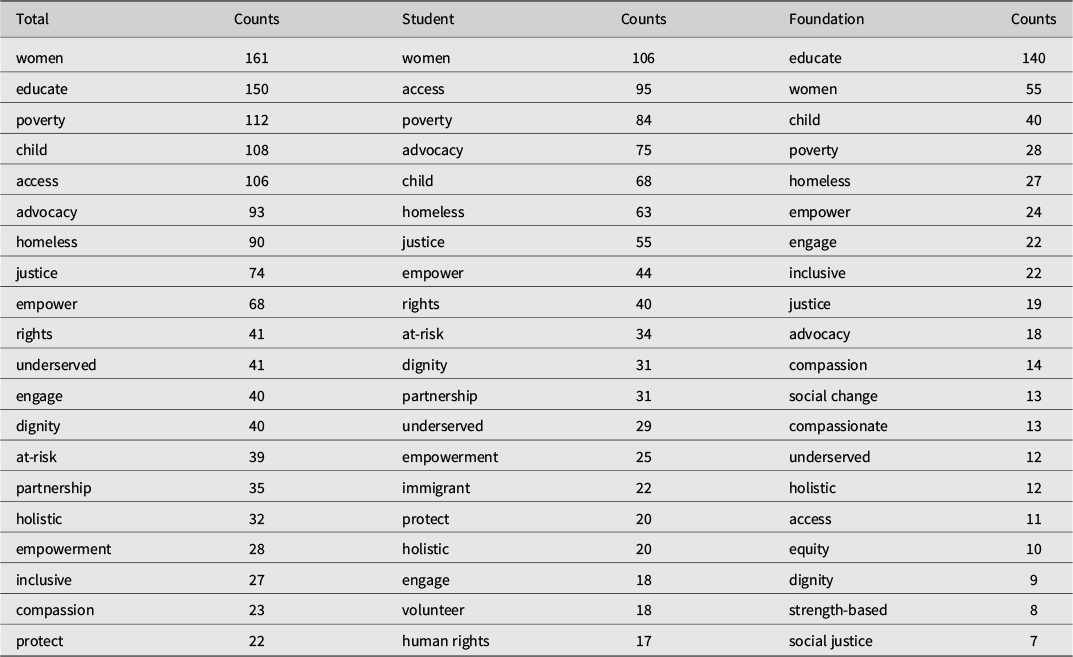
Table 1 presents the four dimensions of justice orientation, each defined by specific indicators and illustrated with example mission language. The dictionary terms were derived through an iterative process that combined theoretical constructs from justice philanthropy scholarship with inductive review of nonprofit mission language in the dataset. The dictionary includes over 100 terms and phrases associated with four dimensions of justice: equity focus, systemic framing, rights-based language, and participatory ethos. Table A1 in Appendix A shows the twenty commonly used justice-oriented words in organizational missions.
Justice-oriented language in nonprofit mission statements

Table 1. Long description
The table is organized into four rows, each representing a specific justice-oriented category.
* Row 1: Equity focus. Defined as an explicit commitment to serving marginalized or underrepresented populations. Key terms include mentions of race, class, disability, gender, and geographic exclusion. Example: empowering women and girls in rural communities.
* Row 2: Systemic framing. Defined as addressing structural causes of social problems. Key terms include systemic inequality, policy reform, and institutional change. Example: advocating for criminal justice reform to dismantle mass incarceration.
* Row 3: Rights-based language. Defined as emphasizing rights and dignity rather than charity or pity. Key terms include justice, human rights, and solidarity, contrasted against helping the needy. Example: defending the human rights of immigrants.
* Row 4: Participatory ethos. Defined as highlighting community involvement or shared power. Key terms include community-led, grassroots, co-designed, and amplifying local voices. Example: supporting grassroots organizations led by L G B T Q youth.
Each mission statement was analyzed using an automated R-based script that searched for dictionary terms and assigned a value for each dimension based on the presence and emphasis of relevant language:
-
• 0 = Not present
-
• 1 = Implicit or vague reference
-
• 2 = Explicit or strongly emphasized reference
For example, the nonprofit Bikes Not Bombs mission statement is “uses the bicycle to achieve racial equity and empower marginalized youth.” This nonprofit received a score of 2 for equity focus (“racial equity,” “marginalized”) and 2 for participatory ethos (“empower,” which is a strong action word), yielding a total justice score of 4. Rights-based language and systemic framing were not present and thus scored 0. The organization’s total justice-orientation score is, therefore, 4.
The distinction between implicit and explicit was based on the directness and specificity of justice-oriented terms. For example:
-
• A statement like “supporting underserved communities” might be scored as implicit for equity.
-
• A statement like “advancing racial and economic justice” would be scored as explicit.
To ensure coding consistency, a subset of mission statements (n = 80) was manually reviewed by multiple researchers, allowing iterative refinement of dictionary definitions. While formal intercoder reliability statistics were not calculated for the full dataset, this process ensured consistency in dictionary construction. A detailed description of the justice scoring process is presented in Appendix B.
Each organization received a composite justice-orientation score ranging from 0 to 8, based on the sum of scores across the four dimensions, allowing for quantitative comparison of grantees funded by students versus foundation professionals. The relatively low overall justice scores reflect the intentionally narrow operationalization used in this study. The justice dictionary prioritizes explicit references to structural inequality, rights, and participatory governance rather than general service-oriented language. As a result, nonprofits that frame their work primarily in terms of service delivery may receive low justice scores even when doing important work.
Results
Descriptive statistics
Table 2 presents descriptive statistics for all variables. The four justice dimensions each have a range of 0 to 2, with mean scores of 0.38 (equity), 0.11 (rights), 0.22 (systemic), and 0.23 (participation). The total justice score ranges from 0 to 8, with a mean of 0.94 (SD = 0.98) and a median of 1. Organizational characteristics vary considerably. The average number of board members is 23.75 (SD = 23.52), and financial variables are log-transformed to address skewness, with mean logged contributions of 15.03 (SD = 3.10), logged compensation of 13.62 (SD = 5.29), and logged expenses of 15.69 (SD = 3.17). Missing data is most prevalent for board size (n = 516).
Descriptive statistics of variables

Table 2. Long description
The table consists of eight columns: Variable, N, Mean, St. Dev., Min, Max, Median, and N/A.
* Equity: N 2291, Mean 0.38, St. Dev. 0.50, Min 0, Max 2, Median 0, N/A 0.
* Rights: N 2291, Mean 0.11, St. Dev. 0.33, Min 0, Max 2, Median 0, N/A 0.
* Systemic: N 2291, Mean 0.22, St. Dev. 0.42, Min 0, Max 2, Median 0, N/A 0.
* Participation: N 2291, Mean 0.23, St. Dev. 0.43, Min 0, Max 2, Median 0, N/A 0.
* Total score: N 2291, Mean 0.94, St. Dev. 0.98, Min 0, Max 8, Median 1, N/A 0.
* Board members: N 1775, Mean 23.74, St. Dev. 23.52, Min 0, Max 187 super 4, Median 18, N/A 516.
* log Contributions: N 1919, Mean 15.03, St. Dev. 3.10, Min 0, Max 21.67, Median 14.85, N/A 372.
* log Compensation: N 1925, Mean 13.62, St. Dev. 5.29, Min 0, Max 22.07, Median 14.28, N/A 366.
* log Expenses: N 1919, Mean 15.69, St. Dev. 3.17, Min 0, Max 22.65, Median 15.30, N/A 372.
4 The maximum board size of 187 (Van Cliburn Foundation) was verified against the organization’s Form 990s and retained in the analysis.
Table 3 disaggregates key organizational characteristics by donor type. Student-funded nonprofits are consistently smaller and less resourced. They have fewer board members (mean = 13.57, SD = 8.69) than foundation-funded organizations (mean = 30.72, SD = 27.59) and exhibit lower financial indicators across all three measures. These differences confirm that student grantmakers tend to support smaller, less-resourced organizations than their foundation counterparts.
Descriptive statistics by donor type

Table 3. Long description
The table contains eight columns: Donor Type, Statistic, N, Mean, St. Dev., Min, Max, and Median.
For the Student donor type:
* Board members: N 721, Mean 13.57, St. Dev. 8.69, Min 0, Max 103, Median 12.
* log Contributions: N 801, Mean 14.03, St. Dev. 2.12, Min 0.00, Max 21.34, Median 14.01.
* log Compensation: N 801, Mean 12.52, St. Dev. 4.13, Min 0.00, Max 21.43, Median 13.40.
* log Expenses: N 801, Mean 14.20, St. Dev. 2.18, Min 0.00, Max 22.25, Median 14.18.
For the Foundation donor type:
* Board Members: N 1,054, Mean 30.72, St. Dev. 27.59, Min 0, Max 187, Median 23.
* log Contributions: N 1,118, Mean 15.75, St. Dev. 3.46, Min 0.00, Max 21.67, Median 15.56.
* log Compensation: N 1,124, Mean 14.40, St. Dev. 5.86, Min 0.00, Max 22.07, Median 15.17.
* log Expenses: N 1,118, Mean 16.77, St. Dev. 3.33, Min 0.00, Max 22.65, Median 16.44.
Because justice score variables are discrete and deviate significantly from normality (Shapiro–Wilk test, p < 0.001), we used the Wilcoxon rank-sum test to compare distributions between groups. Table 4 presents results for each dimension and the total justice score. Across all measures, student-funded nonprofits scored significantly higher than foundation-funded nonprofits (p < 0.001). Effect sizes ranged from small to moderate, with the largest observed for the total justice score (r = 0.374) and equity score (r = 0.313). Student-funded nonprofits had mean scores of 0.58, 0.18, 0.29, and 0.36 across the four dimensions, compared to 0.26, 0.07, 0.17, and 0.16 for foundation-funded nonprofits. The average total justice score was more than twice as high for student-funded organizations (mean = 1.41) as for foundation-funded ones (mean = 0.65). Figure 1 visualizes these differences across all dimensions.
Wilcoxon rank-sum test results: comparison of donor type and justice scores

Table 4. Long description
The table contains 11 columns: Score dimensions, Donor type, N, Mean, St. Dev., Min, Max, Median, W, p value, and Effect size (r). Data is grouped by five score dimensions:
* Equity: Student (N=881, Mean=0.58, Median=1) vs Foundation (N=1410, Mean=0.26, Median=0). W=815002, p < 2.2e-16, r=0.313.
* Rights: Student (N=881, Mean=0.18, Median=0) vs Foundation (N=1410, Mean=0.07, Median=0). W=688976, p=3.04e-16, r=0.171.
* Systemic: Student (N=881, Mean=0.29, Median=0) vs Foundation (N=1410, Mean=0.17, Median=0). W=694514, p=1.98e-11, r=0.140.
* Participation: Student (N=881, Mean=0.36, Median=0) vs Foundation (N=1410, Mean=0.16, Median=0). W=741808, p < 2.2e-16, r=0.225.
* Total: Student (N=881, Mean=1.41, Median=1) vs Foundation (N=1410, Mean=0.65, Median=0). W=880500, p < 2.2e-16, r=0.374.
Across all dimensions, Student donors consistently show higher mean and median scores than Foundation donors with statistically significant p values.
Mean justice scores by donor type.
Note: *** p < 0.001.

Fig. 1. Long description
The y-axis is labeled Mean Score with a scale from 0.0 to 1.5. The x-axis is labeled Justice Dimension with five categories: Equity, Rights, Systemic, Participation, and Total. A legend on the right identifies teal bars as Foundation and salmon bars as Student.
* Equity: Foundation is approximately 0.25 and Student is approximately 0.6.
* Rights: Foundation is approximately 0.08 and Student is approximately 0.2.
* Systemic: Foundation is approximately 0.18 and Student is approximately 0.3.
* Participation: Foundation is approximately 0.15 and Student is approximately 0.35.
* Total: Foundation is approximately 0.65 and Student is approximately 1.4.
Each pair of bars is topped with a bracket and three asterisks, indicating a statistically significant difference between the donor types in every dimension.
Regression analysis of justice score dimensions
Each justice score dimension is an ordinal variable with three possible values (0, 1, and 2), reflecting a sequential rather than continuous relationship. We use ordered logistic regression and report average marginal effects (AMEs) of donor type on the probability of each outcome category. Models M1, M3, M5, and M7 in Table 5 include only donor type (student = 1, foundation = 0) as the independent variable; Models M2, M4, M6, and M8 add organizational controls (board size, log-transformed contributions and grants, log-transformed salaries and other compensation, employee benefits, and log-transformed total expenses).
Ordered logit regression results for four justice score dimensions

Table 5. Long description
The table presents regression results for Equity (M 1, M 2), Rights (M 3, M 4), Systemic (M 5, M 6), and Participation (M 7, M 8).
* Donor type A M E (score = 0): Shows negative coefficients across all models, ranging from -0.310 in M 1 to -0.084 in M 4, all significant at p < 0.001.
* Donor type A M E (score = 1): Shows positive coefficients across all models, ranging from 0.302 in M 1 to 0.082 in M 4, all significant at p < 0.001.
* Donor type A M E (score = 2): Shows small positive coefficients, with the highest being 0.04 in M 2 (p < 0.001).
* Board Members: Significant negative coefficients in M 2 (-0.017) and M 8 (-0.006), and a positive coefficient in M 6 (0.011).
* (log) Contribution: No statistically significant results across models M 2, M 4, M 6, or M 8.
* (log) Compensation: Significant positive coefficients in M 2 (0.168) and M 8 (0.095).
* (log) Expenses: Significant negative coefficients in M 2 (-0.355) and M 8 (-0.147).
Model statistics at the bottom show N = 2291 for odd-numbered models and N = 1775 for even-numbered models. Pseudo R super 2 values increase significantly when controls are added, for example, from 0.071 in M 1 to 0.304 in M 2. Robust standard errors are provided in parentheses below each coefficient.
Notes: Robust standard errors in parentheses. *p < 0.05, **p < 0.01, ***p < 0.001. Models M1, M3, M5, M7 include only donor type; Models M2, M4, M6, M8 include donor type and controls (BD_A, log_CON, log_COMP_B, log_EXP_B).
Across all four justice score dimensions, donor type is a significant predictor of justice orientation. In the bivariate models, student-funded nonprofits show significantly lower probabilities of receiving a score of 0 and higher probabilities of receiving scores of 1 or 2 (p < 0.001 for all dimensions). These effects remain significant with controls, though reduced in magnitude. In the equity model without controls (M1), student-funded organizations show a 31.0 percentage point lower probability of receiving a score of 0 (AME = −0.310, SE = 0.020, p < 0.001) and a 30.2 percentage point higher probability of receiving a score of 1 (AME = 0.302, SE = 0.020, p < 0.001). After adding controls (M2), these margins narrow but remain highly significant (score = 0: AME = −0.131, SE = 0.026, p < 0.001; score = 1: AME = 0.126, SE = 0.026, p < 0.001). These results demonstrate that student-led philanthropy is consistently associated with stronger justice orientations, even after accounting for organizational size, resources, and staffing.
Regression analysis of total justice score
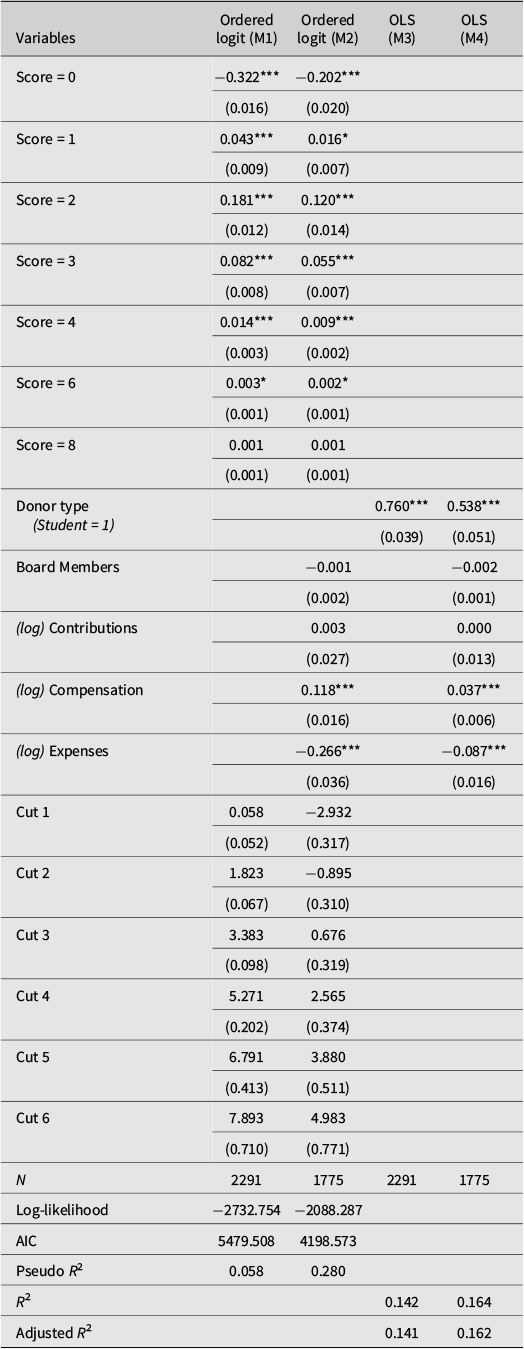
Table 6 reports results for the effect of donor type on total justice scores. Models M1 and M2 estimate ordered logistic regressions. M1 includes only donor type, while M2 adds organizational controls. In M1, student-funded organizations show a 32.2 percentage point lower probability of receiving a total justice score of 0 (AME = −0.322, SE = 0.016, p < 0.001), with higher probabilities of receiving scores of 1 through 4 (all p < 0.001). In M2, the AME on score = 0 is −0.202 (SE = 0.020, p < 0.001), and positive marginal effects on higher score categories remain statistically significant. Models M3 and M4 re-estimate the relationship using ordinary least squares (OLS) as robustness checks. The donor type coefficient remains positive and significant in both, with effect sizes somewhat reduced when organizational controls are included.
Ordered logit and OLS results for total justice score

Table 6. Long description
The table consists of five columns: Variables, Ordered logit M 1, Ordered logit M 2, O L S M 3, and O L S M 4.
Row-by-row data for justice score categories:
- Score equals 0: M 1 is minus 0.322, M 2 is minus 0.202. Both significant at p less than 0.001.
- Score equals 1: M 1 is 0.043 p less than 0.001, M 2 is 0.016 p less than 0.05.
- Score equals 2: M 1 is 0.181, M 2 is 0.120. Both significant at p less than 0.001.
- Score equals 3: M 1 is 0.082, M 2 is 0.055. Both significant at p less than 0.001.
- Score equals 4: M 1 is 0.014, M 2 is 0.009. Both significant at p less than 0.001.
- Score equals 6: M 1 is 0.003, M 2 is 0.002. Both significant at p less than 0.05.
- Score equals 8: M 1 is 0.001, M 2 is 0.001. Not significant.
Row-by-row data for control variables:
- Donor type Student equals 1: M 3 is 0.760, M 4 is 0.538. Both significant at p less than 0.001.
- Board Members: M 2 is minus 0.001, M 4 is minus 0.002.
- log Contributions: M 2 is 0.003, M 4 is 0.000.
- log Compensation: M 2 is 0.118, M 4 is 0.037. Both significant at p less than 0.001.
- log Expenses: M 2 is minus 0.266, M 4 is minus 0.087. Both significant at p less than 0.001.
Model fit statistics:
- N: 2291 for M 1 and M 3; 1775 for M 2 and M 4.
- Pseudo R-squared: 0.058 for M 1; 0.280 for M 2.
- R-squared: 0.142 for M 3; 0.164 for M 4.
- Adjusted R-squared: 0.141 for M 3; 0.162 for M 4.
Notes: Robust standard errors in parentheses for Ordered Logit; standard errors in parentheses for OLS *p < 0.05, **p < 0.01, ***p < 0.001. M1 and M2 are Ordered Logit models with and without controls; M3 and M4 are OLS models with and without controls. Score categories 5 and 7 are omitted as no organizations in the sample received these scores. Categories 6 and 8 contain very few observations (n = 4 and n = 2, respectively), so estimates for these categories should be interpreted with caution.
Robustness checks
We conducted two additional robustness checks. First, we re-estimated models for each justice dimension using OLS regression (Table 7). Across all four dimensions, the coefficient for donor type is positive and statistically significant (p < 0.001) with and without controls. We further implemented weighted ordered logit models using entropy balancing to address potential covariate imbalance, while also removing outliers (Table 8). Donor type remains a strong and significant predictor across all dimensions and the total justice score. Taken together, these results suggest that differences in decision-making authority are associated not only with the types of organizations funded but also with the justice-oriented framing of nonprofit missions.
OLS models for justice dimensions

Table 7. Long description
The table presents O L S models for four justice dimensions. The columns are Equity, Rights, Systemic, and Participation.
Rows for independent variables include:
* Donor type (student = 1): Equity 0.171, Rights 0.097, Systemic 0.140, Participation 0.131. All are significant at p < 0.001.
* Board members: Equity -0.002 (p < 0.001), Rights -0.001, Systemic 0.002 (p < 0.001), Participation -0.001.
* (log) Contributions: Equity 0.006, Rights -0.003, Systemic -0.007, Participation 0.004. None are statistically significant.
* (log) Compensation: Equity 0.023 (p < 0.001), Rights 0.003, Systemic 0.001, Participation 0.011 (p < 0.001).
* (log) Expenses: Equity -0.060 (p < 0.001), Rights -0.006, Systemic 0.000, Participation -0.021 (p < 0.01).
Model statistics at the bottom:
* N: 1775 for all models.
* R-squared: Equity 0.155, Rights 0.039, Systemic 0.027, Participation 0.045.
* Adjusted R-squared: Equity 0.152, Rights 0.036, Systemic 0.025, Participation 0.042.
Standard errors are provided in parentheses below each coefficient.
Notes: Standard errors are in parentheses. *p<0.05, **p<0.01, ***p<0.001. The dependent variable is the justice sub-score (equity, rights, systemic, or participation).
Weighted ordered logit models (entropy balancing, outlier removed)

Table 8. Long description
The table consists of seven columns: Outcome, b (Student), S E, t-value, N, A I C, and Pseudo R super 2. There are five rows of data corresponding to different outcome scores.
* Equity score: b is 0.986, S E is 0.103, t-value is 9.524, N is 1774, A I C is 2306.629, Pseudo R super 2 is 0.089.
* Rights score: b is 1.155, S E is 0.149, t-value is 7.754, N is 1774, A I C is 1337.352, Pseudo R super 2 is 0.070.
* Systemic score: b is 0.494, S E is 0.117, t-value is 4.227, N is 1774, A I C is 1881.536, Pseudo R super 2 is 0.038.
* Participation score: b is 0.823, S E is 0.112, t-value is 7.337, N is 1774, A I C is 1992.883, Pseudo R super 2 is 0.043.
* Total justice score: b is 1.291, S E is 0.096, t-value is 13.467, N is 1774, A I C is 4259.849, Pseudo R super 2 is 0.069.
Discussion
This study set out to explore whether redistributing philanthropic decision-making power (from elite professionals to undergraduate students) might be associated with more justice-oriented grantmaking. Drawing on Young’s (Reference Young2011) theory of structural injustice, we analyzed the mission statements of over 2,200 nonprofit organizations funded either by professional staff or by college and university students through The Philanthropy Lab. Across all four dimensions of justice orientation (equity, systemic framing, rights-based language, and participatory ethos), student-led grantmakers were significantly more likely to support organizations with explicitly justice-oriented missions. These findings offer compelling evidence that who makes philanthropic decisions matters. Importantly, they do not suggest that individual foundation professionals are less committed to justice. Rather, they highlight how institutional decision-making structures shape which organizations ultimately receive funding (Frumkin, Reference Frumkin2006; Ostrander, Reference Ostrander2007; Reich, Reference Reich2018). In the sections that follow, we organize our discussion around four interrelated stages of the grantmaking process: who decides, how decisions are made, what outcomes result, and how power operates throughout, highlighting at each stage where student-led philanthropy offers a potential corrective to traditional grantmaking, as well as where it risks reproducing, or introducing new versions of, the very dynamics it appears to disrupt.
Who decides: Shifting authority, relocating power
Student-led philanthropy, often framed as merely an educational exercise, may also function in practice as an unanticipated intervention in the philanthropic sector—redirecting resources toward organizations that traditional foundations tend to overlook. For foundations seeking to advance equity meaningfully, these programs can be read as informal pilot spaces for more participatory and community-rooted approaches.
At the same time, these results raise important, perhaps uncomfortable, questions about where decision-making authority actually lands. Although authority shifts away from foundation professionals, it is relocated to colleges and universities—institutions that themselves hold significant economic, cultural, and symbolic power within surrounding communities. Nonprofit partners may still experience these relationships through familiar “town–gown” dynamics, where access to university-affiliated resources carries asymmetries of legitimacy, expertise, and agenda-setting. Student-led philanthropy, therefore, does not dissolve power hierarchies so much as re-situate them within a different institutional setting. Recognizing this dynamic complicates any straightforward narrative of democratization while also illuminating why these programs can function as revealing test cases for how authority operates in philanthropic practice.
Viewed through Ray’s (Reference Ray2019) lens of racialized organizations, these dynamics take on additional significance. If traditional foundations operate as racialized institutions, then the patterns observed here may reflect the degree to which racialized organizational norms shape which nonprofits are seen as legitimate funding recipients. Student-led philanthropy, by relocating decision-making to a different institutional context, may introduce different racialized perspectives into the grantmaking process. Yet colleges and universities are themselves racialized institutions, and whether student decision-makers meaningfully represent the communities they fund remains an open empirical question.
This raises a pointed question for the field: are foundations genuinely using student philanthropy to reimagine justice in their own grantmaking, or are they, in effect, delegating justice-oriented experimentation to educational settings where the work can proceed without requiring foundations themselves to change?
How decisions are made: Deliberation, autonomy, and curricular contingency
Beyond who holds decision-making authority, student-led and foundation-led grantmaking differ in how decisions are reached. One possible explanation for the patterns we observe lies in how students interpret “impact.” Unlike professional grantmakers who evaluate success through scale, measurable outcomes, or strategic alignment, students may approach grantmaking with a more immediate and relational understanding of making a difference. Aware that their grants are modest in size, students may prioritize organizations where funds are perceived to matter most—often smaller, community-based nonprofits more likely to articulate justice-oriented missions (Ashley et al., Reference Ashley, McGinnis Johnson and Faulk2015; Villanueva, Reference Villanueva2018).
This pattern may also reflect deeper structural differences in decision-making itself. Foundation professionals operate as agents of an institution, constrained by organizational missions, board oversight, strategic plans, and internal accountability structures (Frumkin, Reference Frumkin2006). By contrast, students may exercise greater individual autonomy, even when operating within a classroom setting. Research in decision-making theory suggests that organizational decision-making tends to be more risk-averse, bureaucratic, and consensus-driven, whereas individual decision-making (especially in pedagogical or values-driven environments) may reflect more aspirational or justice-oriented goals (Kahneman, Reference Kahneman2011; March, Reference March1994).
However, this autonomy is not necessarily evidence of a more rigorous or democratic deliberative process. Student giving may encourage a short-term, “warm glow” orientation rather than sustained engagement with grantees (Stacey et al., Reference Stacey, Hanson and Novisky2021). Relatedly, the apparent justice orientation of student grantmakers may be shaped substantially by curricular design (the texts, frameworks, and instructor priorities embedded in a given course) rather than reflecting an inherent student disposition (Campbell et al., Reference Campbell, Appe and Rozansky2023). If so, the “who decides” effect we document may be less stable and less generalizable than it first appears.
Funding outcomes: Who benefits, and at what cost
Differences between student and foundation grantmaking may reflect not only decision-making preferences but also how program design shapes the universe of organizations that students consider. Some courses invite nonprofit applications, while others issue effectively unsolicited or “surprise” grants to organizations students encounter through community engagement or local research. The scale of the grants, the semester-based timeline, and localized search processes may channel attention toward organizations that are more visible or accessible within those constraints.
A further distinction lies in how these grants are situated within broader decision-making structures. For students, philanthropy courses involve allocating a single, time-bound grant, experienced as a discrete act of giving. Foundations, by contrast, make grants as part of an ongoing portfolio shaped by institutional mission, long-term strategy, and sequencing across multiple initiatives (Frumkin, Reference Frumkin2006). Our analysis does not evaluate The Once Upon a Time Foundation’s overarching mission. Rather, it uses this shared funding context to compare how episodic, pedagogical decision-making differs from strategic, institutional grantmaking in the types of organizations that receive support.
Importantly, more justice-oriented funding outcomes do not necessarily translate into a better experience for recipient organizations. Recipient organizations sometimes describe these arrangements as extractive—accommodating site visits, interviews, and due-diligence processes designed primarily to serve students’ coursework rather than grantees’ needs (Weber et al., Reference Weber, Casolaro, Simpson and Johnson2025). The higher justice scores observed among student-funded nonprofits therefore do not indicate that student-led philanthropy resolves the structural problems of traditional grantmaking. Rather, they raise the question of whether episodic, course-bound giving can translate into the sustained, accountable relationships that justice-oriented philanthropy requires (Walker, Reference Walker2019).
Power dynamics: Democratization or delegation of moral labor
Seen in this light, student philanthropy is less a wholesale solution than a revealing institutional experiment. If student decision-makers consistently fund more justice-oriented nonprofits, then why aren’t foundations applying the same lens themselves? Foundations may benefit reputationally from these programs while outsourcing not only the decision-making but also the moral labor of equity involved—delegating justice-oriented experimentation to educational settings without requiring institutional change. This concern is amplified by the asymmetry Mao’s (Reference Mao2021) systematic review identifies: research has focused disproportionately on what students gain from these courses, mirroring at the level of scholarship the funder-centered dynamic we describe at the level of practice.
At the same time, these programs may serve an important civic function. They may help build a pipeline of future philanthropic leaders who are more equity-conscious and community-grounded than their predecessors (Benenson & Moldow, Reference Benenson and Moldow2017). The results of this study suggest that experiential philanthropy courses influence not only student learning but real philanthropic outcomes by shaping how emerging decision-makers interpret and prioritize justice-oriented missions. In this sense, experiential philanthropy should not be understood solely as a classroom exercise, but as a meaningful mechanism through which philanthropic values and practices are transmitted to future donors, nonprofit leaders, and public decision-makers.
These tensions suggest that experiential philanthropy’s potential to democratize grantmaking is conditional on how courses are designed and taught. Instructors who want their courses to meaningfully challenge traditional grantmaking norms should deliberately foreground structural inequality and critical philanthropy scholarship (Campbell et al., Reference Campbell, Appe and Rozansky2023); build in structured follow-up with grantees beyond the semester’s end (Stacey et al., Reference Stacey, Hanson and Novisky2021); and treat reciprocity with recipient organizations as a course design priority—for example, limiting burdensome due-diligence requests, compensating organizations for their time where possible, and soliciting grantee feedback on the process (Weber et al., Reference Weber, Casolaro, Simpson and Johnson2025).
Conclusion
This study offers empirical evidence that redistributing philanthropic decision-making authority is associated with meaningfully different funding outcomes. When college and university students serve as grantmakers, the nonprofits they choose to fund are significantly more likely to articulate explicit commitments to equity, systemic change, rights-based advocacy, and community participation. These findings contribute to both the critical philanthropy literature and the scholarship on experiential philanthropy. They provide empirical support for the theoretical claim that decision-making structures shape justice outcomes, not only who gets funded, but what kinds of missions are recognized as worthy of investment. Also, they suggest that student philanthropy programs carry consequences beyond the classroom, functioning as de facto interventions in how philanthropic resources are distributed.
Several limitations worth noting. First, this study relies on nonprofit mission statements as a proxy for justice orientation, publicly visible but imperfect indicators that do not capture programming, impact, or recipient experience. Like much of the experiential philanthropy literature (Mao, Reference Mao2021), this approach centers an outcome that is observable from the funder’s side rather than capturing how grantee organizations themselves understand or are shaped by student-led versus foundation-led support. Future work incorporating recipient perspectives (e.g., Weber et al., Reference Weber, Casolaro, Simpson and Johnson2025) would help address this asymmetry. Second, the dataset does not include demographic or attitudinal information about decision-makers themselves (e.g., diversity, political ideology, professional training, or deliberative processes used during grantmaking), limiting our ability to directly assess how individual characteristics or group dynamics may influence the funding pattern. This is particularly relevant to Ray’s (Reference Ray2019) racialized-organizations framework: without data on the racial composition of decision-making bodies or recipient organizations, we cannot empirically test whether racialized institutional dynamics shape observed funding patterns. Third, differences in how organizations enter the decision set, whether through localized student searches or foundation networks, may influence the types of nonprofits available for selection. Finally, this study reflects a unique institutional context in which both student and foundation grants originate from the same philanthropic entity (the Once Upon a Time Foundation) through its support of The Philanthropy Lab, which, while analytically useful, limits the generalizability to other philanthropic contexts.
Methodological constraints also warrant acknowledgment. The ordered logit models assume proportional odds, an assumption that may not hold uniformly across dimensions and that could be tested further in future work; OLS models are retained as robustness checks. Because detailed institutional identifiers were unavailable for all cases, we were unable to cluster standard errors by university, and some organizational variables were excluded from the models due to high correlations with other predictors, meaning the models control for a reduced but essential set of organizational characteristics.
This study opens several important avenues for future inquiry. Most pressingly, future research would examine whether student-led grants produce sustained benefits for recipient organizations, for instance through longitudinal analysis of IRS Form 990 data to assess whether student-funded nonprofits demonstrate improved financial health or struggle in the years following the grant. Is this funding transformative, or a one-time infusion that fails to produce lasting change for the organization or the communities it serves? Future studies might also explore how to make student-led philanthropy more community-accountable, examining alternative modeling strategies such as generalized ordered logit models or multilevel models to account for potential clustering by institution, and comparative case studies of different experiential philanthropy models. Ethnographic or participatory methods could further illuminate how nonprofit recipients perceive and experience student-led funding. Taken together, these directions are essential to understanding not only the educational value of student philanthropy, but its real-world impact on nonprofit capacity and community wellbeing.
Ultimately, the value of experiential philanthropy lies not just in what students learn, but in what these programs do (or fail to do) for the communities they aim to serve. Are student-led philanthropy programs a bold step toward justice, or a quiet concession to the inertia of traditional philanthropy? The answer is likely not binary. But the question itself is one we must continue to ask.
Funding statement
The authors received no financial support for the research, authorship, and/or publication of this article.
Competing interests
The authors declare that they have no conflicts of interest.
Appendix A
Top 20 justice-related words in organizational missions

Table A1. Long description
The table consists of six columns organized into three pairs: Total and Counts, Student and Counts, and Foundation and Counts.
In the Total category, the top five words are women (161), educate (150), poverty (112), child (108), and access (106). Other notable terms include advocacy (93), homeless (90), justice (74), and empower (68).
In the Student category, the top five words are women (106), access (95), poverty (84), advocacy (75), and child (68). This list also includes homeless (63), justice (55), and empower (44).
In the Foundation category, the top five words are educate (140), women (55), child (40), poverty (28), and homeless (27). Other terms include empower (24), engage (22), inclusive (22), and justice (19).
Differences are observed in word frequency and selection; for instance, ‘educate’ is the primary focus for Foundations (140) but does not appear in the Student top 20, while ‘women’ is mentioned nearly twice as often by Student-funded organizations (106) compared to Foundations (55).
Table A1 presents the top 20 most commonly used justice-oriented words in funded nonprofit organizations’ missions. Both student-funded and foundation-funded organizations tend to focus on issues like women (161), education (150), poverty (112), child (108), and access (106). However, there are significant differences between student-funded and foundation-funded organizations. For example, student-funded organizations mention more women (106) than foundation-funded ones (55). Interestingly, education-related language appears frequently among foundation-funded nonprofits but does not appear among the most common justice-related terms in student-funded organizations. The following analysis also shows the detailed differences in justice scores between student-funded and foundation-funded nonprofits.
Appendix B
B.1. A Detailed Process of Constructing and Calculating the Justice Scores
Based on Iris Marion Young (Reference Young2011)’s theory of justice, we defined justice in four dimensions: 1. Equity Focus, 2. Systemic Framing, 3. Rights-Based Language, and 4. Participatory Ethos (See Table 1). To prepare for a rule-based approach to measure the extent to which a nonprofit is justice oriented, we first developed an initial “justice score” dictionary based on Young (Reference Young2011)’s theory.
justice_dictionary <− list(.
equity = c(“equity,” “equality,” “inclusion,” “marginalized,” “underserved,” “disadvantaged,” “access,”),
rights = c(“rights,” “human rights,” “justice,” “liberty,” “dignity,” “freedom,” “solidarity”),
systemic = c(“systemic,” “structural,” “reform,” “transformation,” “dismantle,” “oppression,” “advocacy”),
participation = c(“community-led,” “grassroots,” “empower,” “co-create,” “collaborate,” “amplify voices,” “participatory”).
)
We then manually examine a subset of our data (randomly selected 80 nonprofit missions) to further develop and refine our “justice score” dictionary. The review of 80 nonprofits’ mission allows for the refinement of the dictionary. For example, we added terms like “at-risk,” “generation poverty,” and “homeless” from missions (e.g., Presbyterian Night Shelter, Justin’s Place) to the Equity dimension; added “compassion,” “healing,” and “transform lives” from missions like Mercy Clinic and Project Kinship to the Rights dimension; added “violence reduction” (Gideon’s Army), “restorative justice,” and “community deterioration” (Servolution Network) to the Systemic dimension; and added “strength-based” (ACH Child Services), “surround students” (Communities in Schools), and “mentor” (HOPE Farm) to the Participation dimension.
We did not include certain religious items to make the dictionary more applicable for secular nonprofits. For example, we excluded “Christian service” from the “Equity” dimension and excluded “redemptive” from “Rights” dimension.
The refined dictionary is as follows:
justice_dictionary <− list(.
equity = c(“equity,” “equality,” “inclusion,” “marginalized,” “underserved,” “disadvantaged,” “access,” “women,” “gender,” “black,” “indigenous,” “minority,” “lgbtq,” “immigrant,” “refugee,” “child,” “disability,” “low income,” “diversity,” “racial equity,” “fairness,” “anti-racism,” “at-risk,” “underprivileged,” “close the gap,” “reduce disparities,” “level the playing field,” “inclusive,” “belonging,” “gender equality,” “poverty,” “homeless,” “generation poverty,” “economic justice”),
rights = c(“rights,” “human rights,” “justice,” “liberty,” “dignity,” “freedom,” “solidarity,” “civil rights,” “social justice,” “gender rights,” “indigenous rights,” “advocacy,” “protect,” “safeguard,” “fight for equality,” “defend freedoms,” “uphold dignity,” “compassion,” “compassionate,” “transform lives”),
systemic = c(“systemic,” “structural,” “reform,” “transformation,” “dismantle,” “oppression,” “institutional,” “power dynamics,” “accountability,” “policy change,” “inequities,” “decolonize,” “root causes,” “challenge norms,” “shift paradigms,” “inclusive policies,” “social change,” “community deterioration,” “violence reduction,” “restorative justice,” “heal,” “holistic,” “empowerment,” “redesign”),
participation = c(“community-led,” “grassroots,” “empower,” “co-create,” “collaborate,” “amplify voices,” “participatory,” “community-driven,” “local leadership,” “mutual aid,” “self-determination,” “engage,” “mobilize,” “by and for,” “nothing about us without us,” “shared decision-making,” “partnership,” “strength-based,” “surround students,” “support families,” “volunteer,” “train,” “educate,” “mentor,” “cultivate leaders,” “build community”).
)
We did not apply stemming or lemmatization to the mission text. Two features of our design make formal stemming largely unnecessary while preserving precision. First, term matching is performed on unanchored substrings, which already captures common inflectional variants of a root term (for example, empower matches empowers, empowered, empowering, and empowerment; reform matches reforms, reformed, and reforming). Second, where meaning depends on a specific form, we curated morphological and lexical variants directly into the dictionary (for example, compassion and compassionate; inclusion and inclusive). Because the dictionary is theory-driven and includes domain-specific multiword expressions (for example, racial equity, restorative justice, and nothing about us without us), aggressive stemming or lemmatization risks over-collapsing conceptually distinct terms and fragmenting multiword phrases, which would reduce both precision and interpretability. For these reasons we retained full word forms and curated variants. We expect the impact of stemming on the justice scores to be modest, given that the most frequent inflectional variants are already captured by substring matching.
We then rate each mission statement on a 0–2 scale per dimension based on the following criteria:
-
0 = Not present.
-
1 = Implicit or vague (only one match and no strong action words including “defend, dismantle, empower, fight, transform”).
-
2 = Clearly stated or strongly emphasized (match more than 1 items or strong action words).
For each dimension, the script assigns a score of 0, 1, or 2. A dimension is scored 0 when no dictionary term for that dimension appears in the mission. It is scored 1 (implicit or vague) when exactly one dictionary term appears and no strong action word is present. It is scored 2 (explicit or strongly emphasized) when more than one dictionary term appears, or when a strong action word is present. In this way, the implicit/explicit distinction is driven by two observable features of the text—the number of distinct dictionary terms matched and the presence of a strong action word—rather than by subjective judgment. We also updated the list of strong action words that include “fight, defend, dismantle, transform, and empower.”
After that, we use a rule-based approach to calculate the scores for each dimension and sum the scores of each dimension to create an overall “Justice Score” of a nonprofit.
For example, Bikes Not Bombs’s mission is “uses the bicycle to achieve racial equity and empower marginalized youth.” The operation of the calculation runs as follows:
equity_score: 2 (multiple terms: “racial equity,” “marginalized”).
rights_score: 0.
systemic_score: 0.
participation_score: 2 (“empower” is a strong action word).
Then the total_justice_score of Bikes Not Bombs is 4.
As you mentioned, “it is plausible that ‘engage’ can be used in a mission statement without a justice-oriented framing. “However, we did not use a binary approach (whether or not), instead, we took a four-dimension approach. In particular, “engage” was included in the “Participation” dimension, which has to be combined with other three dimensions to calculate the “justice” scores. The above mentioned Bikes Not Bombs’s example illustrates the calculation process.
We also attached the R codes and data for your reference.
Data can be downloaded from https://drive.google.com/file/d/1zO9vyyQHux92BTxJfBG9ELk68Q1u7yIW/view
The version we used in the study is dated as funding justice scores 20250508.csv.
# Load your data.
nonprofits <− read.csv(“funding justice scores 20250508.csv”).
# Apply justice dictionary.
justice_dict <− list(.
equity = c(“equity,” “equality,” “inclusion,” “marginalized,” “underserved,” “disadvantaged,” “access,” “women,” “gender,” “black,” “indigenous,” “minority,” “lgbtq,” “immigrant,” “refugee,” “child,” “disability,” “low income,” “diversity,” “racial equity,” “fairness,” “anti-racism,” “at-risk,” “underprivileged,” “close the gap,” “reduce disparities,” “level the playing field,” “inclusive,” “belonging,” “gender equality,” “poverty,” “homeless,” “generation poverty,” “economic justice”),
rights = c(“rights,” “human rights,” “justice,” “liberty,” “dignity,” “freedom,” “solidarity,” “civil rights,” “social justice,” “gender rights,” “indigenous rights,” “advocacy,” “protect,” “safeguard,” “fight for equality,” “defend freedoms,” “uphold dignity,” “compassion,” “compassionate,” “transform lives”),
systemic = c(“systemic,” “structural,” “reform,” “transformation,” “dismantle,” “oppression,” “institutional,” “power dynamics,” “accountability,” “policy change,” “inequities,” “decolonize,” “root causes,” “challenge norms,” “shift paradigms,” “inclusive policies,” “social change,” “community deterioration,” “violence reduction,” “restorative justice,” “heal,” “holistic,” “empowerment,” “redesign”),
participation = c(“community-led,” “grassroots,” “empower,” “co-create,” “collaborate,” “amplify voices,” “participatory,” “community-driven,” “local leadership,” “mutual aid,” “self-determination,” “engage,” “mobilize,” “by and for,” “nothing about us without us,” “shared decision-making,” “partnership,” “strength-based,” “surround students,” “support families,” “volunteer,” “train,” “educate,” “mentor,” “cultivate leaders,” “build community”).
)
# Function to score a mission statement (0–2 per dimension).
score_justice <− function(mission, dict) {.
mission_lower <− tolower(mission).
scores <− sapply(names(dict), function(dim) {.
terms <− dict[[dim]].
matches <− sum(str_detect(mission_lower, regex(paste(terms, collapse = “||”)))).
if (matches == 0) {.
0 # Not present.
} else if (matches == 1 &&!any(str_detect(mission_lower, “\\b(fight|defend|dismantle|transform)\\b”))) {.
1 # Implicit/vague (adjust logic as needed).
} else {.
2 # Clearly stated/emphasized.
}
})
return(scores).
}
# Function to apply scoring to a dataframe.
calculate_justice_scores <− function(data, mission_col = “Mission,” dict = justice_dict) {.
data % > %.
rowwise() % > %.
mutate(.
justice_scores = list(score_justice(get(mission_col), dict)),
equity_score = justice_scores[“equity”],
rights_score = justice_scores[“rights”],
systemic_score = justice_scores[“systemic”],
participation_score = justice_scores[“participation”],
total_justice_score = sum(justice_scores).
) % > %.
select(−justice_scores) % > %.
ungroup().
}
# Calculate scores.
scored_data <− calculate_justice_scores(nonprofits).
# View results.
scored_data % > %.
select(Grantee.Name, Mission, equity_score:total_justice_score) % > %.
arrange(desc(total_justice_score)).
# Note: please select “Grantee.Name” and “Mission” from funding justice scores 20250508.csv for replication.
To further strengthen validation, we conducted an additional targeted manual review of 40 borderline cases characterized by single-dimension justice signals (i.e., missions exhibiting equity-only, rights-only, systemic-only, or participation-only patterns). Approximately ten mission statements from each category were randomly selected and independently using the four-dimension rubric. This verification addresses cases most susceptible to ambiguity and potential misclassification.





 Open access

