INTRODUCTION
Many studies have shown that legislators’ personal characteristics and backgrounds may affect their stands on issues. Yet, are these relationships stable, or do they vary over the history of an issue? If the latter, then why? And if there is change, is it evident among incumbents, or does it stem from their replacement by a new generation? We argue that when an issue is new on the agenda, legislators’ votes may be informed by their personal backgrounds. Over time, however, changes in party coalitions may alter legislators’ incentives, leading them to follow a party cue instead. These incentives will lead some incumbents to adapt, permitting rapid change in a party's stands.
Our empirical focus is on the case of abortion in California. We examine voting on abortion laws in the California State Assembly as the issue moved from cross-cutting to partisan in the late twentieth century. Drawing from an original data set including legislators’ personal characteristics, district demographics, and abortion-related roll calls, as well as archival and secondary evidence of group mobilization, we show that, at first, legislators split more along denominational lines than partisan ones, with Catholics in both parties opposing abortion while Protestants and others were more supportive of reform. Gradually the divide became a partisan one. While the Assembly polarized more generally in this era, the realignment on abortion was distinctive, as we show via a comparison to labor issues that had long been on the legislature's agenda. Our analysis finds little evidence that district-level factors or “sorting” of legislators by religion into party caucuses produced this change. Moreover, polling over this period reveals that mass-level shifts in religious and party alignments on abortion postdated changes in the Assembly. Instead, we argue that growing ties between new movements and parties—feminists for Democrats and the Christian Right for the GOP—helped party supplant religion as the chief cue for legislators on abortion, leading incumbents to take new stands on the issue.
Our findings have implications for multiple audiences. First, they speak to a growing literature that posits groups and movements as important shapers of parties’ issue commitments over time, but has been less attentive to the potential for personal factors to shape politicians’ pre-polarized stance.Footnote 1 While scholars have characterized polarization as a shift from district to party cues, our analysis suggests that polarization may be at times more accurately described as a shift from personal to party cues. Moreover, by highlighting the dynamic interplay between legislators’ personal characteristics, party coalitions, and position taking, we also contribute to scholarship on representation. When issues are new to the agenda or otherwise “uncrystallized,” legislators may have more leeway to vote according to personal background characteristics.Footnote 2 This may wane over time as groups and parties begin to send clearer signals to legislators about their policy positions. Finally, our focus on California brings the study of party position change to the state level. While there has been a renewed debate in recent years among political scientists trying to understand polarization and public opinion at the state level,Footnote 3 states have generally been understudied by students of party position change, with the exception of a small number of race-focused American political development studies.Footnote 4 We believe that a state focus offers an important window into this process, given that many issues first arise in the states. This was certainly the case for abortion, arguably the most important issue in the unraveling of the New Deal coalition other than race.Footnote 5
The remainder of this article proceeds as follows. In the next section, we review literature on party position change and representation, discussing the circumstances under which legislators’ votes may be a product of their personal background and when they may stem from other factors. We then present the case of California, where the abortion liberalization movement first began in 1959, and where legislation legalizing abortion passed years before the issue reached the national stage. After describing the evolution of the abortion controversy and its relationship to groups and parties, which draws predominantly from archival and secondary sources, we then present a series of analyses of an original data set to further probe the relationship between party, personal background characteristics, and voting over time. We show that the issue became increasingly partisan, including among long-serving incumbents, while religious affiliation lost predictive power. We conclude by discussing broader implications and potential extensions of our findings.
A DYNAMIC VIEW OF PERSONAL COMMITMENTS AND PARTISAN VOTING
Scholars have long seen party and constituency as key determinants of politicians’ policy stands. When issues turn from cross-cutting to partisan, some scholars understand this change as a shift from constituency to party cues.Footnote 6 Others do not seek to explain pre-polarized stands.Footnote 7 Yet an elected official's personal background may predispose her or him to a position, independent of constituency factors. While largely absent from the literature on party position change and issue evolution, this claim is investigated in numerous descriptive representation studies focused on race,Footnote 8 gender,Footnote 9 religion,Footnote 10 class or occupation,Footnote 11 parental status, and even smoking.Footnote 12
While explaining long-term change is a central preoccupation for students of political development, representation-focused scholars have paid less attention to how the weight of personal factors may vary over time. Many studies are cross-sectional or examine a brief period. Most scholars exploring the effect of religion in legislatures longitudinally focus on Congress, and their findings differ from ours.Footnote 13 Nicholas Carnes finds little change in the role of class in Congress over decades.Footnote 14 Barry Burden suggests that the importance of personal background may vary depending on the party's position toward the status quo.Footnote 15 Yet the weight of personal factors in a legislator's voting may vary over time. Though more work remains to be done to investigate this empirically, this claim is implicit in some theoretical treatments of descriptive representation. For instance, Jane Mansbridge suggests that descriptive representation may increase substantive representation of disadvantaged groups when issues are new to the agenda or “uncrystallized.”Footnote 16
We posit that the effect of an elected official's personal background on her or his policy positions may vary depending on the partisan context of an issue and may be greatest when an issue is new to voters, politicians, and parties. This is so for multiple reasons. First, in such a context, politicians and their staffs may have difficulty ascertaining their constituents’ views and may inaccurately project their own beliefs onto their constituents. If those beliefs are linked to characteristics like religious affiliation, then the latter may predict legislators’ votes. This possibility is consistent with previous work showing that legislators’ perceptions of their constituents’ views are flawed.Footnote 17 Second, even if they perceive constituents’ views accurately, legislators’ backgrounds may lead them to give greater weight to the perceived views of a “subconstituency.”Footnote 18 A politician may expect to win greater support from co-ethnics, co-religionists, neighbors, or others with whom she or he shares traits or simply be more vulnerable to social pressure from the community. Thus, absent a strong party cue on an issue, a politician may choose to reflect the views of the group in question, regardless of her or his own beliefs. Finally, for all scholars’ focus on politicians’ electoral concerns, few deny that many officials have strong views that underlie their policy positions, some of which stem from their personal backgrounds. Especially when there is a new issue on which there are few pressures to vote a certain way, legislators may feel more free to vote on the basis of their personal backgrounds. For all these reasons, legislators’ personal characteristics may be linked to their voting, especially on new issues.
We would not expect these conditions necessarily to remain stable. The relationship between legislators’ personal characteristics and their policy stands may evolve. Legislators may surmise that they have less leeway to vote on the basis of personal beliefs as the cues sent from parties and constituents become more clear. Legislators who have inaccurately projected their own views onto their constituents may recalibrate their positions as their constituents form and articulate clear preferences on the issue. Legislators may also learn that the views prevalent in their social circles do not reflect those of their broader constituency. And, finally, as groups with divergent stands on an issue are drawn into party coalitions, elected officials’ incentives change, even if public opinion and the politicians’ personal views remain stable. “Policy demanders” with intense issue preferences are over-represented in activist and donor circles.Footnote 19 Politicians seeking nominations will increasingly side with such groups on issues of great concern to them once their strength in the party becomes apparent.Footnote 20 In such circumstances the importance of the factor underlying officials’ positions at the earlier pre-partisan stage—be it constituency or personal background—will decrease.
This will not be true for all elected officials. For some, the stand to which their personal background initially led them emerges as the position of the party, so these two identities will reinforce one another. Yet other politicians face a choice, and many will side with their party and aligned interest groups, even if it means taking a stand at odds with those in their group and, in some cases, modifying a previous position. In such cases, we can expect to see a weaker association between legislators’ backgrounds and their policy stands over time.
We examine these claims by focusing on voting patterns on abortion-related bills in the California State Assembly from the 1960s through the mid-1990s. Abortion was a truly new issue for the California state legislators who encountered it in the 1960s. By contrast, when members of Congress voted on the issue in the 93rd Congress (1973–1974), it had already been addressed by a president and debated at national party conventions, as well as in several states. It had also been the subject of polling for nearly a decade, so members of Congress would have had at least some sense about the costs and benefits of positions on the issue.
Our focus on California is driven by both substantive and practical concerns. On a substantive level, California is an ideal case because it was the first state to see activity on the abortion liberalization debates beginning in the late 1950s. It was also among the first to liberalize its abortion law, which it did in 1967 with the passage of the Therapeutic Abortion Act. Among the other early movers in terms of state legislation, three states—Georgia, Mississippi, and North Carolina—did not have two-party politics at the time, so they cannot inform a study of party position change. Finally, on a practical level, data availability is a key concern in studying state-level political development; documentation in prior decades is far more limited at the state than the national level, and this problem is compounded when attempting to observe change over time on a number of dimensions. While the final early mover, Colorado, did have two-party politics at the time, a comparative lack of data availability made this a more difficult case to study than California.
THE EARLY POLITICS OF ABORTION POLICYMAKING IN CALIFORNIA
In 1967 Governor Ronald Reagan signed the Therapeutic Abortion Act, legalizing abortion in the state of California in cases where it would protect the physical or mental health of the mother and in the cases of rape and incest. It was the first change to the state's abortion laws since the 1872 criminal code, which outlawed the practice of abortion unless to save the life of the mother (thirty-one other states had laws similar to the 1872 code on the books as of 1960). The act passed 21–17 in the Senate and 48–30 in the Assembly.
The nationwide push for abortion liberalization had begun several years earlier, in 1959, when the American Law Institute (ALI) introduced a state model abortion code that would legalize abortion in certain cases, with the approval of a committee of two doctors.Footnote 21 One year later, California became the first state to take up ALI's model code, after it was recommended by a Los Angeles County grand jury tasked with “finding a solution to the problem of widespread illegal abortion.”Footnote 22 In 1961, Assemblyman John Knox introduced a bill modeled after the ALI guidelines, but it failed to advance for a vote. Liberalization bills introduced in subsequent years met a similar fate until 1967, with the passage of a bill proposed by Anthony Beilenson, a Beverly Hills Democrat and former assemblyman who had been newly elected to the state Senate.Footnote 23
The early abortion fight in the California legislature was not a partisan struggle. Instead, as we detail in the sections that follow, one aspect of legislators’ personal backgrounds was key: their religion. Catholic legislators were far more “pro-life” than others, net of party and constituency. The relative importance of legislators' religion and the relative unimportance of party in the early years are consistent with the documentary evidence regarding activism around the issue of abortion at the time. Pro-choice feminists have long been active in the Democratic Party, and pro-life traditionalists have been prominent in the GOP. In 1967, however, neither group was visible in Sacramento. Instead, the chief advocates for reform were doctors. Physicians had led the campaign to criminalize most abortions in the nineteenth century, a drive scholars see as stemming from doctors’ concerns about their then shaky professional status and autonomy; if abortion was to be permitted only when doctors prescribed it, the medical profession would be empowered.Footnote 24 A century later the same concern for professional autonomy underlay doctors’ efforts to liberalize abortion law; the California Medical Association came to endorse abortion liberalization in 1966, a year before legislators first voted on the reform proposal.Footnote 25
The demand for a change to the law was motivated by concerns over the growing gap between law and practice. Many doctors already quietly performed abortions for women whose pregnancies were not life threatening. Yet as medicine improved, the reduced plausibility of “life of the mother” claims made such physicians vulnerable to others who hewed to the letter of the law. In a 1966 case, nine Bay Area doctors were threatened with the loss of their licenses by the state medical board, then led by a Catholic, for performing abortions on women exposed to rubella, which often produced birth defects. A backlash ensued, with 128 medical school deans signing a brief in the doctors’ defense.Footnote 26
While doctors were the most prominent lobby in favor of the 1967 Act, support also came from opinion leaders (major newspapers supported liberalizing the abortion statute), lawyers, hospital professionals, social workers, non-Catholic clergy, and some civic leaders. Many of these had been organized by the California Committee for Therapeutic Abortion (CCTA), which formed in 1966 in response to earlier legislative setbacks.Footnote 27 CCTA defined its role as primarily working to educate the public, believing that this would bolster legislative support, enlisting a public relations firm for help. In addition to distributing a newsletter, CCTA encouraged its affiliates to make radio and television appearances and formed a speaker's bureau to organize public appearances. Over a ten-month period, CCTA sent its affiliates to speak to more than 300 meetings.Footnote 28
Roman Catholics were the main organized opponents of abortion liberalization in the years preceding the 1967 Act. With 30 percent of the state's population identifying as Catholic, legislators’ fears of voter backlash likely kept the issue from reaching the floor of either chamber since its earliest days in the legislature.Footnote 29 In 1965, Beilenson reportedly declined to ask the twenty-one-member Ways and Means Committee for a vote because of the “tremendous pressure” coming from the Church.Footnote 30 Legislators at the time reported receiving a deluge of mail from Roman Catholic constituents—“hundreds and hundreds of letters, the nastiest mail ever,” described one member of the Assembly.Footnote 31 Another described the letters as “intemperate” and highlighted one constituent's hope: “May God in heaven [sic] strike you dead and damn your immortal soul to hell for eternity.”Footnote 32 When, by early 1966, a floor vote began to look inevitable, Catholic clergy planned a statewide campaign to mobilize parishioners, diocese by diocese, against the bill.Footnote 33
As before, Catholics mobilized en masse against the 1967 bill, sending tens of thousands of letters—many handwritten, on the suggestion of the clergy—to their state representatives. Legislators regarded the volume of mail as unprecedented. As a New York Times article reported:
Mail to legislators ran 10 to 1 against the bill. George E. Danielson, a member of the Senate committee considering the measure, received 4,000 opposition letters in a single day. Particular pressure was brought on those Catholic legislators who supported the bill; one state Senator sat in his church and heard his parish priest tell the congregation: “Let us pray for the Senator's soul.”Footnote 34
The Catholic Church also responded by sending physicians and others to testify in opposition to the bill, while some outside of the leadership structure mobilized the grassroots by, for example, sending 100 women to Sacramento to witness the proceedings. Yet, intense opposition by the Church failed to stave off the 1967 legislative push.Footnote 35
The Catholics-versus-doctors alignment evident at the beginning of the dispute over abortion in California affected how the debate mapped onto party divisions. Theories placing “policy demanders” at the center of parties suggest that alignment of the groups active on an issue will determine whether a dispute falls along or cuts across party lines. Thus, it is notable that neither doctors nor the Catholic Church were strongly aligned with a party in this period as organizations. Yet on key concerns physicians had long won more support from Republicans. The American Medical Association's opposition to Medicare was more widely shared among GOP politicians than Democratic ones, for example. Doctors also were probably mostly Republican voters during this period.Footnote 36
Conversely, while their Church was nonpartisan, Catholic voters remained Democratic-leaning in 1967. Given the lobbies active on abortion in California in 1967, we might not expect Democrats to be more pro-choice than Republicans. A “doctors-versus-Catholics” fight might even be expected to find Democrats on what would now be termed the pro-life side. Indeed, most Democratic Catholic legislators were on that side of the debate at first. In 1967 Assemblyman John Vasconcellos, a liberal Democratic Catholic, said, “I cherish life whether it's on Death Row or in Vietnam or in the womb.”Footnote 37
CONTEXTUAL AND COALITIONAL CHANGES AFTER THE THERAPEUTIC ABORTION ACT OF 1967
The passage of the 1967 bill helped to shift the ground on which allies and opponents of abortion liberalization had fought. Under the strictest parameters, the 1967 law should have legalized only 2 to 5 percent of the abortions that were already taking place in the state. However, many hospitals interpreted the mental health provision broadly, with newspaper headlines announcing a 2,000-fold increase in the number of annual abortions between 1968 (the first full year abortions were permitted) and 1972 (at which point the rate stabilized to roughly 100,000 per year).Footnote 38 This figure startled advocates on both sides of the issue. Abortion opponents pointed to not only the massive increase in legal abortions performed, but also the likelihood that by overwhelming hospital resources with so many requests, abortion provision might ultimately move to much-maligned abortion-only clinics.Footnote 39 Meanwhile, though generally supportive of abortion legalization on the grounds of professional autonomy, the medical community found itself facing an unexpected development. By the early 1970s, over 99 percent of patients’ requests for abortion were being granted, suggesting that rather than shoring up doctors’ autonomy, the law had tilted the balance toward patients. As Kristin Luker writes, “For the first time in over a century, medical control of abortion was becoming nothing more than a legal fiction. By 1971, women in California had abortions because they wanted them, not because physicians agreed they could have them.”Footnote 40
The Christian Right and the Evolution of GOP Positioning on Abortion
In the wake of the law, new groups mobilized around abortion legislation, sending stronger signals to legislators about their issue preferences and eventually allying with each of the major political parties. As Darren Dochuk describes, the surprise liberalization in 1967 catalyzed a new “alliance of former foes—Protestants with Catholics.”Footnote 41 Caught off-guard by the rapid move toward legislation in 1967, the Archdiocese of Los Angeles organized anti-abortion activists into the Right to Life League, which would become the oldest pro-life organization in the United States, eventually working to incorporate pro-life evangelicals to the cause. The league emerged too late and lacked the resources to counter CCTA's already-established public relations campaign, though it managed to meet with Governor Reagan, who conveyed his sympathies to the group, shortly before he signed the bill into law.Footnote 42 The Right to Life League grew in size and prominence, while other organizations also emerged, including Voice for the Unborn; Save our Unborn Life; United Parents Under God; and the League for Infants, Fetuses, and the Elderly.Footnote 43
The new constellation of pro-life organizations may have made headlines for their more controversial and public tactics, such as picketing outside of clinics and schools with vivid images of aborted fetuses. The Right to Life League of Southern California even sold sets of these images to activists, while another California organization reproduced a widely circulated image taken in 1971 of a bucket of aborted fetuses onto “postcards that pro-lifers could mail to their state legislators who were considering abortion bills.”Footnote 44 But our examination of archival evidence is also suggestive of a state legislative strategy intended to send stronger signals than before about their constituents’ concern about the issue. To help with this, the Right to Life League hired former Assemblyman Robert Burke, a Republican, to lobby in Sacramento. It also retained Governor Reagan's public relations firm, leading to speculation of a new channel of influence. Activists on the ground worked to mobilize voters by issuing voter guides and circulating petitions, as well as by organizing telephone trees to direct supporters to call or write their legislators on important issues.Footnote 45
Targeting legislators had been discussed as early as 1971, when a conference of several hundred pro-life activists convened in San Francisco. One workshop at the conference focused on legislative action and featured four attorneys who discussed a plan by a coalition of anti-abortion groups to sponsor new legislation to return the state's abortion laws back to the pre-1967 code.Footnote 46 Legislation was also discussed during the general session on the final day, with leaders urging pro-life advocates to “go to the State Capitol as soon as each bill is announced, pin down the legislative assistants, and demand answers and commitments from them.”Footnote 47
Foreshadowing the partisan split that would eventually occur on abortion, one pro-life activist interviewed by Luker compared the pro-life cause to that of the populists, hoping it might spur the “reconstellation of political loyalties.”Footnote 48 As is now well-established by scholarship, pro-life issues ultimately became linked to other positions also important to the conservative movement, as well as to the development of the religious Right and its incorporation into the GOP. In California, this evolution began in the early 1970s, as the Republican Party looked toward evangelical churches in Southern California as a way to expand its coalition.Footnote 49 While the Prolife Council (founded in 1969, as the state branch of the Catholic-dominated National Right to Life Committee) was the chief anti-abortion lobby in Sacramento, from the late 1970s legislators also encountered new anti-abortion voices from the Christian Right. Rev. W. B. Timberlake's Committee on Moral Concerns was a pioneering lobby later joined by the California Coalition on Traditional Values led by Rev. Lou Sheldon, a group active in Republican campaigns.Footnote 50
By the late 1970s, the New Right had “recast the pro-life cause as a conservative issue” as Republicans began to purge pro-choice politicians from the party.Footnote 51 This seems to have occurred somewhat earlier in California than nationally.Footnote 52 The beginnings of the national Republican Party's association with the pro-life stand can be traced to Nixon's 1972 re-election bid. Yet Nixon's effort was short-lived, and the clear alignment of the GOP with the pro-life movement came only with the nomination of Ronald Reagan in 1980, who had termed his earlier support for abortion law liberalization a mistake by the time of his failed 1976 bid for the Republican presidential nomination.Footnote 53
Feminism, Pro-Choice Activism, and the Democratic Party
Like the religious Right, the feminist movement was not a political force when the Therapeutic Abortion Act became law in 1967. To be sure, women “as individuals were amply represented in the elite groups [lawyers, public health officials, physicians, etc.] that supported the Beilenson bill.”Footnote 54 But their arguments in favor of liberalization were “virtually indistinguishable from those of their male peers.”Footnote 55 This changed by the late 1970s, as access to abortion became recast as a feminist issue rather than one of professional autonomy, and as the issue ultimately became linked to Democratic Party politics.
An early mover in California was the Association for the Repeal of Abortion Laws (ARAL), which was established in 1966 as an offshoot of the Society for Humane Abortion. ARAL's position that abortion ought to be fully legalized put it at odds with the coalition supporting the 1967 Therapeutic Abortion Act, so it was inactive during those debates. But by the early 1970s ARAL was sending out candidate questionnaires on abortion-related issues and memos to its supporters with advice on how to support abortion law repeal, suggesting, for example, that they “write state legislators urging introduction of a repeal bill” or to support pro-choice legislation already under consideration.Footnote 56
While ARAL was less prominent, two rising “second-wave” feminist organizations that formed in the late 1960s later became leading voices in the debate, nationally and in California.Footnote 57 The National Organization for Women (NOW) was founded in 1966 with only twenty-eight members. The new group first addressed abortion at its second national meeting in November 1967, some months after abortion reform was enacted in California. At that time NOW called for the repeal of abortion restrictions, though this stand was controversial even within the organization and only gradually became a top priority. By the early 1970s NOW had several chapters in California and was active in Sacramento.Footnote 58 After initially eschewing such conventional tactics, NOW began endorsing candidates in 1976 and created a political action committee (PAC) in 1977. NARAL Pro-Choice America, the leading pro-choice lobby, was established at a conference in Chicago in 1969. Its by-laws proposed “to initiate and coordinate political, social, and legal action of individuals and groups concerned with providing safe abortions by qualified physicians for all women seeking them regardless of economic status.”Footnote 59 NARAL first formed a PAC in 1977 and grew increasingly focused on electoral politics.Footnote 60 A less grassroots-based organization than NOW, it was slower to create branches and only launched the California Abortion Rights Action League (CARAL) in 1977.
As soon as it launched, though, CARAL began sending its members legislative alerts, with advice on how to “repeatedly get the pro-choice message to our legislators.”Footnote 61 It also began training activists on lobbying and political advocacy techniques, beginning at CARAL South's first annual meeting in 1978 (which featured a workshop with staffers from Beilenson's office to discuss the topic). By 1979 CARAL's Northern and Southern California branches had jointly hired a lobbyist to focus on issues in the state legislature.Footnote 62
CARAL was also working at this time to develop a pro-choice action network across the state that could be quickly mobilized to respond to new legislative threats or opportunities.Footnote 63 An alert sent in April 1978 as Medi-Cal funding for abortion was on the table provides an example:
Enclosed, please find a list of State Assemblymen and State Senators for the districts for which CARAL-North Coast is responsible. Also, sample letters are included to help you and your pro-choice friends. Please remember that numbers count; don't worry about writing a lengthy masterpiece, just get those letters in. As I mentioned in the first CARAL-North Coast alert, please start a lobbying file, and keep these mailings for future reference.Footnote 64
Activists noted that a major reason for organizing in this way was to send a stronger message to legislators, since, according to the executive director of CARAL South, “so many of the legislators—both state and federal—take an anti-abortion position when voting on legislation. That must be changed.”Footnote 65 Over the years they engaged in similar advocacy tactics to build legislative support.Footnote 66
Both the NOW and NARAL lobbies became associated with the Democratic Party. Democrats had long been less supportive of the Equal Rights Amendment (ERA)—a feminist priority then surpassing abortion—than Republicans, because their union allies feared the ERA would invalidate state “protective” laws limiting women's working hours. Yet by the early 1970s, unions realized that the 1964 Civil Rights Act made such state laws untenable and endorsed the ERA, facilitating the incorporation of feminists in the Democratic coalition.Footnote 67 Thus Democratic politicians gradually came to face an engaged pro-choice constituency that was absent in 1967 when California reformed its abortion law.
In sum, during the 1970s, interest groups arose on both sides of the abortion debate and rejected the compromise “leave it to the doctors” approach of California's 1967 law. These organizations and the broader constituencies for which they spoke eventually became aligned with the two parties, pulling Democratic and Republican elected officials of all faiths in different directions on abortion.
QUANTITATIVE ANALYSIS OF THE SHIFT IN ABORTION VOTING OVER TIME
In the sections that follow, we examine the factors that shaped abortion voting as the issue turned from cross-cutting to partisan between 1967 and 1996, based on an original data set of recorded votes, constituency characteristics, and personal background information for legislators. Our dependent variable is a scale based on legislators’ votes on abortion in the State Assembly during each term. The scale ranges from 0 to 1, with 1 signifying consistent support for abortion restriction by a legislator and 0 signifying consistent opposition. Our data on voting come from the California State Assembly Journal, which also provides a topic index of bills for each legislative session. After collecting all recorded votes on bills listed under “abortion,” we used principal components factor analysis to ensure that all votes incorporated into the measure tapped into a common dimension, discarding those that did not load on the same factor at .6 or greater. The number of votes on abortion varied from year to year, as did the bills’ provisions. Table A1 in the Appendix lists the votes underlying our scale, by year, on which Figures 1–3 and Tables 1–3 are based. It also provides breakdowns by party and religion for each vote.
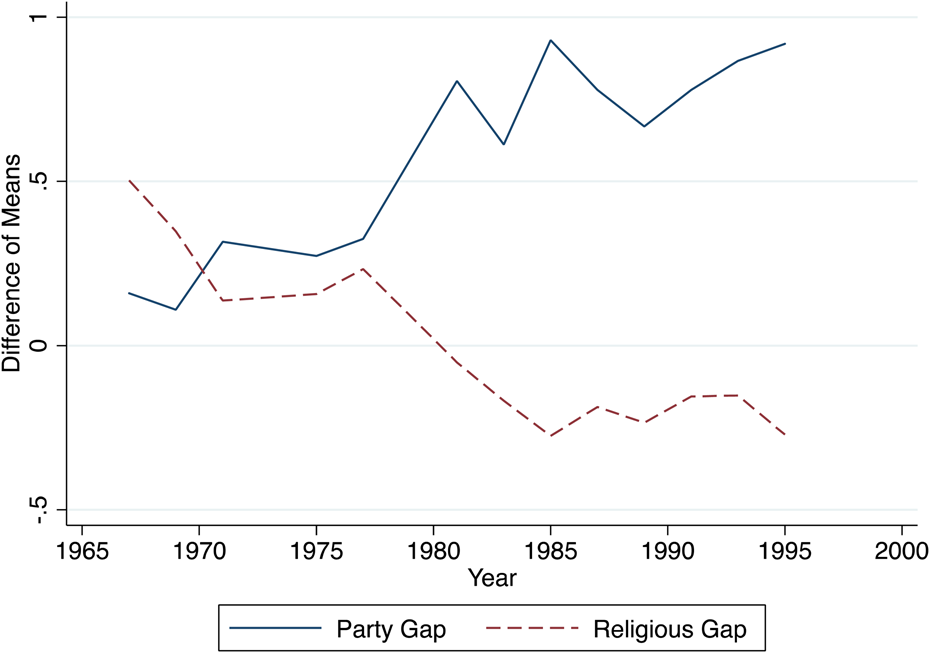
Party, Religion, and Support for Abortion Restriction, California State Assembly, 1967–1996.

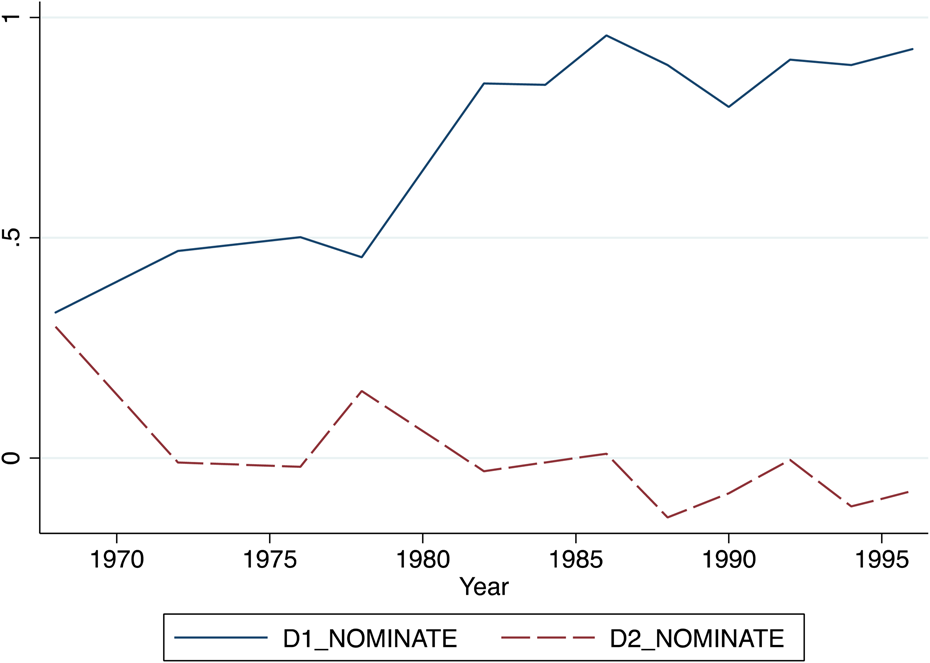
Correlation between NOMINATE Scores and Support for Abortion Restrictions, California Assembly, 1967–1996.

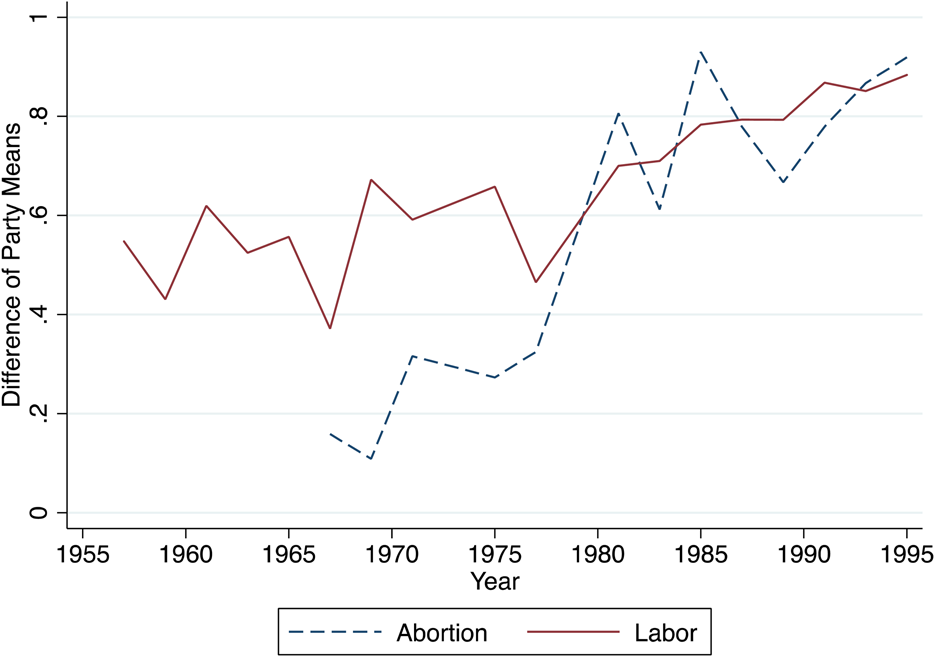
Polarization on Labor Issues and Abortion, California State Assembly, 1957–1996.

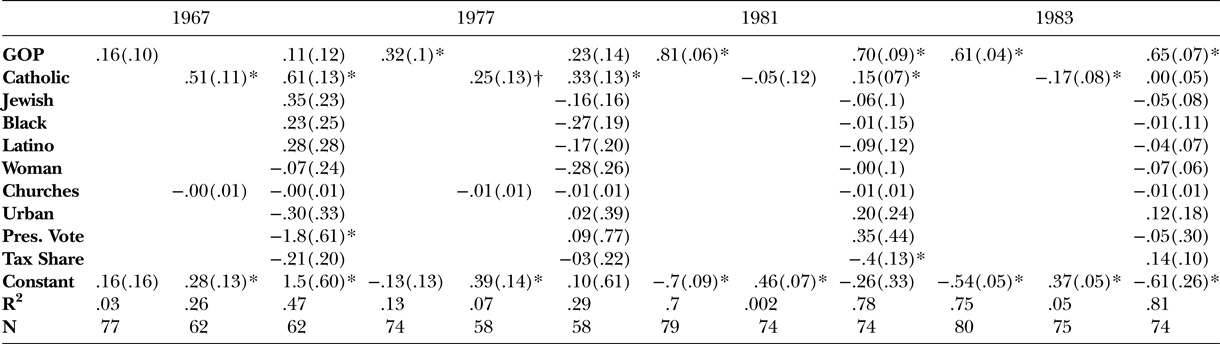
Support for Abortion Restriction in the California Assembly, OLS Regression Models, Select Years

Notes.* p < .05, † p < .1
Religion, Party Affiliation, and Assembly Members’ Votes on Abortion Restriction: Difference of Party Mean Support for All Legislators and Long-Serving Legislators Compared

Difference of Party Means on Abortion Restriction Scale: All Assembly Members and Long-Serving Legislators Compared, OLS Regression Models

Our data on legislator characteristics, such as ideology, party affiliation, sex, race, and religion, come from multiple sources, including the California Blue Book, the California Assembly Handbook, and the Project Vote Smart website. Coding of Assembly members’ religious affiliation was especially challenging, as it was not included in state legislative publications in the early years covered in our study. Many legislators serving in that period were still in office in later years when religion was reported or served in Congress, making their religious affiliation checkable in the Almanac of American Politics (first published in 1972). In other cases, we used newspaper reports (including obituaries), oral histories, and interviews with retired legislators and their relatives to code Assembly members’ religious affiliations. Due to data limitations, we can only identify legislators as Protestant, Catholic, or Jewish, rather than as members of particular Protestant denominations.
Religion, Partisanship, and Abortion Voting
As we argued earlier, the early abortion fight in the California State Assembly was more religious than partisan. Catholic legislators were far more “pro-life” than others net of party and constituency. Figure 1 reports this central finding, showing the difference in mean support for abortion restrictions between Catholics vs. other legislators and Republicans vs. Democrats, from the first votes on the issue in 1967 through 1996. The figure reveals that initially Assembly members’ religious affiliations were a better predictor of their votes on abortion than their party membership. Although Catholics and Republicans were both more pro-life than others, the gap between denominations greatly exceeded that between parties in 1967.
Figure 1 also shows that while both religion and party remained correlates of abortion positions in later years, the association between party affiliation and Assembly members’ votes grew far stronger over time. By contrast, the linkage between religion and abortion diminished and the relationship actually changed sign, with Catholic legislators becoming more supportive of abortion rights than others, beginning in the early 1980s. This last finding is striking given the Catholic Church's unwavering pro-life stand. However, as we show later, it is not evident in multiple regression analyses. In addition, Figure 1 reveals that much of the increase in the partisan divide occurred between the late 1970s and the early 1980s. There were no abortion roll calls in 1979–1980, but the gap between the parties was much larger in 1981–1982 than it had been in 1977–1978. Changes before and after that period were less dramatic. Viewed in isolation, polarization on abortion as shown in Figure 1 could conceivably reflect an overall trend toward party polarization over this same time period. For this reason we also investigate the relationship between votes on abortion and broader voting patterns in the Assembly. Figure 2 reports the correlations between Assembly members’ voting and their DW1 and DW2 NOMINATE scores.Footnote 68 It reveals that initially abortion did not map neatly onto either dimension. Starting in the 1970s, legislators’ abortion voting was more strongly associated with their position on the first dimension, while the second dimension had little connection to the issue. However, abortion did not map neatly onto even the first dimension until the early 1980s, from which point legislators’ voting patterns on the issue ceased to be distinctive.
To the extent that DW1 NOMINATE is a proxy for ideology,Footnote 69Figure 2 suggests that the study of abortion politics in Sacramento is not just one of the polarization of the parties, but that it had its own dynamic. It is not simply that in 1967 abortion divided California liberals and conservatives, and that they later “sorted” themselves into the two parties. Instead, some conservatives, like Governor Reagan, supported reform, while some liberals, often Catholics like John Vasconcellos, opposed it.
Figure 3 offers more context regarding the growth of the partisan divide on abortion in the Assembly. It compares the difference of party means on abortion roll call scales with the same statistic based on rating of legislators by the California Labor Federation (CLF). The CLF focused on labor law, but also included welfare state concerns and, eventually, civil rights bills (especially those related to employment) in their ratings. However, purely “social” issues such as gun control and, importantly, abortion, were not used by unions to rate state legislators, making these ratings a useful comparison case.
The period depicted in Figure 3 begins in 1957, a decade before the Assembly first voted on abortion, and runs for four decades. Polarization is evident on labor issues already in the 1950s, which is no surprise since these topics have been central to party competition since the New Deal.
Again, the story for abortion is different. When the issue first arose in 1967, the gap between parties on abortion was dwarfed by the gap evident on labor issues. Yet by the early 1980s, the divide on abortion had become nearly as great as the one on issues that had long been the parties’ stock-in-trade. This was the case even though there was also a less dramatic increase in party divisions on the older labor agenda during this period. Insofar as abortion was added to, but did not replace, the preexisting cleavage on labor and welfare state issues, these findings accord with Layman et al.'s description of “conflict extension.”Footnote 70 Even so, the growing party gap on abortion was not simply part of a uniform process of polarization, given that the growth in partisan divisions over the same period was far less marked on other issues.
Public Opinion
The growing partisan gap in abortion over this period is also not attributable wholly to shifts in public opinion driving change among elected officials. Turning to California Field Polls conducted over these years, we find that divisions in the public on the issue of abortion differed somewhat from those within the Assembly.Footnote 71 Catholics were less supportive of liberalization than other survey respondents, but most still favored reform. In June 1966, 65 percent of Californians favored “liberalizing somewhat” or an “unrestricted” abortion law; 51 percent of Catholics agreed (36 percent opposed). In May 1967, just before the Therapeutic Abortion Act passed, 73 percent of all Californians and 64 percent of Catholics favored weakening or ending limits on abortion. In contrast, the religious divide in the 1967 Assembly was far greater than in the public, with only 26 percent of Catholic Assembly members voting for reform, compared to 75 percent of non-Catholics.Footnote 72 Both in the general public and legislature, however, Catholics were less supportive of reform.
Party differences in mass-level opinion were small at first, though Republicans were slightly more pro-choice than were Democrats. In 1966, 68 percent of GOP respondents and 62 percent of Democrats favored reform. In 1967, 75 percent of Republicans polled favored reform, compared with 72 percent of Democrats. While abortion initially cut across party lines among Field Poll respondents and elected officials, Democratic Assembly members were more pro-choice from the beginning, with 71 percent voting for final passage of the Beilenson bill, compared to 51 percent of their GOP colleagues.
The alignments of voters and legislators on abortion evolved over time. The gap between Catholic respondents and other Californians on abortion narrowed, though it did not disappear. Change was more dramatic in the Assembly. In 1967, Catholic legislators were more pro-life than Catholic survey respondents. By the 1980s, the roles had reversed; Catholics generally remained less supportive of abortion rights than other Californians, but Catholic members of the Assembly were more pro-choice than their non-Catholic colleagues.
A look at partisan alignments also reveals change. The initially greater support for liberal abortion policies by Republican survey respondents was time-bound. The Field Poll suggests that this mass-level shift occurred earlier in California than it did nationwide. In 1975, California Republican respondents were still more pro-choice, but by 1979, they were more pro-life than Democratic respondents. The timing of this partisan reversal, then, is not consistent with a view that shifts in public opinion inspired change among elected officials. After all, as early as 1967, Democratic legislators were already slightly more pro-choice than were Republican legislators. Instead, the chronology suggests that elite leadership of public opinion occurred.
OLS ANALYSIS
We have demonstrated so far that between 1967 and 1996, voting on abortion-related issues moved from cutting across party lines to highly partisan, with Democrats consistently voting for fewer restrictions on abortion and Republicans consistently voting for more restrictive policies. Our initial findings suggest that in the early years, religion—or more precisely, Catholicism—was more closely tied to an Assembly member's vote than was the member's party, but that over time, party became the main line of division on these issues. Moreover, comparing both to general measures of ideology as well as the CLF's legislative scorecards suggests that, while polarization occurred throughout the legislature on many issues over this time, it was distinctive on abortion issues. A look at these factors alongside the California Field Poll from the time also suggests that political elites led, rather than followed, public opinion into polarizing the abortion issue. Finally, archival and secondary source evidence suggests that organizations on both sides of the issue began to recognize the need to send clearer cues to legislative officials. Movements on both sides eventually became associated with political parties.
But while knowing about these trends and the timing of shifts is important, key questions remain. Were legislators’ religious affiliations a proxy for constituency factors? Did the diversification of the legislature underlie the changes shown in Figures 1 and 2? To answer such questions, additional analyses are required.
In Table 1, we report ordinary least squares (OLS) regression models based on Assembly members’ voting on abortion in four periods: 1967–1968, 1977–1978, 1981–1982, and 1983–1984. We selected these periods to provide snapshots of the conditions both before and after the parties coalesced on the abortion issue. Thus the period from 1967–1968 captures the earliest positioning on abortion by California state legislators, the snapshot from 1977–1978 is drawn from when both party and religious affiliations were important predictors of legislators’ votes, and the period from 1981–1982 reflected the first time in which partisanship was by far the dominant predictor. Finally, we ended our OLS analysis in 1983–1984 because by this point, the relationship between party and voting had largely stabilized, with minimal change occurring in later years. (While we deliberately wanted to choose periods before and after the parties coalesced on the abortion issue, the particular years we selected also were dictated by data availability. As Table A1 shows, there are some years where there are no recorded votes or too few to be informative.)
For each period we present three models of support for abortion restriction by California Assembly members. The first model includes only party. The second incorporates religious affiliation of legislators as well as the number of Catholic churches in their districts. For legislator religion we include an indicator variable coded as 1 if the legislator was Catholic and 0 otherwise. It is also important to know whether legislators’ faiths are a proxy for constituency or have an independent effect. To that end, we would like to know the share of voters in each legislator's district adhering to various faiths, as McTague and Pearson-Merkowitz include in their study of the U.S. Senate.Footnote 73 Such data are unavailable at the level of California Assembly districts, and while a county religious census exists, Assembly districts do not map well onto California counties. Large, diverse counties can contain many districts, while other districts are composed of portions of multiple counties. Given the centrality of religion to our study, we turned to an alternative indicator of a district's Catholicism, Churches, which is a count of the number of Catholic churches in an Assembly District during a given year.Footnote 74 While the number of Catholic churches in a district is not the ideal measure of the strength of Catholicism within a district, analyses not shown revealed that controlling for county population, the number of churches in a county is significantly associated with the percentage of Catholic residents.
The third and final model reported for each period incorporates other legislator characteristics including race, gender, and an indicator variable capturing whether the legislator was Jewish. In addition to the constituency-level variable of churches carried over from the second model, we also include a measure of the share of urban residents in districts, as well as a voter partisanship measure—the percentage of the vote received by the Democratic presidential candidate in the previous election. Finally, we note that both the second and third models are based on a smaller number of observations for each period than in the first model. This is because the religious affiliations of several legislators have proven elusive, requiring us to exclude them from our analyses.
Results
As Table 1 shows, in the 1967 bivariate model, party affiliation has a positive coefficient, meaning that from the beginning, Republican legislators were more opposed to abortion rights than Democrats. Yet this coefficient is small, and party affiliation was not a significant predictor of Assembly members’ votes on abortion in 1967. By contrast, the coefficient for the Catholic indicator variable in model 2 is both positive and significant, despite the smaller number of observations due to the lack of information regarding some legislators’ religious affiliations. However, in this model, the coefficient for the variable capturing the number of Catholic churches in districts is close to zero, suggesting that the relationship between Catholicism and legislators’ votes on abortion as seen in Figure 1 was not driven by constituency factors. Rather, the legislator's own religious affiliation was key. (Analyses not shown, including an interaction term for churches and Catholic legislator, found no significant interaction effect.)
In the third, combined, model for 1967 the coefficient for the Catholic indicator variable actually grows. The only other significant relationship observed is negative: Assembly members from districts where the Democratic presidential candidate (Lyndon B. Johnson) had run better were less likely to take anti-abortion stands. This finding is unexpected in that both national surveys and California Field Polls show that Democratic respondents were slightly more pro-life than Republicans in the 1960s and 1970s.Footnote 75 None of the other variables that reflect the growing diversity of the legislature are predictive in any of the models.
Change is evident by the second time period, 1977–1978, which was a decade after the passage of the Therapeutic Abortion Act and a few years after Roe. As models from this period show, the party coefficient doubled compared to 1967–1968 in both models including a party indicator. The Catholic variable is halved in both the religion (second) and combined (third) models. It falls just short of conventional significance in the second model, though it is significant in the combined model.
Recall that by the third time period (1981–1982) Ronald Reagan had been elected president running with a stronger pro-life position than previous GOP nominees, helping to align the religious Right with the GOP. By this period, party affiliation had become strongly associated with legislators’ abortion stands. A curiosity of the second (religious characteristics) model for 1981–1982 is that the Catholic coefficient changed signs and Catholics in the Assembly were actually more pro-choice than were non-Catholics. Yet the combined (third) model shows that controlling for party, race, and district characteristics, Catholics were still significantly more pro-life than others. This is obscured in models that do not include party, since most Catholic legislators were Democrats.
In the final period (1983–1984), the chief difference observed again concerns the role of Catholicism. In the second (religion) model, the negative coefficient is larger and significant for the first time. Yet once again, the combined (third) model incorporating all of the variables tells a different story, with Catholicism remaining associated with pro-life voting and suggesting that the negative association observed between Catholicism and opposition to abortion restrictions in the second model is a spurious result of Catholics’ greater presence in the Democratic caucus. Yet the coefficient is small and, for the first time, statistically insignificant. Taken together, the models suggest that as party affiliation's importance grew, religion's declined. The irrelevance of legislators’ Catholicism evident by 1983 in California was far ahead of developments in Congress, where Catholics remained relatively pro-life into the 1990s.Footnote 76
LEGISLATIVE TURNOVER OR CONVERSION?
We have shown that voting on abortion in the California Assembly became far more partisan from the late 1960s to the early 1980s and that there was a marked decline in the association between legislators’ religion and their votes on the issue. This appears not to have been driven by constituency factors and is consistent with the shifts in party coalitions evident over the period under study. Moreover, of the Assembly members serving when abortion came up for a vote in 1967, only five remained in office in 1981, suggesting that legislative turnover could have caused the change.
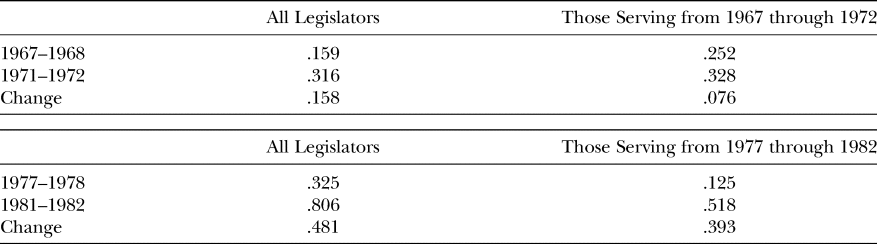
Table 2 examines two periods in which the party divide on abortion grew in the California Assembly. The first is 1967 through 1972, in which a modest increase in the party divide is evident. And the second is 1977 through 1982, when a far larger gap between parties emerged. For both periods, we compare the voting behavior of legislators serving during the beginning and end of the period with the pattern evident in the Assembly as a whole. It is useful to observe these two periods separately since, as we noted, very few legislators serving when the abortion issue arose in the 1960s were still in the office in the 1980s, but many served for portions of this period during which time the divide grew.
Table 2 reports the difference in party mean support for abortion restriction or limitation in the 1967–1968 and 1971–1972 legislatures, and the same statistic for 1977–1978 compared with 1981–1982. As in previous figures and tables, the dependent variable is coded so that higher values mean more support for the “pro-life” side.
Comparing the change in the difference of party reveals that it occurred not only in the Assembly as a whole, but also among the subset of legislators serving at the beginning and the end of each period. In other words, there was substantial position change by incumbents on abortion. The change in the earlier period is less dramatic than the shift evident from 1977 through 1982, the period in which the religious Right emerged. The shift is also smaller among continuing legislators than in the chamber as a whole, indicating that both conversion and turnover contributed to the growing party divide.
Continuing a focus on behavioral change among legislators, Table 3 reports coefficients from multiple regression models for the same groups and time periods explored in Table 2. In both cases we see a decline in the coefficient for the Catholic indicator variable and an increase in the party coefficient. As in Table 3, the same basic trend is evident among continuing legislators, as well as chamber-wide, even if the shift is smaller among the veteran Assembly members. This is evidence that while there may have been some inertia among continuing legislators, the change in party positioning occurred among incumbents and was not entirely a result of turnover.
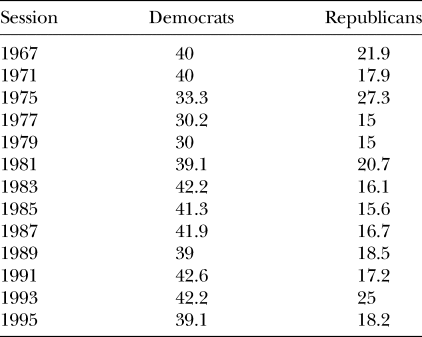
Over the course of the decades we explored, there was of course some change in the alignment of groups vis-à-vis parties and visible evolution of the demographic composition of the state legislature. The California State Assembly is far more diverse than it once was in terms of race and gender. In recent years Speakers have included men and women of color, as well as openly lesbian and gay legislators. Yet much of this diversification postdates the shift in the partisan alignment on abortion that we documented. For example, in 1967 when the first recorded votes on abortion in modern times occurred, there were only three female State Assembly members, out of eighty. In 1981, by which time most of the partisan polarization on abortion had occurred, there were still only ten women in the Assembly. In 2019 there were twenty-three.Footnote 77 Similarly, while there has been change in the relationship between religious affiliation and party, the percentage of Catholics in the Democratic and Republican caucuses within the State Assembly was relatively stable from the 1960s through the 1990s. In 1967 the Democratic caucus was 40 percent Catholic, while the Republican caucus was 22 percent Catholic. In 1995 the analogous percentages were 39 percent for Democrats and 18 percent for Republicans. We report these percentages for each legislative term in Table A2 in the Appendix.
DISCUSSION AND CONCLUSION
In this study, we charted the growing partisan divide on abortion in one of the first state legislatures to face the issue in modern times. This issue is important for students of American political development as it exemplifies the culture war divisions that did so much, along with race, to undermine the New Deal party alignment in the late twentieth century. More broadly, we have shown that the importance of personal background to a legislator's voting can shift over time as issues emerge and evolve, and as positions become linked to political parties. When California legislators faced abortion as a new issue in 1967, their religious affiliations were more important than their party ties or district characteristics. Yet the effect of religion was gone by the mid-1980s. In the intervening years, the issue saw a shift from personal background cues to partisan ones, not, as is typical in the study of party position change, a shift from district cues to party ones. This shift coincided with the incorporation of groups focused on abortion in both parties’ coalitions: feminists for Democrats and the religious Right in the GOP. These changes altered the incentives of legislators. Many incumbents changed their stands, helping to polarize the parties on the issue. Party polarization was evident in the Assembly in this era, yet the abortion issue had its own dynamic.
These results speak to multiple research areas. Our findings highlight the fact that even for voting behavior on a particular issue the importance of legislators’ personal backgrounds may vary over time. In our case the initial importance of religious affiliation seemed to reflect legislators’ own views, rather than serving as a proxy for constituency. The subsequent importance of party affiliation meant that many incumbent legislators who did not change their party or religion still gave more weight to the former in deciding how to vote on abortion. Changes in party coalitions gave them an incentive to do so. A similar process occurred later on in Congress, but as in so much else, California was on the cutting edge of change.
Questions remain. Is the abortion issue sui generis, or are there lessons to be gleaned for other issues across other states and at the national level? Some recent work suggests that the importance of personal characteristics other than religion has also changed over time, with age and education becoming less predictive of Congress members’ votes on environmental issues as party divisions on this topic grew in the 1980s and 1990s.Footnote 78 Yet on other issues that were on the state and national agendas for many years, long enough for attitudes to crystallize,Footnote 79 yet which did not become strongly partisan (e.g., ProhibitionFootnote 80), personal characteristics like religious affiliation might have remained important far longer than they did on abortion or environmental issues. And to what extent might more the recent development of evenly matched and polarized parties at the national level, along with the growing one-party domination of most state governments, complicate these dynamics identified in an earlier period? Both questions are ripe for further examination. Other states were in the forefront of other controversies, and more study is required by students of party position change, representation, and state politics to gain a more comprehensive understanding of these dynamics.
APPENDIX
Descriptive Statistics on Votes Underlying Abortion Measures

Catholic Percentage of Democratic and Republican Caucuses, California State Assembly, 1967–1996